Publication 2000:31E


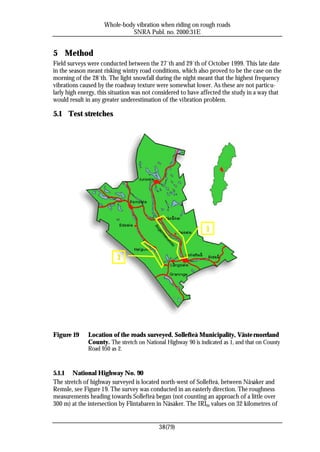
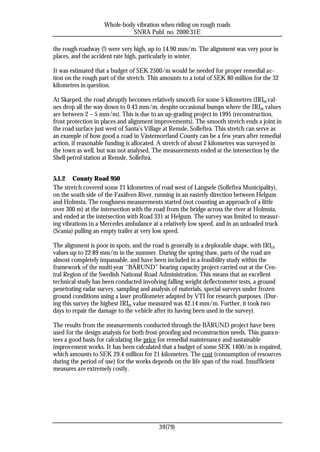
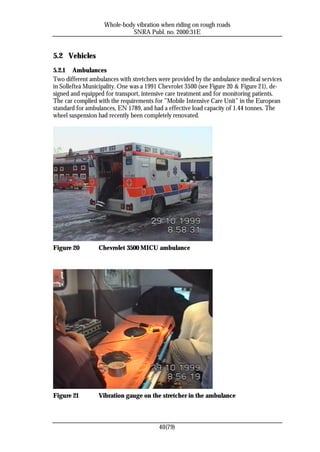
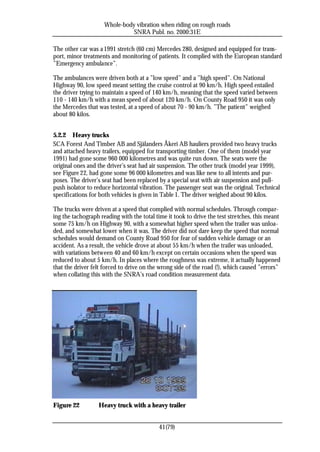
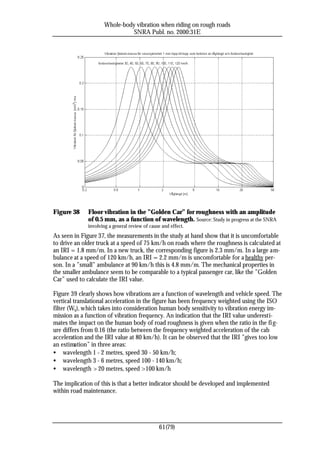
Whole-body vibration when
  riding on rough roads
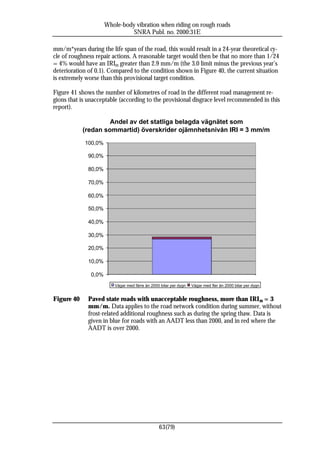
     A          study


                                2000-05
Date                          Document designation
Head Office                                                                  2000-05-15 (2002-03-08)       Publ 2000:31E


Author
Road Engineering Division.
Contact person: Johan Granlund.
Title
Whole-body vibration when riding on rough roads.
Main content
At rural highway speeds, road roughness is a source of undesirable dynamic forces and displacement in
the interaction between road, vehicle and human. These vibrations can cause a sense of discomfort, and
it cannot be ruled out that they could impair the health and performance ability of both drivers and
passengers alike.

A study has therefore been conducted on National Highway 90 and County Road 950, aimed at ascer-
taining the seriousness of the problem of whole-body vibration during travel. The roughness index on
the test stretches varied from very good (IRI 20 = 0.43 mm/m) to extremely poor (IRI 20 = 22.78
mm/m). Vibrations that affect vehicle occupants were measured in different configurations of moving
timber lorries and ambulances. A separate report published by Ingemansson Technology AB presents a
detailed account of how the measurements were carried out and how the data was stored and analysed.
Another separate report published by the National Institute for Working Life presents the findings
from an analysis of the effect on the human body of the vibrations recorded.

This report is a summary of the study. It also contains an interpretation of the findings from collating
the vibration measurement data with the data collected in connection with the routine annual road co n-
dition surveys. There are three main causes of vibration: road roughness, vehicle properties and driver
behaviour (including the choice of speed). The results of this study support the opinion that, within
reasonable variations in these factors, road roughness has a far greater impact than the other two vari-
ables. Further, the study substantiates that the higher frequency of injury, especially in commercial driv-
ers’ locomotor systems (as been found in earlier studies), is related to rough roads. This correlation is
probably strongest in geographical areas where long stretches on a large percentage of the roads have a
high IRI, i.e. in the so-called ”forest counties” of Norrland, Värmland and Dalarna in Sweden. Riding
the roughest road stretches, peak values were registered on the ambulance stretchers with vibration levels
that are considerably above levels that completely healthy people are considered to experience as ”ex-
tremely uncomfortable”, as per an international standard on evaluation of human exposure to whole-
body vibration.
Publisher
Environmental Department.

ISSN 1401-9612
Vägverket printers in Borlänge 2002.

Picture of the ambulance on the cover is published with the permission of Anders Wiman AB, ambulance
manufacturer.


Publisher
National Road Management Division.

Key words
Roads, pavement, roughness, texture, ride, vibrations, shock, dampening, natural frequency, resonance,
dynamic forces, displacement, fracture mechanics, road grip, ride quality, stress, discomfort, performance
ability, health, motion sickness, living environment, working environment, road maintenance, surfacing


Distributor (name, postal address, telephone, telefax)
Swedish National Road Administration, Butiken, Internal Services Division, SE 781 87 BORLÄNGE,
Sweden+ 46 243-755 00, fax +46 243-755 50


Head Office
Postal address                                           Telephone                           Telefax

SE 781 87 BORLÄNGE                                       + 46 243 - 750 00                   +46 243 - 758 25
Whole-body vibration when riding on rough roads
                                       SNRA Publ. no. 2000:31E

                                                           Preface

This is a report of a study that was co-financed by the Västernorrland County Council,
SCA Forest and Timber AB, Själanders Åkeri AB (haulier) and the Environmental De-
partment at the Swedish National Road Administration (SNRA). The project was initiated
by the SNRA subsequent to a survey of the problems associated with driving on rough
roads. Further, the trend towards ”smoother roads” revealed in the SNRA’s annual IRI
(International Roughness Index) measurements seemed questionable in view of the intense
dissatisfaction revealed in road user opinion surveys. Particularly perplexing was the acute
dissatisfaction with the ride quality amongst commercial drivers, primarily in the north of
Sweden. Our interest was stimulated even more when interviewing hauliers and transport
purchasers in Västernorrland County. After having studied reams of literature containing
the key word ”vibration”, including reports on the impact of road roughness on driver per-
formance, driver fatigue, reports on incubators in ambulances being badly shaken during
transport, and the high frequency of health problems amongst commercial drivers, particu-
larly in their locomotor systems, sufficient research material had been collected to warrant
investment in this project.

Kjell Ahlin, Licentiate in Engineering and employed at Ingemansson Technology AB was
responsible for the surveys and analyses. Professor Ronnie Lundström of the National In-
stitute for Working Life was in charge of examining the impact on the human body of ex-
posure to those vibrations measured. The vibration data was collated with the SNRA’s
existing road surface condition data (collected through laser/inertial technology) by the
undersigned. The ambulances were driven by Leif Leding, medical orderly, and the trucks
by Hans Selin and Bengt Själander. Vibration measurements were conducted on non-
frozen roads, to comply with the SNRA routine road surface condition surveys. It is im-
portant to keep in mind that the vibration problem is considerably greater during the spring
thaw, when roads are still partially frozen and roughness even more pronounced.

I would like to take this opportunity to express my sincere appreciation to those who pro-
vided the financial backing for this project, as well as the persons mentioned above and
their colleagues, as well as to my own fellow colleagues throughout the Swedish National
Road Administration.

Finally, I would especially like to thank Kathleen Olsson at the SNRA International Secre-
tariat, for making the English translation possible.


Borlänge 15 May 20001


Johan Granlund, MSc (Civil Engineering)
Project Manager2


1Translation finished on 8 March 2002.
2Translation comments: Johan Granlund is now leading road roughness profilometry operations within SNRA Consulting Services. Kjell
Ahlin is now Professor at Blekinge Institute of Technology. Professor Ronnie Lundström is now head of the Biomedical Engineering
and Informatics Department at the University Hospital of Northern Sweden.


                                                             1(79)
Whole-body vibration when riding on rough roads
                                                 SNRA Publ. no. 2000:31E

                                                                              Contents
1         SUMMARY ........................................................................................................................................................ 4
2         READER INSTRUCTIONS ........................................................................................................................ 6
3         DEFINITION OF TERMS .......................................................................................................................... 7
4         BACKGROUND..............................................................................................................................................18
    4.1   FROM PAST TO PRESENT.............................................................................................................................. 18
    4.2   ROAD ROUGHNESS IN BRIEF ....................................................................................................................... 21
    4.3   MONITORING OF THE ROAD CONDITION AT THE SNRA....................................................................... 23
       4.3.1  Road roughness measurements........................................................................................................ 23
       4.3.2  Road user opinion polls.................................................................................................................... 25
    4.4 ANALYSIS OF ROAD ROUGHNESS ............................................................................................................... 28
    4.5 TRANSMISSION OF VIBRATIONS THROUGH THE VEHICLE....................................................................... 29
    4.6 W HOLE-BODY VIBRATION.......................................................................................................................... 31
       4.6.1  Natural frequencies and resonance in the human body............................................................... 32
       4.6.2  Examples of the effect of whole-body vibration in the 0.5-80 Hz range..................................... 33
       4.6.3  Examples of the effect of extremely low frequency whole-body vibrations ................................ 33
       4.6.4  Origin of whole-body vibration...................................................................................................... 34
       4.6.5  Measurement of whole-body vibration........................................................................................... 36
5         METHOD ........................................................................................................................................................ 38
    5.1   TEST STRETCHES .......................................................................................................................................... 38
       5.1.1      National Highway No. 90............................................................................................................... 38
       5.1.2      County Road 950.............................................................................................................................. 39
    5.2 VEHICLES ...................................................................................................................................................... 40
       5.2.1      Ambulances ....................................................................................................................................... 40
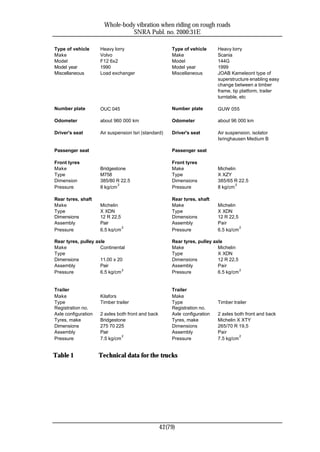
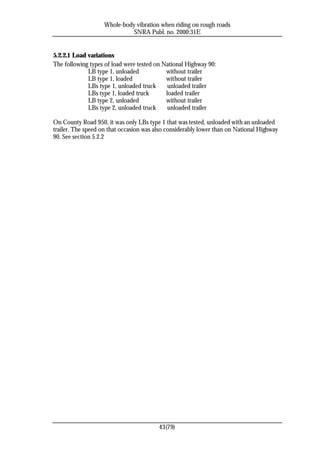
       5.2.2      Heavy trucks...................................................................................................................................... 41
    5.3 MEASUREMENT AND ANALYSIS OF WHOLE-BODY VIBRATIONS............................................................. 44
       5.3.1      Variables ............................................................................................................................................ 44
    5.4 E XPERT ANALYSIS OF THE EFFECT OF VIBRATION ON THE HUMAN BODY........................................... 46
    5.5 COLLATION BETWEEN THE VIBRATION DATA AND THE DATA FROM THE ROAD CONDITION
    SURVEYS ................................................................................................................................................................... 46
       5.5.1      Effect of emergency action, ”the devil’s choice”, on National Highway 90............................... 46
6         RESULTS ......................................................................................................................................................... 49
    6.1   ROAD SURFACE CONDITION AS PER THE SNRA’S ”PMS” DATABASE ................................................... 50
       6.1.1  Roughness expressed as International Roughness Index............................................................... 50
       6.1.2  Crossfall.............................................................................................................................................. 52
       6.1.3  Lane cross-sections............................................................................................................................. 53
       6.1.4  Seasonal variation in road roughness, County Road 950 ........................................................... 54
    6.2 CAB ACCELERATION MODEL AS A FUNCTION OF ROAD ROUGHNESS (IRI).......................................... 55
7         DISCUSSION.................................................................................................................................................. 58
    7.1   ROAD STRETCHES WHERE THE ROUGHNESS PRESENTS A HEALTH HAZARD........................................ 59
    7.2   VARIATIONS IN THE ROAD CROSSFALL ARE PARTICULARLY HAZARDOUS ............................................ 64
    7.3   METHODS TO REDUCE WHOLE-BODY VIBRATION IN CONNECTION WITH ROAD TRANSPORT .......... 67
       7.3.1   Changed travel speeds....................................................................................................................... 67
       7.3.2   Changes in vehicles ........................................................................................................................... 69
       7.3.3   Road maintenance............................................................................................................................ 70
       7.3.4   Does the choice of road maintenance strategy matter? ................................................................ 71
    7.4 CONCLUSIONS .............................................................................................................................................. 72
       7.4.1   Evaluation of impact on humans of vibrations related to road roughness ............................... 72
       7.4.2   Assessment of the need to take action on the road network, etc.................................................. 72
       7.4.3   Need for further research and development................................................................................... 74
8         REFERENCE LIST...................................................................................................................................... 75


                                                                                   2(79)
Whole-body vibration when riding on rough roads
                                         SNRA Publ. no. 2000:31E

Introduction
Apart from the direct impact road roughness and texture has on vehicles and the environ-
ment, these road characteristics are also an indirect source of the noise, infrasonic sound
and whole-body vibration that cause stress on road users. The effect of this stress/load can
be divided into the following three categories, for which criteria can be stipulated and well-
motivated limits set:
                          1. discomfort
                          2. performance ability
                          3. health impact

The effect on the human body depends on the type of load. It varies from individual to
individual, depending on the person’s own particular situation. Reactions can be acute (like
speech impairment), gradually increase during travel (like motion sickness) or steadily de-
velop over time (like spinal injury). The effects can be transient, as in temporary visual im-
pairment, or chronic as in kidney damage. Temporary exposure can cause stress reactions,
like a faster pulse or higher blood pressure, which in turn entails a greater stress on the
heart. Sustained exposure can tire the brain a nd produce drowsiness. Daily exposure can, in
the long run, impair health and result in long periods of sick leave or even early retirement.
Sometimes these ailments can require medical treatment, which in turn can have side ef-
fects that can substantially impair quality of life. Musculo-skeletal injury is by far the great-
est working environment problem in the Western world today.

In the mid 1970’s, the exposure of truck drivers to vibration was an issue raised at the fed-
eral government level in the USA, formulated as ”Do vibrations (as well as noise, toxic
fumes and other factors that contribute to truck “ride quality”) have a negative effect on
driver health and on highway safety?” A research programme that extended over several
years, ”Ride Quality of Commercial Motor Vehicles and the Impact on Truck Driver Per-
formance” was initiated in 1977 to answer this question. The findings were summarised in
a report published in 1982 entitled ”Truck Cab Vibrations and Highway Safety” [66]. This
report was jointly produced by leading researchers, road authorities, vehicle manufacturers,
hauliers and commercial drivers. It shows that the answer to the key question as to whether
there is any correlation between cab vibrations and road safety is YES, that there is good
reason to believe that vibrations affect drivers’ health, and that vibrations must be elimi-
nated at source through effective road maintenance rather than merely dampened. The
report concludes that if the deterioration of the road network is allowed to continue, the
result will be serious health and road safety problems.

Today, further on down the road, we can see how the American road network has been
upgraded. According to the FHWA report Life-Cycle Cost Analysis in Pavement Design,
action is nowadays initiated on federal roads before the condition reaches a level corre-
sponding to IRI 2.7 mm/m [67 ]. In the study conducted during summer on Swedish Na-
tional Highway 90, IRI1 values close to 100 mm/m have been measured3, 37 times above
the American limit. Hw 90 is known to be much rougher during the spring thaw.

At the time of writing, an EC directive stipulating limits for exposure to whole-body vibra-
tion based on health and safety criteria is in the process of being drawn up.

3 Laser/inertial Profilometers have limitated laser measuring range (MR). On the Profilometers used in Sweden MR for vertical distance

is +/ - 100 mm. Since the distance from the laser beam to the front axle of the Profilometer vehicle is close to 1 m, profile slopes (used
when calculating IRI) will begin to be underestimated when they exceed about 100 mm / 1 m = 100 mm/m in static theory case. In
practise, Profilometer pitch and roll dynamic motion reduces this range of use further.


                                                                 3(79)
Whole-body vibration when riding on rough roads
                                       SNRA Publ. no. 2000:31E


1 Summary
The overall aim of this study was to ascertain the seriousness of the problem of whole-
body vibration when driving on roads; ”Is the road roughness such that it entails a health
hazard and/or a road safety hazard through its impact on drivers?”. Other objectives were
to estimate the scope of the problem during non-frozen ground conditions, to examine the
problems and potential related to measurement techniques and to point out the necessity
of further research in this field.

The measurement data was collected when driving on 37 kilometres of National Highway
No. 90 (Hw 90) and 21 kilometres of County Road 950 (Lv 950) in Västernorrland County.
The road condition on the test stretches covered the entire range from very smooth (IRI20
= 0.43 mm/m) to very rough (IRI20 = 22.78 mm/m). Whole-body vibration was measured
in compliance with the ISO 2631-1 (1997) standard “Evaluation of human exposure to
whole-body vibration”. This was done on stretchers with patients in different types of
ambulance and at different speeds, and on the floor and driver and passenger seats for
seated occupants in some different truck configurations.

There are three main sources of vibration: road roughness, vehicle properties and driver
behaviour (including choice of speed). The interpretation of the results supports the opin-
ion that within reasonable variations in these factors, road roughness plays a considerably
greater part than the other two. High-energy, multi-directional vibrations at many natural
body part frequencies were found at the seats in trucks. This is serious due to the risk of
resonance, meaning a greater reproduction of vibration in the parts of the body afflicted
than at the surface4 from which the vibrations are transferred. Further, the study substanti-
ates findings from earlier studies; i.e., that the high frequency of occupational diseases
among commercial drivers, especially in the locomotor systems, is related to rough roads.
This relationship is probably strongest in geographic areas where the road roughness level
is high on a large percentage of the roads. Where the roughness was greatest, peak values
were registered on ambulance stretchers that considerably exceed the level that completely
healthy people are assumed to experience as ”extremely uncomfortable” by international
standards.


4   seat, seat back, floor, stretcher


                                                  4(79)
Whole-body vibration when riding on rough roads
                                            SNRA Publ. no. 2000:31E

          Vibration
                           2
(weighted acceleration [m/s ])
on stretchers, and in the case
   of the bulldozer, at the
       operator’s seat.                                                                                 Some studies indicate that
                                                                                                        exposure to vibrations of
                                 1.6
                                                                                                                           2
                                                                                                        1.30-1.35 m/s for 10
                                 1.4                                                                    minutes a day can be
                                                                                                        harmful even for healthy
                                 1.2
                                                                                                        people. The journey by
                                   1                                                                    ambulance on the rough
                                                                                                        stretch of highway took a
                                 0.8
                                                                                                        little more than 15 minutes.
                                  0.6
                                                                                               Clearing forest for new road construction, bulldozer
                                  0.4                                                                              CASE 1150 C

                                  0.2                                                     Mobile Intensive Care Unit Ambulance

                                       0
                                                                                     Emergency Ambulance

                                             Rough road, IRI
                                           average = 4.0 mm/m     Smooth road, IRI
                                                                average = 1.2 mm/m


During a 15-minute ride on a stretch of National Highway 90, the vibration level in one
type of ambulance was high enough to pose a potential health ha zard had a healthy person
been exposed to it for as little as 10 minutes a day. It was shown that the vibration on the
ambulance stretchers was as great as at the drivers’ seat in wheel loaders loading blasted
rock, bulldozers clearing way in forests for new road construction, etc. See the figure
above. Vibration problems are even greater in the spring due to seasonal frost damage re-
lated a dditional roughness.


                                                                   5(79)
Whole-body vibration when riding on rough roads
                                 SNRA Publ. no. 2000:31E


2 Reader instructions
The project is presented in three separate reports:

1. The first is a technical analysis of the whole-body vibrations measured in trucks and
   ambulances. This report was compiled by Kjell Ahlin, Licentiate in Engineering at In-
   gemansson Technology AB [64], and may be of interest for researchers etc.

2. The second analyses the impact on the human body of the vibrations measured. This
   report was compiled by Professor Ronnie Lundström at the National Institute for
   Working Life [65]. A summary of the conclusions is presented in Chapter 7. The report
   is available (in Swedish) at SNRA as well as NIWL websites, using the following links:
   http://www.vv.se/aktuellt/pressmed/2000/VVRapport.pdf or http://umetech.niwl.se/Published/.Publ.html


3. The third is the report at hand, compiled by Johan Granlund, MSc (Civil Engineering),
   of the Swedish National Road Administration. This report presents the results from
   collating the data collected in the annual road condition surveys with the whole-body
   vibrations measured on the test stretches. It also compares the results with the ISO
   limits for whole-body vibrations, and assesses the magnitude of the problem on the
   state network. This report is available on the SNRA website, using the following link
   for the Swedish version http://www.vv.se/publ_blank/bokhylla/miljo/2000_31/intro.htm and this link for
   the English version http://www.vv.se/for_lang/english/publications/index.htm


                                                 6(79)
Whole-body vibration when riding on rough roads
                                  SNRA Publ. no. 2000:31E


3 Definition of terms
The definitions of the following terms are based on those in the Swedish National Enc yclopaedia [1] with its
appurtenant dictionaries [34], the Swedish Centre for Technical Terminology glossaries [9], Engineering
Mechanics [40], Handbook of Human Vibrations [11], Vägtrafikteknisk nomenklatur (Highway Engineer-
ing Terminology) [16] published by the Transport Research Institute and ASTM´s Terminology Relating to
Vehicle-Pavement Systems [20]

Accident frequency
Number of accidents at a certain intersection, stretch or unit of distance.

                Differences in the accident ratio between two road networks show that one
                is ”more dangerous” for an individual than the other. Differences in acci-
                dent frequency between two road networks depends partially on the differ-
                ence in the accident ratio, and partially on the difference in the number of
                vehicles using the road networks. A simple way to reduce the accident fre-
                quency on a road with heavy traffic volume is to divert certain parts of traf-
                fic to other smaller roads. However, as the accident ratio is generally higher
                on smaller roads, this would increase the total number of accidents. From
                this perspective, the accident ratio is better than the accident frequency for
                assessing how dangerous roads are. The road network in Jämtland County
                (known to have low traffic volumes but poor roads) has the highest accident
                ratio in Sweden.

Accident ratio
Number of accidents related to units of measure in traffic; i.e., the term vehicle kilometres
is the unit commonly used on road stretches. At junctions the unit of measure is the num-
ber of vehicles entering the intersection.

Accuracy
The ability of the measurement instrument to give results close to the true value for the
parameter measured. The greater the accuracy, the less the error.

Alignment
The design of the road profile in space.

Amplitude
Amplitude is the maximum deviation from the mean of a signal (e.g., road roughness, or
vibration), see Figure 10.

Comfort
A subjective state of well-being or absence of mechanical disturbance in relation to the
induced environment (mechanical vibration or repetitive shock).


                                                    7(79)
Whole-body vibration when riding on rough roads
                             SNRA Publ. no. 2000:31E

Agreeable and practical convenience {relaxed conditions under which to live and work}.

             Comfort connotes the absence of significantly disturbing or intrusive physi-
             cal factors. It is a complex subjective entity depending upon the effective
             summation all the physical factors present in the induced environment, as
             well as upon individual sensitivity to those factors and their summation,
             and such psychological factors as expectation. (For these reasons, for example,
             the same values of vibration that might be judged by most riders to be un-
             comfortable in a limousine may be judged acceptably comfortable in a bus.)

The main factors behind comfort reduction (discomfort) are shown in Figure 9.


                                          8(79)
Whole-body vibration when riding on rough roads
                               SNRA Publ. no. 2000:31E

Crest factor
The ratio between the frequency-weighted peak value and the frequency-weighted root
mean square for the parameter studied. See Figure 3.

Criteria
A criterion is a verbal description of the effect, e.g. discomfort, reduced performance ability
or physical injury that is of interest. Limits (threshold values, target values, etc.) are set to
ensure an acceptably low probability of the effect that the criterion defines. In other words,
the criteria explain the reasons for the different limits.

Crossfall
The angle between the horizontal plane and the surface of the roadway, carriageway or
shoulder, measured at a right angle to the longitudinal direction of the road.

Ergonomics
Study of the relationship between people and their work environment, especially the
equipment they use. See also [52].

Estimated vibration dose value, eVDV)
An estimation of a cumulative measure of the vibrations and shocks that a person is ex-
posed to during the period under study, based on the frequency-weighted root mean square
for the vibration. See Formula 1.

        If the vibration level varies or contains shock elements, the vibration dose value
        must be determined directly from the complete measurement series. This is usually
        the case when the crest factor exceeds 6 – 9, which makes eVDV less useful for ride
        quality assessment on the rougher roads.


eVDV = 1.4 * a rms * T1/4
Formula 1          Estimated vibration dose value during exposure time T
Fracture mechanics
The science of how solid material breaks. This is often characterised by one or more cracks
spreading throughout the mass of a structure, ultimately resulting in its splitting into two or
more parts. Cracks can increase through different mechanisms, like fatigue. An increase in
fatigue occurs in structures exposed to repeated load. The increase can be very little at any
individual load. However, major cracks can form in a very short time through exposure to
vibration. The research that laid the foundation for fracture mechanics was carried out dur-
ing the Second World War. Since the 1950’s, fracture mechanics has developed into an
important element in the mechanics of materials. Most research has been conducted in the
USA and has been motivated by safety demands, primarily within the nuclear power and
aviation industries. Fracture mechanics can be used to answer the question ”how quickly
does a small crack grow through fatigue at the load spectrum to which the structure is ex-
posed?”.

Health
A condition of complete physical, psychological and social well-being, and not only the
absence of illness or disability [World Health Organisation (WHO), 1946].

                                             9(79)
Whole-body vibration when riding on rough roads
                                         SNRA Publ. no. 2000:31E

Horizontal curve
The curve indicating the direction of the road alignment in the horizontal plane.

International Roughness Index
The IRI value is a substitute measure for the vertical vibration that occurs in the suspen-
sion of a model (”the Golden Car”) of a quarter of a standard passenger car during a hypo-
thetical journey at the speed of 80 km/h on the road stretch studied. The value describes
the accumulated vertical displacement between the car body and the non-suspended mass
of the wheel, divided by the distance travelled. The unit of measure for the IRI is [mm/m],
which is low when the road is smooth along the wheel track5 in which the roughness pro-
file is measured. The IRI is currently the preferred unit of roughness measure used in Swe-
den and many other countries around the world that conduct objective surveys of the road
condition.

                     Index notation such as IRI 400, IRI 20, IRI 1 etc is used when explaining the
                     length of report/averaging interval, such as 400 metre, 20 metre and 1 me-
                     tre. Up until now, the basic report storage interval in the SNRA PMS has
                     been 20 metre. (As a comparison; the sampling spatial frequency used by ve-
                     hicle manufacturers fatigue researchers typically must be no longer than
                     about 1 decimetre, not to lose information about shock that causes damage).

Jerk
The first time-derivate of acceleration. Jerk is thus a measure of how fast the magnitude of
the acceleration changes.

                     When assessing damage potential, the relation between load and bearing ca-
                     pacity is studied. The “bearing capacity” of the human body depends strongly
                     of the state of muscular brace, comparable to the case where a small child is
                     learning to stand and walk. When exposed to unexpected occasional shock,
                     an intensive jerk may reduce the chance for the body to suddenly increase its
                     “bearing capacity” through instinctive brace. This implies that among differ-
                     ent motions with a similar peak acceleration, motions having a more inten-
                     sive jerk may be more serious than those with a less intensive jerk.


5 In Sweden, the IRI value is measured in the outer wheel track as seen from the centre of the road. In some countries, it is measured
from a mean profile of the outer and inner wheel tracks instead.


                                                                10(79)
Whole-body vibration when riding on rough roads
                              SNRA Publ. no. 2000:31E

Limits
The value stating the maximum permitted limit for a source of discomfort or injury.

             A limit is generally only set for activities that are planned and governed by
             directives issued by public authorities. The general trend in most countries is
             towards reducing limits. It is usually the authority responsible for a specific
             field of expertise that sets these limits. The health and hygienics limits are
             particularly important in the work environment. A health and hygienics
             limit is not a sharp line between harmful and non- harmful exposure. In
             Sweden health and hygienics limits have a legal status. See also the Swedish
             Environmental Code (SFS 1998:808) and the Health and Safety at Work
             Act (SFS 1977:1160).


                                          11(79)
Whole-body vibration when riding on rough roads
                              SNRA Publ. no. 2000:31E

Macrotexture
Term for those aberrations in the road surface (compared to an ideal plane) that have cha r-
acteristic wavelength and amplitude dimensions from 0.5 mm and upwards to those that
have no effect on the interaction between tyre and roadway.

Measurement error
Difference between the measurement value a nd the true value.

Measurement results
The product of the measurement value and the unit of measure. The measurement value
can have been corrected in connection with this through calibration in order to take known
systematic errors into consideration.

Measurement value
The value for the parameter compared to the unit of measure. Can be identical with the
measurement result.

Motion sickness
A physiological reaction in people induced by vibration, where the central nervous system
is incapable of co-ordinating information obtained visually, from the balance organ in the
ear and from joints and muscles. The reaction can cause drowsiness and affect perform-
ance ability. Symptoms include greater salivation, perspiration, depression, apathy, pallor,
nausea, dizziness and vomiting. Motion sickness seldom occurs in connection with vibra-
tions with a higher frequency than 0.5 Hz. When the reaction occurs in a moving vehicle, it
is usually called ”travel sickness”.

      The most renowned hypothesis for a qualitative explanation for the origin of
      motion sickness is called ”the sensory conflict hypothesis”[36]. A schematic dia-
      gram of this hypothesis is shown in Figure 1. Several other conflict hypotheses
      are discussed in Griffins ”Handbook of Human Vibrations” [11].


                                           12(79)
Whole-body vibration when riding on rough roads
                                   SNRA Publ. no. 2000:31E


  Stimuli    Receptors       Central Nervous System                                       Responses


 Active                         Motor
                               control
movement                                                                                     Volitional
                               system                                                        and reflex
                                                                                              move-
                                                                                               ment
                Eyes                                   Updates internal
                                Internal model
                                                       model (adaption)
              Semicir-           neural store of
 Motion        cular           expected signals
 stimuli      canals

               Otoliths                                Leaky             Neural centre         Motion
              and other          Compa-                integ-           mediating signs       sickness
                gravi-            rator                                 & symptoms of         symptom
                                                       ration
              receptors                                                 motion sickness
 Passive
movement                                 Mismatch signal    Threshold


  Figure 1      Schematic diagram of the sensory conflict hypothesis. This figure has
                been modified by Förstberg [36], originally developed by Benson (1988).


  Natural frequency
  The most fundamental property of an oscillating system. Natural frequency constitutes the
  free oscillation frequency of a system after having been disturbed. Every real system has
  several natural frequencies, and each of these has a given pattern of movement. When a
  system is subjected to an external disruptive (driving) force whose frequency is equal to a
  natural frequency in the system, resonance occurs and the magnitude of the vibration in-
  creases. See Figure 2.


                                                   13(79)
Whole-body vibration when riding on rough roads
                            SNRA Publ. no. 2000:31E


Figure 2   Mechanical model of the human body specifying natural frequencies
           for a few parts of the body [51]. Observe that the body lacks the female
           bosom. The natural frequencies refer to vibrations in the axial direction of the body
           parts (e.g. the spinal column)


                                          14(79)
Whole-body vibration when riding on rough roads
                               SNRA Publ. no. 2000:31E

Parameter
A characteristic that is the object of measurement.

Pavement Management Systems, PMS
A system that in an organised, co-ordinated way manages the road administration process.

Peak value
The maximum deviation from the mean of a parameter during a given interval. See Figure
3. The peak value is used especially when assessing the risk of mechanical damage from
motion/force sequences of short duration - shock.

Precision
The degree of agreement between a number of values measured, determined through re-
peated measurements. Precision has nothing to do with the deviation of the values ob-
tained from the true values for the parameter. Precision is sub-divided into repeatability
and reproducibility.

Repeatability
The precision of the values measured for a given parameter, determined in a uniform way
and under similar conditions.

Reproducibility
The precision of the values measured for a given parameter, determined in a uniform way
but under different conditions, such as another measurement method, another operator,
another instrument or another point in time.

Resonance
General phenomenon in oscillating systems implying that even a weak intermittent external
disruption (driving force) within a narrow frequency range can result in a large increase in
the oscillation amplitudes, accelerations and energy content of the system. This increase
depends on the frequency and becomes maximal when the frequency is largely equal to the
free natural frequency of the system. Through resonance, large amounts of energy can be
transferred by the driving force to the oscillating system, in connection with which damage
or disruptions in operation often occur. This phenomenon is of key importance from a
safety perspective, etc.

Road alignment
The (imagined) large scale vertical and horizontal curvature of a road.

Road roughness
Term used for deviations in a road surface compared to a real plane, which affect vehicle
movement, ride quality, dynamic loads, drainage and winter maintenance.

Roadway
Carriageway including the shoulders.

Roll
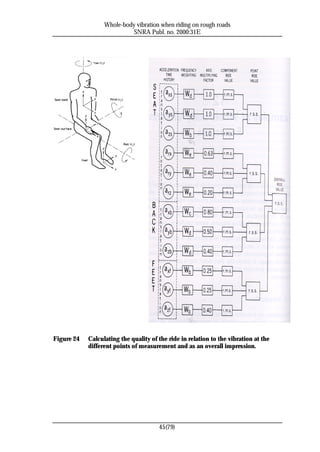
Movement of rotation around the x-axis. See Figure 24.


                                           15(79)
Whole-body vibration when riding on rough roads
                                 SNRA Publ. no. 2000:31E

Root mean square, rms
The root mean square of a variable during the period studied. See Formula 2 and Figure 3.

              When assessing ride quality, effects of occasional shock are often of great in-
              terest. The running root mean square of the weighted acceleration (using in-
              tegration time 1 s) is then often the preferred definition of vibration, since
              this definition has been proven to correlate very closely with perceived an-
              noyance [75]. To assess the risk of mechanical damage to the spine, the
              weighted positive (compression phase) peak acceleration is the preferred defi-
              nition.

              t2

              ∫ a (t ) 2 dt
a rms =
              t1

                   t 2 − t1
Formula 2            Root mean square for acceleration


Root sum of square, r.s.s.
A summation procedure for vectors in different directions. For the root mean
square, the square root is taken from the sum of the vectors squared root mean
squares.

Running rms
A filtering procedure that smoothens a very transient measurement series (as where occa-
sional shocks have occurred) that have a high crest factor.

Second Law of Newton
The acceleration of a particle is proportional to the force acting upon the particle and oc-
curs in the direction of that force. Normally expressed in dynamic analysis as F = m*a.

Stress
The physiological/hormonal reactions in the organs of the body that are triggered by
physical and mental ”stress factors”. Threatening or strenuous situations stimulate in-
creased secretions of adrenaline and noradrenaline. These hormones function such that
they increase the heart rate, blood pressure and circulation of blood to the skeletal muscles,
while decreasing the circulation of blood to other organs. Further, breathing is stimulated,
the trachea expand and the level of sugar and fatty acids in the blood increases. When peo-
ple are unable to control their own situation, the cortisol level also increases substantially.
Cortisol increases the amount of glucose in the blood, as well as the turnover of fats and
proteins. These and some 1400 other reactions to stress mean that the body, through all its
endeavours to adapt to the situation, is prepared to destroy itself after being subjected to an
all too extended or strenuous load.

Survey
A series of measures to determine the value of a parameter.

                                            16(79)
Whole-body vibration when riding on rough roads
                                SNRA Publ. no. 2000:31E

Unit of measure
Reference value for a parameter; e.g., in the case of distance, a metre could be used as a
unit of measure.

Vibration
Oscillation in mechanical systems, where parts of the human body and human organs can
be included. (See Figure 2). This is governed by different kinds of force: mass, restoration,
calming and disruptive (driving, instigating) forces.

      Vibration can be measured in terms of displacement, speed or acceleration.
      The unit of measure used for acceleration is [m/s2]. Results are usually pre-
      sented as peak values (mechanical spinal damage etc) or as a root-mean-square
      or running root-mean-square (perceived ride quality etc). See Figure 3.


             Peak value
                                             Root mean square
                                                                 Mean value


                                                                  Mean value


Figure 3            Peak value, root mean square and mean value for a signal


Vibration dose value, VDV
A cumulative measure of the vibrations and shock elements to which a person was exposed
during the period under study. See Formula 3.

               t2

VDV = 4 ∫ a w (t ) 4 dt
               t1

Formula 3           Vibration dose value for acceleration


Wavelength
The shortest distance between two of the signal’s points with an equal phase. See Figure
10.


                                           17(79)
Whole-body vibration when riding on rough roads
                               SNRA Publ. no. 2000:31E


4 Background
To most people, a roadway is merely a charcoal grey surface of infinite length. They expect
it to provide safe driving conditions, a smooth and quiet ride, minimal splash and spray
when it is raining, good visibility during poor conditions and that it will last a long time (to
avoid disturbance from road works).

A closer examination of the road reveals that it has several important characteristics, such
as surface texture. Texture is needed to provide road grip, minimise spray and mist when it
is raining, and reduce the glare from high beams at night. But the texture can cause more
noise as well as reduce the life span of both roads and tyres. As the road surface ages and is
worn down by studded tyres, heavy vehicle loads and climate, road damage begins to a p-
pear. Deformation (or road roughness), which is one type of damage, can limit both
shorten the life span of a road as well as reduce the quality of the ride. Roughness, primar-
ily longitudinal, can also be built into the road from the outset due to poor geometric de-
sign/construction.

Roughness is the source of many kinds of irritation that road users encounter; flickering
headlight reflections, deep pools of water, the dynamic forces that increase pavement stress
and damage to vehicles and cargo, and poor ride quality. Most road users are very sensitive
to ride quality, making this a prime criterion when setting road maintenance priorities [68].

Road roughness can mean reduced travel speeds. This has led many to believe that rough
roads are safer than smooth ones, since speed is generally acknowledged as dangerous.
However, after collating databases with information on accidents, road surface condition,
climate, road geometry, speed, etc at VTI (Swedish Road & Transport Research Institute),
it was concluded that ”the accident ratio increases with an increase in the roughness” and
”roughness has a major impact” [18]. A strong correlation between road roughness and the
accident ratio on the paved part of the state road network in Sweden has thus been ascer-
tained, implying that the idea of rough roads being safer is probably a serious misconcep-
tion.

However, such a statistical correlation is not clearly tantamount to the accident risk actually
being caused by roughness. For instance, it is likely that the vehicles on the roads in rural
areas, where roughness is worst, are older and less roadworthy than those found on the
smoother roads in and between the larger cities. It is therefore necessary to verify a statisti-
cal correlation through experiments that provide information about possible mechanisms
for an actual cause and effect relationship. This could include the effect of roughness
through mechanical interference on the steering and braking properties of road vehicles,
the effect on winter road maintenance and on drivers’ performance ability.


4.1 From past to present
The mechanisation of human transport on roads has taken place in a very short time. Peo-
ple were still basically travelling on the backs of animals or on foot in the 18th century,
despite the fact that the invention of the wheel 3 500 years before Christ had made the
development of animal-drawn carts possible. The reason was that roads were often almost
entirely impassable, which explains why the carts were primarily used to transport goods,
and even then only at average speeds up to about 10 km/h. This meant that travellers usu-


                                            18(79)
Whole-body vibration when riding on rough roads
                               SNRA Publ. no. 2000:31E

ally experienced more discomfort from dirt than from vibrations. On the narrow streets of
Stockholm, the upper class avoided the dirt by being carried on palanquins. A tariff for this
was laid down in 1726 [58].

Through Carl Snoilsky’s classical poem on Stenbock’s courier, generations of Swedish stu-
dents have learned about how Captain Henrik Hammarberg, who was sent off by General
Magnus Stenbock from Helsingborg with a message to the king and government in Stock-
holm on February 28th 1710, rode so hard that ”a horse collapsed behind him at every
station”. Modern historians maintain, however, that the courier, who covered the journey
of 900 kilometres at an average speed of 18 km/h, probably did not ride on horseback at
all. Verification ”Folio 2282” in the 1710 treasury records (preserved in the National Ar-
chives) for Hammarberg’s travelling-expenses account clearly shows that he travelled by a
carriage drawn by a team of horses from station to station. It is believed that he suffered
from travel sickness during the journey; ”this coach is swaying so frightfully on these terri-
ble roads” [59].

The bicycle could enter the scene at the turn of this century, as a result of the soft non-
bituminous roads, which could be evened out by simple means as needed. Bicycles were
crowded further and further out to the periphery as motoring became more widespread. In
the past 130 years, mobility for people in Sweden has grown a thousand fold. See Figur 4.


                                                          Mobility trend in Sweden, 1850 - 1990
                                         50000

                                         45000

                                         40000

Decade Travelled distance [m]            35000

  1850                     40            30000

  1870                    200            25000

  1890                    350            20000

  1910                    900            15000

  1930                   3000            10000

  1960                 20000              5000

  1980                 40000                 0
                                                   1850       1870   1890   1910    1930   1950   1970   1990

                                                                               Decade


Figur 4       The average daily distance travelled by vehicle by adults in Sweden
              from the 1850’s to the 1990’s. Data in the tables extracted from [61], supple-
              mented in the figure with data from [62].

Roads became steadily harder throughout the years, necessitating more sophisticated care
and maintenance routines. The long distances covered at the high speeds that characterise
modern road traffic, mean an exposure to vibration and shock that, in the presence of sig-
nificant road roughness, can mean people being exposed to mechanical energy that is sub-
stantially higher than at any other time in history. According to the second law of Newton,
the magnitude of this mechanical load can be estimated through measuring the acceleration
of whole-body vibration.


                                                 19(79)
Whole-body vibration when riding on rough roads
                              SNRA Publ. no. 2000:31E

The mental stress is more difficult to measure. At the macro level, it has been shown that
the risk for certain types of cardio-vascular disease in Sweden is more than three times
higher for commercial drivers than for the average worker. Mental stress under certain
driving conditions is considered to explain the raised level of stress hormones found in
commercial drivers, and is believed to cause the problem [69, 70].

Amongst older commercial drivers, musculo-skeletal problems and cardiovascular diseases
are the primary reasons for changing their occupation [71].


                                          20(79)
Whole-body vibration when riding on rough roads
                                                        SNRA Publ. no. 2000:31E


             4.2 Road roughness in brief
             Road roughness can result from faulty basecourse adjustment (usually through insufficient
             repair of crossfall variations or longwave deformations); incorrect initial construction; post-
             compaction of added layers; subgrade settlement; material abrasion -- primarily by studded
             tyres -- or through uneven frost heave during the spring thaw.

             A general rule, based on laboratory tests, is that drained road structures can stand being
             driven on by trucks six to seven times more than those without drainage before unaccept-
             able deformation occurs in the unbound layers. Ditching is thus a very effective mainte-
             nance measure for preventing roughness, if it is executed so that the gradient of the inner
             embankment is not steeper than 1:3 (otherwise there is the risk of edge deformations due
             to insufficient lateral counterstay). A drained road structure is also a prerequisite for avoid-
             ing frost-related roughness in winter.

             The binder stiffness affects the ability of the asphalt to distribute the load and thus the risk
             of deformation in underlying layers. Temperature is a key factor for this stiffness, which
             means that dark asphalt roads become rough faster than those with a light surface.

             The mechanical properties of vehicles can also increase roughness. As early as in the
             1930’s, a large-scale experiment showed a substantial increase in roughness on gravel roads
             when the test vehicles had high-pressure tyres, while there was not even enough roughness
             to measure when low-pressure tyres were used (the roadway had actually been smoothed
             out). Speed and suspension were also shown to be major factors affecting roughness [56].
             These conclusions could even be valid today for roads with a thin surface, like single sur-
             face treatment (Y1G), which is very similar to the dust abatement measures undertaken on
             the old gravel road.
               8,00


               7,00


               6,00


               5,00
IRI [mm/m]


               4,00


               3,00


               2,00


               1,00


               0,00
                   01


                                                                                                                       01


                                                                                                                                            -01
                                        -01


                                                                         -01


                                                                                                           -01
                                                   -01


                                                                                    -01
                             -01


                                                              -01


                                                                                                -01


                                                                                                                                 -01
                 1-


                                                                                                                     0-


                                                                                                                                         -12
                                     -03


                                                                      -06


                                                                                                        -09
                                                -04


                                                                                 -07
                          -02


                                                           -05


                                                                                             -08


                                                                                                                              -11
               -0


                                                                                                                   -1
             00


                                                                                                                 00


                                                                                                                                       00
                                   00


                                                                    00


                                                                                                      00
                                              00


                                                                               00
                        00


                                                         00


                                                                                           00


                                                                                                                            00


                                                                                  Tid på året


             Figure 5              Conceivable variation in roughness per month, on a specific road sec-
                                   tion


                                                                               21(79)
Whole-body vibration when riding on rough roads
                               SNRA Publ. no. 2000:31E

Road roughness varies throughout the year, which often is more noticeable than the annual
deterioration in the road condition. An estimation of what the variation might be like over
the year on a road that is not treated with salt de-icer and that is slightly frost-damaged is
shown in Figure 5. Variable weather conditions in addition to winter maintenance measures
accounts for the greater variation shown in the graph for the winter months, while the ex-
tremes in the spring are explained by the thaw. While there is a high rate of steadily increas-
ing deterioration on roads with deficient bearing capacity and/or problems related to fro-
zen ground conditions, the deterioration on well-constructed roads is minor and disappears
in time (except during the late stage when surface abrasion occurs if no preventive meas-
ures are undertaken). Roughness can be eliminated through appropriate periodic mainte-
nance. Road strengthening serves to reduce roughness immediately, while also retarding its
future speed of increase. Needless to say, this applies regardless of whether the improved
bearing capacity has meant a change in the administrative bearing capacity class of the road.

For microtexture, as well as that part of the macrotexture with wavelengths shorter than ca
25 mm, it is important that the road roughness amplitudes are neither too large nor too
small. To a certain extent, this kind of roughness produces desirable effects; like friction,
noise reduction, a certain amount of drainage, etc. Some effects are undesirable, like greater
wear and tear on tyres [2].

All roughness with wavelengths above ca 25 mm increases transport costs [2]. It is possible
to correct roughness with amplitudes under ca 15 - 30 mm and with wavelengths up to
about 10 metres simply through a new wearing course. Roughness with larger amplitudes,
or of a more longwave nature, is remedied through milling or more fill works. Frost-related
roughness normally demands highly extensive and expensive measures, such as deep drain-
age and extensive material replacement. The maintenance and repair budget (per square
metre road surface) must therefore be several times higher for roads damaged by frost than
for roads damaged by traffic.


                                           22(79)
Whole-body vibration when riding on rough roads
                               SNRA Publ. no. 2000:31E


4.3 Monitoring of the road condition at the SNRA


                                         Roads with an IRI > 5 mm/m

    14%


    12%


    10%

                                                                                           Northern Region
                                                                                           Central Region
     8%
                                                                                           Stockholm Region
                                                                                           Western Region
     6%                                                                                    Mälardalen Region
                                                                                           South-Eastern Region
                                                                                           Skåne Region
     4%


     2%


     0%
               95             96              97               98            99
                                             Year


Figure 6      Development of severe roughness on the paved state road network,
              expressed as time series of IRI 20 > 5 mm/m per road management re-
              gion. A lower percentage indicates fewer very rough stretches on the road network.


4.3.1 Road roughness measurements
The SNRA regularly measures roughness on paved state roads using high technology sur-
vey vehicles. European and National Highways are surveyed annually, and other roads at
least every third year. Up until now, the parameters that have been of greatest interest are
ruts, crossfall and roughness. The IRI value [mm/m] is the most important measure of
roughness, and is calculated from the road roughness profile measured. The IRI value can
be said to describe the vertical vibrations in the suspension of a mathematically simulated
passenger car driving at a speed of 80 km/h, and is affected primarily by roughness with
wavelengths between about 1 and 30 metres. IRI is very similar to the measures of rough-
ness used in the USA as early as the 1920’s when roughness began to be measured using
simple vehicles. These roughness measures were successfully used to stimulate competition
among civil engineers and contractors to achieve better ride quality through their being
officially published as objective comparisons of different road projects [54].

Today’s survey results are analysed and interpreted as the basis for budget discussions, set-
ting priorities, research projects, evaluating performance contracts, etc [8]. Figure 6 shows
the percentage of roads with excessive roughness (very high IRI values) in all road man-
agement regions. Signs of improvement can be seen, particularly up to 1999.

                                            23(79)
Whole-body vibration when riding on rough roads
                              SNRA Publ. no. 2000:31E


However, an entirely different, negative trend was found when reviewing road users’ opin-
ions on ride quality. See Section 4.3.2. The discrepancy between the results from the road
condition and road user surveys can perhaps be attributed to the fact that people are travel-
ling more (which can increase the exposure to vibration even if the road roughness is un-
changed) and that the annual road condition surveys are only performed when there is no
ground frost, for reasons of measurement precision. Roughness on frozen roads can be
much worse than on non-frozen roads, and ground frost conditions vary substantially from
year to year. Much higher local IRI values have been measured on frost-damaged roads,
than what has been registered in the routine surveys in the summer months.

During the quality a ssurance of road condition surveys, it was observed how the vehicle
operators found it much more difficult on rough roads to follow the driving instruction
requirements. In other words, roughness has a strong adverse effect on driver performance
[private comment made by Kerstin Svartling, administrator for the SNRA’s road condition
surveys].

The significance of different types of roughness and different speeds can be studied in
Figure 7.


                                           24(79)
Whole-body vibration when riding on rough roads
                              SNRA Publ. no. 2000:31E


Figure 7      Typical vertical motions at the rear axle and in the car body when driv-
              ing at different speeds on different road roughness [12]


4.3.2 Road user opinion polls
The road user opinion polls conducted by the SNRA between 1995 and 1998 included 30
000 people. The questions cover new roads, care and maintenance. On the whole, the find-
ings were not too negative. The majority of the interviewees were satisfied in most respects,
with one major exception being road roughness.

The smoothest roads in Sweden are found in Skåne Region (southern Sweden). Despite
this, the percentage of commercial drivers in Skåne who are satisfied with ride quality on
the national road network is as low as 30 – 35 percent. The percentage of satisfied road
users is much lower in other parts of the country and with respect to other types of road.


                                           25(79)
Whole-body vibration when riding on rough roads
                                         SNRA Publ. no. 2000:31E

Dissatisfaction is greatest and growing most rapidly in the northern half of the country. For
example, it is expected that 0% (none) of the commercial truck drivers in the counties of
Västernorrland, Jämtland, Gävleborg and Dalarna (the Central Road Management Region,
being part of “northern Sweden”) will be satisfied with the ride quality on regional thor-
oughfares in the winter of 1999. See Figure 8.


                                          SNRA Central Region
                       (Västernorrlands, Jämtlands, Gävleborgs och Dalarnas counties)

                  Marks given by commercial drivers for the ride quality on regional roads


                Results 1996                                                      Results 1997


                                                                                                   8%

                                    18%


    82%

                                                                         92%


                                          Percentage dissatisfied
                Results 1998              Percentage satisfied                    Prognosis 1999


                                                                                                 0%
                               5%


          95%
                                                                           100%


Figure 8           Commercial drivers’ marks for ride quality on regional roads. Väs-
                   ternorrland, Jämtland, Gävleborg and Dalarna Counties [6].

At the national level, the percentage of commercial truck drivers who are satisfied with the
quality of the ride is about half that of passenger car drivers. However, even the percentage
of passenger car drivers who are satisfied in this respect is low [6][37].

Factors that are known to influence people’s sense of discomfort are shown in Figure 9.


                                                           26(79)
Whole-body vibration when riding on rough roads
                                              SNRA Publ. no. 2000:31E

     Texture              Vibrations                                            Vibration-
   Roughness                                                                    related discomfort

   Alignment              Jerky ride                                              Vision disor-
                                                                                  ders

   Megatexture               Shock                                              Difficulties in
   Roughness                                                                    handling


                         Noise and                                               Sleeping disor-
   Roughness             Infrasound                                              ders

     Texture                Visually               Variance between                 Noisiness
   Roughness
                                                    individuals

    Road signs            Information                                             Speech diffi-
Road markings                                                                     culties
                                                     The individual                                             Ride quality
   Rest areas          Food / beverages                                           Sweating /                (sum of discomfort)
                                                                                  freezing

        ?                   Odours                                                 Air quality
                                                     Variance for
                                                     the individual

        ?                 Temperature                                               Glaring
                                                                                    lights

        ?               Body posture                                            Uncomfortable
                                                                                posture

        ?                 Privacy                                                 Social discom-
                                                                                  fort

    Disruptive               Other                                                     Other
   road works


            Figure 9     Factors associated with road management that produce discomfort in
                         connection with road transport. The figure has been modified on the basis of
                         [11]. The figure also helps us understand for example that faulty, irregular crossfall,
                         unsuitable texture and major road roughness cause many different kinds of discom-
                         fort. Road damage, along with recurrent disruptive road works, thus results in poor
                         ride quality.


                                                          27(79)
Whole-body vibration when riding on rough roads
                              SNRA Publ. no. 2000:31E


4.4 Analysis of road roughness
The deviation of the road surface from a horizontal plane can be described by the wave-
lengths and amplitudes of the roughness, see Figure 10. The very shortest roughness wave-
lengths are classed as microtexture, which is determined by the properties of the aggregate
and binder in the surface. Somewhat longer wavelengths are classed as macrotexture,
which is determined by such things as the shape of the aggregate and the particle size dis-
tribution. Longwave deviations are quite simply designated as roughness [2], often caused
by more or less extensive settlement, frost heave or ice lenses in or under the road struc-
ture in the winter.


                           λ                       A

                            λ/2

                                                                     A
Figure 10     Wavelength (λ) and amplitude (A). Above at corrugation, below at a
              pothole.

The basic relationship between travel speed (velocity) v [m/s], wavelength λ [m] and verti-
cal vibration frequency f [s-1] is shown in Formula 5. Depending on the travel speed and
type of vehicle, vehicle properties are a key factor where the wavelengths are up to 25 - 50
m. Where the wavelengths are longer (or more to the point, at lower frequencies) the
dampening property of the vehicle is insignificant [11]. The equation should therefore pro-
vide a reasonable estimation of the vibration frequencies where the roughness is of longer
wavelength. Vibrations with a frequency of 0.1 Hz are caused by roughness (unevenness)
with wavelengths of about 85 m at a travel speed of 30 km/h (8.3 m/s) and wavelengths of
about 360 m at 130 km/h (36.1 m/s). A vibration frequency of 0.5 Hz is caused by rough-
ness with wavelengths of some 15 - 20 m at a speed of 30 km/h and 70 m at 130 km/h.


                                   λ = v/f

Formula 5     The basic relationship between roughness wavelength, travel speed
              and vertical vibration frequency (one wheel, no suspension).


                                          28(79)
Whole-body vibration when riding on rough roads
                                 SNRA Publ. no. 2000:31E


4.5 Transmission of vibrations through the vehicle
The magnitude of the vibration transmitted to vehicle occupants through the vehicle de-
pends on the road roughness and the speed of travel, as shown clearly in Figure 7. This is
accentuated by the mechanical properties of the vehicle. For instance, those riding in
higher vehicles are exposed to a greater amount of pitch and roll than those in low vehicles
[13].

Two-axle cars, are said to have three natural frequencies for vertical vibrations: one that is
related to the car body bouncing on its suspension, one that is connected to the wheel axle
hop between the body suspension and the tyre suspension, and one that originates from
the rocking of the car seat. The car body has a natural frequency of about 1 Hz, and vibra-
tions close to this frequency are amplified by a factor of 1.5 – 3.0. The wheel axles of a car
have a natural frequency of 10 – 15 Hz, which means that at this frequency they tend to
vibrate more than what the car body and tyres together with the road surface would di-
rectly cause [13][14].

Formula 5 indicates that a vibration frequency of 1 Hz when travelling at 90 km/h is
caused by roughness with wavelengths of about 25 metres. Vibration frequencies of 10 –
15 Hz at 90 km/h seem to be caused by roughness with wavelengths of about 2 - 3 metres.
Multi-axle vehicles that are both heavy and long may have considerably different mechani-
cal behaviour than normal cars, particularly if they are towing heavy trailers. Moreover, the
properties of heavy vehicles are changed substantially by the actual weight of the payload.
Some types of heavy-duty vehicles lack suspension altogether.

The natural frequency of the roll of heavy vehicles is less than 3 Hz. Since roll motions at
frequencies under 5 Hz are not common when driving on roads with ”normal”(?) rough-
ness and at normal speeds, it is not usually considered to be of any greater significance.
[55]. This item will be under further discussion later in the report.

The current European trend towards fewer and more specialised hospitals is resulting in a
greater percentage6 of ambulance transports having to cover longer distances while simul-
taneously administering intensive care. To manage this, more -- and heavier -- medical
equipment is required on board. Ambulances must then have a greater load capacity than
before, which means that large vehicles (”container ambulances”) designed similarly to
trucks are needed. See Figure 11. An effective load capacity of more than a tonne is not
unusual.

In many cases it has been shown how even slight road roughness can, through vibration
and dynamic weight transfer, cause the wheel load to temporarily exceed twice the static
load and then revert just as suddenly to 0 (zero!) during the ride. See Figure 12. A feeling
for how dynamic loads can originate can be created by bouncing a little on the bathroom
scales. That the road grip varies between the wheels – and moreover is occasionally non-
existent – involves a major risk of skidding when hitting the brakes in an emergency. [3].
Dynamic loads have been proven to be a large problem when weighing vehicles in motion,
even on very smooth road stretches [48].


6Today, there already are some 850 000 ambulance transports per year in Sweden. Of these, about 200 000
are emergencies [29, 17].


                                                 29(79)
Whole-body vibration when riding on rough roads
                              SNRA Publ. no. 2000:31E


 Figure 11   Well-equipped “Mobile Intensive Care Unit” type of ambulance. The
             effective load capacity of the vehicle in the picture is 1.44 tonnes. Notice the heavy-
             duty wheels, which are even mounted in pairs at the rear.


             Wheel load


        Wheel axle hop


Road roughness profile


 Figure 12   Dynamic change in the wheel load when driving on a rough road [57].
             The static wheel load is designated as ”p” in the figure. As seen here, the actual
             wheel load -- which determines the road grip and thereby the risk of skidding when
             braking -- varies between 0 (zero!) and twice the static load as roughness in the road
             profile causes vibrations and weight transfer in the vehicle.


                                             30(79)
Whole-body vibration when riding on rough roads
                               SNRA Publ. no. 2000:31E


4.6 Whole-body vibration
Describing the consequences of shaking the whole human body -- a complex, active, intel-
ligent structure -- is not a completely simple matter. The National Board of Occupational
Safety and Health has compiled the known effects of humans being over-exposed to
whole-body vibration. A few of the conclusions were: ”It can be assumed without a doubt
that the human being is negatively affected by whole-body vibration, from both a subjec-
tive and objective perspective” and ”It would obviously be desirable from everyone’s point
of view if vibrations could be totally eliminated” [51].

Needless to say, there are also vibrations that are positive. For instance, vibrations that
inform drivers about the movement of their vehicle, [11, 66], that they are driving over a
zebra crossing or that the right front wheel ha s a puncture. For safety reasons, such vibra-
tions -- ”a sense of the road” -- should not be dampened.

Like auditory stimuli, sensory impulses impart strong impressions. These should therefore
be used sparingly, since they partially block or suppress other sources of information. [57].
For instance, unlike operators of forestry machinery working out in the woods, those driv-
ing on public roads find it completely reasonable to expect the underlying surface to be
smooth enough that any vibration generated would be insignificant. In an upcoming EC
directive for limiting exposure to whole-body vibration, it is stipulated that ”the risks aris-
ing from exposure to mechanical vibration shall be eliminated at source or reduced to a
minimum [with the aim of reducing exposure to below the threshold level].”

The survey conducted by the National Board of Occupational Safety and Health on the
effects of overexposure to whole-body vibration showed that although this primarily causes
fatigue, it also gives rise to visual acuity disorders, motion sickness, dizziness,
back/abdomen/face pain, headaches and a frequent need to urinate [51].

That very extreme acceleration causes bodily injury is a factor that has set limits on the
manoeuvrability of manned fighter aircraft. Based on fracture mechanics, it is not unlikely
that even the substantially less intensive forces (but at higher frequencies) that cause more
”normal” whole-body vibrations can cause physical injury in connection with long-term
exposure.

When being subjected to vibration, human body reflexes try to protect organs that are sen-
sitive to resonance through a tightening of the muscles (this is only successful for very
short periods - seconds) [38]. Lengthy exposure to vibration therefore often results in high
muscular tonicity [15], which is dangerous to health on many accounts.

A governmental working committee on public health has estimated that the cost to society
for back problems, which is the primary reason for people reporting in sick and for early
disability retirement in Sweden, exceeds SEK 20 billion per year (1991). In its report, the
committee also ascertained that whole-body vibrations are of ”key importance” as a source
of back problems [53]. However, in the general health statistics, the concept of whole-body
vibration is lacking. ”Vibration injuries” primarily refers to hand/arm vibrations [33]. In
England a direct relationship has been found between the frequency of back problems and
the distance travelled per year [60].


                                            31(79)
Whole-body vibration when riding on rough roads
                               SNRA Publ. no. 2000:31E

The findings of a recent review of epidemiologic studies conducted between 1986 and 1997
on the relationship between exposure to vibration and problems in the lumbar part of the
back provided ”clear evidence for an increased risk for LBP disorders in occupations with
exposure to WBV. Biodynamic and physiological experiments have shown that seated
WBV exposure can affect the spine by mechanical overloading and excessive muscular
fatigue, supporting the epidemiologic findings of a possible causal role of WBV in the de-
velopment of (low) back troubles”. The review also mentions that it is estimated that 4-7%
of the working population in the EU is exposed to potentially harmful whole-body vibra-
tion [74].

Surveys have shown that truck drivers are exposed to considerably greater vibrations than
most other categories of road user. The exposure often exceeds the recommendations and
limits in the International Vibration Standards [10, 7], as well as the limits proposed by the
EU.

Sensitivity to vibration differs substantially between men and women. Women (and the
foetus) are particularly sensitive during pregnancy [30].

Those who are most sensitive to vibration are injured, sick or disabled people who often
require ambulance transportation. The National Swedish Institute for Working Life has
compared the noise and vibration properties in traditional ambulances and the increasingly
more common larger MICU container ambulances. A major difference was found. The rms
for vertical vibration (0,5 – 80 Hz) at the driver’s seat in a large ambulance amounted to as
much as 1.44 m/s2. Interpretations of the findings indicate that levels above 0.5 m/s2 entail
an excessive risk for any normally healthy person sitting behind the wheel 6 hours a day.
The surveys also showed that the vibrations in an infant incubator on board are often even
greater than at the driver’s seat. On one occasion, the rms for the vertical vibration in the
incubator was ranked as a 5 (very uncomfortable) on a six-grade scale of discomfort in the
ISO 2631-1 “Evaluation of human exposure to whole-body vibration” standard. [17, 29].
According to ambulance orderlies, acute motion sickness is a common problem for staff
and patients alike.

More can be learned about the effects of whole-body vibration in the report by Prof.
Ronnie Lundström [65]. Additional information – including the effect of such loads as low
frequency noise and infrasound – can be found in other reference literature compiled in
Chapter 8 as well as from such sources as the National Board of Occupational Safety and
Health, the National Swedish Institute for Working Life’s Vibration Committee [31], Upp-
sala Academic Hospital [15] and the Swedish Road and Transport Research Institute.


4.6.1 Natural frequencies and resonance in the human body
All material bodies have a natural frequency, which to some extent can be compared to the
natural frequency of a swinging pendulum. When a body is exposed to a frequency vibra-
tion that coincides with its own natural frequency, it will vibrate strongly.

The various parts and organs of the human body have different natural frequencies. This
means that the body does not vibrate uniformly, but rather that the different parts behave
like individual, albeit interlinked, material bodies in this respect. (See Figure 2). External
vibrations with frequencies of about 6 Hz are amplified through resonance in the abdomen
by up to 200%. Certain vibrations are amplified in the spine by up to 240%. The head has a


                                            32(79)
Whole-body vibration when riding on rough roads
                               SNRA Publ. no. 2000:31E

natural frequency of about 25 Hz, which means that vibrations with frequencies around
this are amplified by up to 350% [41][42]. The resonance phenomenon leads to a greater
load on the body and thereby a greater risk of injury.

4.6.2 Examples of the effect of whole-body vibration in the 0.5-80 Hz range
Shortwave road roughness produces vibrations with a frequency content that among other
things includes the 0.5 - 80 Hz band.

According to the ISO 2631-1 standard, vibrations with frequencies between 0.5 - 80 Hz
could probably cause a greater risk of injury to the vertebrae in the lumbar region and the
nerves connected to these segments. Exaggerated mechanical strain can be a factor in the
deterioration of the lumbar segments. Vibrations are reported as affecting the body
through causing deformation of the spine (spondylosis deformans), damaging the cartilage
between the vertebrae (osteochondrosis intervertebralis), and by producing chronic pro-
gressive change in the cartilage and bone tissue (arthrosis deformans). Exposure to whole-
body vibration can also exacerbate certain endogenous pathological disorders of the spine.
It is not considered unlikely that the digestive system, the urinary and sexual organs and the
female reproductive organs are affected. Health impairment caused by whole-body vibra-
tion normally only occurs after several years of exposure [10]. Spontaneous abortion is an
exception.


4.6.3 Examples of the effect of extremely low frequency whole-body vibrations
Longwave road roughness produces low frequency vibrations. Vibrations with greater am-
plitudes within the 0.1 – 0.63 Hz frequency band have a particularly strong effect on peo-
ple.

According to the ISO 2631-3 standard, these vibrations cause various degrees of motion
sickness, ”travel sickness”, even after only short exposure. Motion sickness can affect peo-
ple for hours, and even up to days after an arduous trip. It has been observed that motion
sickness lowers performance ability and reduces alertness.

A survey conducted amongst 300 students revealed that about 58% had felt nauseous dur-
ing car rides. Some 33% could remember actually having vomited during car trips before
the age of 12 [11].

A nationwide questionnaire revealed that motion sickness is a frequent working environ-
ment problem amongst ambulance orderlies. 23% replied that they easily felt nauseous
during the ride. [27]. Orderlies in Sollefteå Municipality reported having observed palpable
travel sickness symptoms in patients (in the worst case vomiting, uncontrollable bowel
movements, etc) in 20-25% of the most acute (high speed) transport situations. In the care
unit of the vehicle, it is impossible to watch the horizon.

Vehicle manufacturers are aware that the suspension properties affect the risk of passen-
gers developing motion sickness. A sports car type of suspension is recommended for
people who easily get car sick. It cannot be ruled out that ”comfort suspension” -- by
American standards -- can mean that the high frequency vibrations caused by road surface
damage are converted to an exceptionally high degree into that very type of low frequency
vertical vibration that is known to cause motion sickness. It is also known that rotation
vibrations are a factor in motion sickness. Perhaps even the differences in roll-stability be-


                                            33(79)
Whole-body vibration when riding on rough roads
                               SNRA Publ. no. 2000:31E

tween different vehicles has a major impact? Added to the ”motion sickness vibrations”
created by the ride are the low frequency vibrations that ensue from the billowing align-
ment that roads originally built for horse drawn carriages often have.

4.6.4 Origin of whole-body vibration
According to the Academy of Engineering Sciences (IVA) road roughness is a much
greater cause of vibration in road vehicles than in-vehicle factors (wheel imbalance, drive-
line, etc.). IVA has also ascertained that vibrations have a major impact on the steering and
braking properties of the vehicle, and on the working environment, ride quality, health and
possibly even performance ability of vehicle occupants [19].

Whole-body vibrations originate from two different types of force. A random and sudden
force designated as shock. When the wheel hits a bump or sinks into a pothole, shock oc-
curs. If this shock is strong enough, passengers without a safety belt can be thrown from
their seat. They could also be hit by a loose-flying object. Shock can also cause severe spi-
nal injury [32], such as in several Scandinavian cases due to riding in buses over traffic
calming road humps. Less sudden displacements and forces occur during a normal ride on
more or less rough roads. See Figure 13 - Figure 15. These are the most common motion
induced forces that we experience during a normal day [42]. The second law of Newton
can be used to calculate the dynamic forces that vibrations transfer to human organs.

Certain types of vibration are known to cause car sickness. These include extremely low
frequency vertical vibrations (0.1 – 0.63 Hz) and roll (often in combination with lateral
displacement). The low frequency vertical vibrations are caused by exceedingly longwave
roughness (up to 350 m), but can also occur when a vehicle with worn or poorly designed
wheel suspension transforms high frequency vibrations to low frequencies. Roll occurs
when there is an unfavourable variation in the gradient between the wheel tracks (crossfall);
this often is caused by roadway deformations and all too sharp curves in the alignment.
The limits for whole-body vibration in the ISO 2631-3 Standard can be converted into
standard specifications for the road roughness profile. See Figure 16. On roads where there
is substantial roll (caused for example by sharp curves or deformed edges) the acceptable
longwave road roughness must be reduced by 25%.


                                                      Major vertical
                                                         motion


Figure 13     Origin of vertical vibrations on roads where the roughness wavelength
              coincides with the distance between the vehicle axles. Adapted from [66]


                                           34(79)
Whole-body vibration when riding on rough roads
                                   SNRA Publ. no. 2000:31E


Major pitch and thus
 major longitudinal
     vibration


                                                      Little vertical
                                                      movement


  Figure 14       Vibrations in the direction of travel occur when the wavelength of
  the road roughness does not coincide with the distance between the vehicle axles.
  Adapted from [66].


             Major roll and thus
          substantial lateral vibration


  Figure 15            Origin of lateral vibrations on a road with deformed edges


                                             35(79)
Whole-body vibration when riding on rough roads
                              SNRA Publ. no. 2000:31E


     2.00
     1.80
     1.60
     1.40
     1.20
     1.00
     0.80
     0.60
     0.40
     0.20
     0.00
             153     122       95       76       61       49       38       31       24
                                   Length of the hollow or ridge
                           (i.e., half the roughness wavelength), [m]

Figure 16    Limits for longwave roughness at a speed of 110 km/h, set with respect
             to the criterion for decreased performance ability. The values are derived
             from the vibration limits in the ISO 2631-3 standard. The corresponding limits with
             respect to the discomfort criterion are considerably stricter. The limits assume no
             surface defects at all (aggregate stripping, potholes, etc) or damage that cause rota-
             tion vibration (unevenness at culverts, edge deformation, etc).


4.6.5 Measurement of whole-body vibration
The measurement of whole-body vibration must comply with ISO 2631 “Evaluation of
human exposure to whole-body vibration” (1997). The equipment consists of acceleration
sensors, arranged as shown in Figure 17 and Figure 18.

The reaction time for the sense of motion has been found to be 0.24 – 0.80 s, with a mean
value of 0.72 seconds [57]. This is one of the reasons why comfort-related measurements
are normally done through integration over 1-second intervals. A vehicle travels 20 m in a
second, at the speed of 72 km/h. This means that vibration data measured in compliance
with ISO 2631 at rural highway speeds on sub-stretches are fairly comparable in length to
road roughness data in the SNRA road surface condition database, which after sampling at
the mm-level was ultimately averaged over 20 m intervals.


                                             36(79)
Whole-body vibration when riding on rough roads
                       SNRA Publ. no. 2000:31E


Figure 17   Vibration measurement gauge on the seat


Figure 18   Vibration measurement gauge on the floor


                                 37(79)
Whole-body vibration when riding on rough roads
                              SNRA Publ. no. 2000:31E


5 Method
Field surveys were conducted between the 27´th and 29´th of October 1999. This late date
in the season meant risking wintry road conditions, which also proved to be the case on the
morning of the 28´th. The light snowfall during the night meant that the highest frequency
vibrations caused by the roadway texture were somewhat lower. As these are not particu-
larly high energy, this situation was not considered to have affected the study in a way that
would result in any greater underestimation of the vibration problem.

5.1 Test stretches


                                                               1


                          2


Figure 19     Location of the roads surveyed. Sollefteå Municipality, Väste rnorrland
              County. The stretch on National Highway 90 is indicated as 1, and that on County
              Road 950 as 2.


5.1.1 National Highway No. 90
The stretch of highway surveyed is located north-west of Sollefteå, between Näsåker and
Remsle, see Figure 19. The survey was conducted in an easterly direction. The roughness
measurements heading towards Sollefteå began (not counting an approach of a little over
300 m) at the intersection by Flintabaren in Näsåker. The IRI20 values on 32 kilometres of


                                           38(79)
Whole-body vibration when riding on rough roads
                              SNRA Publ. no. 2000:31E

the rough roadway (!) were very high, up to 14.90 mm/m. The alignment was very poor in
places, and the accident rate high, particularly in winter.

It was estimated that a budget of SEK 2500/m would be needed for proper remedial ac-
tion on the rough part of the stretch. This amounts to a total of SEK 80 million for the 32
kilometres in question.

At Skarped, the road abruptly becomes relatively smooth for some 5 kilometres (IRI20 val-
ues drop all the way down to 0.43 mm/m, despite occasional bumps where the IRI20 values
are between 2 – 5 mm/m). This is due to an up-grading project in 1995 (reconstruction,
frost protection in places and alignment improvements). The smooth stretch ends a joint in
the road surface just west of Santa’s Village at Remsle, Sollefteå. This stretch can serve as
an example of how good a road in Västernorrland County can be a few years after remedial
action, if reasonable funding is allocated. A stretch of about 2 kilometres was surveyed in
the town as well, but was not analysed. The measurements ended at the intersection by the
Shell petrol station at Remsle, Sollefteå.


5.1.2 County Road 950
The stretch covered some 21 kilometres of road west of Långsele (Sollefteå Municipality),
on the south side of the Faxälven River, running in an easterly direction between Helgum
and Holmsta. The roughness measurements started (not counting an approach of a little
over 300 m) at the intersection with the road from the bridge across the river at Holmsta,
and ended at the intersection with Road 331 at Helgum. The survey was limited to measur-
ing vibrations in a Mercedes ambulance at a relatively low speed, and in an unloaded truck
(Scania) pulling an empty trailer at very low speed.

The alignment is poor in spots, and the road is generally in a deplorable shape, with IRI20
values up to 22.89 mm/m in the summer. During the spring thaw, parts of the road are
almost completely impassable, and have been included in a feasibility study within the
framework of the multi-year “BÄRUND” bearing capacity project carried out at the Cen-
tral Region of the Swedish National Road Administration. This means that an excellent
technical study has been conducted involving falling weight deflectometer tests, a ground
penetrating radar survey, sampling and analysis of materials, special surveys under frozen
ground conditions using a laser profilometer adapted by VTI for research purposes. (Dur-
ing this survey the highest IRI20 value measured was 42.14 mm/m. Further, it took two
days to repair the damage to the vehicle after its having been used in the survey).

The results from the measurements conducted through the BÄRUND project have been
used for the design analysis for both frost-proofing and reconstruction needs. This guara n-
tees a good basis for calculating the price for remedial maintenance and sustainable
improvement works. It has been calculated that a budget of some SEK 1400/m is required,
which amounts to SEK 29.4 million for 21 kilometres. The cost (consumption of resources
during the period of use) for the works depends on the life span of the road. Insufficient
measures are extremely costly.


                                           39(79)
Whole-body vibration when riding on rough roads
                             SNRA Publ. no. 2000:31E


5.2 Vehicles
5.2.1 Ambulances
Two different ambulances with stretchers were provided by the ambulance medical services
in Sollefteå Municipality. One was a 1991 Chevrolet 3500 (see Figure 20 & Figure 21), de-
signed and equipped for transport, intensive care treatment and for monitoring patients.
The car complied with the requirements for ”Mobile Intensive Care Unit” in the European
standard for ambulances, EN 1789, and had a effective load capacity of 1.44 tonnes. The
wheel suspension had recently been completely renovated.


Figure 20        Chevrolet 3500 MICU ambulance


Figure 21        Vibration gauge on the stretcher in the ambulance


                                         40(79)
Whole-body vibration when riding on rough roads
                               SNRA Publ. no. 2000:31E

The other car was a 1991 stretch (60 cm) Mercedes 280, designed and equipped for trans-
port, minor treatments and monitoring of patients. It complied with the European standard
”Emergency ambulance”.

The ambulances were driven both at a ”low speed” and a ”high speed”. On National
Highway 90, low speed meant setting the cruise control at 90 km/h. High speed entailed
the driver trying to maintain a speed of 140 km/h, meaning that the speed varied between
110 - 140 km/h with a mean speed of about 120 km/h. On County Road 950 it was only
the Mercedes that was tested, at a speed of about 70 - 90 km/h. ”The patient” weighed
about 80 kilos.


5.2.2 Heavy trucks
SCA Forest And Timber AB and Själanders Åkeri AB hauliers provided two heavy trucks
and attached heavy trailers, equipped for transporting timber. One of them (model year
1991) had gone some 960 000 kilometres and was quite run down. The seats were the
original ones and the driver’s seat had air suspension. The other truck (model year 1999),
see Figure 22, had gone some 96 000 kilometres and was like new to all intents and pur-
poses. The driver’s seat had been replaced by a special seat with air suspension and pull-
push isolator to reduce horizontal vibration. The passenger seat was the original. Technical
specifications for both vehicles is given in Table 1. The driver weighed about 90 kilos.

The trucks were driven at a speed that complied with normal schedules. Through compar-
ing the tachograph reading with the total time it took to drive the test stretches, this meant
some 75 km/h on Highway 90, with a somewhat higher speed when the trailer was unloa-
ded, and somewhat lower when it was. The driver did not dare keep the speed that normal
schedules would demand on County Road 950 for fear of sudden vehicle damage or an
accident. As a result, the vehicle drove at about 55 km/h when the trailer was unloaded,
with variations between 40 and 60 km/h except on certain occasions when the speed was
reduced to about 5 km/h. In places where the roughness was extreme, it actually happened
that the driver felt forced to drive on the wrong side of the road (!), which caused ”errors”
when collating this with the SNRA’s road condition measurement data.


Figure 22         Heavy truck with a heavy trailer


                                           41(79)
Whole-body vibration when riding on rough roads
                                 SNRA Publ. no. 2000:31E

Type of vehicle      Heavy lorry                       Type of vehicle      Heavy lorry
Make                 Volvo                             Make                 Scania
Model                F12 6x2                           Model                144G
Model year           1990                              Model year           1999
Miscellaneous        Load exchanger                    Miscellaneous        JOAB Kameleont type of
                                                                            superstructure enabling easy
                                                                            change between a timber
                                                                            frame, tip platform, trailer
                                                                            turntable, etc

Number plate         OUC 045                           Number plate         GUW 055

Odometer             about 960 000 km                  Odometer             about 96 000 km

Driver's seat        Air suspension Isri (standard)    Driver's seat        Air suspension, isolator
                                                                            Isringhausen Medium B

Passenger seat                                         Passenger seat

Front tyres                                            Front tyres
Make                 Bridgestone                       Make                 Michelin
Type                 M758                              Type                 X XZY
Dimension            385/80 R 22.5                     Dimensions           385/65 R 22.5
                             2                                                      2
Pressure             8 kg/cm                           Pressure             8 kg/cm

Rear tyres, shaft                                      Rear tyres, shaft
Make                 Michelin                          Make                 Michelin
Type                 X XDN                             Type                 X XDN
Dimensions           12 R 22,5                         Dimensions           12 R 22,5
Assembly             Pair                              Assembly             Pair
                               2                                                      2
Pressure             6.5 kg/cm                         Pressure             6.5 kg/cm

Rear tyres, pulley axle                                Rear tyres, pulley axle
Make                 Continental                       Make                 Michelin
Type                                                   Type                 X XDN
Dimensions           11.00 x 20                        Dimensions           12 R 22,5
Assembly             Pair                              Assembly             Pair
                               2                                                      2
Pressure             6.5 kg/cm                         Pressure             6.5 kg/cm


Trailer                                                Trailer
Make                 Kilafors                          Make
Type                 Timber trailer                    Type                 Timber trailer
Registration no.                                       Registration no.
Axle configuration   2 axles both front and back       Axle configuration   2 axles both front and back
Tyres, make          Bridgestone                       Tyres, make          Michelin X XTY
Dimensions           275 70 225                        Dimensions           265/70 R 19,5
Assembly             Pair                              Assembly             Pair
                               2                                                      2
Pressure             7.5 kg/cm                         Pressure             7.5 kg/cm


Table 1              Technical data for the trucks


                                                   42(79)
Whole-body vibration when riding on rough roads
                              SNRA Publ. no. 2000:31E


5.2.2.1 Load variations
The following types of load were tested on National Highway 90:
             LB type 1, unloaded            without trailer
             LB type 1, loaded              without trailer
             LBs type 1, unloaded truck      unloaded trailer
             LBs type 1, loaded truck       loaded trailer
             LB type 2, unloaded            without trailer
             LBs type 2, unloaded truck      unloaded trailer

On County Road 950, it was only LBs type 1 that was tested, unloaded with an unloaded
trailer. The speed on that occasion was also considerably lower than on National Highway
90. See section 5.2.2


                                         43(79)
Whole-body vibration when riding on rough roads
                              SNRA Publ. no. 2000:31E


5.3 Measurement and analysis of whole-body vibrations
The measurements and analysis were conducted by Kjell Ahlin, Licentiate in Engineering
of Ingemansson Technology AB and are detailed in a report [64]. The analysis in principle
is shown in Figure 23 and Figure 24.


5.3.1   Variables
    •   Vertical and horizontal whole-body vibration, and both roll and yaw rotations ob-
        tained through synchronised measurement on the floor and at the driver and pas-
        senger seats. Frequency range 0.5 - 80 Hz in compliance with ISO 2631-1 (revised
        1997).
   •    Vertical measurements at a frequency range of 0.1 - 0.63 Hz in compliance with
        ISO 2631-3 (1985).

The plans contained two methods (redundancy) for registering real travel speed and current
position along the road to enable collation with existing road surface condition data. One
involved a mounted measuring wheel with a pulse transducer, and the other GPS. Ar-
rangements had been made to borrow the measuring wheel from the Swedish Armed
Forces. Unfortunately, it arrived too late and could not be used. The GPS receiver broke
due to severe shocks during the first run. A video film was taped simultaneously. This film,
with its time indicator, was later used as an aid during the data collation.


Figure 23         Flow chart for measurement and analysis of whole-body vibrations


                                          44(79)
Whole-body vibration when riding on rough roads
                            SNRA Publ. no. 2000:31E


Figure 24   Calculating the quality of the ride in relation to the vibration at the
            different points of measurement and as an overall impression.


                                       45(79)
Whole-body vibration when riding on rough roads
                               SNRA Publ. no. 2000:31E


5.4 Expert analysis of the effect of vibration on the human body
An expert analysis of the effect on the human body of the vibrations measured was con-
ducted at the National Institute for Working Life. The findings are presented in a separate
report [65]. See also chapter 7.


5.5 Collation between the vibration data and the data from the road
    condition surveys
The aim was to develop a correlation model for the translation vibrations as a function of
IRI, based on values measured on National Highway 90.

Since the real speed varied somewhat during the runs, the analysis was initiated by dis-
criminating individual measurement values (both IRI values and vibration values) to keep
the distance synchronisation of the measurement series from ”getting out of hand”. The
analysis was then based on the mean values on 100 m long stretches. After having studied
descriptive statistics for data in a computer environment (histogram, distribution, etc.), it
was found suitable to classify the material according to IRI100 values. Classes 0 < IRI100 < 3
mm/m, 3 < IRI100 < 5 mm/m, and IRI100 > 5 mm/m were chosen for the Mercedes ambu-
lance driving at low speed. In all the other cases, classes 0 < IRI100 < 3 mm/m and IRI100 >
3 mm/m were chosen. This was followed by a regression analysis, whereby a linear regres-
sion model was found to give the best results. The results are presented in Chapter 6.


5.5.1 Effect of emergency action, ”the devil’s choice”, on National Highway 90
The road condition data that was collated with the vibration data was collected during the
summer of 1999. In the autumn of 1999 spot emergency actions was taken to reduce
roughness on the stretch at hand. See Figure 25. This meant correcting steep deformations
(amplitude ca 50 – 300 mm) with crushed gravel, which was then provisionally covered
with a bitumen mix.


                                           46(79)
Whole-body vibration when riding on rough roads
                               SNRA Publ. no. 2000:31E


Figure 25     Emergency repair on National Highway 90 between Skarped and
              Näsåker

Vehicular roll motions drastically reduces where spot actions had been taken, particularly
when the repair was close to the edge of the road. This also facilitates effective road main-
tenance during the winter ahead, of course very positive with a view to road safety. How-
ever, spot repair often means a heterogeneous road texture, which leads to split friction
between the wheels, especially when the moisture on the road begins to freeze. In connec-
tion with moisture/freezing, even colour differences are a significant factor, as this affects
the absorption of solar heat.

Split friction considerably increases the risk of skidding. For cars, there is a greater risk of
skidding when braking sharply on bare roads than on winter roads. This is due to fact that
the load on the rear axle is lightened through vehicle pitch in the first case, reducing the
road grip of the rear wheels. On the other hand, steering control is lost faster on winter
road surfaces than on bare roads. It becomes difficult to avoid rear wheel skid in situations
where the rear wheels have less road grip than the front wheels when braking [3].

Hence, split friction means a much greater risk of skidding when having to brake sharply,
or it can cause the ”jack-knife” phenomenon for a truck with a semi-trailer, making it im-
possible for the driver to maintain control of the vehicle. For this reason, spot repairs
should be done so that the texture is the same as on the surrounding surface. It is advisable
that the repair cover the entire lane width. There is always somewhat of a height discrep-
ancy on the road surface at all temporary patching. This can significantly reduce the dy-
namic contact between the tyres and the roadway, which is an obvious safety hazard.

Action similar to that shown in Figure 25 can be described as the ”devil’s choice”, the least
bad alternative where maintenance budgets are all too constricted.


                                            47(79)
Whole-body vibration when riding on rough roads
                              SNRA Publ. no. 2000:31E

Since the remedial action had not affected the condition of the road surface other than in
specific spots, it was concluded through consultation with the regional road authority that
the conclusions from vibration study would not be affected enough to warrant an addi-
tional road condition survey in the autumn of 1999. The vibration measurements were then
carried out after the emergency repair. At that point it was found that the repairs had al-
ready disintegrated after only two months.


                                          48(79)
Whole-body vibration when riding on rough roads
                              SNRA Publ. no. 2000:31E


6 Results
When first driving in a large, comfortable 1999 car model on the ”rough” test stretch of
Highway 90, those taking part in the vibration survey wondered why the Swedish National
Road Administration had not chosen a road in poorer condition. During the subsequent
runs inside the trucks, the same people commented that ”this is not much different than
driving through the forest in an army tank”.

During the survey, they occasionally found it hard to speak because of the vibrations.

While riding in the care unit of the ambulance, members of both the survey team and the
”patient” experienced clear signs of motion sickness -- perspiration, pallor, nausea and diz-
ziness -- when there was little opportunity to keep their eyes on the horizon. Before start-
ing, and at the end of each run, they had to get out of the ambulance for some fresh air.
They also found eating difficult on their lunch break.

Both road authority employees and the survey team had back pain for about ten days after
the intensive round of test driving.

A full account of the measurements and analysis results is contained in a separate report
[64].

The expert analysis of the impact of the vibrations on the human body, conducted at the
National Institute for Working Life, is presented in a separate report [65]. A summary of
the conclusions is compiled here in Chapter 7.

The following are extracts from the SNRA’s current data on the road surface condition and
the results from collating this data with the vibrations measured inside vehicles.


                                           49(79)
Whole-body vibration when riding on rough roads
                                                           SNRA Publ. no. 2000:31E


6.1 Road surface condition as per the SNRA’s ”PMS” database
6.1.1                            Roughness expressed as International Roughness Index

                                                      Rv 90: Fördelning av mätsträckornas ojämnheter (IRI-värde)

                        60


                        50

                                                                                                                            Jämn: Skarped - Remsle
                                                                                                                            Ojämn: Näsåker - Skarped
                        40
  Antal observationer


                        30


                        20


                        10


                        0
                             0     1     2        3        4          5   6      7       8        9       10       11       12       13       14       15
                                                                              IRI-värde [mm/m]


Figure 26                              National Highway 90: IRI20 distribution. Values from the smooth
                                       stretch in blue, values from the rough stretch in pink.


                                                                            Mätsträckor på Rv 90
                                                               Sträckornas ojämnhet uttryckt i måttet IRI [mm/m]
                        8,00


                        7,00


                        6,00


                        5,00
                                                                                                                                               Medelvärde IRI
                                                                                                                                               Stdavv IRI
                        4,00                                                                                                                   5 percentil IRI
                                                                                                                                               95 percentil IRI
                        3,00


                        2,00


                        1,00


                        0,00
                                             Jämn: Skarped - Remsle                              Ojämn: Näsåker - Skarped


Figure 27                              National Highway 90: statistical properties of the distribution of the
                                       IRI20 values. Smooth stretch to the left, rough to the right.


                                                                                  50(79)
Whole-body vibration when riding on rough roads
                                                     SNRA Publ. no. 2000:31E

                                                                     Rv 90, jämn del

                       15


                       10
        Ojämnhet IRI


                        5


                        0
                        67000   67397    67797    68197    68597    68997       69397       69797     70197     70597     70997      71397
                                                                              Sektion


Figure 28                          IRI20 values, extract from the smooth stretch of National Highway 90.
                                   Even here there are a couple of substretches that clearly have a sharp effect on vehi-
                                   cle motion and ride quality.


                                                                   Rv 90, ojämn del

                       15


                       10
 Ojämnhet IRI [mm/m]


                       5


                       0
                       92003    92403   92803    93203    93763    94163      94563       94963     95363     95763     96163     96563      96963
                                                                            Sektion [m]


Figure 29                          IRI20 values, extract from the rough stretch of National Highway 90.
                                   Where the IRI values are as high as they are here, one must drive extremely slowly to
                                   avoid uncomfortable vibrations. However, commercial drivers especially must keep
                                   to a time schedule, which often dictates the speed, and the only variable is the cab
                                   vibration.


                                                                       51(79)
Whole-body vibration when riding on rough roads
                                                        SNRA Publ. no. 2000:31E

6.1.2                          Crossfall


                                                                           Rv 90


                  10


                      8


                      6


                      4


                      2
Tvärfall


                      0
                0


                7


                7
                7


                7
               7
               7


               7


               7


               7
               7
               7
               7
               7
               7
               7
               7
               7
               7
               7
               7
               7
               7
               7
               7
               7
               7
               7
               7
               7
               7
               7
               7
               7
             00


             41


             69
             83


             11
             13
             27


             55


             97


             25
             39
             53
             67
             81
             95
             09
             23
             37
             51
             65
             79
             93
             07
             21
             35
             49
             63
             77
             91
             05
             19
             33
             47
             61
           67


           67


           67
           67


           68
           67
           67


           67


           67


           68
           68
           68
           68
           68
           68
           69
           69
           69
           69
           69
           69
           69
           70
           70
           70
           70
           70
           70
           70
           71
           71
           71
           71
           71
                      -2


                      -4


                      -6


                      -8


              -10
                                                                              Sektion


Figure 30                             Crossfall, extract from the smooth stretch of National Highway 90. The
                                      red lines show maximum permissible crossfall [%] in curves when constructing a
                                      new road (target value, excluding tolerance margins).


                                                                            Rv 90


                       10


                           8


                           6


                           4


                           2
           Tvärfall


                           0
                           82791   83191   83591   83991   84391   84791      85191      85591   85991   86391   86791   87191   87591

                       -2


                       -4


                       -6


                       -8


                      -10
                                                                               Sektion


Figure 31                             Crossfall, extract from the rough stretch of National Highway 90. The
                                      red lines show maximum permissible crossfall [%] in curves when constructing a
                                      new road. Notice the substantial, abrupt changes in the crossfall, which causes ma-
                                      jor roll motions when driving at a normal travel speed.


                                                                           52(79)
Whole-body vibration when riding on rough roads
                                                 SNRA Publ. no. 2000:31E


6.1.3                    Lane cross-sections

                                                 Rv 90: tvärsektion bildad över 20 m i östgående körfält
                                                             Delsträcka med jämn vägbana
                                                         och där låga vibrationsnivåer uppmätts

               35


               25


               15


                 5
   Nivå [mm]


                     0               500             1000                1500                 2000           2500   3000
                -5


               -15


               -25


               -35
                                                                         Sidoläge (mm)


Figure 32                     Lane cross-section, smooth stretch of National Highway 90. Exaggerated
                              vertical scale.


                                                Rv 90: tvärsektioner bildade över 20 m i östgående körfält
                                                             Delsträcka med ojämn vägbana
                                                     och där mycket höga vibrationsnivåer uppmätts

               35


               25


               15


                5
  Nivå [mm]


                     0               500             1000                1500                 2000           2500   3000
                -5


               -15


               -25


               -35
                                                                         Sidoläge (mm)


Figure 33                     Lane cross-sections, rough stretch of National Highway 90. Exaggerated
                              vertical scale.


                                                                   53(79)
Whole-body vibration when riding on rough roads
                                        SNRA Publ. no. 2000:31E


6.1.4 Seasonal variation in road roughness, County Road 950
Figure 34 shows that there can be a vast difference in roughness between winter and sum-
mer. VTI conducted the winter survey within the framework of the SNRA Central Re-
gion’s BÄRUND project (bearing capacity survey).


                                                         Ojämnheter (20 m), Y 950


       14


       12
                                      Den tjälrelaterade ojämnhets-
                                       ökningen är här ca 450 %
       10

 IRI                                                                                                               IRI sommar 96
 [m
 m/     8                                                                                                          IRI vinter 98
 m]                                                                                                                RUD, åtgärd 20 m
                                                                                                                   RUD, åtgärd 400 m
        6                                                                                                          Mål e. rekonstr.


        4


        2


        0
        28   68 108 148 188 228 268 308 348 388 428 468 508 548 588 628 668 706 756 796 836 876 916 956 996 1036


                                                         Sektion [m]


Figure 34            Variation in road roughness IRI between summer and winter. The
                     summer survey is shown by the dark green dotted line, and the winter survey by the
                     blue dotted line. The horizontal green line shows the target level after reconstruc-
                     tion, the red and orange lines show the SNRA’s recommended specifications for
                     maintenance and operations (RUD) [24 ]. Seasonal differences up to 450% can be
                     seen.


                                                              54(79)
Whole-body vibration when riding on rough roads
                                      SNRA Publ. no. 2000:31E


6.2 Cab acceleration model as a function of road roughness (IRI)
Figure 35 shows a typical example of a derived model for the relation between truck cab
vertical vibration acceleration (that is frequency weighted etc as specified in ISO 2631-1),
and road roughness measured as IRI value.

There is a greater variance in cab vibration acceleration at road roughness levels above 3
mm/m. This is probably due to the fact that the IRI is attuned to reflect the resonance
frequencies of cars rather than trucks and that the acceleration of the vibration in the cab,
unlike the IRI, is frequency weighted (see Figure 39). It could also be due to the emergency
road repair undertaken in the period between the road roughness survey and the cab vibra-
tion survey and to the fact that vehicles changed their lateral position on the carriageway to
avoid major visible roughness (even to the extent of driving on the wrong side of the road).
Even a ny minor changes in speed would have some effect.


                            Truck with trailer (75 km/h)
                2,0

                1,6
    Dz [m/s ]
   2


                1,2

                0,8
                                                                         Measured
                0,4                                                      Regression Fit

                0,0
                       0     1      2     3      4 5 6              7      8      9    10
                                                IRI [mm/m]


Figure 35             Regression analysis (prior to the division into IRI classes) for vertical
                      translational vibrations at the seat in the truck

Figure 36 presents the resulting relationships, which can be used to calculate the mean
value over 3 – 5 seconds of the (x, y, z)-vector translational vibrations with a frequency of
0.5 – 80 Hz in the cab (at the truck driver’s seat and on the stretcher in the ambulance),
given that one knows the IRI100-values.


                                                 55(79)
Whole-body vibration when riding on rough roads
                                 SNRA Publ. no. 2000:31E


                                               Trucks and ambulances
                                         Model for predicting translational vibrations
                                            from International Roughness Index
         2.5

         2.0

         1.5

         1.0

         0.5

         0.0
                 0           1                2               3      4               5                6           7   8

                                                      IRI [mm/m], average during 100m
                           MICU ambulance, 120 km/h                      Emergency ambulance, 90 km/h
                           New Truck + Trailer, unloaded, 75 km/h        Old Truck + Trailer, unloaded, 75 km/h
                           "The Golden Car" (only z-direction)           A little uncomfortable
                           Fairly uncomfortable                          Uncomfortable
                           Very uncomfortable                            Extremely uncomfortable


Figure 36       Model for (x, y, z)-vector translational vibrations as a function of road
                roughness

Formulae 6 and 7 can be used to mathematically describe a model for translational (x, y, z)-
vector vibrations in trucks (with a trailer) in normal condition and travelling at a speed
around 75 km/h. A similar relationship for a large ambulance travelling at a speed of about
120 km/h can be described by Formulae 8 and 9. The best degree of correlation is ob-
tained through using Formulae 6 and 8. Formula 10 is used to calculate the sensitivity of
the IRI model, restricted to vertical (z) motion only.


RMS ( atranslation ) = 0.18 + 0.30 * IRI 100
Formula 6       Translational vibrations in a truck with a trailer at an IRI100 of 0 – 3
                mm/m

RMS ( atranslation ) = 0.35 + 0.22 * IRI 100
Formula 7       Translational vibrations in a truck with a trailer at an IRI100 of > 3
                mm/m

RMS ( atranslation ) = 0.04 + 0.33 * IRI 100
Formula 8       Translational vibrations in a large ambulance at an IRI100 of 0 – 3
                mm/m


                                                         56(79)
Whole-body vibration when riding on rough roads
                                 SNRA Publ. no. 2000:31E

RMS ( atranslation ) = 0.49 + 0.20 * IRI 100
Formula 9       Translational vibrations in a large ambulance at an v of > 3 mm/m


RMS ( a z ) = 0.16 * IRI 1sec
Formula 10           Vertical vibrations in the ”Golden Car” at a speed of 80 km/h


                                               57(79)
Whole-body vibration when riding on rough roads
                             SNRA Publ. no. 2000:31E


7 Discussion
An expert analysis of the effect of exposure to whole-body vibration was conducted by
Professor Ronnie Lundström of the National Institute for Working Life. The following is
an account of the discussion in the analysis:

”The findings from this pre-study clearly show that drivers and passengers/patients
travelling in logging trucks/ambulances on the rough stretches of National High-
way 90 were exposed to an unacceptably high vibration load in connection with
several of the driving conditions measured. In many cases, the loads reached levels
that bring a potential or probable health hazard, judging from the guidelines speci-
fied in ISO standard 2631-1. The vibration registrations also showed the frequent
occurrence of shock and rotational vibration, both in the vertical and horizontal
direction during the ride. The development of vibration-related injury symptoms
amongst logging truck drivers, such as lumbago and ischias, must therefore be re-
garded as highly probable under these driving conditions, particularly through re-
peated exposure day after day, year after year. Shock, roll and pitch can also result
in body motion that can impair driving performance and consequently the ability of
the driver to maintain full control of the vehicle. This in turn can jeopardise road
safety. The analysis of the vibration load in ambulances shows that the ride on the
rough stretch of National Highway 90 entails a potential, and in some cases even a
probable health hazard based on ISO 2631-1. This interpretation applies to healthy
individuals. It is unclear how this load should be related to the effect on patients in
need of medical care. There are good grounds to assume that they are more vulner-
able than healthy people. In any event, the vibration load could cause them addi-
tional harm.”

A summary of Professor Lundström’s conclusions is contained in section 7.4.1. A complete
account of the analysis is given in a separate report [65].


                                         58(79)
Whole-body vibration when riding on rough roads
                               SNRA Publ. no. 2000:31E


7.1 Road stretches where the roughness presents a health hazard
To set a limit for an acceptable level of road roughness is not a trivial matter. It is known
that people are more disturbed when exposed to high levels of several stress factors in
combination (e.g. vibration, noise and infrasound) than to one at a time. In other words, a
combination of disturbances has an amplifying effect. This cannot be disregarded, as apart
from causing vibrations, road roughness is a primary source of high frequency sound (>
500 Hz), low frequency noise (20 – 500 Hz) and infrasound (< 20 Hz) [72].

Let’s take a closer look at a specific example: When heavy vehicles drove over a sharp edge
in the road surface that was 25 mm high, the noise level registered at the side of the road 7
metres away increased by as much as 23 dB(A). The same study showed that driving in a
hollow with an amplitude of 40 mm over a wavelength of 2.4 m resulted in an increase in
the noise level with as much as 29 dB(A), with peak values for total noise up to 106 dB(A).
The main source of noise did not come from the contact between tyre and carriageway,
which has been the focus of research up until now. It was a much more mundane problem:
rattling vehicle parts [4]. Unfortunately, the study did not mention the increase in noise
inside the cab.

In the general assessment amongst road authority representatives concerning what levels of
roughness are acceptable, the major focus up until now has been on how they themselves
experience road stretches with varying degrees of roughness. This approach is, however,
highly questionable, since healthy men under short exposure in relatively new comfortable
car models (a category in which almost all Swedish road authority employees on business
trips can be placed) ought to belong to the least sensitive group of road user. Focus should
instead be on road users who are more vulnerable than the average, and on exposure that
applies to commercial drivers over an extended period of time.

One conclusion that can be drawn from the differences shown in the graphs in Figure 36 is
that the effect of road roughness on the vibration level in the cab is about 2 - 3 times
higher in a truck than in a normal car.

An important fact to keep in mind is that the phenomenon of resonance means that two
roads with the same IRI value, but different wavelengths, cause entirely different distur-
bances at speeds other than the reference speed of 80 km/h. In practice, this is of key im-
portance as illustrated by the following examples:

1. Figure 37 shows that the IRI value, which is calculated at a reference speed of 80
   km/h, is more than twice as sensitive to roughness with a wavelength of 2 m than
   when the wavelength is 1 metre. In Figure 38 we can see that if we let the “Golden
   Car” (the car model used to calculate the IRI value) simulate a ride at a speed of 40
   km/h, roughness with a wavelength of 1 m causes acceleration of the cab that is more
   than twice as high as the resulting acceleration when the wavelength is 2 metres. In
   practise, this means that it is relatively senseless to evaluate road roughness driving
   one’s own car at a low speed along the road in question, and expect to achieve an a s-
   sessment in tune with the IRI values measured by the roughness profilometer vehicles.
2. Consider a carriageway that is completely smooth, except for one irregularity where the
   wavelength is 2 m and the amplitude 10 mm. Figure 38 shows a momentary vertical cab
   acceleration of 10*0.23/0.5 = 4.6 m/s2 at the reference speed of 80 km/h. If the speed
   is reduced to 50 km/h the vibration is reduced to 10*0.13/0.5 = 2.6 m/s2. If the speed


                                           59(79)
Whole-body vibration when riding on rough roads
                               SNRA Publ. no. 2000:31E

   is increased to 120 km/h the vibration is reduced to 10*0.13/0.5 = 2.6 m/s2. (This also
   means that reducing the speed is not an obvious solution to the problem of vibration.
   On the contrary, it can intensify the problem (depending on the wavelength of the road
   damage). See also Figure 7).

The phenomenon of resonance also means that the kind of basic relationship that is plot-
ted in Figure 37 cannot completely explain the significance of road roughness on cab accel-
eration. In order to develop models that can explain this well, the wavelength component
of the roughness must also be taken into consideration. Furthermore, since discomfort has
been found to be best correlated with running rms of weighted cab acceleration, integrated
over 1 second (and while many roughness elements will typically be traversed at highway
speed during such a long time frame), it seems unavoidable that ride quality should be a s-
sessed from continuous ride simulations rather than from some kind of general relation
between single roughness components (or compound indices such as IRI-values) and cab
accelerations.


Figure 37    IRI value for roughness with an amplitude of 0.5 mm, as a function of
             wavelength. Source: Study in progress at the SNRA involving a general review of cause
             and effect.


                                            60(79)
Whole-body vibration when riding on rough roads
                               SNRA Publ. no. 2000:31E


Figure 38     Floor vibration in the ”Golden Car” for roughness with an amplitude
              of 0.5 mm, as a function of wavelength. Source: Study in progress at the SNRA
              involving a general review of cause and effect.
As seen in Figure 37, the measurements in the study at hand show that it is uncomfortable
to drive an older truck at a speed of 75 km/h on roads where the roughness is calculated at
an IRI = 1.8 mm/m. In a new truck, the corresponding figure is 2.3 mm/m. In a large am-
bulance at a speed of 120 km/h, an IRI = 2.2 mm/m is uncomfortable for a healthy per-
son. In a ”small” ambulance at 90 km/h this is 4.8 mm/m. The mechanical properties in
the smaller ambulance seem to be comparable to a typical passenger car, like the ”Golden
Car” used to calculate the IRI value.

Figure 39 clearly shows how vibrations are a function of wavelength and vehicle speed. The
vertical translational acceleration in the figure has been frequency weighted using the ISO
filter (Wk), which takes into consideration human body sensitivity to vibration energy im-
mission as a function of vibration frequency. An indication that the IRI value underesti-
mates the impact on the human body of road roughness is given when the ratio in the fi g-
ure differs from 0.16 (the ratio between the frequency weighted acceleration of the cab
acceleration and the IRI value at 80 km/h). It can be observed that the IRI ”gives too low
an estimation” in three areas:
• wavelength 1 - 2 metres, speed 30 - 50 km/h;
• wavelength 3 - 6 metres, speed 100 - 140 km/h;
• wavelength > 20 metres, speed >100 km/h

The implication of this is that a better indicator should be developed and implemented
within road maintenance.


                                                61(79)
Whole-body vibration when riding on rough roads
                               SNRA Publ. no. 2000:31E

IRI values are not enough to indicate the risk of motion sickness and as such should not be
used for this purpose. Rather, this risk should be assessed through direct vibration meas-
urements, 0.1 – 0.5 Hz, or through studying undulations measured on the carriageway.

IRI is, however, preferable to indicators that have been frequency weighted according to
the ISO 2631 standard for human exposure to vibrations when assessing the risk of vehicle
damage, dynamic pavement load etc. But also for this kind of assessments, other indicators
may be even better than IRI.

In light of the above, it is recommended that roughness above the level of IRI20 = 3
mm/m should, in practice, be regarded as entirely unacceptable in road maintenance man-
agement in Sweden. In other words 3 mm/m in average over 20 meter (corresponding to
an accumulated vertical suspension displacement of 6.0 cm during each second of a drive at
72 km/h or 20 m/s highway speed) should be seen as a provisional disgrace limit. Beyond
this, an eventual reduction of this limit should be discussed -- and first and foremost --
supplementary indicators of disturbances related to vibration be implemented. At present, a
lower IRI disgrace limit is not, however, of interest, since it is seen in Figure 40 that a limit
of IRI20 = 3 mm/m means that the condition on about 1/3 of the state roads is unaccept-
able. Considering the budget-/financing need, this presents such a crisis that it is of little
interest to discuss the grey zone below an IRI20 = 3 mm/m within the foreseeable future.


Figure 39     Relationship between the frequency weighted vertical cab acceleration
              and IRI in the ”Golden Car”. Source: Study in progress at the SNRA involving a
              general review of cause and effect.


Assuming that the initial defects after surfacing works can be kept below IRI20 = 0.6
mm/m, once the contractors have learned how to make best use of modern road mainte-
nance engineering methods [63], and that the average increase in roughness is 0.1

                                                    62(79)
Whole-body vibration when riding on rough roads
                                SNRA Publ. no. 2000:31E

mm/m*years during the life span of the road, this would result in a 24-year theoretical cy-
cle of roughness repair actions. A reasonable target would then be that no more than 1/24
= 4% would have an IRI20 greater than 2.9 mm/m (the 3.0 limit minus the previous year’s
deterioration of 0.1). Compared to the condition shown in Figure 40, the current situation
is extremely worse than this provisional target condition.

Figure 41 shows the number of kilometres of road in the different road management re-
gions that is unacceptable (according to the provisional disgrace level recommended in this
report).

                     Andel av det statliga belagda vägnätet som
            (redan sommartid) överskrider ojämnhetsnivån IRI = 3 mm/m
            100,0%

              90,0%

              80,0%

              70,0%

              60,0%

              50,0%

              40,0%

              30,0%

              20,0%

              10,0%

               0,0%
                         Vägar med färre än 2000 bilar per dygn   Vägar med fler än 2000 bilar per dygn


Figure 40     Paved state roads with unacceptable roughness, more than IRI20 = 3
              mm/m. Data applies to the road network condition during summer, without
              frost-related additional roughness such as during the spring thaw. Data is
              given in blue for roads with an AADT less than 2000, and in red where the
              AADT is over 2000.


                                                63(79)
Whole-body vibration when riding on rough roads
                                       SNRA Publ. no. 2000:31E


                     Längd [km] av statliga belagda vägnätet som överstiger
                                 ojämnhetsnivån IRI = 3 mm/m

    5000


    4000


    3000


    2000


    1000


      0
                  M


                                    No


                                                       M


                                                                          St


                                                                                            Sy


                                                                                                               Vä


                                                                                                                                    Sk
                   itt


                                                        äla


                                                                            oc


                                                                                              dö


                                                                                                                                      ån
                                                                                                                 st
                                      rr


                                                                              kh
                                                           rd


                                                                                                st


                                                                                                                                        e
                                                                                olm
                                                             ale
                                                                n


Figure 41           Total length [km] of road stretches with roughness over IRI20 = 3
                    mm/m in the summer per Swedish road management region


7.2 Variations in the road crossfall are particularly hazardous
According to a current proposed revision7 of ISO 2631 [10], the natural frequency of a
typical human spine on the X-Y axis is about 2.1 Hz. It is therefore extremely important
that humans are not exposed to strong vibrations at frequencies around 2.1 Hz in or across
the direction of travel.
As seen in section 4.5, heavy vehicles start to sway on their own if they are exposed to roll
at frequencies under 3 Hz. Roll with frequencies under 5 Hz do not occur when travelling
on ”normal” roads and at normal speeds. Therefore, in practice, vehicle manufacturers do
not focus much attention on the problem of roll resonance. According to a leading truck
manufacturer, there is a theoretical possibility, by designing the vehicle with an extremely
low roll stability. However, this would mean very poor cornering stiffness, and thus a major
tendency to capsize in connection with lateral manoeuvres, which is unacceptable from a
road safety perspective and therefore impossible to implement in practice.
The mechanical impact of vibrations, distributed over the vibration frequencies, for a truck
in good condition with a loaded/unloaded trailer is shown in Figure 42 and Figure 43.
When the truck is driven unloaded, a peak can be seen in the Y-direction (across the direc-
tion of travel) just in the 1.5 – 2.5 Hz range, i.e. exactly around the natural frequency of the
lumbar region of the back. Where the truck is loaded, the effect in this frequency range is
less. See the red circle in each figure.
The conclusion is that the crossfall variations on badly deformed Swedish roads means that
these are no longer satisfactory surfaces on which to drive normal heavy vehicles.

7Translation comment: the proposal has been adopted as a draft upcoming part of the 2631 standard, enti tled ISO/DIS 2631-5 ”Me-
chanical vibration and shock - Evaluation of human exposure to whole-body vibration – Method for evaluation of vibration contain-
ing multiple shocks”.


                                                            64(79)
Whole-body vibration when riding on rough roads
                            SNRA Publ. no. 2000:31E


Figure 42   Power spectral density at the driver’s seat in an unloaded truck (in
            good condition) [64]


                                      65(79)
Whole-body vibration when riding on rough roads
                            SNRA Publ. no. 2000:31E


Figure 43   Power spectral density at the driver’s seat in a loaded lorry (in good
            condition) [64]


                                       66(79)
Whole-body vibration when riding on rough roads
                                        SNRA Publ. no. 2000:31E


7.3 Methods to reduce whole-body vibration in connection with road
    transport
Section 26 of the Swedish Road Act [21] stipulates that the road manager must ensure
roads are kept “at a satisfactory standard for transport and communication” through main-
tenance and repair. It could also be of interest to discuss other ways of reducing vibration
than through more road maintenance and repair (and greater focus on roughness reduction
measures, particular using state of the art CAD/CAM technique [63]).


7.3.1 Changed travel speeds
Needless to say, no vibrations are generated from road roughness when the vehicle is
standing still. IRI, the road roughness indicator, is calculated at a simulated speed of 80
km/h. It would therefore be reasonable to think that road roughness (a road with high IRI
values) could be compensated through slowing down8 and thereby improve the ride quality.
However, when speed data was correlated with roughness data at VTI, it was found that
drivers showed very little tendency to slow down on rough roads.

Figure 37 shows that the vibrations in the vehicle and its suspension are not actually a func-
tion of the travel speed itself, but only of the wavelength (which determines the frequency
of the vibrations) and amplitude (determines the vibration effect at a given frequency) of
the roughness. However, the frequency that occurs when driving over a specific irregularity
depends on the travel speed. Thus, speed can have an indirect effect on the vibration level,
depending on the type of road roughness. The faster one drives, the more the longer wave-
lengths will be able to affect the movement of the vehicle body and suspension.

The roughness found on roads has all kinds of different wavelengths. Since the amplitude
generally is greater for longwave roughness, the vibration energy in most cases will increase
as speed increases. This is not, however, self-evident, but actually is due to the over-
representation of large amplitudes in the longwave road roughness. With modern tech-
niques, these can now be efficiently measured and remedied at road repairs. See [63]. The
resonance phenomenon means that it can be better to actually increase the speed in certain
cases - particularly on roads with shortwave roughness. See section 7.1.

A speed reduction model would be a helpful tool in road management to be able to take
the effects of existing roughness into consideration. However, such a model would have to
consider the mechanical properties of the vehicle in addition to both the amplitude and
wavelength of the road roughness. This kind of speed model is shown in Figure 44 for
vehicles like the ”Golden Car”, which is used to calculate the IRI value, in other words, a
typical passenger car. The model is based on the physical relationship between vertical vi-
bration and the IRI value at different effect density spectra for road roughness, while a p-
plying restrictions for the vibration level. The model is based on the assumption that the
graph in the effect density spectra for road roughness can be described by a gradient coef-
ficient. See ISO 8608 [5].

Figure 44 shows that when travelling by car at parking speed on a road with predominantly
shortwave road roughness, a sense of discomfort starts at an IRI = 2.5 mm/m. If instead

8Translation comment: In a recent paper ”International Roughness Index, IRI, and ISO 2631 Vibration Evaluation” by Kjell Ahlin &
Johan Granlund, it has been analytically proved that speed must be reduced to levels below 20 – 40 km/h to bring substantial ride quality
improvement. Some of the analysis done when preparing the paper work can be seen in Figure 44.


                                                               67(79)
Whole-body vibration when riding on rough roads
                                                  SNRA Publ. no. 2000:31E

the road has predominantly longwave roughness, an IRI up to 10 mm/m can be tolerated.
If the speed is increased to 140 km/h, the longwave roughness cannot exceed an IRI above
1.6 mm/m. However, at the same speed, shortwave roughness with an IRI = 2 mm/m can
be tolerated without discomfort.

The conclusion is that even longwave roughness must be eliminated in an efficient road
transport system.


                                        Högsta komfortabla hastighet i "The Golden Car"
                                     Olika samband vid olika lutning för grafen i PSD-diagrammet för vägojämnhetsprofilen


                       140

                       120
  Hastighet [km/tim]


                       100
                                                                                                                            -2,5 (0,63)
                                                                                                                            -2,0 (0,63)
                       80
                                                                                                                            -1,5 (0,63)
                                                                                                                            -2,5 (0,315)
                       60
                                                                                                                            -2,0 (0,315)
                                                                                                                            -1,5 (0,315)
                       40

                       20

                        0
                             0      1       2        3         4        5        6         7        8        9        10
                                                              IRI-värde [mm/m]

Figure 44                        Vertical vibration-related speed model. The steepest lines refer to roads with a
                                 large predominance of shortwave roughness, and the flattest to roads with predominantly
                                 longwave roughness. Vibration limits of 0.315 and 0.63 m/s2 were used in the figure. Source:
                                 Study in progress at the SNRA involving a general review of cause and effect.


At the time of writing, the speed limit on National Highway 90 between Näsåker and
Skarped is 90 km/h. Figure 44 shows that cars should not be driven at a higher average
speed than 65 - 80 km/h, with the roughness that occurs there, and not faster than about
20 km/h (if that) on the stretches where the roughness is greatest. Heavy trucks are about 2
- 3 times more sensitive than cars to increased road roughness. Speed reductions would
increase transport times drastically -- and thus transport costs -- for the private sector. As
an example of the significance of transport costs in national economy, mention can be
made of how the forestry industry has already declared that the loading and transport of
raw products accounts for as much as 20% of their refinement value.

As significant roughness does not exist everywhere along a road, the method of reducing
exposure to vibration through changes in speed means that the driving rhythm will be
more affected than the average speed. An irregular driving pattern is both dangerous in
traffic (encourages reckless overtaking, heavy vehicles have to brake more than cars at
rough spots) and is more harmful to the environment.


                                                                      68(79)
Whole-body vibration when riding on rough roads
                               SNRA Publ. no. 2000:31E

7.3.1.1 Low-frequency (motion sickness) vibrations
Formula 5 shows that at speeds under 30 km/h, roughness where the wavelength is greater
than 10 m (which is the longest wavelength within which we know from experience that a
thin new wearing course layer alone can noticeably reduce roughness) will cause such low
frequency motion that the vibration frequencies will be less than 0.1 Hz. As far as we
know, such low frequency vibrations have no effect on humans. The question is, however,
whether road users will accept driving as slowly as 30 km/h, particularly in long-distance
emergency ambulance transport.


7.3.2 Changes in vehicles
Developing vehicles that could dampen extremely low frequency (0.1 – 0.63 Hz) random
vibrations does not seem realistic. In practice, it is even very difficult to dampen vibrations
with frequencies below around 5 Hz. The fact is that a very soft suspension design is nec-
essary for the natural vibration range to be low enough.

Transport needs are not constant, thus changes develop over time. This also means that
unsuitable vehicles (vis-à-vis vibration) are being increasingly used for certain transports;
e.g., there is a growing demand for more medical intensive care and monitoring equipment
in ambulances, which means a greater load and that ambulances are starting to resemble
truck & bus constructions more and more.

In trucks, some of the vibrations transferred through the seat and back rest can be damp-
ened to a certain extent by replacing older seats with new, modern ones fitted with im-
proved vibration isolators. Reducing vibrations at the floor may bring a change to a spring-
mounted cab. This, however, can suppress vibrations that are positive in the sense that they
inform the driver about the movement of the vehicle (thus erasing “road feeling”). Chang-
ing to a spring-mounted cab could also possibly increase the low frequency vibrations (in-
cluding side-to-side vibrations on roads with damages that include much cross slope vari-
ance), through the cab suspension’s own transformation of high-frequency vibrations. This
can intensify travel sickness. Both of these side effects are negative from a road safety
viewpoint. Perhaps it would be of more merit to install a Central Tyre Inflation (CTI) sys-
tem to regulate tyre pressure during travel. This permits easy reduction of the tyre pressure
when the vehicle is being driven with a light load or without any load at all, which means
that the vibrations are not propagated as easily up via the wheel axles and onward into the
cab. At the time of writing, this system not being favoured in the preliminary European
norm 1032 on vibration emission values in vehicles [73]. The present issue focuses on the
difference between vibrations in wheel axles and the seats, not on the difference between
the roughness profile of the road and the vibrations higher up. This plays down the signifi-
cance of the wheels.

If the road manager were to provide statistics on the wavelength/amplitude characteristics
along different parts of the road network (through PSD diagrams as per ISO 8608 [5]), or
even better; complete roughness profiles, vehicle manufacturers would be able to custom-
ise the mechanical properties to the road roughness encountered by the customer and the
speeds at which s/he intends to drive. Considering the extreme segmentation of the vehicle
market that this would mean, the price for the relatively limited improvement that could be
achieved in this way would probably be very high.


                                            69(79)
Whole-body vibration when riding on rough roads
                              SNRA Publ. no. 2000:31E

7.3.3 Road maintenance
It ought to be an obvious goal that the alignment and roughness on all roads (during the
entire year) would be such that driving at normal speeds in vehicles that comply with EU
mechanical directives and that have passed vehicle inspection would not cause motion
sickness or expose vehicle occupants to vibrations that are uncomfortable, or even injuri-
ous. As far as the discomfort limit is concerned, 0.315 m/s2 has been recommended for
cars in the project entitled ”Ergonomic vehicle classification” [35].

In order to prevent motion sickness, the road roughness index must be acceptable for all
wavelengths up to 350 metres [63] and the horizontal curvature must meet the require-
ments of motor vehicle traffic. This entails a major need for up-grading/re-construction on
roads that originated as cow paths.

During the past ten years or so, the SNRA has collaborated with different suppliers to co-
develop a CAD/CAM geometric pavement model to optimise “mill and fill” road mainte-
nance in the method specifications entitled ”Procedures at road repairs” [63]. Through
surveying the road geometry, planning the best action to take and using plant and equip-
ment as directed, all road roughness known to have a negative impact on people and vehi-
cles can be minimised within budget allowances. On roads with poor bearing capacity or
frost damage, a new simple bituminous surface is not cost effective. What is then needed is
reconstruction and frost-proofing in spots or along complete road stretches.


                                          70(79)
Whole-body vibration when riding on rough roads
                                                                SNRA Publ. no. 2000:31E


7.3.4                         Does the choice of road maintenance strategy matter?


                                                                    Tillståndsutveckling vid två olika underhållstrategier

                        3,5


                         3


                        2,5
  Ojämnhet IRI [mm/m]


                         2


                        1,5


                         1


                        0,5


                         0
                              0   1   2   3   4   5   6   7   8   9 10 11 12 13 14 15 16 17 18 19 20 21 22 23 24 25 26 27 28 29 30 31 32 33 34 35 36 37 38 39 40
                                                                                                 Tid [år]


Figure 45                                 Roughness development over years in connection with two different
                                          strategies of road maintenance and repair.

Figure 45 shows, in principle, the surface condition deterioration caused by traffic load and
climate over the years in connection with two different maintenance strategies. Road
roughness steadily increases from the ideal (green line). The road is repaired when it
reaches the intervention level (red line). The one strategy means undertaking few, but dura-
ble measures (black graph). The other strategy entails several weak measures (orange
graph). A simple mathematical analysis shows a considerably higher dose of disturbance
where many, meagre measures are undertaken. Moreover, this entails much greater distur-
bance from frequent road works.


                                                                                        71(79)
Whole-body vibration when riding on rough roads
                               SNRA Publ. no. 2000:31E


7.4 Conclusions
7.4.1 Evaluation of impact on humans of vibrations related to road roughness
The following is a summary of the conclusions drawn by Prof. Ronnie Lundström of the
National Institute for Working Life, subsequent to having analysed the vibrations measured
in this study:

–   road roughness has a decisive impact on the vibration load to which the vehicle
    occupant is exposed in all respects,
– when travelling on the old part of National Highway 90 in both the logging
    trucks and the ambulances, drivers, passengers and patients were exposed to an
    unacceptably high vibration load,
– when travelling on the old part of National Highway 90 and County Road 950
• the vibration load is compatible with potential, and sometimes even a probable
health hazard,
• the vibration load is compatible with a considerably higher degree of discomfort
compared to the newer and smoother part of National Highway 90,
• the vibration load is compatible with a greater risk of reduced performance ability,
• the occupants run a higher risk of developing symptoms of travel sickness than
when travelling on the newer and smoother part of National Highway 90,
– when transporting patients in a state of health that demands keeping the body
    completely still, for example in the case of brain, spinal and neck injuries, the
    ride on the old part of National Highway 90 and County Road 950 generates un-
    acceptably high vibration levels,
– the vibrations registered on the old part of National Highway 90 and County
    Road 950 have a clear element of shock and rotational motion at levels high
    enough that they probably exacerbate the risk of injury, discomfort and motion
    sickness.


7.4.2 Assessment of the need to take action on the road network, etc
• A reduction in speed of between 30 - 50 km/h in the ambulance resulted in a reduction
    of discomfort by 0 (zero!) ISO class on the rough test stretch of National Highway 90
    and by one (1) ISO class on the smooth part [65].
• Changing from a badly run down truck to a new one resulted in a reduction of discom-
    fort of one (1) ISO class on both test stretches of National Highway 90 [65].
• Changing from a lurching intensive care ambulance to a comfortable emergency ambu-
    lance resulted in a reduction of discomfort of one (1) ISO class on both test stretches
    of National Highway 90 [65].
• In all the trucks and ambulances, driving at a given speed on a test stretch with a
    “smooth” carriageway, compared to driving on a ”rough” one resulted in a reduction
    of discomfort of 2 – 3 (!) ISO classes on both test stretches on National Highway 90
    [65].
• The mechanical properties of the smaller ambulance are comparable to a normal car
    (see Figure 36). The fact that driving a car 4 hours a day on a carriageway where the
    roughness is equal to the rough stretches on National Highway 90 means ”potential
    health risk” [65] is alarming considering the effect on travelling salesmen, taxi drivers,
    etc.

                                           72(79)
Whole-body vibration when riding on rough roads
                               SNRA Publ. no. 2000:31E

•   Increased road roughness affects the vibration levels in the cab of a truck about 2-3
    times more than in a car.
•   A considerable amount of the vibration problem is caused by relatively longwave /
    extremely longwave road roughness and by uneven crossfall. This type of road damage
    is not shown particularly well by the IRI, which means that objective knowledge about
    this kind of deterioration is lacking in the SNRA PMS database. Longwave road rough-
    ness is considered primarily to be caused by settlement. In certain types of soil, this
    kind of steady damage can continue up to 100 years after the road was first built or
    most recently strengthened. This in combination can explain why drivers feel that the
    quality of the ride has deteriorated despite the fact that the IRI statistics remains rela-
    tively stable.
•   The problem is greatest during late winter / spring, due to frost heave variance in and
    under the road structure.
•   Badly damaged stretches must be completely re-constructed.
•   Exceptionally sharp curves and steep undulations should be remedied.
•   Moderately damaged stretches can be repaired, based on ergonomic principles, through
    the use of the best state of the art technology as in the SNRA’s ”Procedures at road
    works”, the so-called “mill and fill” CAD-design [63].
•   A provisional ”disgrace limit” for road roughness is an IRI20 = 3 mm/m, correspond-
    ing to 6.0 cm accumulated suspension stroke per second during a 72 km/h passenger
    car ride. The 3 mm/m limit is based on human considerations (risk of injury, reduced
    performance ability, etc) rather than on potential vehicle damage, etc.
•   Even in the summer, about one-third of the state road network is in a completely una c-
    ceptable condition (IRI20 > 3 mm/m).
•   A special plan of action for repairing the road network will involve extensive amounts
    of transported road materials. As far as possible, materials from borrow pits should be
    transported and stored close to road projects during winter, when the roads are frozen
    and the bearing capacity is good in order to prevent further damage to the roads.
•   Stretches within each road class where the condition is worse than the disgrace level
    can only be prioritised according to “worst first”. Otherwise, the disgrace limit princi-
    ple can be ignored.
•   One possible alternative on low traffic volume roads is to reconstruct them as gravel
    roads, which can then be graded regularly.
•   For now, the ambition is that the IRI20 after remedial works should be less than 1.00
    mm/m during unfrozen ground conditions and 1.40 mm/m when the ground is fro-
    zen. With the exception of the first 100 m on the traffic lane in the direction of travel --
    where movement in the body of the vehicle can be caused by damage ahead of the re-
    pair -- an IRI20 higher than 1.8 mm/m should fail inspection, and the contractor should
    be required to take the necessary action to rectify this without any additional remunera-
    tion. This would, however, be under the condition that the road authority had specified
    that the design should take into consideration all roughness that affects the IRI during
    each respective season.
•   In connection with surveys for drawing up design documents for ergonomically correct
    road maintenance, or when inspecting contract works, etc, the road roughness must be
    measured with profilometers that can handle wavelengths up to at least 70 m. Also, to
    be completely able to prevent the risk of motion sickness, it is necessary to be able to
    measure wavelengths up to some 350 m. Instruments that are unable to meet the envi-
    ronmentally related needs of road users -- traditional recording coaches, straightedges,
    yardsticks, visual inspection, etc. -- are completely out of the question for the purposes

                                            73(79)
Whole-body vibration when riding on rough roads
                                          SNRA Publ. no. 2000:31E

        mentioned above. See also the Environmental Code, Instructions on Load Ergonomics
        published by the National Board of Occupational Safety and Health, Instructions on
        the design of installations, etc.


7.4.3 Need for further research and development
• Ensure that any problems (technical, contract, organisation, etc.) that would prevent
    the full application of the SNRA’s ”Procedures at road repairs” [63] CAD/CAM-
    technology are eliminated immediately.
• Refined limits for road roughness and texture that put human health at risk should be
    further examined in consultation with the National Institute for Working Life based on
    the criteria for the combined exposure to vibrations, noise and infrasound for truck
    drivers driving at legal speeds, and for particularly vulnerable people during emergency
    transport in ambulances (defined as driving about 25% faster than the posted speed).
• Motion sickness is reported much more frequently by medical orderlies and patients in
    ambulances than by those travelling in cars. A unique motion sickness constant, K m,
    see formula 7 in [65], should therefore be determined for these particular categories of
    road user.
• Develop different filters9 for the profilometers that replace the IRI value when assess-
    ing the risk of discomfort, injury and motion sickness. The filters should be used on
    vehicle models like ”The Golden Car”, but should ultimately process the vibrations in
    compliance with the Wk and Wf filters in ISO 2631. The assessment of vehicle damage
    costs, etc should, however, continue to be based on the IRI value (or other unit of
    measure for suspension vibration that is not filtered with respect to human sensitivity
    to frequency).
• Develop specifications for ergonomically correct geometric design for road mainte-
    nance purposes. New construction specifications are not completely applicable at the
    maintenance stage. Examples of questions that need to be answered (see also the fore-
    going paragraph): ”What roughness can be accepted in different wavelength bands in
    the longitudinal direction of the road?”, ”How much can the nominal crossfall be a l-
    lowed to vary along the road?”, ”When is a curve so sharp that it must be straightened
    out through re-construction?”, ”What nominal crossfall is to apply in existing curves,
    when these are considerably sharper than what is allowed in the specifications for new
    construction?”.

The possibilities and problems associated with vibration measurements are presented in a
technical report [64]. Any vehicle used for collecting measurement data should be equipped
with a distance meter (like the KUAB road logger, Coralba Digitrip or similar) that can be
connected to a computer when registering data that is to be correlated with the road sur-
face condition data stored in the SNRA’s road database. This reduces the work spent on
correlating data by at least 90%.


9   Translation comment: This is done in the recently developed software Ride Quality Meter ®


                                                                74(79)
Whole-body vibration when riding on rough roads
                              SNRA Publ. no. 2000:31E


8 Reference list
[1] Nationalencyklopedin.

[2] Sandberg, U. (1998). Influence of Road Surface Texture on Traffic Characteristics Re-
lated to Environment, Economy and Safety. Väg- och transportforskningsinstitutet, Notat
53A-1997

[3] Strandberg, L. (1996). Olycksrisker och bromskraftfördelning i personbilar. Väg- och
transportforskningsinstitutet, Meddelande 768-1996

[4] Harris, G.J. & Nelson, P.M. (1999). Control of body noise from commercial vehicles.
TRL Journal of Research 1999, vol 2, no 1

[5] Mechanical vibration - Road surface profiles - Reporting of measured data. (1995). In-
ternationell standard, ISO 8608:1995

[6] Trafikantbetyg. Vägverket. Årliga rapporter under perioden 1995-98 från IFS AB till
trafikantavdelningen.

[7] Vibration och stöt - Vägledning för bedömning av helkroppsvibrationers inverkan på
människan – Del 3: Inverkan på människan av vertikala helkroppsvibrationer i z-
riktningen inom frekvensområdet 0.1 – 0.63 Hz. (1985). Svensk och internationell stan-
dard, SS-ISO 2361/3

[8] Granlund, J. (1996). Funktionsmätning på väg – med Laser RST mätbilar. ISSN 0349-
6023. Luleå Tekniska Högskola.

[9] Tekniska NomenklaturCentralen. http://www.tnc.se

[10] Vibration och stöt - Vägledning för bedömning av helkroppsvibrationers inverkan på
människan – Del 1: Allmänna krav. (1998). Svensk och internationell standard, SS-ISO
2361/1

[11] Griffin, M.J. (1990). Handbook of Human Vibration. Human Factors Research Unit,
University of Southampton.

[12] Gillespie, T.D. & Sayers, M.W. (1983). Guidelines for the Conduct and Calibration of
Road roughness Measurements. Supplementary report to the World Bank, Washington
D.C.

[13] Karamihas, S.M. & Sayers, M.W. (1997). The Little Book of Profiling. University of
Michigan. http://www.umtri.umich.edu/erd/roughness/litbook.html

[14] Magnusson, G. (1993). Metoder och instrument för mätning av egenskaper som är
viktiga för vägytans funktion. Väg- och transportforskningsinstitutet, Opublicerat manu-
skript


                                          75(79)
Whole-body vibration when riding on rough roads
                                SNRA Publ. no. 2000:31E

[15] Friis, L. (1998). Vibrationsskador. Akademiska sjukhuset, Arbets- och miljömedicin
www.occmed.uu.se

[16] Vägtrafikteknisk nomenklatur – Begreppsdefinitioner och termer. (1978). Transport-
ForskningsKommissionen, rapport 1978:2

[17] Lindberg, L. (1999). Buller och vibrationer i spädbarnskuvös vid transport i ambu-
lansbil. Arbetslivsinstitutet.

[18] Sjölinder, K., et al (1997). Vägytans inverkan på trafiksäkerheten. Väg- och transport-
forskningsinstitutet, Notat 67-1997

[19] Vibrationer. (1984). Ingenjörsvetenskapsakademien, rapport 256

[20] Terminology Relating to Vehicle-Pavement Systems. American Society of Testing and
Materials, ASTM E867 – 97. http://www.astm.org/

[21] Väglagen. http://www.notisum.se/

[22] Avåkningar på löpande band. (1999). Västerbottens Folkblad 3 mars 1999

[23] Yrkeschaufförer rasar mot spårig riksväg 90. (1999). Nya Norrland 5 mars 1999

[24] Regler för underhåll och drift. (1990). Vägverket, publ 1990:51

[27] Leding, L. (1999). Arbetsmiljö- och säkerhetsenkät, riktad till rikets samtliga sjukhus
med barnavdelning.

[29] Lindberg, L. (1999). Buller och vibrationer i ambulansbilar under transport på
landsväg. Arbetslivsinstitutet, rapport 1999:15

[30] Bylund, S.H. (1998). Skador och besvär av vibrationer – en jämförelse mellan kvin-
nor och män Arbete och hälsa, vetenskaplig skriftserie. 1998:26. http://www.niwl.se/ah/

[31] Vibrationer. (1999). Arbetslivsinstitutets yrkesmedicinska enhet, Vibrationsgruppen.
http://umetech.niwl.se/Swedish/Vibrationer.html

[32] Dupuis H, Zerlett G. (1986). The effects of whole-body vibration. Springer Verlag.

[33] Arbetsorsakade besvär 1997. (1998). Arbetarskyddsstyrelsen, Am43 SM 9701.
http://www.arbsky.se/isa/publ/besvar97.pdf

[34] Nationalencyklopedins ordbok.

[35] Hellsten, M. & Hopen, A-G. (1994). Komfortklassning av personbilar. Mikael Hells-
ten AB, Falkenberg.


                                                  76(79)
Whole-body vibration when riding on rough roads
                               SNRA Publ. no. 2000:31E

[36] Förstberg, J. (1998). Varför kan man bli åksjuk när man åker tåg? Väg- och trans-
portforskningsinstitutet, Särtryck 296-1998

[37] Årsredovisning 1998. (1999). Vägverket, Publ. 1999:33. http://www.vv.se/

[38] Arnberg, P.W. & Åström, G. (1979). Vägojämnheters inverkan på bilförares presta-
tion och trötthet. Statens väg- och trafikinstitut, Rapport 181-1979

[40] Meriam, J.L. & Kraige, L.G. (1987). Engineering Mechanics, vol. 2, Dynamics. John
Wiley & Sons, New York.
[41] Automobile Ride, Handling, and Suspension Design. (1996). Robert Q Riley Enter-
prises. http://www.rqriley.com/suspensn.html

[42] Evaluation of vibration. (1999). Ergotech company.
http://www.ergotech.co.za/vib_wbv.htm

[48] Weigh-In-Motion of Road Vehicles. (1999). European Commission, Directorate Gen-
eral Transport. COST Action 323. http://www.cordis.lu/cost-transport/src/cost-323.htm

[51] Helkroppsvibrationer: Stötar och icke-harmoniska vibrationer. Förekomst samt effek-
ter på människan. (1986). Arbetarskyddsstyrelsen, Slutrapport ASF 78-1550

[52] Arbetarskyddsstyrelsens föreskrifter om belastningsergonomi. (1998). Arbetarskydds-
styrelsen, AFS 1998:1 http://www.arbsky.se/afs/1998_01.pdf

[53] Ont i ryggen. (1991). Statens beredning för medicinsk utvärdering. http://www.sbu.se/
[54] Dana, H.J. (1933). The Dana Automatic Recording Roughometer for Measuring
Highway Roughness. Highway Research Board, Proceeding

[55] Cebon, D. (1999). Handbook of Vehicle-Road Interaction. University of Cambridge,
England.

[56] Dana, H.J. (1930). Formation of Washboards in Gravel Highways. Highway Research
Board, Proceeding

[57] Nilsson, L-E. et al. (1989). Trafikledsteknik, del 1: Vägar, gator, trafik & miljö.
Institutionen för vägbyggnad, Chalmers Tekniska Högskola.

[58] Sylwan, O. (1937). Lyx och komfort. Svenska Humanistiska Förbundet.

[59] Widding, L. et al. (1996). Svenska äventyr, 1710 - 1780.

[60] Buckle, P. et al. (1980). Factors influencing occupational back pains in Bedfordshire.
Spine 5.

[61] Tengström, E. (1991). Bilismen – i kris? Rabén & Sjögren.


                                            77(79)
Whole-body vibration when riding on rough roads
                               SNRA Publ. no. 2000:31E


[62] Nationell plan för vägtransportsystemet 1998 - 2007. (1998). Vägverket, förslag

[63] Vägbanemodell för datorstödd utformning av underhållsbeläggningar. (1999). Väg-
verket, publ 1999:100 http://www.vv.se

[64] Ahlin, K. (2000). Helkroppsvibrationer vid färd på ojämna vägar. Ingemansson
Technology AB, Mät- och Analysrapport S-13542-r-A http://www.ingemansson.com

[65] Lundström, R. (2000). Helkroppsvibrationer vid färd på ojämna vägar - en förstudie.
Arbetslivsinstitutet, tekniska enheten, uppdragsrapport 2000:1. http://umetech.niwl.se/

[66] Gillespie, T.D. et al. (1982). Truck Cab Vibrations and Highway Safety. Highway
Safety Research Institute, University of Michigan. FHWA report RD-82/093

[67] Life-Cycle Cost Analysis in Pavement Design. US Department of Transportation,
Federal Highway Administration. Publication No. FHWA-SA-98-079
http://www.fhwa.dot.gov


[68] Hegmon, R. R. (1993). A close look at Road Surfaces. Public Roads.
http://www.tfhrc.gov/pubrds/summer93/p93su4.htm

[69] Hedberg, G.E., et al. (1991). Mortality in circulatory diseases, especially ischemic heart
disease, among Swedish professional drivers. J Human Ergol., 1991;20:1-5

[70] Hedberg, G.E., et al. (1993). Risk indicators of ischemic heart disease among male
professional drivers in Sweden. Scand. J Work Environ Health, 1993;19:326-33

[71] Hedberg, G.E. & Langendoen, S.M. (1989). Factors Influencing the turnover of Swed-
ish Professional Drivers. Scand. J Soc Med, 1989;17:231-237

[72] Landström, U. & Löfstedt, P. (1987). Buller, vibrationer och vakenhet under last-
bilskörning. Arbete och hälsa, 1987:41

[73] Mechanical vibration - Testing of mobile machinery in order to determine the vibra-
tion emission value. (2000). Preliminär Europanorm, prEN 1032

[74] Bovenzi, M. & Hulshof, C.T.J. (1999). An updated review of epidemiologic studies on
the relationship between exposure to whole-body vibration and low back pain (1986-1997).
Int Arch Occup Environ Health (1999) 72:351-365

[75] Spång, K. (1997). Assessment of whole-body vibration containing single event shocks.
Noise Control Eng. J., 45(1), 1997, pp 19-25.


                                            78(79)
SE-781 87 Borlänge
Telephone +46 43-750 00. Fax + 46 243-753 25. Text telephone +46 243-750 90
              E-mail: vagverket@vv.se / Internet: www.vv.se

Whole-Body Vibrations When Riding on Rough Roads

  • 1.
    Publication 2000:31E Whole-body vibrationwhen riding on rough roads A study 2000-05
  • 2.
    Date Document designation Head Office 2000-05-15 (2002-03-08) Publ 2000:31E Author Road Engineering Division. Contact person: Johan Granlund. Title Whole-body vibration when riding on rough roads. Main content At rural highway speeds, road roughness is a source of undesirable dynamic forces and displacement in the interaction between road, vehicle and human. These vibrations can cause a sense of discomfort, and it cannot be ruled out that they could impair the health and performance ability of both drivers and passengers alike. A study has therefore been conducted on National Highway 90 and County Road 950, aimed at ascer- taining the seriousness of the problem of whole-body vibration during travel. The roughness index on the test stretches varied from very good (IRI 20 = 0.43 mm/m) to extremely poor (IRI 20 = 22.78 mm/m). Vibrations that affect vehicle occupants were measured in different configurations of moving timber lorries and ambulances. A separate report published by Ingemansson Technology AB presents a detailed account of how the measurements were carried out and how the data was stored and analysed. Another separate report published by the National Institute for Working Life presents the findings from an analysis of the effect on the human body of the vibrations recorded. This report is a summary of the study. It also contains an interpretation of the findings from collating the vibration measurement data with the data collected in connection with the routine annual road co n- dition surveys. There are three main causes of vibration: road roughness, vehicle properties and driver behaviour (including the choice of speed). The results of this study support the opinion that, within reasonable variations in these factors, road roughness has a far greater impact than the other two vari- ables. Further, the study substantiates that the higher frequency of injury, especially in commercial driv- ers’ locomotor systems (as been found in earlier studies), is related to rough roads. This correlation is probably strongest in geographical areas where long stretches on a large percentage of the roads have a high IRI, i.e. in the so-called ”forest counties” of Norrland, Värmland and Dalarna in Sweden. Riding the roughest road stretches, peak values were registered on the ambulance stretchers with vibration levels that are considerably above levels that completely healthy people are considered to experience as ”ex- tremely uncomfortable”, as per an international standard on evaluation of human exposure to whole- body vibration. Publisher Environmental Department. ISSN 1401-9612 Vägverket printers in Borlänge 2002. Picture of the ambulance on the cover is published with the permission of Anders Wiman AB, ambulance manufacturer. Publisher National Road Management Division. Key words Roads, pavement, roughness, texture, ride, vibrations, shock, dampening, natural frequency, resonance, dynamic forces, displacement, fracture mechanics, road grip, ride quality, stress, discomfort, performance ability, health, motion sickness, living environment, working environment, road maintenance, surfacing Distributor (name, postal address, telephone, telefax) Swedish National Road Administration, Butiken, Internal Services Division, SE 781 87 BORLÄNGE, Sweden+ 46 243-755 00, fax +46 243-755 50 Head Office Postal address Telephone Telefax SE 781 87 BORLÄNGE + 46 243 - 750 00 +46 243 - 758 25
  • 3.
    Whole-body vibration whenriding on rough roads SNRA Publ. no. 2000:31E Preface This is a report of a study that was co-financed by the Västernorrland County Council, SCA Forest and Timber AB, Själanders Åkeri AB (haulier) and the Environmental De- partment at the Swedish National Road Administration (SNRA). The project was initiated by the SNRA subsequent to a survey of the problems associated with driving on rough roads. Further, the trend towards ”smoother roads” revealed in the SNRA’s annual IRI (International Roughness Index) measurements seemed questionable in view of the intense dissatisfaction revealed in road user opinion surveys. Particularly perplexing was the acute dissatisfaction with the ride quality amongst commercial drivers, primarily in the north of Sweden. Our interest was stimulated even more when interviewing hauliers and transport purchasers in Västernorrland County. After having studied reams of literature containing the key word ”vibration”, including reports on the impact of road roughness on driver per- formance, driver fatigue, reports on incubators in ambulances being badly shaken during transport, and the high frequency of health problems amongst commercial drivers, particu- larly in their locomotor systems, sufficient research material had been collected to warrant investment in this project. Kjell Ahlin, Licentiate in Engineering and employed at Ingemansson Technology AB was responsible for the surveys and analyses. Professor Ronnie Lundström of the National In- stitute for Working Life was in charge of examining the impact on the human body of ex- posure to those vibrations measured. The vibration data was collated with the SNRA’s existing road surface condition data (collected through laser/inertial technology) by the undersigned. The ambulances were driven by Leif Leding, medical orderly, and the trucks by Hans Selin and Bengt Själander. Vibration measurements were conducted on non- frozen roads, to comply with the SNRA routine road surface condition surveys. It is im- portant to keep in mind that the vibration problem is considerably greater during the spring thaw, when roads are still partially frozen and roughness even more pronounced. I would like to take this opportunity to express my sincere appreciation to those who pro- vided the financial backing for this project, as well as the persons mentioned above and their colleagues, as well as to my own fellow colleagues throughout the Swedish National Road Administration. Finally, I would especially like to thank Kathleen Olsson at the SNRA International Secre- tariat, for making the English translation possible. Borlänge 15 May 20001 Johan Granlund, MSc (Civil Engineering) Project Manager2 1Translation finished on 8 March 2002. 2Translation comments: Johan Granlund is now leading road roughness profilometry operations within SNRA Consulting Services. Kjell Ahlin is now Professor at Blekinge Institute of Technology. Professor Ronnie Lundström is now head of the Biomedical Engineering and Informatics Department at the University Hospital of Northern Sweden. 1(79)
  • 4.
    Whole-body vibration whenriding on rough roads SNRA Publ. no. 2000:31E Contents 1 SUMMARY ........................................................................................................................................................ 4 2 READER INSTRUCTIONS ........................................................................................................................ 6 3 DEFINITION OF TERMS .......................................................................................................................... 7 4 BACKGROUND..............................................................................................................................................18 4.1 FROM PAST TO PRESENT.............................................................................................................................. 18 4.2 ROAD ROUGHNESS IN BRIEF ....................................................................................................................... 21 4.3 MONITORING OF THE ROAD CONDITION AT THE SNRA....................................................................... 23 4.3.1 Road roughness measurements........................................................................................................ 23 4.3.2 Road user opinion polls.................................................................................................................... 25 4.4 ANALYSIS OF ROAD ROUGHNESS ............................................................................................................... 28 4.5 TRANSMISSION OF VIBRATIONS THROUGH THE VEHICLE....................................................................... 29 4.6 W HOLE-BODY VIBRATION.......................................................................................................................... 31 4.6.1 Natural frequencies and resonance in the human body............................................................... 32 4.6.2 Examples of the effect of whole-body vibration in the 0.5-80 Hz range..................................... 33 4.6.3 Examples of the effect of extremely low frequency whole-body vibrations ................................ 33 4.6.4 Origin of whole-body vibration...................................................................................................... 34 4.6.5 Measurement of whole-body vibration........................................................................................... 36 5 METHOD ........................................................................................................................................................ 38 5.1 TEST STRETCHES .......................................................................................................................................... 38 5.1.1 National Highway No. 90............................................................................................................... 38 5.1.2 County Road 950.............................................................................................................................. 39 5.2 VEHICLES ...................................................................................................................................................... 40 5.2.1 Ambulances ....................................................................................................................................... 40 5.2.2 Heavy trucks...................................................................................................................................... 41 5.3 MEASUREMENT AND ANALYSIS OF WHOLE-BODY VIBRATIONS............................................................. 44 5.3.1 Variables ............................................................................................................................................ 44 5.4 E XPERT ANALYSIS OF THE EFFECT OF VIBRATION ON THE HUMAN BODY........................................... 46 5.5 COLLATION BETWEEN THE VIBRATION DATA AND THE DATA FROM THE ROAD CONDITION SURVEYS ................................................................................................................................................................... 46 5.5.1 Effect of emergency action, ”the devil’s choice”, on National Highway 90............................... 46 6 RESULTS ......................................................................................................................................................... 49 6.1 ROAD SURFACE CONDITION AS PER THE SNRA’S ”PMS” DATABASE ................................................... 50 6.1.1 Roughness expressed as International Roughness Index............................................................... 50 6.1.2 Crossfall.............................................................................................................................................. 52 6.1.3 Lane cross-sections............................................................................................................................. 53 6.1.4 Seasonal variation in road roughness, County Road 950 ........................................................... 54 6.2 CAB ACCELERATION MODEL AS A FUNCTION OF ROAD ROUGHNESS (IRI).......................................... 55 7 DISCUSSION.................................................................................................................................................. 58 7.1 ROAD STRETCHES WHERE THE ROUGHNESS PRESENTS A HEALTH HAZARD........................................ 59 7.2 VARIATIONS IN THE ROAD CROSSFALL ARE PARTICULARLY HAZARDOUS ............................................ 64 7.3 METHODS TO REDUCE WHOLE-BODY VIBRATION IN CONNECTION WITH ROAD TRANSPORT .......... 67 7.3.1 Changed travel speeds....................................................................................................................... 67 7.3.2 Changes in vehicles ........................................................................................................................... 69 7.3.3 Road maintenance............................................................................................................................ 70 7.3.4 Does the choice of road maintenance strategy matter? ................................................................ 71 7.4 CONCLUSIONS .............................................................................................................................................. 72 7.4.1 Evaluation of impact on humans of vibrations related to road roughness ............................... 72 7.4.2 Assessment of the need to take action on the road network, etc.................................................. 72 7.4.3 Need for further research and development................................................................................... 74 8 REFERENCE LIST...................................................................................................................................... 75 2(79)
  • 5.
    Whole-body vibration whenriding on rough roads SNRA Publ. no. 2000:31E Introduction Apart from the direct impact road roughness and texture has on vehicles and the environ- ment, these road characteristics are also an indirect source of the noise, infrasonic sound and whole-body vibration that cause stress on road users. The effect of this stress/load can be divided into the following three categories, for which criteria can be stipulated and well- motivated limits set: 1. discomfort 2. performance ability 3. health impact The effect on the human body depends on the type of load. It varies from individual to individual, depending on the person’s own particular situation. Reactions can be acute (like speech impairment), gradually increase during travel (like motion sickness) or steadily de- velop over time (like spinal injury). The effects can be transient, as in temporary visual im- pairment, or chronic as in kidney damage. Temporary exposure can cause stress reactions, like a faster pulse or higher blood pressure, which in turn entails a greater stress on the heart. Sustained exposure can tire the brain a nd produce drowsiness. Daily exposure can, in the long run, impair health and result in long periods of sick leave or even early retirement. Sometimes these ailments can require medical treatment, which in turn can have side ef- fects that can substantially impair quality of life. Musculo-skeletal injury is by far the great- est working environment problem in the Western world today. In the mid 1970’s, the exposure of truck drivers to vibration was an issue raised at the fed- eral government level in the USA, formulated as ”Do vibrations (as well as noise, toxic fumes and other factors that contribute to truck “ride quality”) have a negative effect on driver health and on highway safety?” A research programme that extended over several years, ”Ride Quality of Commercial Motor Vehicles and the Impact on Truck Driver Per- formance” was initiated in 1977 to answer this question. The findings were summarised in a report published in 1982 entitled ”Truck Cab Vibrations and Highway Safety” [66]. This report was jointly produced by leading researchers, road authorities, vehicle manufacturers, hauliers and commercial drivers. It shows that the answer to the key question as to whether there is any correlation between cab vibrations and road safety is YES, that there is good reason to believe that vibrations affect drivers’ health, and that vibrations must be elimi- nated at source through effective road maintenance rather than merely dampened. The report concludes that if the deterioration of the road network is allowed to continue, the result will be serious health and road safety problems. Today, further on down the road, we can see how the American road network has been upgraded. According to the FHWA report Life-Cycle Cost Analysis in Pavement Design, action is nowadays initiated on federal roads before the condition reaches a level corre- sponding to IRI 2.7 mm/m [67 ]. In the study conducted during summer on Swedish Na- tional Highway 90, IRI1 values close to 100 mm/m have been measured3, 37 times above the American limit. Hw 90 is known to be much rougher during the spring thaw. At the time of writing, an EC directive stipulating limits for exposure to whole-body vibra- tion based on health and safety criteria is in the process of being drawn up. 3 Laser/inertial Profilometers have limitated laser measuring range (MR). On the Profilometers used in Sweden MR for vertical distance is +/ - 100 mm. Since the distance from the laser beam to the front axle of the Profilometer vehicle is close to 1 m, profile slopes (used when calculating IRI) will begin to be underestimated when they exceed about 100 mm / 1 m = 100 mm/m in static theory case. In practise, Profilometer pitch and roll dynamic motion reduces this range of use further. 3(79)
  • 6.
    Whole-body vibration whenriding on rough roads SNRA Publ. no. 2000:31E 1 Summary The overall aim of this study was to ascertain the seriousness of the problem of whole- body vibration when driving on roads; ”Is the road roughness such that it entails a health hazard and/or a road safety hazard through its impact on drivers?”. Other objectives were to estimate the scope of the problem during non-frozen ground conditions, to examine the problems and potential related to measurement techniques and to point out the necessity of further research in this field. The measurement data was collected when driving on 37 kilometres of National Highway No. 90 (Hw 90) and 21 kilometres of County Road 950 (Lv 950) in Västernorrland County. The road condition on the test stretches covered the entire range from very smooth (IRI20 = 0.43 mm/m) to very rough (IRI20 = 22.78 mm/m). Whole-body vibration was measured in compliance with the ISO 2631-1 (1997) standard “Evaluation of human exposure to whole-body vibration”. This was done on stretchers with patients in different types of ambulance and at different speeds, and on the floor and driver and passenger seats for seated occupants in some different truck configurations. There are three main sources of vibration: road roughness, vehicle properties and driver behaviour (including choice of speed). The interpretation of the results supports the opin- ion that within reasonable variations in these factors, road roughness plays a considerably greater part than the other two. High-energy, multi-directional vibrations at many natural body part frequencies were found at the seats in trucks. This is serious due to the risk of resonance, meaning a greater reproduction of vibration in the parts of the body afflicted than at the surface4 from which the vibrations are transferred. Further, the study substanti- ates findings from earlier studies; i.e., that the high frequency of occupational diseases among commercial drivers, especially in the locomotor systems, is related to rough roads. This relationship is probably strongest in geographic areas where the road roughness level is high on a large percentage of the roads. Where the roughness was greatest, peak values were registered on ambulance stretchers that considerably exceed the level that completely healthy people are assumed to experience as ”extremely uncomfortable” by international standards. 4 seat, seat back, floor, stretcher 4(79)
  • 7.
    Whole-body vibration whenriding on rough roads SNRA Publ. no. 2000:31E Vibration 2 (weighted acceleration [m/s ]) on stretchers, and in the case of the bulldozer, at the operator’s seat. Some studies indicate that exposure to vibrations of 1.6 2 1.30-1.35 m/s for 10 1.4 minutes a day can be harmful even for healthy 1.2 people. The journey by 1 ambulance on the rough stretch of highway took a 0.8 little more than 15 minutes. 0.6 Clearing forest for new road construction, bulldozer 0.4 CASE 1150 C 0.2 Mobile Intensive Care Unit Ambulance 0 Emergency Ambulance Rough road, IRI average = 4.0 mm/m Smooth road, IRI average = 1.2 mm/m During a 15-minute ride on a stretch of National Highway 90, the vibration level in one type of ambulance was high enough to pose a potential health ha zard had a healthy person been exposed to it for as little as 10 minutes a day. It was shown that the vibration on the ambulance stretchers was as great as at the drivers’ seat in wheel loaders loading blasted rock, bulldozers clearing way in forests for new road construction, etc. See the figure above. Vibration problems are even greater in the spring due to seasonal frost damage re- lated a dditional roughness. 5(79)
  • 8.
    Whole-body vibration whenriding on rough roads SNRA Publ. no. 2000:31E 2 Reader instructions The project is presented in three separate reports: 1. The first is a technical analysis of the whole-body vibrations measured in trucks and ambulances. This report was compiled by Kjell Ahlin, Licentiate in Engineering at In- gemansson Technology AB [64], and may be of interest for researchers etc. 2. The second analyses the impact on the human body of the vibrations measured. This report was compiled by Professor Ronnie Lundström at the National Institute for Working Life [65]. A summary of the conclusions is presented in Chapter 7. The report is available (in Swedish) at SNRA as well as NIWL websites, using the following links: http://www.vv.se/aktuellt/pressmed/2000/VVRapport.pdf or http://umetech.niwl.se/Published/.Publ.html 3. The third is the report at hand, compiled by Johan Granlund, MSc (Civil Engineering), of the Swedish National Road Administration. This report presents the results from collating the data collected in the annual road condition surveys with the whole-body vibrations measured on the test stretches. It also compares the results with the ISO limits for whole-body vibrations, and assesses the magnitude of the problem on the state network. This report is available on the SNRA website, using the following link for the Swedish version http://www.vv.se/publ_blank/bokhylla/miljo/2000_31/intro.htm and this link for the English version http://www.vv.se/for_lang/english/publications/index.htm 6(79)
  • 9.
    Whole-body vibration whenriding on rough roads SNRA Publ. no. 2000:31E 3 Definition of terms The definitions of the following terms are based on those in the Swedish National Enc yclopaedia [1] with its appurtenant dictionaries [34], the Swedish Centre for Technical Terminology glossaries [9], Engineering Mechanics [40], Handbook of Human Vibrations [11], Vägtrafikteknisk nomenklatur (Highway Engineer- ing Terminology) [16] published by the Transport Research Institute and ASTM´s Terminology Relating to Vehicle-Pavement Systems [20] Accident frequency Number of accidents at a certain intersection, stretch or unit of distance. Differences in the accident ratio between two road networks show that one is ”more dangerous” for an individual than the other. Differences in acci- dent frequency between two road networks depends partially on the differ- ence in the accident ratio, and partially on the difference in the number of vehicles using the road networks. A simple way to reduce the accident fre- quency on a road with heavy traffic volume is to divert certain parts of traf- fic to other smaller roads. However, as the accident ratio is generally higher on smaller roads, this would increase the total number of accidents. From this perspective, the accident ratio is better than the accident frequency for assessing how dangerous roads are. The road network in Jämtland County (known to have low traffic volumes but poor roads) has the highest accident ratio in Sweden. Accident ratio Number of accidents related to units of measure in traffic; i.e., the term vehicle kilometres is the unit commonly used on road stretches. At junctions the unit of measure is the num- ber of vehicles entering the intersection. Accuracy The ability of the measurement instrument to give results close to the true value for the parameter measured. The greater the accuracy, the less the error. Alignment The design of the road profile in space. Amplitude Amplitude is the maximum deviation from the mean of a signal (e.g., road roughness, or vibration), see Figure 10. Comfort A subjective state of well-being or absence of mechanical disturbance in relation to the induced environment (mechanical vibration or repetitive shock). 7(79)
  • 10.
    Whole-body vibration whenriding on rough roads SNRA Publ. no. 2000:31E Agreeable and practical convenience {relaxed conditions under which to live and work}. Comfort connotes the absence of significantly disturbing or intrusive physi- cal factors. It is a complex subjective entity depending upon the effective summation all the physical factors present in the induced environment, as well as upon individual sensitivity to those factors and their summation, and such psychological factors as expectation. (For these reasons, for example, the same values of vibration that might be judged by most riders to be un- comfortable in a limousine may be judged acceptably comfortable in a bus.) The main factors behind comfort reduction (discomfort) are shown in Figure 9. 8(79)
  • 11.
    Whole-body vibration whenriding on rough roads SNRA Publ. no. 2000:31E Crest factor The ratio between the frequency-weighted peak value and the frequency-weighted root mean square for the parameter studied. See Figure 3. Criteria A criterion is a verbal description of the effect, e.g. discomfort, reduced performance ability or physical injury that is of interest. Limits (threshold values, target values, etc.) are set to ensure an acceptably low probability of the effect that the criterion defines. In other words, the criteria explain the reasons for the different limits. Crossfall The angle between the horizontal plane and the surface of the roadway, carriageway or shoulder, measured at a right angle to the longitudinal direction of the road. Ergonomics Study of the relationship between people and their work environment, especially the equipment they use. See also [52]. Estimated vibration dose value, eVDV) An estimation of a cumulative measure of the vibrations and shocks that a person is ex- posed to during the period under study, based on the frequency-weighted root mean square for the vibration. See Formula 1. If the vibration level varies or contains shock elements, the vibration dose value must be determined directly from the complete measurement series. This is usually the case when the crest factor exceeds 6 – 9, which makes eVDV less useful for ride quality assessment on the rougher roads. eVDV = 1.4 * a rms * T1/4 Formula 1 Estimated vibration dose value during exposure time T Fracture mechanics The science of how solid material breaks. This is often characterised by one or more cracks spreading throughout the mass of a structure, ultimately resulting in its splitting into two or more parts. Cracks can increase through different mechanisms, like fatigue. An increase in fatigue occurs in structures exposed to repeated load. The increase can be very little at any individual load. However, major cracks can form in a very short time through exposure to vibration. The research that laid the foundation for fracture mechanics was carried out dur- ing the Second World War. Since the 1950’s, fracture mechanics has developed into an important element in the mechanics of materials. Most research has been conducted in the USA and has been motivated by safety demands, primarily within the nuclear power and aviation industries. Fracture mechanics can be used to answer the question ”how quickly does a small crack grow through fatigue at the load spectrum to which the structure is ex- posed?”. Health A condition of complete physical, psychological and social well-being, and not only the absence of illness or disability [World Health Organisation (WHO), 1946]. 9(79)
  • 12.
    Whole-body vibration whenriding on rough roads SNRA Publ. no. 2000:31E Horizontal curve The curve indicating the direction of the road alignment in the horizontal plane. International Roughness Index The IRI value is a substitute measure for the vertical vibration that occurs in the suspen- sion of a model (”the Golden Car”) of a quarter of a standard passenger car during a hypo- thetical journey at the speed of 80 km/h on the road stretch studied. The value describes the accumulated vertical displacement between the car body and the non-suspended mass of the wheel, divided by the distance travelled. The unit of measure for the IRI is [mm/m], which is low when the road is smooth along the wheel track5 in which the roughness pro- file is measured. The IRI is currently the preferred unit of roughness measure used in Swe- den and many other countries around the world that conduct objective surveys of the road condition. Index notation such as IRI 400, IRI 20, IRI 1 etc is used when explaining the length of report/averaging interval, such as 400 metre, 20 metre and 1 me- tre. Up until now, the basic report storage interval in the SNRA PMS has been 20 metre. (As a comparison; the sampling spatial frequency used by ve- hicle manufacturers fatigue researchers typically must be no longer than about 1 decimetre, not to lose information about shock that causes damage). Jerk The first time-derivate of acceleration. Jerk is thus a measure of how fast the magnitude of the acceleration changes. When assessing damage potential, the relation between load and bearing ca- pacity is studied. The “bearing capacity” of the human body depends strongly of the state of muscular brace, comparable to the case where a small child is learning to stand and walk. When exposed to unexpected occasional shock, an intensive jerk may reduce the chance for the body to suddenly increase its “bearing capacity” through instinctive brace. This implies that among differ- ent motions with a similar peak acceleration, motions having a more inten- sive jerk may be more serious than those with a less intensive jerk. 5 In Sweden, the IRI value is measured in the outer wheel track as seen from the centre of the road. In some countries, it is measured from a mean profile of the outer and inner wheel tracks instead. 10(79)
  • 13.
    Whole-body vibration whenriding on rough roads SNRA Publ. no. 2000:31E Limits The value stating the maximum permitted limit for a source of discomfort or injury. A limit is generally only set for activities that are planned and governed by directives issued by public authorities. The general trend in most countries is towards reducing limits. It is usually the authority responsible for a specific field of expertise that sets these limits. The health and hygienics limits are particularly important in the work environment. A health and hygienics limit is not a sharp line between harmful and non- harmful exposure. In Sweden health and hygienics limits have a legal status. See also the Swedish Environmental Code (SFS 1998:808) and the Health and Safety at Work Act (SFS 1977:1160). 11(79)
  • 14.
    Whole-body vibration whenriding on rough roads SNRA Publ. no. 2000:31E Macrotexture Term for those aberrations in the road surface (compared to an ideal plane) that have cha r- acteristic wavelength and amplitude dimensions from 0.5 mm and upwards to those that have no effect on the interaction between tyre and roadway. Measurement error Difference between the measurement value a nd the true value. Measurement results The product of the measurement value and the unit of measure. The measurement value can have been corrected in connection with this through calibration in order to take known systematic errors into consideration. Measurement value The value for the parameter compared to the unit of measure. Can be identical with the measurement result. Motion sickness A physiological reaction in people induced by vibration, where the central nervous system is incapable of co-ordinating information obtained visually, from the balance organ in the ear and from joints and muscles. The reaction can cause drowsiness and affect perform- ance ability. Symptoms include greater salivation, perspiration, depression, apathy, pallor, nausea, dizziness and vomiting. Motion sickness seldom occurs in connection with vibra- tions with a higher frequency than 0.5 Hz. When the reaction occurs in a moving vehicle, it is usually called ”travel sickness”. The most renowned hypothesis for a qualitative explanation for the origin of motion sickness is called ”the sensory conflict hypothesis”[36]. A schematic dia- gram of this hypothesis is shown in Figure 1. Several other conflict hypotheses are discussed in Griffins ”Handbook of Human Vibrations” [11]. 12(79)
  • 15.
    Whole-body vibration whenriding on rough roads SNRA Publ. no. 2000:31E Stimuli Receptors Central Nervous System Responses Active Motor control movement Volitional system and reflex move- ment Eyes Updates internal Internal model model (adaption) Semicir- neural store of Motion cular expected signals stimuli canals Otoliths Leaky Neural centre Motion and other Compa- integ- mediating signs sickness gravi- rator & symptoms of symptom ration receptors motion sickness Passive movement Mismatch signal Threshold Figure 1 Schematic diagram of the sensory conflict hypothesis. This figure has been modified by Förstberg [36], originally developed by Benson (1988). Natural frequency The most fundamental property of an oscillating system. Natural frequency constitutes the free oscillation frequency of a system after having been disturbed. Every real system has several natural frequencies, and each of these has a given pattern of movement. When a system is subjected to an external disruptive (driving) force whose frequency is equal to a natural frequency in the system, resonance occurs and the magnitude of the vibration in- creases. See Figure 2. 13(79)
  • 16.
    Whole-body vibration whenriding on rough roads SNRA Publ. no. 2000:31E Figure 2 Mechanical model of the human body specifying natural frequencies for a few parts of the body [51]. Observe that the body lacks the female bosom. The natural frequencies refer to vibrations in the axial direction of the body parts (e.g. the spinal column) 14(79)
  • 17.
    Whole-body vibration whenriding on rough roads SNRA Publ. no. 2000:31E Parameter A characteristic that is the object of measurement. Pavement Management Systems, PMS A system that in an organised, co-ordinated way manages the road administration process. Peak value The maximum deviation from the mean of a parameter during a given interval. See Figure 3. The peak value is used especially when assessing the risk of mechanical damage from motion/force sequences of short duration - shock. Precision The degree of agreement between a number of values measured, determined through re- peated measurements. Precision has nothing to do with the deviation of the values ob- tained from the true values for the parameter. Precision is sub-divided into repeatability and reproducibility. Repeatability The precision of the values measured for a given parameter, determined in a uniform way and under similar conditions. Reproducibility The precision of the values measured for a given parameter, determined in a uniform way but under different conditions, such as another measurement method, another operator, another instrument or another point in time. Resonance General phenomenon in oscillating systems implying that even a weak intermittent external disruption (driving force) within a narrow frequency range can result in a large increase in the oscillation amplitudes, accelerations and energy content of the system. This increase depends on the frequency and becomes maximal when the frequency is largely equal to the free natural frequency of the system. Through resonance, large amounts of energy can be transferred by the driving force to the oscillating system, in connection with which damage or disruptions in operation often occur. This phenomenon is of key importance from a safety perspective, etc. Road alignment The (imagined) large scale vertical and horizontal curvature of a road. Road roughness Term used for deviations in a road surface compared to a real plane, which affect vehicle movement, ride quality, dynamic loads, drainage and winter maintenance. Roadway Carriageway including the shoulders. Roll Movement of rotation around the x-axis. See Figure 24. 15(79)
  • 18.
    Whole-body vibration whenriding on rough roads SNRA Publ. no. 2000:31E Root mean square, rms The root mean square of a variable during the period studied. See Formula 2 and Figure 3. When assessing ride quality, effects of occasional shock are often of great in- terest. The running root mean square of the weighted acceleration (using in- tegration time 1 s) is then often the preferred definition of vibration, since this definition has been proven to correlate very closely with perceived an- noyance [75]. To assess the risk of mechanical damage to the spine, the weighted positive (compression phase) peak acceleration is the preferred defi- nition. t2 ∫ a (t ) 2 dt a rms = t1 t 2 − t1 Formula 2 Root mean square for acceleration Root sum of square, r.s.s. A summation procedure for vectors in different directions. For the root mean square, the square root is taken from the sum of the vectors squared root mean squares. Running rms A filtering procedure that smoothens a very transient measurement series (as where occa- sional shocks have occurred) that have a high crest factor. Second Law of Newton The acceleration of a particle is proportional to the force acting upon the particle and oc- curs in the direction of that force. Normally expressed in dynamic analysis as F = m*a. Stress The physiological/hormonal reactions in the organs of the body that are triggered by physical and mental ”stress factors”. Threatening or strenuous situations stimulate in- creased secretions of adrenaline and noradrenaline. These hormones function such that they increase the heart rate, blood pressure and circulation of blood to the skeletal muscles, while decreasing the circulation of blood to other organs. Further, breathing is stimulated, the trachea expand and the level of sugar and fatty acids in the blood increases. When peo- ple are unable to control their own situation, the cortisol level also increases substantially. Cortisol increases the amount of glucose in the blood, as well as the turnover of fats and proteins. These and some 1400 other reactions to stress mean that the body, through all its endeavours to adapt to the situation, is prepared to destroy itself after being subjected to an all too extended or strenuous load. Survey A series of measures to determine the value of a parameter. 16(79)
  • 19.
    Whole-body vibration whenriding on rough roads SNRA Publ. no. 2000:31E Unit of measure Reference value for a parameter; e.g., in the case of distance, a metre could be used as a unit of measure. Vibration Oscillation in mechanical systems, where parts of the human body and human organs can be included. (See Figure 2). This is governed by different kinds of force: mass, restoration, calming and disruptive (driving, instigating) forces. Vibration can be measured in terms of displacement, speed or acceleration. The unit of measure used for acceleration is [m/s2]. Results are usually pre- sented as peak values (mechanical spinal damage etc) or as a root-mean-square or running root-mean-square (perceived ride quality etc). See Figure 3. Peak value Root mean square Mean value Mean value Figure 3 Peak value, root mean square and mean value for a signal Vibration dose value, VDV A cumulative measure of the vibrations and shock elements to which a person was exposed during the period under study. See Formula 3. t2 VDV = 4 ∫ a w (t ) 4 dt t1 Formula 3 Vibration dose value for acceleration Wavelength The shortest distance between two of the signal’s points with an equal phase. See Figure 10. 17(79)
  • 20.
    Whole-body vibration whenriding on rough roads SNRA Publ. no. 2000:31E 4 Background To most people, a roadway is merely a charcoal grey surface of infinite length. They expect it to provide safe driving conditions, a smooth and quiet ride, minimal splash and spray when it is raining, good visibility during poor conditions and that it will last a long time (to avoid disturbance from road works). A closer examination of the road reveals that it has several important characteristics, such as surface texture. Texture is needed to provide road grip, minimise spray and mist when it is raining, and reduce the glare from high beams at night. But the texture can cause more noise as well as reduce the life span of both roads and tyres. As the road surface ages and is worn down by studded tyres, heavy vehicle loads and climate, road damage begins to a p- pear. Deformation (or road roughness), which is one type of damage, can limit both shorten the life span of a road as well as reduce the quality of the ride. Roughness, primar- ily longitudinal, can also be built into the road from the outset due to poor geometric de- sign/construction. Roughness is the source of many kinds of irritation that road users encounter; flickering headlight reflections, deep pools of water, the dynamic forces that increase pavement stress and damage to vehicles and cargo, and poor ride quality. Most road users are very sensitive to ride quality, making this a prime criterion when setting road maintenance priorities [68]. Road roughness can mean reduced travel speeds. This has led many to believe that rough roads are safer than smooth ones, since speed is generally acknowledged as dangerous. However, after collating databases with information on accidents, road surface condition, climate, road geometry, speed, etc at VTI (Swedish Road & Transport Research Institute), it was concluded that ”the accident ratio increases with an increase in the roughness” and ”roughness has a major impact” [18]. A strong correlation between road roughness and the accident ratio on the paved part of the state road network in Sweden has thus been ascer- tained, implying that the idea of rough roads being safer is probably a serious misconcep- tion. However, such a statistical correlation is not clearly tantamount to the accident risk actually being caused by roughness. For instance, it is likely that the vehicles on the roads in rural areas, where roughness is worst, are older and less roadworthy than those found on the smoother roads in and between the larger cities. It is therefore necessary to verify a statisti- cal correlation through experiments that provide information about possible mechanisms for an actual cause and effect relationship. This could include the effect of roughness through mechanical interference on the steering and braking properties of road vehicles, the effect on winter road maintenance and on drivers’ performance ability. 4.1 From past to present The mechanisation of human transport on roads has taken place in a very short time. Peo- ple were still basically travelling on the backs of animals or on foot in the 18th century, despite the fact that the invention of the wheel 3 500 years before Christ had made the development of animal-drawn carts possible. The reason was that roads were often almost entirely impassable, which explains why the carts were primarily used to transport goods, and even then only at average speeds up to about 10 km/h. This meant that travellers usu- 18(79)
  • 21.
    Whole-body vibration whenriding on rough roads SNRA Publ. no. 2000:31E ally experienced more discomfort from dirt than from vibrations. On the narrow streets of Stockholm, the upper class avoided the dirt by being carried on palanquins. A tariff for this was laid down in 1726 [58]. Through Carl Snoilsky’s classical poem on Stenbock’s courier, generations of Swedish stu- dents have learned about how Captain Henrik Hammarberg, who was sent off by General Magnus Stenbock from Helsingborg with a message to the king and government in Stock- holm on February 28th 1710, rode so hard that ”a horse collapsed behind him at every station”. Modern historians maintain, however, that the courier, who covered the journey of 900 kilometres at an average speed of 18 km/h, probably did not ride on horseback at all. Verification ”Folio 2282” in the 1710 treasury records (preserved in the National Ar- chives) for Hammarberg’s travelling-expenses account clearly shows that he travelled by a carriage drawn by a team of horses from station to station. It is believed that he suffered from travel sickness during the journey; ”this coach is swaying so frightfully on these terri- ble roads” [59]. The bicycle could enter the scene at the turn of this century, as a result of the soft non- bituminous roads, which could be evened out by simple means as needed. Bicycles were crowded further and further out to the periphery as motoring became more widespread. In the past 130 years, mobility for people in Sweden has grown a thousand fold. See Figur 4. Mobility trend in Sweden, 1850 - 1990 50000 45000 40000 Decade Travelled distance [m] 35000 1850 40 30000 1870 200 25000 1890 350 20000 1910 900 15000 1930 3000 10000 1960 20000 5000 1980 40000 0 1850 1870 1890 1910 1930 1950 1970 1990 Decade Figur 4 The average daily distance travelled by vehicle by adults in Sweden from the 1850’s to the 1990’s. Data in the tables extracted from [61], supple- mented in the figure with data from [62]. Roads became steadily harder throughout the years, necessitating more sophisticated care and maintenance routines. The long distances covered at the high speeds that characterise modern road traffic, mean an exposure to vibration and shock that, in the presence of sig- nificant road roughness, can mean people being exposed to mechanical energy that is sub- stantially higher than at any other time in history. According to the second law of Newton, the magnitude of this mechanical load can be estimated through measuring the acceleration of whole-body vibration. 19(79)
  • 22.
    Whole-body vibration whenriding on rough roads SNRA Publ. no. 2000:31E The mental stress is more difficult to measure. At the macro level, it has been shown that the risk for certain types of cardio-vascular disease in Sweden is more than three times higher for commercial drivers than for the average worker. Mental stress under certain driving conditions is considered to explain the raised level of stress hormones found in commercial drivers, and is believed to cause the problem [69, 70]. Amongst older commercial drivers, musculo-skeletal problems and cardiovascular diseases are the primary reasons for changing their occupation [71]. 20(79)
  • 23.
    Whole-body vibration whenriding on rough roads SNRA Publ. no. 2000:31E 4.2 Road roughness in brief Road roughness can result from faulty basecourse adjustment (usually through insufficient repair of crossfall variations or longwave deformations); incorrect initial construction; post- compaction of added layers; subgrade settlement; material abrasion -- primarily by studded tyres -- or through uneven frost heave during the spring thaw. A general rule, based on laboratory tests, is that drained road structures can stand being driven on by trucks six to seven times more than those without drainage before unaccept- able deformation occurs in the unbound layers. Ditching is thus a very effective mainte- nance measure for preventing roughness, if it is executed so that the gradient of the inner embankment is not steeper than 1:3 (otherwise there is the risk of edge deformations due to insufficient lateral counterstay). A drained road structure is also a prerequisite for avoid- ing frost-related roughness in winter. The binder stiffness affects the ability of the asphalt to distribute the load and thus the risk of deformation in underlying layers. Temperature is a key factor for this stiffness, which means that dark asphalt roads become rough faster than those with a light surface. The mechanical properties of vehicles can also increase roughness. As early as in the 1930’s, a large-scale experiment showed a substantial increase in roughness on gravel roads when the test vehicles had high-pressure tyres, while there was not even enough roughness to measure when low-pressure tyres were used (the roadway had actually been smoothed out). Speed and suspension were also shown to be major factors affecting roughness [56]. These conclusions could even be valid today for roads with a thin surface, like single sur- face treatment (Y1G), which is very similar to the dust abatement measures undertaken on the old gravel road. 8,00 7,00 6,00 5,00 IRI [mm/m] 4,00 3,00 2,00 1,00 0,00 01 01 -01 -01 -01 -01 -01 -01 -01 -01 -01 -01 1- 0- -12 -03 -06 -09 -04 -07 -02 -05 -08 -11 -0 -1 00 00 00 00 00 00 00 00 00 00 00 00 Tid på året Figure 5 Conceivable variation in roughness per month, on a specific road sec- tion 21(79)
  • 24.
    Whole-body vibration whenriding on rough roads SNRA Publ. no. 2000:31E Road roughness varies throughout the year, which often is more noticeable than the annual deterioration in the road condition. An estimation of what the variation might be like over the year on a road that is not treated with salt de-icer and that is slightly frost-damaged is shown in Figure 5. Variable weather conditions in addition to winter maintenance measures accounts for the greater variation shown in the graph for the winter months, while the ex- tremes in the spring are explained by the thaw. While there is a high rate of steadily increas- ing deterioration on roads with deficient bearing capacity and/or problems related to fro- zen ground conditions, the deterioration on well-constructed roads is minor and disappears in time (except during the late stage when surface abrasion occurs if no preventive meas- ures are undertaken). Roughness can be eliminated through appropriate periodic mainte- nance. Road strengthening serves to reduce roughness immediately, while also retarding its future speed of increase. Needless to say, this applies regardless of whether the improved bearing capacity has meant a change in the administrative bearing capacity class of the road. For microtexture, as well as that part of the macrotexture with wavelengths shorter than ca 25 mm, it is important that the road roughness amplitudes are neither too large nor too small. To a certain extent, this kind of roughness produces desirable effects; like friction, noise reduction, a certain amount of drainage, etc. Some effects are undesirable, like greater wear and tear on tyres [2]. All roughness with wavelengths above ca 25 mm increases transport costs [2]. It is possible to correct roughness with amplitudes under ca 15 - 30 mm and with wavelengths up to about 10 metres simply through a new wearing course. Roughness with larger amplitudes, or of a more longwave nature, is remedied through milling or more fill works. Frost-related roughness normally demands highly extensive and expensive measures, such as deep drain- age and extensive material replacement. The maintenance and repair budget (per square metre road surface) must therefore be several times higher for roads damaged by frost than for roads damaged by traffic. 22(79)
  • 25.
    Whole-body vibration whenriding on rough roads SNRA Publ. no. 2000:31E 4.3 Monitoring of the road condition at the SNRA Roads with an IRI > 5 mm/m 14% 12% 10% Northern Region Central Region 8% Stockholm Region Western Region 6% Mälardalen Region South-Eastern Region Skåne Region 4% 2% 0% 95 96 97 98 99 Year Figure 6 Development of severe roughness on the paved state road network, expressed as time series of IRI 20 > 5 mm/m per road management re- gion. A lower percentage indicates fewer very rough stretches on the road network. 4.3.1 Road roughness measurements The SNRA regularly measures roughness on paved state roads using high technology sur- vey vehicles. European and National Highways are surveyed annually, and other roads at least every third year. Up until now, the parameters that have been of greatest interest are ruts, crossfall and roughness. The IRI value [mm/m] is the most important measure of roughness, and is calculated from the road roughness profile measured. The IRI value can be said to describe the vertical vibrations in the suspension of a mathematically simulated passenger car driving at a speed of 80 km/h, and is affected primarily by roughness with wavelengths between about 1 and 30 metres. IRI is very similar to the measures of rough- ness used in the USA as early as the 1920’s when roughness began to be measured using simple vehicles. These roughness measures were successfully used to stimulate competition among civil engineers and contractors to achieve better ride quality through their being officially published as objective comparisons of different road projects [54]. Today’s survey results are analysed and interpreted as the basis for budget discussions, set- ting priorities, research projects, evaluating performance contracts, etc [8]. Figure 6 shows the percentage of roads with excessive roughness (very high IRI values) in all road man- agement regions. Signs of improvement can be seen, particularly up to 1999. 23(79)
  • 26.
    Whole-body vibration whenriding on rough roads SNRA Publ. no. 2000:31E However, an entirely different, negative trend was found when reviewing road users’ opin- ions on ride quality. See Section 4.3.2. The discrepancy between the results from the road condition and road user surveys can perhaps be attributed to the fact that people are travel- ling more (which can increase the exposure to vibration even if the road roughness is un- changed) and that the annual road condition surveys are only performed when there is no ground frost, for reasons of measurement precision. Roughness on frozen roads can be much worse than on non-frozen roads, and ground frost conditions vary substantially from year to year. Much higher local IRI values have been measured on frost-damaged roads, than what has been registered in the routine surveys in the summer months. During the quality a ssurance of road condition surveys, it was observed how the vehicle operators found it much more difficult on rough roads to follow the driving instruction requirements. In other words, roughness has a strong adverse effect on driver performance [private comment made by Kerstin Svartling, administrator for the SNRA’s road condition surveys]. The significance of different types of roughness and different speeds can be studied in Figure 7. 24(79)
  • 27.
    Whole-body vibration whenriding on rough roads SNRA Publ. no. 2000:31E Figure 7 Typical vertical motions at the rear axle and in the car body when driv- ing at different speeds on different road roughness [12] 4.3.2 Road user opinion polls The road user opinion polls conducted by the SNRA between 1995 and 1998 included 30 000 people. The questions cover new roads, care and maintenance. On the whole, the find- ings were not too negative. The majority of the interviewees were satisfied in most respects, with one major exception being road roughness. The smoothest roads in Sweden are found in Skåne Region (southern Sweden). Despite this, the percentage of commercial drivers in Skåne who are satisfied with ride quality on the national road network is as low as 30 – 35 percent. The percentage of satisfied road users is much lower in other parts of the country and with respect to other types of road. 25(79)
  • 28.
    Whole-body vibration whenriding on rough roads SNRA Publ. no. 2000:31E Dissatisfaction is greatest and growing most rapidly in the northern half of the country. For example, it is expected that 0% (none) of the commercial truck drivers in the counties of Västernorrland, Jämtland, Gävleborg and Dalarna (the Central Road Management Region, being part of “northern Sweden”) will be satisfied with the ride quality on regional thor- oughfares in the winter of 1999. See Figure 8. SNRA Central Region (Västernorrlands, Jämtlands, Gävleborgs och Dalarnas counties) Marks given by commercial drivers for the ride quality on regional roads Results 1996 Results 1997 8% 18% 82% 92% Percentage dissatisfied Results 1998 Percentage satisfied Prognosis 1999 0% 5% 95% 100% Figure 8 Commercial drivers’ marks for ride quality on regional roads. Väs- ternorrland, Jämtland, Gävleborg and Dalarna Counties [6]. At the national level, the percentage of commercial truck drivers who are satisfied with the quality of the ride is about half that of passenger car drivers. However, even the percentage of passenger car drivers who are satisfied in this respect is low [6][37]. Factors that are known to influence people’s sense of discomfort are shown in Figure 9. 26(79)
  • 29.
    Whole-body vibration whenriding on rough roads SNRA Publ. no. 2000:31E Texture Vibrations Vibration- Roughness related discomfort Alignment Jerky ride Vision disor- ders Megatexture Shock Difficulties in Roughness handling Noise and Sleeping disor- Roughness Infrasound ders Texture Visually Variance between Noisiness Roughness individuals Road signs Information Speech diffi- Road markings culties The individual Ride quality Rest areas Food / beverages Sweating / (sum of discomfort) freezing ? Odours Air quality Variance for the individual ? Temperature Glaring lights ? Body posture Uncomfortable posture ? Privacy Social discom- fort Disruptive Other Other road works Figure 9 Factors associated with road management that produce discomfort in connection with road transport. The figure has been modified on the basis of [11]. The figure also helps us understand for example that faulty, irregular crossfall, unsuitable texture and major road roughness cause many different kinds of discom- fort. Road damage, along with recurrent disruptive road works, thus results in poor ride quality. 27(79)
  • 30.
    Whole-body vibration whenriding on rough roads SNRA Publ. no. 2000:31E 4.4 Analysis of road roughness The deviation of the road surface from a horizontal plane can be described by the wave- lengths and amplitudes of the roughness, see Figure 10. The very shortest roughness wave- lengths are classed as microtexture, which is determined by the properties of the aggregate and binder in the surface. Somewhat longer wavelengths are classed as macrotexture, which is determined by such things as the shape of the aggregate and the particle size dis- tribution. Longwave deviations are quite simply designated as roughness [2], often caused by more or less extensive settlement, frost heave or ice lenses in or under the road struc- ture in the winter. λ A λ/2 A Figure 10 Wavelength (λ) and amplitude (A). Above at corrugation, below at a pothole. The basic relationship between travel speed (velocity) v [m/s], wavelength λ [m] and verti- cal vibration frequency f [s-1] is shown in Formula 5. Depending on the travel speed and type of vehicle, vehicle properties are a key factor where the wavelengths are up to 25 - 50 m. Where the wavelengths are longer (or more to the point, at lower frequencies) the dampening property of the vehicle is insignificant [11]. The equation should therefore pro- vide a reasonable estimation of the vibration frequencies where the roughness is of longer wavelength. Vibrations with a frequency of 0.1 Hz are caused by roughness (unevenness) with wavelengths of about 85 m at a travel speed of 30 km/h (8.3 m/s) and wavelengths of about 360 m at 130 km/h (36.1 m/s). A vibration frequency of 0.5 Hz is caused by rough- ness with wavelengths of some 15 - 20 m at a speed of 30 km/h and 70 m at 130 km/h. λ = v/f Formula 5 The basic relationship between roughness wavelength, travel speed and vertical vibration frequency (one wheel, no suspension). 28(79)
  • 31.
    Whole-body vibration whenriding on rough roads SNRA Publ. no. 2000:31E 4.5 Transmission of vibrations through the vehicle The magnitude of the vibration transmitted to vehicle occupants through the vehicle de- pends on the road roughness and the speed of travel, as shown clearly in Figure 7. This is accentuated by the mechanical properties of the vehicle. For instance, those riding in higher vehicles are exposed to a greater amount of pitch and roll than those in low vehicles [13]. Two-axle cars, are said to have three natural frequencies for vertical vibrations: one that is related to the car body bouncing on its suspension, one that is connected to the wheel axle hop between the body suspension and the tyre suspension, and one that originates from the rocking of the car seat. The car body has a natural frequency of about 1 Hz, and vibra- tions close to this frequency are amplified by a factor of 1.5 – 3.0. The wheel axles of a car have a natural frequency of 10 – 15 Hz, which means that at this frequency they tend to vibrate more than what the car body and tyres together with the road surface would di- rectly cause [13][14]. Formula 5 indicates that a vibration frequency of 1 Hz when travelling at 90 km/h is caused by roughness with wavelengths of about 25 metres. Vibration frequencies of 10 – 15 Hz at 90 km/h seem to be caused by roughness with wavelengths of about 2 - 3 metres. Multi-axle vehicles that are both heavy and long may have considerably different mechani- cal behaviour than normal cars, particularly if they are towing heavy trailers. Moreover, the properties of heavy vehicles are changed substantially by the actual weight of the payload. Some types of heavy-duty vehicles lack suspension altogether. The natural frequency of the roll of heavy vehicles is less than 3 Hz. Since roll motions at frequencies under 5 Hz are not common when driving on roads with ”normal”(?) rough- ness and at normal speeds, it is not usually considered to be of any greater significance. [55]. This item will be under further discussion later in the report. The current European trend towards fewer and more specialised hospitals is resulting in a greater percentage6 of ambulance transports having to cover longer distances while simul- taneously administering intensive care. To manage this, more -- and heavier -- medical equipment is required on board. Ambulances must then have a greater load capacity than before, which means that large vehicles (”container ambulances”) designed similarly to trucks are needed. See Figure 11. An effective load capacity of more than a tonne is not unusual. In many cases it has been shown how even slight road roughness can, through vibration and dynamic weight transfer, cause the wheel load to temporarily exceed twice the static load and then revert just as suddenly to 0 (zero!) during the ride. See Figure 12. A feeling for how dynamic loads can originate can be created by bouncing a little on the bathroom scales. That the road grip varies between the wheels – and moreover is occasionally non- existent – involves a major risk of skidding when hitting the brakes in an emergency. [3]. Dynamic loads have been proven to be a large problem when weighing vehicles in motion, even on very smooth road stretches [48]. 6Today, there already are some 850 000 ambulance transports per year in Sweden. Of these, about 200 000 are emergencies [29, 17]. 29(79)
  • 32.
    Whole-body vibration whenriding on rough roads SNRA Publ. no. 2000:31E Figure 11 Well-equipped “Mobile Intensive Care Unit” type of ambulance. The effective load capacity of the vehicle in the picture is 1.44 tonnes. Notice the heavy- duty wheels, which are even mounted in pairs at the rear. Wheel load Wheel axle hop Road roughness profile Figure 12 Dynamic change in the wheel load when driving on a rough road [57]. The static wheel load is designated as ”p” in the figure. As seen here, the actual wheel load -- which determines the road grip and thereby the risk of skidding when braking -- varies between 0 (zero!) and twice the static load as roughness in the road profile causes vibrations and weight transfer in the vehicle. 30(79)
  • 33.
    Whole-body vibration whenriding on rough roads SNRA Publ. no. 2000:31E 4.6 Whole-body vibration Describing the consequences of shaking the whole human body -- a complex, active, intel- ligent structure -- is not a completely simple matter. The National Board of Occupational Safety and Health has compiled the known effects of humans being over-exposed to whole-body vibration. A few of the conclusions were: ”It can be assumed without a doubt that the human being is negatively affected by whole-body vibration, from both a subjec- tive and objective perspective” and ”It would obviously be desirable from everyone’s point of view if vibrations could be totally eliminated” [51]. Needless to say, there are also vibrations that are positive. For instance, vibrations that inform drivers about the movement of their vehicle, [11, 66], that they are driving over a zebra crossing or that the right front wheel ha s a puncture. For safety reasons, such vibra- tions -- ”a sense of the road” -- should not be dampened. Like auditory stimuli, sensory impulses impart strong impressions. These should therefore be used sparingly, since they partially block or suppress other sources of information. [57]. For instance, unlike operators of forestry machinery working out in the woods, those driv- ing on public roads find it completely reasonable to expect the underlying surface to be smooth enough that any vibration generated would be insignificant. In an upcoming EC directive for limiting exposure to whole-body vibration, it is stipulated that ”the risks aris- ing from exposure to mechanical vibration shall be eliminated at source or reduced to a minimum [with the aim of reducing exposure to below the threshold level].” The survey conducted by the National Board of Occupational Safety and Health on the effects of overexposure to whole-body vibration showed that although this primarily causes fatigue, it also gives rise to visual acuity disorders, motion sickness, dizziness, back/abdomen/face pain, headaches and a frequent need to urinate [51]. That very extreme acceleration causes bodily injury is a factor that has set limits on the manoeuvrability of manned fighter aircraft. Based on fracture mechanics, it is not unlikely that even the substantially less intensive forces (but at higher frequencies) that cause more ”normal” whole-body vibrations can cause physical injury in connection with long-term exposure. When being subjected to vibration, human body reflexes try to protect organs that are sen- sitive to resonance through a tightening of the muscles (this is only successful for very short periods - seconds) [38]. Lengthy exposure to vibration therefore often results in high muscular tonicity [15], which is dangerous to health on many accounts. A governmental working committee on public health has estimated that the cost to society for back problems, which is the primary reason for people reporting in sick and for early disability retirement in Sweden, exceeds SEK 20 billion per year (1991). In its report, the committee also ascertained that whole-body vibrations are of ”key importance” as a source of back problems [53]. However, in the general health statistics, the concept of whole-body vibration is lacking. ”Vibration injuries” primarily refers to hand/arm vibrations [33]. In England a direct relationship has been found between the frequency of back problems and the distance travelled per year [60]. 31(79)
  • 34.
    Whole-body vibration whenriding on rough roads SNRA Publ. no. 2000:31E The findings of a recent review of epidemiologic studies conducted between 1986 and 1997 on the relationship between exposure to vibration and problems in the lumbar part of the back provided ”clear evidence for an increased risk for LBP disorders in occupations with exposure to WBV. Biodynamic and physiological experiments have shown that seated WBV exposure can affect the spine by mechanical overloading and excessive muscular fatigue, supporting the epidemiologic findings of a possible causal role of WBV in the de- velopment of (low) back troubles”. The review also mentions that it is estimated that 4-7% of the working population in the EU is exposed to potentially harmful whole-body vibra- tion [74]. Surveys have shown that truck drivers are exposed to considerably greater vibrations than most other categories of road user. The exposure often exceeds the recommendations and limits in the International Vibration Standards [10, 7], as well as the limits proposed by the EU. Sensitivity to vibration differs substantially between men and women. Women (and the foetus) are particularly sensitive during pregnancy [30]. Those who are most sensitive to vibration are injured, sick or disabled people who often require ambulance transportation. The National Swedish Institute for Working Life has compared the noise and vibration properties in traditional ambulances and the increasingly more common larger MICU container ambulances. A major difference was found. The rms for vertical vibration (0,5 – 80 Hz) at the driver’s seat in a large ambulance amounted to as much as 1.44 m/s2. Interpretations of the findings indicate that levels above 0.5 m/s2 entail an excessive risk for any normally healthy person sitting behind the wheel 6 hours a day. The surveys also showed that the vibrations in an infant incubator on board are often even greater than at the driver’s seat. On one occasion, the rms for the vertical vibration in the incubator was ranked as a 5 (very uncomfortable) on a six-grade scale of discomfort in the ISO 2631-1 “Evaluation of human exposure to whole-body vibration” standard. [17, 29]. According to ambulance orderlies, acute motion sickness is a common problem for staff and patients alike. More can be learned about the effects of whole-body vibration in the report by Prof. Ronnie Lundström [65]. Additional information – including the effect of such loads as low frequency noise and infrasound – can be found in other reference literature compiled in Chapter 8 as well as from such sources as the National Board of Occupational Safety and Health, the National Swedish Institute for Working Life’s Vibration Committee [31], Upp- sala Academic Hospital [15] and the Swedish Road and Transport Research Institute. 4.6.1 Natural frequencies and resonance in the human body All material bodies have a natural frequency, which to some extent can be compared to the natural frequency of a swinging pendulum. When a body is exposed to a frequency vibra- tion that coincides with its own natural frequency, it will vibrate strongly. The various parts and organs of the human body have different natural frequencies. This means that the body does not vibrate uniformly, but rather that the different parts behave like individual, albeit interlinked, material bodies in this respect. (See Figure 2). External vibrations with frequencies of about 6 Hz are amplified through resonance in the abdomen by up to 200%. Certain vibrations are amplified in the spine by up to 240%. The head has a 32(79)
  • 35.
    Whole-body vibration whenriding on rough roads SNRA Publ. no. 2000:31E natural frequency of about 25 Hz, which means that vibrations with frequencies around this are amplified by up to 350% [41][42]. The resonance phenomenon leads to a greater load on the body and thereby a greater risk of injury. 4.6.2 Examples of the effect of whole-body vibration in the 0.5-80 Hz range Shortwave road roughness produces vibrations with a frequency content that among other things includes the 0.5 - 80 Hz band. According to the ISO 2631-1 standard, vibrations with frequencies between 0.5 - 80 Hz could probably cause a greater risk of injury to the vertebrae in the lumbar region and the nerves connected to these segments. Exaggerated mechanical strain can be a factor in the deterioration of the lumbar segments. Vibrations are reported as affecting the body through causing deformation of the spine (spondylosis deformans), damaging the cartilage between the vertebrae (osteochondrosis intervertebralis), and by producing chronic pro- gressive change in the cartilage and bone tissue (arthrosis deformans). Exposure to whole- body vibration can also exacerbate certain endogenous pathological disorders of the spine. It is not considered unlikely that the digestive system, the urinary and sexual organs and the female reproductive organs are affected. Health impairment caused by whole-body vibra- tion normally only occurs after several years of exposure [10]. Spontaneous abortion is an exception. 4.6.3 Examples of the effect of extremely low frequency whole-body vibrations Longwave road roughness produces low frequency vibrations. Vibrations with greater am- plitudes within the 0.1 – 0.63 Hz frequency band have a particularly strong effect on peo- ple. According to the ISO 2631-3 standard, these vibrations cause various degrees of motion sickness, ”travel sickness”, even after only short exposure. Motion sickness can affect peo- ple for hours, and even up to days after an arduous trip. It has been observed that motion sickness lowers performance ability and reduces alertness. A survey conducted amongst 300 students revealed that about 58% had felt nauseous dur- ing car rides. Some 33% could remember actually having vomited during car trips before the age of 12 [11]. A nationwide questionnaire revealed that motion sickness is a frequent working environ- ment problem amongst ambulance orderlies. 23% replied that they easily felt nauseous during the ride. [27]. Orderlies in Sollefteå Municipality reported having observed palpable travel sickness symptoms in patients (in the worst case vomiting, uncontrollable bowel movements, etc) in 20-25% of the most acute (high speed) transport situations. In the care unit of the vehicle, it is impossible to watch the horizon. Vehicle manufacturers are aware that the suspension properties affect the risk of passen- gers developing motion sickness. A sports car type of suspension is recommended for people who easily get car sick. It cannot be ruled out that ”comfort suspension” -- by American standards -- can mean that the high frequency vibrations caused by road surface damage are converted to an exceptionally high degree into that very type of low frequency vertical vibration that is known to cause motion sickness. It is also known that rotation vibrations are a factor in motion sickness. Perhaps even the differences in roll-stability be- 33(79)
  • 36.
    Whole-body vibration whenriding on rough roads SNRA Publ. no. 2000:31E tween different vehicles has a major impact? Added to the ”motion sickness vibrations” created by the ride are the low frequency vibrations that ensue from the billowing align- ment that roads originally built for horse drawn carriages often have. 4.6.4 Origin of whole-body vibration According to the Academy of Engineering Sciences (IVA) road roughness is a much greater cause of vibration in road vehicles than in-vehicle factors (wheel imbalance, drive- line, etc.). IVA has also ascertained that vibrations have a major impact on the steering and braking properties of the vehicle, and on the working environment, ride quality, health and possibly even performance ability of vehicle occupants [19]. Whole-body vibrations originate from two different types of force. A random and sudden force designated as shock. When the wheel hits a bump or sinks into a pothole, shock oc- curs. If this shock is strong enough, passengers without a safety belt can be thrown from their seat. They could also be hit by a loose-flying object. Shock can also cause severe spi- nal injury [32], such as in several Scandinavian cases due to riding in buses over traffic calming road humps. Less sudden displacements and forces occur during a normal ride on more or less rough roads. See Figure 13 - Figure 15. These are the most common motion induced forces that we experience during a normal day [42]. The second law of Newton can be used to calculate the dynamic forces that vibrations transfer to human organs. Certain types of vibration are known to cause car sickness. These include extremely low frequency vertical vibrations (0.1 – 0.63 Hz) and roll (often in combination with lateral displacement). The low frequency vertical vibrations are caused by exceedingly longwave roughness (up to 350 m), but can also occur when a vehicle with worn or poorly designed wheel suspension transforms high frequency vibrations to low frequencies. Roll occurs when there is an unfavourable variation in the gradient between the wheel tracks (crossfall); this often is caused by roadway deformations and all too sharp curves in the alignment. The limits for whole-body vibration in the ISO 2631-3 Standard can be converted into standard specifications for the road roughness profile. See Figure 16. On roads where there is substantial roll (caused for example by sharp curves or deformed edges) the acceptable longwave road roughness must be reduced by 25%. Major vertical motion Figure 13 Origin of vertical vibrations on roads where the roughness wavelength coincides with the distance between the vehicle axles. Adapted from [66] 34(79)
  • 37.
    Whole-body vibration whenriding on rough roads SNRA Publ. no. 2000:31E Major pitch and thus major longitudinal vibration Little vertical movement Figure 14 Vibrations in the direction of travel occur when the wavelength of the road roughness does not coincide with the distance between the vehicle axles. Adapted from [66]. Major roll and thus substantial lateral vibration Figure 15 Origin of lateral vibrations on a road with deformed edges 35(79)
  • 38.
    Whole-body vibration whenriding on rough roads SNRA Publ. no. 2000:31E 2.00 1.80 1.60 1.40 1.20 1.00 0.80 0.60 0.40 0.20 0.00 153 122 95 76 61 49 38 31 24 Length of the hollow or ridge (i.e., half the roughness wavelength), [m] Figure 16 Limits for longwave roughness at a speed of 110 km/h, set with respect to the criterion for decreased performance ability. The values are derived from the vibration limits in the ISO 2631-3 standard. The corresponding limits with respect to the discomfort criterion are considerably stricter. The limits assume no surface defects at all (aggregate stripping, potholes, etc) or damage that cause rota- tion vibration (unevenness at culverts, edge deformation, etc). 4.6.5 Measurement of whole-body vibration The measurement of whole-body vibration must comply with ISO 2631 “Evaluation of human exposure to whole-body vibration” (1997). The equipment consists of acceleration sensors, arranged as shown in Figure 17 and Figure 18. The reaction time for the sense of motion has been found to be 0.24 – 0.80 s, with a mean value of 0.72 seconds [57]. This is one of the reasons why comfort-related measurements are normally done through integration over 1-second intervals. A vehicle travels 20 m in a second, at the speed of 72 km/h. This means that vibration data measured in compliance with ISO 2631 at rural highway speeds on sub-stretches are fairly comparable in length to road roughness data in the SNRA road surface condition database, which after sampling at the mm-level was ultimately averaged over 20 m intervals. 36(79)
  • 39.
    Whole-body vibration whenriding on rough roads SNRA Publ. no. 2000:31E Figure 17 Vibration measurement gauge on the seat Figure 18 Vibration measurement gauge on the floor 37(79)
  • 40.
    Whole-body vibration whenriding on rough roads SNRA Publ. no. 2000:31E 5 Method Field surveys were conducted between the 27´th and 29´th of October 1999. This late date in the season meant risking wintry road conditions, which also proved to be the case on the morning of the 28´th. The light snowfall during the night meant that the highest frequency vibrations caused by the roadway texture were somewhat lower. As these are not particu- larly high energy, this situation was not considered to have affected the study in a way that would result in any greater underestimation of the vibration problem. 5.1 Test stretches 1 2 Figure 19 Location of the roads surveyed. Sollefteå Municipality, Väste rnorrland County. The stretch on National Highway 90 is indicated as 1, and that on County Road 950 as 2. 5.1.1 National Highway No. 90 The stretch of highway surveyed is located north-west of Sollefteå, between Näsåker and Remsle, see Figure 19. The survey was conducted in an easterly direction. The roughness measurements heading towards Sollefteå began (not counting an approach of a little over 300 m) at the intersection by Flintabaren in Näsåker. The IRI20 values on 32 kilometres of 38(79)
  • 41.
    Whole-body vibration whenriding on rough roads SNRA Publ. no. 2000:31E the rough roadway (!) were very high, up to 14.90 mm/m. The alignment was very poor in places, and the accident rate high, particularly in winter. It was estimated that a budget of SEK 2500/m would be needed for proper remedial ac- tion on the rough part of the stretch. This amounts to a total of SEK 80 million for the 32 kilometres in question. At Skarped, the road abruptly becomes relatively smooth for some 5 kilometres (IRI20 val- ues drop all the way down to 0.43 mm/m, despite occasional bumps where the IRI20 values are between 2 – 5 mm/m). This is due to an up-grading project in 1995 (reconstruction, frost protection in places and alignment improvements). The smooth stretch ends a joint in the road surface just west of Santa’s Village at Remsle, Sollefteå. This stretch can serve as an example of how good a road in Västernorrland County can be a few years after remedial action, if reasonable funding is allocated. A stretch of about 2 kilometres was surveyed in the town as well, but was not analysed. The measurements ended at the intersection by the Shell petrol station at Remsle, Sollefteå. 5.1.2 County Road 950 The stretch covered some 21 kilometres of road west of Långsele (Sollefteå Municipality), on the south side of the Faxälven River, running in an easterly direction between Helgum and Holmsta. The roughness measurements started (not counting an approach of a little over 300 m) at the intersection with the road from the bridge across the river at Holmsta, and ended at the intersection with Road 331 at Helgum. The survey was limited to measur- ing vibrations in a Mercedes ambulance at a relatively low speed, and in an unloaded truck (Scania) pulling an empty trailer at very low speed. The alignment is poor in spots, and the road is generally in a deplorable shape, with IRI20 values up to 22.89 mm/m in the summer. During the spring thaw, parts of the road are almost completely impassable, and have been included in a feasibility study within the framework of the multi-year “BÄRUND” bearing capacity project carried out at the Cen- tral Region of the Swedish National Road Administration. This means that an excellent technical study has been conducted involving falling weight deflectometer tests, a ground penetrating radar survey, sampling and analysis of materials, special surveys under frozen ground conditions using a laser profilometer adapted by VTI for research purposes. (Dur- ing this survey the highest IRI20 value measured was 42.14 mm/m. Further, it took two days to repair the damage to the vehicle after its having been used in the survey). The results from the measurements conducted through the BÄRUND project have been used for the design analysis for both frost-proofing and reconstruction needs. This guara n- tees a good basis for calculating the price for remedial maintenance and sustainable improvement works. It has been calculated that a budget of some SEK 1400/m is required, which amounts to SEK 29.4 million for 21 kilometres. The cost (consumption of resources during the period of use) for the works depends on the life span of the road. Insufficient measures are extremely costly. 39(79)
  • 42.
    Whole-body vibration whenriding on rough roads SNRA Publ. no. 2000:31E 5.2 Vehicles 5.2.1 Ambulances Two different ambulances with stretchers were provided by the ambulance medical services in Sollefteå Municipality. One was a 1991 Chevrolet 3500 (see Figure 20 & Figure 21), de- signed and equipped for transport, intensive care treatment and for monitoring patients. The car complied with the requirements for ”Mobile Intensive Care Unit” in the European standard for ambulances, EN 1789, and had a effective load capacity of 1.44 tonnes. The wheel suspension had recently been completely renovated. Figure 20 Chevrolet 3500 MICU ambulance Figure 21 Vibration gauge on the stretcher in the ambulance 40(79)
  • 43.
    Whole-body vibration whenriding on rough roads SNRA Publ. no. 2000:31E The other car was a 1991 stretch (60 cm) Mercedes 280, designed and equipped for trans- port, minor treatments and monitoring of patients. It complied with the European standard ”Emergency ambulance”. The ambulances were driven both at a ”low speed” and a ”high speed”. On National Highway 90, low speed meant setting the cruise control at 90 km/h. High speed entailed the driver trying to maintain a speed of 140 km/h, meaning that the speed varied between 110 - 140 km/h with a mean speed of about 120 km/h. On County Road 950 it was only the Mercedes that was tested, at a speed of about 70 - 90 km/h. ”The patient” weighed about 80 kilos. 5.2.2 Heavy trucks SCA Forest And Timber AB and Själanders Åkeri AB hauliers provided two heavy trucks and attached heavy trailers, equipped for transporting timber. One of them (model year 1991) had gone some 960 000 kilometres and was quite run down. The seats were the original ones and the driver’s seat had air suspension. The other truck (model year 1999), see Figure 22, had gone some 96 000 kilometres and was like new to all intents and pur- poses. The driver’s seat had been replaced by a special seat with air suspension and pull- push isolator to reduce horizontal vibration. The passenger seat was the original. Technical specifications for both vehicles is given in Table 1. The driver weighed about 90 kilos. The trucks were driven at a speed that complied with normal schedules. Through compar- ing the tachograph reading with the total time it took to drive the test stretches, this meant some 75 km/h on Highway 90, with a somewhat higher speed when the trailer was unloa- ded, and somewhat lower when it was. The driver did not dare keep the speed that normal schedules would demand on County Road 950 for fear of sudden vehicle damage or an accident. As a result, the vehicle drove at about 55 km/h when the trailer was unloaded, with variations between 40 and 60 km/h except on certain occasions when the speed was reduced to about 5 km/h. In places where the roughness was extreme, it actually happened that the driver felt forced to drive on the wrong side of the road (!), which caused ”errors” when collating this with the SNRA’s road condition measurement data. Figure 22 Heavy truck with a heavy trailer 41(79)
  • 44.
    Whole-body vibration whenriding on rough roads SNRA Publ. no. 2000:31E Type of vehicle Heavy lorry Type of vehicle Heavy lorry Make Volvo Make Scania Model F12 6x2 Model 144G Model year 1990 Model year 1999 Miscellaneous Load exchanger Miscellaneous JOAB Kameleont type of superstructure enabling easy change between a timber frame, tip platform, trailer turntable, etc Number plate OUC 045 Number plate GUW 055 Odometer about 960 000 km Odometer about 96 000 km Driver's seat Air suspension Isri (standard) Driver's seat Air suspension, isolator Isringhausen Medium B Passenger seat Passenger seat Front tyres Front tyres Make Bridgestone Make Michelin Type M758 Type X XZY Dimension 385/80 R 22.5 Dimensions 385/65 R 22.5 2 2 Pressure 8 kg/cm Pressure 8 kg/cm Rear tyres, shaft Rear tyres, shaft Make Michelin Make Michelin Type X XDN Type X XDN Dimensions 12 R 22,5 Dimensions 12 R 22,5 Assembly Pair Assembly Pair 2 2 Pressure 6.5 kg/cm Pressure 6.5 kg/cm Rear tyres, pulley axle Rear tyres, pulley axle Make Continental Make Michelin Type Type X XDN Dimensions 11.00 x 20 Dimensions 12 R 22,5 Assembly Pair Assembly Pair 2 2 Pressure 6.5 kg/cm Pressure 6.5 kg/cm Trailer Trailer Make Kilafors Make Type Timber trailer Type Timber trailer Registration no. Registration no. Axle configuration 2 axles both front and back Axle configuration 2 axles both front and back Tyres, make Bridgestone Tyres, make Michelin X XTY Dimensions 275 70 225 Dimensions 265/70 R 19,5 Assembly Pair Assembly Pair 2 2 Pressure 7.5 kg/cm Pressure 7.5 kg/cm Table 1 Technical data for the trucks 42(79)
  • 45.
    Whole-body vibration whenriding on rough roads SNRA Publ. no. 2000:31E 5.2.2.1 Load variations The following types of load were tested on National Highway 90: LB type 1, unloaded without trailer LB type 1, loaded without trailer LBs type 1, unloaded truck unloaded trailer LBs type 1, loaded truck loaded trailer LB type 2, unloaded without trailer LBs type 2, unloaded truck unloaded trailer On County Road 950, it was only LBs type 1 that was tested, unloaded with an unloaded trailer. The speed on that occasion was also considerably lower than on National Highway 90. See section 5.2.2 43(79)
  • 46.
    Whole-body vibration whenriding on rough roads SNRA Publ. no. 2000:31E 5.3 Measurement and analysis of whole-body vibrations The measurements and analysis were conducted by Kjell Ahlin, Licentiate in Engineering of Ingemansson Technology AB and are detailed in a report [64]. The analysis in principle is shown in Figure 23 and Figure 24. 5.3.1 Variables • Vertical and horizontal whole-body vibration, and both roll and yaw rotations ob- tained through synchronised measurement on the floor and at the driver and pas- senger seats. Frequency range 0.5 - 80 Hz in compliance with ISO 2631-1 (revised 1997). • Vertical measurements at a frequency range of 0.1 - 0.63 Hz in compliance with ISO 2631-3 (1985). The plans contained two methods (redundancy) for registering real travel speed and current position along the road to enable collation with existing road surface condition data. One involved a mounted measuring wheel with a pulse transducer, and the other GPS. Ar- rangements had been made to borrow the measuring wheel from the Swedish Armed Forces. Unfortunately, it arrived too late and could not be used. The GPS receiver broke due to severe shocks during the first run. A video film was taped simultaneously. This film, with its time indicator, was later used as an aid during the data collation. Figure 23 Flow chart for measurement and analysis of whole-body vibrations 44(79)
  • 47.
    Whole-body vibration whenriding on rough roads SNRA Publ. no. 2000:31E Figure 24 Calculating the quality of the ride in relation to the vibration at the different points of measurement and as an overall impression. 45(79)
  • 48.
    Whole-body vibration whenriding on rough roads SNRA Publ. no. 2000:31E 5.4 Expert analysis of the effect of vibration on the human body An expert analysis of the effect on the human body of the vibrations measured was con- ducted at the National Institute for Working Life. The findings are presented in a separate report [65]. See also chapter 7. 5.5 Collation between the vibration data and the data from the road condition surveys The aim was to develop a correlation model for the translation vibrations as a function of IRI, based on values measured on National Highway 90. Since the real speed varied somewhat during the runs, the analysis was initiated by dis- criminating individual measurement values (both IRI values and vibration values) to keep the distance synchronisation of the measurement series from ”getting out of hand”. The analysis was then based on the mean values on 100 m long stretches. After having studied descriptive statistics for data in a computer environment (histogram, distribution, etc.), it was found suitable to classify the material according to IRI100 values. Classes 0 < IRI100 < 3 mm/m, 3 < IRI100 < 5 mm/m, and IRI100 > 5 mm/m were chosen for the Mercedes ambu- lance driving at low speed. In all the other cases, classes 0 < IRI100 < 3 mm/m and IRI100 > 3 mm/m were chosen. This was followed by a regression analysis, whereby a linear regres- sion model was found to give the best results. The results are presented in Chapter 6. 5.5.1 Effect of emergency action, ”the devil’s choice”, on National Highway 90 The road condition data that was collated with the vibration data was collected during the summer of 1999. In the autumn of 1999 spot emergency actions was taken to reduce roughness on the stretch at hand. See Figure 25. This meant correcting steep deformations (amplitude ca 50 – 300 mm) with crushed gravel, which was then provisionally covered with a bitumen mix. 46(79)
  • 49.
    Whole-body vibration whenriding on rough roads SNRA Publ. no. 2000:31E Figure 25 Emergency repair on National Highway 90 between Skarped and Näsåker Vehicular roll motions drastically reduces where spot actions had been taken, particularly when the repair was close to the edge of the road. This also facilitates effective road main- tenance during the winter ahead, of course very positive with a view to road safety. How- ever, spot repair often means a heterogeneous road texture, which leads to split friction between the wheels, especially when the moisture on the road begins to freeze. In connec- tion with moisture/freezing, even colour differences are a significant factor, as this affects the absorption of solar heat. Split friction considerably increases the risk of skidding. For cars, there is a greater risk of skidding when braking sharply on bare roads than on winter roads. This is due to fact that the load on the rear axle is lightened through vehicle pitch in the first case, reducing the road grip of the rear wheels. On the other hand, steering control is lost faster on winter road surfaces than on bare roads. It becomes difficult to avoid rear wheel skid in situations where the rear wheels have less road grip than the front wheels when braking [3]. Hence, split friction means a much greater risk of skidding when having to brake sharply, or it can cause the ”jack-knife” phenomenon for a truck with a semi-trailer, making it im- possible for the driver to maintain control of the vehicle. For this reason, spot repairs should be done so that the texture is the same as on the surrounding surface. It is advisable that the repair cover the entire lane width. There is always somewhat of a height discrep- ancy on the road surface at all temporary patching. This can significantly reduce the dy- namic contact between the tyres and the roadway, which is an obvious safety hazard. Action similar to that shown in Figure 25 can be described as the ”devil’s choice”, the least bad alternative where maintenance budgets are all too constricted. 47(79)
  • 50.
    Whole-body vibration whenriding on rough roads SNRA Publ. no. 2000:31E Since the remedial action had not affected the condition of the road surface other than in specific spots, it was concluded through consultation with the regional road authority that the conclusions from vibration study would not be affected enough to warrant an addi- tional road condition survey in the autumn of 1999. The vibration measurements were then carried out after the emergency repair. At that point it was found that the repairs had al- ready disintegrated after only two months. 48(79)
  • 51.
    Whole-body vibration whenriding on rough roads SNRA Publ. no. 2000:31E 6 Results When first driving in a large, comfortable 1999 car model on the ”rough” test stretch of Highway 90, those taking part in the vibration survey wondered why the Swedish National Road Administration had not chosen a road in poorer condition. During the subsequent runs inside the trucks, the same people commented that ”this is not much different than driving through the forest in an army tank”. During the survey, they occasionally found it hard to speak because of the vibrations. While riding in the care unit of the ambulance, members of both the survey team and the ”patient” experienced clear signs of motion sickness -- perspiration, pallor, nausea and diz- ziness -- when there was little opportunity to keep their eyes on the horizon. Before start- ing, and at the end of each run, they had to get out of the ambulance for some fresh air. They also found eating difficult on their lunch break. Both road authority employees and the survey team had back pain for about ten days after the intensive round of test driving. A full account of the measurements and analysis results is contained in a separate report [64]. The expert analysis of the impact of the vibrations on the human body, conducted at the National Institute for Working Life, is presented in a separate report [65]. A summary of the conclusions is compiled here in Chapter 7. The following are extracts from the SNRA’s current data on the road surface condition and the results from collating this data with the vibrations measured inside vehicles. 49(79)
  • 52.
    Whole-body vibration whenriding on rough roads SNRA Publ. no. 2000:31E 6.1 Road surface condition as per the SNRA’s ”PMS” database 6.1.1 Roughness expressed as International Roughness Index Rv 90: Fördelning av mätsträckornas ojämnheter (IRI-värde) 60 50 Jämn: Skarped - Remsle Ojämn: Näsåker - Skarped 40 Antal observationer 30 20 10 0 0 1 2 3 4 5 6 7 8 9 10 11 12 13 14 15 IRI-värde [mm/m] Figure 26 National Highway 90: IRI20 distribution. Values from the smooth stretch in blue, values from the rough stretch in pink. Mätsträckor på Rv 90 Sträckornas ojämnhet uttryckt i måttet IRI [mm/m] 8,00 7,00 6,00 5,00 Medelvärde IRI Stdavv IRI 4,00 5 percentil IRI 95 percentil IRI 3,00 2,00 1,00 0,00 Jämn: Skarped - Remsle Ojämn: Näsåker - Skarped Figure 27 National Highway 90: statistical properties of the distribution of the IRI20 values. Smooth stretch to the left, rough to the right. 50(79)
  • 53.
    Whole-body vibration whenriding on rough roads SNRA Publ. no. 2000:31E Rv 90, jämn del 15 10 Ojämnhet IRI 5 0 67000 67397 67797 68197 68597 68997 69397 69797 70197 70597 70997 71397 Sektion Figure 28 IRI20 values, extract from the smooth stretch of National Highway 90. Even here there are a couple of substretches that clearly have a sharp effect on vehi- cle motion and ride quality. Rv 90, ojämn del 15 10 Ojämnhet IRI [mm/m] 5 0 92003 92403 92803 93203 93763 94163 94563 94963 95363 95763 96163 96563 96963 Sektion [m] Figure 29 IRI20 values, extract from the rough stretch of National Highway 90. Where the IRI values are as high as they are here, one must drive extremely slowly to avoid uncomfortable vibrations. However, commercial drivers especially must keep to a time schedule, which often dictates the speed, and the only variable is the cab vibration. 51(79)
  • 54.
    Whole-body vibration whenriding on rough roads SNRA Publ. no. 2000:31E 6.1.2 Crossfall Rv 90 10 8 6 4 2 Tvärfall 0 0 7 7 7 7 7 7 7 7 7 7 7 7 7 7 7 7 7 7 7 7 7 7 7 7 7 7 7 7 7 7 7 7 7 00 41 69 83 11 13 27 55 97 25 39 53 67 81 95 09 23 37 51 65 79 93 07 21 35 49 63 77 91 05 19 33 47 61 67 67 67 67 68 67 67 67 67 68 68 68 68 68 68 69 69 69 69 69 69 69 70 70 70 70 70 70 70 71 71 71 71 71 -2 -4 -6 -8 -10 Sektion Figure 30 Crossfall, extract from the smooth stretch of National Highway 90. The red lines show maximum permissible crossfall [%] in curves when constructing a new road (target value, excluding tolerance margins). Rv 90 10 8 6 4 2 Tvärfall 0 82791 83191 83591 83991 84391 84791 85191 85591 85991 86391 86791 87191 87591 -2 -4 -6 -8 -10 Sektion Figure 31 Crossfall, extract from the rough stretch of National Highway 90. The red lines show maximum permissible crossfall [%] in curves when constructing a new road. Notice the substantial, abrupt changes in the crossfall, which causes ma- jor roll motions when driving at a normal travel speed. 52(79)
  • 55.
    Whole-body vibration whenriding on rough roads SNRA Publ. no. 2000:31E 6.1.3 Lane cross-sections Rv 90: tvärsektion bildad över 20 m i östgående körfält Delsträcka med jämn vägbana och där låga vibrationsnivåer uppmätts 35 25 15 5 Nivå [mm] 0 500 1000 1500 2000 2500 3000 -5 -15 -25 -35 Sidoläge (mm) Figure 32 Lane cross-section, smooth stretch of National Highway 90. Exaggerated vertical scale. Rv 90: tvärsektioner bildade över 20 m i östgående körfält Delsträcka med ojämn vägbana och där mycket höga vibrationsnivåer uppmätts 35 25 15 5 Nivå [mm] 0 500 1000 1500 2000 2500 3000 -5 -15 -25 -35 Sidoläge (mm) Figure 33 Lane cross-sections, rough stretch of National Highway 90. Exaggerated vertical scale. 53(79)
  • 56.
    Whole-body vibration whenriding on rough roads SNRA Publ. no. 2000:31E 6.1.4 Seasonal variation in road roughness, County Road 950 Figure 34 shows that there can be a vast difference in roughness between winter and sum- mer. VTI conducted the winter survey within the framework of the SNRA Central Re- gion’s BÄRUND project (bearing capacity survey). Ojämnheter (20 m), Y 950 14 12 Den tjälrelaterade ojämnhets- ökningen är här ca 450 % 10 IRI IRI sommar 96 [m m/ 8 IRI vinter 98 m] RUD, åtgärd 20 m RUD, åtgärd 400 m 6 Mål e. rekonstr. 4 2 0 28 68 108 148 188 228 268 308 348 388 428 468 508 548 588 628 668 706 756 796 836 876 916 956 996 1036 Sektion [m] Figure 34 Variation in road roughness IRI between summer and winter. The summer survey is shown by the dark green dotted line, and the winter survey by the blue dotted line. The horizontal green line shows the target level after reconstruc- tion, the red and orange lines show the SNRA’s recommended specifications for maintenance and operations (RUD) [24 ]. Seasonal differences up to 450% can be seen. 54(79)
  • 57.
    Whole-body vibration whenriding on rough roads SNRA Publ. no. 2000:31E 6.2 Cab acceleration model as a function of road roughness (IRI) Figure 35 shows a typical example of a derived model for the relation between truck cab vertical vibration acceleration (that is frequency weighted etc as specified in ISO 2631-1), and road roughness measured as IRI value. There is a greater variance in cab vibration acceleration at road roughness levels above 3 mm/m. This is probably due to the fact that the IRI is attuned to reflect the resonance frequencies of cars rather than trucks and that the acceleration of the vibration in the cab, unlike the IRI, is frequency weighted (see Figure 39). It could also be due to the emergency road repair undertaken in the period between the road roughness survey and the cab vibra- tion survey and to the fact that vehicles changed their lateral position on the carriageway to avoid major visible roughness (even to the extent of driving on the wrong side of the road). Even a ny minor changes in speed would have some effect. Truck with trailer (75 km/h) 2,0 1,6 Dz [m/s ] 2 1,2 0,8 Measured 0,4 Regression Fit 0,0 0 1 2 3 4 5 6 7 8 9 10 IRI [mm/m] Figure 35 Regression analysis (prior to the division into IRI classes) for vertical translational vibrations at the seat in the truck Figure 36 presents the resulting relationships, which can be used to calculate the mean value over 3 – 5 seconds of the (x, y, z)-vector translational vibrations with a frequency of 0.5 – 80 Hz in the cab (at the truck driver’s seat and on the stretcher in the ambulance), given that one knows the IRI100-values. 55(79)
  • 58.
    Whole-body vibration whenriding on rough roads SNRA Publ. no. 2000:31E Trucks and ambulances Model for predicting translational vibrations from International Roughness Index 2.5 2.0 1.5 1.0 0.5 0.0 0 1 2 3 4 5 6 7 8 IRI [mm/m], average during 100m MICU ambulance, 120 km/h Emergency ambulance, 90 km/h New Truck + Trailer, unloaded, 75 km/h Old Truck + Trailer, unloaded, 75 km/h "The Golden Car" (only z-direction) A little uncomfortable Fairly uncomfortable Uncomfortable Very uncomfortable Extremely uncomfortable Figure 36 Model for (x, y, z)-vector translational vibrations as a function of road roughness Formulae 6 and 7 can be used to mathematically describe a model for translational (x, y, z)- vector vibrations in trucks (with a trailer) in normal condition and travelling at a speed around 75 km/h. A similar relationship for a large ambulance travelling at a speed of about 120 km/h can be described by Formulae 8 and 9. The best degree of correlation is ob- tained through using Formulae 6 and 8. Formula 10 is used to calculate the sensitivity of the IRI model, restricted to vertical (z) motion only. RMS ( atranslation ) = 0.18 + 0.30 * IRI 100 Formula 6 Translational vibrations in a truck with a trailer at an IRI100 of 0 – 3 mm/m RMS ( atranslation ) = 0.35 + 0.22 * IRI 100 Formula 7 Translational vibrations in a truck with a trailer at an IRI100 of > 3 mm/m RMS ( atranslation ) = 0.04 + 0.33 * IRI 100 Formula 8 Translational vibrations in a large ambulance at an IRI100 of 0 – 3 mm/m 56(79)
  • 59.
    Whole-body vibration whenriding on rough roads SNRA Publ. no. 2000:31E RMS ( atranslation ) = 0.49 + 0.20 * IRI 100 Formula 9 Translational vibrations in a large ambulance at an v of > 3 mm/m RMS ( a z ) = 0.16 * IRI 1sec Formula 10 Vertical vibrations in the ”Golden Car” at a speed of 80 km/h 57(79)
  • 60.
    Whole-body vibration whenriding on rough roads SNRA Publ. no. 2000:31E 7 Discussion An expert analysis of the effect of exposure to whole-body vibration was conducted by Professor Ronnie Lundström of the National Institute for Working Life. The following is an account of the discussion in the analysis: ”The findings from this pre-study clearly show that drivers and passengers/patients travelling in logging trucks/ambulances on the rough stretches of National High- way 90 were exposed to an unacceptably high vibration load in connection with several of the driving conditions measured. In many cases, the loads reached levels that bring a potential or probable health hazard, judging from the guidelines speci- fied in ISO standard 2631-1. The vibration registrations also showed the frequent occurrence of shock and rotational vibration, both in the vertical and horizontal direction during the ride. The development of vibration-related injury symptoms amongst logging truck drivers, such as lumbago and ischias, must therefore be re- garded as highly probable under these driving conditions, particularly through re- peated exposure day after day, year after year. Shock, roll and pitch can also result in body motion that can impair driving performance and consequently the ability of the driver to maintain full control of the vehicle. This in turn can jeopardise road safety. The analysis of the vibration load in ambulances shows that the ride on the rough stretch of National Highway 90 entails a potential, and in some cases even a probable health hazard based on ISO 2631-1. This interpretation applies to healthy individuals. It is unclear how this load should be related to the effect on patients in need of medical care. There are good grounds to assume that they are more vulner- able than healthy people. In any event, the vibration load could cause them addi- tional harm.” A summary of Professor Lundström’s conclusions is contained in section 7.4.1. A complete account of the analysis is given in a separate report [65]. 58(79)
  • 61.
    Whole-body vibration whenriding on rough roads SNRA Publ. no. 2000:31E 7.1 Road stretches where the roughness presents a health hazard To set a limit for an acceptable level of road roughness is not a trivial matter. It is known that people are more disturbed when exposed to high levels of several stress factors in combination (e.g. vibration, noise and infrasound) than to one at a time. In other words, a combination of disturbances has an amplifying effect. This cannot be disregarded, as apart from causing vibrations, road roughness is a primary source of high frequency sound (> 500 Hz), low frequency noise (20 – 500 Hz) and infrasound (< 20 Hz) [72]. Let’s take a closer look at a specific example: When heavy vehicles drove over a sharp edge in the road surface that was 25 mm high, the noise level registered at the side of the road 7 metres away increased by as much as 23 dB(A). The same study showed that driving in a hollow with an amplitude of 40 mm over a wavelength of 2.4 m resulted in an increase in the noise level with as much as 29 dB(A), with peak values for total noise up to 106 dB(A). The main source of noise did not come from the contact between tyre and carriageway, which has been the focus of research up until now. It was a much more mundane problem: rattling vehicle parts [4]. Unfortunately, the study did not mention the increase in noise inside the cab. In the general assessment amongst road authority representatives concerning what levels of roughness are acceptable, the major focus up until now has been on how they themselves experience road stretches with varying degrees of roughness. This approach is, however, highly questionable, since healthy men under short exposure in relatively new comfortable car models (a category in which almost all Swedish road authority employees on business trips can be placed) ought to belong to the least sensitive group of road user. Focus should instead be on road users who are more vulnerable than the average, and on exposure that applies to commercial drivers over an extended period of time. One conclusion that can be drawn from the differences shown in the graphs in Figure 36 is that the effect of road roughness on the vibration level in the cab is about 2 - 3 times higher in a truck than in a normal car. An important fact to keep in mind is that the phenomenon of resonance means that two roads with the same IRI value, but different wavelengths, cause entirely different distur- bances at speeds other than the reference speed of 80 km/h. In practice, this is of key im- portance as illustrated by the following examples: 1. Figure 37 shows that the IRI value, which is calculated at a reference speed of 80 km/h, is more than twice as sensitive to roughness with a wavelength of 2 m than when the wavelength is 1 metre. In Figure 38 we can see that if we let the “Golden Car” (the car model used to calculate the IRI value) simulate a ride at a speed of 40 km/h, roughness with a wavelength of 1 m causes acceleration of the cab that is more than twice as high as the resulting acceleration when the wavelength is 2 metres. In practise, this means that it is relatively senseless to evaluate road roughness driving one’s own car at a low speed along the road in question, and expect to achieve an a s- sessment in tune with the IRI values measured by the roughness profilometer vehicles. 2. Consider a carriageway that is completely smooth, except for one irregularity where the wavelength is 2 m and the amplitude 10 mm. Figure 38 shows a momentary vertical cab acceleration of 10*0.23/0.5 = 4.6 m/s2 at the reference speed of 80 km/h. If the speed is reduced to 50 km/h the vibration is reduced to 10*0.13/0.5 = 2.6 m/s2. If the speed 59(79)
  • 62.
    Whole-body vibration whenriding on rough roads SNRA Publ. no. 2000:31E is increased to 120 km/h the vibration is reduced to 10*0.13/0.5 = 2.6 m/s2. (This also means that reducing the speed is not an obvious solution to the problem of vibration. On the contrary, it can intensify the problem (depending on the wavelength of the road damage). See also Figure 7). The phenomenon of resonance also means that the kind of basic relationship that is plot- ted in Figure 37 cannot completely explain the significance of road roughness on cab accel- eration. In order to develop models that can explain this well, the wavelength component of the roughness must also be taken into consideration. Furthermore, since discomfort has been found to be best correlated with running rms of weighted cab acceleration, integrated over 1 second (and while many roughness elements will typically be traversed at highway speed during such a long time frame), it seems unavoidable that ride quality should be a s- sessed from continuous ride simulations rather than from some kind of general relation between single roughness components (or compound indices such as IRI-values) and cab accelerations. Figure 37 IRI value for roughness with an amplitude of 0.5 mm, as a function of wavelength. Source: Study in progress at the SNRA involving a general review of cause and effect. 60(79)
  • 63.
    Whole-body vibration whenriding on rough roads SNRA Publ. no. 2000:31E Figure 38 Floor vibration in the ”Golden Car” for roughness with an amplitude of 0.5 mm, as a function of wavelength. Source: Study in progress at the SNRA involving a general review of cause and effect. As seen in Figure 37, the measurements in the study at hand show that it is uncomfortable to drive an older truck at a speed of 75 km/h on roads where the roughness is calculated at an IRI = 1.8 mm/m. In a new truck, the corresponding figure is 2.3 mm/m. In a large am- bulance at a speed of 120 km/h, an IRI = 2.2 mm/m is uncomfortable for a healthy per- son. In a ”small” ambulance at 90 km/h this is 4.8 mm/m. The mechanical properties in the smaller ambulance seem to be comparable to a typical passenger car, like the ”Golden Car” used to calculate the IRI value. Figure 39 clearly shows how vibrations are a function of wavelength and vehicle speed. The vertical translational acceleration in the figure has been frequency weighted using the ISO filter (Wk), which takes into consideration human body sensitivity to vibration energy im- mission as a function of vibration frequency. An indication that the IRI value underesti- mates the impact on the human body of road roughness is given when the ratio in the fi g- ure differs from 0.16 (the ratio between the frequency weighted acceleration of the cab acceleration and the IRI value at 80 km/h). It can be observed that the IRI ”gives too low an estimation” in three areas: • wavelength 1 - 2 metres, speed 30 - 50 km/h; • wavelength 3 - 6 metres, speed 100 - 140 km/h; • wavelength > 20 metres, speed >100 km/h The implication of this is that a better indicator should be developed and implemented within road maintenance. 61(79)
  • 64.
    Whole-body vibration whenriding on rough roads SNRA Publ. no. 2000:31E IRI values are not enough to indicate the risk of motion sickness and as such should not be used for this purpose. Rather, this risk should be assessed through direct vibration meas- urements, 0.1 – 0.5 Hz, or through studying undulations measured on the carriageway. IRI is, however, preferable to indicators that have been frequency weighted according to the ISO 2631 standard for human exposure to vibrations when assessing the risk of vehicle damage, dynamic pavement load etc. But also for this kind of assessments, other indicators may be even better than IRI. In light of the above, it is recommended that roughness above the level of IRI20 = 3 mm/m should, in practice, be regarded as entirely unacceptable in road maintenance man- agement in Sweden. In other words 3 mm/m in average over 20 meter (corresponding to an accumulated vertical suspension displacement of 6.0 cm during each second of a drive at 72 km/h or 20 m/s highway speed) should be seen as a provisional disgrace limit. Beyond this, an eventual reduction of this limit should be discussed -- and first and foremost -- supplementary indicators of disturbances related to vibration be implemented. At present, a lower IRI disgrace limit is not, however, of interest, since it is seen in Figure 40 that a limit of IRI20 = 3 mm/m means that the condition on about 1/3 of the state roads is unaccept- able. Considering the budget-/financing need, this presents such a crisis that it is of little interest to discuss the grey zone below an IRI20 = 3 mm/m within the foreseeable future. Figure 39 Relationship between the frequency weighted vertical cab acceleration and IRI in the ”Golden Car”. Source: Study in progress at the SNRA involving a general review of cause and effect. Assuming that the initial defects after surfacing works can be kept below IRI20 = 0.6 mm/m, once the contractors have learned how to make best use of modern road mainte- nance engineering methods [63], and that the average increase in roughness is 0.1 62(79)
  • 65.
    Whole-body vibration whenriding on rough roads SNRA Publ. no. 2000:31E mm/m*years during the life span of the road, this would result in a 24-year theoretical cy- cle of roughness repair actions. A reasonable target would then be that no more than 1/24 = 4% would have an IRI20 greater than 2.9 mm/m (the 3.0 limit minus the previous year’s deterioration of 0.1). Compared to the condition shown in Figure 40, the current situation is extremely worse than this provisional target condition. Figure 41 shows the number of kilometres of road in the different road management re- gions that is unacceptable (according to the provisional disgrace level recommended in this report). Andel av det statliga belagda vägnätet som (redan sommartid) överskrider ojämnhetsnivån IRI = 3 mm/m 100,0% 90,0% 80,0% 70,0% 60,0% 50,0% 40,0% 30,0% 20,0% 10,0% 0,0% Vägar med färre än 2000 bilar per dygn Vägar med fler än 2000 bilar per dygn Figure 40 Paved state roads with unacceptable roughness, more than IRI20 = 3 mm/m. Data applies to the road network condition during summer, without frost-related additional roughness such as during the spring thaw. Data is given in blue for roads with an AADT less than 2000, and in red where the AADT is over 2000. 63(79)
  • 66.
    Whole-body vibration whenriding on rough roads SNRA Publ. no. 2000:31E Längd [km] av statliga belagda vägnätet som överstiger ojämnhetsnivån IRI = 3 mm/m 5000 4000 3000 2000 1000 0 M No M St Sy Vä Sk itt äla oc dö ån st rr kh rd st e olm ale n Figure 41 Total length [km] of road stretches with roughness over IRI20 = 3 mm/m in the summer per Swedish road management region 7.2 Variations in the road crossfall are particularly hazardous According to a current proposed revision7 of ISO 2631 [10], the natural frequency of a typical human spine on the X-Y axis is about 2.1 Hz. It is therefore extremely important that humans are not exposed to strong vibrations at frequencies around 2.1 Hz in or across the direction of travel. As seen in section 4.5, heavy vehicles start to sway on their own if they are exposed to roll at frequencies under 3 Hz. Roll with frequencies under 5 Hz do not occur when travelling on ”normal” roads and at normal speeds. Therefore, in practice, vehicle manufacturers do not focus much attention on the problem of roll resonance. According to a leading truck manufacturer, there is a theoretical possibility, by designing the vehicle with an extremely low roll stability. However, this would mean very poor cornering stiffness, and thus a major tendency to capsize in connection with lateral manoeuvres, which is unacceptable from a road safety perspective and therefore impossible to implement in practice. The mechanical impact of vibrations, distributed over the vibration frequencies, for a truck in good condition with a loaded/unloaded trailer is shown in Figure 42 and Figure 43. When the truck is driven unloaded, a peak can be seen in the Y-direction (across the direc- tion of travel) just in the 1.5 – 2.5 Hz range, i.e. exactly around the natural frequency of the lumbar region of the back. Where the truck is loaded, the effect in this frequency range is less. See the red circle in each figure. The conclusion is that the crossfall variations on badly deformed Swedish roads means that these are no longer satisfactory surfaces on which to drive normal heavy vehicles. 7Translation comment: the proposal has been adopted as a draft upcoming part of the 2631 standard, enti tled ISO/DIS 2631-5 ”Me- chanical vibration and shock - Evaluation of human exposure to whole-body vibration – Method for evaluation of vibration contain- ing multiple shocks”. 64(79)
  • 67.
    Whole-body vibration whenriding on rough roads SNRA Publ. no. 2000:31E Figure 42 Power spectral density at the driver’s seat in an unloaded truck (in good condition) [64] 65(79)
  • 68.
    Whole-body vibration whenriding on rough roads SNRA Publ. no. 2000:31E Figure 43 Power spectral density at the driver’s seat in a loaded lorry (in good condition) [64] 66(79)
  • 69.
    Whole-body vibration whenriding on rough roads SNRA Publ. no. 2000:31E 7.3 Methods to reduce whole-body vibration in connection with road transport Section 26 of the Swedish Road Act [21] stipulates that the road manager must ensure roads are kept “at a satisfactory standard for transport and communication” through main- tenance and repair. It could also be of interest to discuss other ways of reducing vibration than through more road maintenance and repair (and greater focus on roughness reduction measures, particular using state of the art CAD/CAM technique [63]). 7.3.1 Changed travel speeds Needless to say, no vibrations are generated from road roughness when the vehicle is standing still. IRI, the road roughness indicator, is calculated at a simulated speed of 80 km/h. It would therefore be reasonable to think that road roughness (a road with high IRI values) could be compensated through slowing down8 and thereby improve the ride quality. However, when speed data was correlated with roughness data at VTI, it was found that drivers showed very little tendency to slow down on rough roads. Figure 37 shows that the vibrations in the vehicle and its suspension are not actually a func- tion of the travel speed itself, but only of the wavelength (which determines the frequency of the vibrations) and amplitude (determines the vibration effect at a given frequency) of the roughness. However, the frequency that occurs when driving over a specific irregularity depends on the travel speed. Thus, speed can have an indirect effect on the vibration level, depending on the type of road roughness. The faster one drives, the more the longer wave- lengths will be able to affect the movement of the vehicle body and suspension. The roughness found on roads has all kinds of different wavelengths. Since the amplitude generally is greater for longwave roughness, the vibration energy in most cases will increase as speed increases. This is not, however, self-evident, but actually is due to the over- representation of large amplitudes in the longwave road roughness. With modern tech- niques, these can now be efficiently measured and remedied at road repairs. See [63]. The resonance phenomenon means that it can be better to actually increase the speed in certain cases - particularly on roads with shortwave roughness. See section 7.1. A speed reduction model would be a helpful tool in road management to be able to take the effects of existing roughness into consideration. However, such a model would have to consider the mechanical properties of the vehicle in addition to both the amplitude and wavelength of the road roughness. This kind of speed model is shown in Figure 44 for vehicles like the ”Golden Car”, which is used to calculate the IRI value, in other words, a typical passenger car. The model is based on the physical relationship between vertical vi- bration and the IRI value at different effect density spectra for road roughness, while a p- plying restrictions for the vibration level. The model is based on the assumption that the graph in the effect density spectra for road roughness can be described by a gradient coef- ficient. See ISO 8608 [5]. Figure 44 shows that when travelling by car at parking speed on a road with predominantly shortwave road roughness, a sense of discomfort starts at an IRI = 2.5 mm/m. If instead 8Translation comment: In a recent paper ”International Roughness Index, IRI, and ISO 2631 Vibration Evaluation” by Kjell Ahlin & Johan Granlund, it has been analytically proved that speed must be reduced to levels below 20 – 40 km/h to bring substantial ride quality improvement. Some of the analysis done when preparing the paper work can be seen in Figure 44. 67(79)
  • 70.
    Whole-body vibration whenriding on rough roads SNRA Publ. no. 2000:31E the road has predominantly longwave roughness, an IRI up to 10 mm/m can be tolerated. If the speed is increased to 140 km/h, the longwave roughness cannot exceed an IRI above 1.6 mm/m. However, at the same speed, shortwave roughness with an IRI = 2 mm/m can be tolerated without discomfort. The conclusion is that even longwave roughness must be eliminated in an efficient road transport system. Högsta komfortabla hastighet i "The Golden Car" Olika samband vid olika lutning för grafen i PSD-diagrammet för vägojämnhetsprofilen 140 120 Hastighet [km/tim] 100 -2,5 (0,63) -2,0 (0,63) 80 -1,5 (0,63) -2,5 (0,315) 60 -2,0 (0,315) -1,5 (0,315) 40 20 0 0 1 2 3 4 5 6 7 8 9 10 IRI-värde [mm/m] Figure 44 Vertical vibration-related speed model. The steepest lines refer to roads with a large predominance of shortwave roughness, and the flattest to roads with predominantly longwave roughness. Vibration limits of 0.315 and 0.63 m/s2 were used in the figure. Source: Study in progress at the SNRA involving a general review of cause and effect. At the time of writing, the speed limit on National Highway 90 between Näsåker and Skarped is 90 km/h. Figure 44 shows that cars should not be driven at a higher average speed than 65 - 80 km/h, with the roughness that occurs there, and not faster than about 20 km/h (if that) on the stretches where the roughness is greatest. Heavy trucks are about 2 - 3 times more sensitive than cars to increased road roughness. Speed reductions would increase transport times drastically -- and thus transport costs -- for the private sector. As an example of the significance of transport costs in national economy, mention can be made of how the forestry industry has already declared that the loading and transport of raw products accounts for as much as 20% of their refinement value. As significant roughness does not exist everywhere along a road, the method of reducing exposure to vibration through changes in speed means that the driving rhythm will be more affected than the average speed. An irregular driving pattern is both dangerous in traffic (encourages reckless overtaking, heavy vehicles have to brake more than cars at rough spots) and is more harmful to the environment. 68(79)
  • 71.
    Whole-body vibration whenriding on rough roads SNRA Publ. no. 2000:31E 7.3.1.1 Low-frequency (motion sickness) vibrations Formula 5 shows that at speeds under 30 km/h, roughness where the wavelength is greater than 10 m (which is the longest wavelength within which we know from experience that a thin new wearing course layer alone can noticeably reduce roughness) will cause such low frequency motion that the vibration frequencies will be less than 0.1 Hz. As far as we know, such low frequency vibrations have no effect on humans. The question is, however, whether road users will accept driving as slowly as 30 km/h, particularly in long-distance emergency ambulance transport. 7.3.2 Changes in vehicles Developing vehicles that could dampen extremely low frequency (0.1 – 0.63 Hz) random vibrations does not seem realistic. In practice, it is even very difficult to dampen vibrations with frequencies below around 5 Hz. The fact is that a very soft suspension design is nec- essary for the natural vibration range to be low enough. Transport needs are not constant, thus changes develop over time. This also means that unsuitable vehicles (vis-à-vis vibration) are being increasingly used for certain transports; e.g., there is a growing demand for more medical intensive care and monitoring equipment in ambulances, which means a greater load and that ambulances are starting to resemble truck & bus constructions more and more. In trucks, some of the vibrations transferred through the seat and back rest can be damp- ened to a certain extent by replacing older seats with new, modern ones fitted with im- proved vibration isolators. Reducing vibrations at the floor may bring a change to a spring- mounted cab. This, however, can suppress vibrations that are positive in the sense that they inform the driver about the movement of the vehicle (thus erasing “road feeling”). Chang- ing to a spring-mounted cab could also possibly increase the low frequency vibrations (in- cluding side-to-side vibrations on roads with damages that include much cross slope vari- ance), through the cab suspension’s own transformation of high-frequency vibrations. This can intensify travel sickness. Both of these side effects are negative from a road safety viewpoint. Perhaps it would be of more merit to install a Central Tyre Inflation (CTI) sys- tem to regulate tyre pressure during travel. This permits easy reduction of the tyre pressure when the vehicle is being driven with a light load or without any load at all, which means that the vibrations are not propagated as easily up via the wheel axles and onward into the cab. At the time of writing, this system not being favoured in the preliminary European norm 1032 on vibration emission values in vehicles [73]. The present issue focuses on the difference between vibrations in wheel axles and the seats, not on the difference between the roughness profile of the road and the vibrations higher up. This plays down the signifi- cance of the wheels. If the road manager were to provide statistics on the wavelength/amplitude characteristics along different parts of the road network (through PSD diagrams as per ISO 8608 [5]), or even better; complete roughness profiles, vehicle manufacturers would be able to custom- ise the mechanical properties to the road roughness encountered by the customer and the speeds at which s/he intends to drive. Considering the extreme segmentation of the vehicle market that this would mean, the price for the relatively limited improvement that could be achieved in this way would probably be very high. 69(79)
  • 72.
    Whole-body vibration whenriding on rough roads SNRA Publ. no. 2000:31E 7.3.3 Road maintenance It ought to be an obvious goal that the alignment and roughness on all roads (during the entire year) would be such that driving at normal speeds in vehicles that comply with EU mechanical directives and that have passed vehicle inspection would not cause motion sickness or expose vehicle occupants to vibrations that are uncomfortable, or even injuri- ous. As far as the discomfort limit is concerned, 0.315 m/s2 has been recommended for cars in the project entitled ”Ergonomic vehicle classification” [35]. In order to prevent motion sickness, the road roughness index must be acceptable for all wavelengths up to 350 metres [63] and the horizontal curvature must meet the require- ments of motor vehicle traffic. This entails a major need for up-grading/re-construction on roads that originated as cow paths. During the past ten years or so, the SNRA has collaborated with different suppliers to co- develop a CAD/CAM geometric pavement model to optimise “mill and fill” road mainte- nance in the method specifications entitled ”Procedures at road repairs” [63]. Through surveying the road geometry, planning the best action to take and using plant and equip- ment as directed, all road roughness known to have a negative impact on people and vehi- cles can be minimised within budget allowances. On roads with poor bearing capacity or frost damage, a new simple bituminous surface is not cost effective. What is then needed is reconstruction and frost-proofing in spots or along complete road stretches. 70(79)
  • 73.
    Whole-body vibration whenriding on rough roads SNRA Publ. no. 2000:31E 7.3.4 Does the choice of road maintenance strategy matter? Tillståndsutveckling vid två olika underhållstrategier 3,5 3 2,5 Ojämnhet IRI [mm/m] 2 1,5 1 0,5 0 0 1 2 3 4 5 6 7 8 9 10 11 12 13 14 15 16 17 18 19 20 21 22 23 24 25 26 27 28 29 30 31 32 33 34 35 36 37 38 39 40 Tid [år] Figure 45 Roughness development over years in connection with two different strategies of road maintenance and repair. Figure 45 shows, in principle, the surface condition deterioration caused by traffic load and climate over the years in connection with two different maintenance strategies. Road roughness steadily increases from the ideal (green line). The road is repaired when it reaches the intervention level (red line). The one strategy means undertaking few, but dura- ble measures (black graph). The other strategy entails several weak measures (orange graph). A simple mathematical analysis shows a considerably higher dose of disturbance where many, meagre measures are undertaken. Moreover, this entails much greater distur- bance from frequent road works. 71(79)
  • 74.
    Whole-body vibration whenriding on rough roads SNRA Publ. no. 2000:31E 7.4 Conclusions 7.4.1 Evaluation of impact on humans of vibrations related to road roughness The following is a summary of the conclusions drawn by Prof. Ronnie Lundström of the National Institute for Working Life, subsequent to having analysed the vibrations measured in this study: – road roughness has a decisive impact on the vibration load to which the vehicle occupant is exposed in all respects, – when travelling on the old part of National Highway 90 in both the logging trucks and the ambulances, drivers, passengers and patients were exposed to an unacceptably high vibration load, – when travelling on the old part of National Highway 90 and County Road 950 • the vibration load is compatible with potential, and sometimes even a probable health hazard, • the vibration load is compatible with a considerably higher degree of discomfort compared to the newer and smoother part of National Highway 90, • the vibration load is compatible with a greater risk of reduced performance ability, • the occupants run a higher risk of developing symptoms of travel sickness than when travelling on the newer and smoother part of National Highway 90, – when transporting patients in a state of health that demands keeping the body completely still, for example in the case of brain, spinal and neck injuries, the ride on the old part of National Highway 90 and County Road 950 generates un- acceptably high vibration levels, – the vibrations registered on the old part of National Highway 90 and County Road 950 have a clear element of shock and rotational motion at levels high enough that they probably exacerbate the risk of injury, discomfort and motion sickness. 7.4.2 Assessment of the need to take action on the road network, etc • A reduction in speed of between 30 - 50 km/h in the ambulance resulted in a reduction of discomfort by 0 (zero!) ISO class on the rough test stretch of National Highway 90 and by one (1) ISO class on the smooth part [65]. • Changing from a badly run down truck to a new one resulted in a reduction of discom- fort of one (1) ISO class on both test stretches of National Highway 90 [65]. • Changing from a lurching intensive care ambulance to a comfortable emergency ambu- lance resulted in a reduction of discomfort of one (1) ISO class on both test stretches of National Highway 90 [65]. • In all the trucks and ambulances, driving at a given speed on a test stretch with a “smooth” carriageway, compared to driving on a ”rough” one resulted in a reduction of discomfort of 2 – 3 (!) ISO classes on both test stretches on National Highway 90 [65]. • The mechanical properties of the smaller ambulance are comparable to a normal car (see Figure 36). The fact that driving a car 4 hours a day on a carriageway where the roughness is equal to the rough stretches on National Highway 90 means ”potential health risk” [65] is alarming considering the effect on travelling salesmen, taxi drivers, etc. 72(79)
  • 75.
    Whole-body vibration whenriding on rough roads SNRA Publ. no. 2000:31E • Increased road roughness affects the vibration levels in the cab of a truck about 2-3 times more than in a car. • A considerable amount of the vibration problem is caused by relatively longwave / extremely longwave road roughness and by uneven crossfall. This type of road damage is not shown particularly well by the IRI, which means that objective knowledge about this kind of deterioration is lacking in the SNRA PMS database. Longwave road rough- ness is considered primarily to be caused by settlement. In certain types of soil, this kind of steady damage can continue up to 100 years after the road was first built or most recently strengthened. This in combination can explain why drivers feel that the quality of the ride has deteriorated despite the fact that the IRI statistics remains rela- tively stable. • The problem is greatest during late winter / spring, due to frost heave variance in and under the road structure. • Badly damaged stretches must be completely re-constructed. • Exceptionally sharp curves and steep undulations should be remedied. • Moderately damaged stretches can be repaired, based on ergonomic principles, through the use of the best state of the art technology as in the SNRA’s ”Procedures at road works”, the so-called “mill and fill” CAD-design [63]. • A provisional ”disgrace limit” for road roughness is an IRI20 = 3 mm/m, correspond- ing to 6.0 cm accumulated suspension stroke per second during a 72 km/h passenger car ride. The 3 mm/m limit is based on human considerations (risk of injury, reduced performance ability, etc) rather than on potential vehicle damage, etc. • Even in the summer, about one-third of the state road network is in a completely una c- ceptable condition (IRI20 > 3 mm/m). • A special plan of action for repairing the road network will involve extensive amounts of transported road materials. As far as possible, materials from borrow pits should be transported and stored close to road projects during winter, when the roads are frozen and the bearing capacity is good in order to prevent further damage to the roads. • Stretches within each road class where the condition is worse than the disgrace level can only be prioritised according to “worst first”. Otherwise, the disgrace limit princi- ple can be ignored. • One possible alternative on low traffic volume roads is to reconstruct them as gravel roads, which can then be graded regularly. • For now, the ambition is that the IRI20 after remedial works should be less than 1.00 mm/m during unfrozen ground conditions and 1.40 mm/m when the ground is fro- zen. With the exception of the first 100 m on the traffic lane in the direction of travel -- where movement in the body of the vehicle can be caused by damage ahead of the re- pair -- an IRI20 higher than 1.8 mm/m should fail inspection, and the contractor should be required to take the necessary action to rectify this without any additional remunera- tion. This would, however, be under the condition that the road authority had specified that the design should take into consideration all roughness that affects the IRI during each respective season. • In connection with surveys for drawing up design documents for ergonomically correct road maintenance, or when inspecting contract works, etc, the road roughness must be measured with profilometers that can handle wavelengths up to at least 70 m. Also, to be completely able to prevent the risk of motion sickness, it is necessary to be able to measure wavelengths up to some 350 m. Instruments that are unable to meet the envi- ronmentally related needs of road users -- traditional recording coaches, straightedges, yardsticks, visual inspection, etc. -- are completely out of the question for the purposes 73(79)
  • 76.
    Whole-body vibration whenriding on rough roads SNRA Publ. no. 2000:31E mentioned above. See also the Environmental Code, Instructions on Load Ergonomics published by the National Board of Occupational Safety and Health, Instructions on the design of installations, etc. 7.4.3 Need for further research and development • Ensure that any problems (technical, contract, organisation, etc.) that would prevent the full application of the SNRA’s ”Procedures at road repairs” [63] CAD/CAM- technology are eliminated immediately. • Refined limits for road roughness and texture that put human health at risk should be further examined in consultation with the National Institute for Working Life based on the criteria for the combined exposure to vibrations, noise and infrasound for truck drivers driving at legal speeds, and for particularly vulnerable people during emergency transport in ambulances (defined as driving about 25% faster than the posted speed). • Motion sickness is reported much more frequently by medical orderlies and patients in ambulances than by those travelling in cars. A unique motion sickness constant, K m, see formula 7 in [65], should therefore be determined for these particular categories of road user. • Develop different filters9 for the profilometers that replace the IRI value when assess- ing the risk of discomfort, injury and motion sickness. The filters should be used on vehicle models like ”The Golden Car”, but should ultimately process the vibrations in compliance with the Wk and Wf filters in ISO 2631. The assessment of vehicle damage costs, etc should, however, continue to be based on the IRI value (or other unit of measure for suspension vibration that is not filtered with respect to human sensitivity to frequency). • Develop specifications for ergonomically correct geometric design for road mainte- nance purposes. New construction specifications are not completely applicable at the maintenance stage. Examples of questions that need to be answered (see also the fore- going paragraph): ”What roughness can be accepted in different wavelength bands in the longitudinal direction of the road?”, ”How much can the nominal crossfall be a l- lowed to vary along the road?”, ”When is a curve so sharp that it must be straightened out through re-construction?”, ”What nominal crossfall is to apply in existing curves, when these are considerably sharper than what is allowed in the specifications for new construction?”. The possibilities and problems associated with vibration measurements are presented in a technical report [64]. Any vehicle used for collecting measurement data should be equipped with a distance meter (like the KUAB road logger, Coralba Digitrip or similar) that can be connected to a computer when registering data that is to be correlated with the road sur- face condition data stored in the SNRA’s road database. This reduces the work spent on correlating data by at least 90%. 9 Translation comment: This is done in the recently developed software Ride Quality Meter ® 74(79)
  • 77.
    Whole-body vibration whenriding on rough roads SNRA Publ. no. 2000:31E 8 Reference list [1] Nationalencyklopedin. [2] Sandberg, U. (1998). Influence of Road Surface Texture on Traffic Characteristics Re- lated to Environment, Economy and Safety. Väg- och transportforskningsinstitutet, Notat 53A-1997 [3] Strandberg, L. (1996). Olycksrisker och bromskraftfördelning i personbilar. Väg- och transportforskningsinstitutet, Meddelande 768-1996 [4] Harris, G.J. & Nelson, P.M. (1999). Control of body noise from commercial vehicles. TRL Journal of Research 1999, vol 2, no 1 [5] Mechanical vibration - Road surface profiles - Reporting of measured data. (1995). In- ternationell standard, ISO 8608:1995 [6] Trafikantbetyg. Vägverket. Årliga rapporter under perioden 1995-98 från IFS AB till trafikantavdelningen. [7] Vibration och stöt - Vägledning för bedömning av helkroppsvibrationers inverkan på människan – Del 3: Inverkan på människan av vertikala helkroppsvibrationer i z- riktningen inom frekvensområdet 0.1 – 0.63 Hz. (1985). Svensk och internationell stan- dard, SS-ISO 2361/3 [8] Granlund, J. (1996). Funktionsmätning på väg – med Laser RST mätbilar. ISSN 0349- 6023. Luleå Tekniska Högskola. [9] Tekniska NomenklaturCentralen. http://www.tnc.se [10] Vibration och stöt - Vägledning för bedömning av helkroppsvibrationers inverkan på människan – Del 1: Allmänna krav. (1998). Svensk och internationell standard, SS-ISO 2361/1 [11] Griffin, M.J. (1990). Handbook of Human Vibration. Human Factors Research Unit, University of Southampton. [12] Gillespie, T.D. & Sayers, M.W. (1983). Guidelines for the Conduct and Calibration of Road roughness Measurements. Supplementary report to the World Bank, Washington D.C. [13] Karamihas, S.M. & Sayers, M.W. (1997). The Little Book of Profiling. University of Michigan. http://www.umtri.umich.edu/erd/roughness/litbook.html [14] Magnusson, G. (1993). Metoder och instrument för mätning av egenskaper som är viktiga för vägytans funktion. Väg- och transportforskningsinstitutet, Opublicerat manu- skript 75(79)
  • 78.
    Whole-body vibration whenriding on rough roads SNRA Publ. no. 2000:31E [15] Friis, L. (1998). Vibrationsskador. Akademiska sjukhuset, Arbets- och miljömedicin www.occmed.uu.se [16] Vägtrafikteknisk nomenklatur – Begreppsdefinitioner och termer. (1978). Transport- ForskningsKommissionen, rapport 1978:2 [17] Lindberg, L. (1999). Buller och vibrationer i spädbarnskuvös vid transport i ambu- lansbil. Arbetslivsinstitutet. [18] Sjölinder, K., et al (1997). Vägytans inverkan på trafiksäkerheten. Väg- och transport- forskningsinstitutet, Notat 67-1997 [19] Vibrationer. (1984). Ingenjörsvetenskapsakademien, rapport 256 [20] Terminology Relating to Vehicle-Pavement Systems. American Society of Testing and Materials, ASTM E867 – 97. http://www.astm.org/ [21] Väglagen. http://www.notisum.se/ [22] Avåkningar på löpande band. (1999). Västerbottens Folkblad 3 mars 1999 [23] Yrkeschaufförer rasar mot spårig riksväg 90. (1999). Nya Norrland 5 mars 1999 [24] Regler för underhåll och drift. (1990). Vägverket, publ 1990:51 [27] Leding, L. (1999). Arbetsmiljö- och säkerhetsenkät, riktad till rikets samtliga sjukhus med barnavdelning. [29] Lindberg, L. (1999). Buller och vibrationer i ambulansbilar under transport på landsväg. Arbetslivsinstitutet, rapport 1999:15 [30] Bylund, S.H. (1998). Skador och besvär av vibrationer – en jämförelse mellan kvin- nor och män Arbete och hälsa, vetenskaplig skriftserie. 1998:26. http://www.niwl.se/ah/ [31] Vibrationer. (1999). Arbetslivsinstitutets yrkesmedicinska enhet, Vibrationsgruppen. http://umetech.niwl.se/Swedish/Vibrationer.html [32] Dupuis H, Zerlett G. (1986). The effects of whole-body vibration. Springer Verlag. [33] Arbetsorsakade besvär 1997. (1998). Arbetarskyddsstyrelsen, Am43 SM 9701. http://www.arbsky.se/isa/publ/besvar97.pdf [34] Nationalencyklopedins ordbok. [35] Hellsten, M. & Hopen, A-G. (1994). Komfortklassning av personbilar. Mikael Hells- ten AB, Falkenberg. 76(79)
  • 79.
    Whole-body vibration whenriding on rough roads SNRA Publ. no. 2000:31E [36] Förstberg, J. (1998). Varför kan man bli åksjuk när man åker tåg? Väg- och trans- portforskningsinstitutet, Särtryck 296-1998 [37] Årsredovisning 1998. (1999). Vägverket, Publ. 1999:33. http://www.vv.se/ [38] Arnberg, P.W. & Åström, G. (1979). Vägojämnheters inverkan på bilförares presta- tion och trötthet. Statens väg- och trafikinstitut, Rapport 181-1979 [40] Meriam, J.L. & Kraige, L.G. (1987). Engineering Mechanics, vol. 2, Dynamics. John Wiley & Sons, New York. [41] Automobile Ride, Handling, and Suspension Design. (1996). Robert Q Riley Enter- prises. http://www.rqriley.com/suspensn.html [42] Evaluation of vibration. (1999). Ergotech company. http://www.ergotech.co.za/vib_wbv.htm [48] Weigh-In-Motion of Road Vehicles. (1999). European Commission, Directorate Gen- eral Transport. COST Action 323. http://www.cordis.lu/cost-transport/src/cost-323.htm [51] Helkroppsvibrationer: Stötar och icke-harmoniska vibrationer. Förekomst samt effek- ter på människan. (1986). Arbetarskyddsstyrelsen, Slutrapport ASF 78-1550 [52] Arbetarskyddsstyrelsens föreskrifter om belastningsergonomi. (1998). Arbetarskydds- styrelsen, AFS 1998:1 http://www.arbsky.se/afs/1998_01.pdf [53] Ont i ryggen. (1991). Statens beredning för medicinsk utvärdering. http://www.sbu.se/ [54] Dana, H.J. (1933). The Dana Automatic Recording Roughometer for Measuring Highway Roughness. Highway Research Board, Proceeding [55] Cebon, D. (1999). Handbook of Vehicle-Road Interaction. University of Cambridge, England. [56] Dana, H.J. (1930). Formation of Washboards in Gravel Highways. Highway Research Board, Proceeding [57] Nilsson, L-E. et al. (1989). Trafikledsteknik, del 1: Vägar, gator, trafik & miljö. Institutionen för vägbyggnad, Chalmers Tekniska Högskola. [58] Sylwan, O. (1937). Lyx och komfort. Svenska Humanistiska Förbundet. [59] Widding, L. et al. (1996). Svenska äventyr, 1710 - 1780. [60] Buckle, P. et al. (1980). Factors influencing occupational back pains in Bedfordshire. Spine 5. [61] Tengström, E. (1991). Bilismen – i kris? Rabén & Sjögren. 77(79)
  • 80.
    Whole-body vibration whenriding on rough roads SNRA Publ. no. 2000:31E [62] Nationell plan för vägtransportsystemet 1998 - 2007. (1998). Vägverket, förslag [63] Vägbanemodell för datorstödd utformning av underhållsbeläggningar. (1999). Väg- verket, publ 1999:100 http://www.vv.se [64] Ahlin, K. (2000). Helkroppsvibrationer vid färd på ojämna vägar. Ingemansson Technology AB, Mät- och Analysrapport S-13542-r-A http://www.ingemansson.com [65] Lundström, R. (2000). Helkroppsvibrationer vid färd på ojämna vägar - en förstudie. Arbetslivsinstitutet, tekniska enheten, uppdragsrapport 2000:1. http://umetech.niwl.se/ [66] Gillespie, T.D. et al. (1982). Truck Cab Vibrations and Highway Safety. Highway Safety Research Institute, University of Michigan. FHWA report RD-82/093 [67] Life-Cycle Cost Analysis in Pavement Design. US Department of Transportation, Federal Highway Administration. Publication No. FHWA-SA-98-079 http://www.fhwa.dot.gov [68] Hegmon, R. R. (1993). A close look at Road Surfaces. Public Roads. http://www.tfhrc.gov/pubrds/summer93/p93su4.htm [69] Hedberg, G.E., et al. (1991). Mortality in circulatory diseases, especially ischemic heart disease, among Swedish professional drivers. J Human Ergol., 1991;20:1-5 [70] Hedberg, G.E., et al. (1993). Risk indicators of ischemic heart disease among male professional drivers in Sweden. Scand. J Work Environ Health, 1993;19:326-33 [71] Hedberg, G.E. & Langendoen, S.M. (1989). Factors Influencing the turnover of Swed- ish Professional Drivers. Scand. J Soc Med, 1989;17:231-237 [72] Landström, U. & Löfstedt, P. (1987). Buller, vibrationer och vakenhet under last- bilskörning. Arbete och hälsa, 1987:41 [73] Mechanical vibration - Testing of mobile machinery in order to determine the vibra- tion emission value. (2000). Preliminär Europanorm, prEN 1032 [74] Bovenzi, M. & Hulshof, C.T.J. (1999). An updated review of epidemiologic studies on the relationship between exposure to whole-body vibration and low back pain (1986-1997). Int Arch Occup Environ Health (1999) 72:351-365 [75] Spång, K. (1997). Assessment of whole-body vibration containing single event shocks. Noise Control Eng. J., 45(1), 1997, pp 19-25. 78(79)
  • 81.
    SE-781 87 Borlänge Telephone+46 43-750 00. Fax + 46 243-753 25. Text telephone +46 243-750 90 E-mail: vagverket@vv.se / Internet: www.vv.se