
“Classifying Rational &
Irrational Numbers”
Formative assessment lesson
Mathematical goals:
• Classifying numbers as rational and
irrational numbers
• Moving between different representations
of rational and irrational numbers
• Agenda:
• pretest
• lesson
• post test
Pretest= “Is it rational or irrational?”
Number on notebook paper 1- 12
For each of the numbers below,
decide whether it is rational or
irrational.
Explain you reasoning in detail.
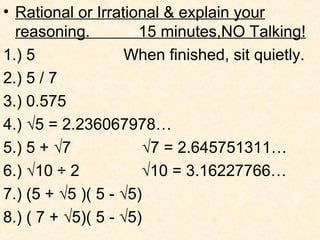
• Rational or Irrational & explain your
reasoning. 15 minutes,NO Talking!
1.) 5 When finished, sit quietly.
2.) 5 / 7
3.) 0.575
4.) √5 = 2.236067978…
5.) 5 + √7 √7 = 2.645751311…
6.) √10 ÷ 2 √10 = 3.16227766…
7.) (5 + √5 )( 5 - √5)
8.) ( 7 + √5)( 5 - √5)
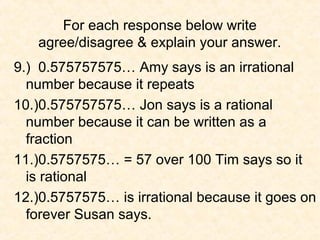
For each response below write
agree/disagree & explain your answer.
9.) 0.575757575… Amy says is an irrational
number because it repeats
10.)0.575757575… Jon says is a rational
number because it can be written as a
fraction
11.)0.5757575… = 57 over 100 Tim says so it
is rational
12.)0.5757575… is irrational because it goes on
forever Susan says.
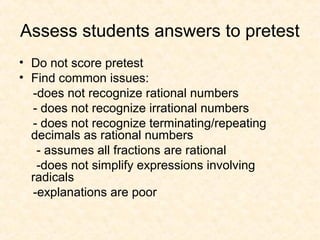
Assess students answers to pretest
• Do not score pretest
• Find common issues:
-does not recognize rational numbers
- does not recognize irrational numbers
- does not recognize terminating/repeating
decimals as rational numbers
- assumes all fractions are rational
-does not simplify expressions involving
radicals
-explanations are poor
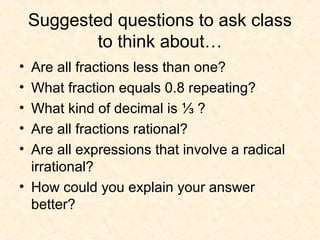
Suggested questions to ask class
to think about…
• Are all fractions less than one?
• What fraction equals 0.8 repeating?
• What kind of decimal is ⅓ ?
• Are all fractions rational?
• Are all expressions that involve a radical
irrational?
• How could you explain your answer
better?
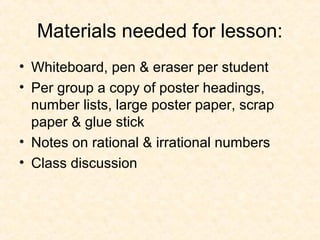
Materials needed for lesson:
• Whiteboard, pen & eraser per student
• Per group a copy of poster headings,
number lists, large poster paper, scrap
paper & glue stick
• Notes on rational & irrational numbers
• Class discussion
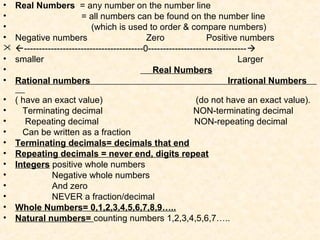
• Real Numbers = any number on the number line
• = all numbers can be found on the number line
• (which is used to order & compare numbers)
• Negative numbers Zero Positive numbers
 ----------------------------------------0---------------------------------
• smaller Larger
• Real Numbers
• Rational numbers Irrational Numbers
• ( have an exact value) (do not have an exact value).
• Terminating decimal NON-terminating decimal
• Repeating decimal NON-repeating decimal
• Can be written as a fraction
• Terminating decimals= decimals that end
• Repeating decimals = never end, digits repeat
• Integers positive whole numbers
• Negative whole numbers
• And zero
• NEVER a fraction/decimal
• Whole Numbers= 0,1,2,3,4,5,6,7,8,9…..
• Natural numbers= counting numbers 1,2,3,4,5,6,7…..
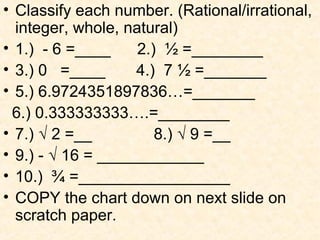
• Classify each number. (Rational/irrational,
integer, whole, natural)
• 1.) - 6 =____ 2.) ½ =________
• 3.) 0 =____ 4.) 7 ½ =_______
• 5.) 6.9724351897836…=_______
6.) 0.333333333….=________
• 7.) √ 2 =__ 8.) √ 9 =__
• 9.) - √ 16 = ____________
• 10.) ¾ =_________________
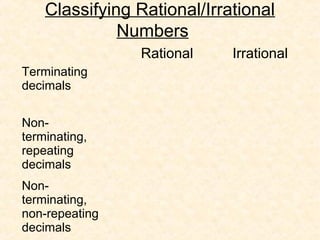
• COPY the chart down on next slide on
scratch paper.
Classifying Rational/Irrational
Numbers
Rational Irrational
Terminating
decimals
Non-
terminating,
repeating
decimals
Non-
terminating,
non-repeating
decimals
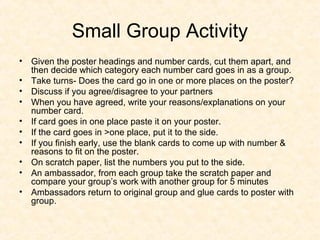
Small Group Activity
• Given the poster headings and number cards, cut them apart, and
then decide which category each number card goes in as a group.
• Take turns- Does the card go in one or more places on the poster?
• Discuss if you agree/disagree to your partners
• When you have agreed, write your reasons/explanations on your
number card.
• If card goes in one place paste it on your poster.
• If the card goes in >one place, put it to the side.
• If you finish early, use the blank cards to come up with number &
reasons to fit on the poster.
• On scratch paper, list the numbers you put to the side.
• An ambassador, from each group take the scratch paper and
compare your group’s work with another group for 5 minutes
• Ambassadors return to original group and glue cards to poster with
group.
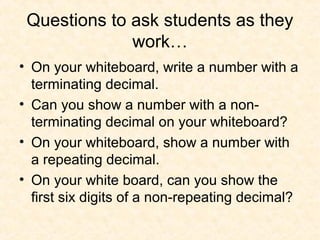
Questions to ask students as they
work…
• On your whiteboard, write a number with a
terminating decimal.
• Can you show a number with a non-
terminating decimal on your whiteboard?
• On your whiteboard, show a number with
a repeating decimal.
• On your white board, can you show the
first six digits of a non-repeating decimal?
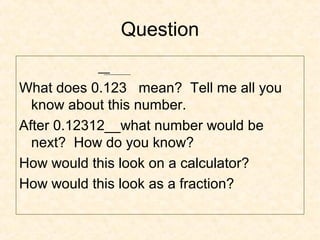
Question
What does 0.123 mean? Tell me all you
know about this number.
After 0.12312__what number would be
next? How do you know?
How would this look on a calculator?
How would this look as a fraction?
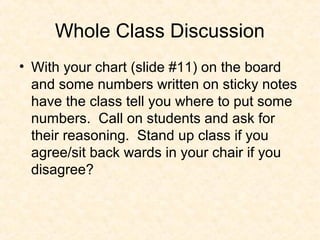
Whole Class Discussion
• With your chart (slide #11) on the board
and some numbers written on sticky notes
have the class tell you where to put some
numbers. Call on students and ask for
their reasoning. Stand up class if you
agree/sit back wards in your chair if you
disagree?
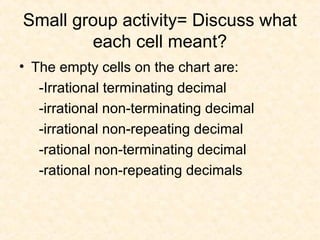
Small group activity= Discuss what
each cell meant?
• The empty cells on the chart are:
-Irrational terminating decimal
-irrational non-terminating decimal
-irrational non-repeating decimal
-rational non-terminating decimal
-rational non-repeating decimals
Go over pretest
• Give back students their papers
• Let them discuss their answers in their
groups who is correct and why?
• Let them fix their papers
• Discuss what they learned
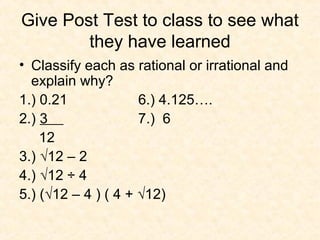
Give Post Test to class to see what
they have learned
• Classify each as rational or irrational and
explain why?
1.) 0.21 6.) 4.125….
2.) 3 7.) 6
12
3.) √12 – 2
4.) √12 ÷ 4
5.) (√12 – 4 ) ( 4 + √12)
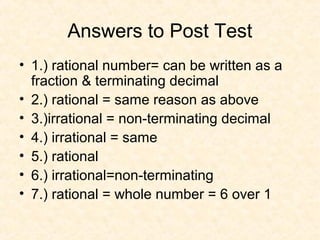
Answers to Post Test
• 1.) rational number= can be written as a
fraction & terminating decimal
• 2.) rational = same reason as above
• 3.)irrational = non-terminating decimal
• 4.) irrational = same
• 5.) rational
• 6.) irrational=non-terminating
• 7.) rational = whole number = 6 over 1

Don't FAL out; Techno IN! Classifying Rational & Irrational Numbers

  • 1.
    “Classifying Rational & IrrationalNumbers” Formative assessment lesson
  • 2.
    Mathematical goals: • Classifyingnumbers as rational and irrational numbers • Moving between different representations of rational and irrational numbers • Agenda: • pretest • lesson • post test
  • 3.
    Pretest= “Is itrational or irrational?” Number on notebook paper 1- 12 For each of the numbers below, decide whether it is rational or irrational. Explain you reasoning in detail.
  • 4.
    • Rational orIrrational & explain your reasoning. 15 minutes,NO Talking! 1.) 5 When finished, sit quietly. 2.) 5 / 7 3.) 0.575 4.) √5 = 2.236067978… 5.) 5 + √7 √7 = 2.645751311… 6.) √10 ÷ 2 √10 = 3.16227766… 7.) (5 + √5 )( 5 - √5) 8.) ( 7 + √5)( 5 - √5)
  • 5.
    For each responsebelow write agree/disagree & explain your answer. 9.) 0.575757575… Amy says is an irrational number because it repeats 10.)0.575757575… Jon says is a rational number because it can be written as a fraction 11.)0.5757575… = 57 over 100 Tim says so it is rational 12.)0.5757575… is irrational because it goes on forever Susan says.
  • 6.
    Assess students answersto pretest • Do not score pretest • Find common issues: -does not recognize rational numbers - does not recognize irrational numbers - does not recognize terminating/repeating decimals as rational numbers - assumes all fractions are rational -does not simplify expressions involving radicals -explanations are poor
  • 7.
    Suggested questions toask class to think about… • Are all fractions less than one? • What fraction equals 0.8 repeating? • What kind of decimal is ⅓ ? • Are all fractions rational? • Are all expressions that involve a radical irrational? • How could you explain your answer better?
  • 8.
    Materials needed forlesson: • Whiteboard, pen & eraser per student • Per group a copy of poster headings, number lists, large poster paper, scrap paper & glue stick • Notes on rational & irrational numbers • Class discussion
  • 9.
    • Real Numbers= any number on the number line • = all numbers can be found on the number line • (which is used to order & compare numbers) • Negative numbers Zero Positive numbers  ----------------------------------------0--------------------------------- • smaller Larger • Real Numbers • Rational numbers Irrational Numbers • ( have an exact value) (do not have an exact value). • Terminating decimal NON-terminating decimal • Repeating decimal NON-repeating decimal • Can be written as a fraction • Terminating decimals= decimals that end • Repeating decimals = never end, digits repeat • Integers positive whole numbers • Negative whole numbers • And zero • NEVER a fraction/decimal • Whole Numbers= 0,1,2,3,4,5,6,7,8,9….. • Natural numbers= counting numbers 1,2,3,4,5,6,7…..
  • 10.
    • Classify eachnumber. (Rational/irrational, integer, whole, natural) • 1.) - 6 =____ 2.) ½ =________ • 3.) 0 =____ 4.) 7 ½ =_______ • 5.) 6.9724351897836…=_______ 6.) 0.333333333….=________ • 7.) √ 2 =__ 8.) √ 9 =__ • 9.) - √ 16 = ____________ • 10.) ¾ =_________________ • COPY the chart down on next slide on scratch paper.
  • 11.
  • 12.
    Small Group Activity •Given the poster headings and number cards, cut them apart, and then decide which category each number card goes in as a group. • Take turns- Does the card go in one or more places on the poster? • Discuss if you agree/disagree to your partners • When you have agreed, write your reasons/explanations on your number card. • If card goes in one place paste it on your poster. • If the card goes in >one place, put it to the side. • If you finish early, use the blank cards to come up with number & reasons to fit on the poster. • On scratch paper, list the numbers you put to the side. • An ambassador, from each group take the scratch paper and compare your group’s work with another group for 5 minutes • Ambassadors return to original group and glue cards to poster with group.
  • 13.
    Questions to askstudents as they work… • On your whiteboard, write a number with a terminating decimal. • Can you show a number with a non- terminating decimal on your whiteboard? • On your whiteboard, show a number with a repeating decimal. • On your white board, can you show the first six digits of a non-repeating decimal?
  • 14.
    Question What does 0.123mean? Tell me all you know about this number. After 0.12312__what number would be next? How do you know? How would this look on a calculator? How would this look as a fraction?
  • 15.
    Whole Class Discussion •With your chart (slide #11) on the board and some numbers written on sticky notes have the class tell you where to put some numbers. Call on students and ask for their reasoning. Stand up class if you agree/sit back wards in your chair if you disagree?
  • 16.
    Small group activity=Discuss what each cell meant? • The empty cells on the chart are: -Irrational terminating decimal -irrational non-terminating decimal -irrational non-repeating decimal -rational non-terminating decimal -rational non-repeating decimals
  • 17.
    Go over pretest •Give back students their papers • Let them discuss their answers in their groups who is correct and why? • Let them fix their papers • Discuss what they learned
  • 18.
    Give Post Testto class to see what they have learned • Classify each as rational or irrational and explain why? 1.) 0.21 6.) 4.125…. 2.) 3 7.) 6 12 3.) √12 – 2 4.) √12 ÷ 4 5.) (√12 – 4 ) ( 4 + √12)
  • 19.
    Answers to PostTest • 1.) rational number= can be written as a fraction & terminating decimal • 2.) rational = same reason as above • 3.)irrational = non-terminating decimal • 4.) irrational = same • 5.) rational • 6.) irrational=non-terminating • 7.) rational = whole number = 6 over 1