Supporting
Transition from ECSE
to Kindergarten
Portland Public Schools Special
Education
Robert D. Cantwell
Academic Programs Administrator
Maria Gianotti
Early Childhood Transition Specialist
Beth Raisman
Kindergarten Teacher
Why are you here?
Who’s in the audience?
3 WORDS
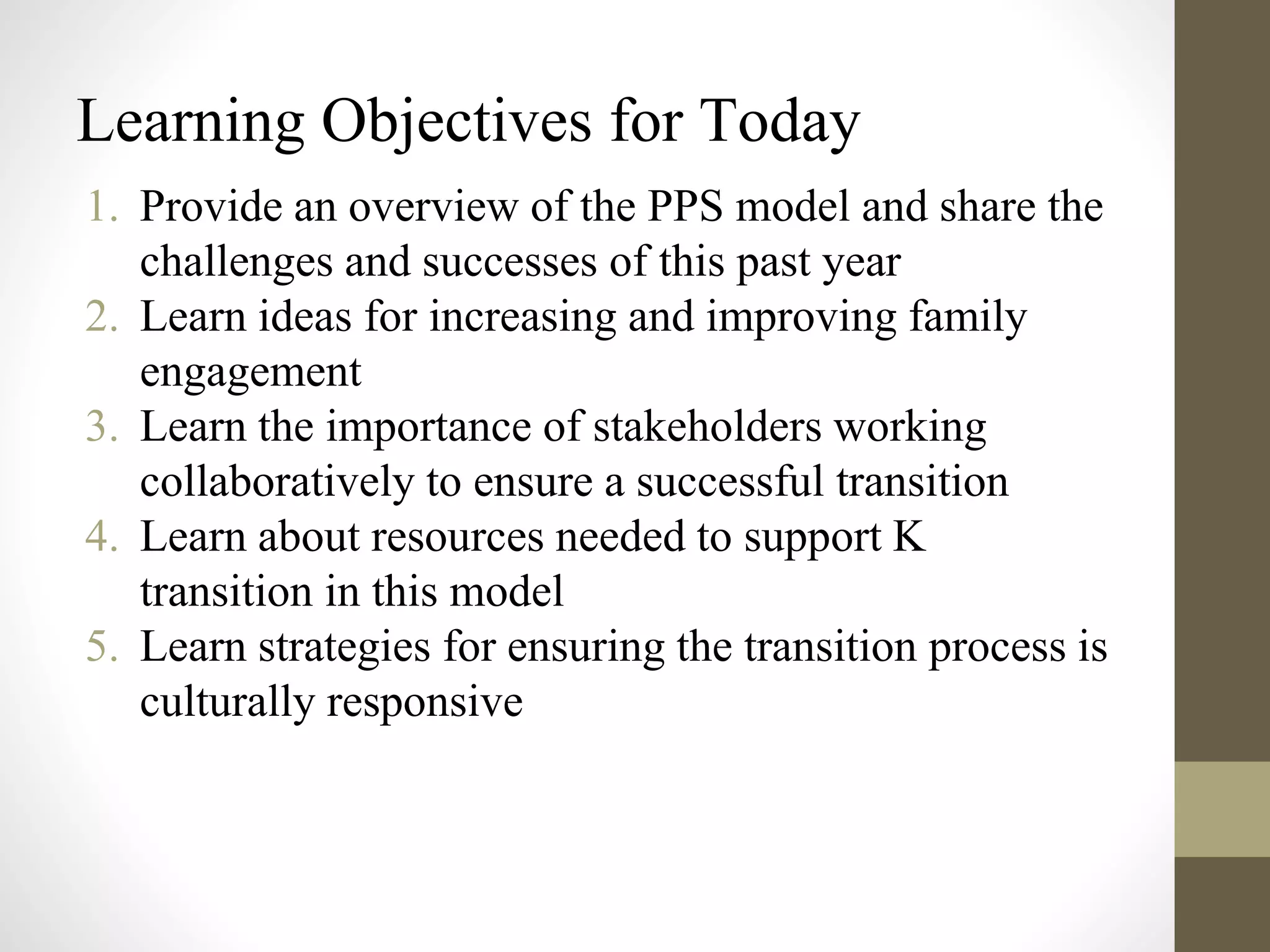
Learning Objectives for Today
1. Provide an overview of the PPS model and share the
challenges and successes of this past year
2. Learn ideas for increasing and improving family
engagement
3. Learn the importance of stakeholders working
collaboratively to ensure a successful transition
4. Learn about resources needed to support K
transition in this model
5. Learn strategies for ensuring the transition process is
culturally responsive
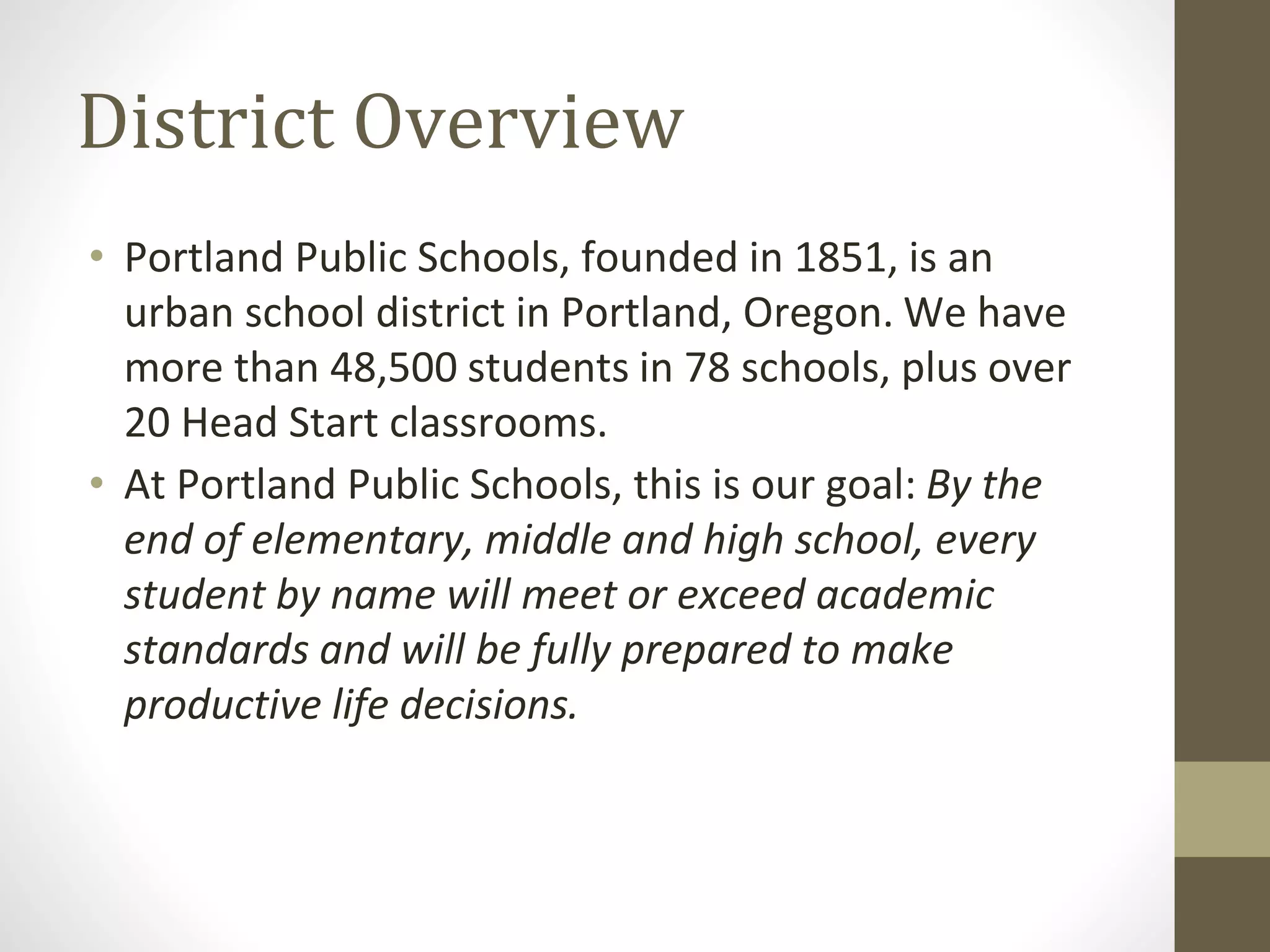
District Overview
• Portland Public Schools, founded in 1851, is an
urban school district in Portland, Oregon. We have
more than 48,500 students in 78 schools, plus over
20 Head Start classrooms.
• At Portland Public Schools, this is our goal: By the
end of elementary, middle and high school, every
student by name will meet or exceed academic
standards and will be fully prepared to make
productive life decisions.
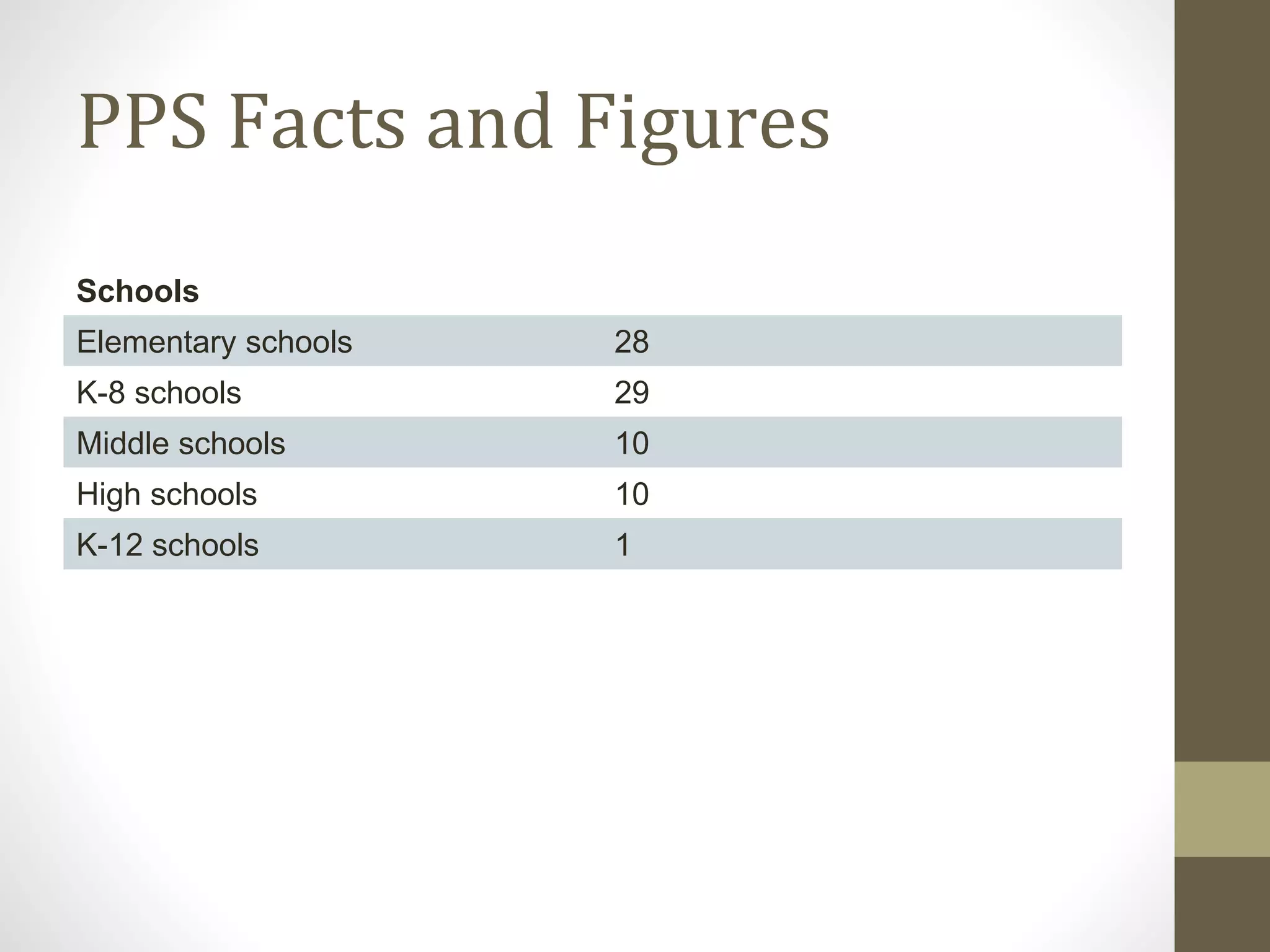
PPS Facts and Figures
Schools
Elementary schools 28
K-8 schools 29
Middle schools 10
High schools 10
K-12 schools 1
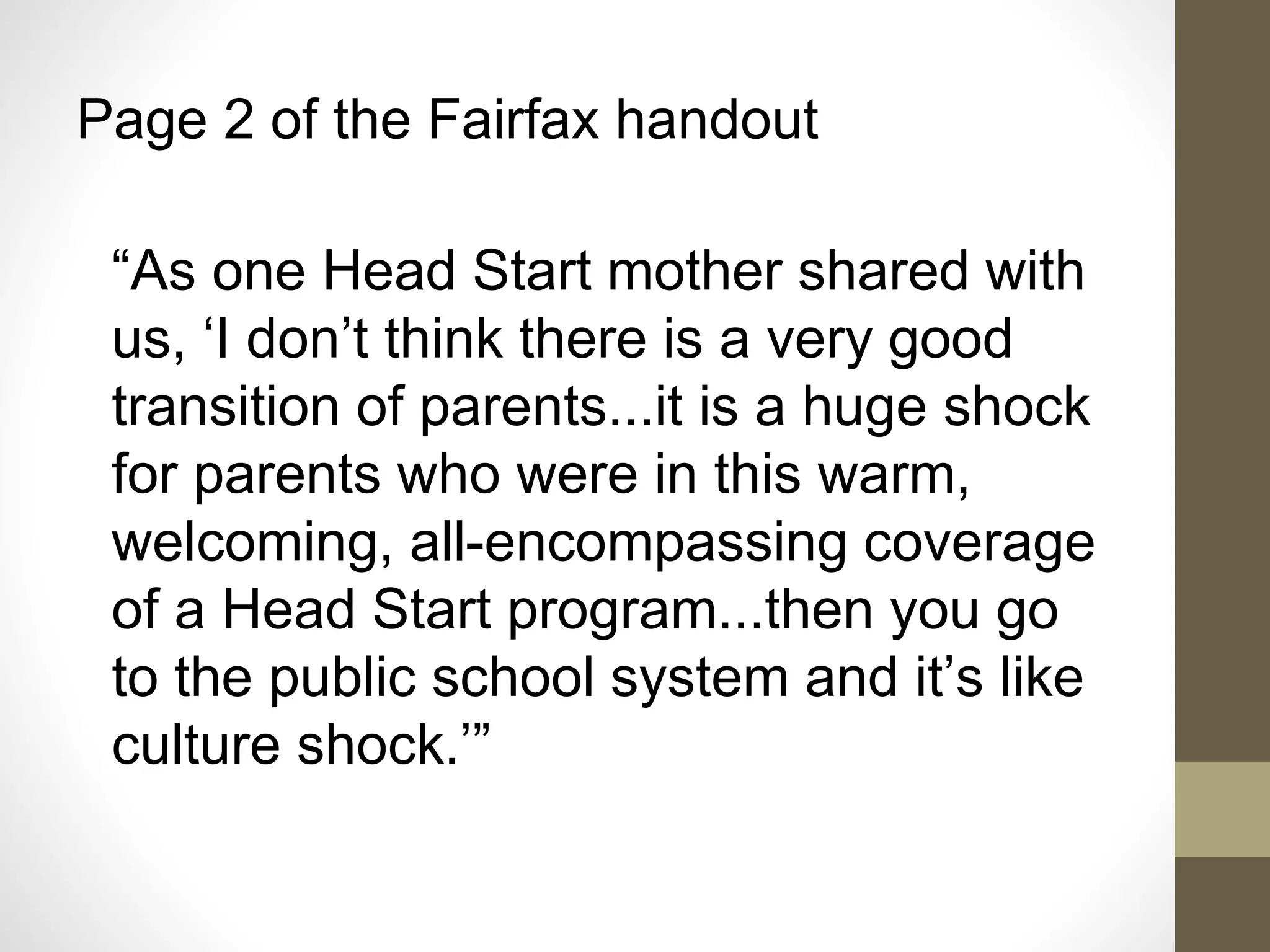
Page 2 of the Fairfax handout
“As one Head Start mother shared with
us, ‘I don’t think there is a very good
transition of parents...it is a huge shock
for parents who were in this warm,
welcoming, all-encompassing coverage
of a Head Start program...then you go
to the public school system and it’s like
culture shock.’”
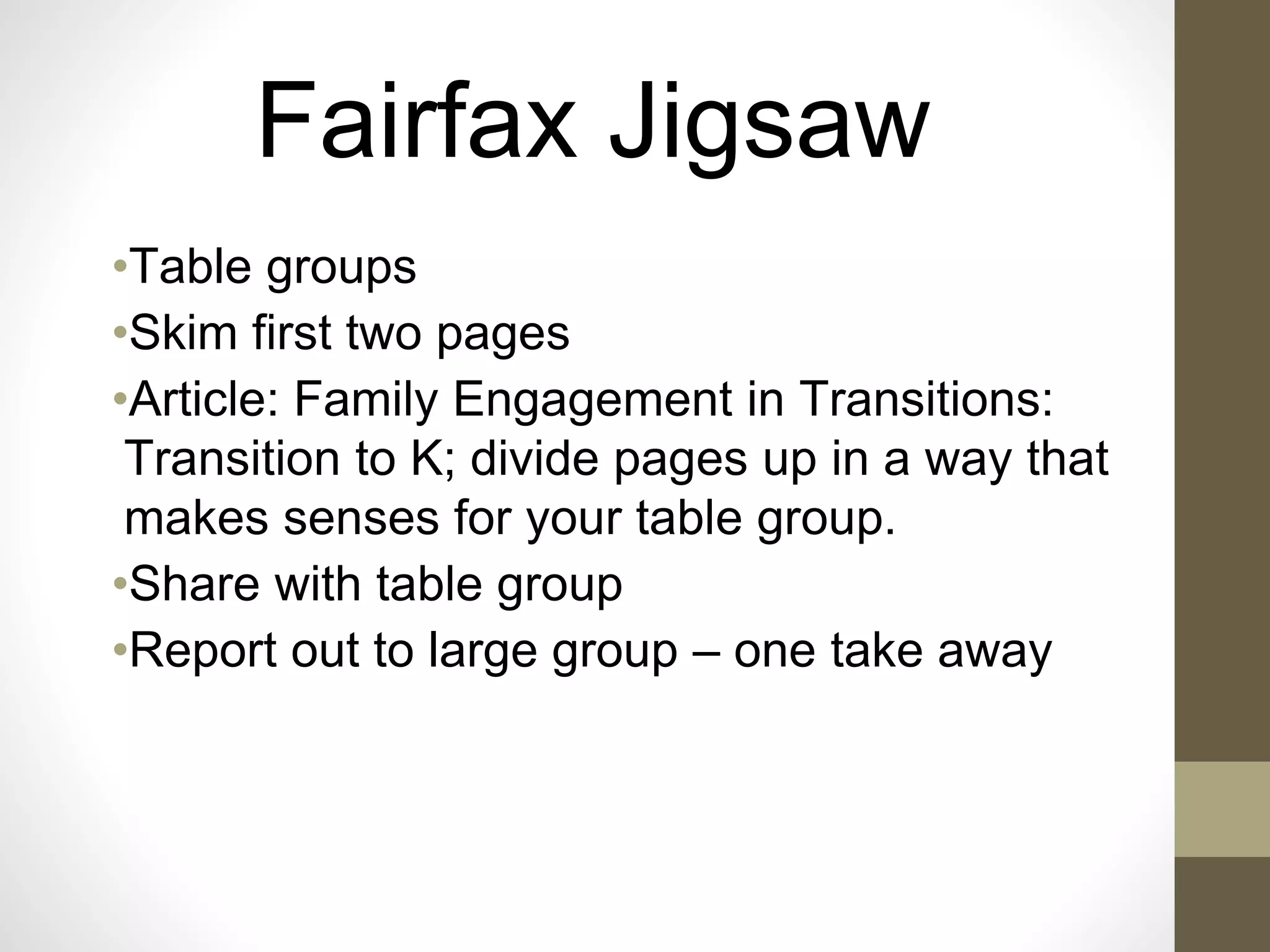
Fairfax Jigsaw
•Table groups
•Skim first two pages
•Article: Family Engagement in Transitions:
Transition to K; divide pages up in a way that
makes senses for your table group.
•Share with table group
•Report out to large group – one take away
Early Childhood Transition
Team
•Provides children and families with an
internal primary point of contact and
support to ensure a successful transition
from early childhood special education
services to kindergarten.
•Provides additional support to K teachers
and school teams.
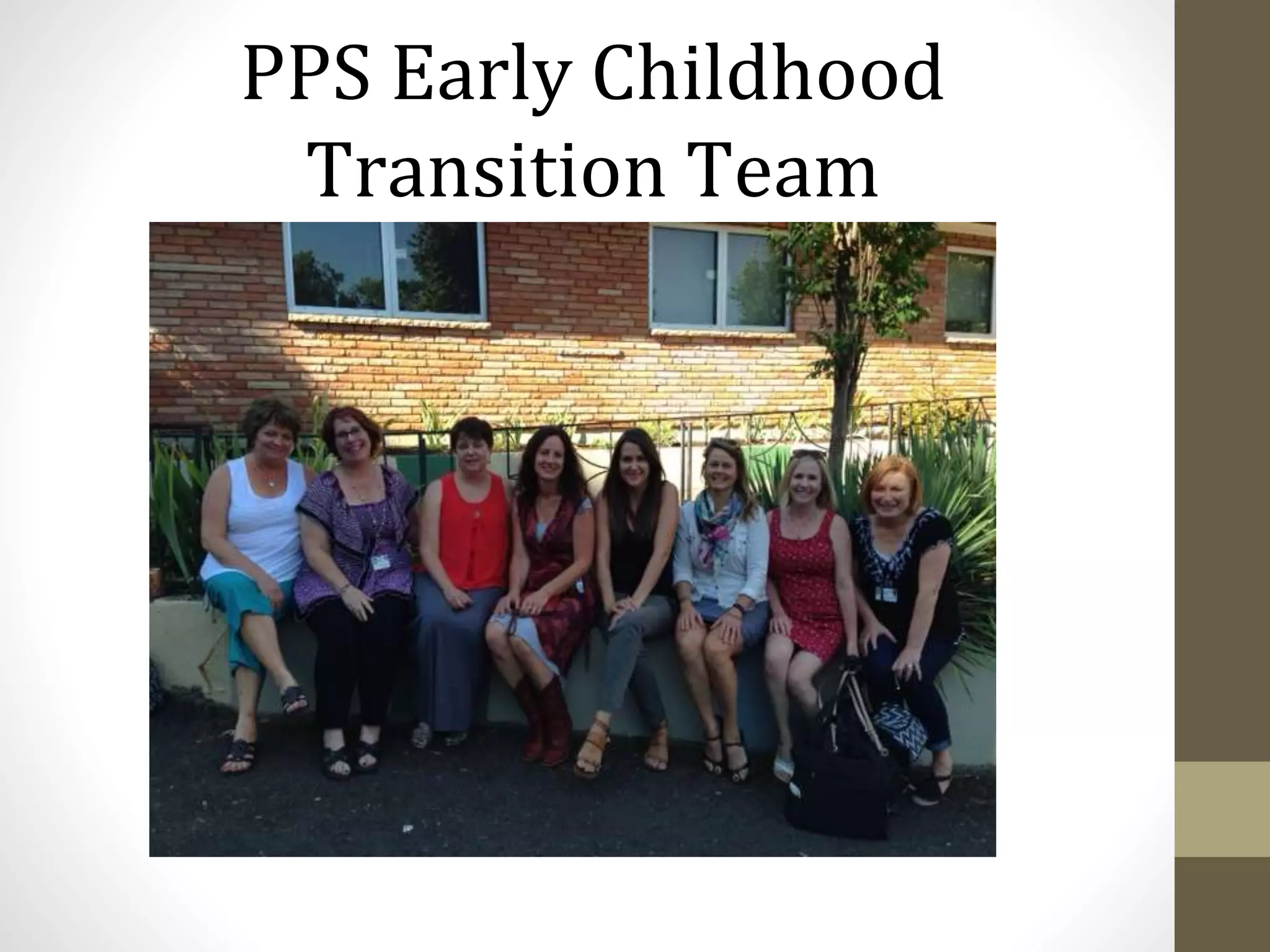
PPS Early Childhood
Transition Team
Role of Transition
Coordinators
Managing the Process
Background/Context
 Not a brand new model
 Brought back in Fall 2014 to relieve workload
issues
 Partnership with DDMECP; they provide services;
we do all assessments for children residing in our
district; we support K transition
 We supported 480+ transitioning children this year
 Transitioning children need to have a school age
categorical eligibility; can’t transition with DD in
Oregon
 3D Process in PPS; way to frontload supports and
fade over time
Successes
• Using a lens of cultural/linguistic diversity in our
approach
• Making a personal connection with families
• Having one familiar face (transition coordinator) all
through the process
• Principals attending transition IEP meetings to meet
families and learn about the students’ strengths and
needs
• More children starting in inclusive learning
environments
• Families visiting learning environment options that were
being considered
• Strengths-based and Person-Centered Approach
• Sharing pictures of child at meeting
• Having ECSE service providers at meetings
Successes (cont’d)
• Observations completed by transition
coordinators
• Use Google Apps during meetings to take
notes on children
• K teachers appreciate the scheduling in
advance; ECTT coordinated scheduling with
parents
• IEPs were written by staff who have a
knowledge of school-based services
• First-hand knowledge from in-district team
member who had observed the child
Challenges
• Starting transition evals too late
• Sometimes families choose other school options and the
school team must still meet to complete transition IEP.
Feels like lost time and energy.
• K has become more academic due to CCSS. Children’s
pre-K experience is critical.
• Within the early childhood context, social emotional
readiness is K readiness.
• K Teachers report that 3-4 IEPs in one day makes for a
long, intense day.
• Some staff feel that CD has become a “gateway” to
special education.
• School teams still feel more adult support is better; 1:1s.
• Capacity building of school staff; resource mapping
• Funding
DEC Recommended Practices
Jigsaw
•Table groups
•Focus on Family (p. 9), Teaming and
Collaboration (p. 14), & Transition (p. 15)
•Each person take a section
•Reflect with your group: What are you
already doing in your work? What are some
next steps you might take in your practice?
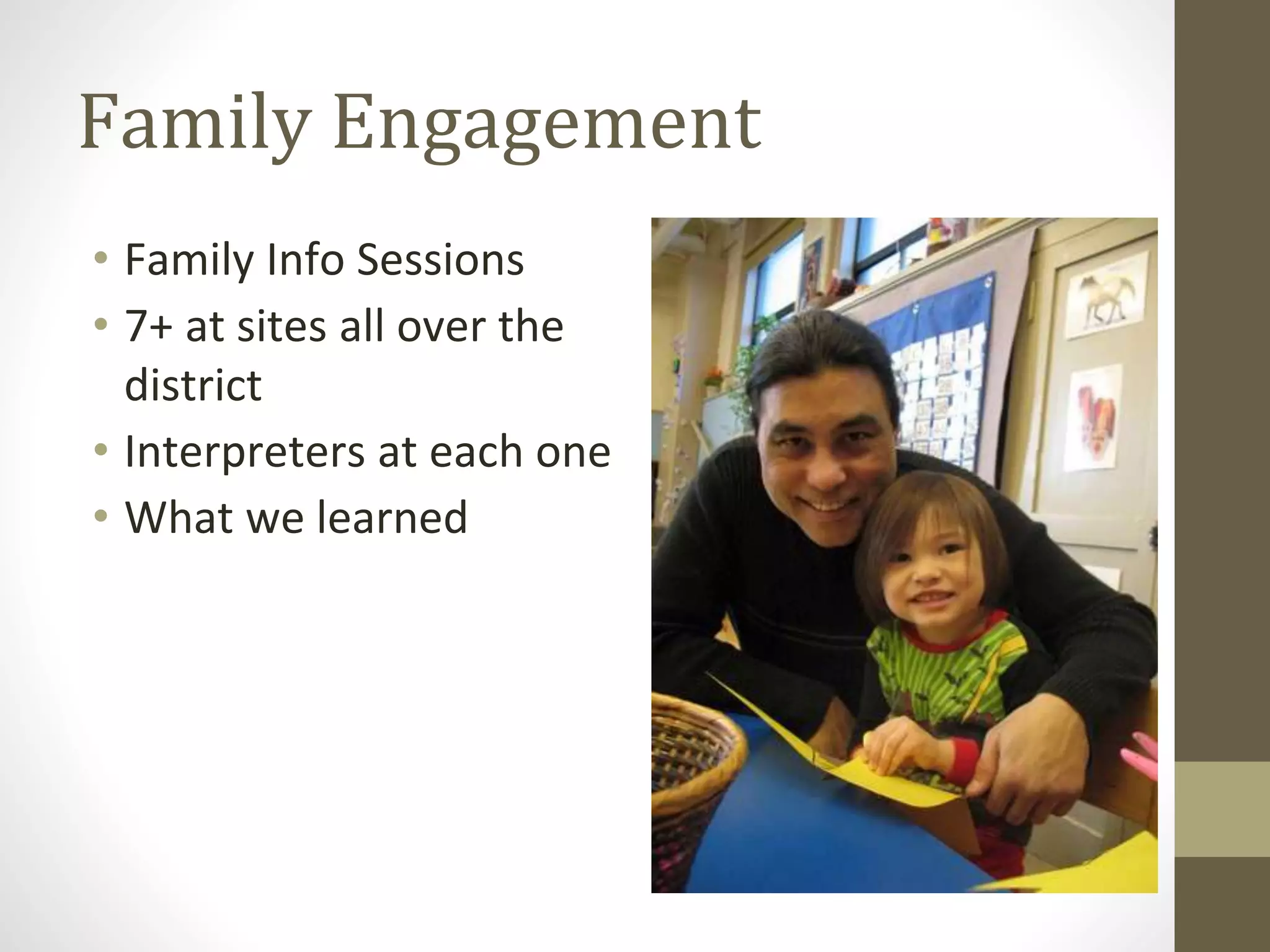
Family Engagement
• Family Info Sessions
• 7+ at sites all over the
district
• Interpreters at each one
• What we learned
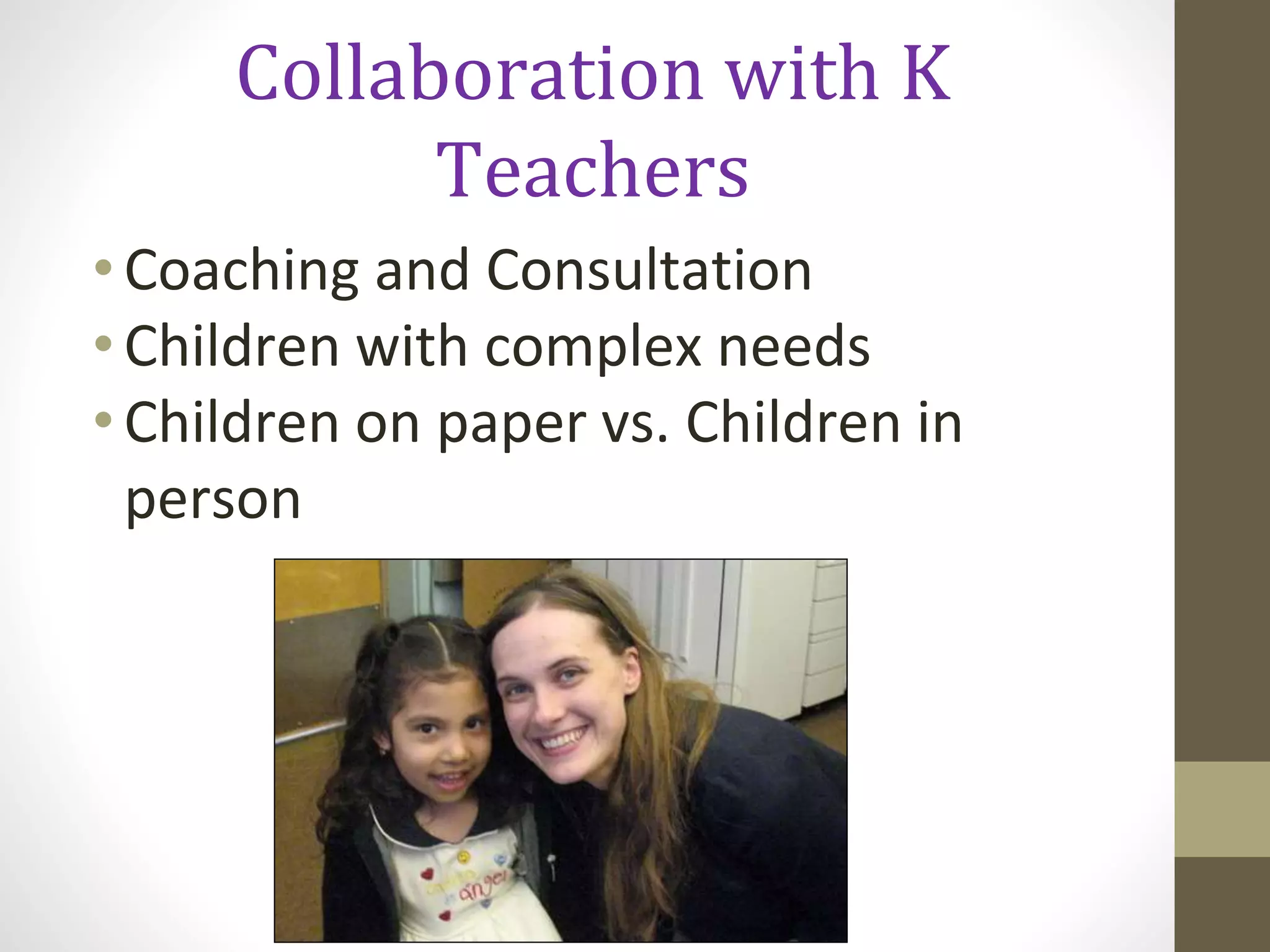
Collaboration with K
Teachers
•Coaching and Consultation
•Children with complex needs
•Children on paper vs. Children in
person
Culturally Responsive
Practices
We meet families where they’re at.
• Home visits
• Considering a family’s cultural and linguistic
background
• Asking families to define their cultural
background
Handouts
•Kindergarten Checklist
•Parent Input Survey for IEP Planning
•Evaluation Planning Worksheet
•IEP Preparation and Family Participation Form
•Parent Tip Sheet
•Preparing for a Successful Transition to
Kindergarten by FACT Oregon
•DEC Recommended Practices
•Fairfax Futures
Questions?
Preguntas?

Supporting Transition from ECSE to K

  • 1.
    Supporting Transition from ECSE toKindergarten Portland Public Schools Special Education Robert D. Cantwell Academic Programs Administrator Maria Gianotti Early Childhood Transition Specialist Beth Raisman Kindergarten Teacher
  • 2.
    Why are youhere? Who’s in the audience?
  • 3.
  • 4.
    Learning Objectives forToday 1. Provide an overview of the PPS model and share the challenges and successes of this past year 2. Learn ideas for increasing and improving family engagement 3. Learn the importance of stakeholders working collaboratively to ensure a successful transition 4. Learn about resources needed to support K transition in this model 5. Learn strategies for ensuring the transition process is culturally responsive
  • 5.
    District Overview • PortlandPublic Schools, founded in 1851, is an urban school district in Portland, Oregon. We have more than 48,500 students in 78 schools, plus over 20 Head Start classrooms. • At Portland Public Schools, this is our goal: By the end of elementary, middle and high school, every student by name will meet or exceed academic standards and will be fully prepared to make productive life decisions.
  • 6.
    PPS Facts andFigures Schools Elementary schools 28 K-8 schools 29 Middle schools 10 High schools 10 K-12 schools 1
  • 7.
    Page 2 ofthe Fairfax handout “As one Head Start mother shared with us, ‘I don’t think there is a very good transition of parents...it is a huge shock for parents who were in this warm, welcoming, all-encompassing coverage of a Head Start program...then you go to the public school system and it’s like culture shock.’”
  • 8.
    Fairfax Jigsaw •Table groups •Skimfirst two pages •Article: Family Engagement in Transitions: Transition to K; divide pages up in a way that makes senses for your table group. •Share with table group •Report out to large group – one take away
  • 9.
    Early Childhood Transition Team •Provideschildren and families with an internal primary point of contact and support to ensure a successful transition from early childhood special education services to kindergarten. •Provides additional support to K teachers and school teams.
  • 10.
  • 11.
  • 12.
    Background/Context  Not abrand new model  Brought back in Fall 2014 to relieve workload issues  Partnership with DDMECP; they provide services; we do all assessments for children residing in our district; we support K transition  We supported 480+ transitioning children this year  Transitioning children need to have a school age categorical eligibility; can’t transition with DD in Oregon  3D Process in PPS; way to frontload supports and fade over time
  • 13.
    Successes • Using alens of cultural/linguistic diversity in our approach • Making a personal connection with families • Having one familiar face (transition coordinator) all through the process • Principals attending transition IEP meetings to meet families and learn about the students’ strengths and needs • More children starting in inclusive learning environments • Families visiting learning environment options that were being considered • Strengths-based and Person-Centered Approach • Sharing pictures of child at meeting • Having ECSE service providers at meetings
  • 14.
    Successes (cont’d) • Observationscompleted by transition coordinators • Use Google Apps during meetings to take notes on children • K teachers appreciate the scheduling in advance; ECTT coordinated scheduling with parents • IEPs were written by staff who have a knowledge of school-based services • First-hand knowledge from in-district team member who had observed the child
  • 15.
    Challenges • Starting transitionevals too late • Sometimes families choose other school options and the school team must still meet to complete transition IEP. Feels like lost time and energy. • K has become more academic due to CCSS. Children’s pre-K experience is critical. • Within the early childhood context, social emotional readiness is K readiness. • K Teachers report that 3-4 IEPs in one day makes for a long, intense day. • Some staff feel that CD has become a “gateway” to special education. • School teams still feel more adult support is better; 1:1s. • Capacity building of school staff; resource mapping • Funding
  • 16.
    DEC Recommended Practices Jigsaw •Tablegroups •Focus on Family (p. 9), Teaming and Collaboration (p. 14), & Transition (p. 15) •Each person take a section •Reflect with your group: What are you already doing in your work? What are some next steps you might take in your practice?
  • 17.
    Family Engagement • FamilyInfo Sessions • 7+ at sites all over the district • Interpreters at each one • What we learned
  • 18.
    Collaboration with K Teachers •Coachingand Consultation •Children with complex needs •Children on paper vs. Children in person
  • 19.
    Culturally Responsive Practices We meetfamilies where they’re at. • Home visits • Considering a family’s cultural and linguistic background • Asking families to define their cultural background
  • 20.
    Handouts •Kindergarten Checklist •Parent InputSurvey for IEP Planning •Evaluation Planning Worksheet •IEP Preparation and Family Participation Form •Parent Tip Sheet •Preparing for a Successful Transition to Kindergarten by FACT Oregon •DEC Recommended Practices •Fairfax Futures
  • 21.