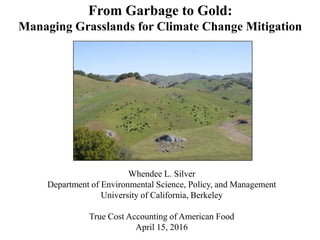
From Garbage to Gold:
Managing Grasslands for Climate Change Mitigation
Whendee L. Silver
Department of Environmental Science, Policy, and Management
University of California, Berkeley
True Cost Accounting of American Food
April 15, 2016
A large fraction of anthropogenic climate change
resulting from CO2 emissions is irreversible on a
multi-century to millennial time scale, except in the
case of a large net removal of CO2 from the atmosphere
over a sustained period. Surface temperatures will remain
approximately constant at elevated levels for many
centuries after a complete cessation of net anthropogenic
CO2 emissions. Due to the long time scales of heat
transfer from the ocean surface to depth, ocean warming
will continue for centuries. Depending on the scenario,
about 15 to 40% of emitted CO2 will remain in the
atmosphere longer than 1,000 years.
IPCC AR 5 (2013)
A large fraction of anthropogenic climate change resulting
from CO2 emissions is irreversible on a multi-century to
millennial time scale, except in the case of a large net
removal of CO2 from the atmosphere over a sustained
period. Surface temperatures will remain approximately
constant at elevated levels for many centuries after a
complete cessation of net anthropogenic CO2 emissions.
Due to the long time scales of heat transfer from the
ocean surface to depth, ocean warming will continue for
centuries. Depending on the scenario, about 15 to 40% of
emitted CO2 will remain in the atmosphere longer than
1,000 years.
IPCC AR 5 (2013)
Atmosphere carbon
760 Pg
Vegetation carbon
610 Pg
Soil carbon
2000 Pg
(or more)
Photosynthesis
Plant/tissue death
Microbe
respiration
Grasses allocate a high proportion of their photosynthate
belowground to roots  greater soil carbon pools
Grasslands are geographically expansive
The majority of grasslands are degraded
30% of global land surface area
30% of US land area
23 million hectares in California (40-50 % of the land area)
At a rate of 0.5 Mg C ha-1 y-1
= 21 MMT CO2e/y
Units:
Mg = Metric ton
MMT= Million metric tons
CO2e = CO2 equivalents
At a rate of 1 Mg C ha-1 y-1
= 42 MMT CO2e/y
Using half of California’s grasslands
At a rate of 0.5 Mg C ha-1 y-1
= 21 MMT CO2e y-1
Units:
Mg = Metric ton
MMT= Million metric tons
CO2e = CO2 equivalents
Emissions data: CA GHG Inventory 2013
At a rate of 1 Mg C ha-1 y-1
= 42 MMT CO2e y-1
Using half of California’s grasslands
•Livestock (enteric fermentation)
~ 12 MMT CO2e y-1
•Commercial/residential
~ 43 MMT CO2e y-1
•Electrical generation (in state)
~50 MMT CO2e y-1
Amendments of livestock manure increased soil
carbon by 50 Mg C ha-1 in the top meter of soil
Not amended Amended
0
100
200
300
SoilCarbon(MgCha-1)
From Silver et al. In prepAnalysis of 35 fields (1050 samples) from Marin and Sonoma Counties
0 10 20 30
Agricultural Soil
Management
Stationary Combustion
Mobile Combustion
Manure Management
Nitric Acid Production
Wastewater Treatment
Composting
0 50 100 150 200
Enteric Fermentation
Natural Gas Systems
Landfills
Coal Mining
Manure Management
Petroleum Systems
Wastewater
Treatment
Rice Cultivation
Composting
Livestock manure is a large source of greenhouse gases
x10
U.S. Methane Emissions (MMT CO2e) U.S. Nitrous Oxide Emissions (MMT CO2e)
U.S. EPA EPA 430-R-15-004 2013; Owen and Silver 2015 Global Change Biology
-1
0
1
2
Grazed and manured
Grazed
Climateimpact(MgCO2eha-1y-1)
From 2012 to 2100, manure applications creates a large net carbon
source to the atmosphere (positive values)
Owen et al. 2015, Global Change Biology
Source
Sink
One time application
Did not increase field
nitrous oxide and
methane emissions
Created a slow release
organic fertilizer
Composted organic matter
has much lower emissions
0
500
1000
1500
2000
2500
3000
3500
4000
2008 2009 2010 2011 2012
Soilorganiccarbon(gm-2)
A single application of compost increased both plant (forage)
production and soil carbon stocks for multiple years
AbovegroundNetPrimaryProduction(gm-2)
control compost
0
250
500
750
1000
1 2 3 4
Year
2009 2010 2011 2012
Ryals and Silver 2013, Ryals et al. 2015, Silver et al. in prep.
Year
9/08 9/09 9/10 9/11
Date
Changeinsoilmoisture(%) Compost-treated soils had higher soil moisture
during the growing season in most plots
Ryals and Silver 2013 Ecological Applications
Model results suggest that carbon gains persist for
approximately 100 years
Ryals et al. 2015 Ecological Applications
GHG Mitigation
GHG Emissions
Compost Manure Fertilizer
-40
-30
-20
-10
0
10
20
30
Globalwarmingpotential(MMTCO2e)
Net
Life cycle assessment suggests high climate change
mitigation potential even at small scales
Emissions from livestock
Redrawn from DeLonge et al. 2013
Applied to 5% of CA Rangeland
Emissions from household
energy use
Marin Carbon Project
Nicasio Native Grass Ranch
Support provided by:
United States Department of Agriculture
United States National Science Foundation
The 11th Hour Foundation
The Marin Community Foundation
The Rathmann Family Foundation
The Lia Foundation
The Kearney Foundation for Soil Science
University of California, Berkeley
Science  Action
 It is critical that carbon sequestration be included in
climate action planning at all levels
 Agriculture is poised to contribute to climate change
mitigation; this is supported by science
 Soil is a resource that can facilitate both mitigation
and adaptation; more research is needed in this area;
we are just scratching the surface
 Creative solutions may cross sectors, posing new
regulatory challenges, and new opportunities
Ryals et al. 2016
Compost amendments did not significantly change plant diversity

Whendee Silver - Soil

  • 1.
    From Garbage toGold: Managing Grasslands for Climate Change Mitigation Whendee L. Silver Department of Environmental Science, Policy, and Management University of California, Berkeley True Cost Accounting of American Food April 15, 2016
  • 2.
    A large fractionof anthropogenic climate change resulting from CO2 emissions is irreversible on a multi-century to millennial time scale, except in the case of a large net removal of CO2 from the atmosphere over a sustained period. Surface temperatures will remain approximately constant at elevated levels for many centuries after a complete cessation of net anthropogenic CO2 emissions. Due to the long time scales of heat transfer from the ocean surface to depth, ocean warming will continue for centuries. Depending on the scenario, about 15 to 40% of emitted CO2 will remain in the atmosphere longer than 1,000 years. IPCC AR 5 (2013)
  • 3.
    A large fractionof anthropogenic climate change resulting from CO2 emissions is irreversible on a multi-century to millennial time scale, except in the case of a large net removal of CO2 from the atmosphere over a sustained period. Surface temperatures will remain approximately constant at elevated levels for many centuries after a complete cessation of net anthropogenic CO2 emissions. Due to the long time scales of heat transfer from the ocean surface to depth, ocean warming will continue for centuries. Depending on the scenario, about 15 to 40% of emitted CO2 will remain in the atmosphere longer than 1,000 years. IPCC AR 5 (2013)
  • 4.
    Atmosphere carbon 760 Pg Vegetationcarbon 610 Pg Soil carbon 2000 Pg (or more) Photosynthesis Plant/tissue death Microbe respiration
  • 5.
    Grasses allocate ahigh proportion of their photosynthate belowground to roots  greater soil carbon pools
  • 6.
    Grasslands are geographicallyexpansive The majority of grasslands are degraded 30% of global land surface area 30% of US land area 23 million hectares in California (40-50 % of the land area)
  • 7.
    At a rateof 0.5 Mg C ha-1 y-1 = 21 MMT CO2e/y Units: Mg = Metric ton MMT= Million metric tons CO2e = CO2 equivalents At a rate of 1 Mg C ha-1 y-1 = 42 MMT CO2e/y Using half of California’s grasslands
  • 8.
    At a rateof 0.5 Mg C ha-1 y-1 = 21 MMT CO2e y-1 Units: Mg = Metric ton MMT= Million metric tons CO2e = CO2 equivalents Emissions data: CA GHG Inventory 2013 At a rate of 1 Mg C ha-1 y-1 = 42 MMT CO2e y-1 Using half of California’s grasslands •Livestock (enteric fermentation) ~ 12 MMT CO2e y-1 •Commercial/residential ~ 43 MMT CO2e y-1 •Electrical generation (in state) ~50 MMT CO2e y-1
  • 9.
    Amendments of livestockmanure increased soil carbon by 50 Mg C ha-1 in the top meter of soil Not amended Amended 0 100 200 300 SoilCarbon(MgCha-1) From Silver et al. In prepAnalysis of 35 fields (1050 samples) from Marin and Sonoma Counties
  • 10.
    0 10 2030 Agricultural Soil Management Stationary Combustion Mobile Combustion Manure Management Nitric Acid Production Wastewater Treatment Composting 0 50 100 150 200 Enteric Fermentation Natural Gas Systems Landfills Coal Mining Manure Management Petroleum Systems Wastewater Treatment Rice Cultivation Composting Livestock manure is a large source of greenhouse gases x10 U.S. Methane Emissions (MMT CO2e) U.S. Nitrous Oxide Emissions (MMT CO2e) U.S. EPA EPA 430-R-15-004 2013; Owen and Silver 2015 Global Change Biology
  • 11.
    -1 0 1 2 Grazed and manured Grazed Climateimpact(MgCO2eha-1y-1) From2012 to 2100, manure applications creates a large net carbon source to the atmosphere (positive values) Owen et al. 2015, Global Change Biology Source Sink
  • 12.
    One time application Didnot increase field nitrous oxide and methane emissions Created a slow release organic fertilizer Composted organic matter has much lower emissions
  • 13.
    0 500 1000 1500 2000 2500 3000 3500 4000 2008 2009 20102011 2012 Soilorganiccarbon(gm-2) A single application of compost increased both plant (forage) production and soil carbon stocks for multiple years AbovegroundNetPrimaryProduction(gm-2) control compost 0 250 500 750 1000 1 2 3 4 Year 2009 2010 2011 2012 Ryals and Silver 2013, Ryals et al. 2015, Silver et al. in prep. Year
  • 14.
    9/08 9/09 9/109/11 Date Changeinsoilmoisture(%) Compost-treated soils had higher soil moisture during the growing season in most plots Ryals and Silver 2013 Ecological Applications
  • 15.
    Model results suggestthat carbon gains persist for approximately 100 years Ryals et al. 2015 Ecological Applications
  • 16.
    GHG Mitigation GHG Emissions CompostManure Fertilizer -40 -30 -20 -10 0 10 20 30 Globalwarmingpotential(MMTCO2e) Net Life cycle assessment suggests high climate change mitigation potential even at small scales Emissions from livestock Redrawn from DeLonge et al. 2013 Applied to 5% of CA Rangeland Emissions from household energy use
  • 17.
    Marin Carbon Project NicasioNative Grass Ranch Support provided by: United States Department of Agriculture United States National Science Foundation The 11th Hour Foundation The Marin Community Foundation The Rathmann Family Foundation The Lia Foundation The Kearney Foundation for Soil Science University of California, Berkeley
  • 18.
    Science  Action It is critical that carbon sequestration be included in climate action planning at all levels  Agriculture is poised to contribute to climate change mitigation; this is supported by science  Soil is a resource that can facilitate both mitigation and adaptation; more research is needed in this area; we are just scratching the surface  Creative solutions may cross sectors, posing new regulatory challenges, and new opportunities
  • 19.
    Ryals et al.2016 Compost amendments did not significantly change plant diversity

Editor's Notes

  • #3 What many people don’t realize however is that
  • #6 Grasslands are a great place to try to sequester C in soils because grasses put a lot of their energy (and thus C) below ground in roots. They do this because they need to search for water and nutrients in the seasonally dry climates where they grow. From UK Agriculture: “Grassland is the UK's most important crop by area covering just over half of the entire UK landmass - nearly three times as great as all other crops combined. The whole of the UK (24 million ha) is just a little larger than the grassland area in the state of CA (23 million ha) where I am from.
  • #7 CA rangelands roughly store about 1-2 Pg C in the top meter;
  • #8 There is considerable potential to offset some of California’s energy use with soil C sequestration
  • #9 There is considerable potential to offset some of California’s energy use with soil C sequestration
  • #10 Sites with and without organic matter amendments.
  • #11 Note composting has lower emissions
  • #17 Using a range of estimates from the EPA on the low end and a value from the DICE model by Moore and Diaz published last year. This gives us values of ~450-2700 million US$ last year is the social costs of C emissions from livestock manure in CA. The $$ saved over 25% of CA using this approach are ~780 to 4600 million US$.
  • #19 In addition to describing the problems
  • #20 Or invasion by noxious weeds