My Journey to Net Zero
Policy and Political Flux
UK Food standards
BREXIT
Anti-Microbial
Resistance
Henry Dimbleby’s
Food Policy Commission
NET ZERO BY
2050
Soil Health
New Environmental Land
Management schemes
TRADE
New Prime
Minister
New Breeding
Technology
Obesity
New Defra
Secretary
Bovine TB
Chlorinated chicken
Animal welfare
Productivity vs
Environment
Seasonal and
Permanent
Labour
CLIMATE FRIENDLY FOOD
IS A
PUBLIC GOOD
Net Zero 2040 Ambition
Early effort share
Production Efficiency
Natural Carbon Capture
Bioenergy with Carbon capture
• Agriculture’s annual
emissions 46.5MtCO2e
• Portfolio strategy:
– Invest in productive
efficiency
– Boost natural carbon
capture and storage
– Bioenergy with carbon
capture
• No export of production
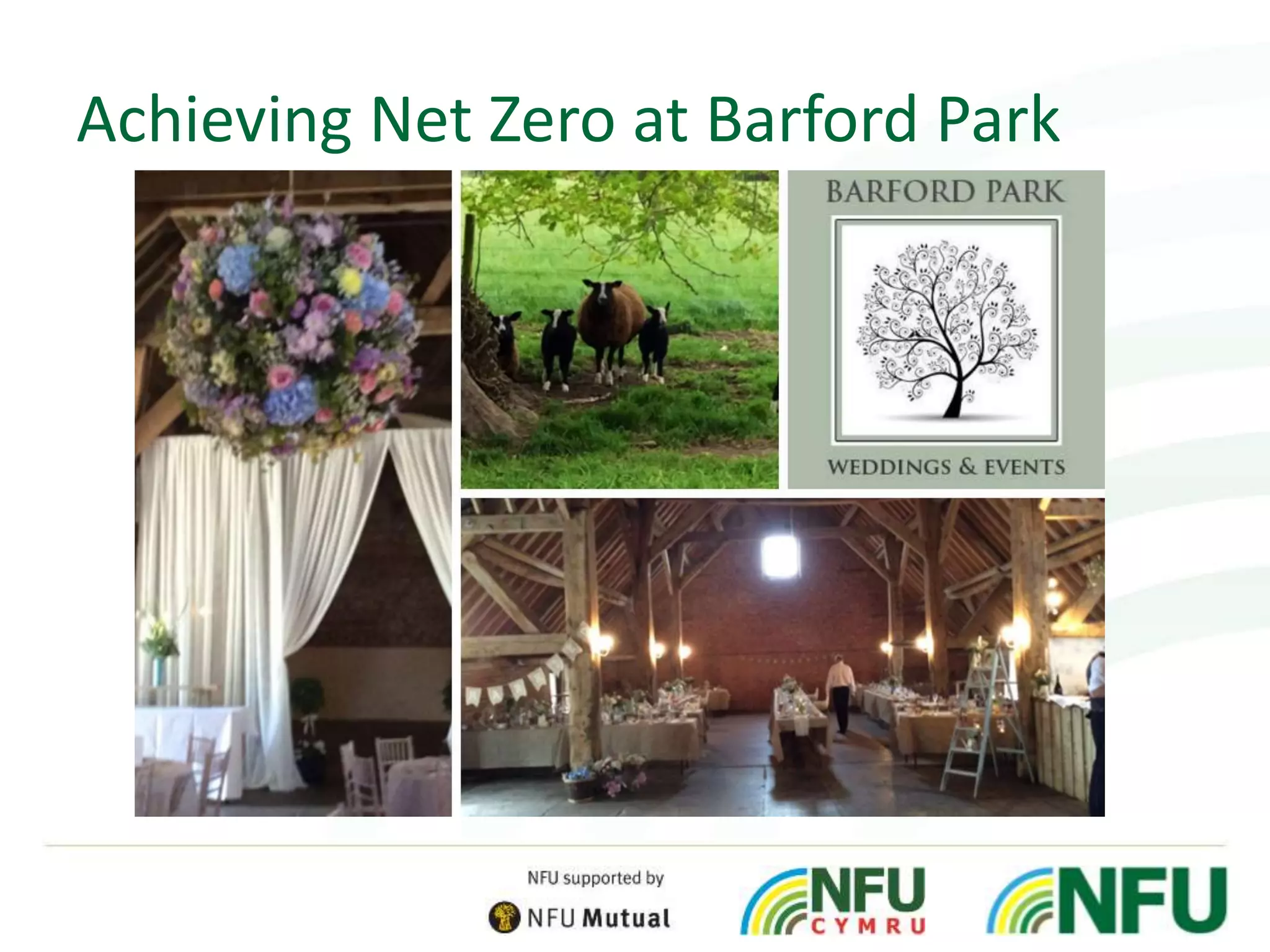
Achieving Net Zero at Barford Park

Minette Batters

  • 2.
    My Journey toNet Zero
  • 3.
    Policy and PoliticalFlux UK Food standards BREXIT Anti-Microbial Resistance Henry Dimbleby’s Food Policy Commission NET ZERO BY 2050 Soil Health New Environmental Land Management schemes TRADE New Prime Minister New Breeding Technology Obesity New Defra Secretary Bovine TB Chlorinated chicken Animal welfare Productivity vs Environment Seasonal and Permanent Labour
  • 4.
  • 5.
    Net Zero 2040Ambition Early effort share Production Efficiency Natural Carbon Capture Bioenergy with Carbon capture • Agriculture’s annual emissions 46.5MtCO2e • Portfolio strategy: – Invest in productive efficiency – Boost natural carbon capture and storage – Bioenergy with carbon capture • No export of production
  • 6.
    Achieving Net Zeroat Barford Park
  • 7.
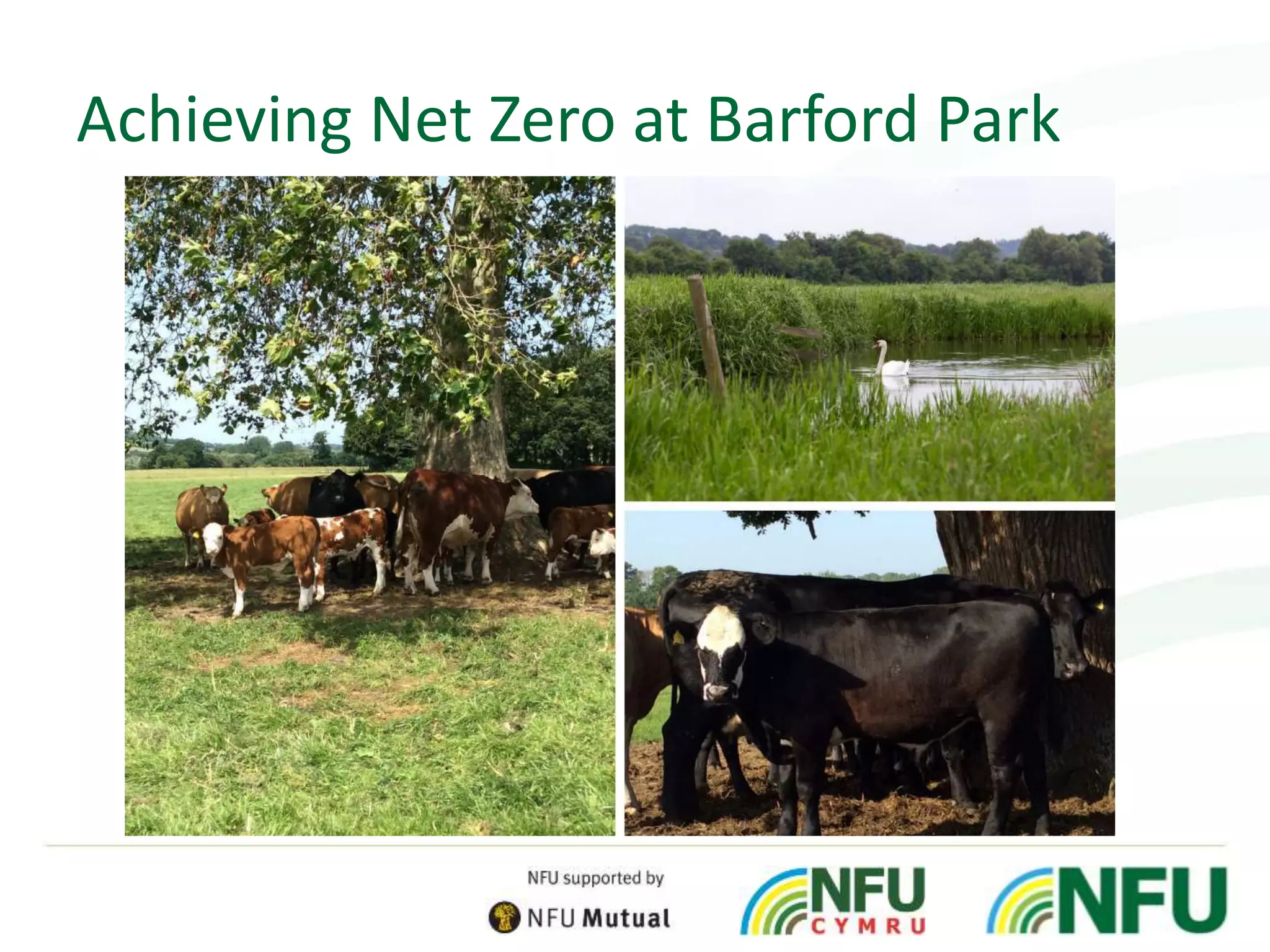
    Achieving Net Zeroat Barford Park

Editor's Notes

  • #2 This will be a short video opening Minette’s presentation - Sarah working on this…
  • #3 In this slide describe Minette’s ‘journey’ towards challenge of Net Zero Agriculture by 2040. My journey: When I joined the NFU as branch chairman I felt the NFU didn’t challenge our critics and didn’t champion farming loudly enough I was frustrated that Bovine TB was rife and livestock farmers were helpless in its path I was angry that farmers were the butt of the food chain, last to see a price rise, first to see the market downturn And yes, 10years ago I would have seen climate change as a remote concern, a scientific question, something that affects farms in Africa or southern Europe, while the UK would do quite well. Now I am not saying the same challenges I saw when I first stepped on the NFU ladder are sorted but I am in a different place on climate change now… I’ve learned that leadership is about listening to your critics and building consensus. About taking solutions to policy makers not problems. And I have learned that climate change is the greatest and most compelling of the environmental challenges facing society today (use WFO experience to illustrate) So my journey is about moving from a contested and conflicted future, of magnifying differences, to one of partnership and consensus, focusing on the progressive middle ground. Its about learning from one another rather than claiming the moral high ground Its about working smarter rather than shouting louder Examples: NFU partnering with Sustainable Farming Trust over this conference
  • #4 In this slide Minette will speak about the wider policy and political context… It would be naive to believe climate concern is shared equally by all in society - from climate change deniers to Tory leadership candidates: many have other priorities! It is also important to recognise the huge volatility not just in our weather but also our politics and our policy at present At best Brexit is a catalyst for new policy thinking, but it could equally make achieving net zero harder or impossible So important to acknowledge that [our/my] ambition of achieving net zero by 2040 is not taken in isolation Mention several other challenges: Food standards and trade – our call for a Commission with Ministerial backing Multi-annual financial framework to support and sustain positive land management Access to labour for seasonal and permanent roles Fairer food chains that share the value of production to all
  • #5 In this slide we make the case for climate-friendly food as a public good
  • #6 In which Minette explains route towards net zero We are ambitious because agriculture is uniquely placed as both a sink and a source, we have a solution in our grasp As farmers we have a special responsibility to steward carbon reserves in our soils and vegetation And we must recognise that UK Agriculture Emissions amount to 46.4Million tonnes of CO2 equivalent – about 10% of UK GHG emissions But a stark difference with rest of economy is that only 10% of this is CO2, around 40% nitrous dioxide and 50% methane. NFU’s assessment is that we can only deliver net zero if we act across a range of internationally recognised inventories Our approach has been discussed with Committee for Climate Change and we believe we’re going on correct lines - challenging but achievable given the right incentives. We are arguing for a portfolio of measures under three broad headings: Investing in production efficiency – producing the same quantity of food, on more with less input in smarter ways Improving land management and changing land use to capture more carbon – bigger hedgerows, more woodland and especially more carbon-rich soils Participating in bioenergy and land-based renewables combined with carbon capture and storage The chart shows the distribution of effort in the initial plan period (i.e. 5ys in) but over the course of the 20years we expect 50% of GHG savings to be evenly split between productivity gains and land use and half from bioenergy. Key point is that the UK must not achieve its climate change ambitions, net zero by exporting UK production
  • #8 Every farm starts the Net Zero journey in a different place and will need a unique action plan Important that one starts by assessing the likely emission sources - at Barford these are likely to be from cattle and grassland (check, arable too?) What about diversified business – wedding venue - could introduce an offer to wedding guests to offset CO2 emissions by funding tree planting on the Estate? I’m assuming that key agricultural sources of greenhouse gases at Barford would be from cattle (methane), manure storage and fertilising grassland. Important to say that you must conserve the significant carbon sink already in river meadows and grassland. So 5 priority are: Benchmarking livestock performance Improving cattle health status Feed additives in livestock diets Larger hedgerows Managing grassland to conserve and increase carbon storage