H. Kim Lyerly, MD and Julia Kravchenko, MD, PhD
Environmental Health Scholars Program
Duke University School of Medicine
A variety of health effects on nearby residents of
CAFOs have been reported:
• More depression and fatigue (Schiffman et al, 1995; 2000).
• Stress-mediated impact on immune function: decreased IgA levels
(Avery et al, 2004).
• Children and adults susceptible to asthma (Mirabelli et al., 2006).
• Impaired neurobehavioral function and pulmonary function (Keil et
al, 2011).
• Acute blood pressure increase (Kilburn, 2012).
We wanted to determine the impact of CAFOs
on nearby residents, which include children
and the elderly
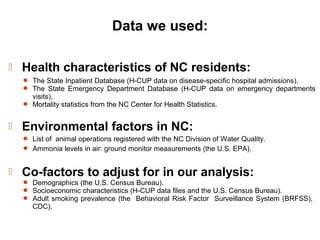
Data we used:
 Health characteristics of NC residents:
 The State Inpatient Database (H-CUP data on disease-specific hospital admissions),
 The State Emergency Department Database (H-CUP data on emergency departments
visits),
 Mortality statistics from the NC Center for Health Statistics.
 Environmental factors in NC:
 List of animal operations registered with the NC Division of Water Quality.
 Ammonia levels in air: ground monitor measurements (the U.S. EPA).
 Co-factors to adjust for in our analysis:
 Demographics (the U.S. Census Bureau).
 Socioeconomic characteristics (H-CUP data files and the U.S. Census Bureau).
 Adult smoking prevalence (the Behavioral Risk Factor Surveillance System (BRFSS),
CDC).
100 NC Counties Can Be Analysed
Study Group: 17 NC counties with hog CAFOs selected for
analysis (100,000-2,000,000+ Hogs)-
1,488,842 lives
Control Group: 40 NC counties with no registered Hog
Farms- 3,733,227 lives
No hog farms
<100,000 hogs
100,000 – 2,352,741 hogs
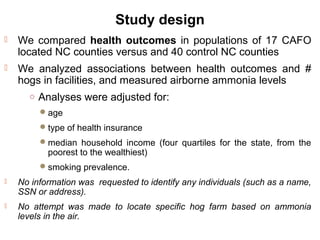
Study design
 We compared health outcomes in populations of 17 CAFO
located NC counties versus and 40 control NC counties
 We analyzed associations between health outcomes and #
hogs in facilities, and measured airborne ammonia levels
○ Analyses were adjusted for:
age
type of health insurance
median household income (four quartiles for the state, from the
poorest to the wealthiest)
smoking prevalence.
 No information was requested to identify any individuals (such as a name,
SSN or address).
 No attempt was made to locate specific hog farm based on ammonia
levels in the air.
Characteristics of populations living
in 17 CAFO versus 40 non-CAFO counties
Study Group: 17 Counties
with >100,000 hogs
Control Group: 40 Counties
with no registered hog farms
Total population 1,488,842 3,733,227
Sex: Male 49.2% 48.5%
Female 50.8% 51.5%
Race: White 63.0% 77.5%
Black 30.6% 19.0%
American Indian 4.8% 0.9%
Asian 1.6% 2.6%
Have Hispanic origin 9.2% 8.1%
Age: < 19 years 28.9% 25.8%
20-64 years 59.9% 60.8%
65+ years 11.2% 13.4%
30% increase in ED visits for infectious
disease/population:
Increase in ID related ED visits as % of all ED visits (age
and income adjusted):
OR 1.17 (CI 1.15-1.19)
Increase in hospital admissions (age adjusted):
OR 1.03 (CI 1.01-1.04)
Higher risks of Infectious Diseases (ID) Has Been
Reported for Hog Farms Workers and Local Residents
As expected, we confirmed in the
CAFO counties:
Kravchenko and Lyerly, unpublished
20% increase in ED visits for Acute Respiratory
Disease/population
Increase in respiratory ED visits as % of all ED visits (age
and income adjusted):
OR 1.16 (1.15-1.17)
Increase hospital admissions (age adjusted):
OR 1.06 (CI 1.01-1.10)
An Increase in Respiratory Diseases Has Been Reported
for Hog Farms Workers and Local Residents
As expected, we confirmed
in the CAFO counties:
Kravchenko and Lyerly, unpublished
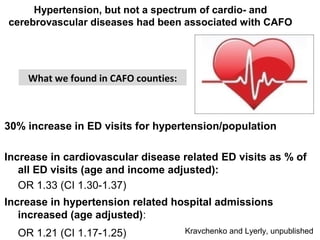
30% increase in ED visits for hypertension/population
Increase in cardiovascular disease related ED visits as % of
all ED visits (age and income adjusted):
OR 1.33 (CI 1.30-1.37)
Increase in hypertension related hospital admissions
increased (age adjusted):
OR 1.21 (CI 1.17-1.25)
Hypertension, but not a spectrum of cardio- and
cerebrovascular diseases had been associated with CAFO
What we found in CAFO counties:
Kravchenko and Lyerly, unpublished
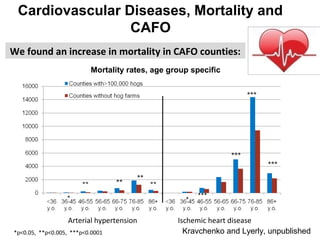
Mortality rates, age group specific
Arterial hypertension Ischemic heart disease
*
* ***
*p<0.05, **p<0.005, ***p<0.0001
Cardiovascular Diseases, Mortality and
CAFO
We found an increase in mortality in CAFO counties:
Kravchenko and Lyerly, unpublished
70% increase in ED visits for Type II diabetes/population
Increase in diabetes ED visits as % of all ED visits (age
and income adjusted):
Diabetes type I: OR 1.37 (CI 1.21-1.56)
Diabetes type II: OR 1.52 (1.04-2.21)
Increase in diabetes hospital admissions (age
adjusted):
Diabetes type II: OR 1.18 (CI 1.14-1.21)
Diabetes had not previously been associated with
CAFO
What we found in CAFO counties:
Kravchenko and Lyerly, unpublished
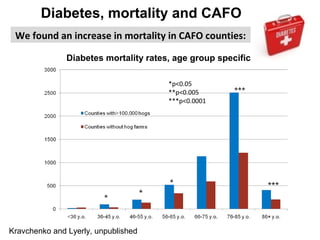
Diabetes mortality rates, age group specific
*p<0.05
**p<0.005
***p<0.0001
Diabetes, mortality and CAFO
We found an increase in mortality in CAFO counties:
Kravchenko and Lyerly, unpublished
30% increase in ED visits nephritis/nephrosis/population
Increase in nephritis/nephrosis ED visits as % of all ED
visits:
OR 1.12 (1.02-1.22)
Increase in nephritis/nephrosis hospital admissions
increased:
OR 1.18 (CI 1.15-1.21)
Kidney diseases had not been previously
associated with CAFO
What we found in CAFO counties:
Kravchenko and Lyerly, unpublished
Mortality rates from genitourinary diseases and renal failure, age group specific.
*p<0.05, **p<0.005, ***p<0.0001
Kidney diseases, mortality and CAFO
Renal failureGenitourinary diseases
We found an increase in mortality in CAFO counties:
Kravchenko and Lyerly, unpublished
Summary of our preliminary findings
 Populations living in counties with CAFOs (>100,000 pigs) in NC have
higher risk for ED visits, hospitalization, and death for various
diseases, as compared to people living in counties without CAFOs:
although some of these diseases have been previously associated
with CAFO, we report new associations with diseases.
 Our study includes the vulnerable, such as children, those with
chronic diseases, and the elderly (in contrast to previous studies of
workers in CAFO): children and older residents in our study have
higher mortality rates and worse health outcomes for certain diseases
as compared to healthy residents.
 An appreciation of the vulnerable populations living in proximity to
CAFOs is needed to gauge their true health impact.
 Study team:
H. Kim Lyerly
Julia Kravchenko
Pankaj Agarwal
 We thank:
 Igor Akushevich, SSRI, Duke University
 Amy Keyworth, Christine Lawson, Evan Kane from the NC Division
of Water Resources
 John Walker and Jesse Bash from the U.S. EPA
 Fred and Alice Stanback for supporting this study.
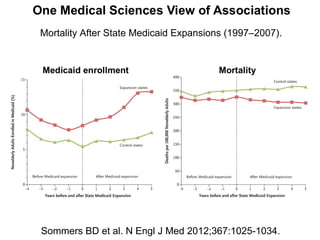
Sommers BD et al. N Engl J Med 2012;367:1025-1034.
Mortality After State Medicaid Expansions (1997–2007).
Pregnancy and labor/delivery complications
25% increase in ED visits for complications of pregnancy
/population
Increase in complications of pregnancy ED visits as % of all
ED visits (age and income adjusted):
OR 1.30 (CI 1.27-1.32)
Reported:
•Excessive nitrate ingestion has been associated with miscarriages and the CDC blamed water
contaminated with nitrates from a swine farms for some miscarriages occurred in 1993 and 1994
(Fan, Steinberg, 1996; Kramer et al, 1996).
What we found in CAFO counties:
Kravchenko and Lyerly, unpublished
Neurological disorders
70% increase in ED visits for Epilepsy/population
Increase in Epilepsy ED visits as % of all ED visits (age and
income adjusted):
OR 1.39 (CI 1.32-1.47)
Increase in hospital admissions (age adjusted):
OR 1.17 (1.11-1.22)
Reported:
•Occupational exposures to hydrogen sulfide at hog farms can be associated with
transitory CNS symptoms (National Research Council, 2003).
•Children are particularly susceptible to these neurological effects (Hannah et al,
1991).
What we found in CAFO counties:
Kravchenko and Lyerly, unpublished

Kim Lyerly - CAFOs

  • 1.
    H. Kim Lyerly,MD and Julia Kravchenko, MD, PhD Environmental Health Scholars Program Duke University School of Medicine
  • 2.
    A variety ofhealth effects on nearby residents of CAFOs have been reported: • More depression and fatigue (Schiffman et al, 1995; 2000). • Stress-mediated impact on immune function: decreased IgA levels (Avery et al, 2004). • Children and adults susceptible to asthma (Mirabelli et al., 2006). • Impaired neurobehavioral function and pulmonary function (Keil et al, 2011). • Acute blood pressure increase (Kilburn, 2012).
  • 3.
    We wanted todetermine the impact of CAFOs on nearby residents, which include children and the elderly
  • 4.
    Data we used: Health characteristics of NC residents:  The State Inpatient Database (H-CUP data on disease-specific hospital admissions),  The State Emergency Department Database (H-CUP data on emergency departments visits),  Mortality statistics from the NC Center for Health Statistics.  Environmental factors in NC:  List of animal operations registered with the NC Division of Water Quality.  Ammonia levels in air: ground monitor measurements (the U.S. EPA).  Co-factors to adjust for in our analysis:  Demographics (the U.S. Census Bureau).  Socioeconomic characteristics (H-CUP data files and the U.S. Census Bureau).  Adult smoking prevalence (the Behavioral Risk Factor Surveillance System (BRFSS), CDC).
  • 5.
    100 NC CountiesCan Be Analysed Study Group: 17 NC counties with hog CAFOs selected for analysis (100,000-2,000,000+ Hogs)- 1,488,842 lives Control Group: 40 NC counties with no registered Hog Farms- 3,733,227 lives No hog farms <100,000 hogs 100,000 – 2,352,741 hogs
  • 6.
    Study design  Wecompared health outcomes in populations of 17 CAFO located NC counties versus and 40 control NC counties  We analyzed associations between health outcomes and # hogs in facilities, and measured airborne ammonia levels ○ Analyses were adjusted for: age type of health insurance median household income (four quartiles for the state, from the poorest to the wealthiest) smoking prevalence.  No information was requested to identify any individuals (such as a name, SSN or address).  No attempt was made to locate specific hog farm based on ammonia levels in the air.
  • 7.
    Characteristics of populationsliving in 17 CAFO versus 40 non-CAFO counties Study Group: 17 Counties with >100,000 hogs Control Group: 40 Counties with no registered hog farms Total population 1,488,842 3,733,227 Sex: Male 49.2% 48.5% Female 50.8% 51.5% Race: White 63.0% 77.5% Black 30.6% 19.0% American Indian 4.8% 0.9% Asian 1.6% 2.6% Have Hispanic origin 9.2% 8.1% Age: < 19 years 28.9% 25.8% 20-64 years 59.9% 60.8% 65+ years 11.2% 13.4%
  • 8.
    30% increase inED visits for infectious disease/population: Increase in ID related ED visits as % of all ED visits (age and income adjusted): OR 1.17 (CI 1.15-1.19) Increase in hospital admissions (age adjusted): OR 1.03 (CI 1.01-1.04) Higher risks of Infectious Diseases (ID) Has Been Reported for Hog Farms Workers and Local Residents As expected, we confirmed in the CAFO counties: Kravchenko and Lyerly, unpublished
  • 9.
    20% increase inED visits for Acute Respiratory Disease/population Increase in respiratory ED visits as % of all ED visits (age and income adjusted): OR 1.16 (1.15-1.17) Increase hospital admissions (age adjusted): OR 1.06 (CI 1.01-1.10) An Increase in Respiratory Diseases Has Been Reported for Hog Farms Workers and Local Residents As expected, we confirmed in the CAFO counties: Kravchenko and Lyerly, unpublished
  • 10.
    30% increase inED visits for hypertension/population Increase in cardiovascular disease related ED visits as % of all ED visits (age and income adjusted): OR 1.33 (CI 1.30-1.37) Increase in hypertension related hospital admissions increased (age adjusted): OR 1.21 (CI 1.17-1.25) Hypertension, but not a spectrum of cardio- and cerebrovascular diseases had been associated with CAFO What we found in CAFO counties: Kravchenko and Lyerly, unpublished
  • 11.
    Mortality rates, agegroup specific Arterial hypertension Ischemic heart disease * * *** *p<0.05, **p<0.005, ***p<0.0001 Cardiovascular Diseases, Mortality and CAFO We found an increase in mortality in CAFO counties: Kravchenko and Lyerly, unpublished
  • 12.
    70% increase inED visits for Type II diabetes/population Increase in diabetes ED visits as % of all ED visits (age and income adjusted): Diabetes type I: OR 1.37 (CI 1.21-1.56) Diabetes type II: OR 1.52 (1.04-2.21) Increase in diabetes hospital admissions (age adjusted): Diabetes type II: OR 1.18 (CI 1.14-1.21) Diabetes had not previously been associated with CAFO What we found in CAFO counties: Kravchenko and Lyerly, unpublished
  • 13.
    Diabetes mortality rates,age group specific *p<0.05 **p<0.005 ***p<0.0001 Diabetes, mortality and CAFO We found an increase in mortality in CAFO counties: Kravchenko and Lyerly, unpublished
  • 14.
    30% increase inED visits nephritis/nephrosis/population Increase in nephritis/nephrosis ED visits as % of all ED visits: OR 1.12 (1.02-1.22) Increase in nephritis/nephrosis hospital admissions increased: OR 1.18 (CI 1.15-1.21) Kidney diseases had not been previously associated with CAFO What we found in CAFO counties: Kravchenko and Lyerly, unpublished
  • 15.
    Mortality rates fromgenitourinary diseases and renal failure, age group specific. *p<0.05, **p<0.005, ***p<0.0001 Kidney diseases, mortality and CAFO Renal failureGenitourinary diseases We found an increase in mortality in CAFO counties: Kravchenko and Lyerly, unpublished
  • 16.
    Summary of ourpreliminary findings  Populations living in counties with CAFOs (>100,000 pigs) in NC have higher risk for ED visits, hospitalization, and death for various diseases, as compared to people living in counties without CAFOs: although some of these diseases have been previously associated with CAFO, we report new associations with diseases.  Our study includes the vulnerable, such as children, those with chronic diseases, and the elderly (in contrast to previous studies of workers in CAFO): children and older residents in our study have higher mortality rates and worse health outcomes for certain diseases as compared to healthy residents.  An appreciation of the vulnerable populations living in proximity to CAFOs is needed to gauge their true health impact.
  • 17.
     Study team: H.Kim Lyerly Julia Kravchenko Pankaj Agarwal  We thank:  Igor Akushevich, SSRI, Duke University  Amy Keyworth, Christine Lawson, Evan Kane from the NC Division of Water Resources  John Walker and Jesse Bash from the U.S. EPA  Fred and Alice Stanback for supporting this study.
  • 18.
    Sommers BD etal. N Engl J Med 2012;367:1025-1034. Mortality After State Medicaid Expansions (1997–2007).
  • 19.
    Pregnancy and labor/deliverycomplications 25% increase in ED visits for complications of pregnancy /population Increase in complications of pregnancy ED visits as % of all ED visits (age and income adjusted): OR 1.30 (CI 1.27-1.32) Reported: •Excessive nitrate ingestion has been associated with miscarriages and the CDC blamed water contaminated with nitrates from a swine farms for some miscarriages occurred in 1993 and 1994 (Fan, Steinberg, 1996; Kramer et al, 1996). What we found in CAFO counties: Kravchenko and Lyerly, unpublished
  • 20.
    Neurological disorders 70% increasein ED visits for Epilepsy/population Increase in Epilepsy ED visits as % of all ED visits (age and income adjusted): OR 1.39 (CI 1.32-1.47) Increase in hospital admissions (age adjusted): OR 1.17 (1.11-1.22) Reported: •Occupational exposures to hydrogen sulfide at hog farms can be associated with transitory CNS symptoms (National Research Council, 2003). •Children are particularly susceptible to these neurological effects (Hannah et al, 1991). What we found in CAFO counties: Kravchenko and Lyerly, unpublished

Editor's Notes

  • #19 Figure 1. Unadjusted Mortality and Rates of Medicaid Coverage among Nonelderly Adults before and after State Medicaid Expansions (1997–2007). The vertical line represents the year during which the Medicaid expansions were implemented, meaning that year 1 was the first full year after the expansions (2002 for Arizona and New York and 2003 for Maine). In unadjusted models, the expansions were associated with a significant decrease in all-cause mortality in expansion states, as compared with control states (−25.4 deaths per 100,000 population; 95% confidence interval [CI], −46.0 to −4.8; P=0.02) (Panel A) and a significant increase in Medicaid coverage (by 2.2 percentage points; 95% CI, 0.7 to 3.7; P=0.01) (Panel B). Data for adults between the ages of 20 and 64 years are included in Panel A and data for those between the ages of 19 and 64 years in Panel B, owing to differences in the two data sets.