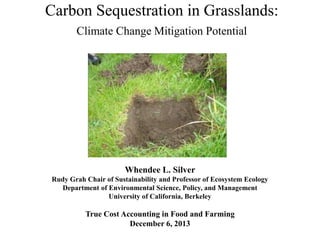
Carbon Sequestration in Grasslands:
Climate Change Mitigation Potential

Whendee L. Silver
Rudy Grah Chair of Sustainability and Professor of Ecosystem Ecology
Department of Environmental Science, Policy, and Management
University of California, Berkeley

True Cost Accounting in Food and Farming
December 6, 2013
Atmospheric CO2 concentrations are increasing

Atmospheric CO2 (ppm)

400
390
August 2013

380
370
360
350
340
330
320
310
1950

1960

1970

1980

1990

2000

2010

2020

Year
Data: Dr. Pieter Tans, NOAA/ESRL (www.esrl.noaa.gov/gmd/ccgg/trends/) and Dr. Ralph Keeling, Scripps Institution of Oceanography
We need to do something
Projected Atmospheric CO2 (ppmv)

450

Reducing emissions alone will not mitigate
climate change

440

430
420
410
400

390
380
370
360
350

Year
Atmospheric CO2 concentrations are increasing

Atmospheric CO2 (ppm)

400
390
August 2013

380
370
360
350
340
330
320
310
1950

1960

1970

1980

1990

2000

2010

2020

Year
Data: Dr. Pieter Tans, NOAA/ESRL (www.esrl.noaa.gov/gmd/ccgg/trends/) and Dr. Ralph Keeling, Scripps Institution of Oceanography
Atmospheric CO2 concentrations are increasing

Atmospheric CO2 (ppm)

400
390

Can land management
be part of the solution?
August 2013

380
370
360
350
340
330
320
310
1950

1960

1970

1980

1990

2000

2010

2020

Year
Data: Dr. Pieter Tans, NOAA/ESRL (www.esrl.noaa.gov/gmd/ccgg/trends/) and Dr. Ralph Keeling, Scripps Institution of Oceanography
Atmosphere carbon
760 Pg
Photosynthesis

Microbe
respiration

Vegetation carbon
610 Pg

Plant/tissue death

Soil carbon
2000 Pg
(or more)
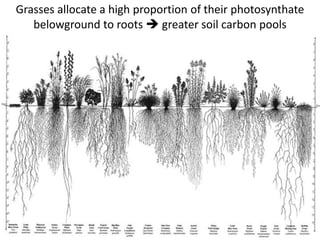
Grasses allocate a high proportion of their photosynthate
belowground to roots  greater soil carbon pools
Grasslands cover a significant portion of the Earth’s
land surface

*30% of global land surface *Over half of the global land use
*50% of the UK land area
*50% of California land area
Managing soils for increased carbon content
has many co-benefits:
•Fertility
•Water holding capacity
•Soil stability
•Sustainability
•Productivity
Converting waste to food
Food and agricultural
waste

Compost it…..

And create a
carbon sink
Plant production (aka forage) has increased every year following a
one time compost application
control

compost

Aboveground Net Primary
Production (g / m2)

1000

750

500

250

0
1
2009

2
2010

3
2011

4
2012

Year
Ryals and Silver 2013 Ecological Application, Ryals et al. in prep.
A one-time application of compost increased soil carbon

Pre-treatment

2009

2010

2011

Ryals et al 2014 Soil Biology and Biochemistry
Global warming potential (MMT CO2e)

Life cycle assessment suggests much higher climate
change mitigation potential
Applied to 1 million hectare
30

GHG Emissions
GHG Mitigation

Net
20
10

0
-10
-20
-30
-40

Compost Manure Nitrogen
Fertilizer

Redrawn from DeLonge et al. 2013
A survey of 35 fields showed that organic amendments
increased soil carbon by depth
90

Soil Carbon (Mg ha-1)

80

Extensive (24)
Amended (11)

70
60
50
40
30
20
10
0

0-10

10-30 30-50 50-100
Depth (cm)

Silver et al. in prep
Soil Carbon (Mg ha-1 to 1 m)

…and that amended fields had an average of 40 Mg more soil
carbon per hectare
150

100

50

0

Extensive Amended
Management

Silver et al. in prep
1 metric ton of carbon per hectare over 6 million hectares =

21 million metric tons (MMT) of CO2e

* 1 MMT = 1012 g
1 metric ton of carbon per hectare over 6 million hectares =

21 million metric tons (MMT) of CO2e
•Livestock ~ 15 MMT CO2e/y

•Commercial/residential ~ 42 MMT
CO2e/y
•Electrical generation ~112 MMT
CO2e/y

* 1 MMT = 1012 g
Improved grazing practices can sequester soil carbon

Conant and Paustian 2002
Carbon sequestration potential
from improved grazing practices:
Scaled to 12 million hectares of rangelands
0.4 to 0.9 Mg C ha-1 y-1: 15-37 MMT CO2e y-1
1 Mg C ha-1 y-1: 42 MMT CO2e y-1

* 1 MMT = 1012 g

Data sources: Eagle et al. 2011, Conant et al. 2001
Summary
1. Agriculture can be part of the solution to climate
change (in a significant way!)
2. Soil carbon sequestration is possible and quantifiable
in rangeland soils
3. Key questions and next steps:
What are the best grazing practices work and why?
Testing in arid and semi-arid grasslands.
Marin Carbon Project

Nicasio Native Grass Ranch

Support provided by:
United States Department of Agriculture
United States National Science Foundation
The 11th Hour Foundation
The Marin Community Foundation
The Rathmann Family Foundation
The Lia Foundation
The Kearney Foundation for Soil Science
University of California, Berkeley
The Silver Lab

Marcia DeLonge

Justine Owen

Becca Ryals
Availability of compost
Potential compost production: 27 to 33 MMT y-1
Enough to reapply to 12 million ha of rangelands
every 17-40 years
400
390
380
Atmospheric CO2 (ppm)

September 2012

370
360
350
340
330
320
310
1950

1960

1970

1980

1990

2000

2010

2020

Data: Dr. Pieter Tans, NOAA/ESRL (www.esrl.noaa.gov/gmd/ccgg/trends/) and Dr. Ralph Keeling, Scripps Institution of Oceanography .
400
390

Can land management
be part of the solution?

380
Atmospheric CO2 (ppm)

September 2012

370
360
350
340
330
320
310
1950

1960

1970

1980

1990

2000

2010

2020

Data: Dr. Pieter Tans, NOAA/ESRL (www.esrl.noaa.gov/gmd/ccgg/trends/) and Dr. Ralph Keeling, Scripps Institution of Oceanography .
Global warming can’t be explained by solar cycles

http://www.ncdc.noaa.gov/cmb-faq/globalwarming.html
Scalability
One quarter of the rangeland area in California:
= 23 Tg of CO2e y-1 (without including compost C)
= 337 Tg of CO2e y-1 (with compost C additions)

* 1 Tg (Teragram) = 1012 g
Arctic Sea Ice Shrinks To New Low

Source: NASA
There are several sources and sinks of greenhouse gases
associated with soil amendment application to grasslands

+

DeLonge et al. in review
Whendee Silver

Whendee Silver

  • 1.
    Carbon Sequestration inGrasslands: Climate Change Mitigation Potential Whendee L. Silver Rudy Grah Chair of Sustainability and Professor of Ecosystem Ecology Department of Environmental Science, Policy, and Management University of California, Berkeley True Cost Accounting in Food and Farming December 6, 2013
  • 2.
    Atmospheric CO2 concentrationsare increasing Atmospheric CO2 (ppm) 400 390 August 2013 380 370 360 350 340 330 320 310 1950 1960 1970 1980 1990 2000 2010 2020 Year Data: Dr. Pieter Tans, NOAA/ESRL (www.esrl.noaa.gov/gmd/ccgg/trends/) and Dr. Ralph Keeling, Scripps Institution of Oceanography
  • 3.
    We need todo something
  • 4.
    Projected Atmospheric CO2(ppmv) 450 Reducing emissions alone will not mitigate climate change 440 430 420 410 400 390 380 370 360 350 Year
  • 5.
    Atmospheric CO2 concentrationsare increasing Atmospheric CO2 (ppm) 400 390 August 2013 380 370 360 350 340 330 320 310 1950 1960 1970 1980 1990 2000 2010 2020 Year Data: Dr. Pieter Tans, NOAA/ESRL (www.esrl.noaa.gov/gmd/ccgg/trends/) and Dr. Ralph Keeling, Scripps Institution of Oceanography
  • 6.
    Atmospheric CO2 concentrationsare increasing Atmospheric CO2 (ppm) 400 390 Can land management be part of the solution? August 2013 380 370 360 350 340 330 320 310 1950 1960 1970 1980 1990 2000 2010 2020 Year Data: Dr. Pieter Tans, NOAA/ESRL (www.esrl.noaa.gov/gmd/ccgg/trends/) and Dr. Ralph Keeling, Scripps Institution of Oceanography
  • 7.
    Atmosphere carbon 760 Pg Photosynthesis Microbe respiration Vegetationcarbon 610 Pg Plant/tissue death Soil carbon 2000 Pg (or more)
  • 8.
    Grasses allocate ahigh proportion of their photosynthate belowground to roots  greater soil carbon pools
  • 9.
    Grasslands cover asignificant portion of the Earth’s land surface *30% of global land surface *Over half of the global land use *50% of the UK land area *50% of California land area
  • 10.
    Managing soils forincreased carbon content has many co-benefits: •Fertility •Water holding capacity •Soil stability •Sustainability •Productivity
  • 11.
    Converting waste tofood Food and agricultural waste Compost it….. And create a carbon sink
  • 13.
    Plant production (akaforage) has increased every year following a one time compost application control compost Aboveground Net Primary Production (g / m2) 1000 750 500 250 0 1 2009 2 2010 3 2011 4 2012 Year Ryals and Silver 2013 Ecological Application, Ryals et al. in prep.
  • 14.
    A one-time applicationof compost increased soil carbon Pre-treatment 2009 2010 2011 Ryals et al 2014 Soil Biology and Biochemistry
  • 15.
    Global warming potential(MMT CO2e) Life cycle assessment suggests much higher climate change mitigation potential Applied to 1 million hectare 30 GHG Emissions GHG Mitigation Net 20 10 0 -10 -20 -30 -40 Compost Manure Nitrogen Fertilizer Redrawn from DeLonge et al. 2013
  • 16.
    A survey of35 fields showed that organic amendments increased soil carbon by depth 90 Soil Carbon (Mg ha-1) 80 Extensive (24) Amended (11) 70 60 50 40 30 20 10 0 0-10 10-30 30-50 50-100 Depth (cm) Silver et al. in prep
  • 17.
    Soil Carbon (Mgha-1 to 1 m) …and that amended fields had an average of 40 Mg more soil carbon per hectare 150 100 50 0 Extensive Amended Management Silver et al. in prep
  • 18.
    1 metric tonof carbon per hectare over 6 million hectares = 21 million metric tons (MMT) of CO2e * 1 MMT = 1012 g
  • 19.
    1 metric tonof carbon per hectare over 6 million hectares = 21 million metric tons (MMT) of CO2e •Livestock ~ 15 MMT CO2e/y •Commercial/residential ~ 42 MMT CO2e/y •Electrical generation ~112 MMT CO2e/y * 1 MMT = 1012 g
  • 20.
    Improved grazing practicescan sequester soil carbon Conant and Paustian 2002
  • 21.
    Carbon sequestration potential fromimproved grazing practices: Scaled to 12 million hectares of rangelands 0.4 to 0.9 Mg C ha-1 y-1: 15-37 MMT CO2e y-1 1 Mg C ha-1 y-1: 42 MMT CO2e y-1 * 1 MMT = 1012 g Data sources: Eagle et al. 2011, Conant et al. 2001
  • 22.
    Summary 1. Agriculture canbe part of the solution to climate change (in a significant way!) 2. Soil carbon sequestration is possible and quantifiable in rangeland soils 3. Key questions and next steps: What are the best grazing practices work and why? Testing in arid and semi-arid grasslands.
  • 23.
    Marin Carbon Project NicasioNative Grass Ranch Support provided by: United States Department of Agriculture United States National Science Foundation The 11th Hour Foundation The Marin Community Foundation The Rathmann Family Foundation The Lia Foundation The Kearney Foundation for Soil Science University of California, Berkeley
  • 24.
    The Silver Lab MarciaDeLonge Justine Owen Becca Ryals
  • 25.
    Availability of compost Potentialcompost production: 27 to 33 MMT y-1 Enough to reapply to 12 million ha of rangelands every 17-40 years
  • 27.
    400 390 380 Atmospheric CO2 (ppm) September2012 370 360 350 340 330 320 310 1950 1960 1970 1980 1990 2000 2010 2020 Data: Dr. Pieter Tans, NOAA/ESRL (www.esrl.noaa.gov/gmd/ccgg/trends/) and Dr. Ralph Keeling, Scripps Institution of Oceanography .
  • 28.
    400 390 Can land management bepart of the solution? 380 Atmospheric CO2 (ppm) September 2012 370 360 350 340 330 320 310 1950 1960 1970 1980 1990 2000 2010 2020 Data: Dr. Pieter Tans, NOAA/ESRL (www.esrl.noaa.gov/gmd/ccgg/trends/) and Dr. Ralph Keeling, Scripps Institution of Oceanography .
  • 29.
    Global warming can’tbe explained by solar cycles http://www.ncdc.noaa.gov/cmb-faq/globalwarming.html
  • 30.
    Scalability One quarter ofthe rangeland area in California: = 23 Tg of CO2e y-1 (without including compost C) = 337 Tg of CO2e y-1 (with compost C additions) * 1 Tg (Teragram) = 1012 g
  • 31.
    Arctic Sea IceShrinks To New Low Source: NASA
  • 33.
    There are severalsources and sinks of greenhouse gases associated with soil amendment application to grasslands + DeLonge et al. in review

Editor's Notes

  • #3 And of course we know that fossil fuel emissions are the primary culprit
  • #4 We are all on thin ice
  • #6 396.78
  • #7 396.78
  • #16 Using plant and animal waste products provides significant offsets in addition to the C gains at the field scale. The net offsets from compost amendments are very large, when applied to just 10% UK’s rangelands or 5% of CA rangelands
  • #21 Up to 1 MgC/ha/y
  • #26 California currently landfills approximately 10 million Mt of compostable organic waste per year and Cal recycle estimates over the next decade it hopes to increase organic waste diversion to compost to 14-16 million Mt/y. Add in approximately 6 million Mt of landfill paper, an additional 10.8 million Mt of animal waste, and approximately 6.5 million Mt of biosolids could be composted. Together this amounts to 33 million Mt of compost per year, increase to almost 40 million Mt by 2020.This will yield somewhere between 18-22 million m^3 of compost. It would cover 25% of CA rangelands in 17-41 years (I will have explained the fact that we don't need to apply very often) and sequester between 0.3 and 0.6 MMT CO2e per year assuming a rate of 0.5 and 1 Mt C/ha/y, respectively. It may be possible to get the same effect with less compost, in which case the net sequestration rate for the state would increase.
  • #28 396.78
  • #29 396.78
  • #31 California currently landfills approximately 10 million Mt of compostable organic waste per year and Cal recycle estimates over the next decade it hopes to increase organic waste diversion to compost to 14-16 million Mt/y. Add in approximately 6 million Mt of landfill paper, an additional 10.8 million Mt of animal waste, and approximately 6.5 million Mt of biosolids could be composted. Together this amounts to 33 million Mt of compost per year, increase to almost 40 million Mt by 2020.This will yield somewhere between 18-22 million m^3 of compost. It would cover 25% of CA rangelands in 17-41 years (I will have explained the fact that we don't need to apply very often) and sequester between 0.3 and 0.6 MMT CO2e per year assuming a rate of 0.5 and 1 Mt C/ha/y, respectively. It may be possible to get the same effect with less compost, in which case the net sequestration rate for the state would increase.
  • #32 Line is average minimum extent 1979-2010
  • #34 That said, we realized that our field experiment was only a piece of a larger puzzle, and that to truly understand the implications of this management practice over large areas we would need to consider a wide array of other greenhouse gas sinks and sources.