Soil Carbon Sequestration in a Changing Climate Dr Andrew Rawson NSW Dept of Environment and Climate Change
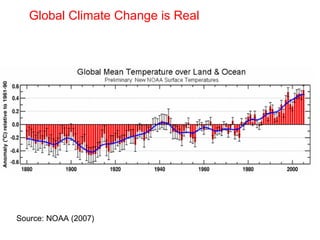
Source: NOAA (2007) Global Climate Change is Real
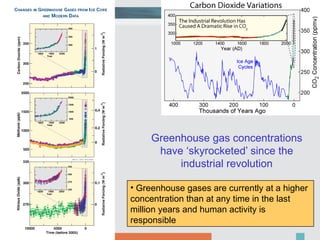
Greenhouse gas concentrations have ‘skyrocketed’ since the industrial revolution Greenhouse gases are currently at a higher concentration than at any time in the last million years and human activity is responsible
Global Climate Change Climate trends are  measurable , and have been  observed . The global instrumental record of these changes represents the output of the most comprehensive network of data gathering in history, for any scientific discipline or endeavour. The observed rate of change is  faster  than anything previously experienced, and it is  accelerating . The processes that govern climate are relatively well understood by scientists, and global climatic models (GCMs) have improved to the extent that we can have great confidence in using them to predict future scenarios.
Global Climate Change Outputs of anthropogenic GHGs are measureable, and their impact on temperatures are consistent with the observed climate changes. Known natural forcings of climate (including water vapour, solar inputs, volcanoes) cannot explain the observed changes.  Ancillary evidence of climate change is abundant around the world. This includes sealevel rises, changes in animal behaviour, reductions in sea ice extent, reductions in snow cover and glacier size, increases in extreme weather events. Modelling shows that the changes will continue to accelerate towards a rate of change that we can no longer control.  Now is the time to address the issue, not in 50 years time .
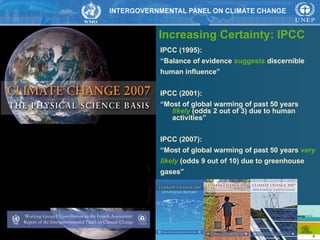
Increasing Certainty: IPCC IPCC (1995): “ Balance of evidence  suggests  discernible human influence” IPCC (2001): “ Most of global warming of past 50 years  likely  (odds 2 out of 3) due to human activities” IPCC (2007): “ Most of global warming of past 50 years  very likely   (odds 9 out of 10) due to greenhouse gases” •  Completed February 2007 •  152 Authors •  ~450 contributors •  ~600 expert reviewers •  30,000+ review comments •  ~5000 literature references •  ~1000 pages
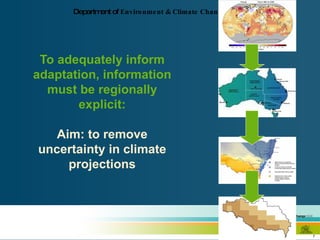
To adequately inform adaptation, information must be regionally explicit: Aim: to remove uncertainty in climate projections
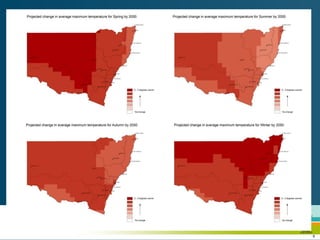
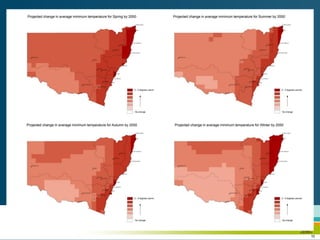
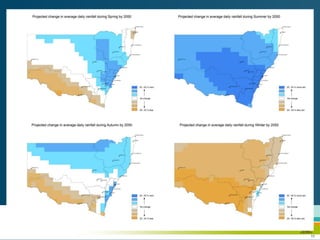
Refined Climate Change Projections for NSW Commissioned by DECC for adaptation planning purposes UNSW – Prof Andy Pitman Uses IPCC AR4 GCMs Only one scenario (A2) Uses 4 best models based on skill at predicting current climate Interpolated down to 50km grid In general, this approach appears to accentuate the published trends


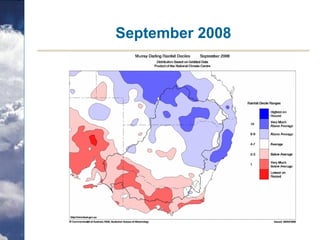
September 2008
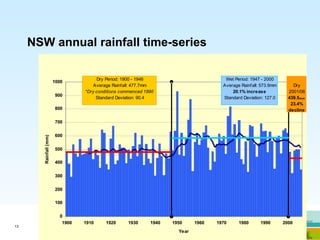
NSW annual rainfall time-series
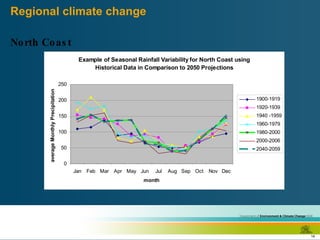
Regional climate change North Coast
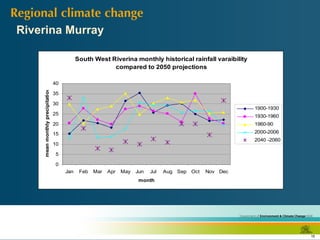
Riverina Murray Regional climate change
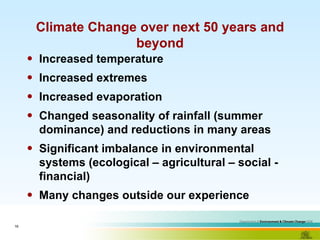
Climate Change over next 50 years and beyond Increased temperature Increased extremes Increased evaporation Changed seasonality of rainfall (summer dominance) and reductions in many areas Significant imbalance in environmental systems (ecological – agricultural – social - financial) Many changes outside our experience
What’s needed to adapt? greater emphasis on RESILIENT natural and agricultural systems greater emphasis on BUFFERING change, increasing soil OM  by any means possible ,  restoration of floodplains, swampy meadows,  revegetation of catchments,  keeping water higher in catchments;  reducing “flashiness” of fluvial systems.
What’s needed? “ Soften the landscape to soften the blow” Soil carbon sequestration increasingly important in a changing climate: Mitigation – need to draw down CO 2  from atmosphere Long term storage Adaptation and resilience
However…….. It will become increasingly difficult to sequester soil carbon in a changed climate, esp. in south of the State Therefore  increased urgency  to sequester now to: Build in resilience Prepare the landscape for the changes


Dr Andrew Rawson: Soil Carbon Sequestration in a Changing Climate

  • 1.
    Soil Carbon Sequestrationin a Changing Climate Dr Andrew Rawson NSW Dept of Environment and Climate Change
  • 2.
    Source: NOAA (2007)Global Climate Change is Real
  • 3.
    Greenhouse gas concentrationshave ‘skyrocketed’ since the industrial revolution Greenhouse gases are currently at a higher concentration than at any time in the last million years and human activity is responsible
  • 4.
    Global Climate ChangeClimate trends are measurable , and have been observed . The global instrumental record of these changes represents the output of the most comprehensive network of data gathering in history, for any scientific discipline or endeavour. The observed rate of change is faster than anything previously experienced, and it is accelerating . The processes that govern climate are relatively well understood by scientists, and global climatic models (GCMs) have improved to the extent that we can have great confidence in using them to predict future scenarios.
  • 5.
    Global Climate ChangeOutputs of anthropogenic GHGs are measureable, and their impact on temperatures are consistent with the observed climate changes. Known natural forcings of climate (including water vapour, solar inputs, volcanoes) cannot explain the observed changes. Ancillary evidence of climate change is abundant around the world. This includes sealevel rises, changes in animal behaviour, reductions in sea ice extent, reductions in snow cover and glacier size, increases in extreme weather events. Modelling shows that the changes will continue to accelerate towards a rate of change that we can no longer control. Now is the time to address the issue, not in 50 years time .
  • 6.
    Increasing Certainty: IPCCIPCC (1995): “ Balance of evidence suggests discernible human influence” IPCC (2001): “ Most of global warming of past 50 years likely (odds 2 out of 3) due to human activities” IPCC (2007): “ Most of global warming of past 50 years very likely (odds 9 out of 10) due to greenhouse gases” • Completed February 2007 • 152 Authors • ~450 contributors • ~600 expert reviewers • 30,000+ review comments • ~5000 literature references • ~1000 pages
  • 7.
    To adequately informadaptation, information must be regionally explicit: Aim: to remove uncertainty in climate projections
  • 8.
    Refined Climate ChangeProjections for NSW Commissioned by DECC for adaptation planning purposes UNSW – Prof Andy Pitman Uses IPCC AR4 GCMs Only one scenario (A2) Uses 4 best models based on skill at predicting current climate Interpolated down to 50km grid In general, this approach appears to accentuate the published trends
  • 9.
  • 10.
  • 11.
  • 12.
  • 13.
  • 14.
  • 15.
  • 16.
    Climate Change overnext 50 years and beyond Increased temperature Increased extremes Increased evaporation Changed seasonality of rainfall (summer dominance) and reductions in many areas Significant imbalance in environmental systems (ecological – agricultural – social - financial) Many changes outside our experience
  • 17.
    What’s needed toadapt? greater emphasis on RESILIENT natural and agricultural systems greater emphasis on BUFFERING change, increasing soil OM by any means possible , restoration of floodplains, swampy meadows, revegetation of catchments, keeping water higher in catchments; reducing “flashiness” of fluvial systems.
  • 18.
    What’s needed? “Soften the landscape to soften the blow” Soil carbon sequestration increasingly important in a changing climate: Mitigation – need to draw down CO 2 from atmosphere Long term storage Adaptation and resilience
  • 19.
    However…….. It willbecome increasingly difficult to sequester soil carbon in a changed climate, esp. in south of the State Therefore increased urgency to sequester now to: Build in resilience Prepare the landscape for the changes
  • 20.
  • 21.
  • 22.