
DISC or Jedi Mind
Tricks?
How to Build Instant Rapport and Get Your
Message Across in Record Time
Today’s program …
• Introductions
• DISC overview
• Behavioral styles
• Your DISC profile
• DISC and sales
• Finish by 12:00 noon
What I want from this workshop …
Share your objectives…
What can I possibly learn
today?
• Learn something about yourself, even if you
think you already know everything!
• Learn something about behavioral styles
• Learn how to improve or change your
relationship with your team, your family &
friends
So, what is DISC?
Firstly, this is what
it is not …
DISC is NOT about:
• a person’s INTELLIGENCE
• a person’s VALUES
• a person’s SKILLS and EXPERIENCE
• a person’s EDUCATION and TRAINING
But DISC is …
• an OBSERVABLE LANGUAGE
• a UNIVERSAL LANGUAGE
• a NEUTRAL LANGUAGE
• a SILENT LANGUAGE
DISC is about the HOW...
- it describes
HOW people behave and
HOW we can respond to them
to get our needs and their
needs met!
DISC can show you how to...
Understand your own style, and how your behaviour is
perceived by others.
Identify someone else’s style so you can treat them the
way they like to be treated.
Adjust your behaviour so people are more at ease with
you, and you with them.
Enhance your Leadership ability & get more from your
team
Why understand DISC?
Avoid sparking conflict in the workplace
Improve relationships – even if you don’t want to
You’ll know why someone can’t stand you.
You’ll know why you can’t stand someone
You’ll build teams that actually work
History of the DISC language …
• 400BC Hippocrates observed and classified four
different human behaviors
• 1921 C.G. Jung described 4 “types”; thinking, feeling,
sensation and intuition. Further divided into
“introversion” and “extroversion”.
• 1928 “The Emotions of Normal People” published by
Dr. William Moulton Marston – this is the theory we
use today, and provides the basis for today’s
workshop.
DISC is not a test!
• You cannot pass or fail
• There are no right or wrong
answers
• There is no style that is better than
another
A review of each of the DISC
styles …
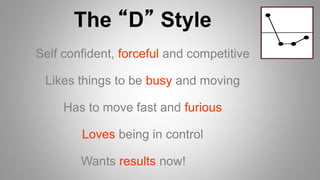
The “D” Style
Self confident, forceful and competitive
Likes things to be busy and moving
Has to move fast and furious
Loves being in control
Wants results now!
What does dominant mean?
Controlling
Questioning the status quo
Taking authority
Managing trouble
Solving problems
Impatient
D — DOMINANCE
Emphasize: shaping the environment by overcoming opposition
and challenge
Tendencies: getting immediate results, taking action, accepting
challenges
Motivated by: challenge, power and authority,
direct answers
Fears: loss of control in their environment; being taken
advantage of
You will notice: self-confidence, decisiveness, and risk-taking
Limitations: lack of concern for others, impatience
More About You: DIf you have a high-D style, your strengths as a co-worker or team member may be that
you
 make decisions when others cannot
 confront tough issues or situations
 accept change as a personal challenge
 keep the team focused and on task
Others may see limitations because you
 may come across as unapproachable
 can be insensitive to others
 may show impatience with others
 try to move the team before it is ready
You can be more effective by
 developing more patience
 toning down your directness and asking more questions
 working on your body language to seem more approachable and offering more
encouragement in conversation
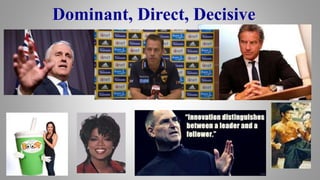
Dominant, Direct, Decisive
You know you’re a “High D” when…
• You are walking around the lake and decide
you’d like to walk across it for a change…
• You feel the urge to direct traffic at 5 pm…
• You start reminiscing about the good old days
when it was legal to duel with guns to settle an
argument …
• You arrive at work at 8am and by 8.03am no
one is speaking to you!
Discuss
How do you cope with
people when they behave
in a “D” Style?
Talkative, enthusiastic, energetic & optimistic
Likes things to be stimulating, personal,
cluttered and friendly
Do it when you feel like it !
Likes variety
Loves to be the centre of attention
The “I” Style
Charming
Optimism & enthusiasm
Confident
Creative & problem solving
Convincing
Motivates others towards goals
Enthusiastic, Inspiring, Team Player
What does Influential Mean?
I — INFLUENCE
Emphasize: shaping the environment by persuading and
influencing others
Tendencies involvement with people, making a favorable
impression
Motivated by: social recognition, group activities, relationships
Fears: social rejection, disapproval, loss
of influence
You will notice: enthusiasm, charm, sociability
Limitations: impulsiveness, disorganization, and lack of follow
through
More About You: I
If you have a high-i style, your strengths as a co-worker or team member may be that you
 are available to others
 inspire others
 spread your enthusiasm and positive attitude to others
 give positive feedback to your colleagues
Others may see limitations because you
 can be disorganized
 may be superficial in your approach
 lack follow-through
You can be more effective by
 listening more carefully
 becoming more organized
 providing more detail
Influencing, Inspiring
You know you’re a “High I” when
• You’re leaving a message and you need to call four
times to leave the entire message …
• You offer to help an elderly lady cross the street when
she is sitting on her front porch with no intention of
moving …
• You dial a wrong number and engage the person in
conversation for half an hour, anyway!
• You consider that strangers are just friends you haven’t
met yet!
Discuss
How do you cope with
people when they behave
in an “I” Style?
Friendly, co-operative, and patient
Likes things to be relaxed, warm and informal
Needs time to think before acting
Feels safe when people get along and things stay
the same
Just needs the occasional pat on the back
The “S” Style
S — STEADINESS
Emphasize: achieving stability, accomplishing tasks by
cooperating with others
Tendencies: calm, patient, loyal, good listener
Motivated by: infrequent change, stability, sincere appreciation,
cooperation
Fears: loss of stability, the unknown, change,
unpredictability
You will
notice:
patience, a team player, stability, methodical
approach, calm
Limitations: overly willing to give, putting
their needs last
More About You: S
If you have a high-S style, your strengths as a co-worker or team member may be that you
• are a good team player
• are sensitive to others’ needs
• approach meeting agendas methodically
• listen well
• are likable
Others may see limitations because you
• can be indecisive
• may be indirect
• resist change
You can be more effective by
• becoming more assertive and direct
• coping better with change
• not carrying the burden of everyone else’s problems
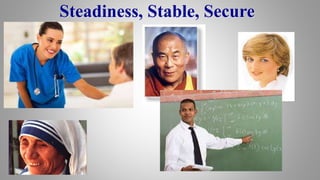
Steadiness, Stable, Secure
You know you’re a “High S”
when• You listen for 30 minutes to a sales pitch for snow
removal equipment – and you live in Queensland …
• Are checked for signs of life when a co-worker
observes a spider building a web between you and
your chair …
• Are so diplomatic when you fire a person they thank
you and take you out for lunch!
Discuss
How do you cope with
people when they behave
in a “S” Style?
Insists that things be accurate and a high standard.
Likes things to be structured, organised, functional
and formal
Does thing according to the system and not
concerned with slower time
Has to be well prepared
Needs to get it right
The “C” Style
C — CONSCIENTIOUSNESS
Emphasize: working within circumstances to ensure quality
and accuracy
Tendencies: attention to standards and details, analytical
thinking
Motivated by: clearly defined performance expectations, quality
and accuracy being valued
Fears: criticism of their work, slipshod methods
You will notice: behavior that is cautious, precise, diplomatic,
restrained
Limitations: overly critical of self and others, indecision
because of desire to collect and analyze data
More About You: C
If you have a high-C style, your strengths as a co-worker or team member may be that you
• are thorough
• follow standards
• emphasize accuracy
• use diplomacy
Others may see limitations because you
• can be overly concerned with perfection
• act aloof
• tend to hamper others’ creativity by sticking to the rules
You can be more effective by
• accepting differences
• being more open
• focusing on communication
Conscientious, Correct, Careful
You know you’re a “High C” when…
• You write a 5-page report, when all you were asked for
was the number of tickets you need for the picnic …
• You make a habit out of checking the claims of laundry
detergents …
• You run out of petrol on purpose to find out exactly how
far your car goes on a litre of petrol …
• You receive a one-way ticket from your team, for a 2-
week vacation in a country at civil war!
Discuss
How do you cope with
people when they behave
in a “C” Style?
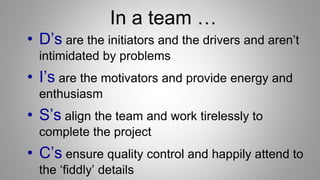
In a team …
• D’s are the initiators and the drivers and aren’t
intimidated by problems
• I’s are the motivators and provide energy and
enthusiasm
• S’s align the team and work tirelessly to
complete the project
• C’s ensure quality control and happily attend to
the ‘fiddly’ details
People Reading Clues …
When we see the world
from the experience of
others, we communicate
with them more
effectively.
Clues to look for …
D i S C
Personal decor Large, new, practical Flashy, trendy & fun Family mementos Functional,
simple
Body language Leans forward, big
gestures
Hand gestures,
smiling
Softly spoken,
reassuring, gentle
tones
Controlled,
reserved,
assessing
Organisation Practical, not neat Piles rather than files Systematic,
traditional
Highly organised
Energisers Aggressive physical
competition
Social activity and
interaction
Retreating, quiet or
family activity
Solitude,
thinking activity
Speech Patterns Direct, abrupt,
interrupting
Talkative, easily
distracted
Warmth, attentive
listening
Logical,
clarifying,
emotionless
In life …
Getting into a busy elevator…
• The D walks up, gets on the elevator, and pushes the button
that closes the door.
• The I lets others in, says “Always room for one more,” and
“Come in, you’re going to be late; we’ll wait for you!”
• The S will wait in line, moving from one line to another, unable
to make a decision.
• The C will get on the elevator. If it’s crowded, the C will count
the number of people and, if the number is over the limit, will
make someone get off.
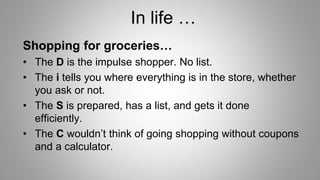
In life …
Shopping for groceries…
• The D is the impulse shopper. No list.
• The i tells you where everything is in the store, whether
you ask or not.
• The S is prepared, has a list, and gets it done
efficiently.
• The C wouldn’t think of going shopping without coupons
and a calculator.
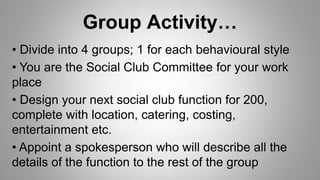
Group Activity…
• Divide into 4 groups; 1 for each behavioural style
• You are the Social Club Committee for your work
place
• Design your next social club function for 200,
complete with location, catering, costing,
entertainment etc.
• Appoint a spokesperson who will describe all the
details of the function to the rest of the group
Modalities of Communication
• Understanding your own communication style (VAK)
will help you understand how your communication is
impacting others
• Learning how to be “high DISC” means that you can
communicate more effectively with all “styles”
• DISC is about your behavioural style …
•Now let’s explore your VAK (your preferred
communication modality)
“High DISC” people communicate in
3 different ways:
Visual
Auditory
Kinesthetic
40%
20%
40%
Visual people …
• Remember what they see rather than what they
hear
• Use words like “I see what you mean”
• Like to doodle whilst on the phone or in a meeting
• Are keen, fast readers
• Are appearance oriented
• Are rarely distracted by noise
Auditory people …
• Are talkative and love discussion
• Are easily distracted by noise
• Talk to themselves
• Use words like “I hear what you’re saying”
• Are frequently eloquent speakers
• Learn through listening
Kynesthetic people …
• Stand close when talking to someone
• Gain attention by touching
• Gesticulate a lot
• May have messy hand-writing
• Can’t sit still for long periods of time
• Use words like “I know how you feel”
How is DISC relevant to sales?
• People buy from people they like …
therefore, if they don’t like you, they won’t buy
from you
• The size of the sale is determined by the
size of the relationship you’ve built with your
customer
• Influence is the key to successful selling of a
product or an idea
Selling to the different styles …
To be consistently successful in sales, an
informed or intuitive sales person will
ADAPT his/her behavioural style to match the
style of the customer.
Buying Styles / Selling Approaches
Buying Style:
Telling what is wanted in a strong, direct manner. Deciding
quickly when results are perceived, based upon key data and
projected benefits.
High D
Selling Approach:
Direct, results-oriented: telling in a strong, direct manner.
Expecting the buyer to quickly decide based upon key data
and perceived benefits and results.
Buying Styles / Selling Approaches
Buying Style:
Telling about ideas and accomplishments in an expressive,
accepting manner. Deciding to purchase suddenly, after
perceiving that the two of you are on the same frequency.
High I
Selling Approach:
Expressive, Relationship: Telling in an expressive,
accepting manner. Expecting the buyer to be quickly
influenced by the relationship.
Buying Styles / Selling Approaches
Buying Style:
Listening with some expression of acceptance. Deciding after
having heard enough facts to indicate that you clearly
understand their needs and are prepared to meet them.
High S
Selling Approach:
Supportive, Cooperative: Asking in a calm, accepting
manner. Expecting the buyer to progress steadily toward a
decision as the relationship develops.
Buying Styles / Selling Approaches
Buying Style:
Listening in a controlled manner, asking key questions if
needed. Deciding ultimately after all the facts are analyzed
and the desired results are no longer in doubt.
High C
Selling Approach:
Analytical, Deliberative: Asking in a controlled, logical
manner. Expecting the buyer to decide after all the facts
are available and results have been projected.
Decision-Making by DISC Profile:
What product or service does for them.
Who is using your product or service and what they
say about it.
How product or service will help stabilize conditions
for them.
Why product or service is a logical investment for
them.
D
I
S
C
So how do we
make use of this
information?
Workplace Relationships
Look at the people you work
with, partners, significant
clients/customers and
suppliers
What is their style?
Use the visual clues to guess
the style of each person
Do some people rub you up the
wrong way while with others it’s
smooth sailing?
Remember what is essential
may be invisible …
Take time to explore beneath
the surface …
Dominating bully who doesn’t care
about anyone.
Only cares about getting the job
finished no matter who gets hurt.
Commonly thought of as a
mongrel.
The Dark “D”
Talks incessantly and has a great
aversion to work.
Selfish as a plank of wood.
Favourite subject is themselves.
Loyal if it suits them, and when it doesn’t
… they’ll forget the agreement!
The Dark “I”
Slow dull and boring.
Has no drive to get things done.
Absolutely dishonest in that they’ll
always agree ‘face-to-face’ and then
find reasons not to later.
Very frustrating to be around.
The Dark “S”
Pedantic and judgemental to the extreme.
Given their own way, all they do is
block, block, block.
Poor social skills and a ‘holier than thou’ attitude.
Not liked (hard to like)
The Dark “C”
To Finish Up…
• Top 7 things you’ve got from today
• Questions???

Disc or jedi mind tricks?

  • 1.
    DISC or JediMind Tricks? How to Build Instant Rapport and Get Your Message Across in Record Time
  • 2.
    Today’s program … •Introductions • DISC overview • Behavioral styles • Your DISC profile • DISC and sales • Finish by 12:00 noon
  • 3.
    What I wantfrom this workshop … Share your objectives…
  • 4.
    What can Ipossibly learn today? • Learn something about yourself, even if you think you already know everything! • Learn something about behavioral styles • Learn how to improve or change your relationship with your team, your family & friends
  • 5.
    So, what isDISC? Firstly, this is what it is not …
  • 6.
    DISC is NOTabout: • a person’s INTELLIGENCE • a person’s VALUES • a person’s SKILLS and EXPERIENCE • a person’s EDUCATION and TRAINING
  • 7.
    But DISC is… • an OBSERVABLE LANGUAGE • a UNIVERSAL LANGUAGE • a NEUTRAL LANGUAGE • a SILENT LANGUAGE
  • 8.
    DISC is aboutthe HOW... - it describes HOW people behave and HOW we can respond to them to get our needs and their needs met!
  • 9.
    DISC can showyou how to... Understand your own style, and how your behaviour is perceived by others. Identify someone else’s style so you can treat them the way they like to be treated. Adjust your behaviour so people are more at ease with you, and you with them. Enhance your Leadership ability & get more from your team
  • 10.
    Why understand DISC? Avoidsparking conflict in the workplace Improve relationships – even if you don’t want to You’ll know why someone can’t stand you. You’ll know why you can’t stand someone You’ll build teams that actually work
  • 11.
    History of theDISC language … • 400BC Hippocrates observed and classified four different human behaviors • 1921 C.G. Jung described 4 “types”; thinking, feeling, sensation and intuition. Further divided into “introversion” and “extroversion”. • 1928 “The Emotions of Normal People” published by Dr. William Moulton Marston – this is the theory we use today, and provides the basis for today’s workshop.
  • 12.
    DISC is nota test! • You cannot pass or fail • There are no right or wrong answers • There is no style that is better than another
  • 14.
    A review ofeach of the DISC styles …
  • 15.
    The “D” Style Selfconfident, forceful and competitive Likes things to be busy and moving Has to move fast and furious Loves being in control Wants results now!
  • 16.
    What does dominantmean? Controlling Questioning the status quo Taking authority Managing trouble Solving problems Impatient
  • 17.
    D — DOMINANCE Emphasize:shaping the environment by overcoming opposition and challenge Tendencies: getting immediate results, taking action, accepting challenges Motivated by: challenge, power and authority, direct answers Fears: loss of control in their environment; being taken advantage of You will notice: self-confidence, decisiveness, and risk-taking Limitations: lack of concern for others, impatience
  • 18.
    More About You:DIf you have a high-D style, your strengths as a co-worker or team member may be that you  make decisions when others cannot  confront tough issues or situations  accept change as a personal challenge  keep the team focused and on task Others may see limitations because you  may come across as unapproachable  can be insensitive to others  may show impatience with others  try to move the team before it is ready You can be more effective by  developing more patience  toning down your directness and asking more questions  working on your body language to seem more approachable and offering more encouragement in conversation
  • 19.
  • 20.
    You know you’rea “High D” when… • You are walking around the lake and decide you’d like to walk across it for a change… • You feel the urge to direct traffic at 5 pm… • You start reminiscing about the good old days when it was legal to duel with guns to settle an argument … • You arrive at work at 8am and by 8.03am no one is speaking to you!
  • 21.
    Discuss How do youcope with people when they behave in a “D” Style?
  • 22.
    Talkative, enthusiastic, energetic& optimistic Likes things to be stimulating, personal, cluttered and friendly Do it when you feel like it ! Likes variety Loves to be the centre of attention The “I” Style
  • 23.
    Charming Optimism & enthusiasm Confident Creative& problem solving Convincing Motivates others towards goals Enthusiastic, Inspiring, Team Player What does Influential Mean?
  • 24.
    I — INFLUENCE Emphasize:shaping the environment by persuading and influencing others Tendencies involvement with people, making a favorable impression Motivated by: social recognition, group activities, relationships Fears: social rejection, disapproval, loss of influence You will notice: enthusiasm, charm, sociability Limitations: impulsiveness, disorganization, and lack of follow through
  • 25.
    More About You:I If you have a high-i style, your strengths as a co-worker or team member may be that you  are available to others  inspire others  spread your enthusiasm and positive attitude to others  give positive feedback to your colleagues Others may see limitations because you  can be disorganized  may be superficial in your approach  lack follow-through You can be more effective by  listening more carefully  becoming more organized  providing more detail
  • 26.
  • 27.
    You know you’rea “High I” when • You’re leaving a message and you need to call four times to leave the entire message … • You offer to help an elderly lady cross the street when she is sitting on her front porch with no intention of moving … • You dial a wrong number and engage the person in conversation for half an hour, anyway! • You consider that strangers are just friends you haven’t met yet!
  • 28.
    Discuss How do youcope with people when they behave in an “I” Style?
  • 29.
    Friendly, co-operative, andpatient Likes things to be relaxed, warm and informal Needs time to think before acting Feels safe when people get along and things stay the same Just needs the occasional pat on the back The “S” Style
  • 30.
    S — STEADINESS Emphasize:achieving stability, accomplishing tasks by cooperating with others Tendencies: calm, patient, loyal, good listener Motivated by: infrequent change, stability, sincere appreciation, cooperation Fears: loss of stability, the unknown, change, unpredictability You will notice: patience, a team player, stability, methodical approach, calm Limitations: overly willing to give, putting their needs last
  • 31.
    More About You:S If you have a high-S style, your strengths as a co-worker or team member may be that you • are a good team player • are sensitive to others’ needs • approach meeting agendas methodically • listen well • are likable Others may see limitations because you • can be indecisive • may be indirect • resist change You can be more effective by • becoming more assertive and direct • coping better with change • not carrying the burden of everyone else’s problems
  • 32.
  • 33.
    You know you’rea “High S” when• You listen for 30 minutes to a sales pitch for snow removal equipment – and you live in Queensland … • Are checked for signs of life when a co-worker observes a spider building a web between you and your chair … • Are so diplomatic when you fire a person they thank you and take you out for lunch!
  • 34.
    Discuss How do youcope with people when they behave in a “S” Style?
  • 35.
    Insists that thingsbe accurate and a high standard. Likes things to be structured, organised, functional and formal Does thing according to the system and not concerned with slower time Has to be well prepared Needs to get it right The “C” Style
  • 36.
    C — CONSCIENTIOUSNESS Emphasize:working within circumstances to ensure quality and accuracy Tendencies: attention to standards and details, analytical thinking Motivated by: clearly defined performance expectations, quality and accuracy being valued Fears: criticism of their work, slipshod methods You will notice: behavior that is cautious, precise, diplomatic, restrained Limitations: overly critical of self and others, indecision because of desire to collect and analyze data
  • 37.
    More About You:C If you have a high-C style, your strengths as a co-worker or team member may be that you • are thorough • follow standards • emphasize accuracy • use diplomacy Others may see limitations because you • can be overly concerned with perfection • act aloof • tend to hamper others’ creativity by sticking to the rules You can be more effective by • accepting differences • being more open • focusing on communication
  • 38.
  • 39.
    You know you’rea “High C” when… • You write a 5-page report, when all you were asked for was the number of tickets you need for the picnic … • You make a habit out of checking the claims of laundry detergents … • You run out of petrol on purpose to find out exactly how far your car goes on a litre of petrol … • You receive a one-way ticket from your team, for a 2- week vacation in a country at civil war!
  • 40.
    Discuss How do youcope with people when they behave in a “C” Style?
  • 41.
    In a team… • D’s are the initiators and the drivers and aren’t intimidated by problems • I’s are the motivators and provide energy and enthusiasm • S’s align the team and work tirelessly to complete the project • C’s ensure quality control and happily attend to the ‘fiddly’ details
  • 42.
    People Reading Clues… When we see the world from the experience of others, we communicate with them more effectively.
  • 43.
    Clues to lookfor … D i S C Personal decor Large, new, practical Flashy, trendy & fun Family mementos Functional, simple Body language Leans forward, big gestures Hand gestures, smiling Softly spoken, reassuring, gentle tones Controlled, reserved, assessing Organisation Practical, not neat Piles rather than files Systematic, traditional Highly organised Energisers Aggressive physical competition Social activity and interaction Retreating, quiet or family activity Solitude, thinking activity Speech Patterns Direct, abrupt, interrupting Talkative, easily distracted Warmth, attentive listening Logical, clarifying, emotionless
  • 44.
    In life … Gettinginto a busy elevator… • The D walks up, gets on the elevator, and pushes the button that closes the door. • The I lets others in, says “Always room for one more,” and “Come in, you’re going to be late; we’ll wait for you!” • The S will wait in line, moving from one line to another, unable to make a decision. • The C will get on the elevator. If it’s crowded, the C will count the number of people and, if the number is over the limit, will make someone get off.
  • 45.
    In life … Shoppingfor groceries… • The D is the impulse shopper. No list. • The i tells you where everything is in the store, whether you ask or not. • The S is prepared, has a list, and gets it done efficiently. • The C wouldn’t think of going shopping without coupons and a calculator.
  • 46.
    Group Activity… • Divideinto 4 groups; 1 for each behavioural style • You are the Social Club Committee for your work place • Design your next social club function for 200, complete with location, catering, costing, entertainment etc. • Appoint a spokesperson who will describe all the details of the function to the rest of the group
  • 47.
    Modalities of Communication •Understanding your own communication style (VAK) will help you understand how your communication is impacting others • Learning how to be “high DISC” means that you can communicate more effectively with all “styles” • DISC is about your behavioural style … •Now let’s explore your VAK (your preferred communication modality)
  • 48.
    “High DISC” peoplecommunicate in 3 different ways: Visual Auditory Kinesthetic 40% 20% 40%
  • 49.
    Visual people … •Remember what they see rather than what they hear • Use words like “I see what you mean” • Like to doodle whilst on the phone or in a meeting • Are keen, fast readers • Are appearance oriented • Are rarely distracted by noise
  • 50.
    Auditory people … •Are talkative and love discussion • Are easily distracted by noise • Talk to themselves • Use words like “I hear what you’re saying” • Are frequently eloquent speakers • Learn through listening
  • 51.
    Kynesthetic people … •Stand close when talking to someone • Gain attention by touching • Gesticulate a lot • May have messy hand-writing • Can’t sit still for long periods of time • Use words like “I know how you feel”
  • 52.
    How is DISCrelevant to sales? • People buy from people they like … therefore, if they don’t like you, they won’t buy from you • The size of the sale is determined by the size of the relationship you’ve built with your customer • Influence is the key to successful selling of a product or an idea
  • 53.
    Selling to thedifferent styles … To be consistently successful in sales, an informed or intuitive sales person will ADAPT his/her behavioural style to match the style of the customer.
  • 54.
    Buying Styles /Selling Approaches Buying Style: Telling what is wanted in a strong, direct manner. Deciding quickly when results are perceived, based upon key data and projected benefits. High D Selling Approach: Direct, results-oriented: telling in a strong, direct manner. Expecting the buyer to quickly decide based upon key data and perceived benefits and results.
  • 55.
    Buying Styles /Selling Approaches Buying Style: Telling about ideas and accomplishments in an expressive, accepting manner. Deciding to purchase suddenly, after perceiving that the two of you are on the same frequency. High I Selling Approach: Expressive, Relationship: Telling in an expressive, accepting manner. Expecting the buyer to be quickly influenced by the relationship.
  • 56.
    Buying Styles /Selling Approaches Buying Style: Listening with some expression of acceptance. Deciding after having heard enough facts to indicate that you clearly understand their needs and are prepared to meet them. High S Selling Approach: Supportive, Cooperative: Asking in a calm, accepting manner. Expecting the buyer to progress steadily toward a decision as the relationship develops.
  • 57.
    Buying Styles /Selling Approaches Buying Style: Listening in a controlled manner, asking key questions if needed. Deciding ultimately after all the facts are analyzed and the desired results are no longer in doubt. High C Selling Approach: Analytical, Deliberative: Asking in a controlled, logical manner. Expecting the buyer to decide after all the facts are available and results have been projected.
  • 58.
    Decision-Making by DISCProfile: What product or service does for them. Who is using your product or service and what they say about it. How product or service will help stabilize conditions for them. Why product or service is a logical investment for them. D I S C
  • 59.
    So how dowe make use of this information?
  • 60.
    Workplace Relationships Look atthe people you work with, partners, significant clients/customers and suppliers
  • 61.
    What is theirstyle? Use the visual clues to guess the style of each person Do some people rub you up the wrong way while with others it’s smooth sailing?
  • 62.
    Remember what isessential may be invisible … Take time to explore beneath the surface …
  • 63.
    Dominating bully whodoesn’t care about anyone. Only cares about getting the job finished no matter who gets hurt. Commonly thought of as a mongrel. The Dark “D”
  • 64.
    Talks incessantly andhas a great aversion to work. Selfish as a plank of wood. Favourite subject is themselves. Loyal if it suits them, and when it doesn’t … they’ll forget the agreement! The Dark “I”
  • 65.
    Slow dull andboring. Has no drive to get things done. Absolutely dishonest in that they’ll always agree ‘face-to-face’ and then find reasons not to later. Very frustrating to be around. The Dark “S”
  • 66.
    Pedantic and judgementalto the extreme. Given their own way, all they do is block, block, block. Poor social skills and a ‘holier than thou’ attitude. Not liked (hard to like) The Dark “C”
  • 67.
    To Finish Up… •Top 7 things you’ve got from today • Questions???