Communication Styles
Presented by
Dr.M.Sasidharan
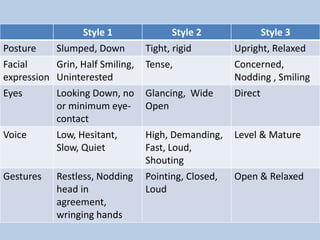
Style 1 Style 2 Style 3
Posture Slumped, Down Tight, rigid Upright, Relaxed
Facial
expression
Grin, Half Smiling,
Uninterested
Tense, Concerned,
Nodding , Smiling
Eyes Looking Down, no
or minimum eye-
contact
Glancing, Wide
Open
Direct
Voice Low, Hesitant,
Slow, Quiet
High, Demanding,
Fast, Loud,
Shouting
Level & Mature
Gestures Restless, Nodding
head in
agreement,
wringing hands
Pointing, Closed,
Loud
Open & Relaxed
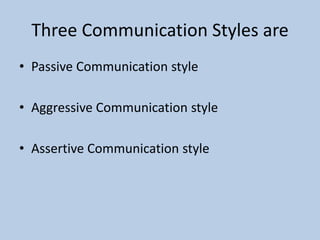
Three Communication Styles are
• Passive Communication style
• Aggressive Communication style
• Assertive Communication style
Game: Stamping the Number Plates
Objective: Stamp all the numbers from 1 to 60
• Two Teams
• Team Leaders Communicating the Goal to the Tea.
• All Participants are involved so that all the numbers plates which are
scattered from 1 to 60 are stamped by the participant.
• Learnings: Communication Skills of the Leaders, Emerging Leader,
Involving team members, being sensitive not to hurt others, because of
one person the entire team gets disqualified, Do not blame others but
each person has to take responsibility and be proactive.
Passive Communication Style
• You hope that you will get what you want
• You sit on your feelings and rely on others to
guess what you want
• You feel helpless, anxious, disappointed with
yourself, trying to please others
• Avoiding any conflict and controversy
• Perceived as apologetic or not confident
• You feel manipulated and pushed around
• You do not express your needs
• You give up your rights
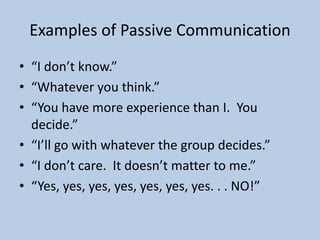
Examples of Passive Communication
• “I don’t know.”
• “Whatever you think.”
• “You have more experience than I. You
decide.”
• “I’ll go with whatever the group decides.”
• “I don’t care. It doesn’t matter to me.”
• “Yes, yes, yes, yes, yes, yes, yes. . . NO!”
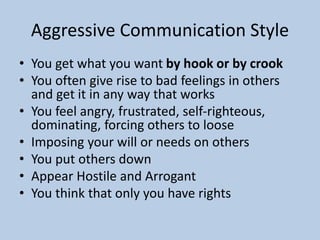
Aggressive Communication Style
• You get what you want by hook or by crook
• You often give rise to bad feelings in others
and get it in any way that works
• You feel angry, frustrated, self-righteous,
dominating, forcing others to loose
• Imposing your will or needs on others
• You put others down
• Appear Hostile and Arrogant
• You think that only you have rights
Examples of Aggressive
Communication
• “I don’t know why you can’t see that this is
the right way to do it.”
• “It’s going to be my way or not at all.”
• “You’re just stupid if you think that will work.”
• “ “Who cares what you feel. We’re talking
about making things work here.”
Assertive Communication Style
• You ASK for what you want
• You COMMUNICATE openly, directly, honestly,
appropriately without feeling guilty or
emotional.
• You give space to the other person
• Expressing your needs openly without
imposing on the other
• You stand for your rights without violating the
rights of others
Examples of Assertive Communication
• “So what you’re saying is. . . .”
• “I can see that this is important to you, and it
is also important to me. Perhaps we can talk
more respectfully and try to solve the
problem.”
• “I think. . . I feel. . . I believe that. . . .”
• “I would appreciate it if you. . .”
• Let me understand your thoughts on this…
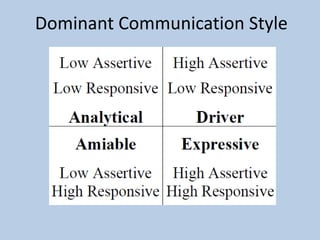
Dominant Communication Style
DIFFERENT TYPES OF PERSONALITY
STYLES
Communication Style
• Golden Rule:
– "Treat people as you want to be treated"
• The Platinum Rule
– "Treat people the way they want to be treated"
Open Do it with People
Guarded / Closed Do it Alone
•Emotionally open
•Comforting in expressing emotions – Joy, Sadness, Confusion
•Maintain a close physical proximity, tend to be huggers, hand shakers and touchers
•Are informal, relaxed, warm relationships
•Enjoy amusing conversations, tell stories
•Prefer unstructured time and are seldom disturbed when other people waste their time
•Emotionally reserved
•Guarded physically, mentally and emotionally
•Keep physical distance from others
•Task oriented, Fast decision makers, depend on statistics and other hard evidence
•Prefer working alone and put little opinion on feelings, Comfortable working in
intellectual mode
•Champion on time management and follow rigid plans, schedules and agenda
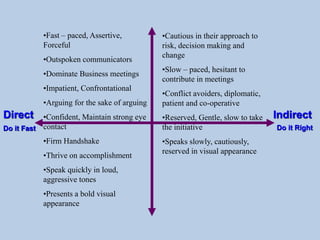
Direct
Do it Fast
Indirect
Do it Right
•Fast – paced, Assertive,
Forceful
•Outspoken communicators
•Dominate Business meetings
•Impatient, Confrontational
•Arguing for the sake of arguing
•Confident, Maintain strong eye
contact
•Firm Handshake
•Thrive on accomplishment
•Speak quickly in loud,
aggressive tones
•Presents a bold visual
appearance
•Cautious in their approach to
risk, decision making and
change
•Slow – paced, hesitant to
contribute in meetings
•Conflict avoiders, diplomatic,
patient and co-operative
•Reserved, Gentle, slow to take
the initiative
•Speaks slowly, cautiously,
reserved in visual appearance
Dr. Tony Alessandra’s “The Platinum Rule”
Socializers
Directors
Relators
Thinkers
Direct
Do it Fast
Indirect
Do it Right
Open Do it with People
Guarded / Closed Do it Alone
Dr. Tony Alessandra’s “The Platinum Rule”
Direct
Do it Fast
Indirect
Do it Right
Open Do it with People
Guarded / Closed Do it Alone
Socializers
•More Fun
•Visibility
•Recognition
•Excitement
Relators
•Stability
•Security
•Surety
•Relationships
Directors
•Control
•Power
•Authority
•Save Time
Thinkers
•Order
•Precision
•Reliability
•Quality
DIRECTORS
Direct and Guarded
• Needs to Know About: What it does / by when / what it costs
Do It With: Conviction
Save Them: Time
To Facilitate Decision-Making Provide: Options with supporting analysis
Likes You to Be: To the point
Support Their: Goals
Create This Environment: Businesslike
Maintain This Pace: Fast/ decisive
Focus on This Priority: The task/ the results
At Play Be: Competitive and aggressive
Use Time To: Act efficiently
Write This Way: Short and to the point
On the Telephone Be: Short and to the point
THINKERS
Indirect and Guarded
• Needs to Know About: How they can justify it logically / how it works
Do It With: Accuracy
Save Them: Embarrassment
To Facilitate Decision-Making Provide: Data and documentation
Likes You to Be: Precise
Support Their: Procedures
Create This Environment: Serious
Maintain This Pace: Slow/systematic
Focus on This Priority: The task/the process
At Play Be: Structured/Play by the rules
Use Time To: Ensure accuracy
Write This Way: Detailed and precise
On the Telephone Be: Businesslike and precise
RELATORS
Indirect and Open
• Needs to Know About: How it will affect their personal circumstances and relationships
Do It With: Warmth and friendliness
Save Them: Conflict and sudden change
To Facilitate Decision-Making, Provide: Attentive service and personal assurances
Likes You to Be: Pleasant
Support Their: Feelings
Create This Environment: Personal
Maintain This Pace: Slow/relaxed
Focus on This Priority: The relationship/ communication
At Play Be: Casual and cooperative
Use Time To: Develop the relationship and listening to them
Write This Way: Warm and friendly
On the Telephone Be: Warm and pleasant
SOCIALIZERS
Direct and Open
• Needs to Know About: How it enhances their status and visibility
Do It With: Flair
Save Them: Effort
To Facilitate Decision-Making Provide: Testimonials and incentives
Likes You to Be: Stimulating
Support Their: Ideas
Create This Environment: Enthusiastic
Maintain This Pace: Fast/ spontaneous
Focus on This Priority: The relationship/ interaction
At Play Be: Spontaneous and playful
Use Time To: Enjoy the interaction
Write This Way: Informal and dramatic
On the Telephone Be: Conversational and playful
One Day Communication Skills Workshop
Designed & Created by
Specialized in Corporate Soft Skills Training

Communication Styles

  • 1.
  • 2.
    Style 1 Style2 Style 3 Posture Slumped, Down Tight, rigid Upright, Relaxed Facial expression Grin, Half Smiling, Uninterested Tense, Concerned, Nodding , Smiling Eyes Looking Down, no or minimum eye- contact Glancing, Wide Open Direct Voice Low, Hesitant, Slow, Quiet High, Demanding, Fast, Loud, Shouting Level & Mature Gestures Restless, Nodding head in agreement, wringing hands Pointing, Closed, Loud Open & Relaxed
  • 3.
    Three Communication Stylesare • Passive Communication style • Aggressive Communication style • Assertive Communication style
  • 4.
    Game: Stamping theNumber Plates Objective: Stamp all the numbers from 1 to 60 • Two Teams • Team Leaders Communicating the Goal to the Tea. • All Participants are involved so that all the numbers plates which are scattered from 1 to 60 are stamped by the participant. • Learnings: Communication Skills of the Leaders, Emerging Leader, Involving team members, being sensitive not to hurt others, because of one person the entire team gets disqualified, Do not blame others but each person has to take responsibility and be proactive.
  • 5.
    Passive Communication Style •You hope that you will get what you want • You sit on your feelings and rely on others to guess what you want • You feel helpless, anxious, disappointed with yourself, trying to please others • Avoiding any conflict and controversy • Perceived as apologetic or not confident • You feel manipulated and pushed around • You do not express your needs • You give up your rights
  • 6.
    Examples of PassiveCommunication • “I don’t know.” • “Whatever you think.” • “You have more experience than I. You decide.” • “I’ll go with whatever the group decides.” • “I don’t care. It doesn’t matter to me.” • “Yes, yes, yes, yes, yes, yes, yes. . . NO!”
  • 7.
    Aggressive Communication Style •You get what you want by hook or by crook • You often give rise to bad feelings in others and get it in any way that works • You feel angry, frustrated, self-righteous, dominating, forcing others to loose • Imposing your will or needs on others • You put others down • Appear Hostile and Arrogant • You think that only you have rights
  • 8.
    Examples of Aggressive Communication •“I don’t know why you can’t see that this is the right way to do it.” • “It’s going to be my way or not at all.” • “You’re just stupid if you think that will work.” • “ “Who cares what you feel. We’re talking about making things work here.”
  • 9.
    Assertive Communication Style •You ASK for what you want • You COMMUNICATE openly, directly, honestly, appropriately without feeling guilty or emotional. • You give space to the other person • Expressing your needs openly without imposing on the other • You stand for your rights without violating the rights of others
  • 10.
    Examples of AssertiveCommunication • “So what you’re saying is. . . .” • “I can see that this is important to you, and it is also important to me. Perhaps we can talk more respectfully and try to solve the problem.” • “I think. . . I feel. . . I believe that. . . .” • “I would appreciate it if you. . .” • Let me understand your thoughts on this…
  • 11.
  • 12.
    DIFFERENT TYPES OFPERSONALITY STYLES
  • 13.
    Communication Style • GoldenRule: – "Treat people as you want to be treated" • The Platinum Rule – "Treat people the way they want to be treated"
  • 14.
    Open Do itwith People Guarded / Closed Do it Alone •Emotionally open •Comforting in expressing emotions – Joy, Sadness, Confusion •Maintain a close physical proximity, tend to be huggers, hand shakers and touchers •Are informal, relaxed, warm relationships •Enjoy amusing conversations, tell stories •Prefer unstructured time and are seldom disturbed when other people waste their time •Emotionally reserved •Guarded physically, mentally and emotionally •Keep physical distance from others •Task oriented, Fast decision makers, depend on statistics and other hard evidence •Prefer working alone and put little opinion on feelings, Comfortable working in intellectual mode •Champion on time management and follow rigid plans, schedules and agenda
  • 15.
    Direct Do it Fast Indirect Doit Right •Fast – paced, Assertive, Forceful •Outspoken communicators •Dominate Business meetings •Impatient, Confrontational •Arguing for the sake of arguing •Confident, Maintain strong eye contact •Firm Handshake •Thrive on accomplishment •Speak quickly in loud, aggressive tones •Presents a bold visual appearance •Cautious in their approach to risk, decision making and change •Slow – paced, hesitant to contribute in meetings •Conflict avoiders, diplomatic, patient and co-operative •Reserved, Gentle, slow to take the initiative •Speaks slowly, cautiously, reserved in visual appearance
  • 16.
    Dr. Tony Alessandra’s“The Platinum Rule” Socializers Directors Relators Thinkers Direct Do it Fast Indirect Do it Right Open Do it with People Guarded / Closed Do it Alone
  • 17.
    Dr. Tony Alessandra’s“The Platinum Rule” Direct Do it Fast Indirect Do it Right Open Do it with People Guarded / Closed Do it Alone Socializers •More Fun •Visibility •Recognition •Excitement Relators •Stability •Security •Surety •Relationships Directors •Control •Power •Authority •Save Time Thinkers •Order •Precision •Reliability •Quality
  • 18.
    DIRECTORS Direct and Guarded •Needs to Know About: What it does / by when / what it costs Do It With: Conviction Save Them: Time To Facilitate Decision-Making Provide: Options with supporting analysis Likes You to Be: To the point Support Their: Goals Create This Environment: Businesslike Maintain This Pace: Fast/ decisive Focus on This Priority: The task/ the results At Play Be: Competitive and aggressive Use Time To: Act efficiently Write This Way: Short and to the point On the Telephone Be: Short and to the point
  • 19.
    THINKERS Indirect and Guarded •Needs to Know About: How they can justify it logically / how it works Do It With: Accuracy Save Them: Embarrassment To Facilitate Decision-Making Provide: Data and documentation Likes You to Be: Precise Support Their: Procedures Create This Environment: Serious Maintain This Pace: Slow/systematic Focus on This Priority: The task/the process At Play Be: Structured/Play by the rules Use Time To: Ensure accuracy Write This Way: Detailed and precise On the Telephone Be: Businesslike and precise
  • 20.
    RELATORS Indirect and Open •Needs to Know About: How it will affect their personal circumstances and relationships Do It With: Warmth and friendliness Save Them: Conflict and sudden change To Facilitate Decision-Making, Provide: Attentive service and personal assurances Likes You to Be: Pleasant Support Their: Feelings Create This Environment: Personal Maintain This Pace: Slow/relaxed Focus on This Priority: The relationship/ communication At Play Be: Casual and cooperative Use Time To: Develop the relationship and listening to them Write This Way: Warm and friendly On the Telephone Be: Warm and pleasant
  • 21.
    SOCIALIZERS Direct and Open •Needs to Know About: How it enhances their status and visibility Do It With: Flair Save Them: Effort To Facilitate Decision-Making Provide: Testimonials and incentives Likes You to Be: Stimulating Support Their: Ideas Create This Environment: Enthusiastic Maintain This Pace: Fast/ spontaneous Focus on This Priority: The relationship/ interaction At Play Be: Spontaneous and playful Use Time To: Enjoy the interaction Write This Way: Informal and dramatic On the Telephone Be: Conversational and playful
  • 22.
    One Day CommunicationSkills Workshop Designed & Created by Specialized in Corporate Soft Skills Training