HOUSING, OPPORTUNITY & RACE:
    THE CASE OF THOMPSON V. HUD
    IN BALTIMORE, MD
    Jason Reece, AICP
1
    Senior Researcher
    The Kirwan Institute for the Study of Race & Ethnicity
    Reece.35@osu.edu and www.kirwaninstitute.org
    Guest Lecture May 7th 2009
    City and Regional Planning 815: Urban Planning Case Studies in Housing
    Case Studies in Housing
TODAY’S CLASS & DISCUSSION

   Thinking about our History: Planning, Housing,
    Opportunity & Race
       Access to Opportunity Matters
   Baltimore, MD at the time of Thompson v. HUD
     The Litigation & Judicial Decision
     Moving Past Litigation - Crafting a response
     New Housing Challenges in the Region
     Discussion: How would you respond?
   Discussion: Supporting regional housing solutions
     What are the factors driving and impeding regional
      housing challenges?
     What role should planners play?                      2
THINKING ABOUT OUR HISTORY
3   Planning, Housing, Opportunity & Race
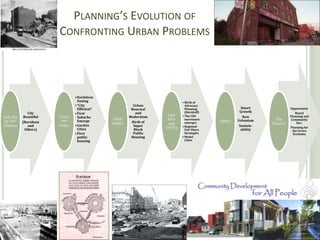
PLANNING’S EVOLUTION OF
                        CONFRONTING URBAN PROBLEMS
  4


                                 • Euclidean
                                   Zoning                                     • Birth of
                                 • “City                   Urban                Advocacy
                                   Efficient”             Renewal               Planning                Smart               Opportunity
              City                                          and                 (Davidoff)             Growth                   Based
                                 • First                              Late
Late/Ea     Beautiful   1920’s     Suburbs               Modernism            • The CDC                  New                Planning and
                         and       Emerge       1950-                 60’s      movement              Urbanism      The      Community
rly 19th   (Burnham                                       Birth of              emerges      1990’s
                                                1960’s                and                                         Future?        Dev.
Century        and      1930’s   • Garden                  Super              • Regional               Sustain-
             Others)               Cities                  Block     1970’s     Fair Share              ability
                                                                                                                            Planning for
                                                                                                                              the Green
                                 • First                   Public               Strategies                                    Economy
                                   public                 Housing             • Model
                                   housing                                      Cities
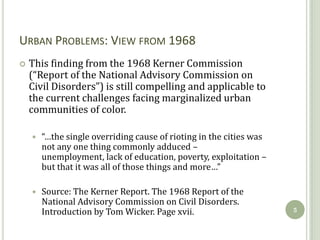
URBAN PROBLEMS: VIEW FROM 1968
   This finding from the 1968 Kerner Commission
    (“Report of the National Advisory Commission on
    Civil Disorders”) is still compelling and applicable to
    the current challenges facing marginalized urban
    communities of color.

       “…the single overriding cause of rioting in the cities was
        not any one thing commonly adduced –
        unemployment, lack of education, poverty, exploitation –
        but that it was all of those things and more…”

       Source: The Kerner Report. The 1968 Report of the
        National Advisory Commission on Civil Disorders.
        Introduction by Tom Wicker. Page xvii.                       5
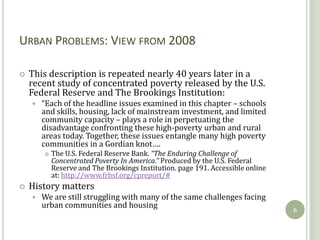
URBAN PROBLEMS: VIEW FROM 2008

   This description is repeated nearly 40 years later in a
    recent study of concentrated poverty released by the U.S.
    Federal Reserve and The Brookings Institution:
       “Each of the headline issues examined in this chapter – schools
        and skills, housing, lack of mainstream investment, and limited
        community capacity – plays a role in perpetuating the
        disadvantage confronting these high-poverty urban and rural
        areas today. Together, these issues entangle many high poverty
        communities in a Gordian knot….
           The U.S. Federal Reserve Bank. “The Enduring Challenge of
            Concentrated Poverty In America.” Produced by the U.S. Federal
            Reserve and The Brookings Institution. page 191. Accessible online
            at: http://www.frbsf.org/cpreport/#
   History matters
       We are still struggling with many of the same challenges facing
        urban communities and housing
                                                                                 6
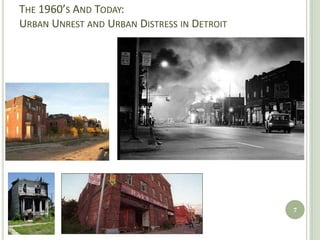
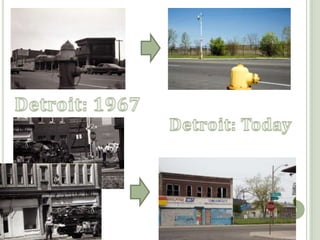
THE 1960’S AND TODAY:
URBAN UNREST AND URBAN DISTRESS IN DETROIT


                                             7
8
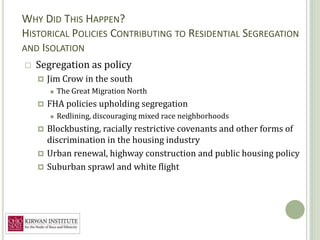
WHY DID THIS HAPPEN?
    HISTORICAL POLICIES CONTRIBUTING TO RESIDENTIAL SEGREGATION
9   AND ISOLATION
       Segregation as policy
           Jim Crow in the south
               The Great Migration North
           FHA policies upholding segregation
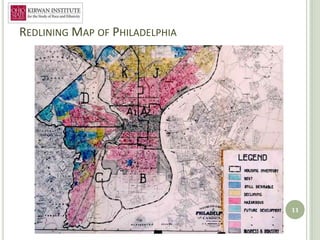
               Redlining, discouraging mixed race neighborhoods
         Blockbusting, racially restrictive covenants and other forms of
          discrimination in the housing industry
         Urban renewal, highway construction and public housing policy
         Suburban sprawl and white flight
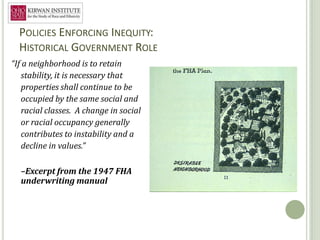
POLICIES ENFORCING INEQUITY:
  HISTORICAL GOVERNMENT ROLE
“If a neighborhood is to retain
   stability, it is necessary that
   properties shall continue to be
   occupied by the same social and
   racial classes. A change in social
   or racial occupancy generally
   contributes to instability and a
   decline in values.”

  –Excerpt from the 1947 FHA
  underwriting manual


                                        10
REDLINING MAP OF PHILADELPHIA


                                11
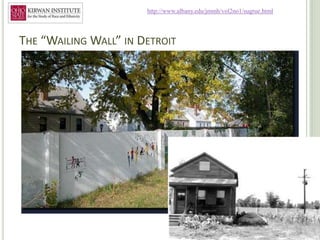
http://www.albany.edu/jmmh/vol2no1/sugrue.html


THE “WAILING WALL” IN DETROIT


                                                                 12
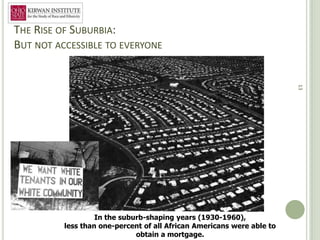
THE RISE OF SUBURBIA:
BUT NOT ACCESSIBLE TO EVERYONE


                                                                        13
                   In the suburb-shaping years (1930-1960),
          less than one-percent of all African Americans were able to
                              obtain a mortgage.
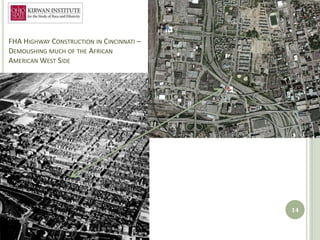
FHA HIGHWAY CONSTRUCTION IN CINCINNATI –
DEMOLISHING MUCH OF THE AFRICAN
AMERICAN WEST SIDE


                                           14
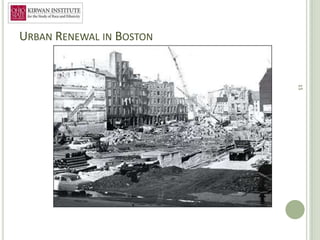
URBAN RENEWAL IN BOSTON


                          15
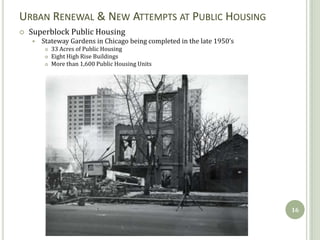
URBAN RENEWAL & NEW ATTEMPTS AT PUBLIC HOUSING
   Superblock Public Housing
       Stateway Gardens in Chicago being completed in the late 1950’s
            33 Acres of Public Housing
            Eight High Rise Buildings
            More than 1,600 Public Housing Units


                                                                         16
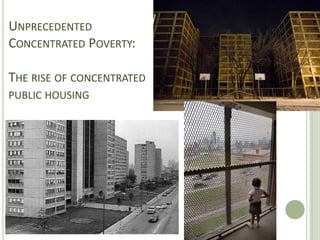
UNPRECEDENTED
CONCENTRATED POVERTY:

THE RISE OF CONCENTRATED


                           17
PUBLIC HOUSING
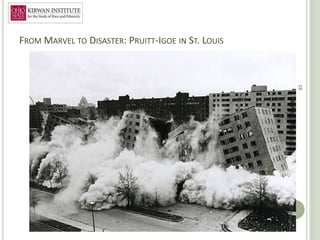
FROM MARVEL TO DISASTER: PRUITT-IGOE IN ST. LOUIS


                                                    18
WHY DOES THIS CONTINUE?
CONTEMPORARY FACTORS CONTRIBUTING TO RESIDENTIAL
SEGREGATION AND ISOLATION
   De facto segregation and opportunity isolation
     Exclusionary zoning
     Subtle forms of housing discrimination
           Racial steering, editorializing
     Fragmented school districts and court decisions
     Economic development policy, infrastructure policy and
      subsidized housing policy
     Continued exurban sprawl and white flight
     Reverse redlining
           Buy here pay here, rent to own, payday lending, subprime mortgage
            loans

                                                                                19
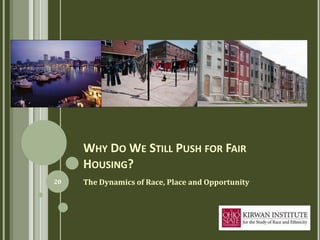
WHY DO WE STILL PUSH FOR FAIR
     HOUSING?
20   The Dynamics of Race, Place and Opportunity
Section 2
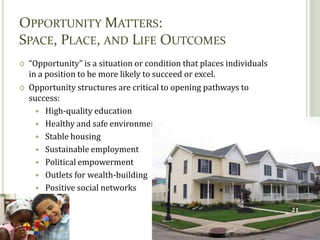
OPPORTUNITY MATTERS:
SPACE, PLACE, AND LIFE OUTCOMES
   “Opportunity” is a situation or condition that places individuals
    in a position to be more likely to succeed or excel.
   Opportunity structures are critical to opening pathways to
    success:
       High-quality education
       Healthy and safe environment
       Stable housing
       Sustainable employment
       Political empowerment
       Outlets for wealth-building
       Positive social networks


                                                                        21
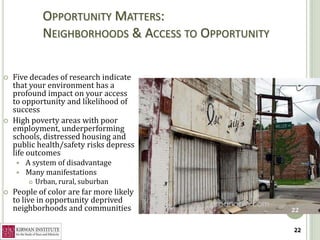
OPPORTUNITY MATTERS:
              NEIGHBORHOODS & ACCESS TO OPPORTUNITY

   Five decades of research indicate
    that your environment has a
    profound impact on your access
    to opportunity and likelihood of
    success
   High poverty areas with poor
    employment, underperforming
    schools, distressed housing and
    public health/safety risks depress
    life outcomes
       A system of disadvantage
       Many manifestations
           Urban, rural, suburban
   People of color are far more likely
    to live in opportunity deprived
    neighborhoods and communities                     22


                                                      22
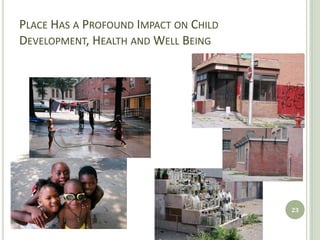
PLACE HAS A PROFOUND IMPACT ON CHILD
DEVELOPMENT, HEALTH AND WELL BEING


                                       23
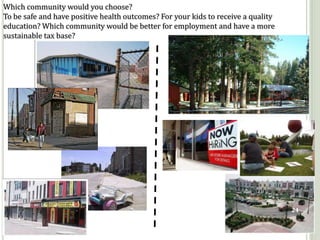
Which community would you choose?
To be safe and have positive health outcomes? For your kids to receive a quality
education? Which community would be better for employment and have a more
sustainable tax base?


                                                                                   24
WHAT ARE THE IMPLICATIONS OF OPPORTUNITY
ISOLATION?

   Individual
     Poor economic outcomes, lower educational
      outcomes, degraded asset development
     Poor health conditions, higher exposure and risk from crime
     Psychological distress, weak social and professional
      networks
   Community/Economy
     High social costs, distressed and stressed communities, fiscal
      challenges
     Weakened civic engagement and democratic participation
     Underdeveloped human capital, poor labor outlook, poor
      economic development prospects
                                                                 25
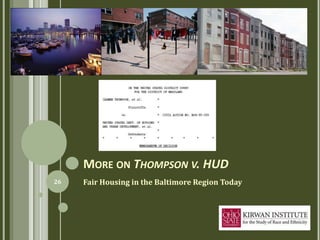
MORE ON THOMPSON V. HUD
26   Fair Housing in the Baltimore Region Today
WHAT IS THOMPSON V. HUD?
   Litigation brought on behalf of class of 14,000
    African-American residents of public housing in
    response to history of racial segregation of public
    housing and concentration in poor, distressed
    neighborhoods in Baltimore
     Plaintiffs include Maryland ACLU and NAACP Legal
      Defense Fund
     Originally defendants included the local public housing
      authority and the US Department of Housing & Urban
      Development
 Began in 1995…judge issued liability ruling in 2005
 Remedial trial held in 2006
       Still waiting for final remedial decision

                27
FAIR HOUSING IN BALTIMORE
   Some facts and figures….
       Baltimore is the 14th most segregated metropolitan region in the
        USA (as of 2000)
       Approximately 67% of Baltimore’s African American or White
        population would need to relocate to integrate the region (based on
        the regional dissimilarity rate of .67
       More than 53% of African Americans are physically segregated from
        jobs in the region
       African American neighborhoods on average had poverty rates
        nearly 3 times the rate found in the average White neighborhood
        and vacancy rates more than double rates found in White
        neighborhoods
       Nearly 3 out 4 African American kids would need to change schools
        to integrate the region’s schools
       The average African American student attended a school with a
        42% poverty rate in 2000, double the average for White students
           In 2003, in the Baltimore City Schools:
           3 out of 4 students were poor, more than 1/3 of classes were taught by non
            highly qualified teachers, less than a 1/3 of students passed proficiency exams   28
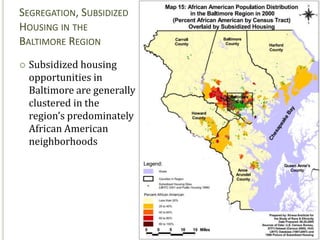
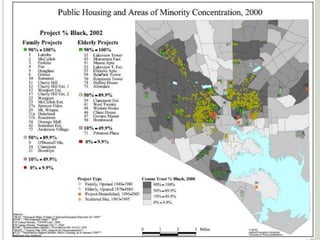
SEGREGATION, SUBSIDIZED
HOUSING IN THE
BALTIMORE REGION
   Subsidized housing
    opportunities in
    Baltimore are generally
    clustered in the
    region’s predominately
    African American
    neighborhoods


                              29
30
MORE ON THOMPSON V. HUD
   In January 2005, US District Court Judge Garbis found HUD
    liable for violating the federal Fair Housing Act, for not
    providing fair housing opportunities to Baltimore’s African
    American public housing residents
       "Baltimore City should not be viewed ... as a container for all of the poor
        of a contiguous region“
   HUD failed to affirmatively promote fair housing by failing to consider a
    regional approach to desegregating public housing
       “[T]he failure adequately to take a regional approach to the desegregation of
        public housing in the region that included Baltimore City violated the Fair
        Housing Act and requires consideration of appropriate remedial action by the
        Court.”
          [Hon. Marvin J. Garbis, Memorandum of Decision. Carmen Thompson et. al. vs. US
           Department of Housing and Urban Development et. al. January 6, 2005: 104]

                                                                                     31
PLAINTIFF’S RESPONSE
   “We intend to secure a remedy that will help African American
    public housing residents undo the harms they have suffered for
    more than sixty years because of HUD’s discriminatory policies.
    We believe that this case, in Thurgood Marshall’s hometown, is
    the most important housing desegregation lawsuit in a
    generation.”
      -Theodore M. Shaw, NAACP LDF Director-Counsel
      and President


                                                                32
DIRECTOR POWELL’S REMEDIAL PROPOSAL
   The remedy must provide desegregative housing units in
    areas of opportunity
       The proposal conducted an “opportunity mapping” analysis in the
        region to locate high opportunity census tracts
 The remedy must be regional in scope
 The remedy must be race conscious
 The remedial program should be a structured choice model
  and voluntary for P.H. residents
 The remedy must be goal driven, not process driven
 HUD must consider both vouchers and housing production to
  meet the remedy’s goals
                                                                          33
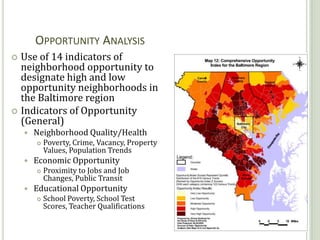
OPPORTUNITY ANALYSIS
 Use of 14 indicators of
  neighborhood opportunity to
  designate high and low
  opportunity neighborhoods in
  the Baltimore region
 Indicators of Opportunity
  (General)
       Neighborhood Quality/Health
           Poverty, Crime, Vacancy, Property
            Values, Population Trends
       Economic Opportunity
           Proximity to Jobs and Job
            Changes, Public Transit
       Educational Opportunity
           School Poverty, School Test
            Scores, Teacher Qualifications

                                                34
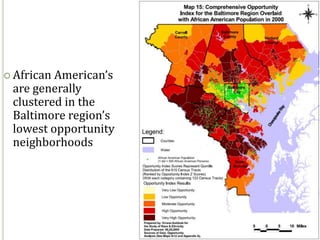
 AfricanAmerican’s
 are generally
 clustered in the
 Baltimore region’s
 lowest opportunity
 neighborhoods


                      35
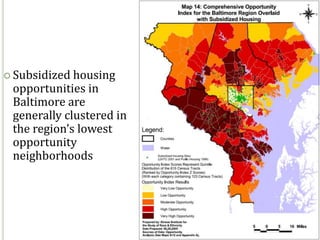
 Subsidized housing
 opportunities in
 Baltimore are
 generally clustered in
 the region’s lowest
 opportunity
 neighborhoods


                          36
FINAL PLAINTIFF’S PROPOSED REMEDY
 Plaintiffspropose providing desegregative housing
  opportunities in the region’s high opportunity
  neighborhoods to remedy HUD’s fair housing
  violations
     With the goal of providing nearly 7,000 affordable housing
      opportunities in high opportunity communities to public
      housing residents who volunteer to relocate in ten years
     Flexibility in implementation (new construction and
      vouchers)
 Aligned  with proposals to provide support services
  for residents who volunteer for the program         37
HUD’S RESPONSE
 The judge has not legal authority to impose a remedy, only the
  ability to recommend a remedy
 The remedial proposal is infeasible
       A regional remedial program is impractical and new housing
        production will be too costly
       The selection of opportunity areas is arbitrary
   HUD’s experts arguments
       Segregation is natural and the result of only income and personal
        preference, the government can do nothing about this
       More African Americans are living in the suburbs therefore segregation
        is not a concern in our current society
       The harms of living in concentrated poverty and the benefits of living
        near opportunity structures, are overstated and not provable
       Too few public housing residents will wish to relocate
       Mobility based housing programs are not sustainable and “in-place”
        strategies are preferable (enterprise zones in urban areas etc.)
                                                                          38
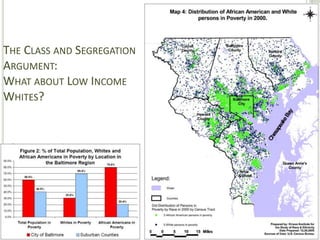
THE CLASS AND SEGREGATION
ARGUMENT:
WHAT ABOUT LOW INCOME
WHITES?


                            39
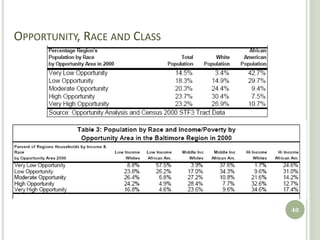
OPPORTUNITY, RACE AND CLASS


                              40
STATUS OF THE CASE

 Remedial phase  trial ended in early May of 2006
 Awaiting Judge Garbis’s final decision later this year
     The HUD/DOJ very likely to appeal
 Consortium   of advocates in the Baltimore region are
  starting a campaign to build support for the program
  and aligning support services for movers
 Partial consent decree program is continuing and is
  very popular

                                                      41
THE PARTIAL CONSENT DECREE PROGRAM
   Approximately 14,000 have applied, smaller scale
    housing mobility program (which has moved over
    1,300 families as of 2008)
     It places priority on placements in non segregated and
      non poor communities
     Includes rental and homeownership programs, includes
      counseling services
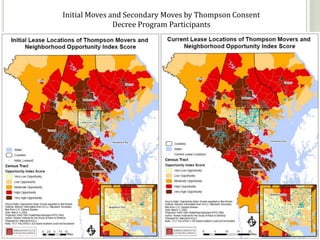
     Also analyzing the number of movers locating to
      “opportunity areas”
   Other changes impacting the Baltimore market
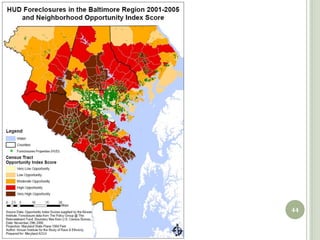
       The Foreclosure crisis
         Widespread foreclosures in Baltimore                 42
         Creating an additional housing burden
Initial Moves and Secondary Moves by Thompson Consent
               Decree Program Participants


                                                        43
44
WHAT IF THE BALTIMORE REGION HAD DEVELOPED
DIFFERENTLY?
   According to David Rusk, inclusionary zoning (e.g. the
    Montgomery County, MD model of IZ) could have
    transformed the housing landscape in the Baltimore
    region (he modeled the impact the ordinance would have
    had on the Baltimore region)
     David Rusk’s analysis projected that had Baltimore adopted
      inclusionary zoning by 1980, in two decades the region would
      have produced 15,800 “workforce” moderate income housing
      units and 7,900 units for very low income households
     The majority of these units 90% would have been constructed in
      the suburban jurisdiction’s in the metropolitan region
     The policies could of resulted in the movement of at least 18,500
      impoverished residents in Baltimore to non-high poverty
      suburban areas
     It would have resulted in student poverty rates in the City of
                                                                          45
      Baltimore school district to drop from 83% to 53% (as of 2002)
SUPPORTING REGIONAL HOUSING SOLUTIONS
46   Discussion
DISCUSSION: SUPPORTING REGIONAL HOUSING
SOLUTIONS
   What challenges do you anticipate confronting in
    implementing regional fair housing programs?
     How can we address these challenges?
     How do we deal with the dynamic and fluid nature of housing
      markets (how do we address this in program design and housing
      decisions)
   What role should planners play?
       What is the “public good” and what takes priority?
           What’s good for the region? What good for your community? What’s
            good for marginalized communities? What’s good for the housing
            industry?
           How do you balance these things?
   How do planners support change in face of confronting
    institutional power?
       Especially in the context of regional decision making or               47
        upholding civil rights concerns?
TO LEARN MORE ABOUT THIS CASE OR THE INSTITUTE, PLEASE VISIT US
ON-LINE AT: WWW.KIRWANINSTITUTE.ORG


                                                                  48

Housing, Opportunity & Race: The Case of Thompson v. HUD in Baltimore, MD

  • 1.
    HOUSING, OPPORTUNITY &RACE: THE CASE OF THOMPSON V. HUD IN BALTIMORE, MD Jason Reece, AICP 1 Senior Researcher The Kirwan Institute for the Study of Race & Ethnicity Reece.35@osu.edu and www.kirwaninstitute.org Guest Lecture May 7th 2009 City and Regional Planning 815: Urban Planning Case Studies in Housing Case Studies in Housing
  • 2.
    TODAY’S CLASS &DISCUSSION  Thinking about our History: Planning, Housing, Opportunity & Race  Access to Opportunity Matters  Baltimore, MD at the time of Thompson v. HUD  The Litigation & Judicial Decision  Moving Past Litigation - Crafting a response  New Housing Challenges in the Region  Discussion: How would you respond?  Discussion: Supporting regional housing solutions  What are the factors driving and impeding regional housing challenges?  What role should planners play? 2
  • 3.
    THINKING ABOUT OURHISTORY 3 Planning, Housing, Opportunity & Race
  • 4.
    PLANNING’S EVOLUTION OF CONFRONTING URBAN PROBLEMS 4 • Euclidean Zoning • Birth of • “City Urban Advocacy Efficient” Renewal Planning Smart Opportunity City and (Davidoff) Growth Based • First Late Late/Ea Beautiful 1920’s Suburbs Modernism • The CDC New Planning and and Emerge 1950- 60’s movement Urbanism The Community rly 19th (Burnham Birth of emerges 1990’s 1960’s and Future? Dev. Century and 1930’s • Garden Super • Regional Sustain- Others) Cities Block 1970’s Fair Share ability Planning for the Green • First Public Strategies Economy public Housing • Model housing Cities
  • 5.
    URBAN PROBLEMS: VIEWFROM 1968  This finding from the 1968 Kerner Commission (“Report of the National Advisory Commission on Civil Disorders”) is still compelling and applicable to the current challenges facing marginalized urban communities of color.  “…the single overriding cause of rioting in the cities was not any one thing commonly adduced – unemployment, lack of education, poverty, exploitation – but that it was all of those things and more…”  Source: The Kerner Report. The 1968 Report of the National Advisory Commission on Civil Disorders. Introduction by Tom Wicker. Page xvii. 5
  • 6.
    URBAN PROBLEMS: VIEWFROM 2008  This description is repeated nearly 40 years later in a recent study of concentrated poverty released by the U.S. Federal Reserve and The Brookings Institution:  “Each of the headline issues examined in this chapter – schools and skills, housing, lack of mainstream investment, and limited community capacity – plays a role in perpetuating the disadvantage confronting these high-poverty urban and rural areas today. Together, these issues entangle many high poverty communities in a Gordian knot….  The U.S. Federal Reserve Bank. “The Enduring Challenge of Concentrated Poverty In America.” Produced by the U.S. Federal Reserve and The Brookings Institution. page 191. Accessible online at: http://www.frbsf.org/cpreport/#  History matters  We are still struggling with many of the same challenges facing urban communities and housing 6
  • 7.
    THE 1960’S ANDTODAY: URBAN UNREST AND URBAN DISTRESS IN DETROIT 7
  • 8.
  • 9.
    WHY DID THISHAPPEN? HISTORICAL POLICIES CONTRIBUTING TO RESIDENTIAL SEGREGATION 9 AND ISOLATION  Segregation as policy  Jim Crow in the south  The Great Migration North  FHA policies upholding segregation  Redlining, discouraging mixed race neighborhoods  Blockbusting, racially restrictive covenants and other forms of discrimination in the housing industry  Urban renewal, highway construction and public housing policy  Suburban sprawl and white flight
  • 10.
    POLICIES ENFORCING INEQUITY: HISTORICAL GOVERNMENT ROLE “If a neighborhood is to retain stability, it is necessary that properties shall continue to be occupied by the same social and racial classes. A change in social or racial occupancy generally contributes to instability and a decline in values.” –Excerpt from the 1947 FHA underwriting manual 10
  • 11.
    REDLINING MAP OFPHILADELPHIA 11
  • 12.
  • 13.
    THE RISE OFSUBURBIA: BUT NOT ACCESSIBLE TO EVERYONE 13 In the suburb-shaping years (1930-1960), less than one-percent of all African Americans were able to obtain a mortgage.
  • 14.
    FHA HIGHWAY CONSTRUCTIONIN CINCINNATI – DEMOLISHING MUCH OF THE AFRICAN AMERICAN WEST SIDE 14
  • 15.
  • 16.
    URBAN RENEWAL &NEW ATTEMPTS AT PUBLIC HOUSING  Superblock Public Housing  Stateway Gardens in Chicago being completed in the late 1950’s  33 Acres of Public Housing  Eight High Rise Buildings  More than 1,600 Public Housing Units 16
  • 17.
    UNPRECEDENTED CONCENTRATED POVERTY: THE RISEOF CONCENTRATED 17 PUBLIC HOUSING
  • 18.
    FROM MARVEL TODISASTER: PRUITT-IGOE IN ST. LOUIS 18
  • 19.
    WHY DOES THISCONTINUE? CONTEMPORARY FACTORS CONTRIBUTING TO RESIDENTIAL SEGREGATION AND ISOLATION  De facto segregation and opportunity isolation  Exclusionary zoning  Subtle forms of housing discrimination  Racial steering, editorializing  Fragmented school districts and court decisions  Economic development policy, infrastructure policy and subsidized housing policy  Continued exurban sprawl and white flight  Reverse redlining  Buy here pay here, rent to own, payday lending, subprime mortgage loans 19
  • 20.
    WHY DO WESTILL PUSH FOR FAIR HOUSING? 20 The Dynamics of Race, Place and Opportunity
  • 21.
    Section 2 OPPORTUNITY MATTERS: SPACE,PLACE, AND LIFE OUTCOMES  “Opportunity” is a situation or condition that places individuals in a position to be more likely to succeed or excel.  Opportunity structures are critical to opening pathways to success:  High-quality education  Healthy and safe environment  Stable housing  Sustainable employment  Political empowerment  Outlets for wealth-building  Positive social networks 21
  • 22.
    OPPORTUNITY MATTERS: NEIGHBORHOODS & ACCESS TO OPPORTUNITY  Five decades of research indicate that your environment has a profound impact on your access to opportunity and likelihood of success  High poverty areas with poor employment, underperforming schools, distressed housing and public health/safety risks depress life outcomes  A system of disadvantage  Many manifestations  Urban, rural, suburban  People of color are far more likely to live in opportunity deprived neighborhoods and communities 22 22
  • 23.
    PLACE HAS APROFOUND IMPACT ON CHILD DEVELOPMENT, HEALTH AND WELL BEING 23
  • 24.
    Which community wouldyou choose? To be safe and have positive health outcomes? For your kids to receive a quality education? Which community would be better for employment and have a more sustainable tax base? 24
  • 25.
    WHAT ARE THEIMPLICATIONS OF OPPORTUNITY ISOLATION?  Individual  Poor economic outcomes, lower educational outcomes, degraded asset development  Poor health conditions, higher exposure and risk from crime  Psychological distress, weak social and professional networks  Community/Economy  High social costs, distressed and stressed communities, fiscal challenges  Weakened civic engagement and democratic participation  Underdeveloped human capital, poor labor outlook, poor economic development prospects 25
  • 26.
    MORE ON THOMPSONV. HUD 26 Fair Housing in the Baltimore Region Today
  • 27.
    WHAT IS THOMPSONV. HUD?  Litigation brought on behalf of class of 14,000 African-American residents of public housing in response to history of racial segregation of public housing and concentration in poor, distressed neighborhoods in Baltimore  Plaintiffs include Maryland ACLU and NAACP Legal Defense Fund  Originally defendants included the local public housing authority and the US Department of Housing & Urban Development  Began in 1995…judge issued liability ruling in 2005  Remedial trial held in 2006  Still waiting for final remedial decision 27
  • 28.
    FAIR HOUSING INBALTIMORE  Some facts and figures….  Baltimore is the 14th most segregated metropolitan region in the USA (as of 2000)  Approximately 67% of Baltimore’s African American or White population would need to relocate to integrate the region (based on the regional dissimilarity rate of .67  More than 53% of African Americans are physically segregated from jobs in the region  African American neighborhoods on average had poverty rates nearly 3 times the rate found in the average White neighborhood and vacancy rates more than double rates found in White neighborhoods  Nearly 3 out 4 African American kids would need to change schools to integrate the region’s schools  The average African American student attended a school with a 42% poverty rate in 2000, double the average for White students  In 2003, in the Baltimore City Schools:  3 out of 4 students were poor, more than 1/3 of classes were taught by non highly qualified teachers, less than a 1/3 of students passed proficiency exams 28
  • 29.
    SEGREGATION, SUBSIDIZED HOUSING INTHE BALTIMORE REGION  Subsidized housing opportunities in Baltimore are generally clustered in the region’s predominately African American neighborhoods 29
  • 30.
  • 31.
    MORE ON THOMPSONV. HUD  In January 2005, US District Court Judge Garbis found HUD liable for violating the federal Fair Housing Act, for not providing fair housing opportunities to Baltimore’s African American public housing residents  "Baltimore City should not be viewed ... as a container for all of the poor of a contiguous region“  HUD failed to affirmatively promote fair housing by failing to consider a regional approach to desegregating public housing  “[T]he failure adequately to take a regional approach to the desegregation of public housing in the region that included Baltimore City violated the Fair Housing Act and requires consideration of appropriate remedial action by the Court.”  [Hon. Marvin J. Garbis, Memorandum of Decision. Carmen Thompson et. al. vs. US Department of Housing and Urban Development et. al. January 6, 2005: 104] 31
  • 32.
    PLAINTIFF’S RESPONSE  “We intend to secure a remedy that will help African American public housing residents undo the harms they have suffered for more than sixty years because of HUD’s discriminatory policies. We believe that this case, in Thurgood Marshall’s hometown, is the most important housing desegregation lawsuit in a generation.” -Theodore M. Shaw, NAACP LDF Director-Counsel and President 32
  • 33.
    DIRECTOR POWELL’S REMEDIALPROPOSAL  The remedy must provide desegregative housing units in areas of opportunity  The proposal conducted an “opportunity mapping” analysis in the region to locate high opportunity census tracts  The remedy must be regional in scope  The remedy must be race conscious  The remedial program should be a structured choice model and voluntary for P.H. residents  The remedy must be goal driven, not process driven  HUD must consider both vouchers and housing production to meet the remedy’s goals 33
  • 34.
    OPPORTUNITY ANALYSIS  Useof 14 indicators of neighborhood opportunity to designate high and low opportunity neighborhoods in the Baltimore region  Indicators of Opportunity (General)  Neighborhood Quality/Health  Poverty, Crime, Vacancy, Property Values, Population Trends  Economic Opportunity  Proximity to Jobs and Job Changes, Public Transit  Educational Opportunity  School Poverty, School Test Scores, Teacher Qualifications 34
  • 35.
     AfricanAmerican’s aregenerally clustered in the Baltimore region’s lowest opportunity neighborhoods 35
  • 36.
     Subsidized housing opportunities in Baltimore are generally clustered in the region’s lowest opportunity neighborhoods 36
  • 37.
    FINAL PLAINTIFF’S PROPOSEDREMEDY  Plaintiffspropose providing desegregative housing opportunities in the region’s high opportunity neighborhoods to remedy HUD’s fair housing violations  With the goal of providing nearly 7,000 affordable housing opportunities in high opportunity communities to public housing residents who volunteer to relocate in ten years  Flexibility in implementation (new construction and vouchers)  Aligned with proposals to provide support services for residents who volunteer for the program 37
  • 38.
    HUD’S RESPONSE  Thejudge has not legal authority to impose a remedy, only the ability to recommend a remedy  The remedial proposal is infeasible  A regional remedial program is impractical and new housing production will be too costly  The selection of opportunity areas is arbitrary  HUD’s experts arguments  Segregation is natural and the result of only income and personal preference, the government can do nothing about this  More African Americans are living in the suburbs therefore segregation is not a concern in our current society  The harms of living in concentrated poverty and the benefits of living near opportunity structures, are overstated and not provable  Too few public housing residents will wish to relocate  Mobility based housing programs are not sustainable and “in-place” strategies are preferable (enterprise zones in urban areas etc.) 38
  • 39.
    THE CLASS ANDSEGREGATION ARGUMENT: WHAT ABOUT LOW INCOME WHITES? 39
  • 40.
  • 41.
    STATUS OF THECASE  Remedial phase trial ended in early May of 2006  Awaiting Judge Garbis’s final decision later this year  The HUD/DOJ very likely to appeal  Consortium of advocates in the Baltimore region are starting a campaign to build support for the program and aligning support services for movers  Partial consent decree program is continuing and is very popular 41
  • 42.
    THE PARTIAL CONSENTDECREE PROGRAM  Approximately 14,000 have applied, smaller scale housing mobility program (which has moved over 1,300 families as of 2008)  It places priority on placements in non segregated and non poor communities  Includes rental and homeownership programs, includes counseling services  Also analyzing the number of movers locating to “opportunity areas”  Other changes impacting the Baltimore market  The Foreclosure crisis  Widespread foreclosures in Baltimore 42  Creating an additional housing burden
  • 43.
    Initial Moves andSecondary Moves by Thompson Consent Decree Program Participants 43
  • 44.
  • 45.
    WHAT IF THEBALTIMORE REGION HAD DEVELOPED DIFFERENTLY?  According to David Rusk, inclusionary zoning (e.g. the Montgomery County, MD model of IZ) could have transformed the housing landscape in the Baltimore region (he modeled the impact the ordinance would have had on the Baltimore region)  David Rusk’s analysis projected that had Baltimore adopted inclusionary zoning by 1980, in two decades the region would have produced 15,800 “workforce” moderate income housing units and 7,900 units for very low income households  The majority of these units 90% would have been constructed in the suburban jurisdiction’s in the metropolitan region  The policies could of resulted in the movement of at least 18,500 impoverished residents in Baltimore to non-high poverty suburban areas  It would have resulted in student poverty rates in the City of 45 Baltimore school district to drop from 83% to 53% (as of 2002)
  • 46.
    SUPPORTING REGIONAL HOUSINGSOLUTIONS 46 Discussion
  • 47.
    DISCUSSION: SUPPORTING REGIONALHOUSING SOLUTIONS  What challenges do you anticipate confronting in implementing regional fair housing programs?  How can we address these challenges?  How do we deal with the dynamic and fluid nature of housing markets (how do we address this in program design and housing decisions)  What role should planners play?  What is the “public good” and what takes priority?  What’s good for the region? What good for your community? What’s good for marginalized communities? What’s good for the housing industry?  How do you balance these things?  How do planners support change in face of confronting institutional power?  Especially in the context of regional decision making or 47 upholding civil rights concerns?
  • 48.
    TO LEARN MOREABOUT THIS CASE OR THE INSTITUTE, PLEASE VISIT US ON-LINE AT: WWW.KIRWANINSTITUTE.ORG 48