UNIVERSITY KEBANGSAAN MALAYSIA
DEPARTMENT OF CIVIL AND STRUCTURAL
ENGINEERING
Sustainable Urban Transportation
Kajang future development
Prepared by:

ALAA.H.MOUSA

P71081

Lecturer: Prof. Dr. RizaAtiq
INTRODUCTION
sustainable development is a development
that meets the needs of the present without
compromising the ability of future generations
to meet their own needs’. This definition has
attained universal traction and is seen by many
who recognize the current unsustainable nature
of society as a means of achieving
sustainability.
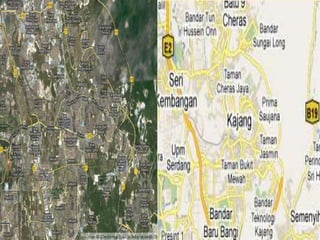
 Kajangis located in Hulu Langat District, in Selangor. The first

settlement in Kajang was established in 1709. In 1807, Kajang was
founded after the Klang War.

 The current location gravity of growth in Kajang would be Sungai

Chua. The total population of Kajang has grown rapidly in the past
few years, with estimated population growth of 9% per annum.

 As of 2004, a few townships have been developed in Kajang, such

as Taman Prima Saujana (straight from JalanCheras), Sungai
Chua, Taman Kajang Perdana (Kajang Highlands).

 Areas surrounding these new townships are easily accessible via the

SILK Expressway.
LANDMARK
ISSUE AT KAJANG


Higher population: the population in Kajang increases rapidly and it’s also due
to the higher employment such as in commercial sector and public sector. All
the residential will be converged at Kajang city.



Environmental issue: the increase in population and rapidly development of
buildings in contribute to pollution in Kajang. The critical pollution that occur
in Kajang due to the air pollution coming from transportation and for water
pollution coming from industrial and residential development along Sungai
Langat



Road congestion: road connection system in Kajang is very narrow and it
cannot occupy the higher density of traffic congestion. Higher traffic congestion
happened during peak hours and weekends


Due to the traffic congested, the pedestrian are not given
priority and the facilities such as pedestrian bridge and
sidewalk are not being provided for the pedestrian. So, the
pedestrian safety is not a priority.



Demand on residential area. At the centre of Kajang city, the
land use is more on the community facilities components and
for the residential areas; it was located at the edge of the town.
There are a few townships have been developed in Kajang
such as Taman Prima Saujana, Taman Kajang Perdana and
many more
QUALITY OF DEVELOPMENT
Our city will produce a quality development to achieve
a sustainable development
There are some qualities that should be focused to
achieve sustainable development in term of
economy quality, social quality and environmental
quality.
Economic quality
One of the ways to achieve the sustainable
development is through economic health of the city
Economy activity, job creation and poverty should be
noted and the role of informal activities and smallscale trade become important.
Social quality
 Sustainable urban development must take into
account social justice, basic human
needs, public health, environmental awareness
in space and time.. Social equality should be
maintained in terms of economic opportunities in
this city.

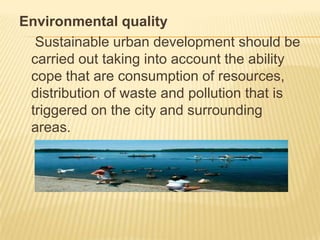
Environmental quality
Sustainable urban development should be
carried out taking into account the ability
cope that are consumption of resources,
distribution of waste and pollution that is
triggered on the city and surrounding
areas.
Access to knowledge
Measures favorable to education, access
to information and research must be
encouraged in order to stimulate
innovation, raise awareness and ensure
effective participation of the public in the
implementation of sustainable
development.
INTEGRATING TRANSPORT AND
DEVELOPMENT





Sustainable development applied to transport systems
requires the promotion of linkages between
environmental protection, economic efficiency and
social progress.
Transportation, as a core component supporting the
interactions and the development of economic
systems, has also been the object of much
consideration about to what extent it is sustainable
PROPOSED STRATEGIES






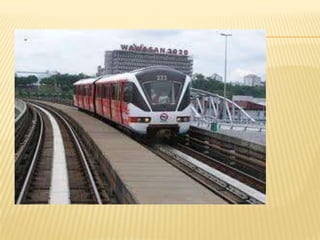
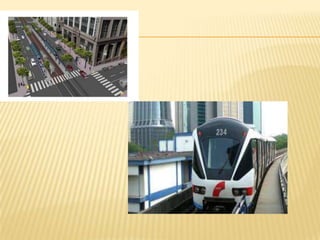
Redirecting the movement pattern of using the private
transport to the public transport and also improving the
service for public transport such as subway, busses and
taxi.
Upgrading the road systems by widening and
implementing the smart grid system for the
transportation systems.
We also suggest making a new Bus Rapid Transit
Systems (BRT)
MINIMUM ENVIRONMENTAL IMPACT DUE TO
SURGE IN TRAVEL DEMANDS
The-density form of traditional kajang cities has recently come
under attack as the antithesis of the sustainable urban form
promoted by the compact city advocates
1.The densification and agglomeration of activities can
involve
spatial structures such as logistics zones or transit
oriented
developments and can result in reduced vehicle trips and
increase transport alternatives
2.The strategy of traffic is a more direct method of reducing
traffic demand.
DEVELOPMENT ACCESS



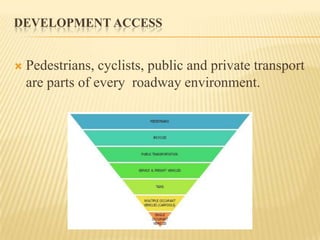
Pedestrians, cyclists, public and private transport
are parts of every roadway environment.
Pedestrian
The demand for provision of more and
better
pedestrian and cyclists facilities, the demand
for
this facilities influenced by :
 Car ownership
 The nature of the local community.
 Local land use activities.
 Quality of provision.
 Safety and security.
IMPROVEMENT STRATEGY






improving the quality of bus services throughout the area
Improving network coverage to give access to key facilities.
Improving bus stations and bus stops to improve the waiting
environment.
Improving the scope and range of information provided to
passengers.
Maintaining a range of tickets which allow travel throughout
the network or can be used on trams and trains
In general plan network due to long-term developments
encourage the use of public transport by it competitive
advantage over private car.
ROAD IMPROVEMENTS






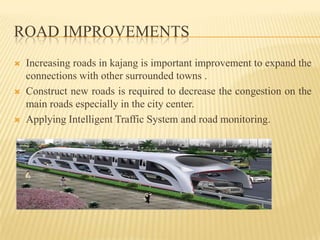
Increasing roads in kajang is important improvement to expand the
connections with other surrounded towns .
Construct new roads is required to decrease the congestion on the
main roads especially in the city center.
Applying Intelligent Traffic System and road monitoring.
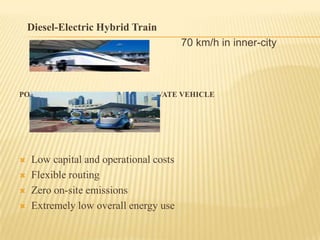
Diesel-Electric Hybrid Train
70 km/h in inner-city
traffic.

POD CAR INSTEAD OF CURRENT PRIVATE VEHICLE






Low capital and operational costs
Flexible routing
Zero on-site emissions
Extremely low overall energy use
PARKING
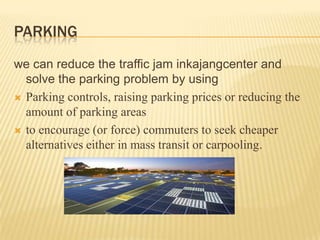
we can reduce the traffic jam inkajangcenter and
solve the parking problem by using
 Parking controls, raising parking prices or reducing the
amount of parking areas
 to encourage (or force) commuters to seek cheaper
alternatives either in mass transit or carpooling.
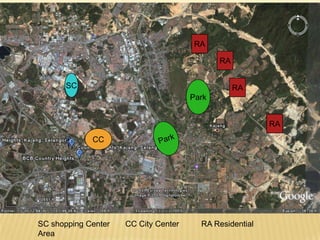
RA
RA
SC

RA
Park
RA
CC

SC shopping Center
Area

CC City Center

RA Residential
URBAN DESIGN PRINCIPLES
are considering the following principles:
1-Density,diversity, and mix uses : users, building type, and
public spaces.
2-transit supportive: shifting from car oriented pattern to transit
oriented pattern.
3-pesdestrains:as alternative modes to reduce car-dependency.
4-Place-making:with a strong sense of identity.
5-Complete communities :with providing needs of daily living.
6-Integrated natural systems: by conserving and enhancing
health of this system.
7-Integrated Technical and Industrial Systems.
8-Local sources :by growing and producing
needed.

the resources

9-Redundant and Durable:
Infrastructure Systems.

and

Life

Safety

Critical

10-Resilient Operations: by developing building types and
urban forms with reducing servicing cost , and reducing
environment footprints.
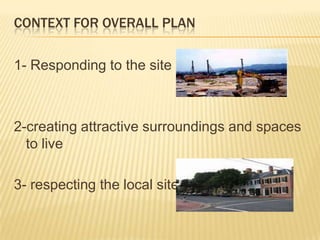
CONTEXT FOR OVERALL PLAN
1- Responding to the site

2-creating attractive surroundings and spaces
to live
3- respecting the local site
SAFETY AND SECURITY










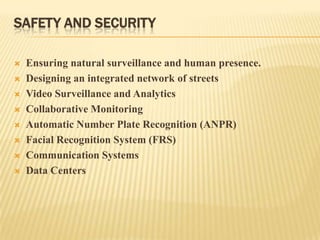
Ensuring natural surveillance and human presence.
Designing an integrated network of streets
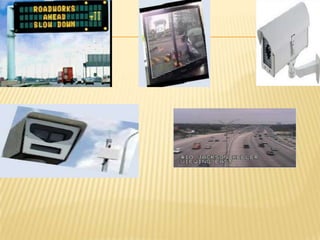
Video Surveillance and Analytics
Collaborative Monitoring
Automatic Number Plate Recognition (ANPR)
Facial Recognition System (FRS)
Communication Systems
Data Centers
LANDSCAPES AND BIODIVERSITY


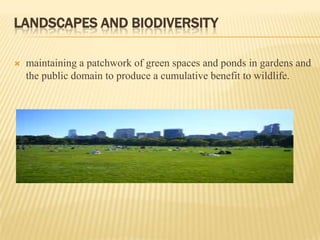
maintaining a patchwork of green spaces and ponds in gardens and
the public domain to produce a cumulative benefit to wildlife.
RENEWABLE ENERGY
SOLAR ENERGY


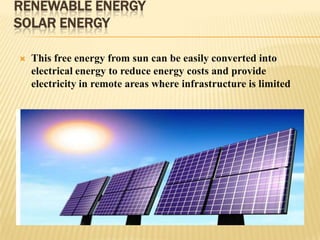
This free energy from sun can be easily converted into
electrical energy to reduce energy costs and provide
electricity in remote areas where infrastructure is limited
BIOMASS ENERGY


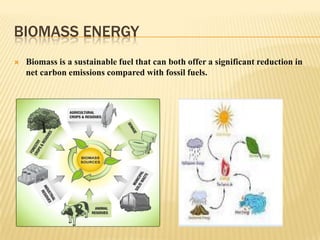
Biomass is a sustainable fuel that can both offer a significant reduction in
net carbon emissions compared with fossil fuels.
AIR QUALITY
Air pollution has many disastrous effects that need to
be curbed. In order to accomplish
this, governments, scientists and environmentalists
are using or testing a variety of methods aimed at
reducing pollution.
 Five major input control methods exist. People may
try to restrict population growth, use less
energy, improve energy efficiency, reduce waste, and
move to non-polluting renewable forms of energy
production. Also, automobile-produced pollution
can be decreased with highly beneficial results.

WATER QUALITY AND DRAINAGE
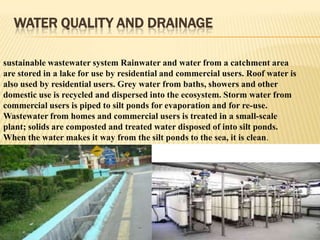
sustainable wastewater system Rainwater and water from a catchment area
are stored in a lake for use by residential and commercial users. Roof water is
also used by residential users. Grey water from baths, showers and other
domestic use is recycled and dispersed into the ecosystem. Storm water from
commercial users is piped to silt ponds for evaporation and for re-use.
Wastewater from homes and commercial users is treated in a small-scale
plant; solids are composted and treated water disposed of into silt ponds.
When the water makes it way from the silt ponds to the sea, it is clean.
PROPOSED DEVELOPMENT FOR
KAJANG CITY
Langat River Basin
The Langat River Basin provides water for its
population for domestic as well as industrial and
agriculture uses. However, population growth, rapid
industrialization, urbanization and infrastructure
development are changing the socioeconomic patterns
of development and affecting the water quality and
ecosystem health of the Langat Basin.
PROJECT RIVER OF LIFE PART II.
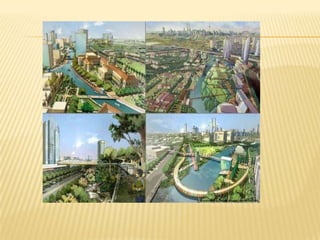
We suggest continuing project river of life part II at Langat River. The objective of this project is to
transform the Langat River into a vibrant and livable waterfront with high economic value. This
transformation is divided into three components that are river cleaning, beautification and river
development.

River cleaning.
The objective of the River Cleaning is to clean and improve the water quality from its current
Class III until Class V water quality that not suitable for body contact transform to Class II b that
suitable for body contact recreational usage.

Beautification.
The objective of the River Beautification is to beautify the river to increase the economic
availability of the area.

River development.
The beautification works will spur economic investments into the areas immediately surrounding
the river corridor. To catalyze development along the corridor, potential government land will be
identified and tendered out to private developers through competitive bidding.
NEW BUILDING DEVELOPMENT

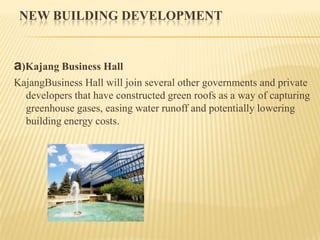
a)Kajang Business Hall
KajangBusiness Hall will join several other governments and private
developers that have constructed green roofs as a way of capturing
greenhouse gases, easing water runoff and potentially lowering
building energy costs.
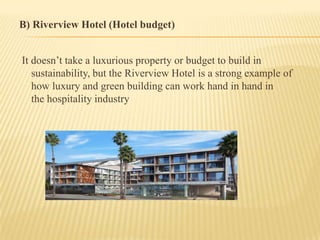
B) Riverview Hotel (Hotel budget)
It doesn’t take a luxurious property or budget to build in
sustainability, but the Riverview Hotel is a strong example of
how luxury and green building can work hand in hand in
the hospitality industry
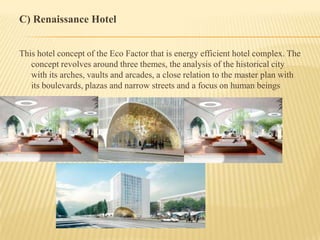
C) Renaissance Hotel
This hotel concept of the Eco Factor that is energy efficient hotel complex. The
concept revolves around three themes, the analysis of the historical city
with its arches, vaults and arcades, a close relation to the master plan with
its boulevards, plazas and narrow streets and a focus on human beings
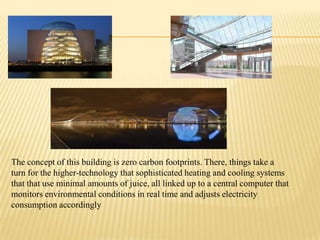
The concept of this building is zero carbon footprints. There, things take a
turn for the higher-technology that sophisticated heating and cooling systems
that that use minimal amounts of juice, all linked up to a central computer that
monitors environmental conditions in real time and adjusts electricity
consumption accordingly
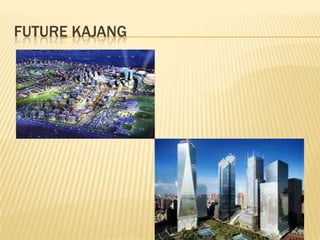
FUTURE KAJANG
Thank you very much

Sustainable urban design presentation

  • 1.
    UNIVERSITY KEBANGSAAN MALAYSIA DEPARTMENTOF CIVIL AND STRUCTURAL ENGINEERING Sustainable Urban Transportation Kajang future development Prepared by: ALAA.H.MOUSA P71081 Lecturer: Prof. Dr. RizaAtiq
  • 2.
    INTRODUCTION sustainable development isa development that meets the needs of the present without compromising the ability of future generations to meet their own needs’. This definition has attained universal traction and is seen by many who recognize the current unsustainable nature of society as a means of achieving sustainability.
  • 3.
     Kajangis locatedin Hulu Langat District, in Selangor. The first settlement in Kajang was established in 1709. In 1807, Kajang was founded after the Klang War.  The current location gravity of growth in Kajang would be Sungai Chua. The total population of Kajang has grown rapidly in the past few years, with estimated population growth of 9% per annum.  As of 2004, a few townships have been developed in Kajang, such as Taman Prima Saujana (straight from JalanCheras), Sungai Chua, Taman Kajang Perdana (Kajang Highlands).  Areas surrounding these new townships are easily accessible via the SILK Expressway.
  • 5.
  • 6.
    ISSUE AT KAJANG  Higherpopulation: the population in Kajang increases rapidly and it’s also due to the higher employment such as in commercial sector and public sector. All the residential will be converged at Kajang city.  Environmental issue: the increase in population and rapidly development of buildings in contribute to pollution in Kajang. The critical pollution that occur in Kajang due to the air pollution coming from transportation and for water pollution coming from industrial and residential development along Sungai Langat  Road congestion: road connection system in Kajang is very narrow and it cannot occupy the higher density of traffic congestion. Higher traffic congestion happened during peak hours and weekends
  • 7.
     Due to thetraffic congested, the pedestrian are not given priority and the facilities such as pedestrian bridge and sidewalk are not being provided for the pedestrian. So, the pedestrian safety is not a priority.  Demand on residential area. At the centre of Kajang city, the land use is more on the community facilities components and for the residential areas; it was located at the edge of the town. There are a few townships have been developed in Kajang such as Taman Prima Saujana, Taman Kajang Perdana and many more
  • 8.
    QUALITY OF DEVELOPMENT Ourcity will produce a quality development to achieve a sustainable development There are some qualities that should be focused to achieve sustainable development in term of economy quality, social quality and environmental quality.
  • 9.
    Economic quality One ofthe ways to achieve the sustainable development is through economic health of the city Economy activity, job creation and poverty should be noted and the role of informal activities and smallscale trade become important. Social quality  Sustainable urban development must take into account social justice, basic human needs, public health, environmental awareness in space and time.. Social equality should be maintained in terms of economic opportunities in this city. 
  • 10.
    Environmental quality Sustainable urbandevelopment should be carried out taking into account the ability cope that are consumption of resources, distribution of waste and pollution that is triggered on the city and surrounding areas.
  • 11.
    Access to knowledge Measuresfavorable to education, access to information and research must be encouraged in order to stimulate innovation, raise awareness and ensure effective participation of the public in the implementation of sustainable development.
  • 12.
    INTEGRATING TRANSPORT AND DEVELOPMENT   Sustainabledevelopment applied to transport systems requires the promotion of linkages between environmental protection, economic efficiency and social progress. Transportation, as a core component supporting the interactions and the development of economic systems, has also been the object of much consideration about to what extent it is sustainable
  • 14.
    PROPOSED STRATEGIES    Redirecting themovement pattern of using the private transport to the public transport and also improving the service for public transport such as subway, busses and taxi. Upgrading the road systems by widening and implementing the smart grid system for the transportation systems. We also suggest making a new Bus Rapid Transit Systems (BRT)
  • 16.
    MINIMUM ENVIRONMENTAL IMPACTDUE TO SURGE IN TRAVEL DEMANDS The-density form of traditional kajang cities has recently come under attack as the antithesis of the sustainable urban form promoted by the compact city advocates 1.The densification and agglomeration of activities can involve spatial structures such as logistics zones or transit oriented developments and can result in reduced vehicle trips and increase transport alternatives 2.The strategy of traffic is a more direct method of reducing traffic demand.
  • 17.
    DEVELOPMENT ACCESS  Pedestrians, cyclists,public and private transport are parts of every roadway environment.
  • 18.
    Pedestrian The demand forprovision of more and better pedestrian and cyclists facilities, the demand for this facilities influenced by :  Car ownership  The nature of the local community.  Local land use activities.  Quality of provision.  Safety and security.
  • 20.
    IMPROVEMENT STRATEGY      improving thequality of bus services throughout the area Improving network coverage to give access to key facilities. Improving bus stations and bus stops to improve the waiting environment. Improving the scope and range of information provided to passengers. Maintaining a range of tickets which allow travel throughout the network or can be used on trams and trains In general plan network due to long-term developments encourage the use of public transport by it competitive advantage over private car.
  • 22.
    ROAD IMPROVEMENTS    Increasing roadsin kajang is important improvement to expand the connections with other surrounded towns . Construct new roads is required to decrease the congestion on the main roads especially in the city center. Applying Intelligent Traffic System and road monitoring.
  • 23.
    Diesel-Electric Hybrid Train 70km/h in inner-city traffic. POD CAR INSTEAD OF CURRENT PRIVATE VEHICLE     Low capital and operational costs Flexible routing Zero on-site emissions Extremely low overall energy use
  • 24.
    PARKING we can reducethe traffic jam inkajangcenter and solve the parking problem by using  Parking controls, raising parking prices or reducing the amount of parking areas  to encourage (or force) commuters to seek cheaper alternatives either in mass transit or carpooling.
  • 25.
  • 26.
    URBAN DESIGN PRINCIPLES areconsidering the following principles: 1-Density,diversity, and mix uses : users, building type, and public spaces. 2-transit supportive: shifting from car oriented pattern to transit oriented pattern. 3-pesdestrains:as alternative modes to reduce car-dependency. 4-Place-making:with a strong sense of identity. 5-Complete communities :with providing needs of daily living. 6-Integrated natural systems: by conserving and enhancing health of this system.
  • 27.
    7-Integrated Technical andIndustrial Systems. 8-Local sources :by growing and producing needed. the resources 9-Redundant and Durable: Infrastructure Systems. and Life Safety Critical 10-Resilient Operations: by developing building types and urban forms with reducing servicing cost , and reducing environment footprints.
  • 28.
    CONTEXT FOR OVERALLPLAN 1- Responding to the site 2-creating attractive surroundings and spaces to live 3- respecting the local site
  • 29.
    SAFETY AND SECURITY         Ensuringnatural surveillance and human presence. Designing an integrated network of streets Video Surveillance and Analytics Collaborative Monitoring Automatic Number Plate Recognition (ANPR) Facial Recognition System (FRS) Communication Systems Data Centers
  • 31.
    LANDSCAPES AND BIODIVERSITY  maintaininga patchwork of green spaces and ponds in gardens and the public domain to produce a cumulative benefit to wildlife.
  • 32.
    RENEWABLE ENERGY SOLAR ENERGY  Thisfree energy from sun can be easily converted into electrical energy to reduce energy costs and provide electricity in remote areas where infrastructure is limited
  • 33.
    BIOMASS ENERGY  Biomass isa sustainable fuel that can both offer a significant reduction in net carbon emissions compared with fossil fuels.
  • 34.
    AIR QUALITY Air pollutionhas many disastrous effects that need to be curbed. In order to accomplish this, governments, scientists and environmentalists are using or testing a variety of methods aimed at reducing pollution.  Five major input control methods exist. People may try to restrict population growth, use less energy, improve energy efficiency, reduce waste, and move to non-polluting renewable forms of energy production. Also, automobile-produced pollution can be decreased with highly beneficial results. 
  • 35.
    WATER QUALITY ANDDRAINAGE sustainable wastewater system Rainwater and water from a catchment area are stored in a lake for use by residential and commercial users. Roof water is also used by residential users. Grey water from baths, showers and other domestic use is recycled and dispersed into the ecosystem. Storm water from commercial users is piped to silt ponds for evaporation and for re-use. Wastewater from homes and commercial users is treated in a small-scale plant; solids are composted and treated water disposed of into silt ponds. When the water makes it way from the silt ponds to the sea, it is clean.
  • 36.
    PROPOSED DEVELOPMENT FOR KAJANGCITY Langat River Basin The Langat River Basin provides water for its population for domestic as well as industrial and agriculture uses. However, population growth, rapid industrialization, urbanization and infrastructure development are changing the socioeconomic patterns of development and affecting the water quality and ecosystem health of the Langat Basin.
  • 37.
    PROJECT RIVER OFLIFE PART II. We suggest continuing project river of life part II at Langat River. The objective of this project is to transform the Langat River into a vibrant and livable waterfront with high economic value. This transformation is divided into three components that are river cleaning, beautification and river development.  River cleaning. The objective of the River Cleaning is to clean and improve the water quality from its current Class III until Class V water quality that not suitable for body contact transform to Class II b that suitable for body contact recreational usage.  Beautification. The objective of the River Beautification is to beautify the river to increase the economic availability of the area.  River development. The beautification works will spur economic investments into the areas immediately surrounding the river corridor. To catalyze development along the corridor, potential government land will be identified and tendered out to private developers through competitive bidding.
  • 39.
    NEW BUILDING DEVELOPMENT a)KajangBusiness Hall KajangBusiness Hall will join several other governments and private developers that have constructed green roofs as a way of capturing greenhouse gases, easing water runoff and potentially lowering building energy costs.
  • 40.
    B) Riverview Hotel(Hotel budget) It doesn’t take a luxurious property or budget to build in sustainability, but the Riverview Hotel is a strong example of how luxury and green building can work hand in hand in the hospitality industry
  • 41.
    C) Renaissance Hotel Thishotel concept of the Eco Factor that is energy efficient hotel complex. The concept revolves around three themes, the analysis of the historical city with its arches, vaults and arcades, a close relation to the master plan with its boulevards, plazas and narrow streets and a focus on human beings
  • 42.
    The concept ofthis building is zero carbon footprints. There, things take a turn for the higher-technology that sophisticated heating and cooling systems that that use minimal amounts of juice, all linked up to a central computer that monitors environmental conditions in real time and adjusts electricity consumption accordingly
  • 43.
  • 44.