1-1
Chapter One
What Is Strategy
And
Why Is It Important
Slides Prepared by:
Professor M. A. Kashem
Deptt. Of MIS, DU
Spring 2019
1-2
Chapter Learning Objectives
1. What we mean by a company’s strategy
2. Understanding the concept of sustainable competitive
advantage
3. The Five most strategic approaches for setting a
company apart from rivals and winning a sustainable
competitive advantage
4. Why a company’s strategy tends to evolve because of
changing circumstances and ongoing efforts by
management to improve the strategy
5. Why it is important for a company to have a viable
business model that outlines the company’s customer
value proposition and its profit formula.
6. Gain awareness of the three tests that distinguish a
winning strategy from a so-so or flawed strategy.
7. Learn why good strategy and good strategy execution are
the most trustworthy signs of good management.
1-3
Chapter Roadmap
 What Do We Mean by “Strategy?”
 Strategy and the Quest for Competitive Advantage
 Identifying a Company’s Strategy
 Why a Company’s Strategy Evolves Over Time
 A Company’s Strategy Is Partly Proactive and
Partly Reactive
 Strategy and Ethics: Passing the Test of Moral
Scrutiny
 The Relationship Between a Company’s Strategy
and Its Business Model
 What Makes a Strategy a Winner?
 Why Are Crafting and Executing Strategy
Important?
1-4
Thinking Strategically:
The Three Big Strategic Questions
1. What’s the company’s present situation?
2. Where does the company need to go from
here?
 Business(es) to be in and market positions to
stake out
 Buyer needs and groups to serve
 Direction to head
3. How should it get there?
 A company’s answer to “how
will we get there?” is its strategy
1-5
What Do We Mean By “Strategy?”
 Set of actions that its managers take to
outperform the company’s competitors and
achieve superior profitability.
 Consists of competitive moves and
business approaches used by managers to
run the company
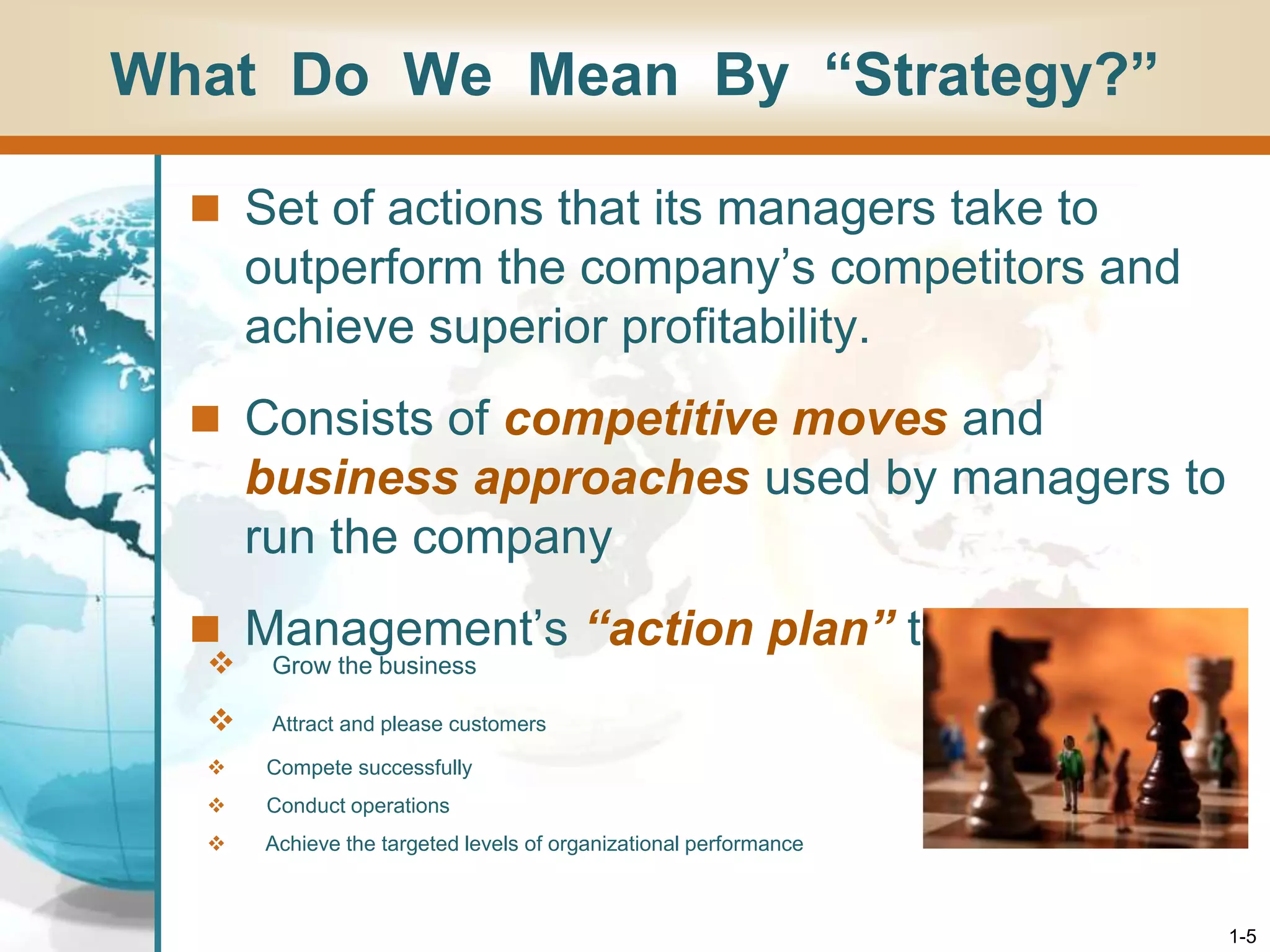
 Management’s “action plan” to
 Grow the business
 Attract and please customers
 Compete successfully
 Conduct operations
 Achieve the targeted levels of organizational performance
1-6
The Hows That Define a Firm's Strategy
 How to position the company in the market place.
 How to attract customers
 How to outcompete rivals
 How to capitalize on opportunities to grow business
 How to manage each functional
piece of the business (R&D, production, marketing, HR,
finance, and so on)
 How to respond to changing market conditions
 How to achieve targeted levels of performance
1-7
Choosing the “Hows” of Strategy
 Strategic choices about “how” are based on
 Trial-and-error organizational learning about what has
worked and what has not worked
 Management’s appetite for taking risks
 Managerial analysis and strategic thinking about how best
to proceed, given market conditions and a company’s
circumstances
 In choosing a strategy, management is in effect
saying,
“Among all the many different ways of competing we could
have chosen, we have decided to employ this combination
of competitive and operating approaches to move the
company in the intended direction, strengthen its market
position and competitiveness, and boost performance.”
1-8
Strategy is About Competing Differently
 Inclusion of some distinctive elements in
products
 What rival firms can’t or don’t do;
 Better chance of winning a strategy depends
on:
Appealing to buyer in ways that set a company
apart from rivals;
Staking out a market that is not crowded with
competitors.
1-9
Figure 1.1: Identifying a Company’s Strategy , p-5
1-9
1-10
Key Elements of a Successful Strategy
 Developing a successful strategy hinges on
making competitive moves aimed at
 Appealing to buyers in ways to set the company
apart from rivals and
 Carving out its own market position
 Involves developing a distinctive “aha”
element to
 Attract customers and
 Produce a competitive edge
Copying competitive moves of other
successful companies rarely works!
1-11
Strategy and the Quest for
Competitive Advantage
 The heart and soul of any strategy are actions a
company makes to
 Improve its financial performance,
 Strengthen its competitive position, and
 Gain a competitive advantage over rivals
 A creative, distinctive strategy that sets a
company apart from rivals and yields a competitive
advantage is a company’s most reliable ticket to
above average profitability
 Operating with a competitive advantage is more profitable
than operating without one
 Operating with a competitive disadvantage nearly always
results in below-average profitability
1-12
A Powerful Strategy Leads to
Sustainable Competitive Advantage
 A company achieves sustainable competitive
advantage when
 An attractive number of buyers prefer its
products/services over those of rivals and
 The basis for this preference is durable
 Its nice when a strategy produces
 A temporary competitive edge but
 A sustainable edge over rivals greatly enhances a
company’s prospects for above-average profitability
What separates a powerful strategy from an ordinary
strategy is management’s ability to forge a series of
moves, both in the marketplace and internally, that
produces sustainable competitive advantage!
1-13
Strategic Approaches to Building
Sustainable Competitive Advantage
 Be the industry’s low-cost provider
 Achieve a cost-based competitive advantage
 Incorporate differentiating features
 Superior product/service keyed to higher quality, better
performance, wider selection, value-added services, or
some other attribute
 Focus on a narrow market niche
 Win a competitive edge by doing a better job than rivals of
serving the needs and preferences of buyers in the niche
 A best-cost provider strategy
 giving customers more value for the money.
 Develop expertise and resource strengths not
easily imitated or matched by rivals
 Achieve a capabilities-based competitive advantage
1-14
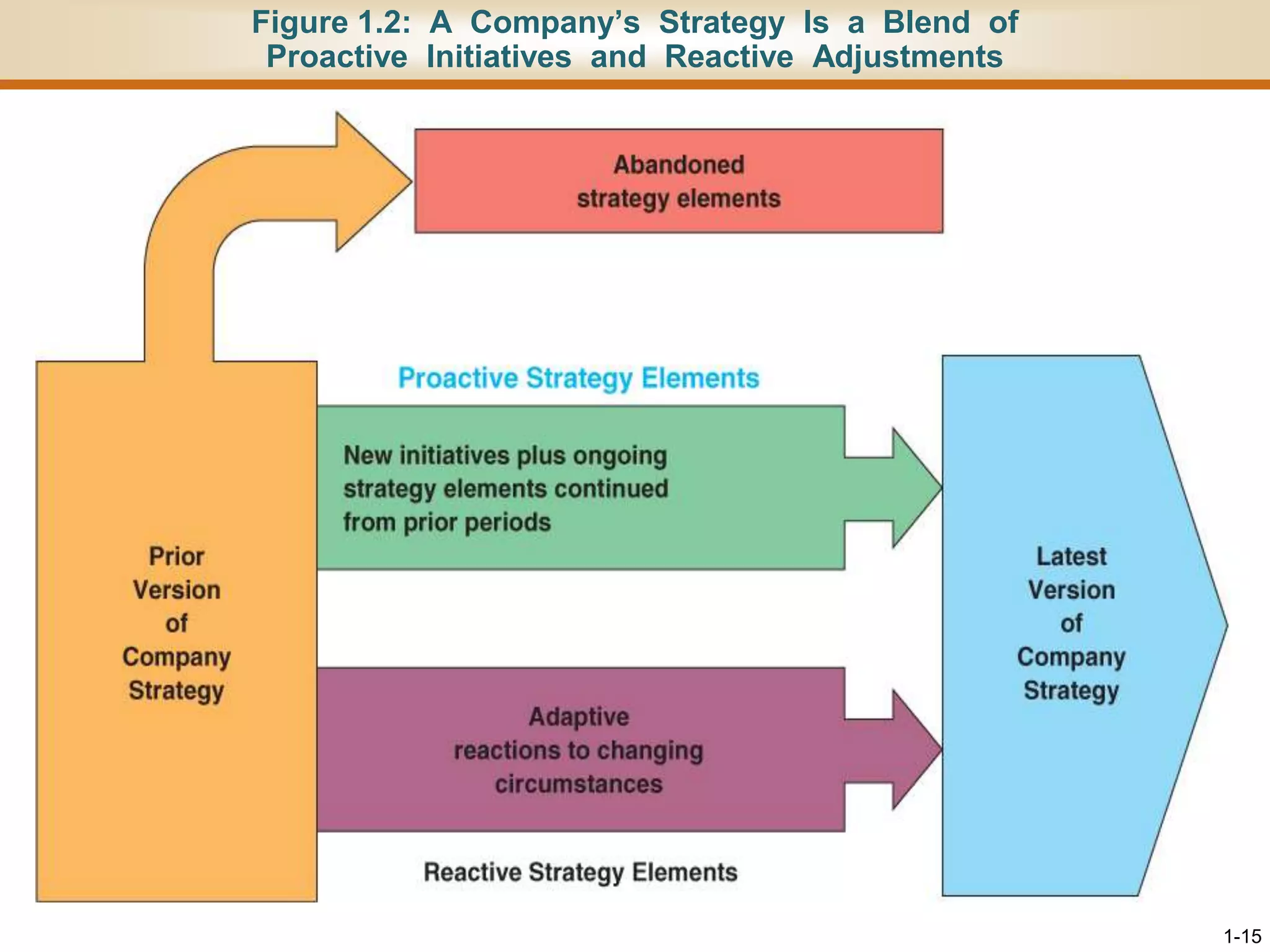
Why Do Strategies Evolve?
 A company’s strategy is a work in progress
 Changes may be necessary to react to
 Financial crisis
 Fresh moves of competitors
 Evolving customer preferences
 Technological breakthroughs
 Emerging market opportunities
 Changing political or economic climate
 New ideas to improve strategy
Figure 1.2: A Company’s Strategy Is a Blend of
Proactive Initiatives and Reactive Adjustments
1-15
1-16
What Is a Business Model?
 A business model addresses “How do we
make money in this business?”
 Is the company’s strategy capable of delivering
good bottom-line results?
 Do the revenue-cost-profit economics
of the strategy make good business sense?
 Look at revenue streams the
strategy is expected to produce
 Look at associated cost structure
and potential profit margins
 Do resulting earnings streams and ROI indicate the
strategy has good potential to deliver acceptable
profitability?
Relationship Between
Strategy and Business Model
Strategy . . .
Deals with a company’s
competitive initiatives and
business approaches
Business Model . . .
Concerns whether revenues
and costs flowing from the
strategy demonstrate a
business can be profitable
and viable
1-17
1-18
Tests of a Winning Strategy
 GOODNESS OF FIT TEST
 How well does the strategy fit
the company’s external and
internal situation?
 COMPETITIVE ADVANTAGE TEST
 Is the strategy helping the company achieve a
sustainable competitive advantage?
 PERFORMANCE TEST
 Is the strategy resulting in better company
performance?
1-19
Why Should Crafting and Executing Strategy
Be Top-Priority Management Tasks?
 A compelling need exists for
managers to proactively
shape how a firm’s business
will be conducted
 A strategy-focused firm is
more likely to be a strong
bottom-line performer
than one that views strategy
as secondary
1-20
Good Strategy + Good Strategy
Execution = Good Management
 Crafting and executing strategy are core
management functions
 Among all things managers do, nothing
affects a company’s ultimate success or
failure more fundamentally than how well its
management team
 Charts a company’s direction,
 Develops competitively effective strategic
moves and business approaches, and
 Pursues what needs to be done internally to
produce good day-in/day-out strategy execution
Excellent execution of an excellent strategy is the
best test of managerial excellence – and the
most reliable recipe for winning in the marketplace!

Smis 01

  • 1.
    1-1 Chapter One What IsStrategy And Why Is It Important Slides Prepared by: Professor M. A. Kashem Deptt. Of MIS, DU Spring 2019
  • 2.
    1-2 Chapter Learning Objectives 1.What we mean by a company’s strategy 2. Understanding the concept of sustainable competitive advantage 3. The Five most strategic approaches for setting a company apart from rivals and winning a sustainable competitive advantage 4. Why a company’s strategy tends to evolve because of changing circumstances and ongoing efforts by management to improve the strategy 5. Why it is important for a company to have a viable business model that outlines the company’s customer value proposition and its profit formula. 6. Gain awareness of the three tests that distinguish a winning strategy from a so-so or flawed strategy. 7. Learn why good strategy and good strategy execution are the most trustworthy signs of good management.
  • 3.
    1-3 Chapter Roadmap  WhatDo We Mean by “Strategy?”  Strategy and the Quest for Competitive Advantage  Identifying a Company’s Strategy  Why a Company’s Strategy Evolves Over Time  A Company’s Strategy Is Partly Proactive and Partly Reactive  Strategy and Ethics: Passing the Test of Moral Scrutiny  The Relationship Between a Company’s Strategy and Its Business Model  What Makes a Strategy a Winner?  Why Are Crafting and Executing Strategy Important?
  • 4.
    1-4 Thinking Strategically: The ThreeBig Strategic Questions 1. What’s the company’s present situation? 2. Where does the company need to go from here?  Business(es) to be in and market positions to stake out  Buyer needs and groups to serve  Direction to head 3. How should it get there?  A company’s answer to “how will we get there?” is its strategy
  • 5.
    1-5 What Do WeMean By “Strategy?”  Set of actions that its managers take to outperform the company’s competitors and achieve superior profitability.  Consists of competitive moves and business approaches used by managers to run the company  Management’s “action plan” to  Grow the business  Attract and please customers  Compete successfully  Conduct operations  Achieve the targeted levels of organizational performance
  • 6.
    1-6 The Hows ThatDefine a Firm's Strategy  How to position the company in the market place.  How to attract customers  How to outcompete rivals  How to capitalize on opportunities to grow business  How to manage each functional piece of the business (R&D, production, marketing, HR, finance, and so on)  How to respond to changing market conditions  How to achieve targeted levels of performance
  • 7.
    1-7 Choosing the “Hows”of Strategy  Strategic choices about “how” are based on  Trial-and-error organizational learning about what has worked and what has not worked  Management’s appetite for taking risks  Managerial analysis and strategic thinking about how best to proceed, given market conditions and a company’s circumstances  In choosing a strategy, management is in effect saying, “Among all the many different ways of competing we could have chosen, we have decided to employ this combination of competitive and operating approaches to move the company in the intended direction, strengthen its market position and competitiveness, and boost performance.”
  • 8.
    1-8 Strategy is AboutCompeting Differently  Inclusion of some distinctive elements in products  What rival firms can’t or don’t do;  Better chance of winning a strategy depends on: Appealing to buyer in ways that set a company apart from rivals; Staking out a market that is not crowded with competitors.
  • 9.
    1-9 Figure 1.1: Identifyinga Company’s Strategy , p-5 1-9
  • 10.
    1-10 Key Elements ofa Successful Strategy  Developing a successful strategy hinges on making competitive moves aimed at  Appealing to buyers in ways to set the company apart from rivals and  Carving out its own market position  Involves developing a distinctive “aha” element to  Attract customers and  Produce a competitive edge Copying competitive moves of other successful companies rarely works!
  • 11.
    1-11 Strategy and theQuest for Competitive Advantage  The heart and soul of any strategy are actions a company makes to  Improve its financial performance,  Strengthen its competitive position, and  Gain a competitive advantage over rivals  A creative, distinctive strategy that sets a company apart from rivals and yields a competitive advantage is a company’s most reliable ticket to above average profitability  Operating with a competitive advantage is more profitable than operating without one  Operating with a competitive disadvantage nearly always results in below-average profitability
  • 12.
    1-12 A Powerful StrategyLeads to Sustainable Competitive Advantage  A company achieves sustainable competitive advantage when  An attractive number of buyers prefer its products/services over those of rivals and  The basis for this preference is durable  Its nice when a strategy produces  A temporary competitive edge but  A sustainable edge over rivals greatly enhances a company’s prospects for above-average profitability What separates a powerful strategy from an ordinary strategy is management’s ability to forge a series of moves, both in the marketplace and internally, that produces sustainable competitive advantage!
  • 13.
    1-13 Strategic Approaches toBuilding Sustainable Competitive Advantage  Be the industry’s low-cost provider  Achieve a cost-based competitive advantage  Incorporate differentiating features  Superior product/service keyed to higher quality, better performance, wider selection, value-added services, or some other attribute  Focus on a narrow market niche  Win a competitive edge by doing a better job than rivals of serving the needs and preferences of buyers in the niche  A best-cost provider strategy  giving customers more value for the money.  Develop expertise and resource strengths not easily imitated or matched by rivals  Achieve a capabilities-based competitive advantage
  • 14.
    1-14 Why Do StrategiesEvolve?  A company’s strategy is a work in progress  Changes may be necessary to react to  Financial crisis  Fresh moves of competitors  Evolving customer preferences  Technological breakthroughs  Emerging market opportunities  Changing political or economic climate  New ideas to improve strategy
  • 15.
    Figure 1.2: ACompany’s Strategy Is a Blend of Proactive Initiatives and Reactive Adjustments 1-15
  • 16.
    1-16 What Is aBusiness Model?  A business model addresses “How do we make money in this business?”  Is the company’s strategy capable of delivering good bottom-line results?  Do the revenue-cost-profit economics of the strategy make good business sense?  Look at revenue streams the strategy is expected to produce  Look at associated cost structure and potential profit margins  Do resulting earnings streams and ROI indicate the strategy has good potential to deliver acceptable profitability?
  • 17.
    Relationship Between Strategy andBusiness Model Strategy . . . Deals with a company’s competitive initiatives and business approaches Business Model . . . Concerns whether revenues and costs flowing from the strategy demonstrate a business can be profitable and viable 1-17
  • 18.
    1-18 Tests of aWinning Strategy  GOODNESS OF FIT TEST  How well does the strategy fit the company’s external and internal situation?  COMPETITIVE ADVANTAGE TEST  Is the strategy helping the company achieve a sustainable competitive advantage?  PERFORMANCE TEST  Is the strategy resulting in better company performance?
  • 19.
    1-19 Why Should Craftingand Executing Strategy Be Top-Priority Management Tasks?  A compelling need exists for managers to proactively shape how a firm’s business will be conducted  A strategy-focused firm is more likely to be a strong bottom-line performer than one that views strategy as secondary
  • 20.
    1-20 Good Strategy +Good Strategy Execution = Good Management  Crafting and executing strategy are core management functions  Among all things managers do, nothing affects a company’s ultimate success or failure more fundamentally than how well its management team  Charts a company’s direction,  Develops competitively effective strategic moves and business approaches, and  Pursues what needs to be done internally to produce good day-in/day-out strategy execution Excellent execution of an excellent strategy is the best test of managerial excellence – and the most reliable recipe for winning in the marketplace!