Strategic Management
Module 1 – Meaning, Importance,
Characteristics
Contents
 What Do We Mean By Strategy?
 Strategy and the Quest for Competitive Advantage
 Why a Company’s Strategy Evolves Over Time
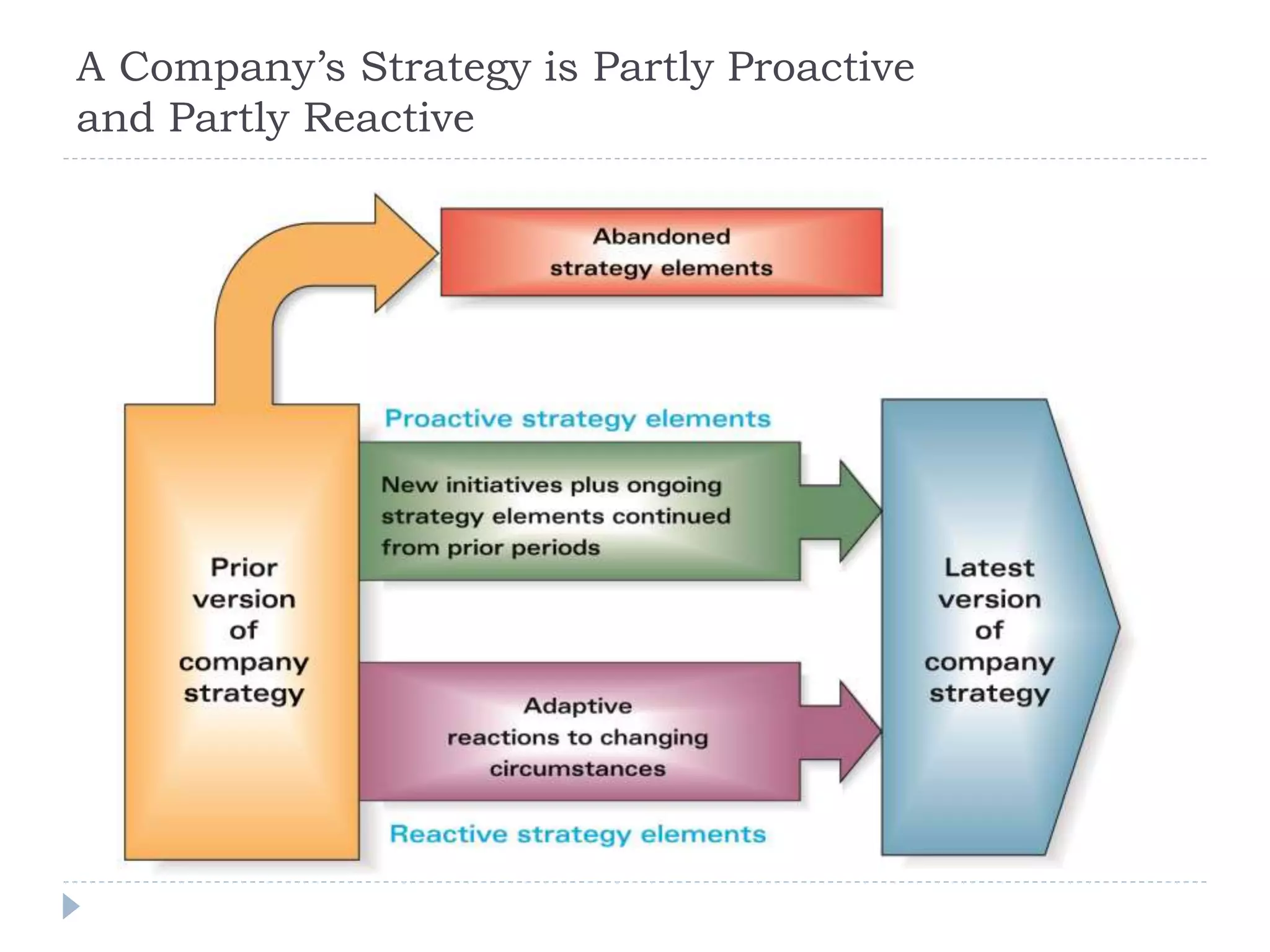
 A Company’s Strategy is Partly Proactive and Partly Reactive
 Strategy and Ethics: Passing the Test of Moral Scrutiny
 The Relationship Between a Company’s Strategy and Its
Business Model
 What Makes a Strategy a Winner?
 Why Are Crafting and Executing Strategy Important?
Thinking Strategically:
The Three Big Strategic Questions
1. What’s the company’s present situation?
2. Where does the company need to go from here?
 Businesses and markets to venture into
 Consumer requirements and groups to serve
 Which direction to head into?
3. How should it get there?
 A company’s answer to “how will we get there?”
is its strategy
E.g. Infosys’s 3.0 strategy
What Do We Mean By ‘Strategy’?
 Consists of competitive moves and business
approaches used by management to run the company
 Management’s “action plan” to:
 Grow the business
 Attract and delight clients
 Compete successfully
 Conduct operations well
 Achieve target levels of
organizational performance
The ‘Hows’ That Define a Firm's Strategy
 How to grow the business - Organic/Inorganic
 How to delight customers – Superior products/services
 How to outcompete rivals – Innovative practices
 How to manage each functional
portion of the business (R&D, Production, Marketing,
HR, Finance etc.) – Robust policies and procedures
 How to respond to changing market conditions – Agile
Sales and Operations
 How to achieve targeted levels of performance –
Absolute focus and clarity
Strategy
is HOW
to . . .
Choosing the ‘Hows’ of Strategy
 Strategic choices about “how” are based on:
 Trial-and-error organizational learning about what has worked
and what has not worked
 Management’s appetite for taking risks
 Managerial analysis and strategic thinking about how best to
proceed, given market conditions and the company’s
circumstances
 e.g. Tata Motors takeover of Jaguar-Land Rover
 In choosing a strategy, management is in effect saying:
“Among all the many different business approaches and ways of
competing we could have chosen, we have decided to employ
this particular combination of competitive and operating
approaches in moving the company in the intended direction,
strengthening its market position, competitiveness and boosting
performance.”
Key Elements of a Successful Strategy
 Developing a successful strategy depends on making
competitive moves aimed at:
 Appealing to buyers in ways to set the enterprise apart from rivals
 Carving out its own market position
 e.g. Nike
 Involves developing a distinctive inspirational
element to:
 Attract customers
 Produce a competitive edge
 e.g. Apple
Copying competitive moves of other successful
companies rarely works!
Strategy and the Quest for Competitive
Advantage
 The heart and soul of any strategy are the actions and
moves in the marketplace that a company makes to
strengthen its competitive position and gain a
competitive advantage over rivals
 A creative and distinctive strategy that sets a company
apart from rivals and yields a competitive advantage is a
company’s most reliable approach to increase
profitability:
 Competing with a competitive dis-advantage almost
always results in below-average profitability
 Competing with a competitive advantage is more
profitable
than competing with no advantage
A Powerful Strategy Leads to
Sustainable Competitive Advantage
 A company achieves sustainable competitive advantage when
more number or buyers prefer its products/services over those of
rivals and when the basis for this preference can be maintained
over time
 Its nice when a strategy produces a temporary competitive edge but
a durable edge over rivals greatly enhances a company’s
prospects for winning in the marketplace and realizing higher profits
in the longer term
What separates a powerful strategy from an ordinary
strategy is management’s ability to forge a series of
moves, both in the marketplace and internally that
produces sustainable competitive advantage!
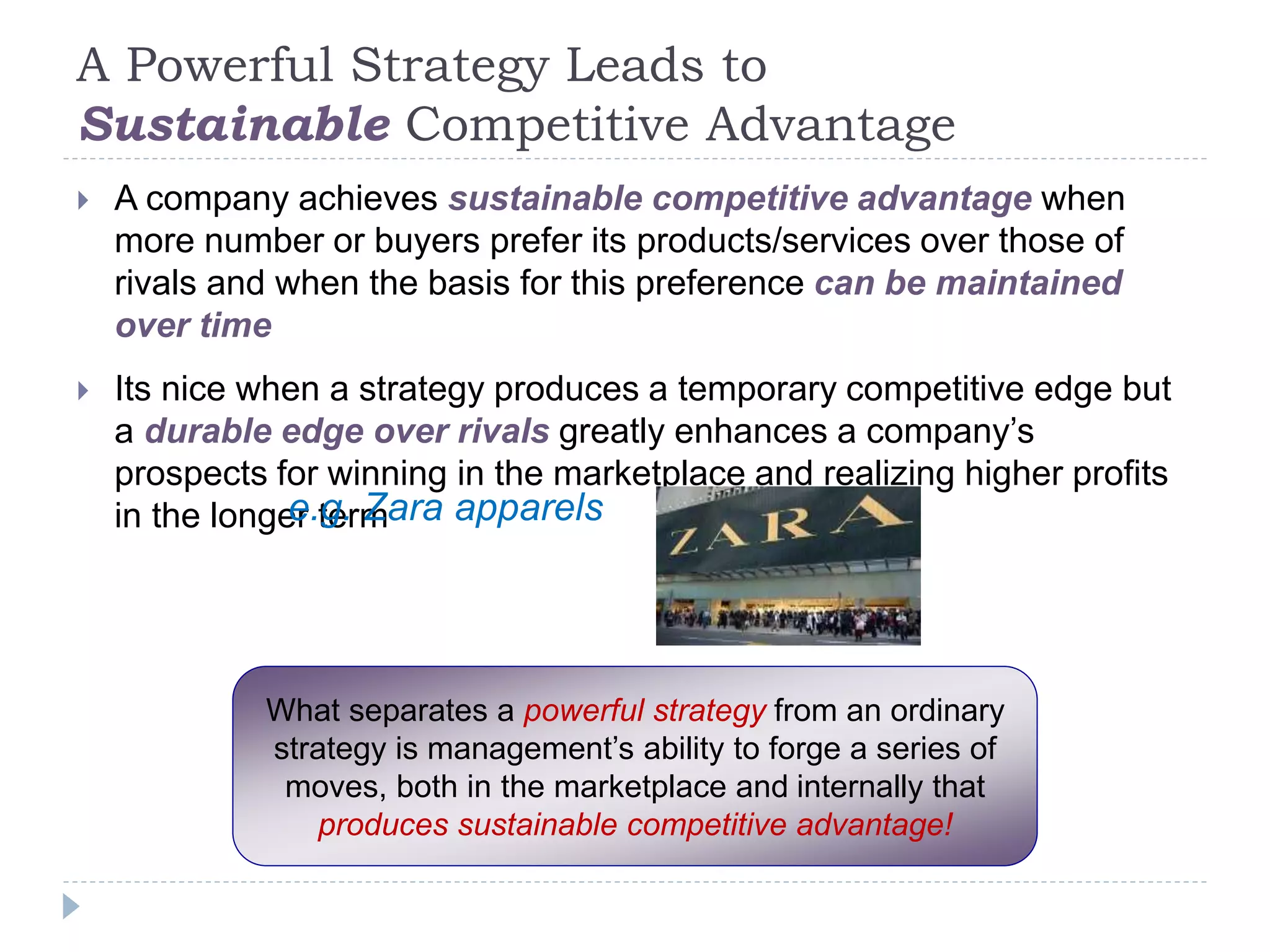
e.g. Zara apparels
Four “Best” Strategic Approaches to
Building Sustainable Competitive Advantage
 Strive to be the industry’s low-cost provider (a cost-based
competitive advantage):
 Big Bazaar – Low cost household products
 Indigo Airlines – No frills, low cost airline
 Outcompete rivals on a key differentiating feature (a “superior
product” type of competitive advantage linked to higher quality,
better performance, wider selection, value-added services or some
other attribute):
 Harley-Davidson – King-of-the-road styling
 Rolex – Top-of-the-line prestige
 BMW – Engineering design and performance
 Amazon.com – Wide selection and convenience
Four “Best” Strategic Approaches to
Building Sustainable Competitive Advantage
 Focus on a narrow market niche (winning a competitive edge
by doing a better job than rivals of serving the needs and
preferences of buyers comprising the niche):
 eBay – Online auctions
 Kaspersky – Virus protection products
 Starbucks – Premium coffees
 Discovery Channel – Science and Technology programs
 Develop expertise, resource strengths and capabilities not
easily imitated by rivals (a capabilities-based competitive
advantage):
 FedEx – Next-day delivery of small packages
 Disneyland – Theme parks and family entertainment
 Toyota – Sophisticated manufacturing system
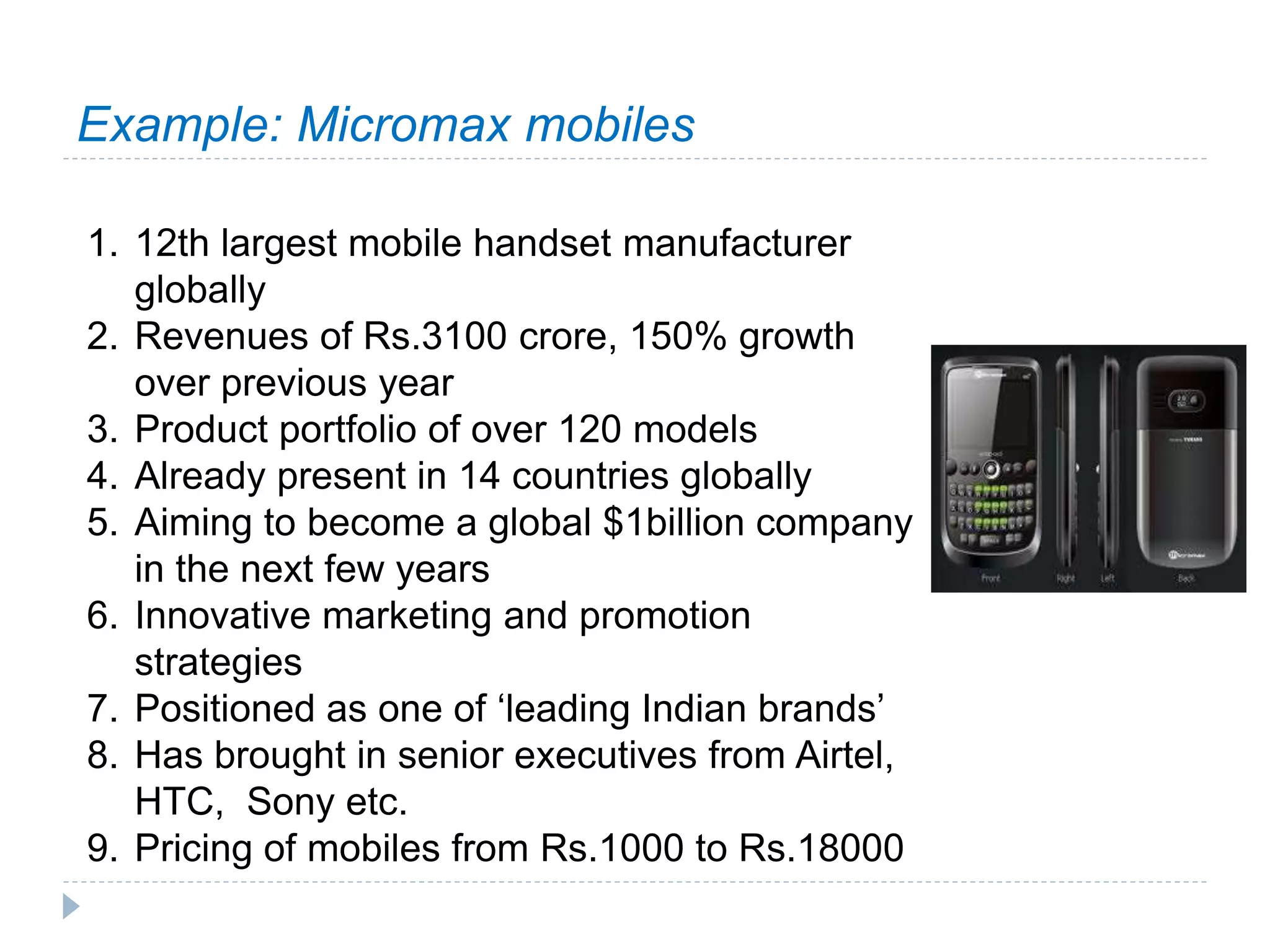
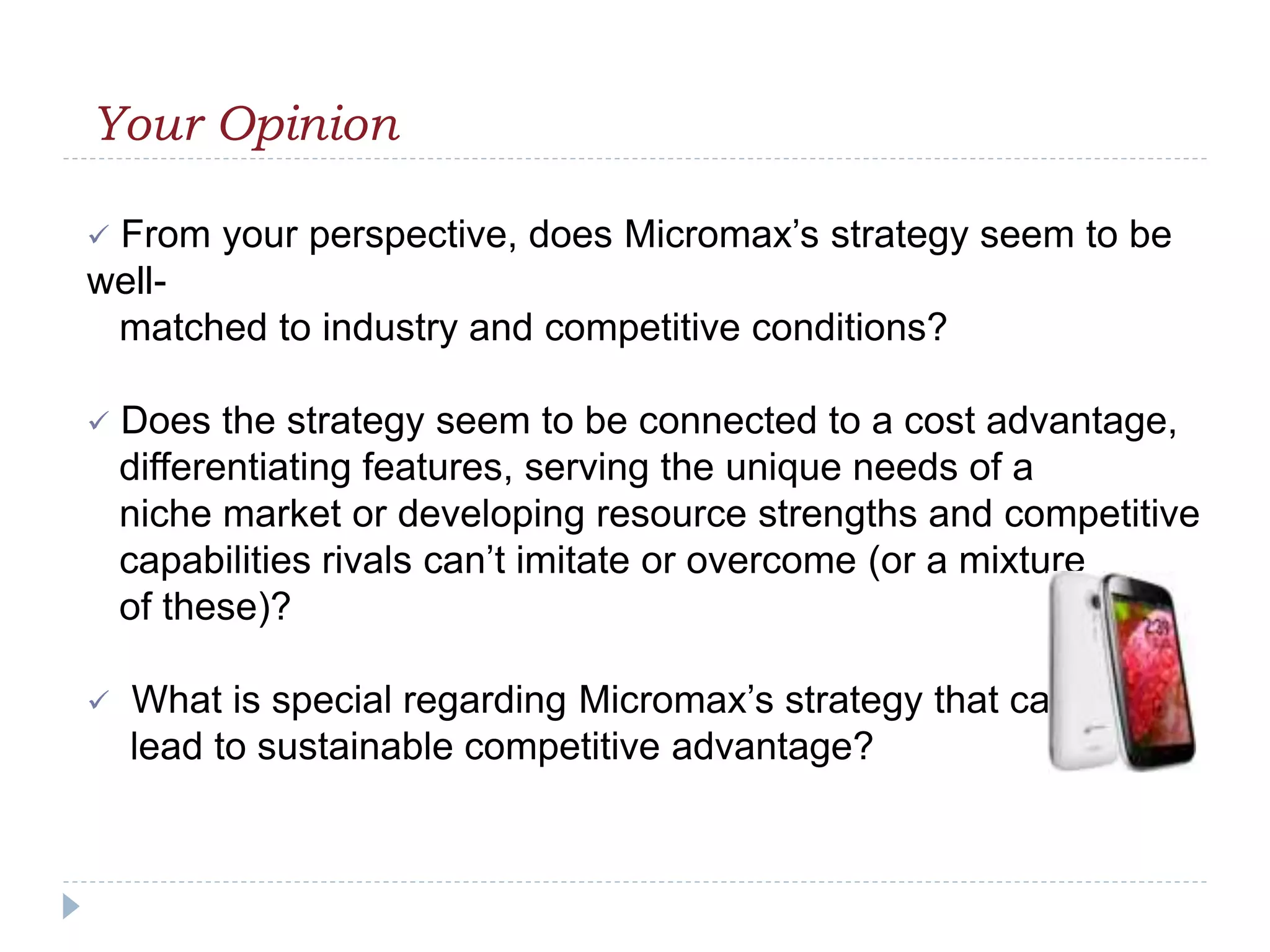
Example: Micromax mobiles
1. 12th largest mobile handset manufacturer
globally
2. Revenues of Rs.3100 crore, 150% growth
over previous year
3. Product portfolio of over 120 models
4. Already present in 14 countries globally
5. Aiming to become a global $1billion company
in the next few years
6. Innovative marketing and promotion
strategies
7. Positioned as one of ‘leading Indian brands’
8. Has brought in senior executives from Airtel,
HTC, Sony etc.
9. Pricing of mobiles from Rs.1000 to Rs.18000
Your Opinion
 From your perspective, does Micromax’s strategy seem to be
well-
matched to industry and competitive conditions?
 Does the strategy seem to be connected to a cost advantage,
differentiating features, serving the unique needs of a
niche market or developing resource strengths and competitive
capabilities rivals can’t imitate or overcome (or a mixture
of these)?
 What is special regarding Micromax’s strategy that can
lead to sustainable competitive advantage?
Test Your Knowledge
A company’s strategy and its quest for competitive advantage are
closely related because
A. a company’s strategy determines whether it will have lower or
higher costs than rivals and thus be at a competitive advantage
or disadvantage.
B. competitive advantage is essential to having a profitable
business model.
C. choosing a competitive advantage to pursue also helps a
company choose which business model is most appropriate.
D. competitive advantage enables a company to achieve its
strategic objectives.
E. a strategy that leads to sustainable competitive advantage is a
company’s most reliable means of achieving higher profitability
and financial performance.
Why Do Strategies Evolve?
 A company’s strategy is a work in progress
 Changes may be necessary to react to:
 Shifting market conditions - Recession
 Technological breakthroughs
 Fresh moves of competitors
 Evolving customer preferences
 Emerging market opportunities – BRICS countries
 New ideas to improve strategy
 Crisis situations – Falling market share
A Company’s Strategy is Partly Proactive
and Partly Reactive
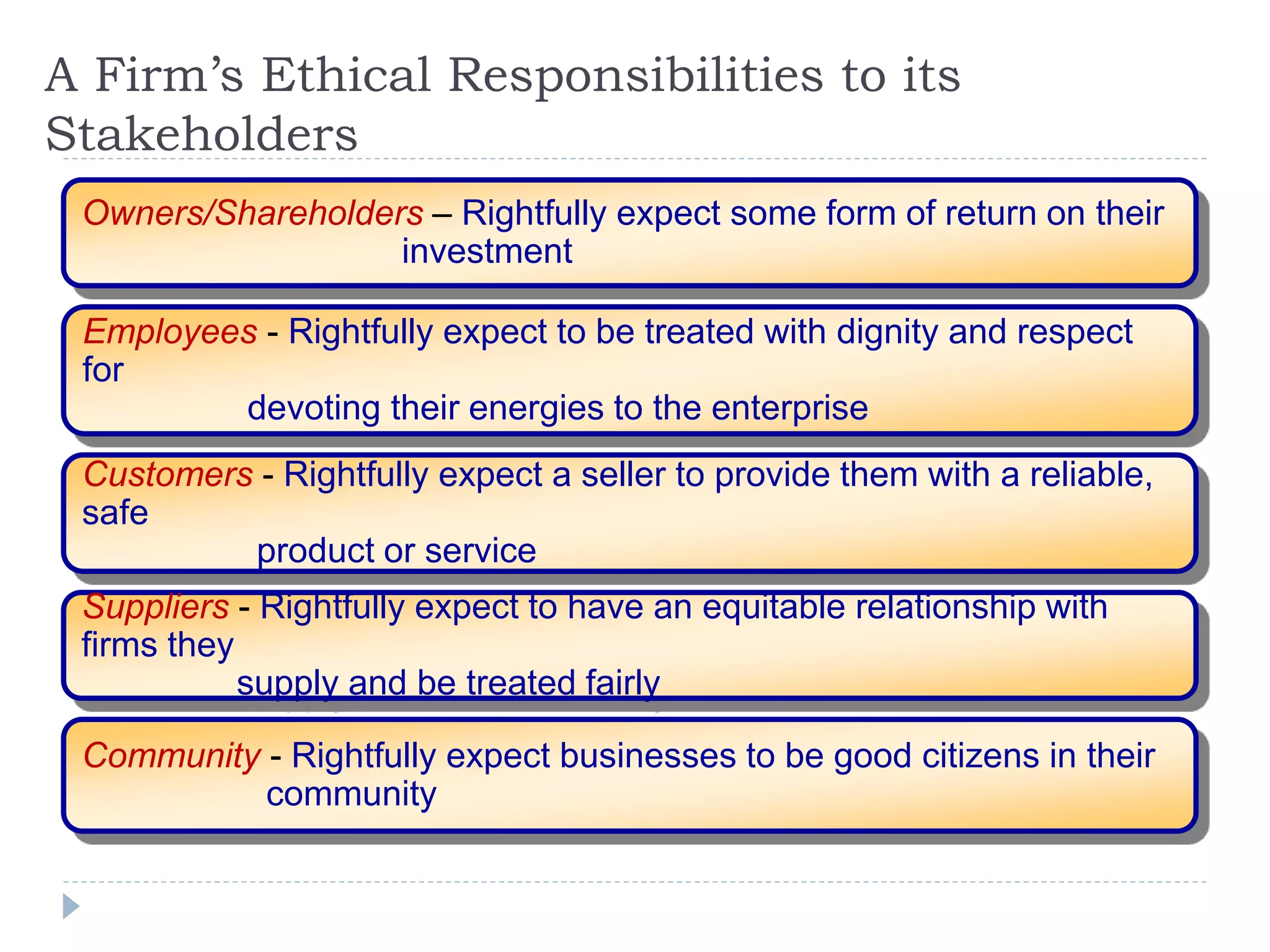
A Firm’s Ethical Responsibilities to its
Stakeholders
Owners/Shareholders – Rightfully expect some form of return on their
investment
Employees - Rightfully expect to be treated with dignity and respect
for
devoting their energies to the enterprise
Customers - Rightfully expect a seller to provide them with a reliable,
safe
product or service
Suppliers - Rightfully expect to have an equitable relationship with
firms they
supply and be treated fairly
Community - Rightfully expect businesses to be good citizens in their
community
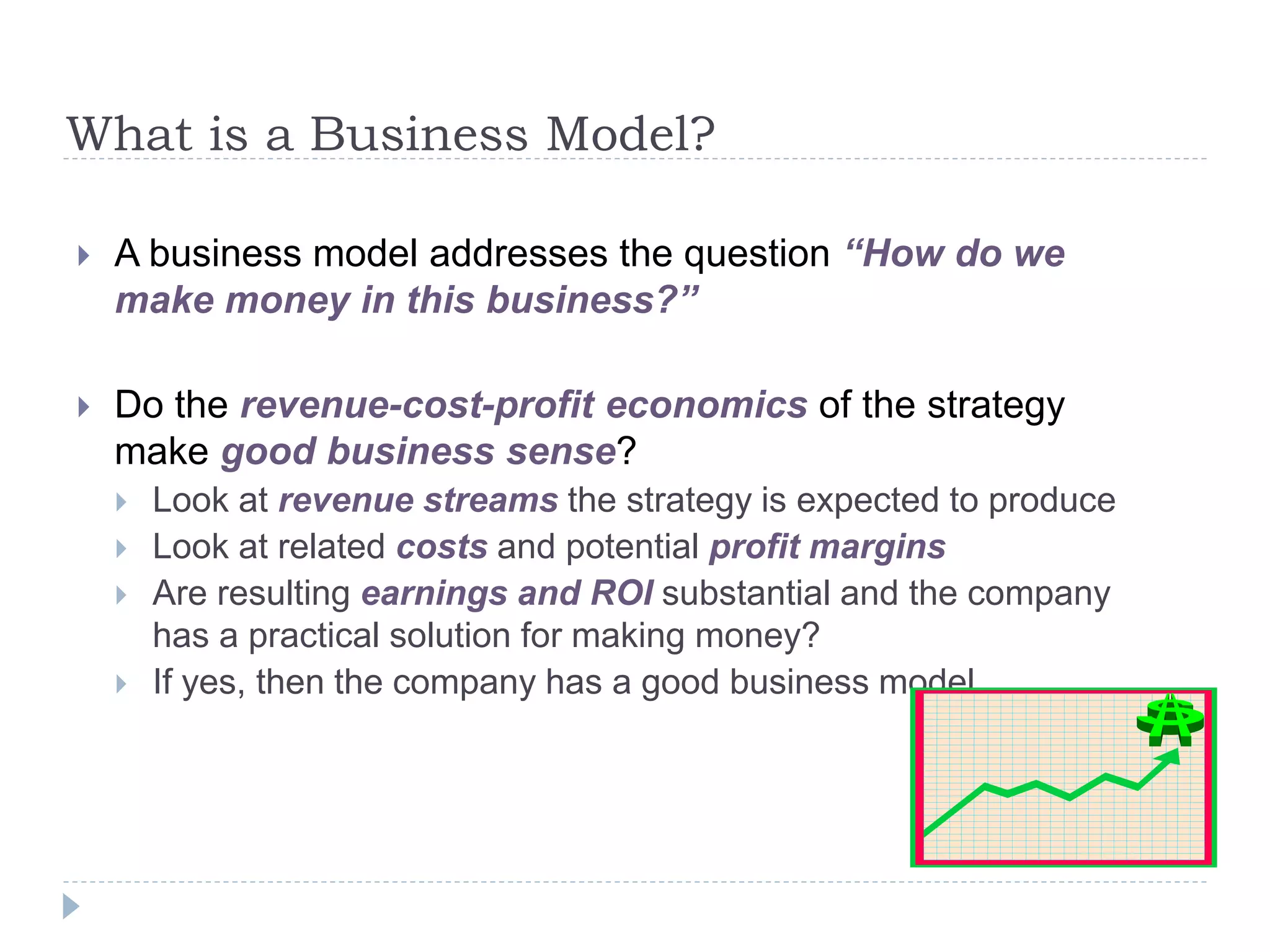
What is a Business Model?
 A business model addresses the question “How do we
make money in this business?”
 Do the revenue-cost-profit economics of the strategy
make good business sense?
 Look at revenue streams the strategy is expected to produce
 Look at related costs and potential profit margins
 Are resulting earnings and ROI substantial and the company
has a practical solution for making money?
 If yes, then the company has a good business model
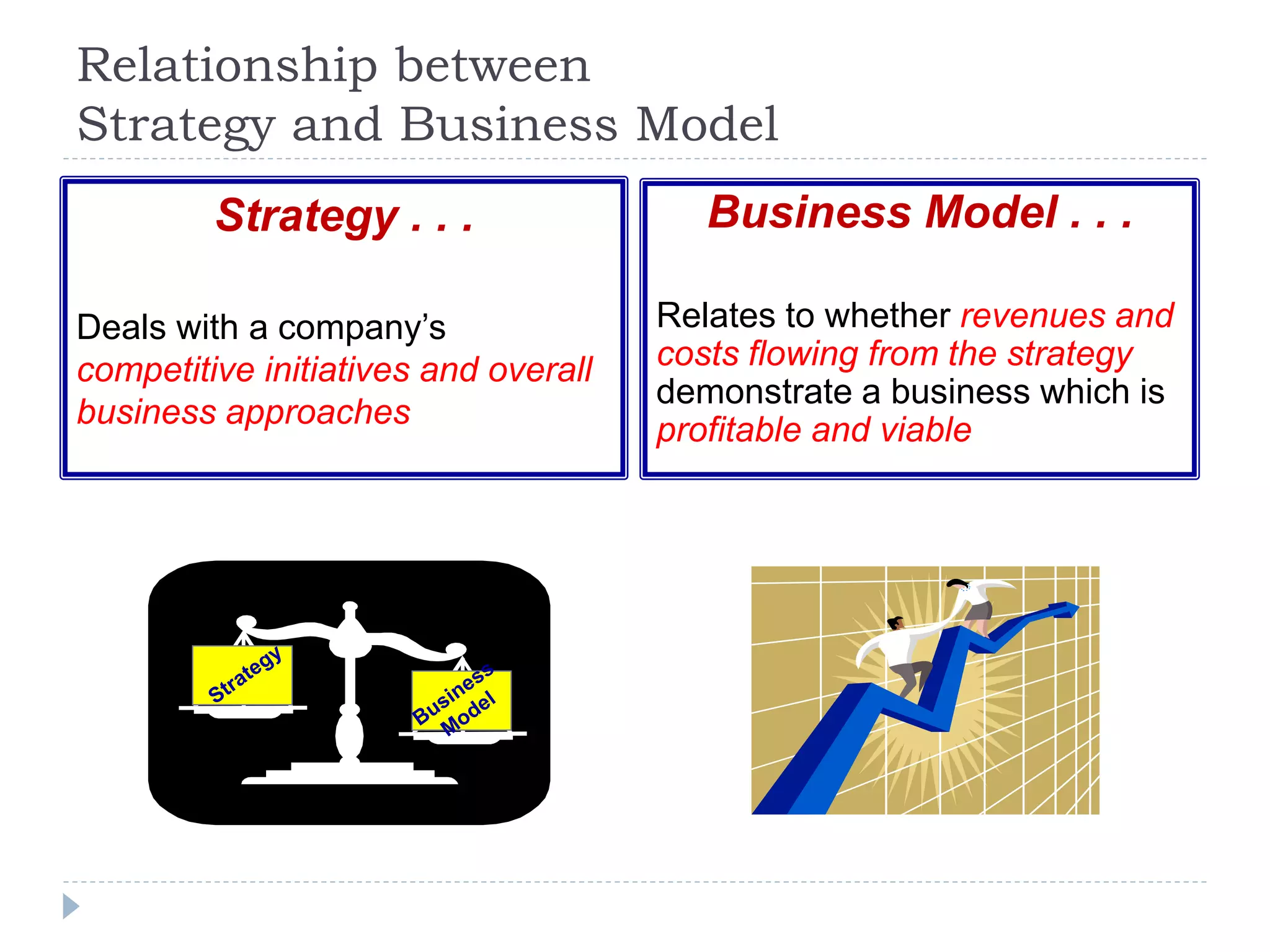
Relationship between
Strategy and Business Model
Strategy . . .
Deals with a company’s
competitive initiatives and overall
business approaches
Business Model . . .
Relates to whether revenues and
costs flowing from the strategy
demonstrate a business which is
profitable and viable
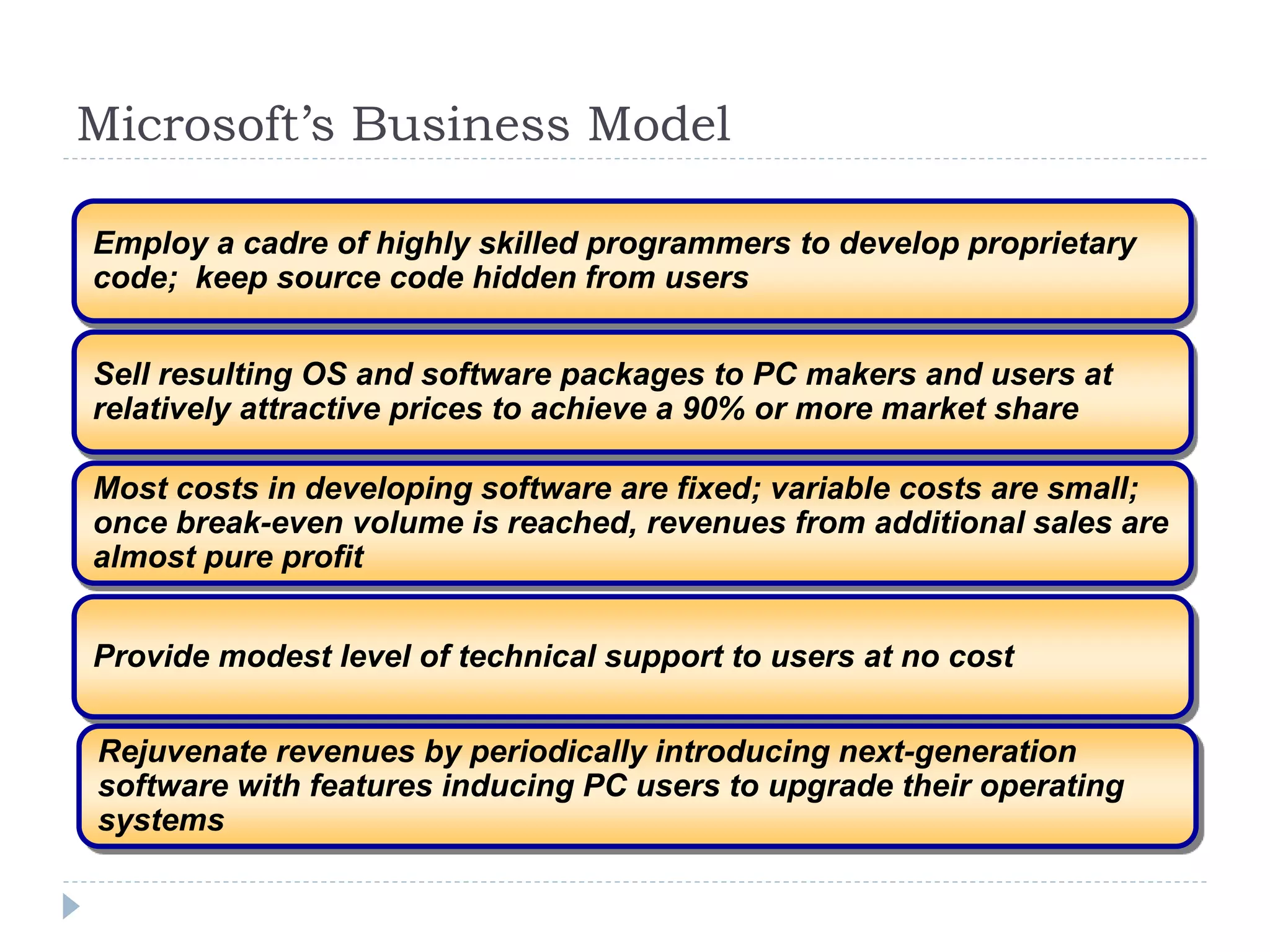
Microsoft’s Business Model
Employ a cadre of highly skilled programmers to develop proprietary
code; keep source code hidden from users
Sell resulting OS and software packages to PC makers and users at
relatively attractive prices to achieve a 90% or more market share
Most costs in developing software are fixed; variable costs are small;
once break-even volume is reached, revenues from additional sales are
almost pure profit
Provide modest level of technical support to users at no cost
Rejuvenate revenues by periodically introducing next-generation
software with features inducing PC users to upgrade their operating
systems
Test Your Knowledge
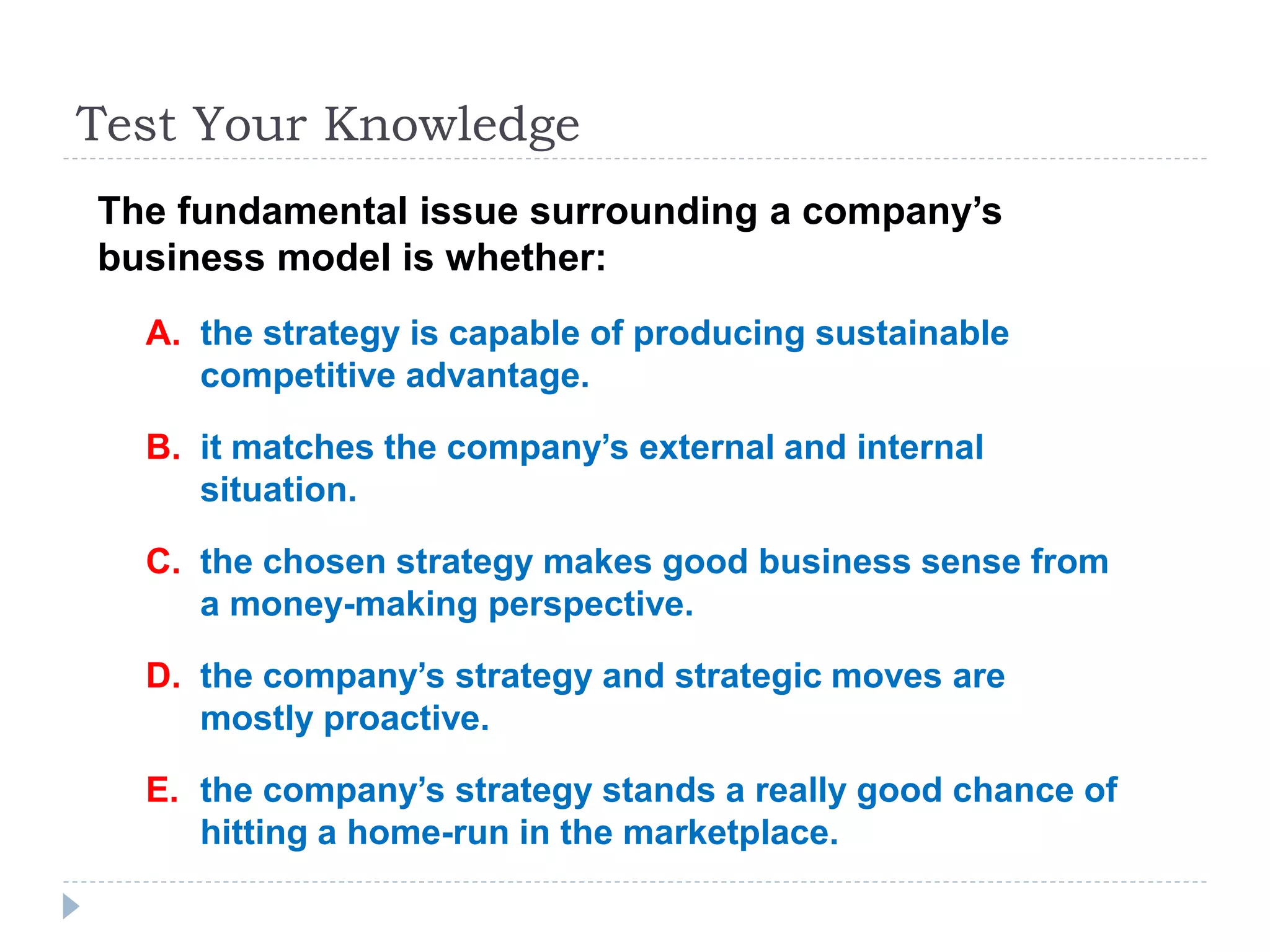
The fundamental issue surrounding a company’s
business model is whether:
A. the strategy is capable of producing sustainable
competitive advantage.
B. it matches the company’s external and internal
situation.
C. the chosen strategy makes good business sense from
a money-making perspective.
D. the company’s strategy and strategic moves are
mostly proactive.
E. the company’s strategy stands a really good chance of
hitting a home-run in the marketplace.
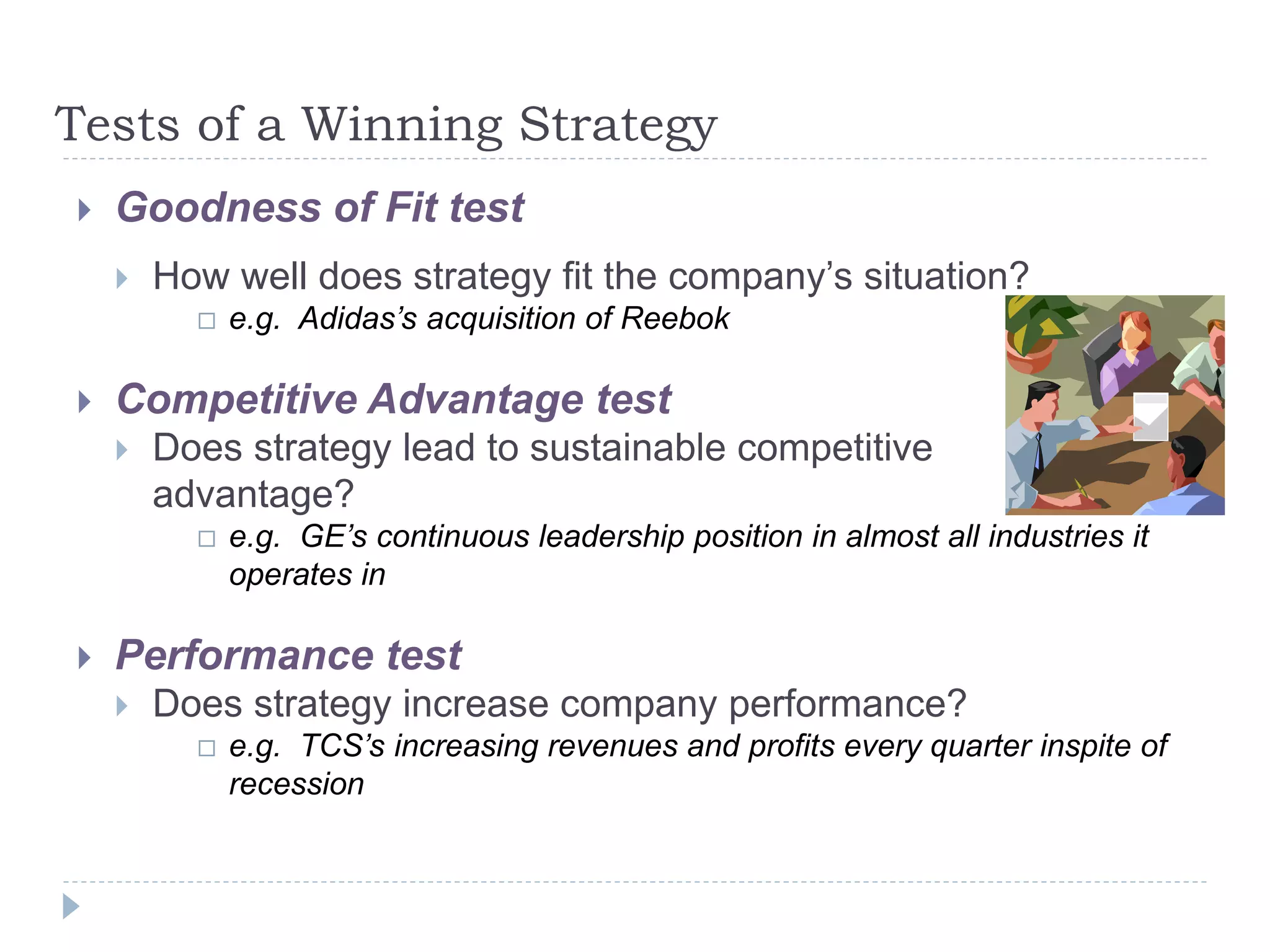
Tests of a Winning Strategy
 Goodness of Fit test
 How well does strategy fit the company’s situation?
 e.g. Adidas’s acquisition of Reebok
 Competitive Advantage test
 Does strategy lead to sustainable competitive
advantage?
 e.g. GE’s continuous leadership position in almost all industries it
operates in
 Performance test
 Does strategy increase company performance?
 e.g. TCS’s increasing revenues and profits every quarter inspite of
recession
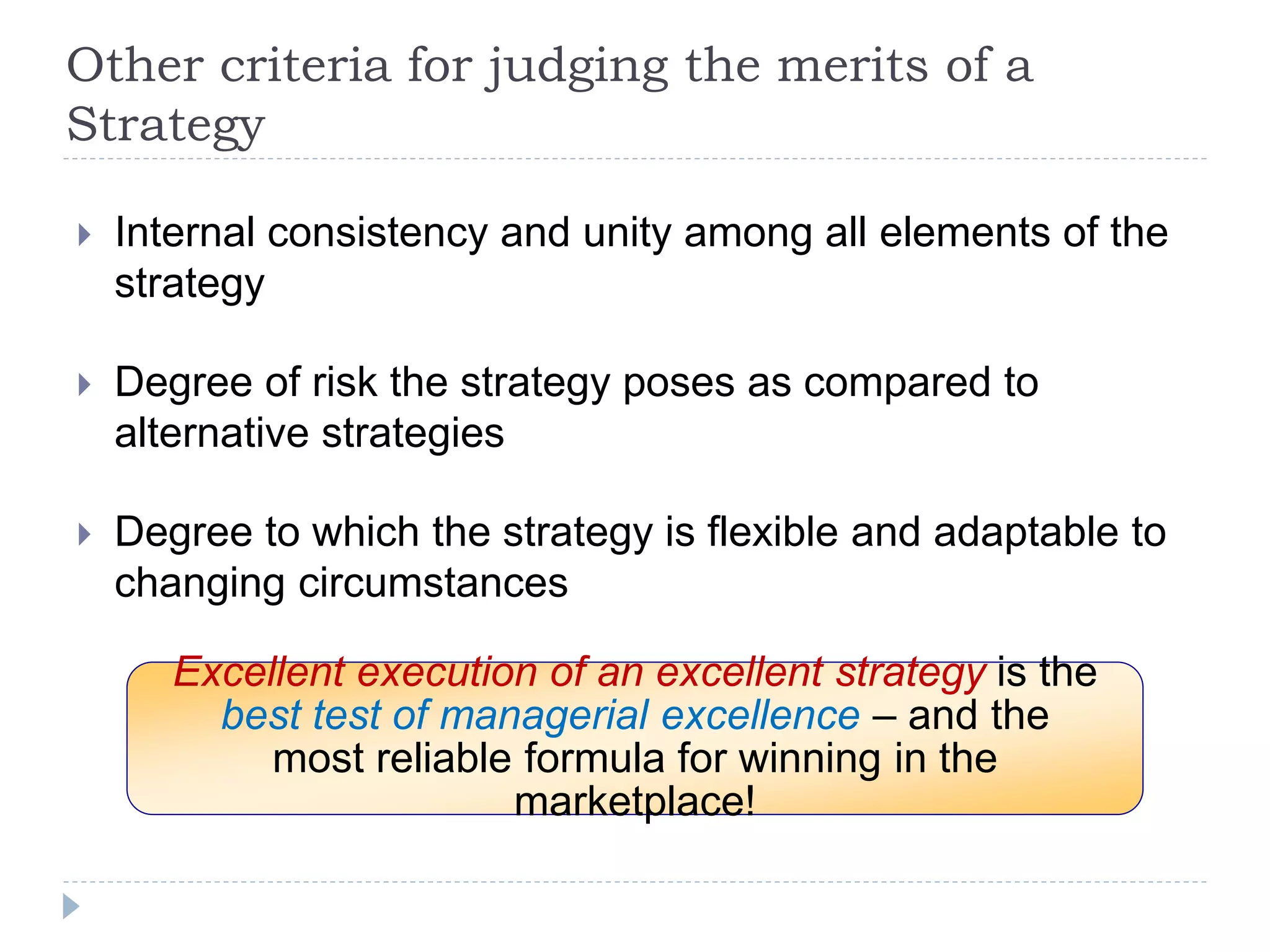
Other criteria for judging the merits of a
Strategy
 Internal consistency and unity among all elements of the
strategy
 Degree of risk the strategy poses as compared to
alternative strategies
 Degree to which the strategy is flexible and adaptable to
changing circumstances
Excellent execution of an excellent strategy is the
best test of managerial excellence – and the
most reliable formula for winning in the
marketplace!

Module 1

  • 1.
    Strategic Management Module 1– Meaning, Importance, Characteristics
  • 2.
    Contents  What DoWe Mean By Strategy?  Strategy and the Quest for Competitive Advantage  Why a Company’s Strategy Evolves Over Time  A Company’s Strategy is Partly Proactive and Partly Reactive  Strategy and Ethics: Passing the Test of Moral Scrutiny  The Relationship Between a Company’s Strategy and Its Business Model  What Makes a Strategy a Winner?  Why Are Crafting and Executing Strategy Important?
  • 3.
    Thinking Strategically: The ThreeBig Strategic Questions 1. What’s the company’s present situation? 2. Where does the company need to go from here?  Businesses and markets to venture into  Consumer requirements and groups to serve  Which direction to head into? 3. How should it get there?  A company’s answer to “how will we get there?” is its strategy E.g. Infosys’s 3.0 strategy
  • 4.
    What Do WeMean By ‘Strategy’?  Consists of competitive moves and business approaches used by management to run the company  Management’s “action plan” to:  Grow the business  Attract and delight clients  Compete successfully  Conduct operations well  Achieve target levels of organizational performance
  • 5.
    The ‘Hows’ ThatDefine a Firm's Strategy  How to grow the business - Organic/Inorganic  How to delight customers – Superior products/services  How to outcompete rivals – Innovative practices  How to manage each functional portion of the business (R&D, Production, Marketing, HR, Finance etc.) – Robust policies and procedures  How to respond to changing market conditions – Agile Sales and Operations  How to achieve targeted levels of performance – Absolute focus and clarity Strategy is HOW to . . .
  • 6.
    Choosing the ‘Hows’of Strategy  Strategic choices about “how” are based on:  Trial-and-error organizational learning about what has worked and what has not worked  Management’s appetite for taking risks  Managerial analysis and strategic thinking about how best to proceed, given market conditions and the company’s circumstances  e.g. Tata Motors takeover of Jaguar-Land Rover  In choosing a strategy, management is in effect saying: “Among all the many different business approaches and ways of competing we could have chosen, we have decided to employ this particular combination of competitive and operating approaches in moving the company in the intended direction, strengthening its market position, competitiveness and boosting performance.”
  • 7.
    Key Elements ofa Successful Strategy  Developing a successful strategy depends on making competitive moves aimed at:  Appealing to buyers in ways to set the enterprise apart from rivals  Carving out its own market position  e.g. Nike  Involves developing a distinctive inspirational element to:  Attract customers  Produce a competitive edge  e.g. Apple Copying competitive moves of other successful companies rarely works!
  • 8.
    Strategy and theQuest for Competitive Advantage  The heart and soul of any strategy are the actions and moves in the marketplace that a company makes to strengthen its competitive position and gain a competitive advantage over rivals  A creative and distinctive strategy that sets a company apart from rivals and yields a competitive advantage is a company’s most reliable approach to increase profitability:  Competing with a competitive dis-advantage almost always results in below-average profitability  Competing with a competitive advantage is more profitable than competing with no advantage
  • 9.
    A Powerful StrategyLeads to Sustainable Competitive Advantage  A company achieves sustainable competitive advantage when more number or buyers prefer its products/services over those of rivals and when the basis for this preference can be maintained over time  Its nice when a strategy produces a temporary competitive edge but a durable edge over rivals greatly enhances a company’s prospects for winning in the marketplace and realizing higher profits in the longer term What separates a powerful strategy from an ordinary strategy is management’s ability to forge a series of moves, both in the marketplace and internally that produces sustainable competitive advantage! e.g. Zara apparels
  • 10.
    Four “Best” StrategicApproaches to Building Sustainable Competitive Advantage  Strive to be the industry’s low-cost provider (a cost-based competitive advantage):  Big Bazaar – Low cost household products  Indigo Airlines – No frills, low cost airline  Outcompete rivals on a key differentiating feature (a “superior product” type of competitive advantage linked to higher quality, better performance, wider selection, value-added services or some other attribute):  Harley-Davidson – King-of-the-road styling  Rolex – Top-of-the-line prestige  BMW – Engineering design and performance  Amazon.com – Wide selection and convenience
  • 11.
    Four “Best” StrategicApproaches to Building Sustainable Competitive Advantage  Focus on a narrow market niche (winning a competitive edge by doing a better job than rivals of serving the needs and preferences of buyers comprising the niche):  eBay – Online auctions  Kaspersky – Virus protection products  Starbucks – Premium coffees  Discovery Channel – Science and Technology programs  Develop expertise, resource strengths and capabilities not easily imitated by rivals (a capabilities-based competitive advantage):  FedEx – Next-day delivery of small packages  Disneyland – Theme parks and family entertainment  Toyota – Sophisticated manufacturing system
  • 12.
    Example: Micromax mobiles 1.12th largest mobile handset manufacturer globally 2. Revenues of Rs.3100 crore, 150% growth over previous year 3. Product portfolio of over 120 models 4. Already present in 14 countries globally 5. Aiming to become a global $1billion company in the next few years 6. Innovative marketing and promotion strategies 7. Positioned as one of ‘leading Indian brands’ 8. Has brought in senior executives from Airtel, HTC, Sony etc. 9. Pricing of mobiles from Rs.1000 to Rs.18000
  • 13.
    Your Opinion  Fromyour perspective, does Micromax’s strategy seem to be well- matched to industry and competitive conditions?  Does the strategy seem to be connected to a cost advantage, differentiating features, serving the unique needs of a niche market or developing resource strengths and competitive capabilities rivals can’t imitate or overcome (or a mixture of these)?  What is special regarding Micromax’s strategy that can lead to sustainable competitive advantage?
  • 14.
    Test Your Knowledge Acompany’s strategy and its quest for competitive advantage are closely related because A. a company’s strategy determines whether it will have lower or higher costs than rivals and thus be at a competitive advantage or disadvantage. B. competitive advantage is essential to having a profitable business model. C. choosing a competitive advantage to pursue also helps a company choose which business model is most appropriate. D. competitive advantage enables a company to achieve its strategic objectives. E. a strategy that leads to sustainable competitive advantage is a company’s most reliable means of achieving higher profitability and financial performance.
  • 15.
    Why Do StrategiesEvolve?  A company’s strategy is a work in progress  Changes may be necessary to react to:  Shifting market conditions - Recession  Technological breakthroughs  Fresh moves of competitors  Evolving customer preferences  Emerging market opportunities – BRICS countries  New ideas to improve strategy  Crisis situations – Falling market share
  • 16.
    A Company’s Strategyis Partly Proactive and Partly Reactive
  • 17.
    A Firm’s EthicalResponsibilities to its Stakeholders Owners/Shareholders – Rightfully expect some form of return on their investment Employees - Rightfully expect to be treated with dignity and respect for devoting their energies to the enterprise Customers - Rightfully expect a seller to provide them with a reliable, safe product or service Suppliers - Rightfully expect to have an equitable relationship with firms they supply and be treated fairly Community - Rightfully expect businesses to be good citizens in their community
  • 18.
    What is aBusiness Model?  A business model addresses the question “How do we make money in this business?”  Do the revenue-cost-profit economics of the strategy make good business sense?  Look at revenue streams the strategy is expected to produce  Look at related costs and potential profit margins  Are resulting earnings and ROI substantial and the company has a practical solution for making money?  If yes, then the company has a good business model
  • 19.
    Relationship between Strategy andBusiness Model Strategy . . . Deals with a company’s competitive initiatives and overall business approaches Business Model . . . Relates to whether revenues and costs flowing from the strategy demonstrate a business which is profitable and viable
  • 20.
    Microsoft’s Business Model Employa cadre of highly skilled programmers to develop proprietary code; keep source code hidden from users Sell resulting OS and software packages to PC makers and users at relatively attractive prices to achieve a 90% or more market share Most costs in developing software are fixed; variable costs are small; once break-even volume is reached, revenues from additional sales are almost pure profit Provide modest level of technical support to users at no cost Rejuvenate revenues by periodically introducing next-generation software with features inducing PC users to upgrade their operating systems
  • 21.
    Test Your Knowledge Thefundamental issue surrounding a company’s business model is whether: A. the strategy is capable of producing sustainable competitive advantage. B. it matches the company’s external and internal situation. C. the chosen strategy makes good business sense from a money-making perspective. D. the company’s strategy and strategic moves are mostly proactive. E. the company’s strategy stands a really good chance of hitting a home-run in the marketplace.
  • 22.
    Tests of aWinning Strategy  Goodness of Fit test  How well does strategy fit the company’s situation?  e.g. Adidas’s acquisition of Reebok  Competitive Advantage test  Does strategy lead to sustainable competitive advantage?  e.g. GE’s continuous leadership position in almost all industries it operates in  Performance test  Does strategy increase company performance?  e.g. TCS’s increasing revenues and profits every quarter inspite of recession
  • 23.
    Other criteria forjudging the merits of a Strategy  Internal consistency and unity among all elements of the strategy  Degree of risk the strategy poses as compared to alternative strategies  Degree to which the strategy is flexible and adaptable to changing circumstances Excellent execution of an excellent strategy is the best test of managerial excellence – and the most reliable formula for winning in the marketplace!