Field Study
FS 1 Episode 2
The Learner's Development and Environment
LEARNER’S CHARACTERISTICS AND NEEDS
Name of FS Student/s:
Course:
Resource Teacher: Signature:
Cooperating School:
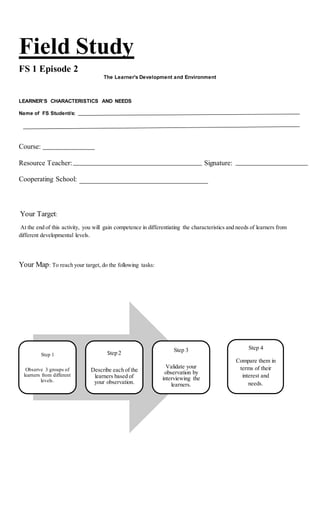
Your Target:
At the end of this activity, you will gain competence in differentiating the characteristics and needs of learners from
different developmental levels.
Your Map: To reach your target, do the following tasks:
Step 1
Observe 3 groups of
learners from different
levels.
Step 2
Describe each of the
learners based of
your observation.
Step 3
Validate your
observation by
interviewing the
learners.
Step 4
Compare them in
terms of their
interest and
needs.
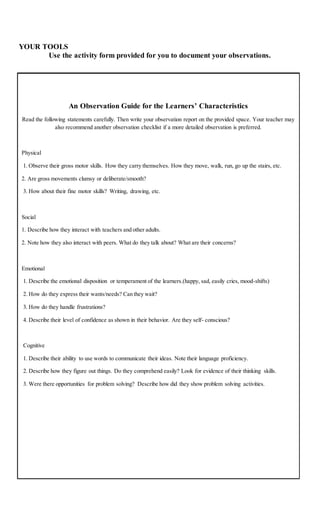
YOUR TOOLS
Use the activity form provided for you to document your observations.
An Observation Guide for the Learners’ Characteristics
Read the following statements carefully. Then write your observation report on the provided space. Your teacher may
also recommend another observation checklist if a more detailed observation is preferred.
Physical
1. Observe their gross motor skills. How they carry themselves. How they move, walk, run, go up the stairs, etc.
2. Are gross movements clumsy or deliberate/smooth?
3. How about their fine motor skills? Writing, drawing, etc.
Social
1. Describe how they interact with teachers and other adults.
2. Note how they also interact with peers. What do they talk about? What are their concerns?
Emotional
1. Describe the emotional disposition or temperament of the learners.(happy, sad, easily cries, mood-shifts)
2. How do they express their wants/needs? Can they wait?
3. How do they handle frustrations?
4. Describe their level of confidence as shown in their behavior. Are they self- conscious?
Cognitive
1. Describe their ability to use words to communicate their ideas. Note their language proficiency.
2. Describe how they figure out things. Do they comprehend easily? Look for evidence of their thinking skills.
3. Were there opportunities for problem solving? Describe how did they show problem solving activities.
LEARNERS’ DEVELOPMENT MATRIX
Development Domain High School
Physical
Gross motor skills
Fine motor skills
Self-help skills
Social
Interaction w/ Teachers
Interaction w/ Classmates/friends
Interests
Emotional
Moods & temperament, expression of
feelings
Emotional independence
Cognitive
Communication skills
Thinking skills
Problem-solving
ANALYSIS
Level Salient Characteristics
Observed
Implications to the Teaching-Learning
Process
High School
Age of learners observed:
REFLECTIONS
1. While you were observing the learners, did you recall yourown experiences when you were their age? What
similarities or differences do you have with the learners you observed?
2. Think of a teacher you cannot forget for positive or negative reasons.How did she/he help or not help you with your
needs (physical, emotional, social, cognitive)? How did it affect you?
3. Which is your favorite theory of development? How can this guide you as a future teacher?
4. Share yourother insights here.

Episode 2 FIELD STUDY 1

  • 1.
    Field Study FS 1Episode 2 The Learner's Development and Environment LEARNER’S CHARACTERISTICS AND NEEDS Name of FS Student/s: Course: Resource Teacher: Signature: Cooperating School: Your Target: At the end of this activity, you will gain competence in differentiating the characteristics and needs of learners from different developmental levels. Your Map: To reach your target, do the following tasks: Step 1 Observe 3 groups of learners from different levels. Step 2 Describe each of the learners based of your observation. Step 3 Validate your observation by interviewing the learners. Step 4 Compare them in terms of their interest and needs.
  • 2.
    YOUR TOOLS Use theactivity form provided for you to document your observations. An Observation Guide for the Learners’ Characteristics Read the following statements carefully. Then write your observation report on the provided space. Your teacher may also recommend another observation checklist if a more detailed observation is preferred. Physical 1. Observe their gross motor skills. How they carry themselves. How they move, walk, run, go up the stairs, etc. 2. Are gross movements clumsy or deliberate/smooth? 3. How about their fine motor skills? Writing, drawing, etc. Social 1. Describe how they interact with teachers and other adults. 2. Note how they also interact with peers. What do they talk about? What are their concerns? Emotional 1. Describe the emotional disposition or temperament of the learners.(happy, sad, easily cries, mood-shifts) 2. How do they express their wants/needs? Can they wait? 3. How do they handle frustrations? 4. Describe their level of confidence as shown in their behavior. Are they self- conscious? Cognitive 1. Describe their ability to use words to communicate their ideas. Note their language proficiency. 2. Describe how they figure out things. Do they comprehend easily? Look for evidence of their thinking skills. 3. Were there opportunities for problem solving? Describe how did they show problem solving activities.
  • 3.
    LEARNERS’ DEVELOPMENT MATRIX DevelopmentDomain High School Physical Gross motor skills Fine motor skills Self-help skills Social Interaction w/ Teachers Interaction w/ Classmates/friends Interests Emotional Moods & temperament, expression of feelings Emotional independence Cognitive Communication skills Thinking skills Problem-solving
  • 4.
    ANALYSIS Level Salient Characteristics Observed Implicationsto the Teaching-Learning Process High School Age of learners observed:
  • 5.
    REFLECTIONS 1. While youwere observing the learners, did you recall yourown experiences when you were their age? What similarities or differences do you have with the learners you observed? 2. Think of a teacher you cannot forget for positive or negative reasons.How did she/he help or not help you with your needs (physical, emotional, social, cognitive)? How did it affect you? 3. Which is your favorite theory of development? How can this guide you as a future teacher? 4. Share yourother insights here.