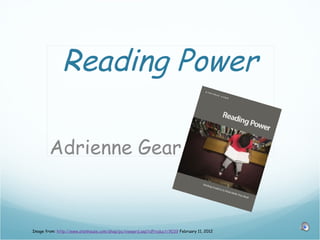
Reading Power

        Adrienne Gear


Image from: http://www.stenhouse.com/shop/pc/viewprd.asp?idProduct=9039 February 11, 2012
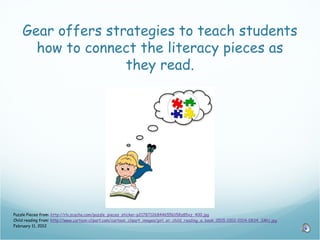
Gear offers strategies to teach students
      how to connect the literacy pieces as
                   they read.


Puzzle Pieces from: http://rlv.zcache.com/puzzle_pieces_sticker-p217871268446556158z85xz_400.jpg
Child reading from: http://www.cartoon-clipart.com/cartoon_clipart_images/girl_or_child_reading_a_book_0515-1002-0104-0834_SMU.jpg
February 11, 2012
 
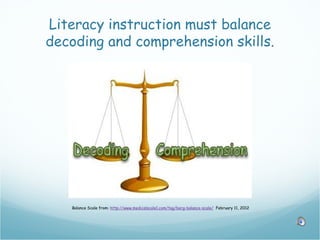
Literacy instruction must balance
decoding and comprehension skills.


   Balance Scale from: http://www.medicalscale1.com/tag/berg-balance-scale/ February 11, 2012
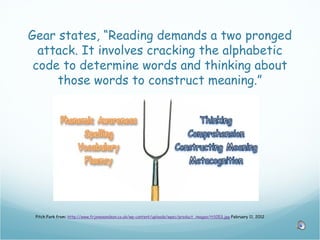
Gear states, “Reading demands a two pronged
  attack. It involves cracking the alphabetic
 code to determine words and thinking about
     those words to construct meaning.”


 Pitch Fork from: http://www.frjonesandson.co.uk/wp-content/uploads/wpsc/product_images/tt1053.jpg February 11, 2012
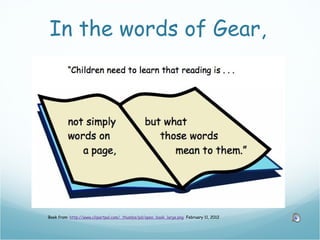
In the words of Gear,


Book from: http://www.clipartpal.com/_thumbs/pd/open_book_large.png February 11, 2012
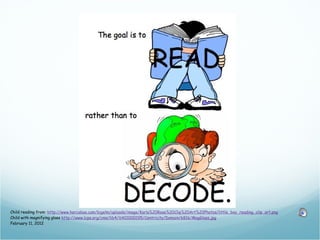
Child reading from: http://www.harcoboe.com/bigelm/uploads/image/Karla%20Rose%20Clip%20Art%20Photos/little_boy_reading_clip_art.png
Child with magnifying glass http://www.lcps.org/cms/lib4/VA01000195/Centricity/Domain/6816/MagGlass.jpg
February 11, 2012
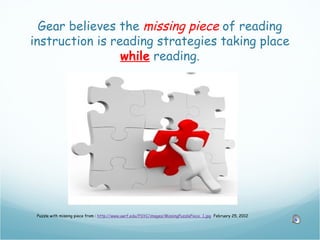
Gear believes the missing piece of reading
instruction is reading strategies taking place
                 while reading.


 Puzzle with missing piece from : http://www.uwrf.edu/PSYC/images/MissingPuzzlePiece_1.jpg February 25, 2012
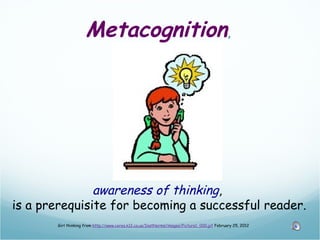
Metacognition,


               awareness of thinking,
is a prerequisite for becoming a successful reader.
       Girl thinking from http://www.ceres.k12.ca.us/InstNorms/images/Picture1_000.gif February 25, 2012
Image from: http://blog.eventbrite.com/wp-content/uploads/2011/08/connecting.jpeg February 25, 2012
Image from: http://hill.troy.k12.mi.us/staff/bnewingham/myweb3/clipart/j0134399.gif February 25, 2012
Image from: http://thejobstop.files.wordpress.com/2012/02/interrogation1.gif February 25, 2012
Image from: http://problemfinding.labanca.net/wp-content/uploads/2009/12/sbpuzzled-300x276.jpg February 25, 2012
Image from: http://blog.afoolishmanifesto.com/wp-content/uploads/2007/08/transform.png February 25, 2012
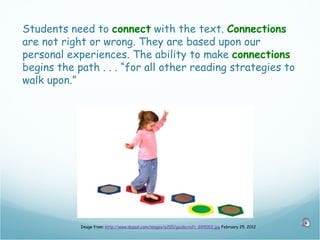
Students need to connect with the text. Connections
are not right or wrong. They are based upon our
personal experiences. The ability to make connections
begins the path . . . “for all other reading strategies to
walk upon.”


            Image from: http://www.dazadi.com/images/p200/guidecraft_G99002.jpg February 25, 2012
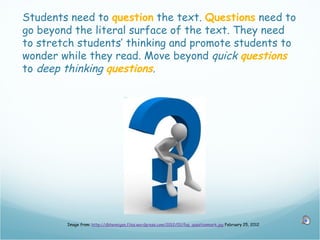
Students need to question the text. Questions need to
go beyond the literal surface of the text. They need
to stretch students’ thinking and promote students to
wonder while they read. Move beyond quick questions
to deep thinking questions.


        Image from: http://dbhennigan.files.wordpress.com/2012/01/faq_questionmark.jpg February 25, 2012
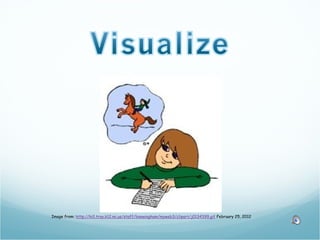
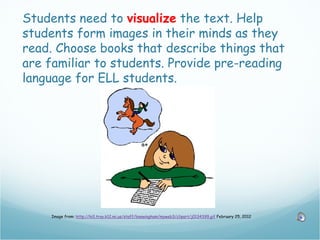
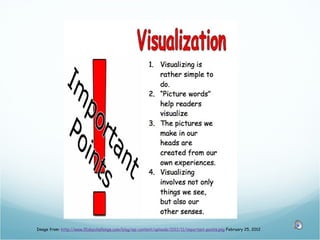
Students need to visualize the text. Help
students form images in their minds as they
read. Choose books that describe things that
are familiar to students. Provide pre-reading
language for ELL students.


    Image from: http://hill.troy.k12.mi.us/staff/bnewingham/myweb3/clipart/j0134399.gif February 25, 2012
Image from: http://www.91daychallenge.com/blog/wp-content/uploads/2011/11/important-points.png February 25, 2012
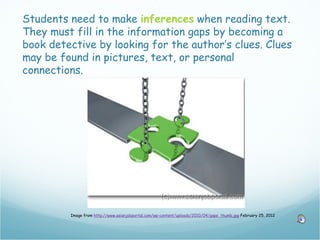
Students need to make inferences when reading text.
They must fill in the information gaps by becoming a
book detective by looking for the author’s clues. Clues
may be found in pictures, text, or personal
connections.


         Image from http://www.asianjobportal.com/wp-content/uploads/2010/04/gaps_thumb.jpg February 25, 2012
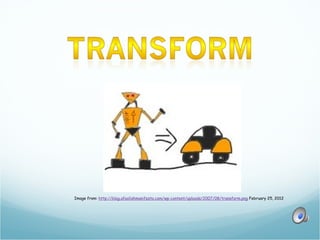
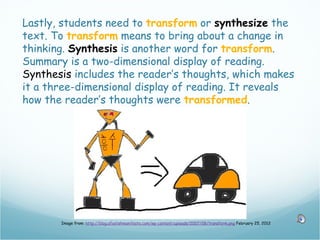
Lastly, students need to transform or synthesize the
text. To transform means to bring about a change in
thinking. Synthesis is another word for transform.
Summary is a two-dimensional display of reading.
Synthesis includes the reader’s thoughts, which makes
it a three-dimensional display of reading. It reveals
how the reader’s thoughts were transformed.


       Image from: http://blog.afoolishmanifesto.com/wp-content/uploads/2007/08/transform.png February 25, 2012
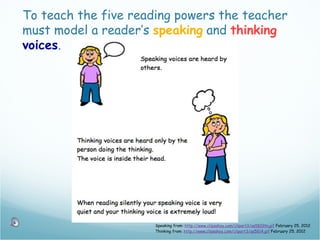
To teach the five reading powers the teacher
must model a reader’s speaking and thinking
voices.


                      Speaking from: http://www.clipsahoy.com/clipart3/as5819tn.gif February 25, 2012
                      Thinking from: http://www.clipsahoy.com/clipart3/as5814.gif February 25, 2012
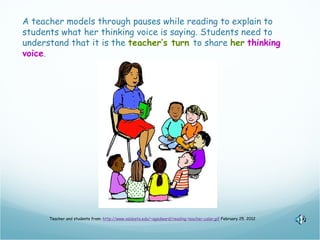
A teacher models through pauses while reading to explain to
students what her thinking voice is saying. Students need to
understand that it is the teacher’s turn to share her thinking
voice.


      Teacher and students from: http://www.valdosta.edu/~agedward/reading-teacher-color.gif February 25, 2012
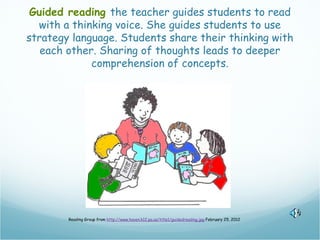
Guided reading the teacher guides students to read
  with a thinking voice. She guides students to use
strategy language. Students share their thinking with
   each other. Sharing of thoughts leads to deeper
             comprehension of concepts.


        Reading Group from http://www.haven.k12.pa.us/title1/guidedreading.jpg February 25, 2012
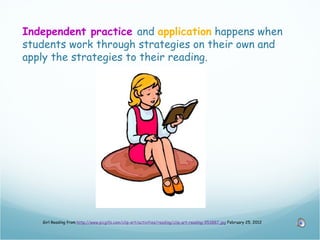
Independent practice and application happens when
students work through strategies on their own and
apply the strategies to their reading.


   Girl Reading from http://www.picgifs.com/clip-art/activities/reading/clip-art-reading-953887.jpg February 25, 2012
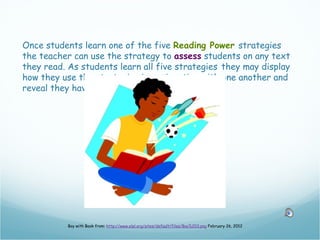
Once students learn one of the five Reading Power strategies
the teacher can use the strategy to assess students on any text
they read. As students learn all five strategies they may display
how they use the strategies in conjunction with one another and
reveal they have the Reading Power!


           Boy with Book from: http://www.elpl.org/sites/default/files/Boy%203.png February 26, 2012
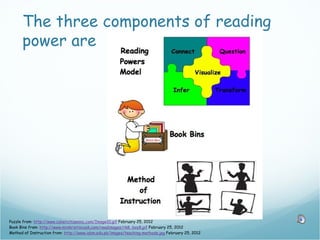
The three components of reading
      power are


Puzzle from: http://www.cybercitizeninc.com/Image10.gif February 25, 2012
Book Bins from: http://www.mrskristincook.com/readimages/rk8_boy8.gif February 25, 2012
Method of Instruction from: http://www.iobm.edu.pk/images/teaching-methods.jpg February 25, 2012
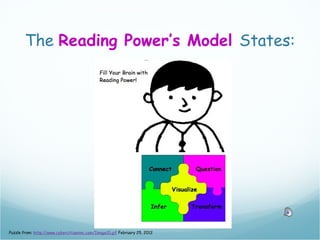
The Reading Power’s Model States:


Puzzle from: http://www.cybercitizeninc.com/Image10.gif February 25, 2012
Book bins, while not necessary, organize
materials to further promote implementation
of the five reading power strategies.


        Book Bins from: http://www.mrskristincook.com/readimages/rk8_boy8.gif February 25, 2012
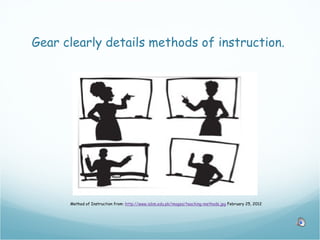
Gear clearly details methods of instruction.


      Method of Instruction from: http://www.iobm.edu.pk/images/teaching-methods.jpg February 25, 2012
She recommends a comprehensive book list for
             each strategy.


    Image retrieved from http://ascplcl.files.wordpress.com/2009/11/booklist-copy.jpg March 4, 2012
Furthermore, Gear has catchy tunes for the
introduction of each strategy. The songs help to move
students to think carefully of the strategy while
reading or being read to.


 Image Retrieved from http://www.thedjservice.com/blog/wp-content/uploads/2010/04/colorful-music-notes-cutout.jpg March 4, 2012
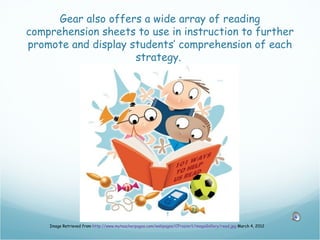
Gear also offers a wide array of reading
comprehension sheets to use in instruction to further
promote and display students’ comprehension of each
                     strategy.


    Image Retrieved from http://www.myteacherpages.com/webpages/CFrazier1/imageGallery/read.jpg March 4, 2012
Adrienne Gear provides outstanding strategies for
reading instruction, thorough explanations of teaching
 methods, lists of resources, and assessment sheets.


         Image Retrieved from http://www.readingpowergear.com/images/asg.jpg March 4, 2012
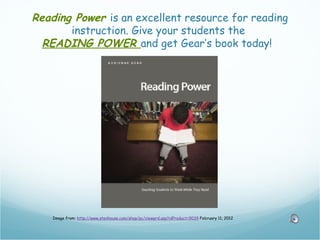
Reading Power is an excellent resource for reading
       instruction. Give your students the
  READING POWER and get Gear’s book today!


    Image from: http://www.stenhouse.com/shop/pc/viewprd.asp?idProduct=9039 February 11, 2012
Additional Resources
 Adrienne Gear Biographical Information
  http://www.readingpowergear.com/bio.html

 Reading Power Home Page
  http://www.readingpowergear.com/

 You Tube Video
  http://www.youtube.com/watch?v=m5gxSIVanmM

 Teacher Tube Video
  http://www.teachertube.com/viewVideo.php?video_id=138

Reading power

  • 1.
    Reading Power Adrienne Gear Image from: http://www.stenhouse.com/shop/pc/viewprd.asp?idProduct=9039 February 11, 2012
  • 2.
    Gear offers strategiesto teach students how to connect the literacy pieces as they read. Puzzle Pieces from: http://rlv.zcache.com/puzzle_pieces_sticker-p217871268446556158z85xz_400.jpg Child reading from: http://www.cartoon-clipart.com/cartoon_clipart_images/girl_or_child_reading_a_book_0515-1002-0104-0834_SMU.jpg February 11, 2012
  • 3.
      Literacy instruction mustbalance decoding and comprehension skills.   Balance Scale from: http://www.medicalscale1.com/tag/berg-balance-scale/ February 11, 2012
  • 4.
    Gear states, “Readingdemands a two pronged attack. It involves cracking the alphabetic code to determine words and thinking about those words to construct meaning.” Pitch Fork from: http://www.frjonesandson.co.uk/wp-content/uploads/wpsc/product_images/tt1053.jpg February 11, 2012
  • 5.
    In the wordsof Gear, Book from: http://www.clipartpal.com/_thumbs/pd/open_book_large.png February 11, 2012
  • 6.
    Child reading from:http://www.harcoboe.com/bigelm/uploads/image/Karla%20Rose%20Clip%20Art%20Photos/little_boy_reading_clip_art.png Child with magnifying glass http://www.lcps.org/cms/lib4/VA01000195/Centricity/Domain/6816/MagGlass.jpg February 11, 2012
  • 7.
    Gear believes themissing piece of reading instruction is reading strategies taking place while reading. Puzzle with missing piece from : http://www.uwrf.edu/PSYC/images/MissingPuzzlePiece_1.jpg February 25, 2012
  • 8.
    Metacognition, awareness of thinking, is a prerequisite for becoming a successful reader. Girl thinking from http://www.ceres.k12.ca.us/InstNorms/images/Picture1_000.gif February 25, 2012
  • 10.
  • 11.
  • 12.
  • 13.
  • 14.
  • 15.
    Students need toconnect with the text. Connections are not right or wrong. They are based upon our personal experiences. The ability to make connections begins the path . . . “for all other reading strategies to walk upon.” Image from: http://www.dazadi.com/images/p200/guidecraft_G99002.jpg February 25, 2012
  • 16.
    Students need toquestion the text. Questions need to go beyond the literal surface of the text. They need to stretch students’ thinking and promote students to wonder while they read. Move beyond quick questions to deep thinking questions. Image from: http://dbhennigan.files.wordpress.com/2012/01/faq_questionmark.jpg February 25, 2012
  • 17.
    Students need tovisualize the text. Help students form images in their minds as they read. Choose books that describe things that are familiar to students. Provide pre-reading language for ELL students. Image from: http://hill.troy.k12.mi.us/staff/bnewingham/myweb3/clipart/j0134399.gif February 25, 2012
  • 18.
  • 19.
    Students need tomake inferences when reading text. They must fill in the information gaps by becoming a book detective by looking for the author’s clues. Clues may be found in pictures, text, or personal connections. Image from http://www.asianjobportal.com/wp-content/uploads/2010/04/gaps_thumb.jpg February 25, 2012
  • 20.
    Lastly, students needto transform or synthesize the text. To transform means to bring about a change in thinking. Synthesis is another word for transform. Summary is a two-dimensional display of reading. Synthesis includes the reader’s thoughts, which makes it a three-dimensional display of reading. It reveals how the reader’s thoughts were transformed. Image from: http://blog.afoolishmanifesto.com/wp-content/uploads/2007/08/transform.png February 25, 2012
  • 22.
    To teach thefive reading powers the teacher must model a reader’s speaking and thinking voices. Speaking from: http://www.clipsahoy.com/clipart3/as5819tn.gif February 25, 2012 Thinking from: http://www.clipsahoy.com/clipart3/as5814.gif February 25, 2012
  • 23.
    A teacher modelsthrough pauses while reading to explain to students what her thinking voice is saying. Students need to understand that it is the teacher’s turn to share her thinking voice. Teacher and students from: http://www.valdosta.edu/~agedward/reading-teacher-color.gif February 25, 2012
  • 24.
    Guided reading theteacher guides students to read with a thinking voice. She guides students to use strategy language. Students share their thinking with each other. Sharing of thoughts leads to deeper comprehension of concepts. Reading Group from http://www.haven.k12.pa.us/title1/guidedreading.jpg February 25, 2012
  • 25.
    Independent practice andapplication happens when students work through strategies on their own and apply the strategies to their reading. Girl Reading from http://www.picgifs.com/clip-art/activities/reading/clip-art-reading-953887.jpg February 25, 2012
  • 26.
    Once students learnone of the five Reading Power strategies the teacher can use the strategy to assess students on any text they read. As students learn all five strategies they may display how they use the strategies in conjunction with one another and reveal they have the Reading Power! Boy with Book from: http://www.elpl.org/sites/default/files/Boy%203.png February 26, 2012
  • 27.
    The three componentsof reading power are Puzzle from: http://www.cybercitizeninc.com/Image10.gif February 25, 2012 Book Bins from: http://www.mrskristincook.com/readimages/rk8_boy8.gif February 25, 2012 Method of Instruction from: http://www.iobm.edu.pk/images/teaching-methods.jpg February 25, 2012
  • 28.
    The Reading Power’sModel States: Puzzle from: http://www.cybercitizeninc.com/Image10.gif February 25, 2012
  • 29.
    Book bins, whilenot necessary, organize materials to further promote implementation of the five reading power strategies. Book Bins from: http://www.mrskristincook.com/readimages/rk8_boy8.gif February 25, 2012
  • 30.
    Gear clearly detailsmethods of instruction. Method of Instruction from: http://www.iobm.edu.pk/images/teaching-methods.jpg February 25, 2012
  • 31.
    She recommends acomprehensive book list for each strategy. Image retrieved from http://ascplcl.files.wordpress.com/2009/11/booklist-copy.jpg March 4, 2012
  • 32.
    Furthermore, Gear hascatchy tunes for the introduction of each strategy. The songs help to move students to think carefully of the strategy while reading or being read to. Image Retrieved from http://www.thedjservice.com/blog/wp-content/uploads/2010/04/colorful-music-notes-cutout.jpg March 4, 2012
  • 33.
    Gear also offersa wide array of reading comprehension sheets to use in instruction to further promote and display students’ comprehension of each strategy. Image Retrieved from http://www.myteacherpages.com/webpages/CFrazier1/imageGallery/read.jpg March 4, 2012
  • 34.
    Adrienne Gear providesoutstanding strategies for reading instruction, thorough explanations of teaching methods, lists of resources, and assessment sheets. Image Retrieved from http://www.readingpowergear.com/images/asg.jpg March 4, 2012
  • 35.
    Reading Power isan excellent resource for reading instruction. Give your students the READING POWER and get Gear’s book today! Image from: http://www.stenhouse.com/shop/pc/viewprd.asp?idProduct=9039 February 11, 2012
  • 36.
    Additional Resources  AdrienneGear Biographical Information http://www.readingpowergear.com/bio.html  Reading Power Home Page http://www.readingpowergear.com/  You Tube Video http://www.youtube.com/watch?v=m5gxSIVanmM  Teacher Tube Video http://www.teachertube.com/viewVideo.php?video_id=138