Sensory Awareness
            Presented by
       Cynthia Miller-Lautman
       Occupational Therapist
  http://cynthiamillerlautman.com


           Cynthia Miller-Lautman, OT
Overview
• Basic Introduction to Sensory Regulation
• Some ideas of how we can help


This presentation does NOT in any way replace
 a proper evaluation for those students who
need a detailed intervention plan and therapy.
                   Cynthia Miller-Lautman, OT
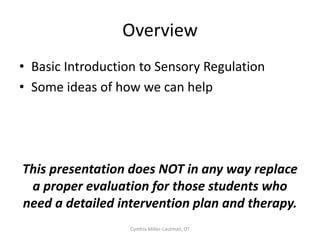
Ice Breaker: Scattegories
1. Sandwiches                     7. Things that
2. Items in a                        Jump/Bounce
   Catalogue                      8. Television Stars
3. World                          9. Things in a Park
   Leader/Politicians             10.Foreign Cities
4. School Subjects                11.Stones/Gems
5. Excuses for Being              12.Musical
   Late                              Instruments
6. Ice Cream Flavors
                   Cynthia Miller-Lautman, OT
Icebreaker

   Reading


 Cynthia Miller-Lautman, OT
Theory

What is Sensory Processing
        Difficulty?


        Cynthia Miller-Lautman, OT
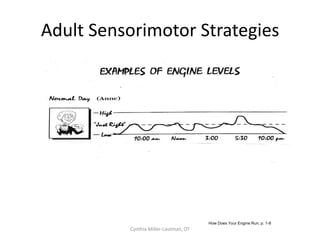
Adult Sensorimotor Strategies


                                       How Does Your Engine Run, p. 1-8
          Cynthia Miller-Lautman, OT
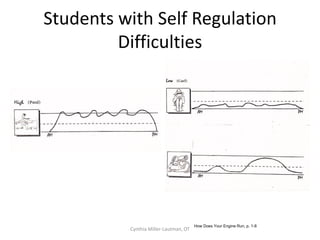
Students with Self Regulation
         Difficulties


                                       How Does Your Engine Run, p. 1-8
          Cynthia Miller-Lautman, OT
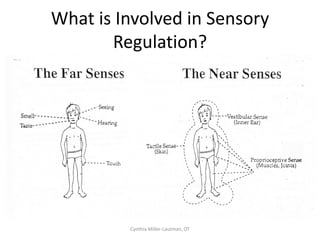
What is Involved in Sensory
       Regulation?


         Cynthia Miller-Lautman, OT
Case Examples
From “The Out of Sync Child” by Carol Stock Kranowitz


                Tactile

                   Cynthia Miller-Lautman, OT
Case Examples


Vestibular

   Cynthia Miller-Lautman, OT
Case Examples


Proprioception


      Cynthia Miller-Lautman, OT
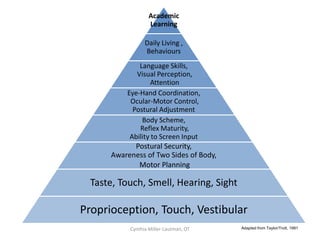
Academic
                  Learning

                 Daily Living ,
                 Behaviours
              Language Skills,
             Visual Perception,
                   Attention
          Eye-Hand Coordination,
           Ocular-Motor Control,
            Postural Adjustment
               Body Scheme,
              Reflex Maturity,
           Ability to Screen Input
            Postural Security,
      Awareness of Two Sides of Body,
             Motor Planning

  Taste, Touch, Smell, Hearing, Sight

Proprioception, Touch, Vestibular
           Cynthia Miller-Lautman, OT   Adapted from Taylor/Trott, 1991
Movement Break


     Cynthia Miller-Lautman, OT
What can Parents Do
•   SLOW DOWN
•   Free Play
•   Let them get dirty
•   Good communication
•   Walk/Run/Ride more
•   Park Play
•   Rough and tumble play


                   Cynthia Miller-Lautman, OT
What Can Schools/Parents Do?

• Frequent Movement Breaks at school and
  during Homework
• Play outside for recess and lunch
   Albert Nerenberg documentary Boredom (2012).


                         Cynthia Miller-Lautman, OT
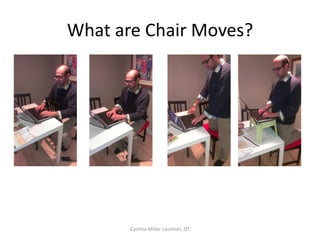
What are Chair Moves?


       Cynthia Miller-Lautman, OT
Functional Fidget Tools
• No Thinking!
• Test It!
• Examples: rubber bands, pen tops, smooth
  rocks and pendants


                 Cynthia Miller-Lautman, OT
Have we picked the right fidget
              tool?
• Do they attend better when manipulating the
  functional fidget tool?
• Does the child bring the tool with them to
  different settings?
• Can the fidget tool be used in most settings?
• Does the tool have a low distraction level to
  the child and to those around them?


                  Cynthia Miller-Lautman, OT
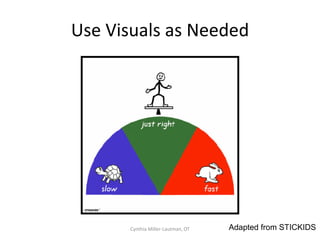
Use Visuals as Needed


       Cynthia Miller-Lautman, OT   Adapted from STICKIDS
Visual Schedules
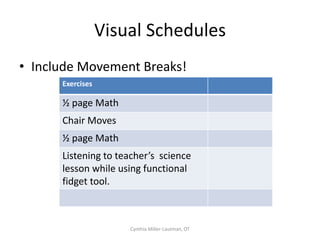
• Include Movement Breaks!
      Exercises

      ½ page Math
      Chair Moves
      ½ page Math
      Listening to teacher’s science
      lesson while using functional
      fidget tool.


                      Cynthia Miller-Lautman, OT
How to Determine When
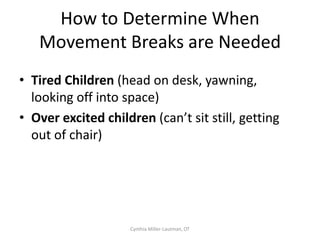
   Movement Breaks are Needed
• Tired Children (head on desk, yawning,
  looking off into space)
• Over excited children (can’t sit still, getting
  out of chair)


                    Cynthia Miller-Lautman, OT
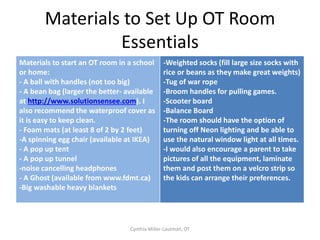
Materials to Set Up OT Room
                Essentials
Materials to start an OT room in a school       -Weighted socks (fill large size socks with
or home:                                        rice or beans as they make great weights)
- A ball with handles (not too big)             -Tug of war rope
- A bean bag (larger the better- available      -Broom handles for pulling games.
at http://www.solutionsensee.com). I            -Scooter board
also recommend the waterproof cover as          -Balance Board
it is easy to keep clean.                       -The room should have the option of
- Foam mats (at least 8 of 2 by 2 feet)         turning off Neon lighting and be able to
-A spinning egg chair (available at IKEA)       use the natural window light at all times.
- A pop up tent                                 -I would also encourage a parent to take
- A pop up tunnel                               pictures of all the equipment, laminate
-noise cancelling headphones                    them and post them on a velcro strip so
- A Ghost (available from www.fdmt.ca)          the kids can arrange their preferences.
-Big washable heavy blankets


                                  Cynthia Miller-Lautman, OT
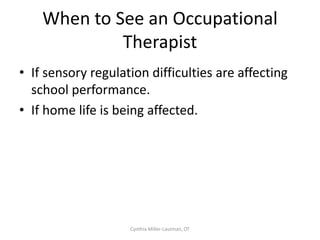
When to See an Occupational
             Therapist
• If sensory regulation difficulties are affecting
  school performance.
• If home life is being affected.


                    Cynthia Miller-Lautman, OT
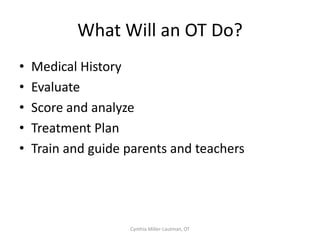
What Will an OT Do?
•   Medical History
•   Evaluate
•   Score and analyze
•   Treatment Plan
•   Train and guide parents and teachers


                    Cynthia Miller-Lautman, OT
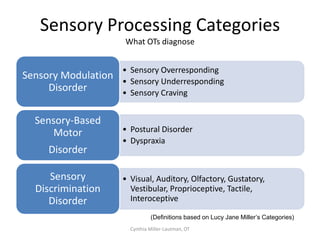
Sensory Processing Categories
                     What OTs diagnose


                     • Sensory Overresponding
Sensory Modulation   • Sensory Underresponding
     Disorder        • Sensory Craving


  Sensory-Based
      Motor          • Postural Disorder
                     • Dyspraxia
     Disorder

     Sensory         • Visual, Auditory, Olfactory, Gustatory,
  Discrimination       Vestibular, Proprioceptive, Tactile,
     Disorder          Interoceptive

                               (Definitions based on Lucy Jane Miller’s Categories)
                       Cynthia Miller-Lautman, OT
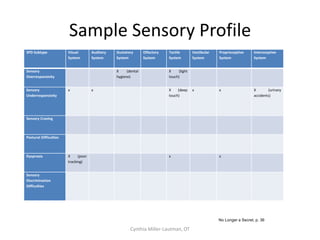
Sample Sensory Profile
SPD Subtype             Visual        Auditory   Gustatory       Olfactory   Tactile        Vestibular   Proprioceptive     Interoceptive
                        System        System     System          System      System         System       System             System


Sensory                                          X     (dental               X     (light
Overresponsivity                                 hygiene)                    touch)


Sensory                 x             x                                      X    (deep     x            x                  X       (urinary
Underresponsivity                                                            touch)                                         accidents)


Sensory Craving


Postural Difficulties


Dyspraxia               X     (poor                                          x                           x
                        tracking)


Sensory
Discrimination
Difficulties


                                                                                                         No Longer a Secret, p. 36

                                                         Cynthia Miller-Lautman, OT
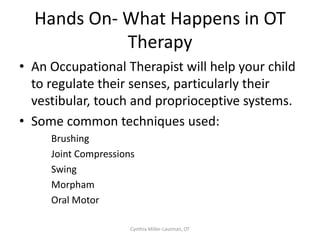
Hands On- What Happens in OT
            Therapy
• An Occupational Therapist will help your child
  to regulate their senses, particularly their
  vestibular, touch and proprioceptive systems.
• Some common techniques used:
     Brushing
     Joint Compressions
     Swing
     Morpham
     Oral Motor

                      Cynthia Miller-Lautman, OT
Properly integrated senses are critical to a
proper development.
We may not be able to change schools
curriculum overnight but we can start
changing the quality and quantity of sensory
experiences we offer our children.


                Cynthia Miller-Lautman, OT
Other Resources
• For a list of recommended books related to
  Sensory Awareness please visit:
                http://bit.ly/16p3X4s
• Download a PDF copy of this presentation at:
                http://bit.ly/10Bzhss


                  Cynthia Miller-Lautman, OT
Credits
This presentation contains material from:
• Summit School’s Occupational Therapy Department,
  Montreal,QC.
• “The Out-of-Sync Child” by Carol Stock Kranowitz, Skylight
  Press, 1998.
• “Sensational Kids” by Lucy Jane Miller, Perigee, 2006
• “How Does your Engine Run?”, by Willams and Shellenberger,
  Therapy Works, 1996.
• “No Longer A Secret” by Bialer and Miller, Future Horizons,
  2011
• STICKIDS (CD-ROM) Community Therapy Associates, Inc.

                        Cynthia Miller-Lautman, OT

Sensory Awareness Workshop

  • 1.
    Sensory Awareness Presented by Cynthia Miller-Lautman Occupational Therapist http://cynthiamillerlautman.com Cynthia Miller-Lautman, OT
  • 2.
    Overview • Basic Introductionto Sensory Regulation • Some ideas of how we can help This presentation does NOT in any way replace a proper evaluation for those students who need a detailed intervention plan and therapy. Cynthia Miller-Lautman, OT
  • 3.
    Ice Breaker: Scattegories 1.Sandwiches 7. Things that 2. Items in a Jump/Bounce Catalogue 8. Television Stars 3. World 9. Things in a Park Leader/Politicians 10.Foreign Cities 4. School Subjects 11.Stones/Gems 5. Excuses for Being 12.Musical Late Instruments 6. Ice Cream Flavors Cynthia Miller-Lautman, OT
  • 4.
    Icebreaker Reading Cynthia Miller-Lautman, OT
  • 5.
    Theory What is SensoryProcessing Difficulty? Cynthia Miller-Lautman, OT
  • 6.
    Adult Sensorimotor Strategies How Does Your Engine Run, p. 1-8 Cynthia Miller-Lautman, OT
  • 7.
    Students with SelfRegulation Difficulties How Does Your Engine Run, p. 1-8 Cynthia Miller-Lautman, OT
  • 8.
    What is Involvedin Sensory Regulation? Cynthia Miller-Lautman, OT
  • 9.
    Case Examples From “TheOut of Sync Child” by Carol Stock Kranowitz Tactile Cynthia Miller-Lautman, OT
  • 10.
    Case Examples Vestibular Cynthia Miller-Lautman, OT
  • 11.
    Case Examples Proprioception Cynthia Miller-Lautman, OT
  • 12.
    Academic Learning Daily Living , Behaviours Language Skills, Visual Perception, Attention Eye-Hand Coordination, Ocular-Motor Control, Postural Adjustment Body Scheme, Reflex Maturity, Ability to Screen Input Postural Security, Awareness of Two Sides of Body, Motor Planning Taste, Touch, Smell, Hearing, Sight Proprioception, Touch, Vestibular Cynthia Miller-Lautman, OT Adapted from Taylor/Trott, 1991
  • 13.
    Movement Break Cynthia Miller-Lautman, OT
  • 14.
    What can ParentsDo • SLOW DOWN • Free Play • Let them get dirty • Good communication • Walk/Run/Ride more • Park Play • Rough and tumble play Cynthia Miller-Lautman, OT
  • 15.
    What Can Schools/ParentsDo? • Frequent Movement Breaks at school and during Homework • Play outside for recess and lunch Albert Nerenberg documentary Boredom (2012). Cynthia Miller-Lautman, OT
  • 16.
    What are ChairMoves? Cynthia Miller-Lautman, OT
  • 17.
    Functional Fidget Tools •No Thinking! • Test It! • Examples: rubber bands, pen tops, smooth rocks and pendants Cynthia Miller-Lautman, OT
  • 18.
    Have we pickedthe right fidget tool? • Do they attend better when manipulating the functional fidget tool? • Does the child bring the tool with them to different settings? • Can the fidget tool be used in most settings? • Does the tool have a low distraction level to the child and to those around them? Cynthia Miller-Lautman, OT
  • 19.
    Use Visuals asNeeded Cynthia Miller-Lautman, OT Adapted from STICKIDS
  • 20.
    Visual Schedules • IncludeMovement Breaks! Exercises ½ page Math Chair Moves ½ page Math Listening to teacher’s science lesson while using functional fidget tool. Cynthia Miller-Lautman, OT
  • 21.
    How to DetermineWhen Movement Breaks are Needed • Tired Children (head on desk, yawning, looking off into space) • Over excited children (can’t sit still, getting out of chair) Cynthia Miller-Lautman, OT
  • 22.
    Materials to SetUp OT Room Essentials Materials to start an OT room in a school -Weighted socks (fill large size socks with or home: rice or beans as they make great weights) - A ball with handles (not too big) -Tug of war rope - A bean bag (larger the better- available -Broom handles for pulling games. at http://www.solutionsensee.com). I -Scooter board also recommend the waterproof cover as -Balance Board it is easy to keep clean. -The room should have the option of - Foam mats (at least 8 of 2 by 2 feet) turning off Neon lighting and be able to -A spinning egg chair (available at IKEA) use the natural window light at all times. - A pop up tent -I would also encourage a parent to take - A pop up tunnel pictures of all the equipment, laminate -noise cancelling headphones them and post them on a velcro strip so - A Ghost (available from www.fdmt.ca) the kids can arrange their preferences. -Big washable heavy blankets Cynthia Miller-Lautman, OT
  • 23.
    When to Seean Occupational Therapist • If sensory regulation difficulties are affecting school performance. • If home life is being affected. Cynthia Miller-Lautman, OT
  • 24.
    What Will anOT Do? • Medical History • Evaluate • Score and analyze • Treatment Plan • Train and guide parents and teachers Cynthia Miller-Lautman, OT
  • 25.
    Sensory Processing Categories What OTs diagnose • Sensory Overresponding Sensory Modulation • Sensory Underresponding Disorder • Sensory Craving Sensory-Based Motor • Postural Disorder • Dyspraxia Disorder Sensory • Visual, Auditory, Olfactory, Gustatory, Discrimination Vestibular, Proprioceptive, Tactile, Disorder Interoceptive (Definitions based on Lucy Jane Miller’s Categories) Cynthia Miller-Lautman, OT
  • 26.
    Sample Sensory Profile SPDSubtype Visual Auditory Gustatory Olfactory Tactile Vestibular Proprioceptive Interoceptive System System System System System System System System Sensory X (dental X (light Overresponsivity hygiene) touch) Sensory x x X (deep x x X (urinary Underresponsivity touch) accidents) Sensory Craving Postural Difficulties Dyspraxia X (poor x x tracking) Sensory Discrimination Difficulties No Longer a Secret, p. 36 Cynthia Miller-Lautman, OT
  • 27.
    Hands On- WhatHappens in OT Therapy • An Occupational Therapist will help your child to regulate their senses, particularly their vestibular, touch and proprioceptive systems. • Some common techniques used: Brushing Joint Compressions Swing Morpham Oral Motor Cynthia Miller-Lautman, OT
  • 28.
    Properly integrated sensesare critical to a proper development. We may not be able to change schools curriculum overnight but we can start changing the quality and quantity of sensory experiences we offer our children. Cynthia Miller-Lautman, OT
  • 29.
    Other Resources • Fora list of recommended books related to Sensory Awareness please visit: http://bit.ly/16p3X4s • Download a PDF copy of this presentation at: http://bit.ly/10Bzhss Cynthia Miller-Lautman, OT
  • 30.
    Credits This presentation containsmaterial from: • Summit School’s Occupational Therapy Department, Montreal,QC. • “The Out-of-Sync Child” by Carol Stock Kranowitz, Skylight Press, 1998. • “Sensational Kids” by Lucy Jane Miller, Perigee, 2006 • “How Does your Engine Run?”, by Willams and Shellenberger, Therapy Works, 1996. • “No Longer A Secret” by Bialer and Miller, Future Horizons, 2011 • STICKIDS (CD-ROM) Community Therapy Associates, Inc. Cynthia Miller-Lautman, OT

Editor's Notes

  • #2 Cynthia Miller-Lautman is a pediatric occupational therapist who specializes in working with children who have developmental, cognitive, sensory and motor delays.She has worked in a variety of settings, including Summit School, as a consultant for school boards, and now runs a private clinic in the West Island.
  • #3 Tonight I am going to talk about Sensory Awareness. By that I mean how our senses work and how they can impact on our schooling , attention, sports and learning.In the old days, kids who learned differently often failed out and were slowly weeded out by the end of high school.Today all children have the right to integration, but are we meeting their varied sensory needs so that they are optimaly set up to learn?Are we as parents doing the right things to prepare their minds and bodies for school?Are we as professionals supporting our children’s sensory needs in the classroom?I would like an idea of who is in the audience tonight? Show of hands of parents, teachers, aids, other professionals..psychologists, speech therapists?
  • #5 How did you feel during Scattergories? Were you overwhelmed? Could you tune it out? What sensation bothered you most?
  • #6 Sensory Processing is how our brain handles all of the information that comes through our senses and allows us to function. When there is problems with how our brains handle this information it leads to dysfunction in daily home and school life.
  • #7 Adult Sensory Strategies-Tapping Feet-Twirling Hair-Rocking on Chair-Chewing Gum-Smoking-Tapping Nails-Jogging-Snacking-Coffee/tea
  • #10 (Out of Sync Child p.66)-Everyone one of us needs constant tactile stimulation to keep us organized and functional.-Info comes from pressure, vibration, mvt, temperature and pain and activate the touch receptors in our skin from head to toe all the time.Two components: 1) Protective (defensive) receptors in skin – alerts us to danger (mosquito). Usually this system gets less sensitive as we get older. Most important in infancy. 2) Discriminatory System - this develops as neuro maturation supresses the defensive system. By “K” age child should be able to precisely tell you what finger hurts and whereRead Comparison stories to Group. p 72, 74, 77Common problems: defensive to light touch (socks, elastics, tags) – Robert (may turn to aggression) under responsive - Patrick poor tactile discrimination - Leah (trouble with new manual skills, handwriting, dressing)
  • #11 Case example p.95Messages from head, neck, eyes and processes to produce normal muscle mvts*Primes body and other senses-Receptors are in inner ear + very sensitive, in hx helped us: 1) detect threatening creatures through vibrations 2) keep upright 3) help us sense our own mvts so we can move efficiently*When vestib system doesn’t work properly it sends inaccurate messages to the rest of body + nervous system has trouble getting started.A normal vestib system learns to: -discrim sounds in inner ear ear and LISTEN -learns to enjoy all types of mvt (linear + twirling)Vestib system is crucial and works in background + establishes itself in early infancy if it doesn’t (as in the case of many children w/ Autism, ADHD, Down Syndrome + Learning disorders)1)Over-sensitive (Don’t spin me) (Kevin)2)Under-sensitive (Jason) – common problems resulting (see pyramid): late walker, clumsy, poor balance, slumping constantly, can’t ride 2 wheeler3)A mix of both
  • #12 Case examples p.132“Proprio” refers to sensory info telling us about our own mvt or body position. It helps integrate mvt or touch sensations.Receptors are found in muscle, ligaments, joints, tendons and connective tissueThese receptors are activated by mvt and gravityEx. Your muscles and joints are sending messages to your brain right now to help you sit up straight. NOT visual systemsProprioceptive system is so closely related to mvt + touch that professionals often refer to them as:Tactile/Proprio = judging weight of a glass of milk and adjusting accordingly, holding a pencil efficientlyVestib/Proprio = Judgin head + body position while moving (throwing and catching a ball, climbing stairs)Child S+S – clumsy, easily frustrated, self-esteem, he may tackle everything and everybody to rev up his systemRead stories p.136, 138, 139
  • #13 Level 1-Basic Sensory Systems develops by 2 months old:Level 2-Perceptual Motor Foundations develops by 1 yearLevel 3-Perceptual Motor Skills develops by 3 yearsLevel 4- Academic Readiness develops by 6 years : Eyes and ears are prepared to take over as the primary teachers.Keep in Mind that Kindergarten age kids are all mostly not ready for true academics and continue to need sensory motor building blocks worked on such as cutting, coloring, big muscle work, working at blackboards, working at easels etc..
  • #15 Slow Down- Decrease extra curricular activities, give your child time to process, give them double the time, give them half the workFree Play- Important to have unstructured play with neighborhood kids where adults intervene minimally, this is where kids often push there sensory development most. -Recess and Lunch have been decreased due to busing issues and then they have an hour of homework and then often watch t.v…..get them outside in unstructured free play…whether that is picking flowers, sitting on a swing, digging in mud or climbing snowbanks.Let Them Get Dirty:Good CommunicationWalk/Run/Ride More- Small sensory adventures always arise…and slow down…kids notice things and often there system is craving to explore it - Walking School BusPark Play- Our parks are oasis of sensory experiences awaiting children- take time to regularly go to the park. I’ve heard of parents that routinely meet afterschool to pick up their kids and play at the local park. Other kids can often get our kids to do things we can’tRough and Tumble play: Fathers!
  • #16 -Younger Grades Should move every 20 minutes- -Preschool/K age children need more frequent movement breaks- No long circle or sitting still times anywhere under the age of 6. In preschool I would suggest 5-10 minutes max In Kindergarten maximum 20 minutes In Grade 1-3 maximum 30 minutes Grades 4-6 up to 45-60 minutes depending on the maturity of the class. less reading and writing tasks. What is reading and writing taking away from? Study- 80% FM time of K is spent with paper and pencil-Blackboards have essentially been eliminated from classrooms, replaced with the SMART BOARd- Have you ever tried writing on a smart board-It’s harder and much less sensitive. Young children need to move more and create more…more easel painting, blackboard work, block construction and other hands one fine motor play.-Recess and Lunch Play- More brain activity happens during recess than math. The brain is resetting itself ready for more learning.