What is Applied
Linguistics?
Universidad de Cádiz
Facultad de Filosofía y Letras
Applied Linguistics
Bárbara Eizaga Rebollar 13/02/2017
Defining Applied Linguistics
It is not easy to define as there is a lack of consensus:
Applied Linguistics then means many things to many people.
(V. Cook 2004)
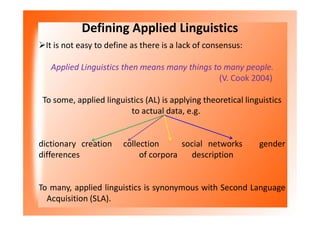
To some, applied linguistics (AL) is applying theoretical linguistics
to actual data, e.g.
dictionary creation collection social networks gender
differences of corpora description
To many, applied linguistics is synonymous with Second Language
Acquisition (SLA).
Defining Applied Linguistics
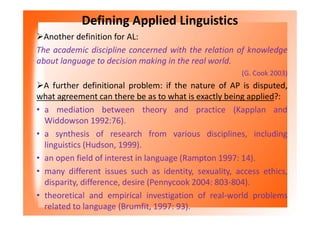
Another definition for AL:
The academic discipline concerned with the relation of knowledge
about language to decision making in the real world.
(G. Cook 2003)
A further definitional problem: if the nature of AP is disputed,
what agreement can there be as to what is exactly being applied?:
• a mediation between theory and practice (Kapplan and
Widdowson 1992:76).
• a synthesis of research from various disciplines, including
linguistics (Hudson, 1999).
• an open field of interest in language (Rampton 1997: 14).
• many different issues such as identity, sexuality, access ethics,
disparity, difference, desire (Pennycook 2004: 803-804).
• theoretical and empirical investigation of real-world problems
related to language (Brumfit, 1997: 93).
Defining Applied Linguistics
Given the many definitions, most books use AL concerns and
activities to illustrate and then analyse what applied linguistics
methods and purposes are.
Most agree that the task of AL is to mediate between linguistics
and language use (Cook 2003:20; Widdowson 2005).
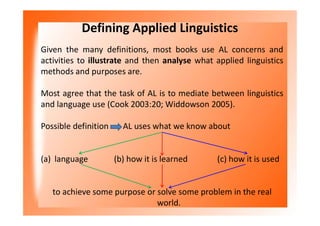
Possible definition AL uses what we know about
(a) language (b) how it is learned (c) how it is used
to achieve some purpose or solve some problem in the real
world.
The need for Applied Linguistics
The range of purposes or real-world problems involves success &
failure; ethical, cultural & gender issues; technology & lack of
resources; etc. Let’s take, for instance, language in education
Cook, 2003):
What language skills should children achieve beyond basic
literacy? (What is basic literacy? Reading & writing?)
Should children speaking a dialect be encouraged to maintain it
or steered towards the standard form of language? (If so, how
is the standard form decided & by whom?)
In communities with more than one language which one/s
should be used in schools?
Should everyone learn foreign languages and, if so, which
one/s? (And what is the best way to learn & teach them?)
The need for Applied Linguistics
These language issues echo those of society at large:
Languages change. Should this be accepted or controlled in
some way?
Some languages are dying out. Should that be prevented and,
if so, how?
Should the growth of English as lingua franca be welcomed or
deplored?
Is language being used for political oppression? (And, if so,
should something be done about it?)
Which languages should be used in law courts and official
documents?
The scope of Applied Linguistics
Since language is implicated in so much of our daily lives, there is
a large and open-ended number of quite disparate activities to
which AL is relevant.
A classification of the areas of study is the following (Cook 2003;
Davies 2007; Kaplan 2002):
1. Language & education: 1st-language acquisition; SLA; foreign
language acquisition (FLA); language teaching curriculum
(content/syllabus); clinical linguistics (language pathology
problems); language testing/assessment.
The scope of Applied Linguistics
2. Language, work, & law: workplace communication; language
planning and policy; forensic linguistics; language & identity
(bilingual, immersion, & language minority education);
language inequality problems (sex, gender, race, etc.);
language, culture & pragmatics.
3. Language, information, & effect: literary stylistics; discourse
analysis (DA); translation & interpretation; information
design; lexicography; language in the media; machine
translation; corpus linguistics; psycho-/neurolinguistics,
sociolinguistics; language & technology.
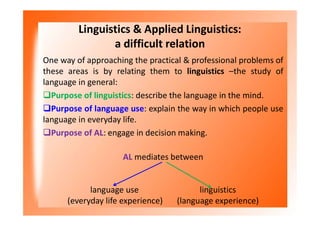
Linguistics & Applied Linguistics:
a difficult relation
One way of approaching the practical & professional problems of
these areas is by relating them to linguistics –the study of
language in general:
Purpose of linguistics: describe the language in the mind.
Purpose of language use: explain the way in which people use
language in everyday life.
Purpose of AL: engage in decision making.
AL mediates between
language use linguistics
(everyday life experience) (language experience)
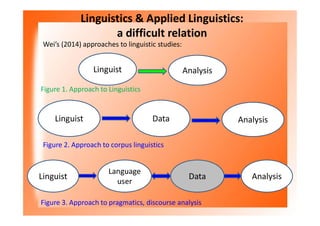
Linguistics & Applied Linguistics:
a difficult relation
Figure 1. Approach to Linguistics
Linguist Analysis
Linguist Analysis
Data
Figure 2. Approach to corpus linguistics
Linguist
Language
user
Analysis
Data
Figure 3. Approach to pragmatics, discourse analysis
Wei’s (2014) approaches to linguistic studies:
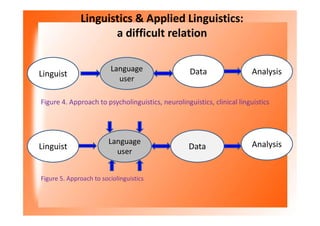
Linguistics & Applied Linguistics:
a difficult relation
Linguist
Language
user
Analysis
Data
Figure 5. Approach to sociolinguistics
Linguist
Language
user
Data Analysis
Figure 4. Approach to psycholinguistics, neurolinguistics, clinical linguistics
Linguistics & Applied
Linguistics: a difficult relation
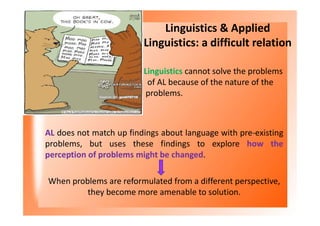
Linguistics cannot solve the problems
of AL because of the nature of the
problems.
AL does not match up findings about language with pre-existing
problems, but uses these findings to explore how the
perception of problems might be changed.
When problems are reformulated from a different perspective,
they become more amenable to solution.
Applied Linguistics methodology
AL methodology is complex:
1. It must refer to the findings and theories of linguistics.
2. It must research & take into account the experience & needs
of the people involved in the problem.
3. It must relate these 2 perspectives to reformulate each.
4. It may apply one specific approach to the problems or a
combination of approaches.
5. It must carry out research & theorizing of its own.
6. It uses ideas from philosophy, education, sociology,
pscyhology, feminism, media studies, etc.
AL is a search for common ground between experience &
expertise, & professional concerns with language problems &
linguistics.
AL as a problem-solving approach
As a problem-solving approach, AL has 3 implications:
1.AL is a Jack of all trades: Real-world problems cannot be
solved by looking at a single aspect of language. Since AL is
interdisciplinary, the Applied Linguist is expected to know a
little about many areas (not only language!) to filter out
relevant ideas to their concerns.
2.AL is a go-between: The problems AL deals with are complex
& varied. Applied Linguists act as consultants contributing
their own interpretation & advice.
3.Description of any area of language is not AL but descriptive
linguistics: Making a description is not solving a problem, even
if it may contribute to the solution.
AL as a problem-solving approach
Does the language element have to dominate?:
1. If there is no language element. Many concerns of AL are
concerns of sociologists, neuroscientists, etc., but AL focuses
on the role of language within these concerns.
2. If the language elements are handled without any theory of
language. AL cannot treat language ignoring language
studies. Nor can the language elements be based on folk
ideas or beliefs.
3. If the research concern is not related to language issues. A
theory from other disciplines cannot be applied without
showing how and why it is relevant. E.g. an idea from
computer simulation needs to show its validity by providing
practical solutions to real-life problems.
Study activity
1.Pick a recent newspaper or magazine and find one article that
talks about a language or a language-related problem. What is
the problem? To whom is it a problem? To what extent is the
problem related to historical, political, cultural or policy
issues?
2.Reflecting on your own language learning or teaching
experience, how much did linguistics help you? Were there
any issues for which you had to go to other disciplines, such as
psychology, sociology or cultural studies, to find possible
solutions or inspirations? What are these disciplines?
3.Keep a diary for a week and see how many events you have
experienced that are related to language and communication
issues. What are the issues? Are there practical solutions to
any of them?
References
 Brumfit, C. (1997), ‘How applied linguistics is the same as any
other science’, AILA Review, 12: 18-30.
 Cook, G. (2003), Applied Linguistics. Oxford: O.U.P.
 Cook, V. (2004), ‘What is Applied Linguistics?’
http://www.viviancook.uk/Writings/Papers/WhatIsAppliedLin
guistics.htm [10 February 2017].
 Davies, A. (2007), An Introduction to Applied Linguistics: From
Practice to Theory. Edinburgh: Edinburgh University Press.
 Hudson, R. (1999), ‘Applied Linguistics: an attempt at a
definition, in A. Davies, An Introduction to Applied Linguistics.
Edinburgh: Edinburgh University Press.
References
 Kaplan, R. B. & H. G. Widdowson (1992), ‘Applied Linguistics’,
in W. Bright International Encyclopedia of Linguistics, vol. 1,
New York: O.U.P.
 Pennycook, A. (2004), ‘Critical Applied Linguistics’, in A. Davies
& C. Elder, The Handbook of Applied Linguistics, Oxford:
Blackwell: 784-807.
 Rampton, B. (1997), ‘Returning in Applied Linguistics’,
International Journal of Applied Linguistics, 16(2): 233-56.
 Wei, L. (2014), Applied Linguistics, Chichester: Wiley Blackwell.
 Widdowson, H. G. (2005). ‘Applied linguistics, interdisciplinary
and disparate realities’, in P. Bruthiaux, D. Atkinson, W. G.
Eggington, W. Grabe and V. Ramanathan, Directions in Applied
Linguistics, Clevendon: Multilingual Matters: 12-25.

What is Applied Linguistics (Guy Cook).pdf

  • 1.
    What is Applied Linguistics? Universidadde Cádiz Facultad de Filosofía y Letras Applied Linguistics Bárbara Eizaga Rebollar 13/02/2017
  • 2.
    Defining Applied Linguistics Itis not easy to define as there is a lack of consensus: Applied Linguistics then means many things to many people. (V. Cook 2004) To some, applied linguistics (AL) is applying theoretical linguistics to actual data, e.g. dictionary creation collection social networks gender differences of corpora description To many, applied linguistics is synonymous with Second Language Acquisition (SLA).
  • 4.
    Defining Applied Linguistics Anotherdefinition for AL: The academic discipline concerned with the relation of knowledge about language to decision making in the real world. (G. Cook 2003) A further definitional problem: if the nature of AP is disputed, what agreement can there be as to what is exactly being applied?: • a mediation between theory and practice (Kapplan and Widdowson 1992:76). • a synthesis of research from various disciplines, including linguistics (Hudson, 1999). • an open field of interest in language (Rampton 1997: 14). • many different issues such as identity, sexuality, access ethics, disparity, difference, desire (Pennycook 2004: 803-804). • theoretical and empirical investigation of real-world problems related to language (Brumfit, 1997: 93).
  • 5.
    Defining Applied Linguistics Giventhe many definitions, most books use AL concerns and activities to illustrate and then analyse what applied linguistics methods and purposes are. Most agree that the task of AL is to mediate between linguistics and language use (Cook 2003:20; Widdowson 2005). Possible definition AL uses what we know about (a) language (b) how it is learned (c) how it is used to achieve some purpose or solve some problem in the real world.
  • 6.
    The need forApplied Linguistics The range of purposes or real-world problems involves success & failure; ethical, cultural & gender issues; technology & lack of resources; etc. Let’s take, for instance, language in education Cook, 2003): What language skills should children achieve beyond basic literacy? (What is basic literacy? Reading & writing?) Should children speaking a dialect be encouraged to maintain it or steered towards the standard form of language? (If so, how is the standard form decided & by whom?) In communities with more than one language which one/s should be used in schools? Should everyone learn foreign languages and, if so, which one/s? (And what is the best way to learn & teach them?)
  • 7.
    The need forApplied Linguistics These language issues echo those of society at large: Languages change. Should this be accepted or controlled in some way? Some languages are dying out. Should that be prevented and, if so, how? Should the growth of English as lingua franca be welcomed or deplored? Is language being used for political oppression? (And, if so, should something be done about it?) Which languages should be used in law courts and official documents?
  • 8.
    The scope ofApplied Linguistics Since language is implicated in so much of our daily lives, there is a large and open-ended number of quite disparate activities to which AL is relevant. A classification of the areas of study is the following (Cook 2003; Davies 2007; Kaplan 2002): 1. Language & education: 1st-language acquisition; SLA; foreign language acquisition (FLA); language teaching curriculum (content/syllabus); clinical linguistics (language pathology problems); language testing/assessment.
  • 9.
    The scope ofApplied Linguistics 2. Language, work, & law: workplace communication; language planning and policy; forensic linguistics; language & identity (bilingual, immersion, & language minority education); language inequality problems (sex, gender, race, etc.); language, culture & pragmatics. 3. Language, information, & effect: literary stylistics; discourse analysis (DA); translation & interpretation; information design; lexicography; language in the media; machine translation; corpus linguistics; psycho-/neurolinguistics, sociolinguistics; language & technology.
  • 10.
    Linguistics & AppliedLinguistics: a difficult relation One way of approaching the practical & professional problems of these areas is by relating them to linguistics –the study of language in general: Purpose of linguistics: describe the language in the mind. Purpose of language use: explain the way in which people use language in everyday life. Purpose of AL: engage in decision making. AL mediates between language use linguistics (everyday life experience) (language experience)
  • 11.
    Linguistics & AppliedLinguistics: a difficult relation Figure 1. Approach to Linguistics Linguist Analysis Linguist Analysis Data Figure 2. Approach to corpus linguistics Linguist Language user Analysis Data Figure 3. Approach to pragmatics, discourse analysis Wei’s (2014) approaches to linguistic studies:
  • 12.
    Linguistics & AppliedLinguistics: a difficult relation Linguist Language user Analysis Data Figure 5. Approach to sociolinguistics Linguist Language user Data Analysis Figure 4. Approach to psycholinguistics, neurolinguistics, clinical linguistics
  • 13.
    Linguistics & Applied Linguistics:a difficult relation Linguistics cannot solve the problems of AL because of the nature of the problems. AL does not match up findings about language with pre-existing problems, but uses these findings to explore how the perception of problems might be changed. When problems are reformulated from a different perspective, they become more amenable to solution.
  • 14.
    Applied Linguistics methodology ALmethodology is complex: 1. It must refer to the findings and theories of linguistics. 2. It must research & take into account the experience & needs of the people involved in the problem. 3. It must relate these 2 perspectives to reformulate each. 4. It may apply one specific approach to the problems or a combination of approaches. 5. It must carry out research & theorizing of its own. 6. It uses ideas from philosophy, education, sociology, pscyhology, feminism, media studies, etc. AL is a search for common ground between experience & expertise, & professional concerns with language problems & linguistics.
  • 15.
    AL as aproblem-solving approach As a problem-solving approach, AL has 3 implications: 1.AL is a Jack of all trades: Real-world problems cannot be solved by looking at a single aspect of language. Since AL is interdisciplinary, the Applied Linguist is expected to know a little about many areas (not only language!) to filter out relevant ideas to their concerns. 2.AL is a go-between: The problems AL deals with are complex & varied. Applied Linguists act as consultants contributing their own interpretation & advice. 3.Description of any area of language is not AL but descriptive linguistics: Making a description is not solving a problem, even if it may contribute to the solution.
  • 16.
    AL as aproblem-solving approach Does the language element have to dominate?: 1. If there is no language element. Many concerns of AL are concerns of sociologists, neuroscientists, etc., but AL focuses on the role of language within these concerns. 2. If the language elements are handled without any theory of language. AL cannot treat language ignoring language studies. Nor can the language elements be based on folk ideas or beliefs. 3. If the research concern is not related to language issues. A theory from other disciplines cannot be applied without showing how and why it is relevant. E.g. an idea from computer simulation needs to show its validity by providing practical solutions to real-life problems.
  • 17.
    Study activity 1.Pick arecent newspaper or magazine and find one article that talks about a language or a language-related problem. What is the problem? To whom is it a problem? To what extent is the problem related to historical, political, cultural or policy issues? 2.Reflecting on your own language learning or teaching experience, how much did linguistics help you? Were there any issues for which you had to go to other disciplines, such as psychology, sociology or cultural studies, to find possible solutions or inspirations? What are these disciplines? 3.Keep a diary for a week and see how many events you have experienced that are related to language and communication issues. What are the issues? Are there practical solutions to any of them?
  • 18.
    References  Brumfit, C.(1997), ‘How applied linguistics is the same as any other science’, AILA Review, 12: 18-30.  Cook, G. (2003), Applied Linguistics. Oxford: O.U.P.  Cook, V. (2004), ‘What is Applied Linguistics?’ http://www.viviancook.uk/Writings/Papers/WhatIsAppliedLin guistics.htm [10 February 2017].  Davies, A. (2007), An Introduction to Applied Linguistics: From Practice to Theory. Edinburgh: Edinburgh University Press.  Hudson, R. (1999), ‘Applied Linguistics: an attempt at a definition, in A. Davies, An Introduction to Applied Linguistics. Edinburgh: Edinburgh University Press.
  • 19.
    References  Kaplan, R.B. & H. G. Widdowson (1992), ‘Applied Linguistics’, in W. Bright International Encyclopedia of Linguistics, vol. 1, New York: O.U.P.  Pennycook, A. (2004), ‘Critical Applied Linguistics’, in A. Davies & C. Elder, The Handbook of Applied Linguistics, Oxford: Blackwell: 784-807.  Rampton, B. (1997), ‘Returning in Applied Linguistics’, International Journal of Applied Linguistics, 16(2): 233-56.  Wei, L. (2014), Applied Linguistics, Chichester: Wiley Blackwell.  Widdowson, H. G. (2005). ‘Applied linguistics, interdisciplinary and disparate realities’, in P. Bruthiaux, D. Atkinson, W. G. Eggington, W. Grabe and V. Ramanathan, Directions in Applied Linguistics, Clevendon: Multilingual Matters: 12-25.