Applied linguistics is a branch of linguistics
where the primary concern is the application
of the linguistic theories, methods and
findings to the explanation of language
problems which have arisen in other areas of
experience.

The term Applied Linguistics (AL) is an Anglo-
American coinage. It was founded first at the
University of Edinburgh School of Applied
Linguistics in 1956.
 Then at the Center of Applied Linguistics in
Washington D.C. in 1957.
 AL use was theoretical linguistics propagated
by those who clearly wanted to be known as
scientists and not as humanists.
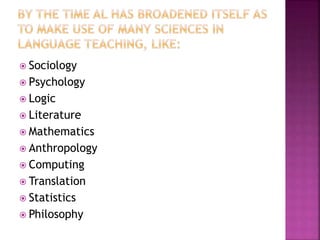
 Sociology
 Psychology
 Logic
 Literature
 Mathematics
 Anthropology
 Computing
 Translation
 Statistics
 Philosophy

The study of second and foreign language
learning and teaching.
 The study of language and linguistics in
relation to practical problems.
 Richards et al. 1985

AL is the utilization of the knowledge about the
nature of language achieved by linguistic
research for the improvement of the efficiency
of some practical task in which language is a
central component. Corder 1974
 A branch of linguistics where the primary
concern is the application of linguistic theories,
methods and findings to the elucidation of
language problems which have arisen in other
areas of experience. Crystal 1985
 “a multidisciplinary approach to the solution
of language-related problems.”
Strevens (1992)

The study of second language and foreign
language learning and teaching. Investigate
problems related to language learning and
teaching. To find some practical steps to
solve those problems.
 The importance of AL lies in the significant role it has
in solving language-related problems.
 Language is crucial to human lives. Without language,
most important activities will be inconceivable.
 Throughout the history and across the world, people
have been using language to communicate. In our
world there are many rapid changes. These changes
affect how people use language. Hence, people need
to investigate and understand the facts of language
use, to organize and formalize what they know and to
subject their knowledge to rational consideration and
critical analysis.
 Only by doing so, people will be able to set out the
options for action and the reasoning behind them.

- How can languages best be learnt and
taught?
 - What social factors affect language
learning?
 - How can technology be used to contribute
to the effectiveness of language
teaching/learning?
 - What are the related problems associated
with language disorders?
 - How can these be prevented?
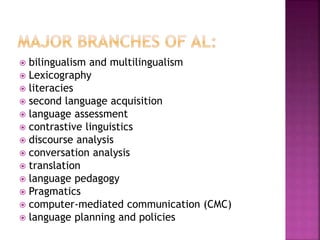
 bilingualism and multilingualism
 Lexicography
 literacies
 second language acquisition
 language assessment
 contrastive linguistics
 discourse analysis
 conversation analysis
 translation
 language pedagogy
 Pragmatics
 computer-mediated communication (CMC)
 language planning and policies

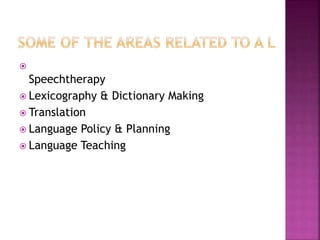
Speechtherapy
 Lexicography & Dictionary Making
 Translation
 Language Policy & Planning
 Language Teaching
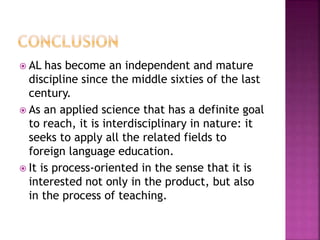
 AL has become an independent and mature
discipline since the middle sixties of the last
century.
 As an applied science that has a definite goal
to reach, it is interdisciplinary in nature: it
seeks to apply all the related fields to
foreign language education.
 It is process-oriented in the sense that it is
interested not only in the product, but also
in the process of teaching.
 This implies the investigation of the internal
structure or the cognitive aspects of the
learner.
 It is very important for language teachers to
have an understanding of the different
aspects of language and draw out useful
implications and applications for foreign
language learning and teaching. Mrs. Hind
Albeladi - March 2010

Sunu1.pptx applied linguistics general info

  • 2.
    Applied linguistics isa branch of linguistics where the primary concern is the application of the linguistic theories, methods and findings to the explanation of language problems which have arisen in other areas of experience.
  • 3.
     The term AppliedLinguistics (AL) is an Anglo- American coinage. It was founded first at the University of Edinburgh School of Applied Linguistics in 1956.  Then at the Center of Applied Linguistics in Washington D.C. in 1957.  AL use was theoretical linguistics propagated by those who clearly wanted to be known as scientists and not as humanists.
  • 4.
     Sociology  Psychology Logic  Literature  Mathematics  Anthropology  Computing  Translation  Statistics  Philosophy
  • 5.
     The study ofsecond and foreign language learning and teaching.  The study of language and linguistics in relation to practical problems.  Richards et al. 1985
  • 6.
     AL is theutilization of the knowledge about the nature of language achieved by linguistic research for the improvement of the efficiency of some practical task in which language is a central component. Corder 1974  A branch of linguistics where the primary concern is the application of linguistic theories, methods and findings to the elucidation of language problems which have arisen in other areas of experience. Crystal 1985  “a multidisciplinary approach to the solution of language-related problems.” Strevens (1992)
  • 7.
     The study ofsecond language and foreign language learning and teaching. Investigate problems related to language learning and teaching. To find some practical steps to solve those problems.
  • 8.
     The importanceof AL lies in the significant role it has in solving language-related problems.  Language is crucial to human lives. Without language, most important activities will be inconceivable.  Throughout the history and across the world, people have been using language to communicate. In our world there are many rapid changes. These changes affect how people use language. Hence, people need to investigate and understand the facts of language use, to organize and formalize what they know and to subject their knowledge to rational consideration and critical analysis.  Only by doing so, people will be able to set out the options for action and the reasoning behind them.
  • 9.
     - How canlanguages best be learnt and taught?  - What social factors affect language learning?  - How can technology be used to contribute to the effectiveness of language teaching/learning?  - What are the related problems associated with language disorders?  - How can these be prevented?
  • 10.
     bilingualism andmultilingualism  Lexicography  literacies  second language acquisition  language assessment  contrastive linguistics  discourse analysis  conversation analysis  translation  language pedagogy  Pragmatics  computer-mediated communication (CMC)  language planning and policies
  • 11.
     Speechtherapy  Lexicography &Dictionary Making  Translation  Language Policy & Planning  Language Teaching
  • 12.
     AL hasbecome an independent and mature discipline since the middle sixties of the last century.  As an applied science that has a definite goal to reach, it is interdisciplinary in nature: it seeks to apply all the related fields to foreign language education.  It is process-oriented in the sense that it is interested not only in the product, but also in the process of teaching.
  • 13.
     This impliesthe investigation of the internal structure or the cognitive aspects of the learner.  It is very important for language teachers to have an understanding of the different aspects of language and draw out useful implications and applications for foreign language learning and teaching. Mrs. Hind Albeladi - March 2010