Applied Linguistics
Lecture 1: An Introduction to Applied Linguistics
Dr. Hanan Abdulqader
Faculty of Arts
Department of English
2
An Introduction to Applied Linguistics
Main issues of this Lecture
• What is linguistics?
• What is the relation between linguistics and applied
linguistics? How do they differ?
• What is applied linguistics?
• When did applied linguistics develop as an independent
area of study?
• What are the main areas of concern of applied linguistics?
• What will this course focus on? How is this course
organised?
3
An Introduction to Applied Linguistics
What is Linguistics?
• Linguistics is the scientific study of language.
Linguists do work on specific languages, but their
primary goal is to understand the nature of Language
in general.
• Linguistics is primarily concerned with the nature of
language and communication. There are broadly
three aspects to the study, including language form,
language meaning, and language use in discursive
and communicative contexts.

4
An Introduction to Applied Linguistics
What is Linguistics?
• Linguistics deals with the study of particular languages,
and the search for general properties common to all
languages or large groups of languages.
5
An Introduction to Applied Linguistics
Some questions linguistics tries to
answer
• What distinguishes human language from other
animal communication systems?
• What features are common to all human
languages?
• How are the modes of linguistic communication
(speech, writing, sign language of the deaf)
related to each other?
6
An Introduction to Applied Linguistics
Some questions linguistics tries to
answer
• How is language related to other types of
human behaviour?
• What is language and how is it organized?
• How is it analysed? How are its units
discovered and tested, etc.
7
An Introduction to Applied Linguistics
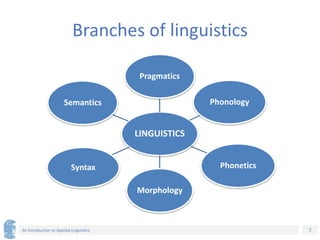
Branches of linguistics
LINGUISTICS
Pragmatics
Phonology
Phonetics
Morphology
Syntax
Semantics
8
An Introduction to Applied Linguistics
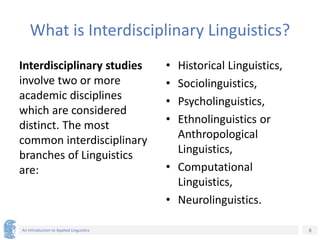
What is Interdisciplinary Linguistics?
Interdisciplinary studies
involve two or more
academic disciplines
which are considered
distinct. The most
common interdisciplinary
branches of Linguistics
are:
• Historical Linguistics,
• Sociolinguistics,
• Psycholinguistics,
• Ethnolinguistics or
Anthropological
Linguistics,
• Computational
Linguistics,
• Neurolinguistics.
9
An Introduction to Applied Linguistics
Applied Linguistics:
When did it all begin?
• The term Applied Linguistics (AL) is an Anglo-
American coinage.
• It was founded first at the University of
Edinburgh School of Applied Linguistics in 1956.
• Then at the Center of Applied Linguistics in
Washington D.C. in 1957.
• It was largely taken for granted in the 1960s and 1970s
that applied linguistics was about language teaching.
10
An Introduction to Applied Linguistics
What is Applied Linguistics? (1/4)
• Applied Linguistics entails using what we know
about language, about how it is used, and about
how it is learned in order to solve some problem in
the real world.
• Applied Linguistics uses language-related research in
a wide variety of fields (e.g. language acquisition,
language teaching, literacy, gender studies, language
policy, speech therapy, discourse analysis,
censorship, workplace communication, media
studies, translation, lexicography, forensic linguistics).
11
An Introduction to Applied Linguistics
What is Applied Linguistics? (2/4)
“AL is the utilisation of the knowledge about the
nature of language achieved by linguistic
research for the improvement of the efficiency
of some practical task in which language is a
central component.” (Corder, 1974, p. 24)
12
An Introduction to Applied Linguistics
What is Applied Linguistics? (3/4)
“Applied Linguistics is using what we know
about (a) language, (b) how it is learned, and (c)
how it is used, in order to achieve some purpose
or solve some problem in the real world”
(Schmitt & Celce-Murcia, 2002, p. 1).
13
An Introduction to Applied Linguistics
What is Applied Linguistics? (4/4)
“The focus of applied linguistics is on trying to
resolve language-based problems that people
encounter in the real world, whether they be
learners, teachers, supervisors, academics,
lawyers, service providers, those who need
social services, test takers, policy developers,
dictionary makers, translators, or a whole range
of business clients.” (Grabe, 2002, p. 9).
14
An Introduction to Applied Linguistics
Defining characteristics of Applied
Linguistics
• Autonomous, multidisciplinary and problem
solving: uses and draws on theory from other related
fields concerned with language and generates its
own theory in order to find solutions to language
related problems and issues in the real world.
• Practical concerns have an important role in shaping
the questions that AL will address.
• Language related problems concern learners,
teachers, academics, lawyers, translators, test takers,
service providers, etc.
15
An Introduction to Applied Linguistics
What problems are related to
language?
Problems related to:
• language learning,
• language teaching,
• literacy,
• language contact
(language & culture),
• language policy and
planning,
• language assessment,
• language use,
• language and
technology,
• translation and
interpretation,
• language pathology.
16
An Introduction to Applied Linguistics
A sample of questions Applied
Linguistics addresses
• How can we teach languages better?
• How can we diagnose speech pathologies
better?
• How can we improve the training of translators?
• How can we develop valid language
examinations?
17
An Introduction to Applied Linguistics
A sample of questions Applied
Linguistics addresses
• How can we determine the literacy levels of a
population?
• What advice can we give the ministry of
education on proposals to introduce a new
teaching method?
• What advice can we give a defence lawyer on
the authenticity of a police transcript of an
interview with a suspect?
18
An Introduction to Applied Linguistics
What is the relationship between AL and
other language related disciplines?
• Applied linguistics occupies an intermediary, mediating
position between language related disciplines (linguistics,
psycholinguistics and sociolinguistics) and professional
practice.
• It uses theories/principles from language related
disciplines in order to understand language related issues
and to solve language related problems.
The choice of which disciplines are involved in applied
linguistics matters depends on the circumstances.
19
An Introduction to Applied Linguistics
What is the relationship between AL and
other language related disciplines?
• Applied linguistics conducts research into
professional practice and on the basis of the
results develops theory.
20
An Introduction to Applied Linguistics
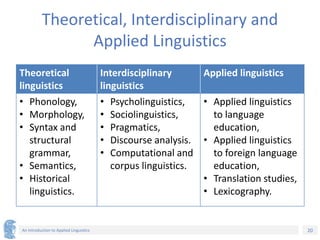
Theoretical, Interdisciplinary and
Applied Linguistics
Theoretical
linguistics
Interdisciplinary
linguistics
Applied linguistics
• Phonology,
• Morphology,
• Syntax and
structural
grammar,
• Semantics,
• Historical
linguistics.
• Psycholinguistics,
• Sociolinguistics,
• Pragmatics,
• Discourse analysis.
• Computational and
corpus linguistics.
• Applied linguistics
to language
education,
• Applied linguistics
to foreign language
education,
• Translation studies,
• Lexicography.
21
An Introduction to Applied Linguistics
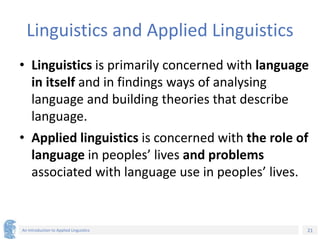
Linguistics and Applied Linguistics
• Linguistics is primarily concerned with language
in itself and in findings ways of analysing
language and building theories that describe
language.
• Applied linguistics is concerned with the role of
language in peoples’ lives and problems
associated with language use in peoples’ lives.
22
An Introduction to Applied Linguistics
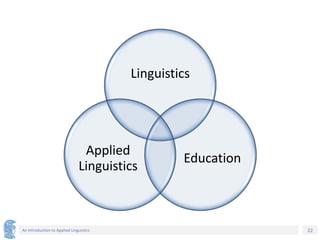
Linguistics
Education
Applied
Linguistics
23
An Introduction to Applied Linguistics
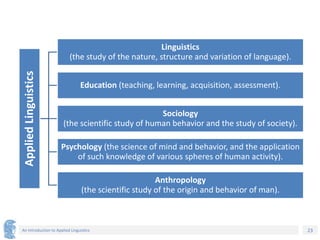
Applied
Linguistics
Linguistics
(the study of the nature, structure and variation of language).
Education (teaching, learning, acquisition, assessment).
Sociology
(the scientific study of human behavior and the study of society).
Psychology (the science of mind and behavior, and the application
of such knowledge of various spheres of human activity).
Anthropology
(the scientific study of the origin and behavior of man).
24
An Introduction to Applied Linguistics
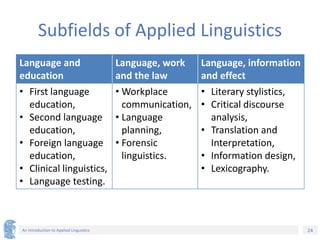
Subfields of Applied Linguistics
Language and
education
Language, work
and the law
Language, information
and effect
• First language
education,
• Second language
education,
• Foreign language
education,
• Clinical linguistics,
• Language testing.
• Workplace
communication,
• Language
planning,
• Forensic
linguistics.
• Literary stylistics,
• Critical discourse
analysis,
• Translation and
Interpretation,
• Information design,
• Lexicography.
25
An Introduction to Applied Linguistics
Applied Linguistics to foreign language
teaching and learning: Related sub-fields
• EAP, ESP, EYL,
• CALL/TELL,
• Materials development and
evaluation,
• Syllabus design and
language curriculum
development,
• Language testing,
• Language teaching methods
and techniques,
• Language teacher training
and education,
• Research into second and
foreign language learning,
• Language education policies
and language planning,
• Educational technology and
language learning,
• Immersion education,
• Language education in
multilingual settings.
26
An Introduction to Applied Linguistics
Focus of this course:
Foreign language didactics
What
• How does one select
and organise the
content of what is to be
taught and learnt?
• What do you teach?
How
• How does one organise
the teaching/learning
process?
• How does one develop
knowledge and skills?
27
An Introduction to Applied Linguistics
Issues discussed in the course
What?
• Methods in language teaching.
• Language theories and their effect on foreign
language teaching.
• Syllabus design and curriculum development.
• Communicative competence.
• Communicative language teaching, task based
language teaching and intercultural competence.
28
An Introduction to Applied Linguistics
Issues discussed in the course
How?
• Theories of language learning and their effect
on foreign language teaching/learning.
• Individual characteristics and their effect on
language learning.
Applied Linguistics
Lecture 2: Topics in Applied Linguistics
Dr. Hanan Abdulqader
Faculty of Arts
Department of English
30
An Introduction to Applied Linguistics
Main Issues
1. Language : Give questions about language.
What do you want to know about the study of
language.
2. Applied Linguistics : Definition, Position
3. Competence vs. Performance
4. Acquisition vs. Learning
5. Language Acquisition and innate capacity
31
An Introduction to Applied Linguistics
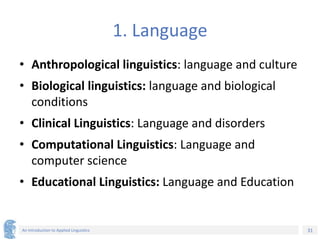
1. Language
• Anthropological linguistics: language and culture
• Biological linguistics: language and biological
conditions
• Clinical Linguistics: Language and disorders
• Computational Linguistics: Language and
computer science
• Educational Linguistics: Language and Education
32
An Introduction to Applied Linguistics
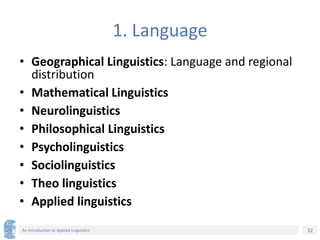
1. Language
• Geographical Linguistics: Language and regional
distribution
• Mathematical Linguistics
• Neurolinguistics
• Philosophical Linguistics
• Psycholinguistics
• Sociolinguistics
• Theo linguistics
• Applied linguistics
33
An Introduction to Applied Linguistics
2. Applied Linguistics
• The application of linguistic theories,
methods, and findings to the elucidation of
language problems that have been arisen in
other domains.
• The term is used in Foreign language teaching
and learning, educational fields, language
planning, language testing, and translation
34
An Introduction to Applied Linguistics
2. Applied Linguistics
• The application of linguistic theories,
methods, and findings to the elucidation of
language problems that have been arisen in
other domains.
• The term is used in Foreign language teaching
and learning, educational fields, language
planning, language testing, and translation
35
An Introduction to Applied Linguistics
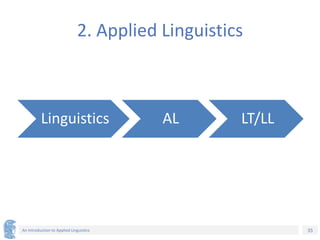
2. Applied Linguistics
Linguistics AL LT/LL
36
An Introduction to Applied Linguistics
Competence vs. Performance
• Competence consists of the mental representations
of linguistic rules. It is the speaker’s knowledge of
the linguistic rules. It is implicit; it exists in the
speaker’s mind and it can be exhibited via hisher
performance.
• Performance: consists of the use of this linguistic
knowledge in the comprehension and production of
language. It is explicit in that it is the actual use of
the linguistic knowledge (speaking, writing). Thus,
competence can be examined through the person’s
performance.
37
An Introduction to Applied Linguistics
• There are rules of speaking without which
the grammatical rules are useless.
-Dell Hymes
Communicative Competence: linguistic
knowledge + pragmatic knowledge
38
An Introduction to Applied Linguistics
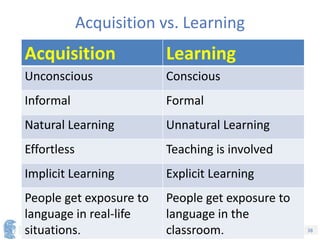
Acquisition vs. Learning
Learning
Acquisition
Conscious
Unconscious
Formal
Informal
Unnatural Learning
Natural Learning
Teaching is involved
Effortless
Explicit Learning
Implicit Learning
People get exposure to
language in the
.
classroom
People get exposure to
language in real-life
.
situations
39
An Introduction to Applied Linguistics
Language Acquisition and innate
capacity
• Innate Capacity has to be activated through
getting enough exposure to language in
society.
• Students of English should always be exposed
much to English to be able to produce it.
• Language Acquisition can be rich or poor
depending upon the language environment.

Applied Linguistics.pptx

  • 1.
    Applied Linguistics Lecture 1:An Introduction to Applied Linguistics Dr. Hanan Abdulqader Faculty of Arts Department of English
  • 2.
    2 An Introduction toApplied Linguistics Main issues of this Lecture • What is linguistics? • What is the relation between linguistics and applied linguistics? How do they differ? • What is applied linguistics? • When did applied linguistics develop as an independent area of study? • What are the main areas of concern of applied linguistics? • What will this course focus on? How is this course organised?
  • 3.
    3 An Introduction toApplied Linguistics What is Linguistics? • Linguistics is the scientific study of language. Linguists do work on specific languages, but their primary goal is to understand the nature of Language in general. • Linguistics is primarily concerned with the nature of language and communication. There are broadly three aspects to the study, including language form, language meaning, and language use in discursive and communicative contexts.
  • 4.
    4 An Introduction toApplied Linguistics What is Linguistics? • Linguistics deals with the study of particular languages, and the search for general properties common to all languages or large groups of languages.
  • 5.
    5 An Introduction toApplied Linguistics Some questions linguistics tries to answer • What distinguishes human language from other animal communication systems? • What features are common to all human languages? • How are the modes of linguistic communication (speech, writing, sign language of the deaf) related to each other?
  • 6.
    6 An Introduction toApplied Linguistics Some questions linguistics tries to answer • How is language related to other types of human behaviour? • What is language and how is it organized? • How is it analysed? How are its units discovered and tested, etc.
  • 7.
    7 An Introduction toApplied Linguistics Branches of linguistics LINGUISTICS Pragmatics Phonology Phonetics Morphology Syntax Semantics
  • 8.
    8 An Introduction toApplied Linguistics What is Interdisciplinary Linguistics? Interdisciplinary studies involve two or more academic disciplines which are considered distinct. The most common interdisciplinary branches of Linguistics are: • Historical Linguistics, • Sociolinguistics, • Psycholinguistics, • Ethnolinguistics or Anthropological Linguistics, • Computational Linguistics, • Neurolinguistics.
  • 9.
    9 An Introduction toApplied Linguistics Applied Linguistics: When did it all begin? • The term Applied Linguistics (AL) is an Anglo- American coinage. • It was founded first at the University of Edinburgh School of Applied Linguistics in 1956. • Then at the Center of Applied Linguistics in Washington D.C. in 1957. • It was largely taken for granted in the 1960s and 1970s that applied linguistics was about language teaching.
  • 10.
    10 An Introduction toApplied Linguistics What is Applied Linguistics? (1/4) • Applied Linguistics entails using what we know about language, about how it is used, and about how it is learned in order to solve some problem in the real world. • Applied Linguistics uses language-related research in a wide variety of fields (e.g. language acquisition, language teaching, literacy, gender studies, language policy, speech therapy, discourse analysis, censorship, workplace communication, media studies, translation, lexicography, forensic linguistics).
  • 11.
    11 An Introduction toApplied Linguistics What is Applied Linguistics? (2/4) “AL is the utilisation of the knowledge about the nature of language achieved by linguistic research for the improvement of the efficiency of some practical task in which language is a central component.” (Corder, 1974, p. 24)
  • 12.
    12 An Introduction toApplied Linguistics What is Applied Linguistics? (3/4) “Applied Linguistics is using what we know about (a) language, (b) how it is learned, and (c) how it is used, in order to achieve some purpose or solve some problem in the real world” (Schmitt & Celce-Murcia, 2002, p. 1).
  • 13.
    13 An Introduction toApplied Linguistics What is Applied Linguistics? (4/4) “The focus of applied linguistics is on trying to resolve language-based problems that people encounter in the real world, whether they be learners, teachers, supervisors, academics, lawyers, service providers, those who need social services, test takers, policy developers, dictionary makers, translators, or a whole range of business clients.” (Grabe, 2002, p. 9).
  • 14.
    14 An Introduction toApplied Linguistics Defining characteristics of Applied Linguistics • Autonomous, multidisciplinary and problem solving: uses and draws on theory from other related fields concerned with language and generates its own theory in order to find solutions to language related problems and issues in the real world. • Practical concerns have an important role in shaping the questions that AL will address. • Language related problems concern learners, teachers, academics, lawyers, translators, test takers, service providers, etc.
  • 15.
    15 An Introduction toApplied Linguistics What problems are related to language? Problems related to: • language learning, • language teaching, • literacy, • language contact (language & culture), • language policy and planning, • language assessment, • language use, • language and technology, • translation and interpretation, • language pathology.
  • 16.
    16 An Introduction toApplied Linguistics A sample of questions Applied Linguistics addresses • How can we teach languages better? • How can we diagnose speech pathologies better? • How can we improve the training of translators? • How can we develop valid language examinations?
  • 17.
    17 An Introduction toApplied Linguistics A sample of questions Applied Linguistics addresses • How can we determine the literacy levels of a population? • What advice can we give the ministry of education on proposals to introduce a new teaching method? • What advice can we give a defence lawyer on the authenticity of a police transcript of an interview with a suspect?
  • 18.
    18 An Introduction toApplied Linguistics What is the relationship between AL and other language related disciplines? • Applied linguistics occupies an intermediary, mediating position between language related disciplines (linguistics, psycholinguistics and sociolinguistics) and professional practice. • It uses theories/principles from language related disciplines in order to understand language related issues and to solve language related problems. The choice of which disciplines are involved in applied linguistics matters depends on the circumstances.
  • 19.
    19 An Introduction toApplied Linguistics What is the relationship between AL and other language related disciplines? • Applied linguistics conducts research into professional practice and on the basis of the results develops theory.
  • 20.
    20 An Introduction toApplied Linguistics Theoretical, Interdisciplinary and Applied Linguistics Theoretical linguistics Interdisciplinary linguistics Applied linguistics • Phonology, • Morphology, • Syntax and structural grammar, • Semantics, • Historical linguistics. • Psycholinguistics, • Sociolinguistics, • Pragmatics, • Discourse analysis. • Computational and corpus linguistics. • Applied linguistics to language education, • Applied linguistics to foreign language education, • Translation studies, • Lexicography.
  • 21.
    21 An Introduction toApplied Linguistics Linguistics and Applied Linguistics • Linguistics is primarily concerned with language in itself and in findings ways of analysing language and building theories that describe language. • Applied linguistics is concerned with the role of language in peoples’ lives and problems associated with language use in peoples’ lives.
  • 22.
    22 An Introduction toApplied Linguistics Linguistics Education Applied Linguistics
  • 23.
    23 An Introduction toApplied Linguistics Applied Linguistics Linguistics (the study of the nature, structure and variation of language). Education (teaching, learning, acquisition, assessment). Sociology (the scientific study of human behavior and the study of society). Psychology (the science of mind and behavior, and the application of such knowledge of various spheres of human activity). Anthropology (the scientific study of the origin and behavior of man).
  • 24.
    24 An Introduction toApplied Linguistics Subfields of Applied Linguistics Language and education Language, work and the law Language, information and effect • First language education, • Second language education, • Foreign language education, • Clinical linguistics, • Language testing. • Workplace communication, • Language planning, • Forensic linguistics. • Literary stylistics, • Critical discourse analysis, • Translation and Interpretation, • Information design, • Lexicography.
  • 25.
    25 An Introduction toApplied Linguistics Applied Linguistics to foreign language teaching and learning: Related sub-fields • EAP, ESP, EYL, • CALL/TELL, • Materials development and evaluation, • Syllabus design and language curriculum development, • Language testing, • Language teaching methods and techniques, • Language teacher training and education, • Research into second and foreign language learning, • Language education policies and language planning, • Educational technology and language learning, • Immersion education, • Language education in multilingual settings.
  • 26.
    26 An Introduction toApplied Linguistics Focus of this course: Foreign language didactics What • How does one select and organise the content of what is to be taught and learnt? • What do you teach? How • How does one organise the teaching/learning process? • How does one develop knowledge and skills?
  • 27.
    27 An Introduction toApplied Linguistics Issues discussed in the course What? • Methods in language teaching. • Language theories and their effect on foreign language teaching. • Syllabus design and curriculum development. • Communicative competence. • Communicative language teaching, task based language teaching and intercultural competence.
  • 28.
    28 An Introduction toApplied Linguistics Issues discussed in the course How? • Theories of language learning and their effect on foreign language teaching/learning. • Individual characteristics and their effect on language learning.
  • 29.
    Applied Linguistics Lecture 2:Topics in Applied Linguistics Dr. Hanan Abdulqader Faculty of Arts Department of English
  • 30.
    30 An Introduction toApplied Linguistics Main Issues 1. Language : Give questions about language. What do you want to know about the study of language. 2. Applied Linguistics : Definition, Position 3. Competence vs. Performance 4. Acquisition vs. Learning 5. Language Acquisition and innate capacity
  • 31.
    31 An Introduction toApplied Linguistics 1. Language • Anthropological linguistics: language and culture • Biological linguistics: language and biological conditions • Clinical Linguistics: Language and disorders • Computational Linguistics: Language and computer science • Educational Linguistics: Language and Education
  • 32.
    32 An Introduction toApplied Linguistics 1. Language • Geographical Linguistics: Language and regional distribution • Mathematical Linguistics • Neurolinguistics • Philosophical Linguistics • Psycholinguistics • Sociolinguistics • Theo linguistics • Applied linguistics
  • 33.
    33 An Introduction toApplied Linguistics 2. Applied Linguistics • The application of linguistic theories, methods, and findings to the elucidation of language problems that have been arisen in other domains. • The term is used in Foreign language teaching and learning, educational fields, language planning, language testing, and translation
  • 34.
    34 An Introduction toApplied Linguistics 2. Applied Linguistics • The application of linguistic theories, methods, and findings to the elucidation of language problems that have been arisen in other domains. • The term is used in Foreign language teaching and learning, educational fields, language planning, language testing, and translation
  • 35.
    35 An Introduction toApplied Linguistics 2. Applied Linguistics Linguistics AL LT/LL
  • 36.
    36 An Introduction toApplied Linguistics Competence vs. Performance • Competence consists of the mental representations of linguistic rules. It is the speaker’s knowledge of the linguistic rules. It is implicit; it exists in the speaker’s mind and it can be exhibited via hisher performance. • Performance: consists of the use of this linguistic knowledge in the comprehension and production of language. It is explicit in that it is the actual use of the linguistic knowledge (speaking, writing). Thus, competence can be examined through the person’s performance.
  • 37.
    37 An Introduction toApplied Linguistics • There are rules of speaking without which the grammatical rules are useless. -Dell Hymes Communicative Competence: linguistic knowledge + pragmatic knowledge
  • 38.
    38 An Introduction toApplied Linguistics Acquisition vs. Learning Learning Acquisition Conscious Unconscious Formal Informal Unnatural Learning Natural Learning Teaching is involved Effortless Explicit Learning Implicit Learning People get exposure to language in the . classroom People get exposure to language in real-life . situations
  • 39.
    39 An Introduction toApplied Linguistics Language Acquisition and innate capacity • Innate Capacity has to be activated through getting enough exposure to language in society. • Students of English should always be exposed much to English to be able to produce it. • Language Acquisition can be rich or poor depending upon the language environment.