First, Break All the Rules
What the World’s Greatest
Managers Do Differently
Brian M. Wills
Director
Agile Transformation Office
3-Feb-2016
2
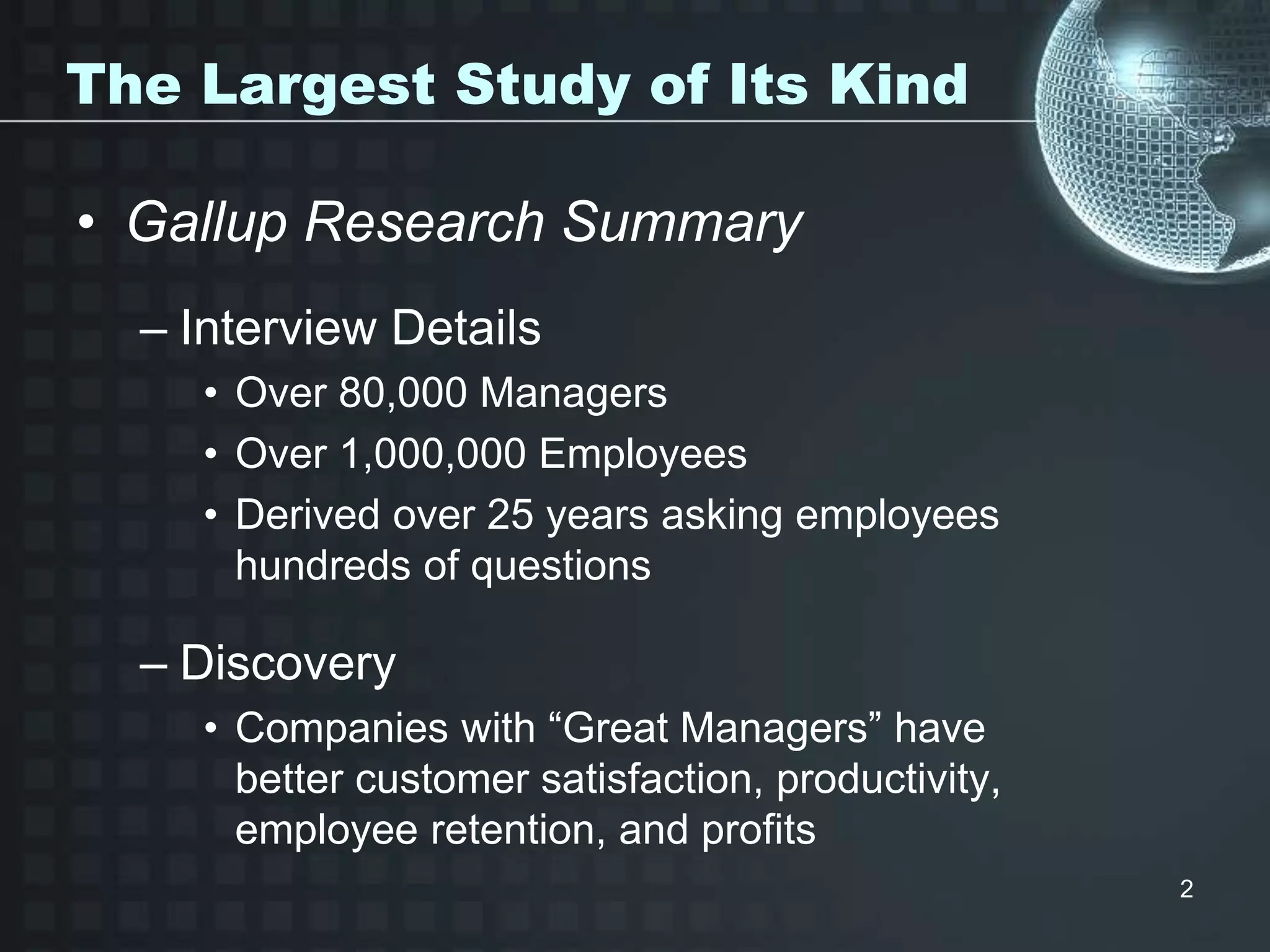
The Largest Study of Its Kind
• Gallup Research Summary
– Interview Details
• Over 80,000 Managers
• Over 1,000,000 Employees
• Derived over 25 years asking employees
hundreds of questions
– Discovery
• Companies with “Great Managers” have
better customer satisfaction, productivity,
employee retention, and profits
3
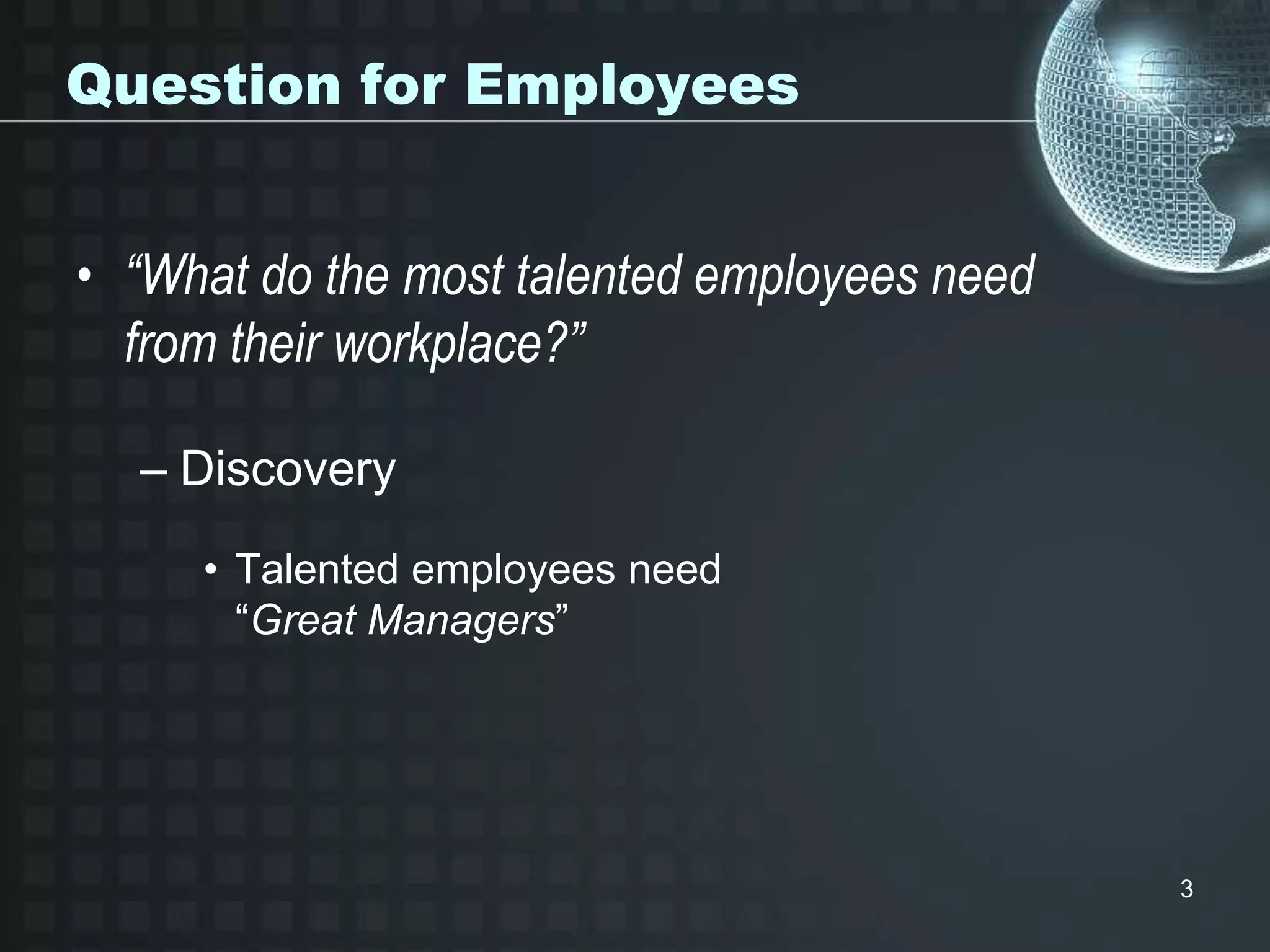
Question for Employees
• “What do the most talented employees need
from their workplace?”
– Discovery
• Talented employees need
“Great Managers”
4
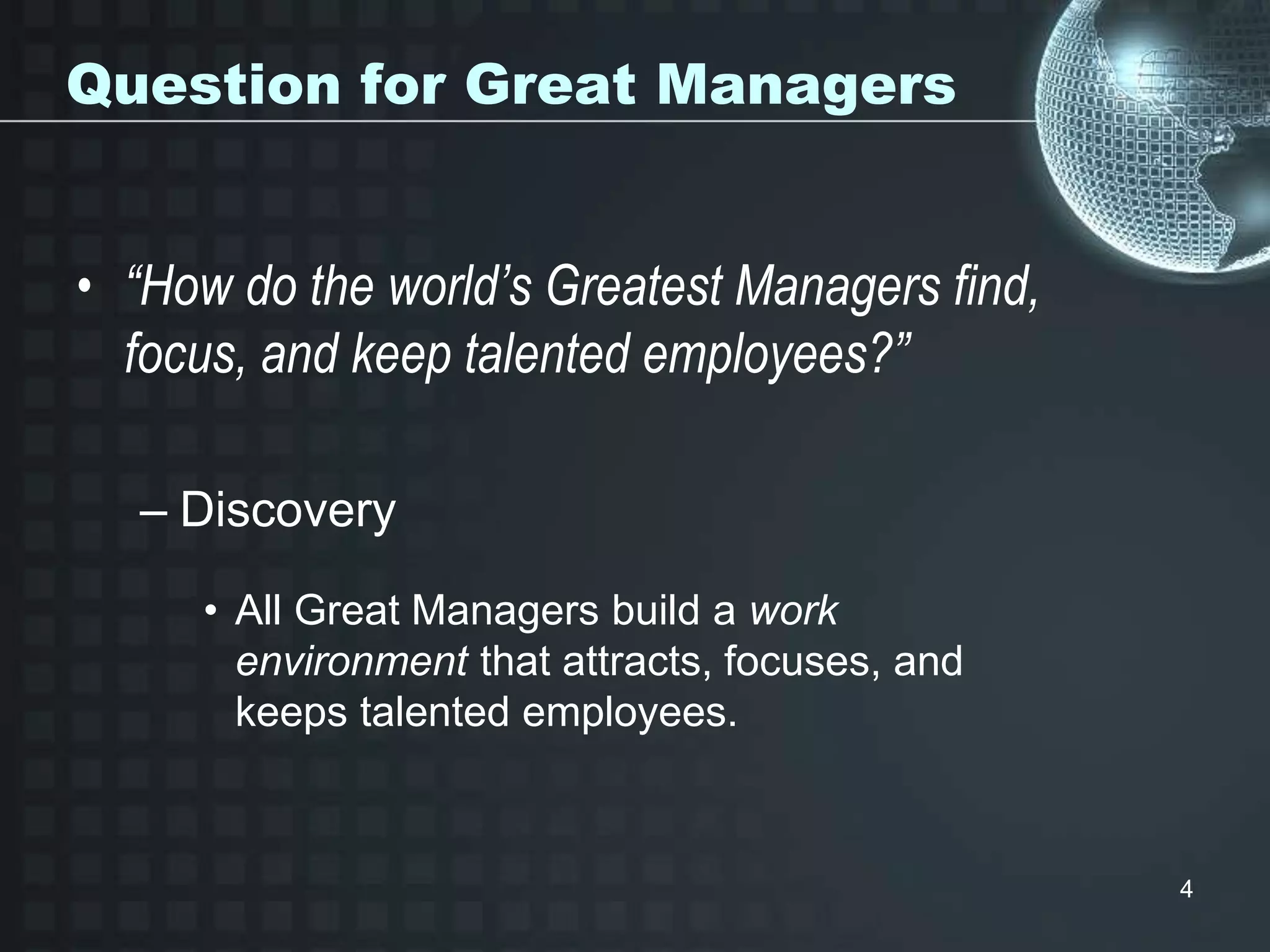
Question for Great Managers
• “How do the world’s Greatest Managers find,
focus, and keep talented employees?”
– Discovery
• All Great Managers build a work
environment that attracts, focuses, and
keeps talented employees.
5
The Holy Grail Question
• “How can we best measure a Great
Manager’s ability to build this kind of work
environment?”
• “If you can’t measure it, you can’t
manage it.”
• “Measuring Stick” created
6
The Holy Grail Found
• Gallup Created a “Measuring Stick” for
work environments
– Simple & Accurate
– Allows workplaces to easily be compared on a
numeric basis
7
The Measuring Stick – “Q12”
• Discovery
– Measuring the strength of a workplace can be
simplified to 12 Questions
– Survey questionnaire referred to as the “Q12”
8
What Great Managers Know
• Insight
– People don’t change that much. Don’t
waste time trying to put in what was left out.
Try to draw out what was left in. That is
hard enough.
• Each individual employee must be
motivated differently
9
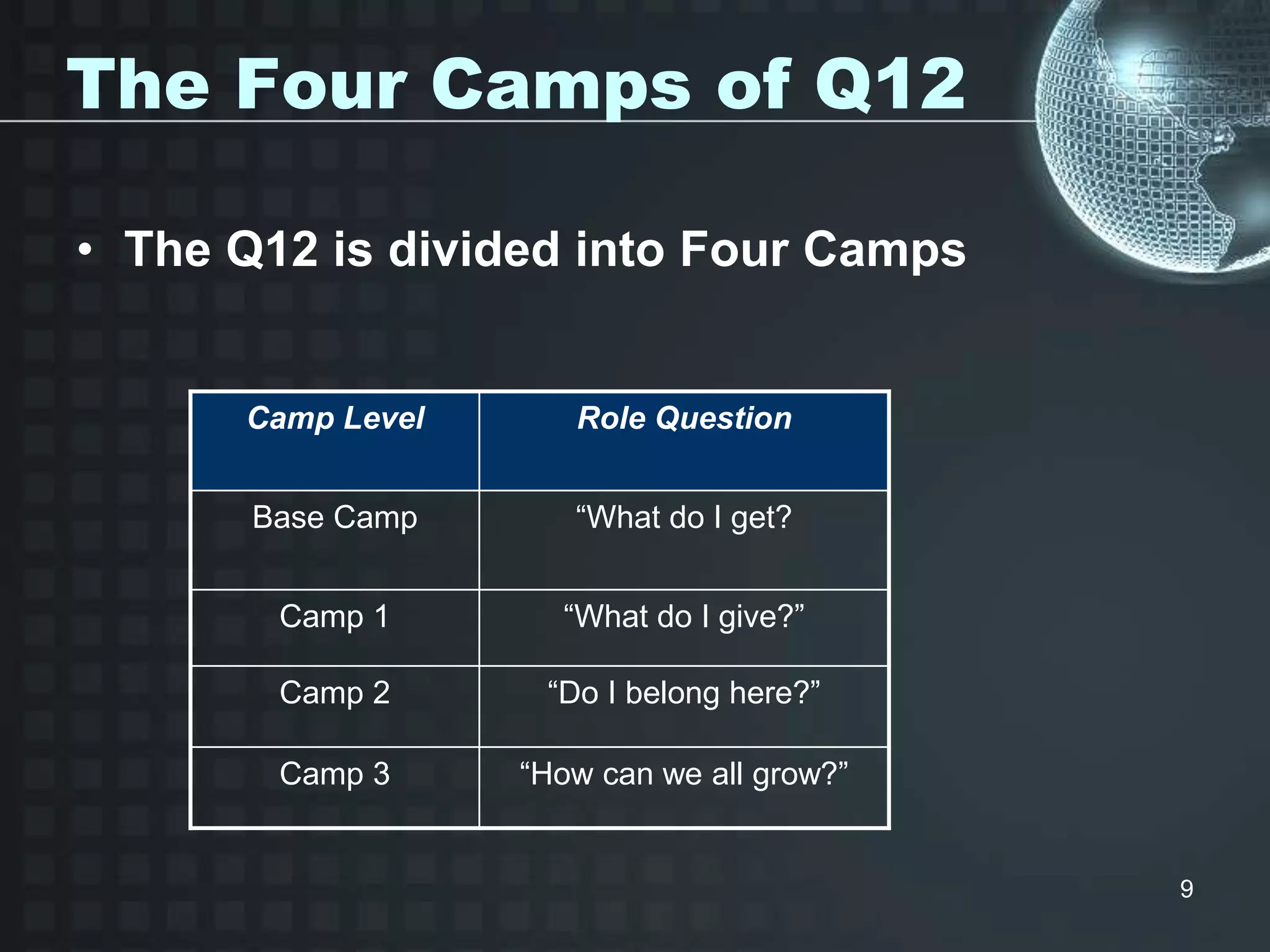
The Four Camps of Q12
• The Q12 is divided into Four Camps
Camp Level Role Question
Base Camp “What do I get?
Camp 1 “What do I give?”
Camp 2 “Do I belong here?”
Camp 3 “How can we all grow?”
10
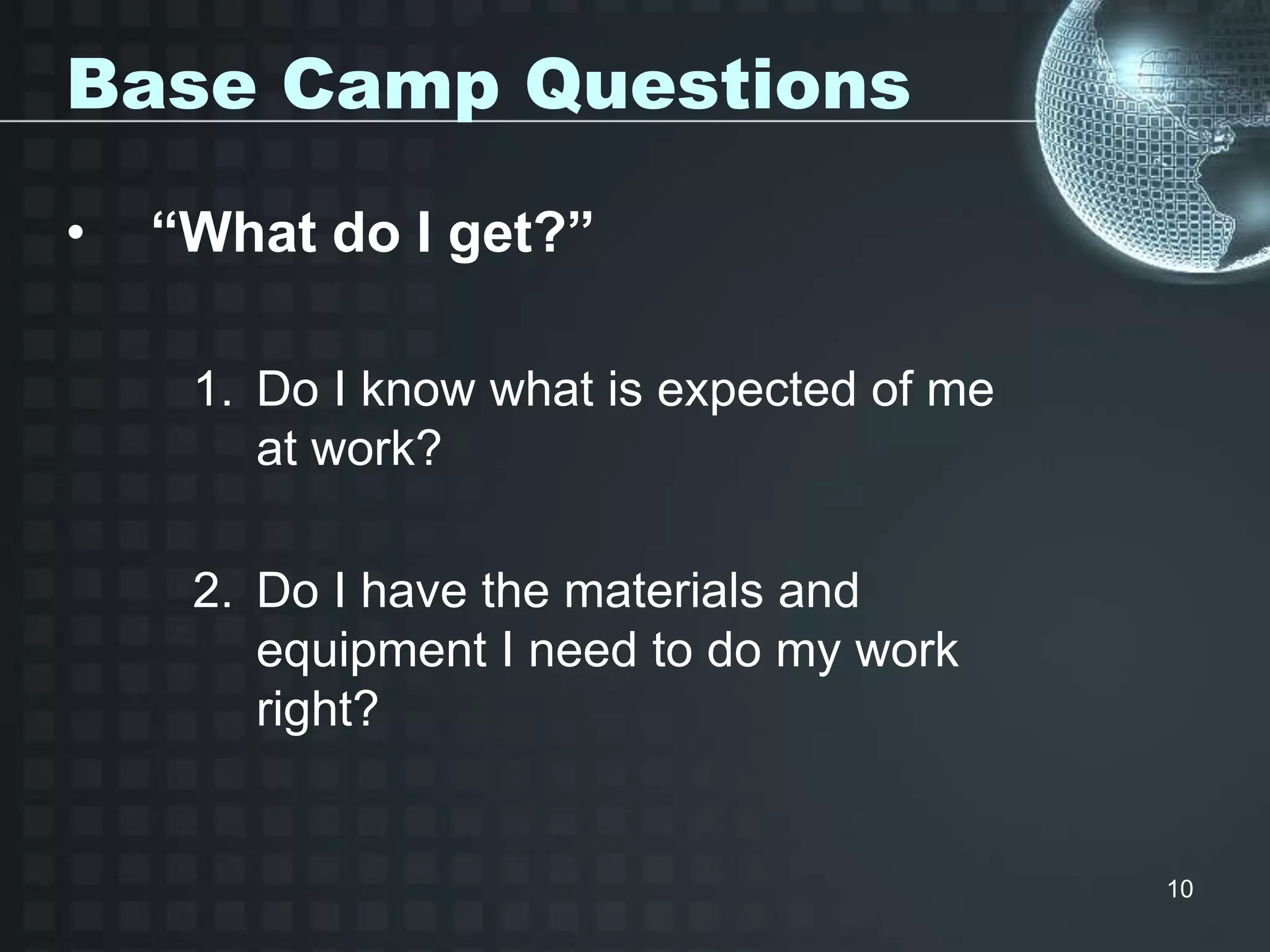
Base Camp Questions
• “What do I get?”
1. Do I know what is expected of me
at work?
2. Do I have the materials and
equipment I need to do my work
right?
11
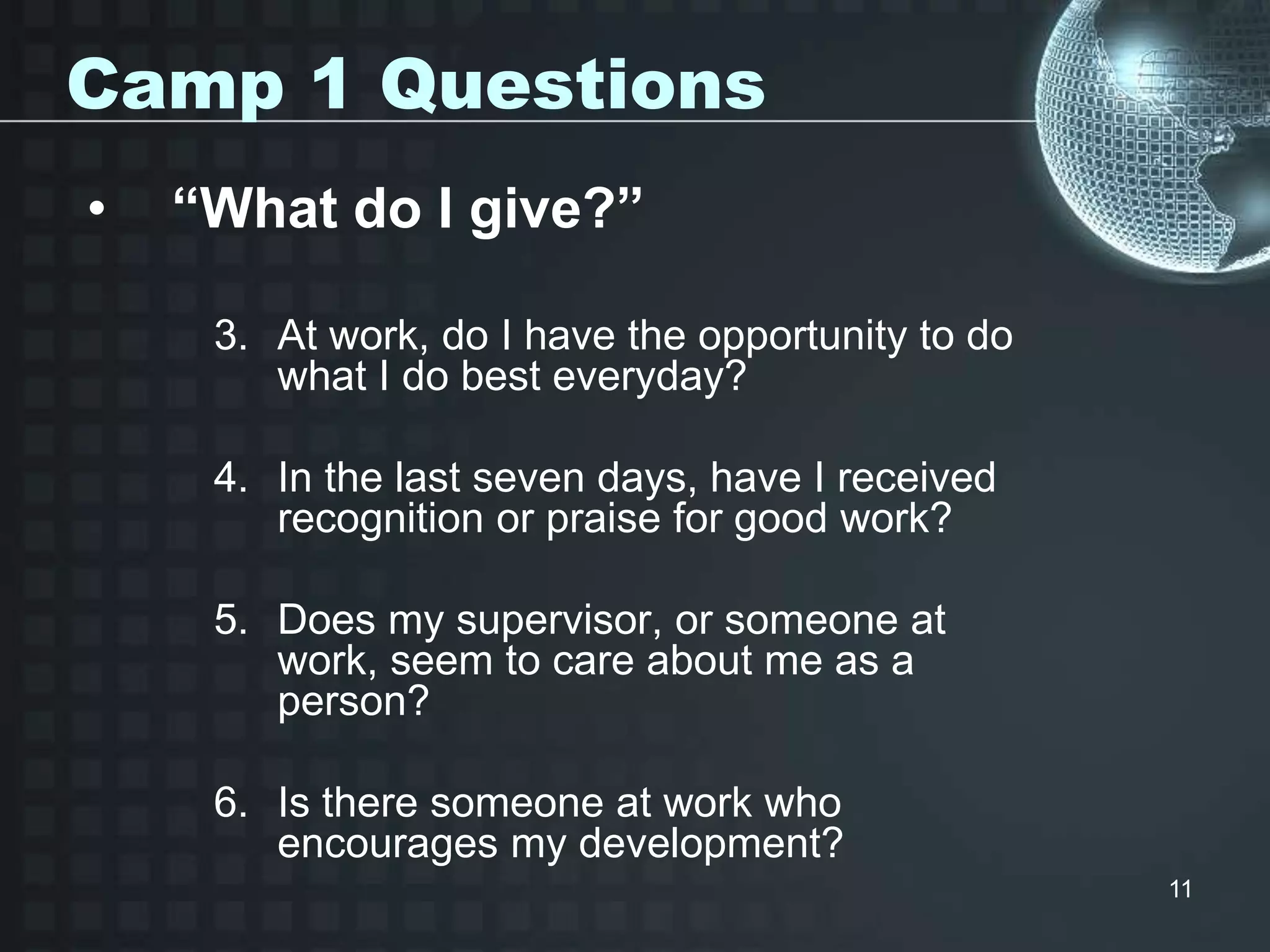
Camp 1 Questions
• “What do I give?”
3. At work, do I have the opportunity to do
what I do best everyday?
4. In the last seven days, have I received
recognition or praise for good work?
5. Does my supervisor, or someone at
work, seem to care about me as a
person?
6. Is there someone at work who
encourages my development?
12
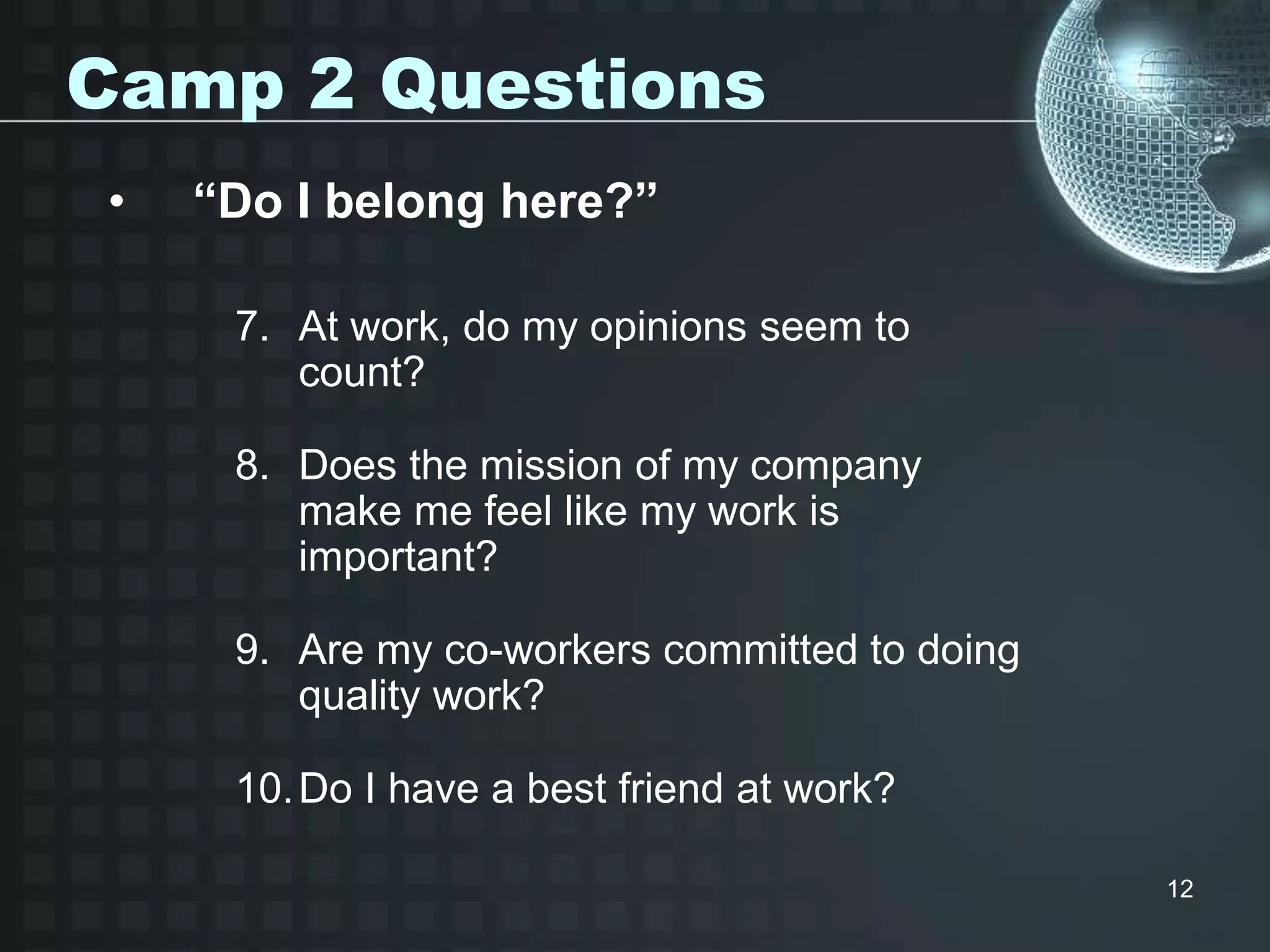
Camp 2 Questions
• “Do I belong here?”
7. At work, do my opinions seem to
count?
8. Does the mission of my company
make me feel like my work is
important?
9. Are my co-workers committed to doing
quality work?
10.Do I have a best friend at work?
13
Camp 3 Questions
• “How can we all grow?”
11. In the last six months, have I talked
with someone about my progress?
12. This last year, have I had
opportunities at work to learn and
grow?
14
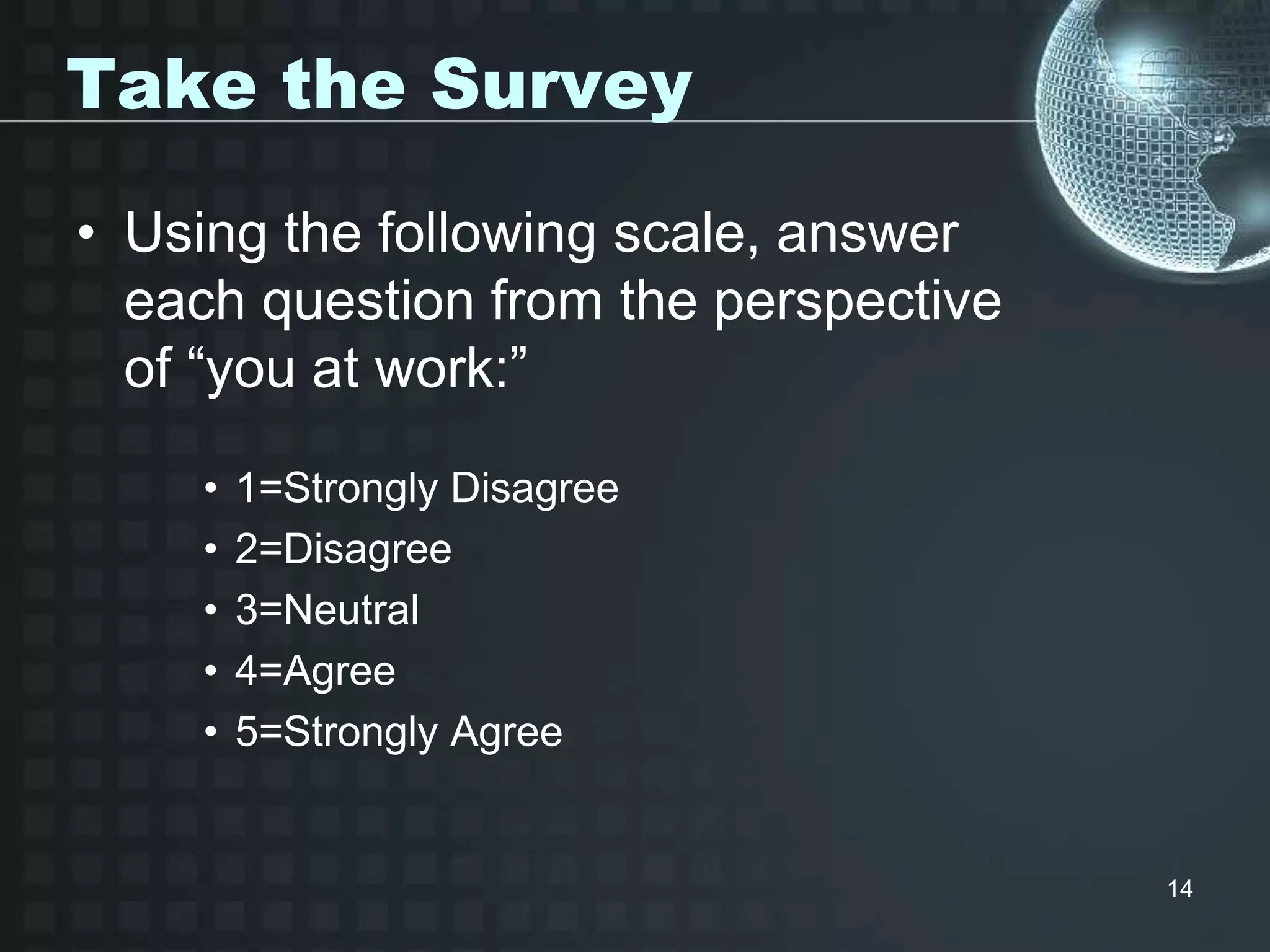
Take the Survey
• Using the following scale, answer
each question from the perspective
of “you at work:”
• 1=Strongly Disagree
• 2=Disagree
• 3=Neutral
• 4=Agree
• 5=Strongly Agree
15
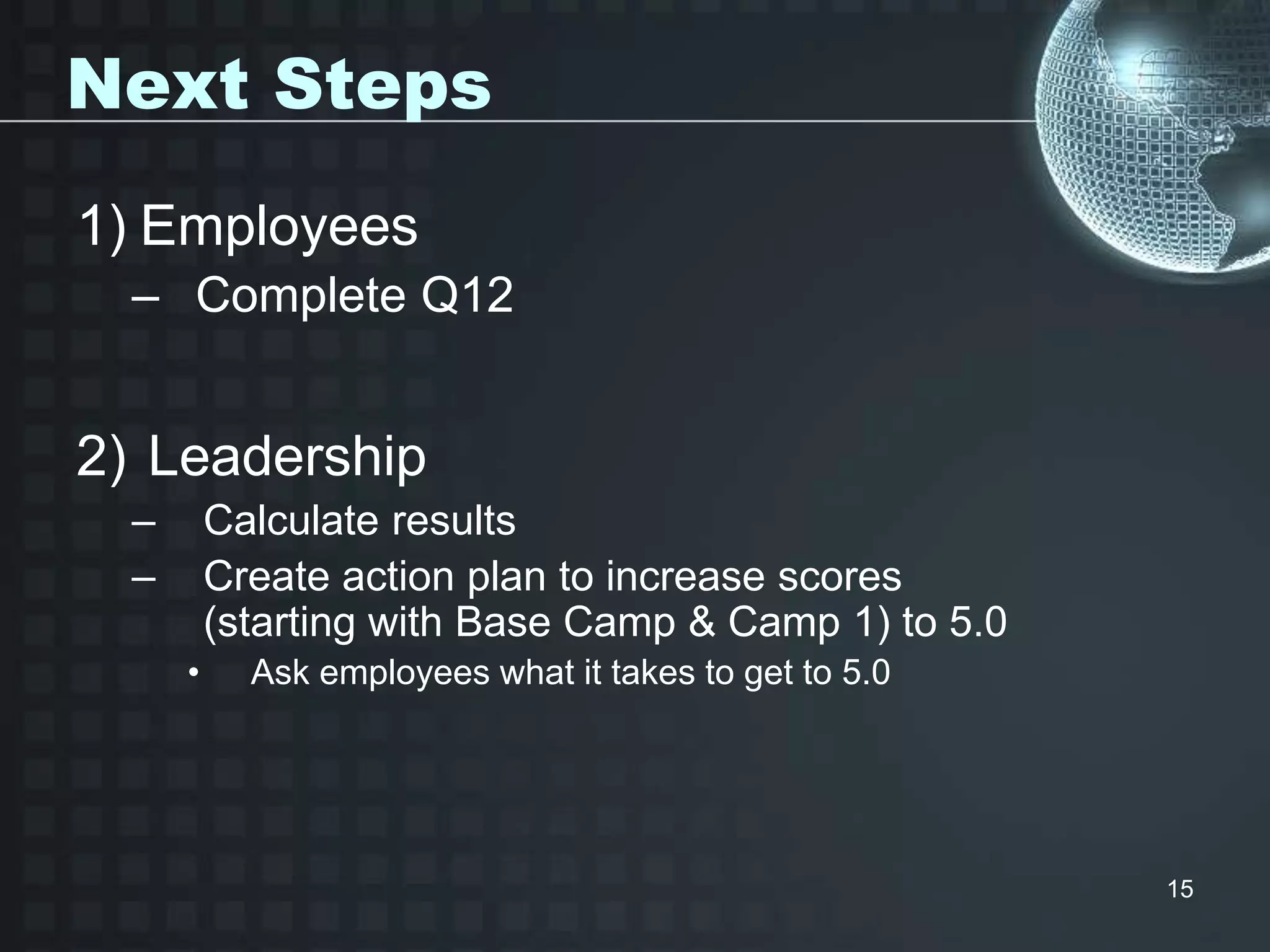
Next Steps
1) Employees
– Complete Q12
2) Leadership
– Calculate results
– Create action plan to increase scores
(starting with Base Camp & Camp 1) to 5.0
• Ask employees what it takes to get to 5.0
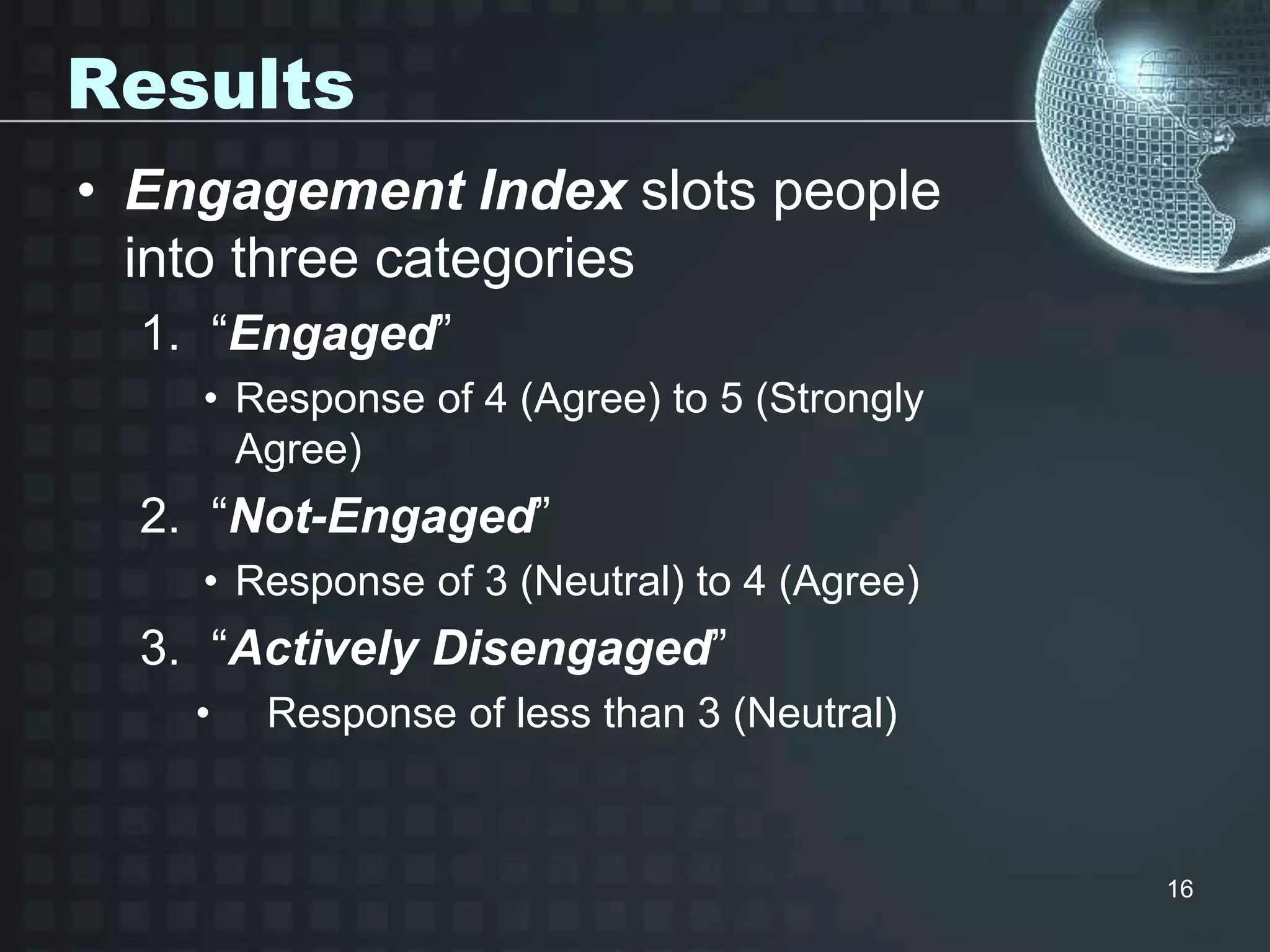
Results
• Engagement Index slots people
into three categories
1. “Engaged”
• Response of 4 (Agree) to 5 (Strongly
Agree)
2. “Not-Engaged”
• Response of 3 (Neutral) to 4 (Agree)
3. “Actively Disengaged”
• Response of less than 3 (Neutral)
16
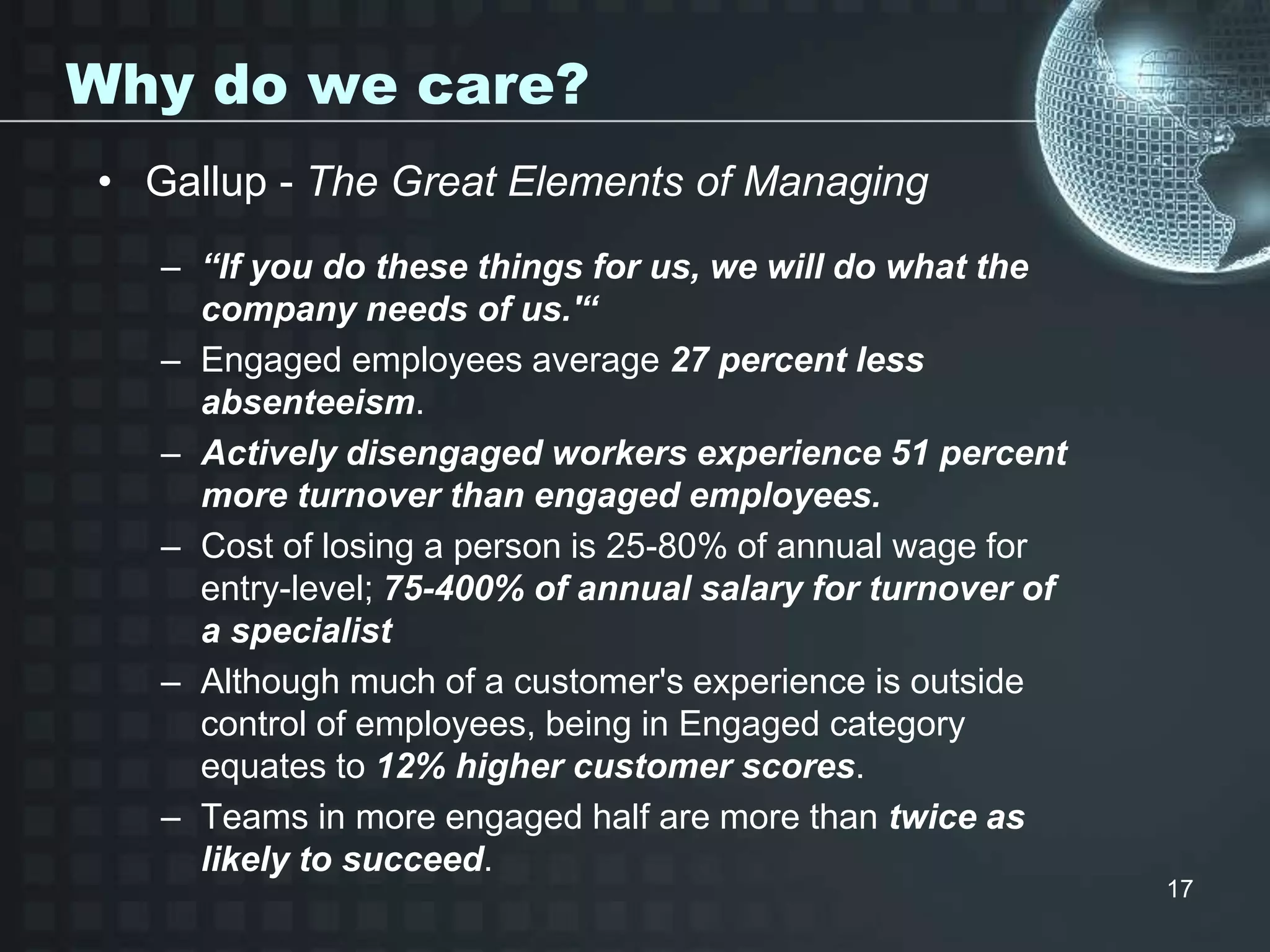
Why do we care?
• Gallup - The Great Elements of Managing
– “If you do these things for us, we will do what the
company needs of us.'“
– Engaged employees average 27 percent less
absenteeism.
– Actively disengaged workers experience 51 percent
more turnover than engaged employees.
– Cost of losing a person is 25-80% of annual wage for
entry-level; 75-400% of annual salary for turnover of
a specialist
– Although much of a customer's experience is outside
control of employees, being in Engaged category
equates to 12% higher customer scores.
– Teams in more engaged half are more than twice as
likely to succeed.
17

What Greatest Mgrs Do Differently

  • 1.
    First, Break Allthe Rules What the World’s Greatest Managers Do Differently Brian M. Wills Director Agile Transformation Office 3-Feb-2016
  • 2.
    2 The Largest Studyof Its Kind • Gallup Research Summary – Interview Details • Over 80,000 Managers • Over 1,000,000 Employees • Derived over 25 years asking employees hundreds of questions – Discovery • Companies with “Great Managers” have better customer satisfaction, productivity, employee retention, and profits
  • 3.
    3 Question for Employees •“What do the most talented employees need from their workplace?” – Discovery • Talented employees need “Great Managers”
  • 4.
    4 Question for GreatManagers • “How do the world’s Greatest Managers find, focus, and keep talented employees?” – Discovery • All Great Managers build a work environment that attracts, focuses, and keeps talented employees.
  • 5.
    5 The Holy GrailQuestion • “How can we best measure a Great Manager’s ability to build this kind of work environment?” • “If you can’t measure it, you can’t manage it.” • “Measuring Stick” created
  • 6.
    6 The Holy GrailFound • Gallup Created a “Measuring Stick” for work environments – Simple & Accurate – Allows workplaces to easily be compared on a numeric basis
  • 7.
    7 The Measuring Stick– “Q12” • Discovery – Measuring the strength of a workplace can be simplified to 12 Questions – Survey questionnaire referred to as the “Q12”
  • 8.
    8 What Great ManagersKnow • Insight – People don’t change that much. Don’t waste time trying to put in what was left out. Try to draw out what was left in. That is hard enough. • Each individual employee must be motivated differently
  • 9.
    9 The Four Campsof Q12 • The Q12 is divided into Four Camps Camp Level Role Question Base Camp “What do I get? Camp 1 “What do I give?” Camp 2 “Do I belong here?” Camp 3 “How can we all grow?”
  • 10.
    10 Base Camp Questions •“What do I get?” 1. Do I know what is expected of me at work? 2. Do I have the materials and equipment I need to do my work right?
  • 11.
    11 Camp 1 Questions •“What do I give?” 3. At work, do I have the opportunity to do what I do best everyday? 4. In the last seven days, have I received recognition or praise for good work? 5. Does my supervisor, or someone at work, seem to care about me as a person? 6. Is there someone at work who encourages my development?
  • 12.
    12 Camp 2 Questions •“Do I belong here?” 7. At work, do my opinions seem to count? 8. Does the mission of my company make me feel like my work is important? 9. Are my co-workers committed to doing quality work? 10.Do I have a best friend at work?
  • 13.
    13 Camp 3 Questions •“How can we all grow?” 11. In the last six months, have I talked with someone about my progress? 12. This last year, have I had opportunities at work to learn and grow?
  • 14.
    14 Take the Survey •Using the following scale, answer each question from the perspective of “you at work:” • 1=Strongly Disagree • 2=Disagree • 3=Neutral • 4=Agree • 5=Strongly Agree
  • 15.
    15 Next Steps 1) Employees –Complete Q12 2) Leadership – Calculate results – Create action plan to increase scores (starting with Base Camp & Camp 1) to 5.0 • Ask employees what it takes to get to 5.0
  • 16.
    Results • Engagement Indexslots people into three categories 1. “Engaged” • Response of 4 (Agree) to 5 (Strongly Agree) 2. “Not-Engaged” • Response of 3 (Neutral) to 4 (Agree) 3. “Actively Disengaged” • Response of less than 3 (Neutral) 16
  • 17.
    Why do wecare? • Gallup - The Great Elements of Managing – “If you do these things for us, we will do what the company needs of us.'“ – Engaged employees average 27 percent less absenteeism. – Actively disengaged workers experience 51 percent more turnover than engaged employees. – Cost of losing a person is 25-80% of annual wage for entry-level; 75-400% of annual salary for turnover of a specialist – Although much of a customer's experience is outside control of employees, being in Engaged category equates to 12% higher customer scores. – Teams in more engaged half are more than twice as likely to succeed. 17