1
Goal Science™ Thinking
2
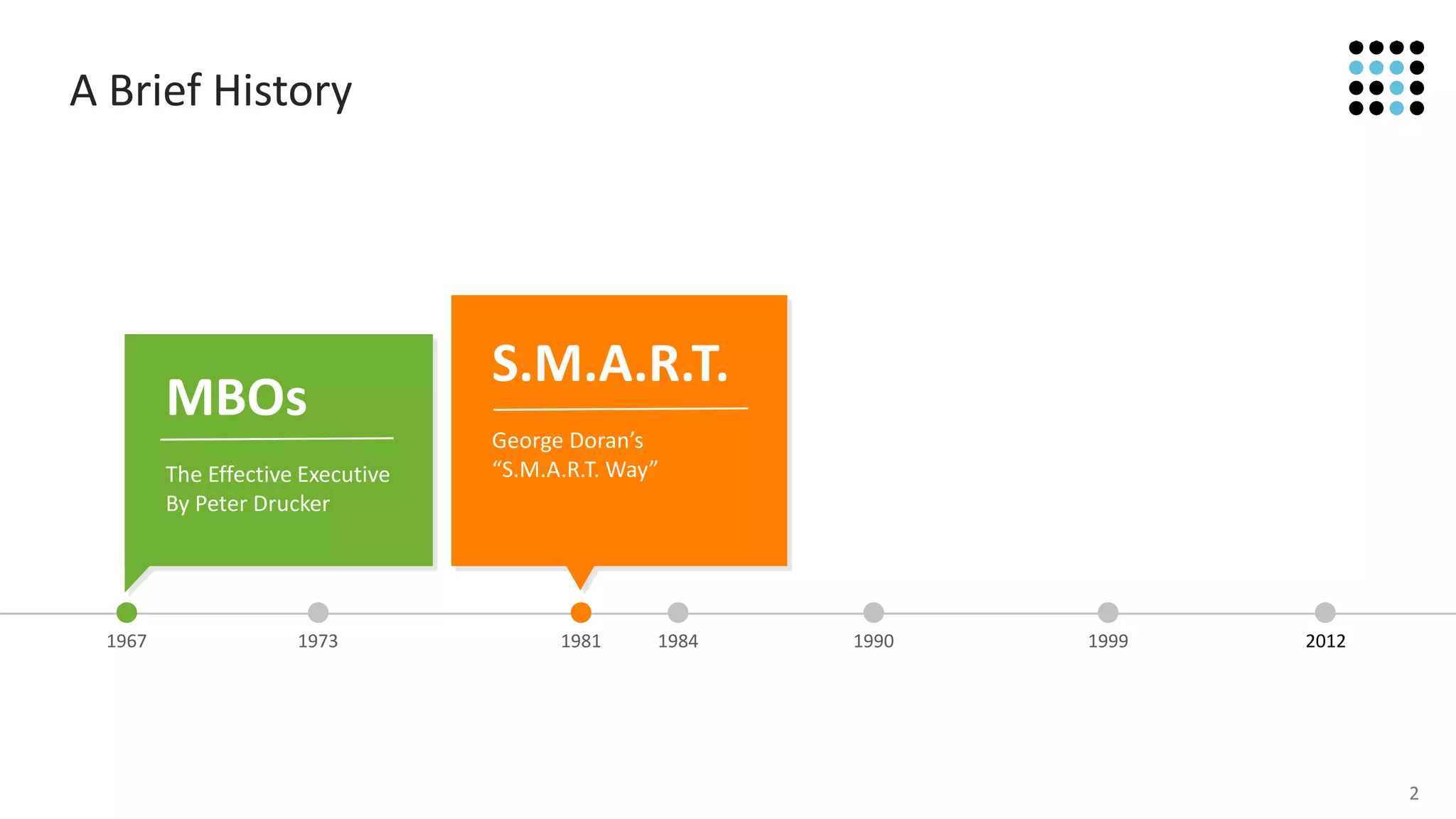
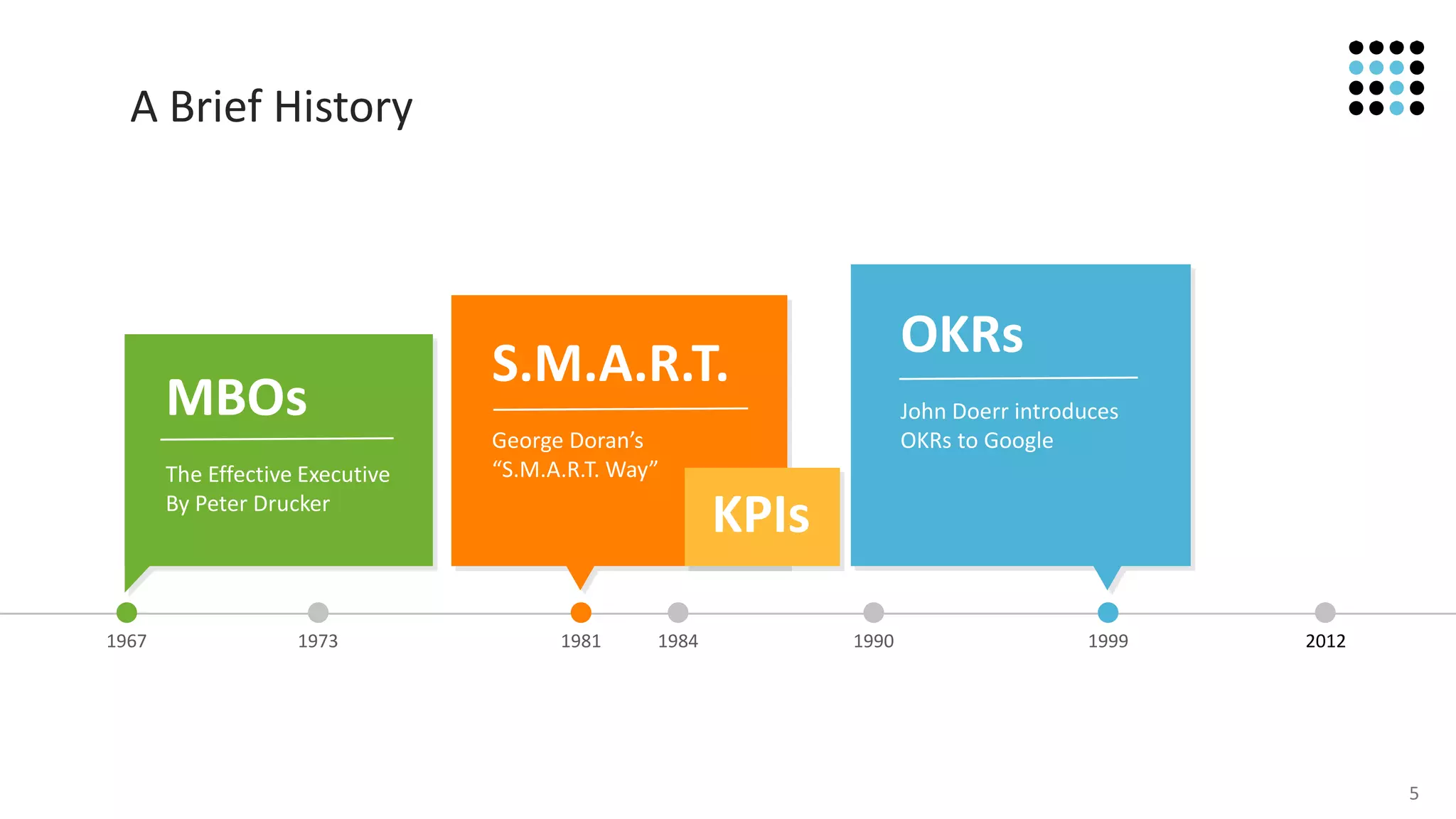
A Brief History
2012
GST
Goal
Science
Thinking!
1967 1973 1981 1984 1990 1999
S.M.A.R.T.
George Doran’s
“S.M.A.R.T. Way”
MBOs
The Effective Executive
By Peter Drucker
3
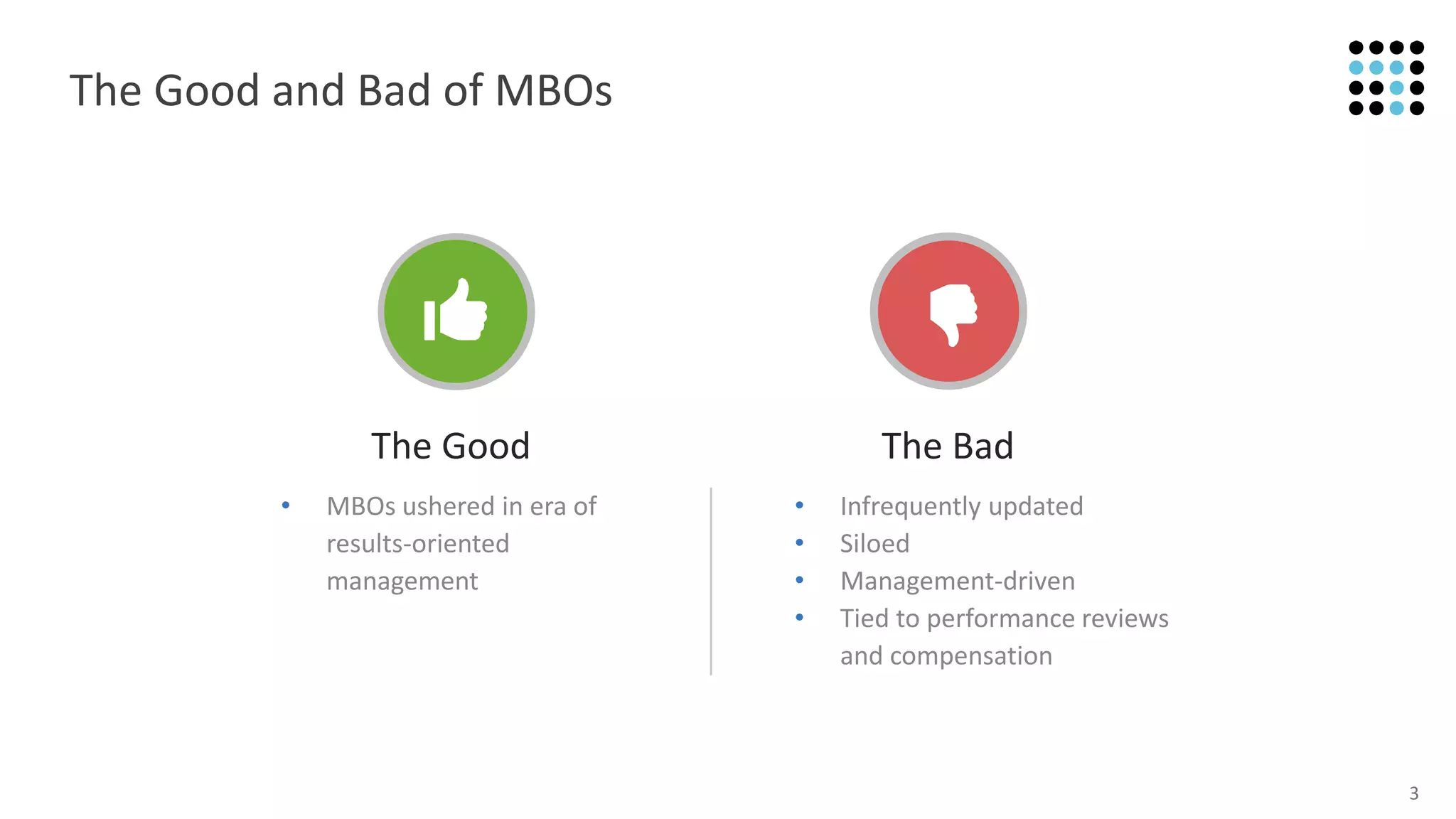
The Good and Bad of MBOs
The Good The Bad
• Infrequently updated
• Siloed
• Management-driven
• Tied to performance reviews
and compensation
• MBOs ushered in era of
results-oriented
management
4
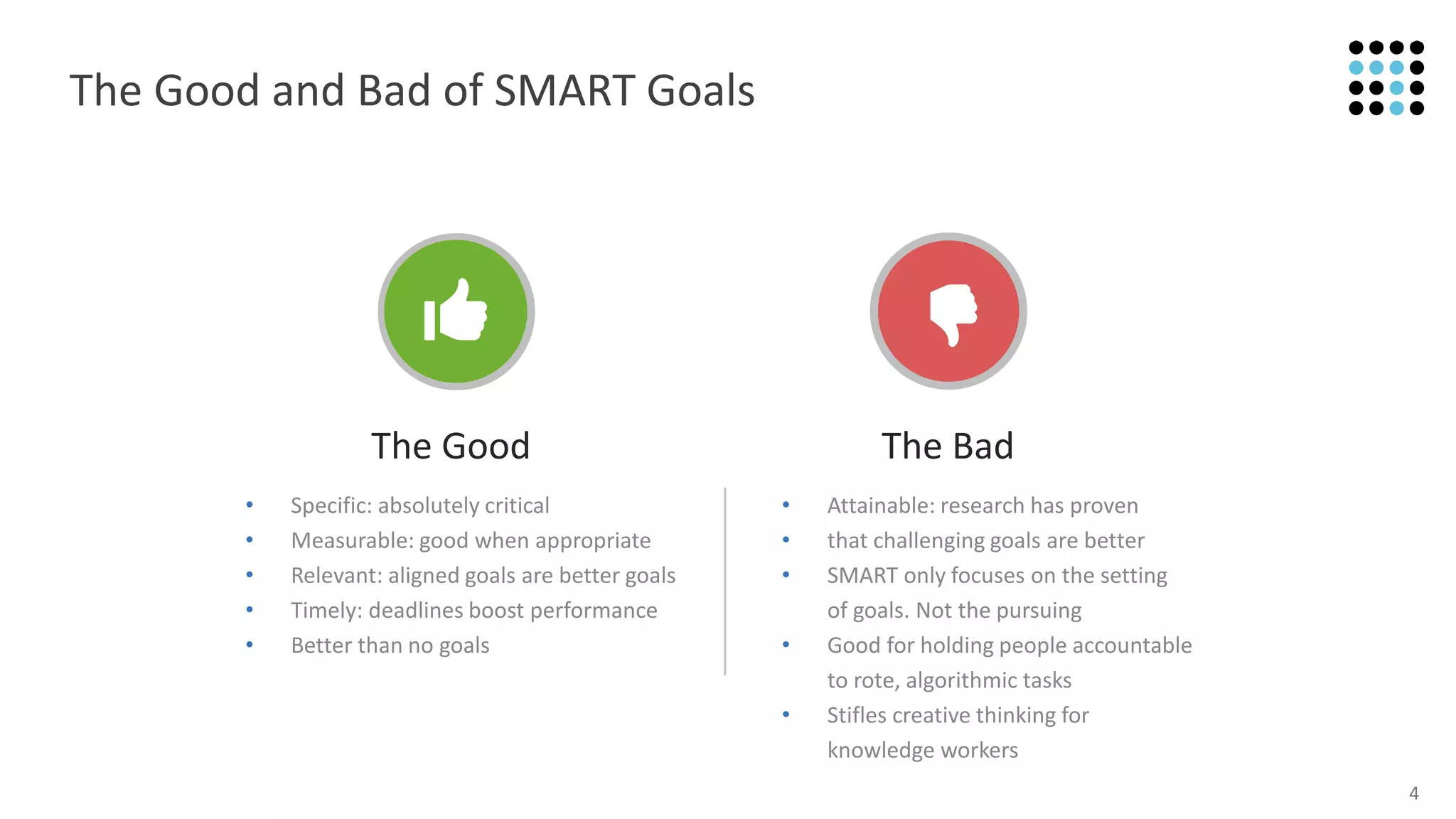
The Good and Bad of SMART Goals
• Attainable: research has proven that
challenging goals are better
• Focuses on the setting
of goals, not pursuing
• Stifles creative thinking for
knowledge workers
• Specific: absolutely critical
• Measurable: good when appropriate
• Relevant: aligned goals are better goals
• Timely: deadlines boost performance
• Better than no goals
The Good The Bad
5
20121967 1973 1981 1984 1990 1999
S.M.A.R.T.
George Doran’s
“S.M.A.R.T. Way”
A Brief History
OKRs
John Doerr introduces
OKRs to Google
KPIs
MBOs
The Effective Executive
By Peter Drucker
6
The OKRs Revolution
• Objectives and Key Results (OKRs) are
invented at Intel
• KPCB’s John Doerr brings OKRs to Google
and more
Benefits
• Quarterly vs. Annual process
• Transparent and aligned
• Aspirational
• Not tied to performance
reviews/compensation
7
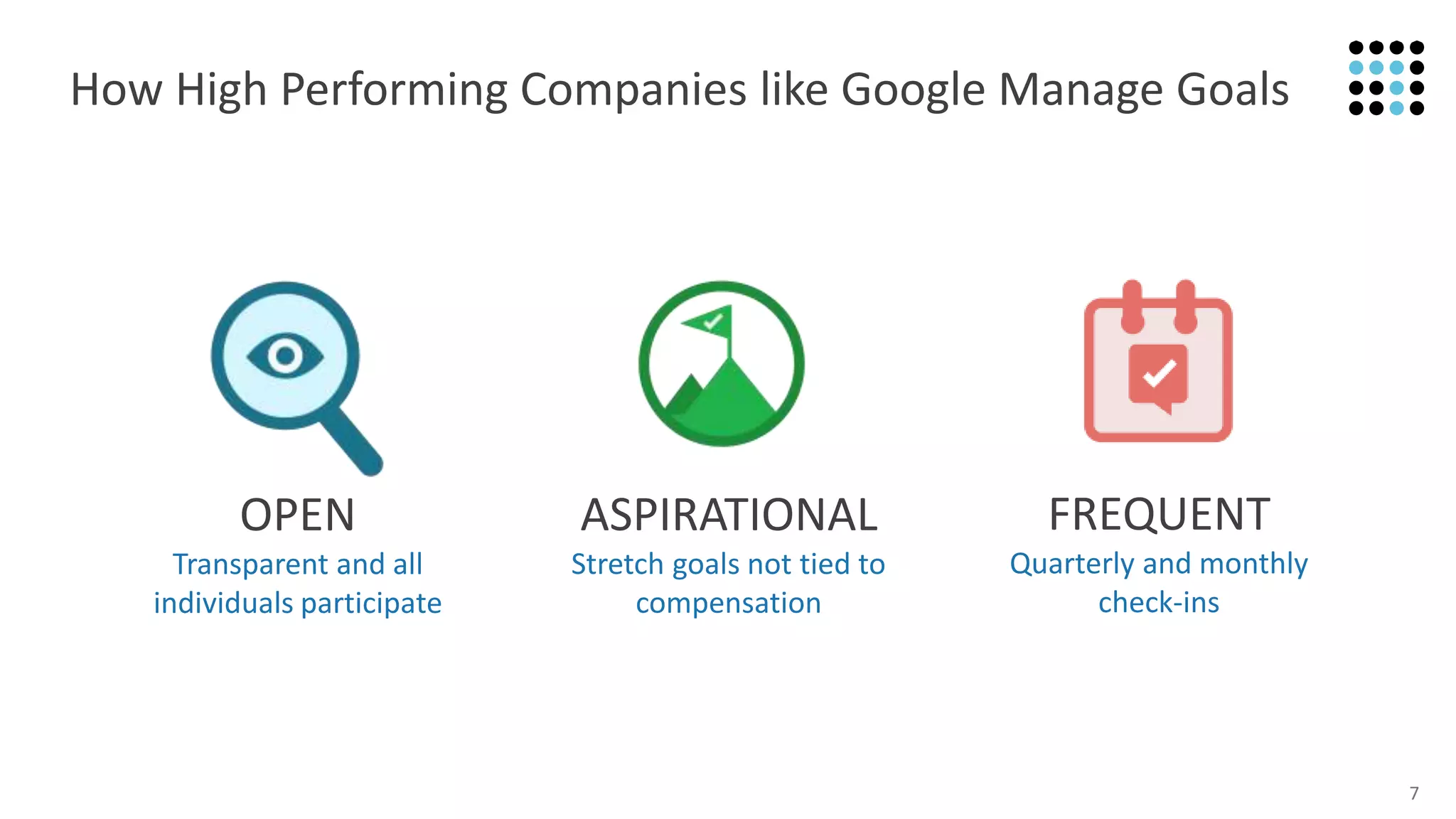
How High Performing Companies Manage Goals
Open
Transparent and all
individuals participate
Frequent
Quarterly and monthly
check-ins
Cross-Functional
Horizontal coordination and
dependency alignment
8
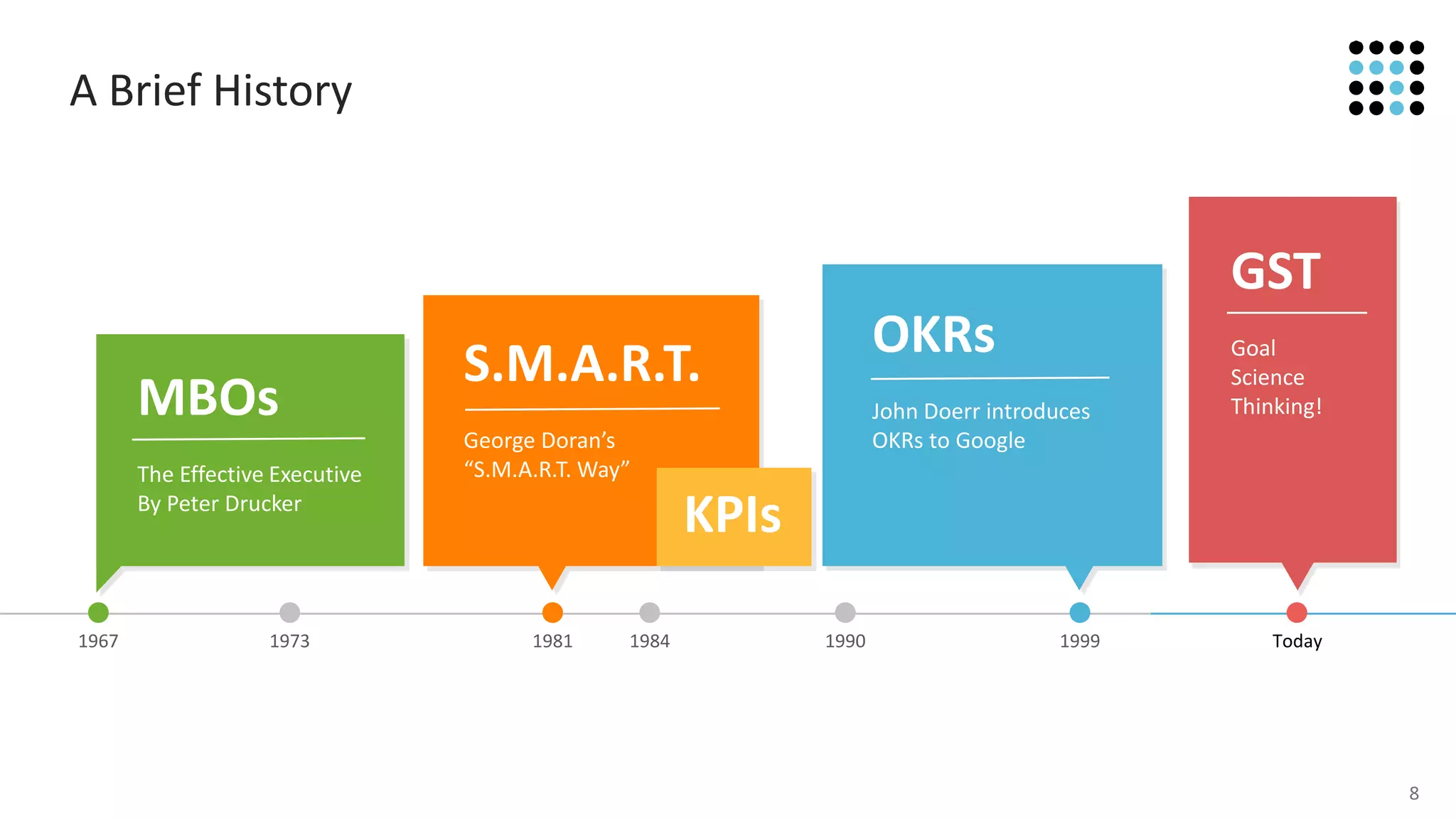
A Brief History
Today
GST
Goal
Science
Thinking
1967 1973 1981 1984 1990 1999
S.M.A.R.T.
George Doran’s
“S.M.A.R.T. Way”
KPIs
MBOs
The Effective Executive
By Peter Drucker
OKRs
John Doerr introduces
OKRs to Google
9
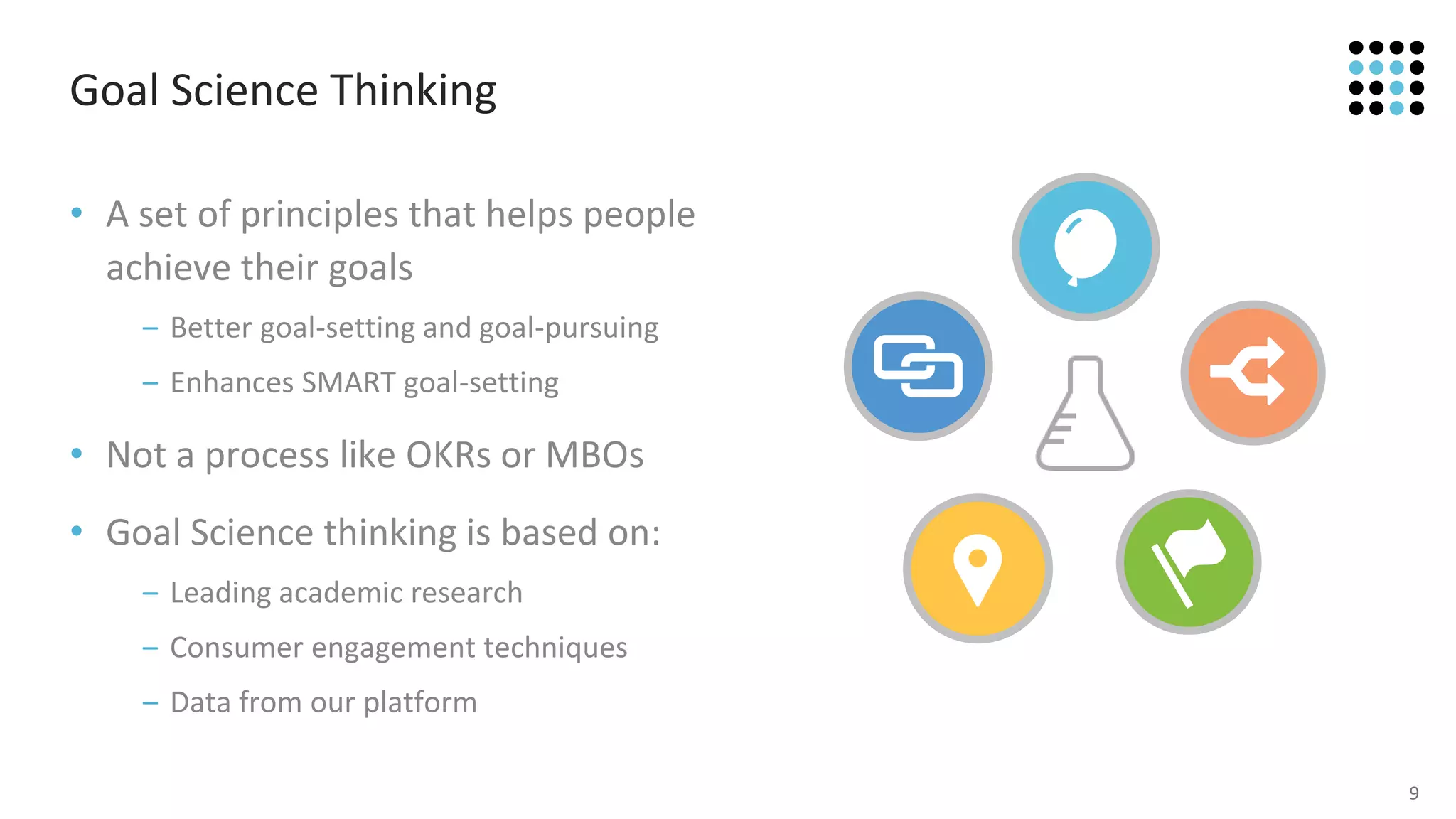
Goal Science Thinking
• A set of principles that helps people
achieve their goals
‒ Better goal-setting and goal-pursuing
‒ Enhances SMART goal-setting
• Not a process like OKRs or MBOs
• Goal Science thinking is based on:
‒ Leading academic research
‒ Consumer engagement techniques
‒ Data from our platform
10
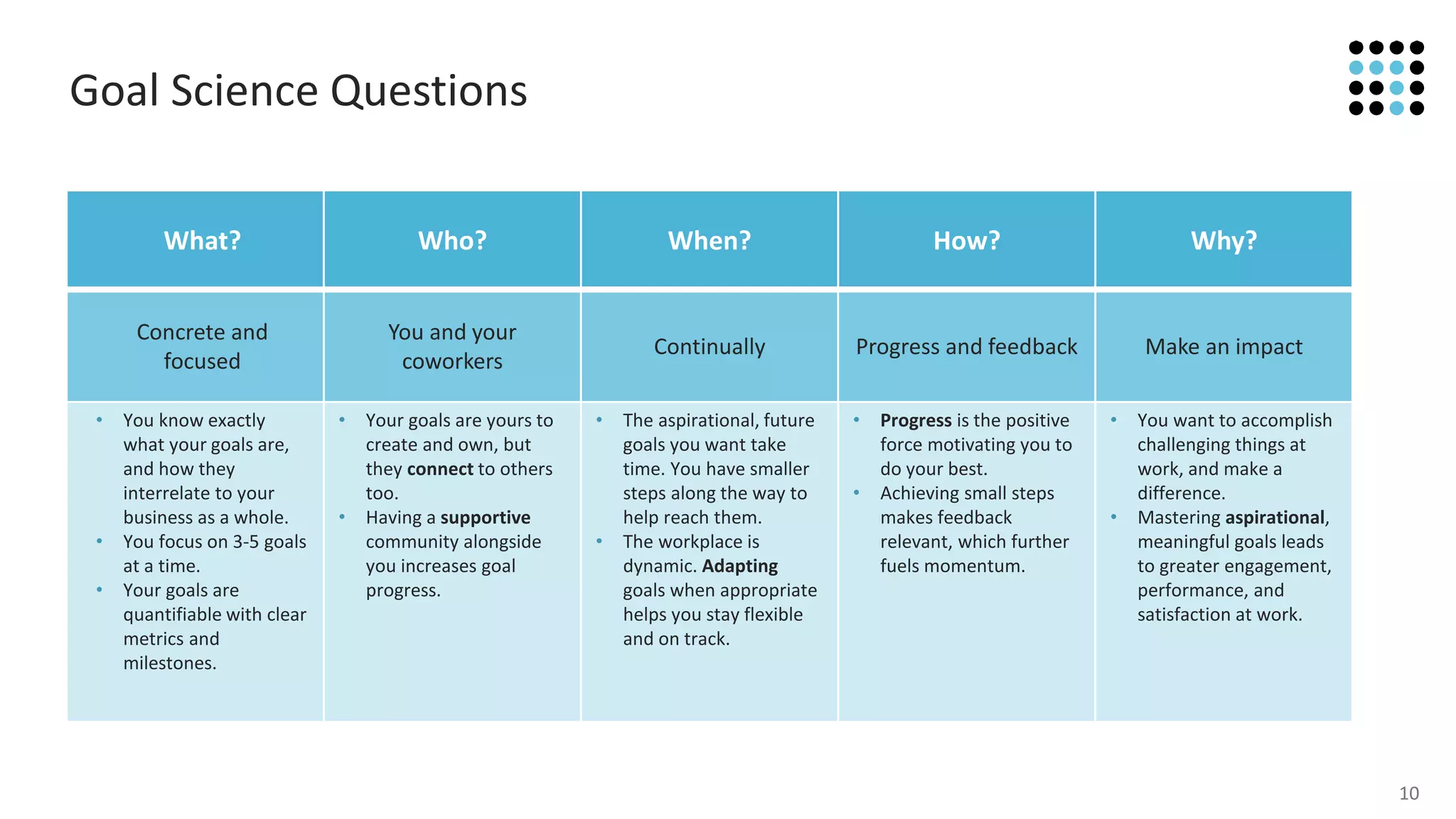
Goal Science Questions
What? Who? When? How? Why?
Concrete and
focused
You and your
coworkers
Continually Progress and feedback Make an impact
• You know exactly
what your goals are,
and how they
interrelate to your
business as a whole.
• You focus on 3-5 goals
at a time.
• Your goals are
quantifiable with clear
metrics and
milestones.
• Your goals are yours to
create and own, but
they connect to others
too.
• Having a supportive
community alongside
you increases goal
progress.
• The aspirational, future
goals you want take
time. You have smaller
steps along the way to
help reach them.
• The workplace is
dynamic. Adapting goals
when appropriate helps
you stay flexible and on
track.
• Progress is the positive
force motivating you to
do your best.
• Achieving small steps
makes feedback
relevant, which further
fuels momentum.
• You want to accomplish
challenging things at
work, and make a
difference.
• Mastering aspirational,
meaningful goals leads
to greater engagement,
performance, and
satisfaction at work.
11
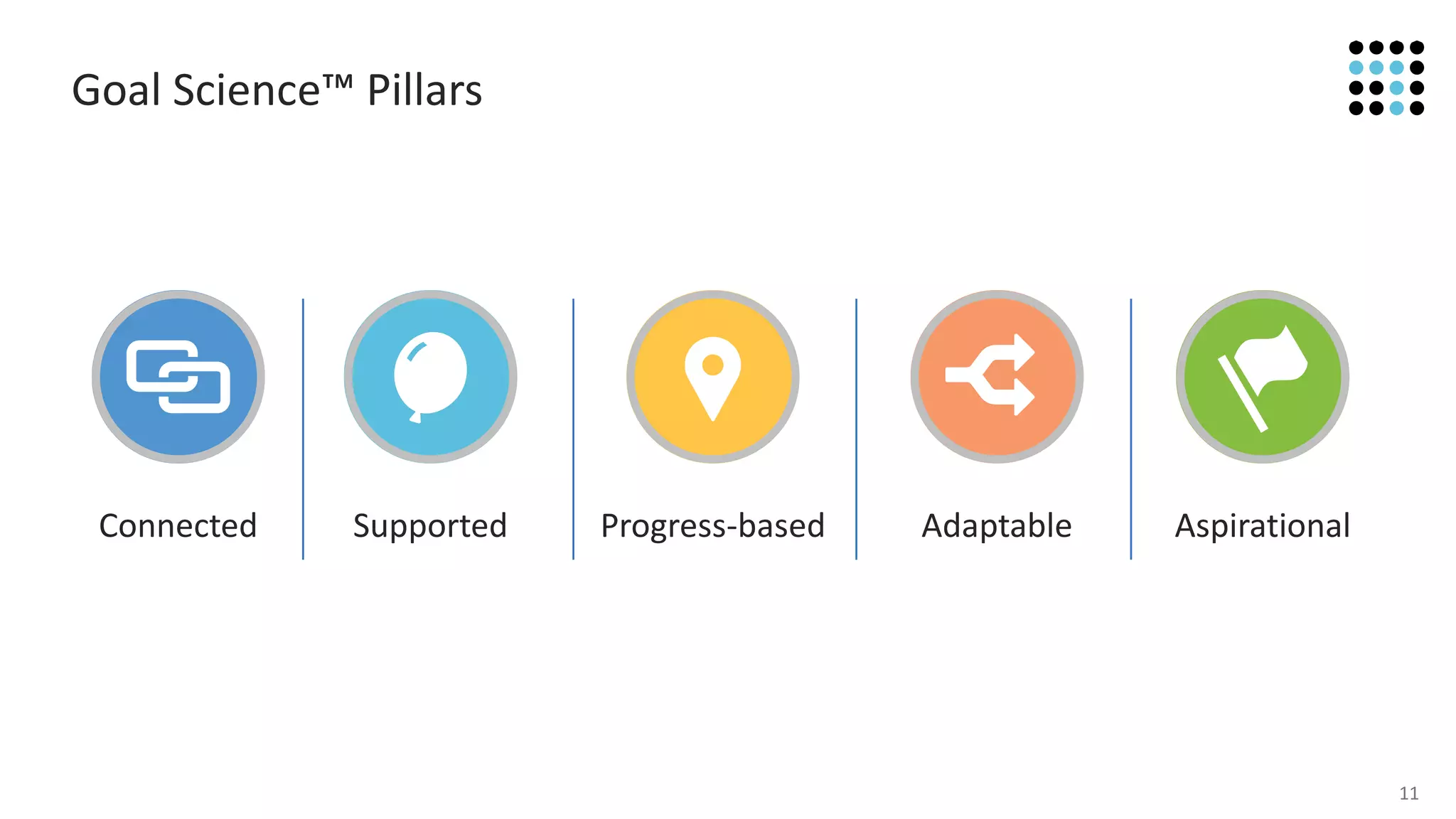
Goal Science™ Thinking
Connected Supported Progress-based Adaptable Aspirational
Transparent and
aligned
Social reinforcement
and recognition
Frequent and
measurable feedback
Flexibility to respond
to changing
priorities
Retrospection to
encourage excellence
12
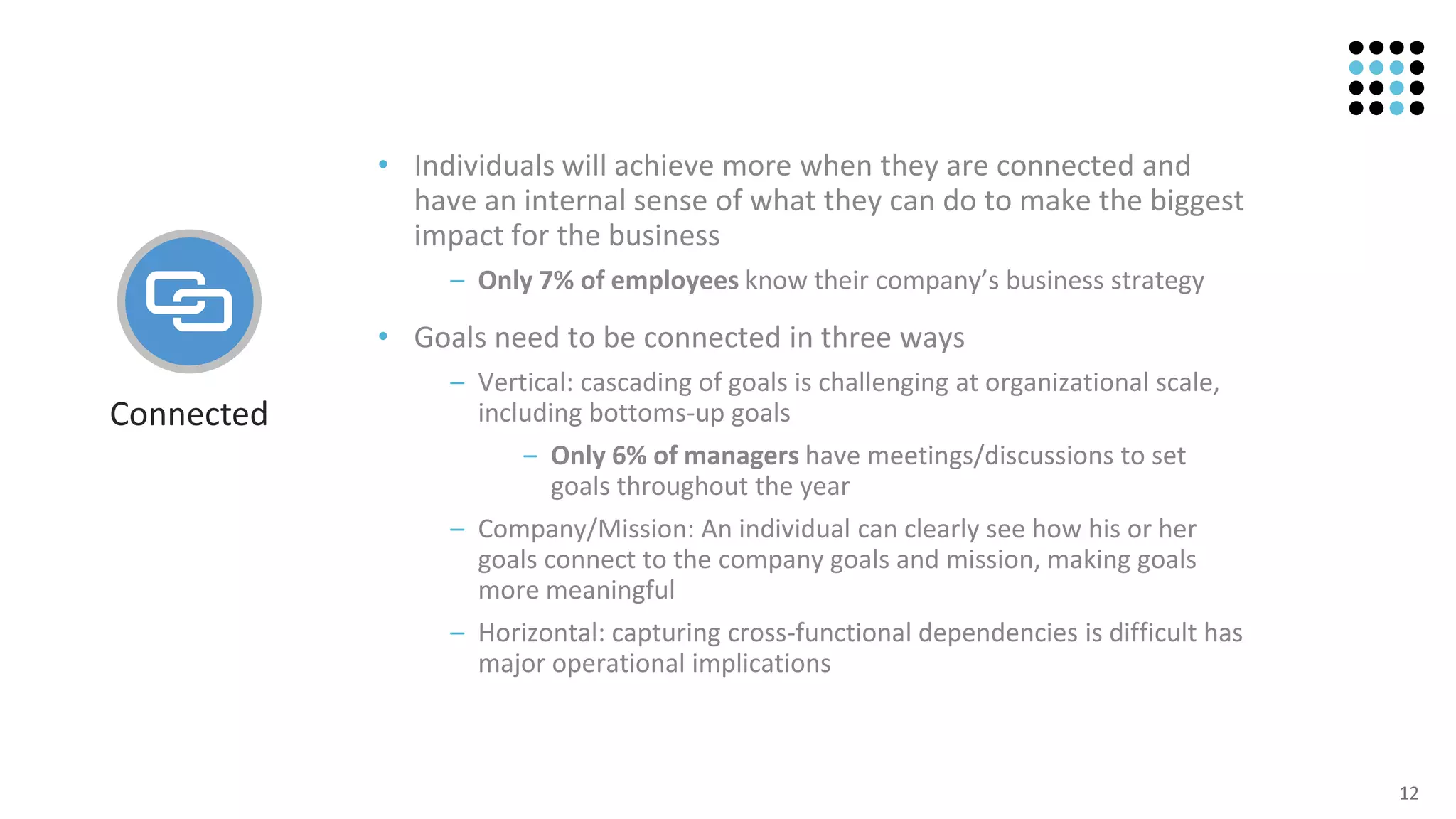
• Individuals will achieve more when they are connected and
have an internal sense of what they can do to make the biggest
impact for the business
• Goals need to be connected in three ways
– Vertical: cascading of goals is challenging at organizational scale,
including bottoms-up goals
‒ Only 6% of managers have meetings/discussions to set
goals throughout the year
– Company/Mission: An individual can clearly see how his or her
goals connect to the company goals and mission, making goals
more meaningful
– Horizontal: capturing cross-functional dependencies is difficult has
major operational implications
Connected
13
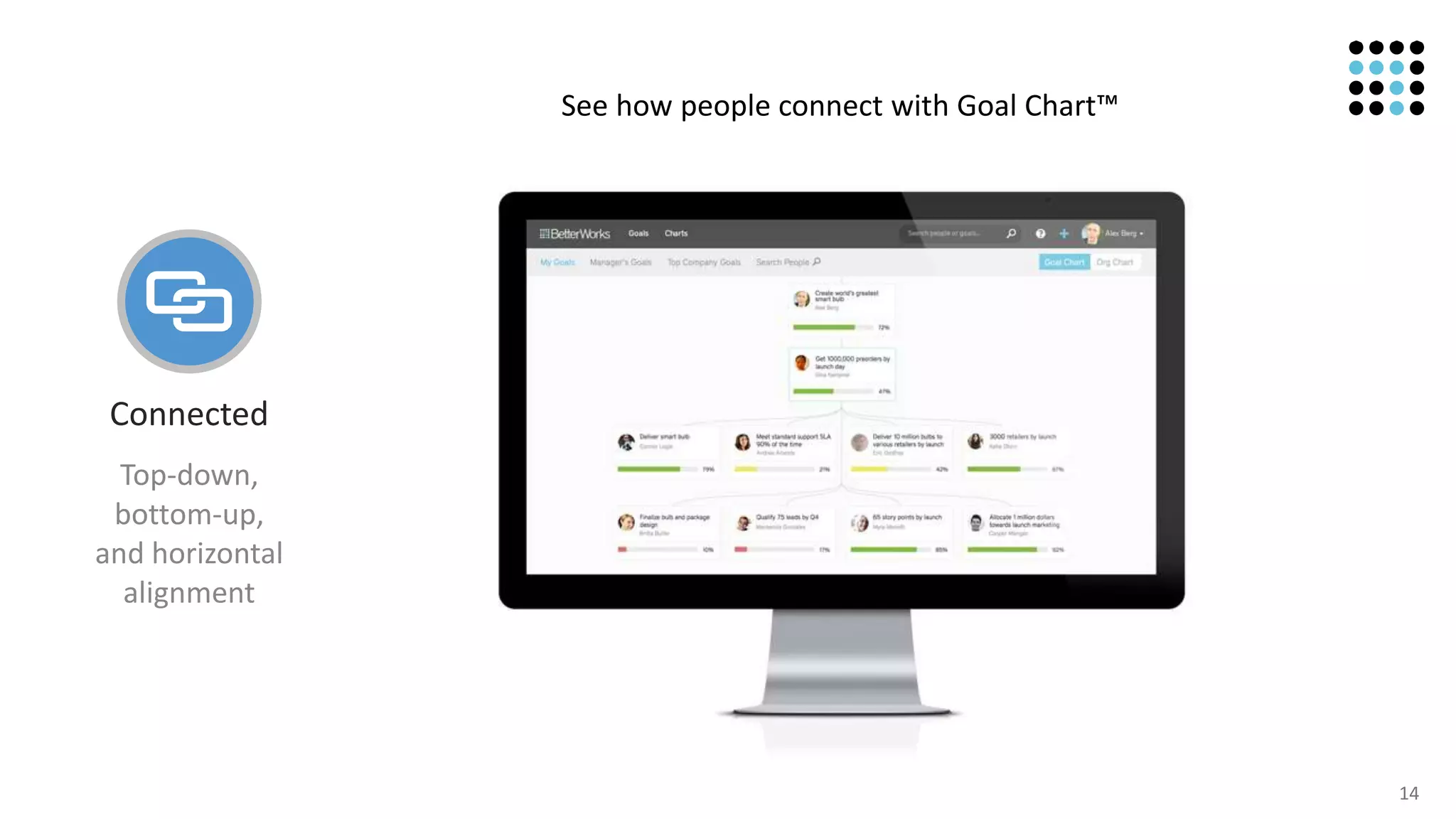
Alignment at a Glance™
Connected
Top-down,
bottom-up,
and horizontal
alignment
14
Connected
Top-down,
bottom-up,
and horizontal
alignment
See how people connect with Goal Chart
15
Connected
Top-down,
bottom-up,
and horizontal
alignment
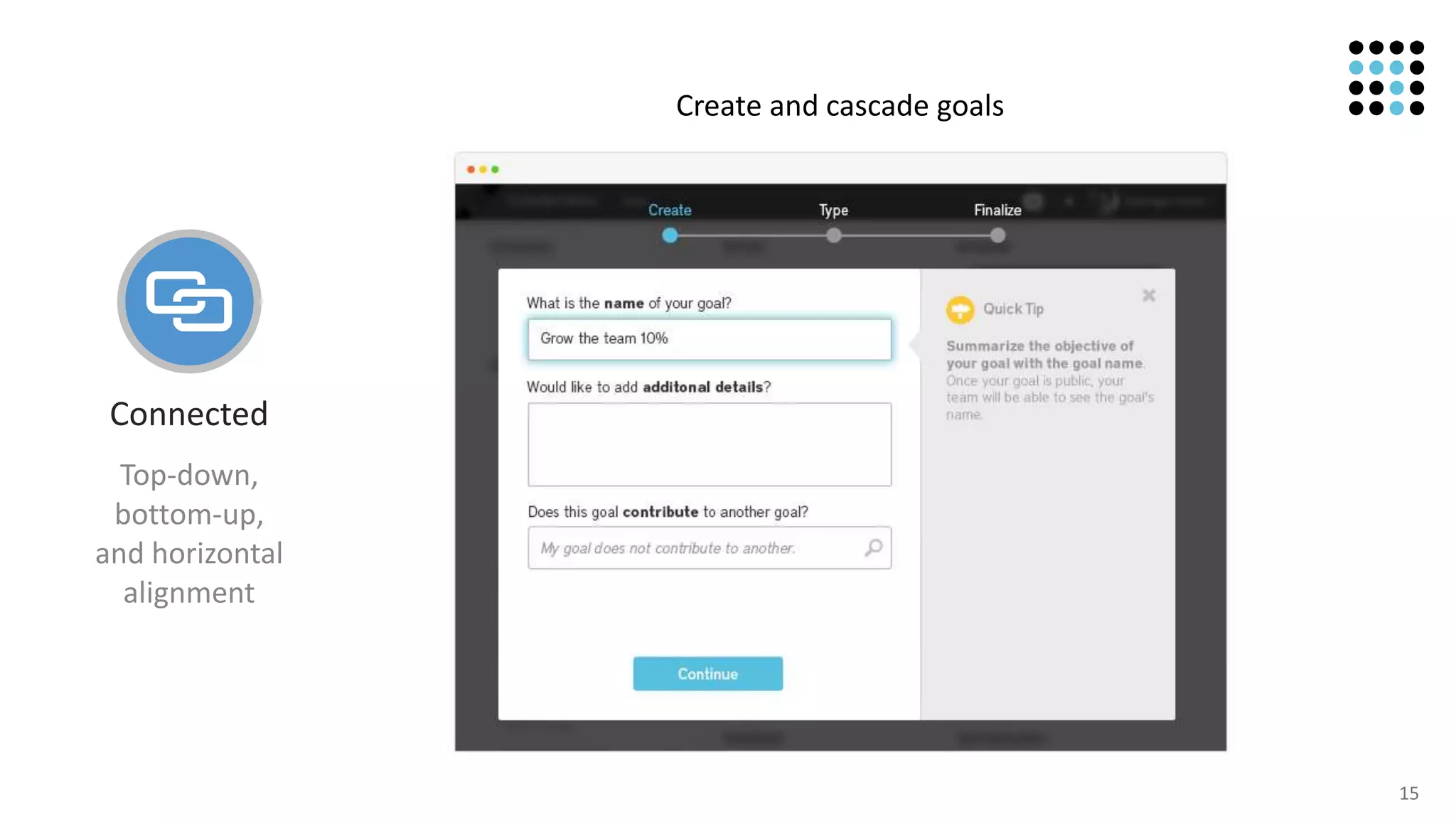
Create and cascade goals
16
Connected
Top-down,
bottom-up,
and horizontal
alignment
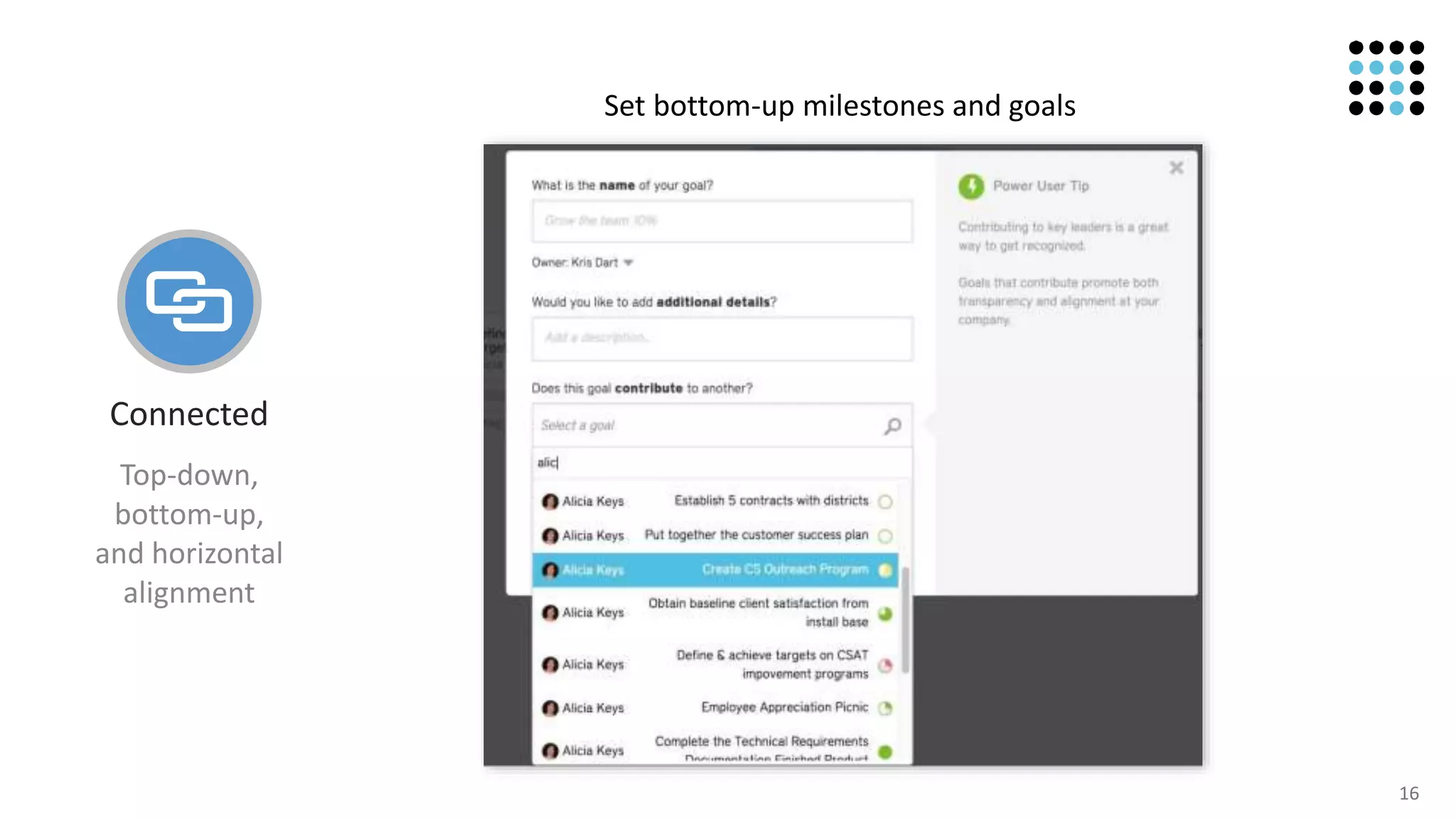
Set bottom-up milestones and goals
17
Supported
Top-down,
bottom-up,
and horizontal
alignment
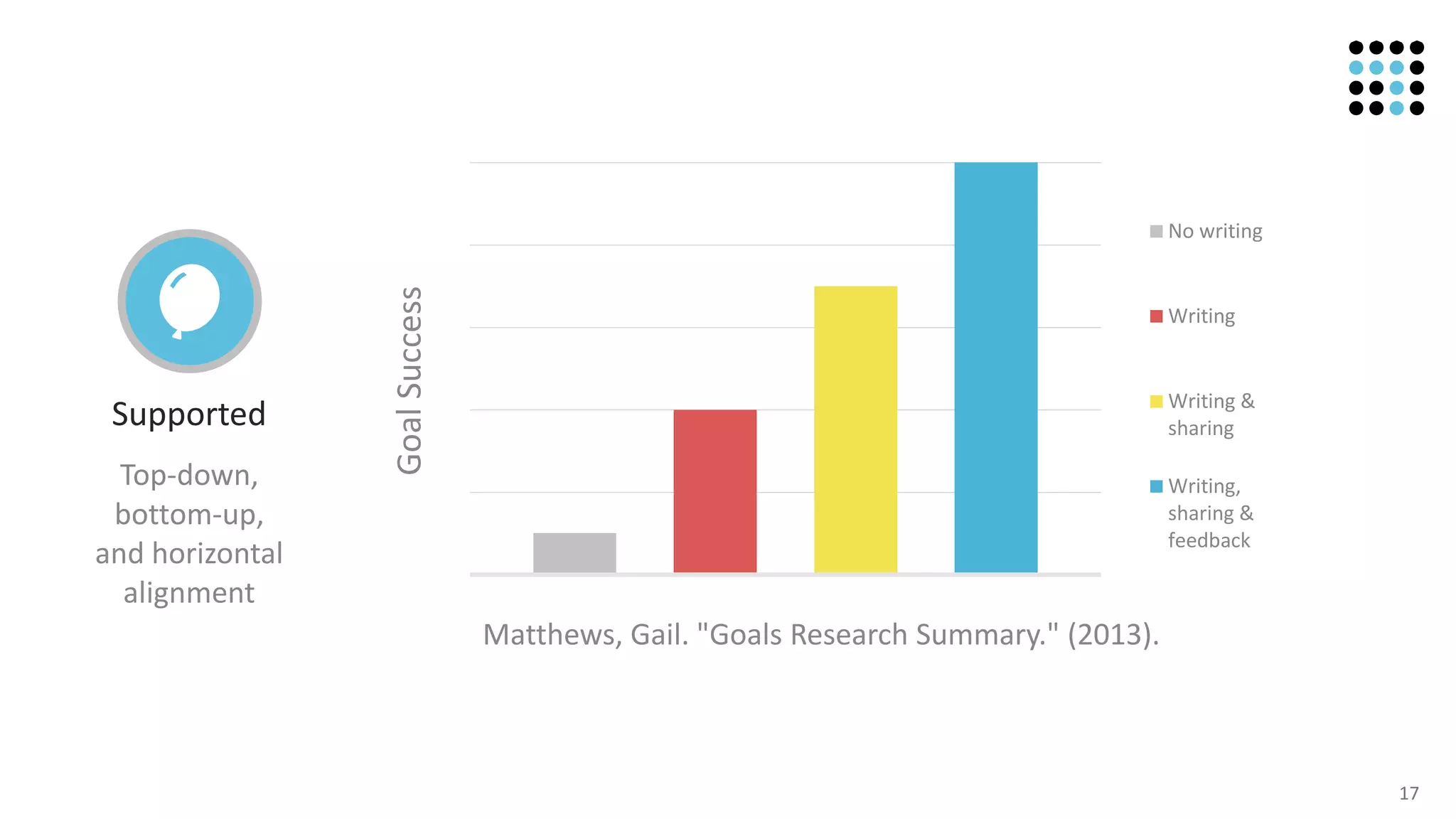
0
20
40
60
80
100
Goal success
Matthews, Gail. "Goals Research Summary." (2013).
No writing
Writing
Writing &
sharing
Writing,
sharing &
feedback
GoalSuccess
18
• Transparent goal setting creates a social contract
– Employees are accountable for their goals
– Co-workers are accountable for helping them achieve
those goals
• Visibility fosters more recognition and encouragement
– #1 factor for happiness at work: appreciation for your
work
• Celebrating success with social gestures is very effective
– 90% of cheers result in a returned cheer or nudge
Supported
19
Supported
Working
transparently
with social
reinforcement
and recognition
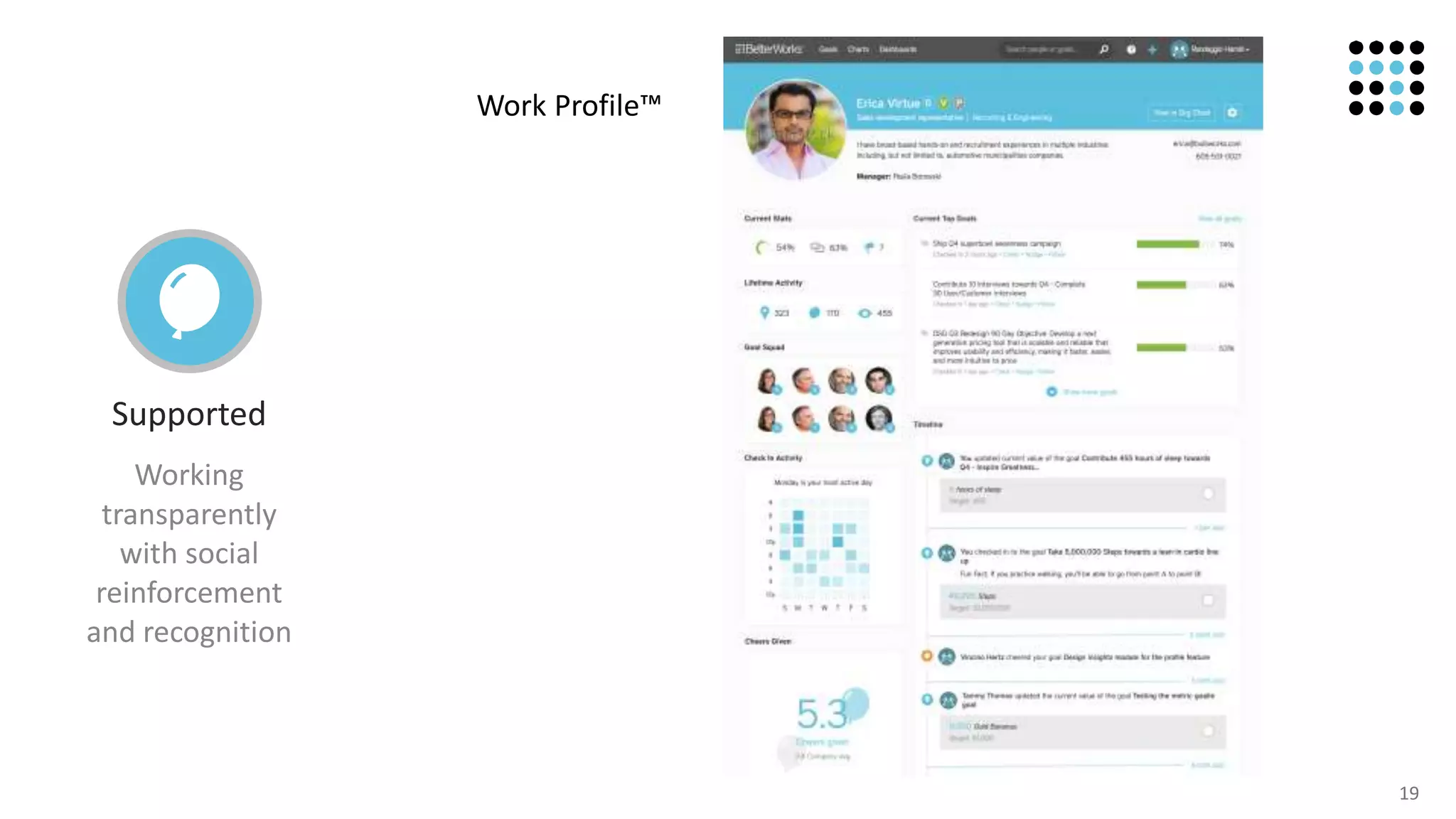
Work Profile™
20
Supported
Working
transparently
with social
reinforcement
and recognition
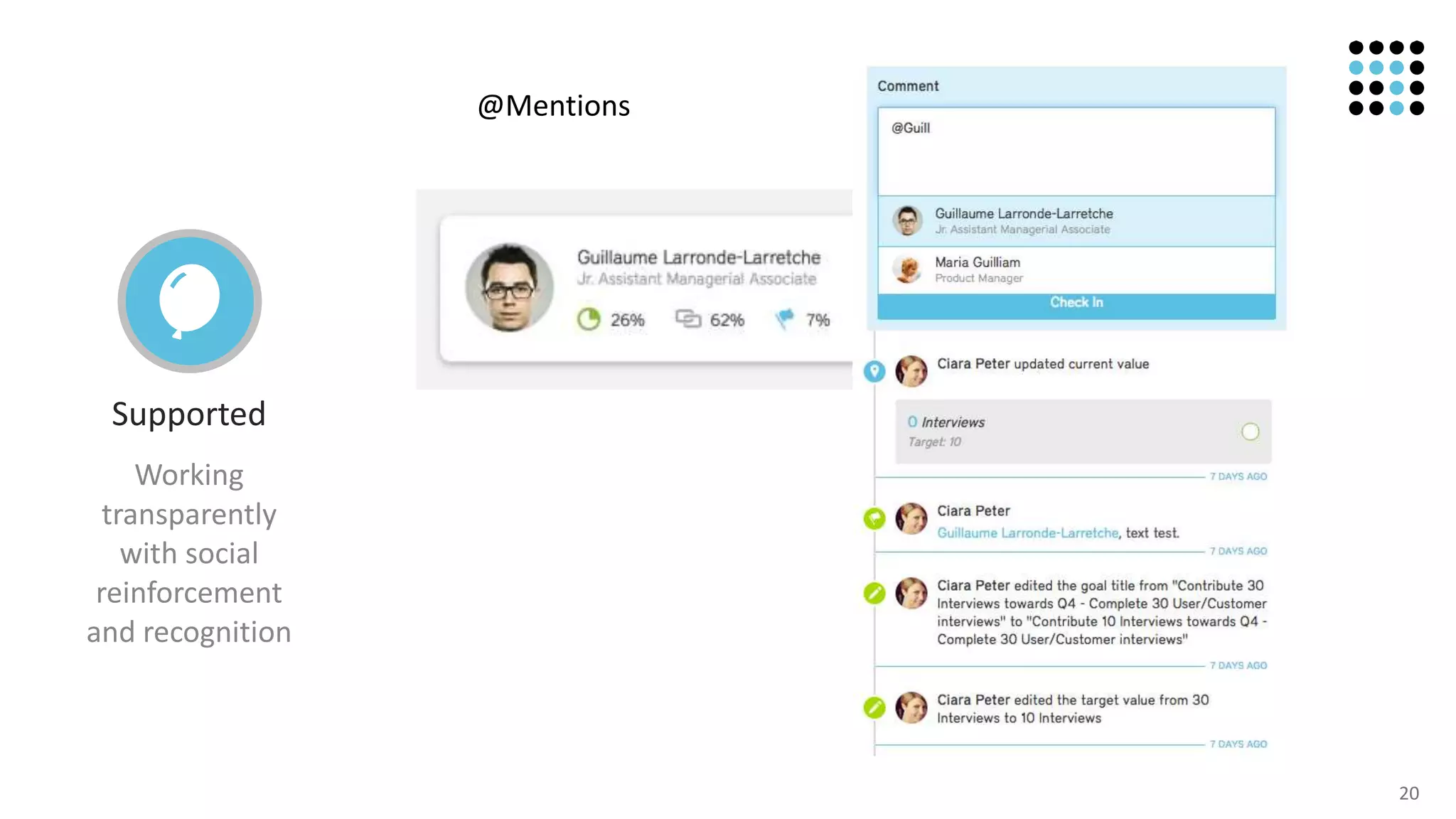
@Mentions
21
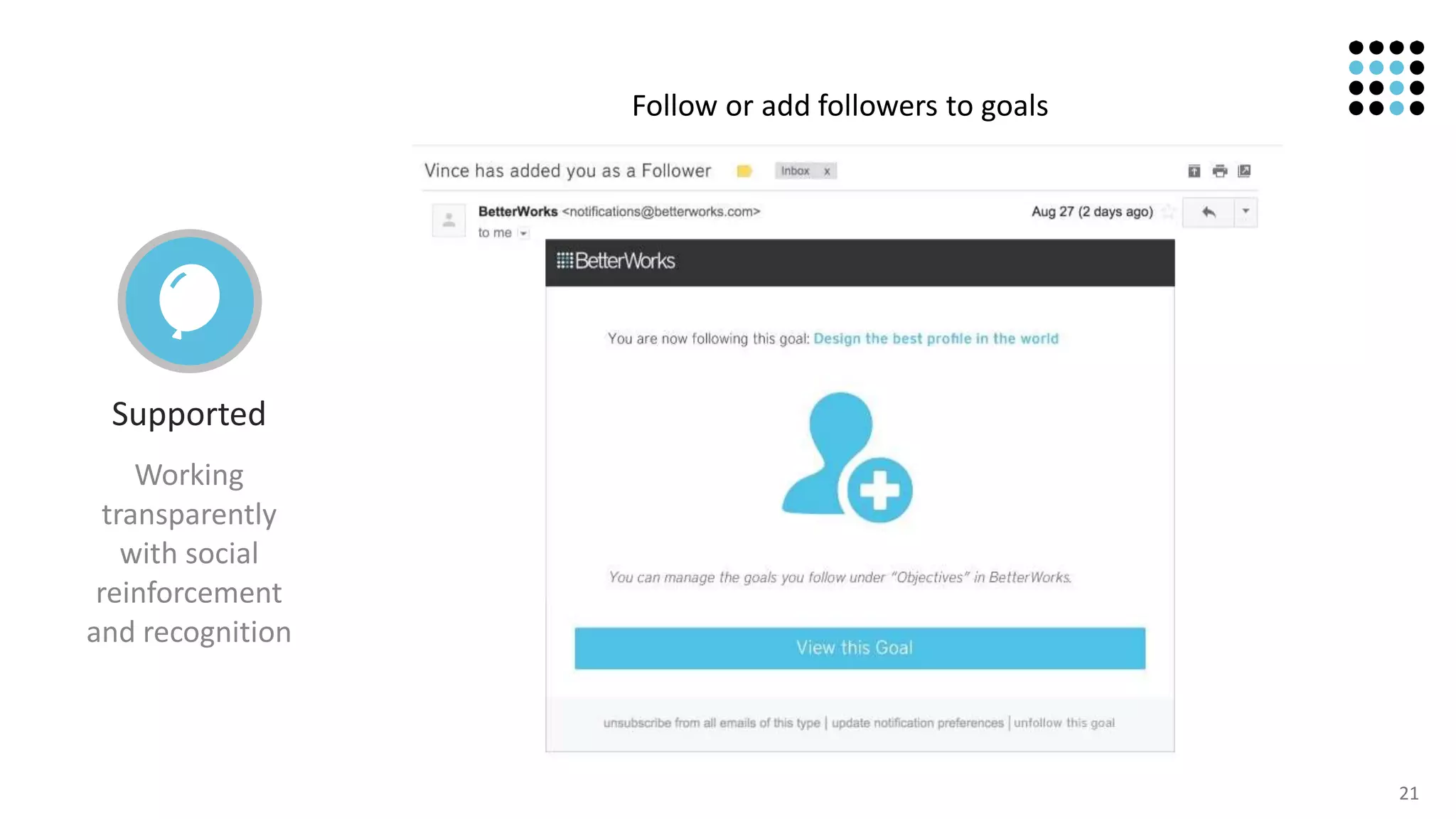
Follow or add followers to goals
Supported
Working
transparently
with social
reinforcement
and recognition
22
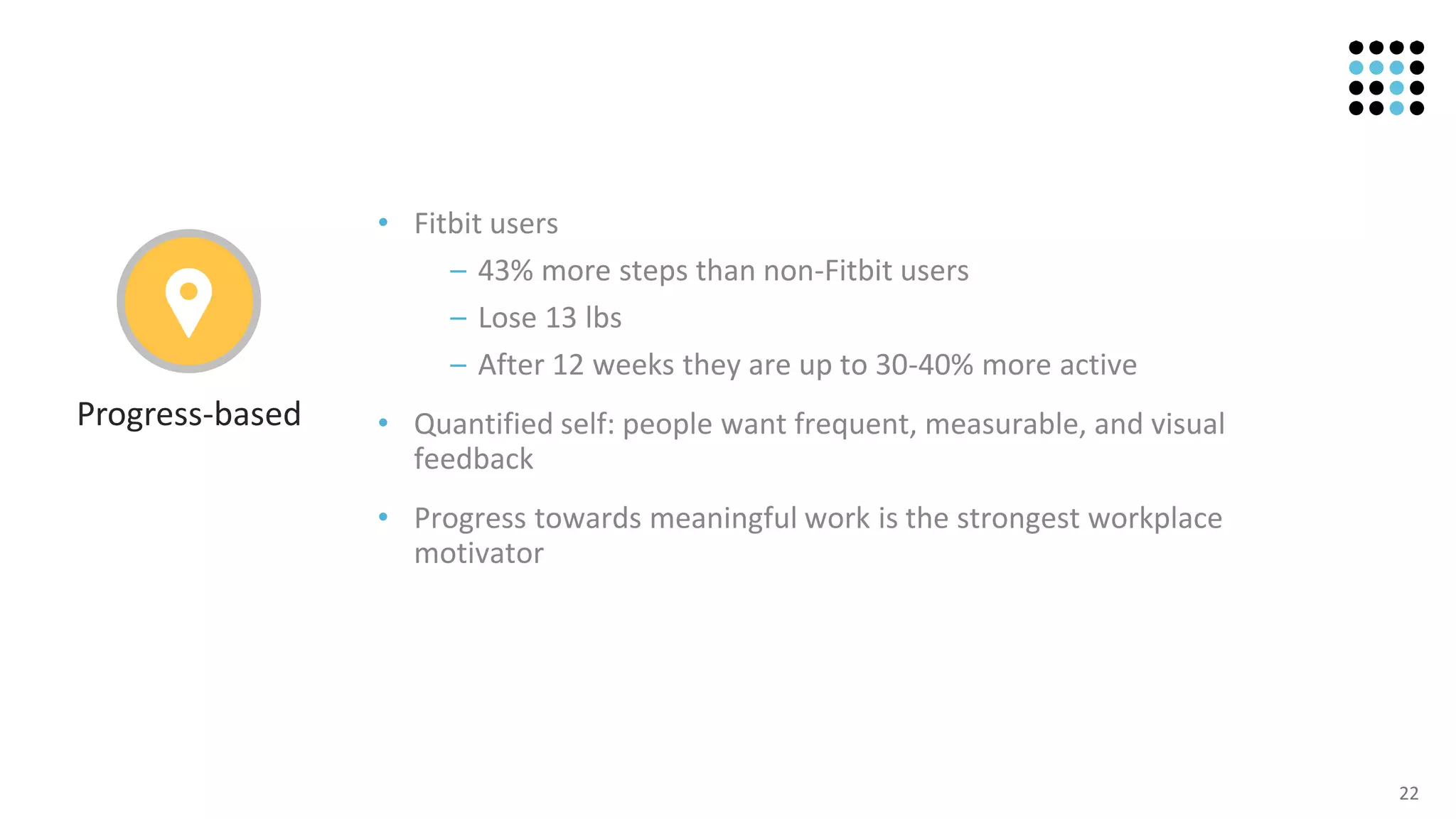
• Fitbit users
– 43% more steps than non-Fitbit users
– Lose 13 lbs
– After 12 weeks they are up to 30-40% more active
• Quantified self: people want frequent, measurable, and visual
feedback
• Progress towards meaningful work is the strongest workplace
motivator
Progress-based
23
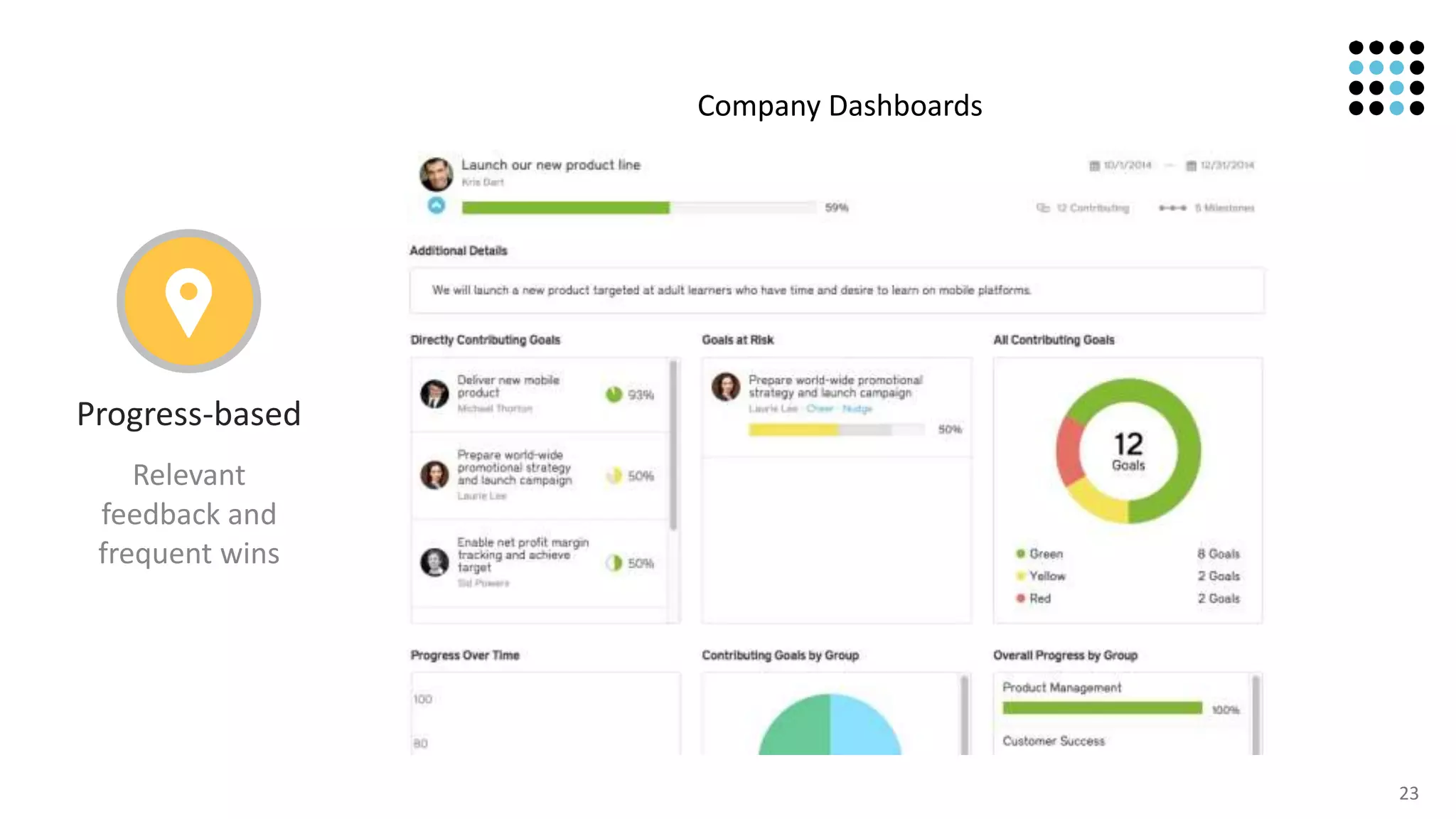
Company Dashboards
Relevant
feedback and
frequent wins
Progress-based
24
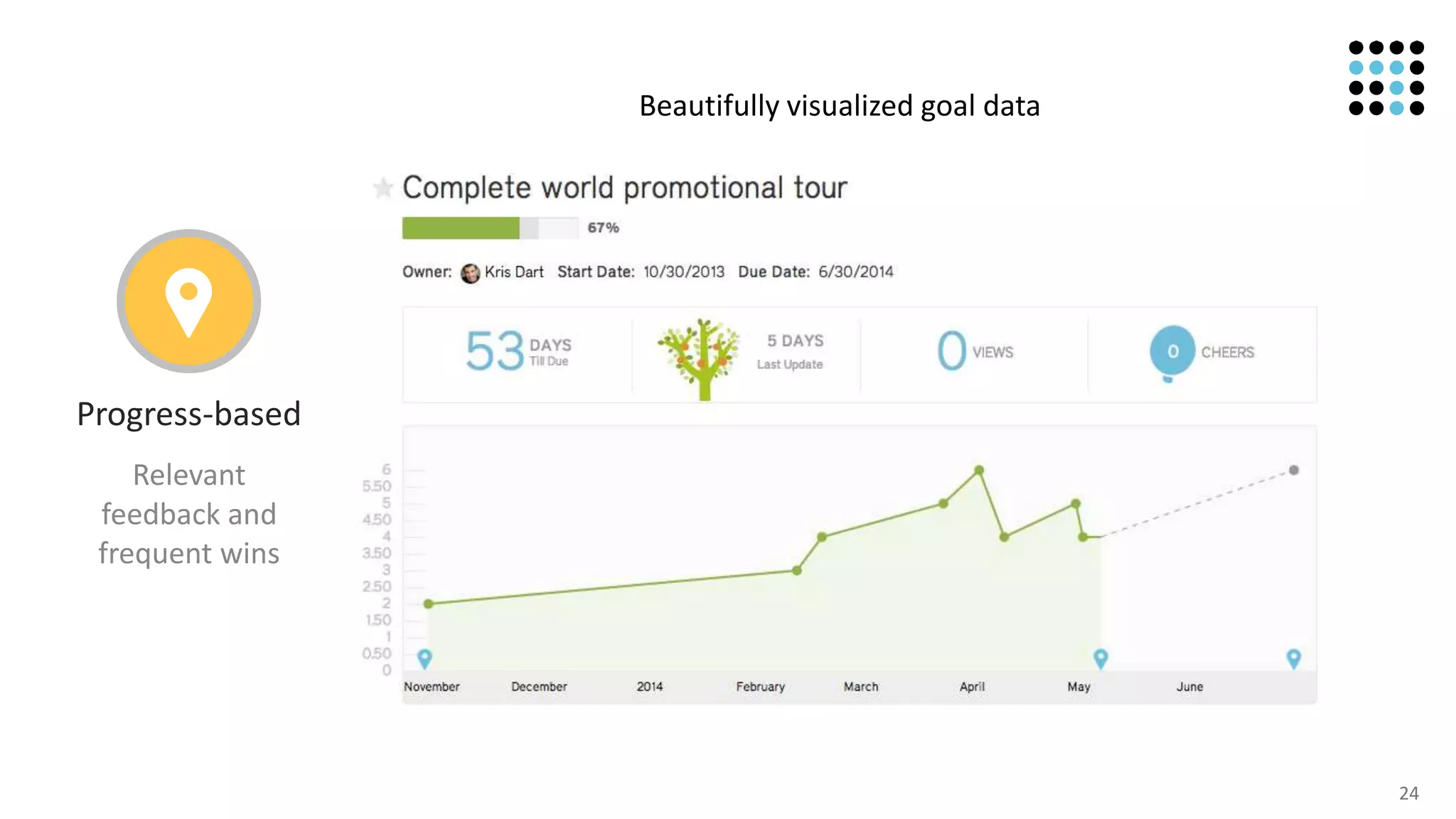
Beautifully visualized goal data
Relevant
feedback and
frequent wins
Progress-based
25
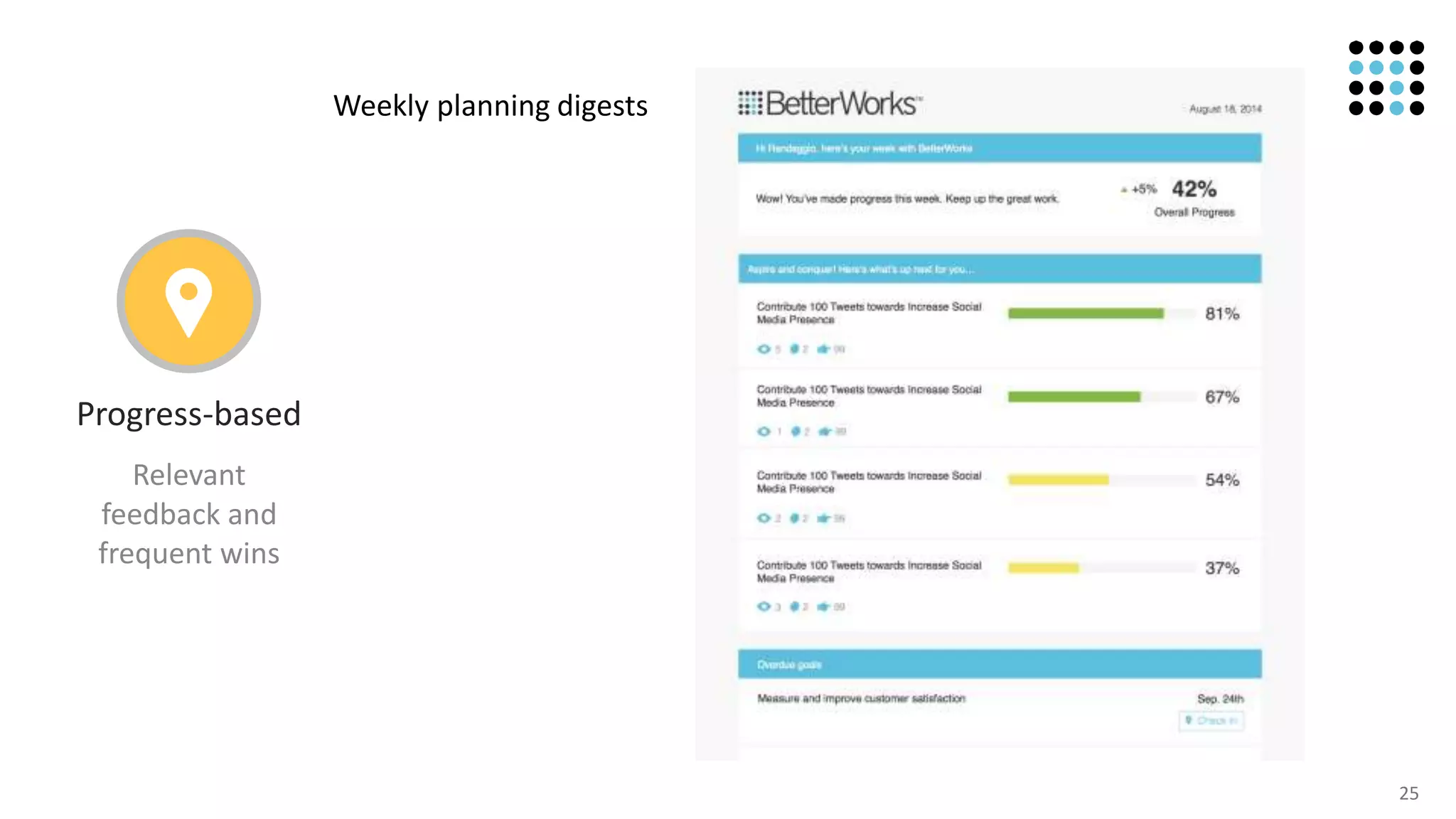
Relevant
feedback and
frequent wins
Progress-based
Weekly planning digests
26
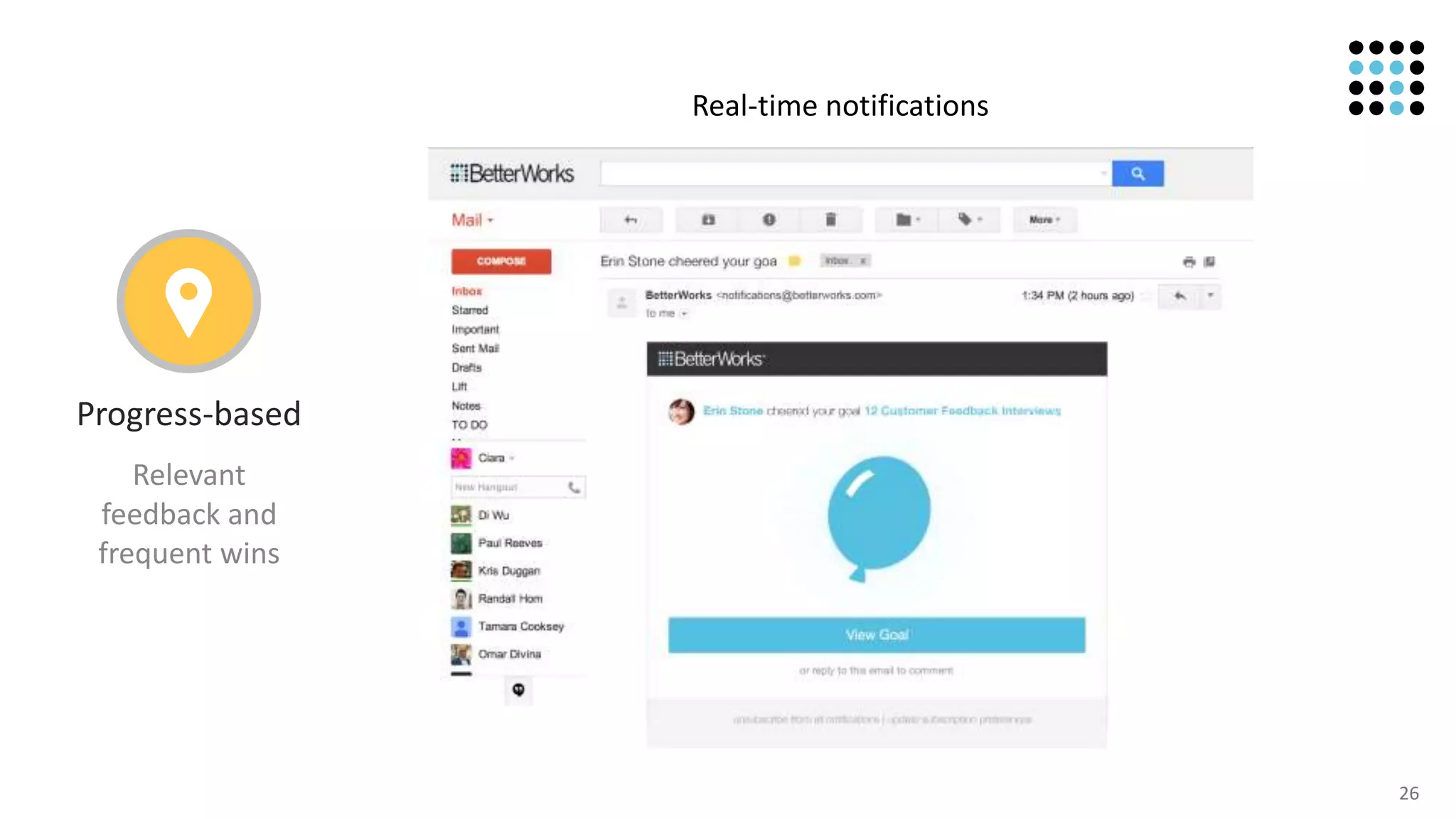
Real-time notifications
Relevant
feedback and
frequent wins
Progress-based
27
Adaptable
High agility orgs:
More likely to capitalize
on change
High agility employees:
More likely to be top
quartile performers
4.5x 3.5x
28
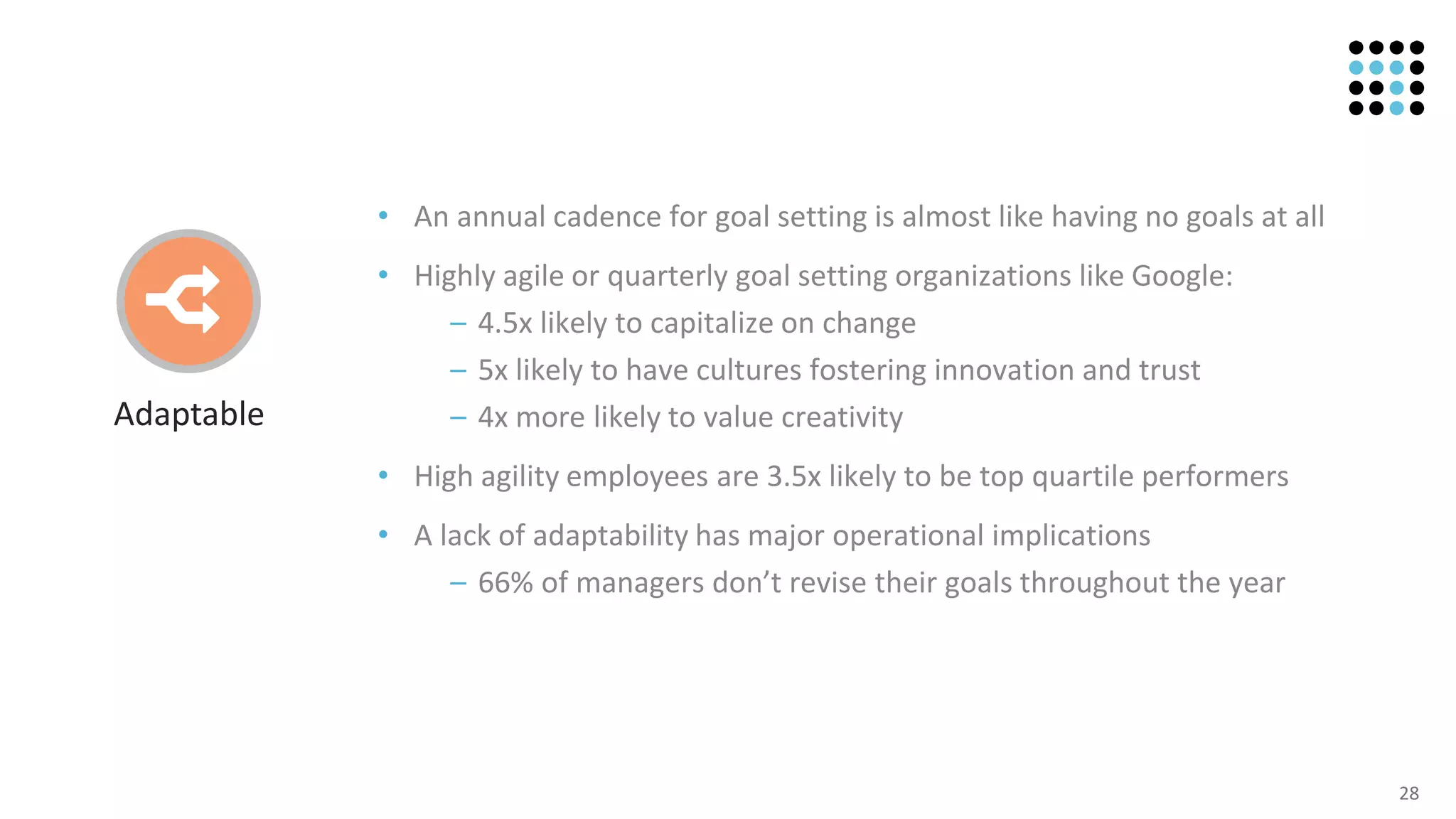
• An annual cadence for goal setting is almost like having no goals at all
• Highly agile or quarterly goal setting organizations like Google:
– 4.5x likely to capitalize on change
– 5x likely to have cultures fostering innovation and trust
– 4x more likely to value creativity
• High agility employees are 3.5x likely to be top quartile performers
• A lack of adaptability has major operational implications
– 66% of managers don’t revise their goals throughout the year
Adaptable
29
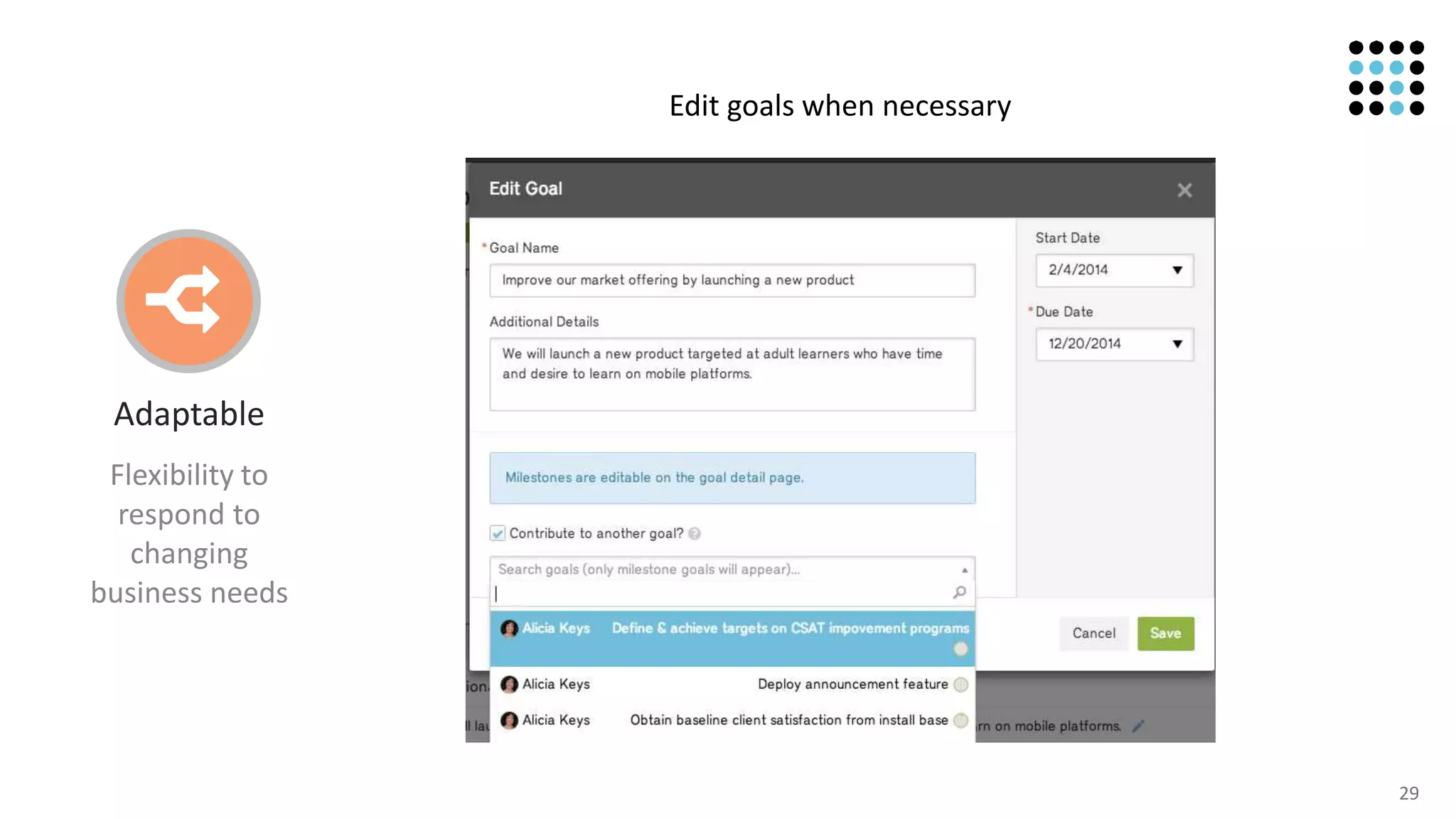
Edit goals when necessary
Flexibility to
respond to
changing
business needs
Adaptable
30
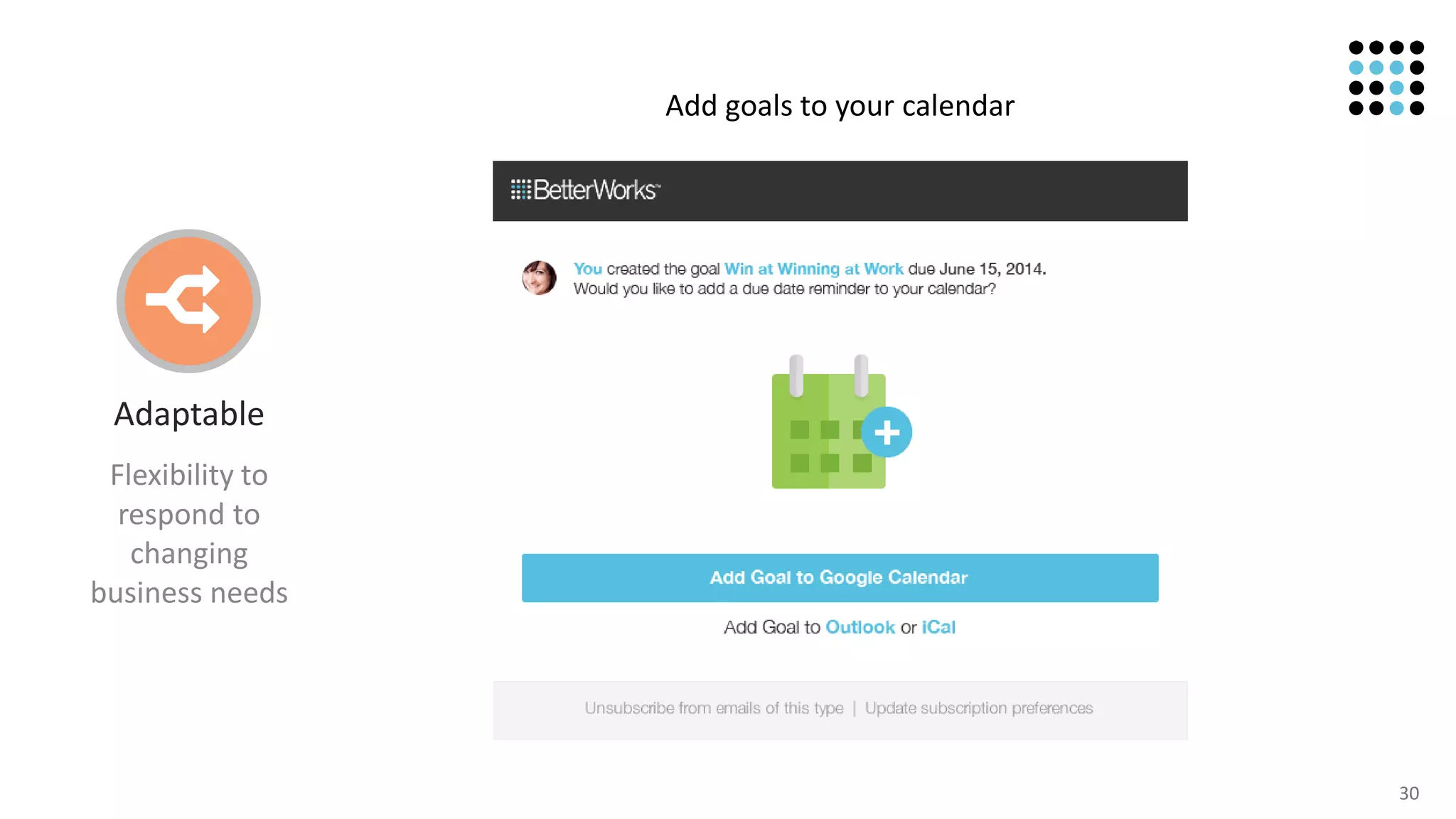
Add goals to your calendar
Flexibility to
respond to
changing
business needs
Adaptable
31
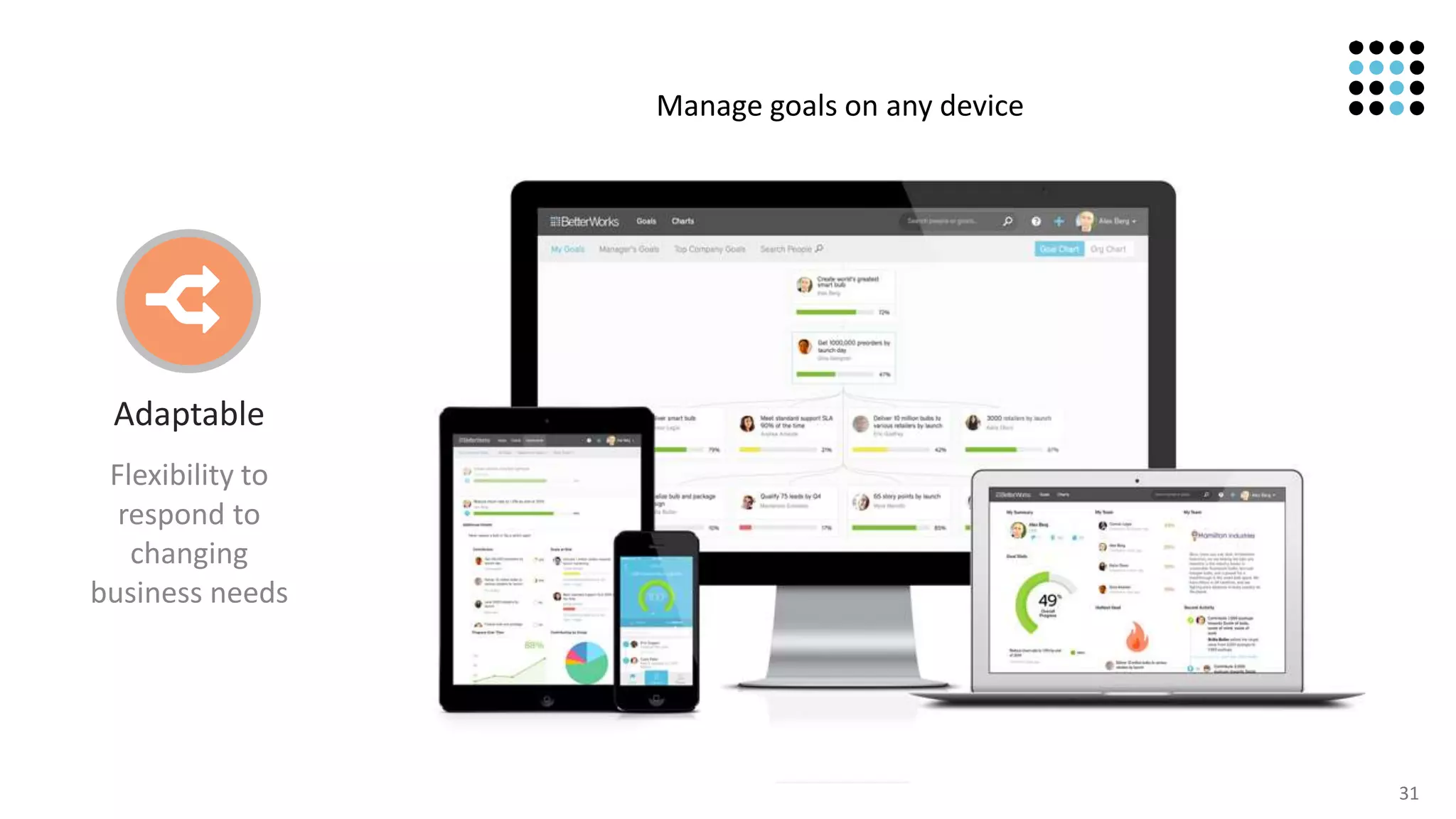
Manage goals on any device
Flexibility to
respond to
changing
business needs
Adaptable
32
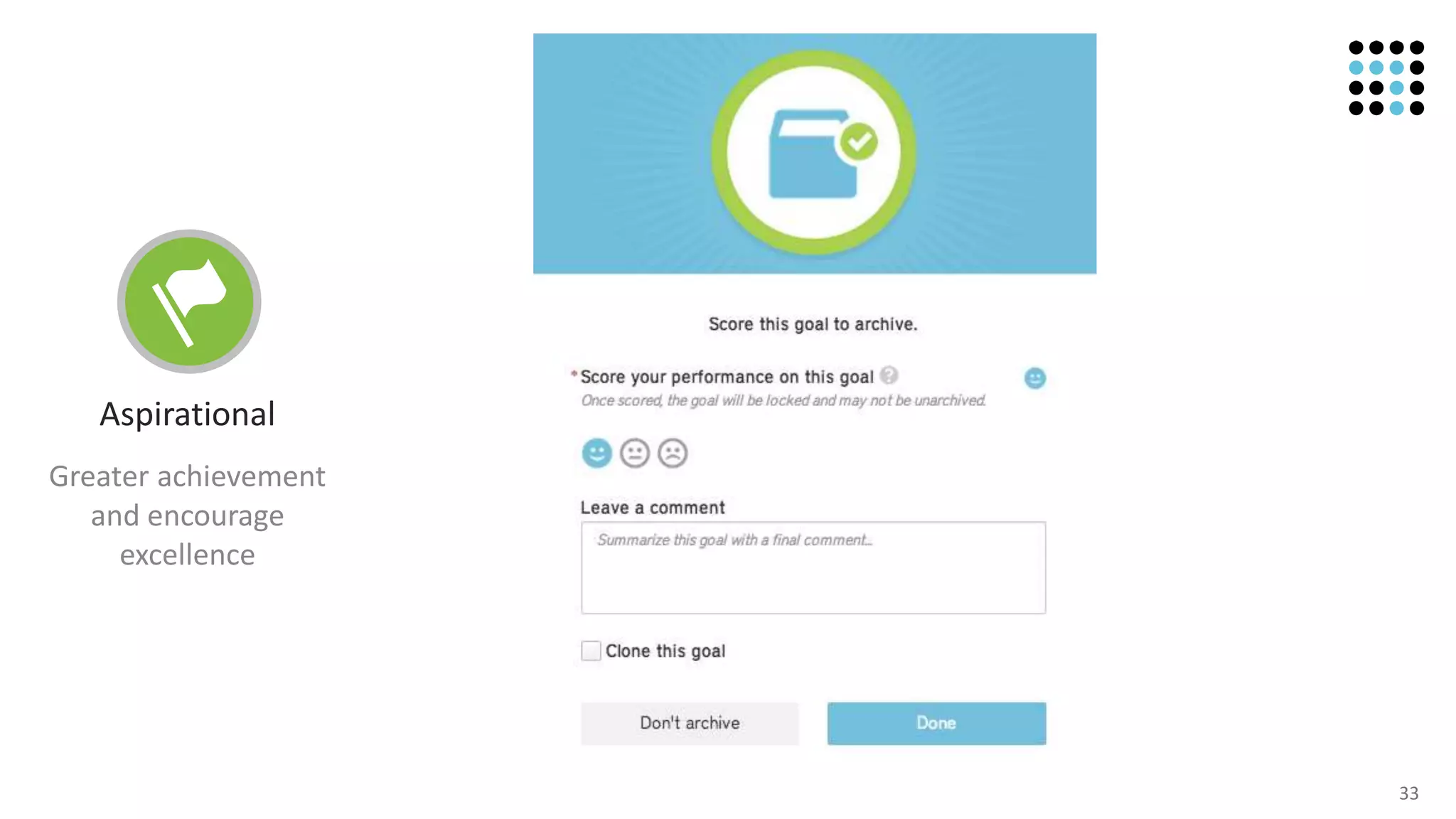
• Stretch goals produce the highest levels of effort and performance
• Because goals should be difficult to achieve, they should not be tightly
coupled to compensation
– Tight coupling can lead to sandbagging
• Aspirational goals need to be personally meaningful
– Not all goals should come from corporate
– GV partner Rick Klau suggests more than 50% of goals should
originate from employees
– Securing employee participation = reaching previously
unattainable goals
Aspirational
33
Aspirational
Greater achievement
and encourage
excellence

What is Goal Science?

  • 1.
  • 2.
    2 A Brief History 2012 GST Goal Science Thinking! 19671973 1981 1984 1990 1999 S.M.A.R.T. George Doran’s “S.M.A.R.T. Way” MBOs The Effective Executive By Peter Drucker
  • 3.
    3 The Good andBad of MBOs The Good The Bad • Infrequently updated • Siloed • Management-driven • Tied to performance reviews and compensation • MBOs ushered in era of results-oriented management
  • 4.
    4 The Good andBad of SMART Goals • Attainable: research has proven that challenging goals are better • Focuses on the setting of goals, not pursuing • Stifles creative thinking for knowledge workers • Specific: absolutely critical • Measurable: good when appropriate • Relevant: aligned goals are better goals • Timely: deadlines boost performance • Better than no goals The Good The Bad
  • 5.
    5 20121967 1973 19811984 1990 1999 S.M.A.R.T. George Doran’s “S.M.A.R.T. Way” A Brief History OKRs John Doerr introduces OKRs to Google KPIs MBOs The Effective Executive By Peter Drucker
  • 6.
    6 The OKRs Revolution •Objectives and Key Results (OKRs) are invented at Intel • KPCB’s John Doerr brings OKRs to Google and more Benefits • Quarterly vs. Annual process • Transparent and aligned • Aspirational • Not tied to performance reviews/compensation
  • 7.
    7 How High PerformingCompanies Manage Goals Open Transparent and all individuals participate Frequent Quarterly and monthly check-ins Cross-Functional Horizontal coordination and dependency alignment
  • 8.
    8 A Brief History Today GST Goal Science Thinking 19671973 1981 1984 1990 1999 S.M.A.R.T. George Doran’s “S.M.A.R.T. Way” KPIs MBOs The Effective Executive By Peter Drucker OKRs John Doerr introduces OKRs to Google
  • 9.
    9 Goal Science Thinking •A set of principles that helps people achieve their goals ‒ Better goal-setting and goal-pursuing ‒ Enhances SMART goal-setting • Not a process like OKRs or MBOs • Goal Science thinking is based on: ‒ Leading academic research ‒ Consumer engagement techniques ‒ Data from our platform
  • 10.
    10 Goal Science Questions What?Who? When? How? Why? Concrete and focused You and your coworkers Continually Progress and feedback Make an impact • You know exactly what your goals are, and how they interrelate to your business as a whole. • You focus on 3-5 goals at a time. • Your goals are quantifiable with clear metrics and milestones. • Your goals are yours to create and own, but they connect to others too. • Having a supportive community alongside you increases goal progress. • The aspirational, future goals you want take time. You have smaller steps along the way to help reach them. • The workplace is dynamic. Adapting goals when appropriate helps you stay flexible and on track. • Progress is the positive force motivating you to do your best. • Achieving small steps makes feedback relevant, which further fuels momentum. • You want to accomplish challenging things at work, and make a difference. • Mastering aspirational, meaningful goals leads to greater engagement, performance, and satisfaction at work.
  • 11.
    11 Goal Science™ Thinking ConnectedSupported Progress-based Adaptable Aspirational Transparent and aligned Social reinforcement and recognition Frequent and measurable feedback Flexibility to respond to changing priorities Retrospection to encourage excellence
  • 12.
    12 • Individuals willachieve more when they are connected and have an internal sense of what they can do to make the biggest impact for the business • Goals need to be connected in three ways – Vertical: cascading of goals is challenging at organizational scale, including bottoms-up goals ‒ Only 6% of managers have meetings/discussions to set goals throughout the year – Company/Mission: An individual can clearly see how his or her goals connect to the company goals and mission, making goals more meaningful – Horizontal: capturing cross-functional dependencies is difficult has major operational implications Connected
  • 13.
    13 Alignment at aGlance™ Connected Top-down, bottom-up, and horizontal alignment
  • 14.
  • 15.
  • 16.
  • 17.
    17 Supported Top-down, bottom-up, and horizontal alignment 0 20 40 60 80 100 Goal success Matthews,Gail. "Goals Research Summary." (2013). No writing Writing Writing & sharing Writing, sharing & feedback GoalSuccess
  • 18.
    18 • Transparent goalsetting creates a social contract – Employees are accountable for their goals – Co-workers are accountable for helping them achieve those goals • Visibility fosters more recognition and encouragement – #1 factor for happiness at work: appreciation for your work • Celebrating success with social gestures is very effective – 90% of cheers result in a returned cheer or nudge Supported
  • 19.
  • 20.
  • 21.
    21 Follow or addfollowers to goals Supported Working transparently with social reinforcement and recognition
  • 22.
    22 • Fitbit users –43% more steps than non-Fitbit users – Lose 13 lbs – After 12 weeks they are up to 30-40% more active • Quantified self: people want frequent, measurable, and visual feedback • Progress towards meaningful work is the strongest workplace motivator Progress-based
  • 23.
  • 24.
    24 Beautifully visualized goaldata Relevant feedback and frequent wins Progress-based
  • 25.
  • 26.
  • 27.
    27 Adaptable High agility orgs: Morelikely to capitalize on change High agility employees: More likely to be top quartile performers 4.5x 3.5x
  • 28.
    28 • An annualcadence for goal setting is almost like having no goals at all • Highly agile or quarterly goal setting organizations like Google: – 4.5x likely to capitalize on change – 5x likely to have cultures fostering innovation and trust – 4x more likely to value creativity • High agility employees are 3.5x likely to be top quartile performers • A lack of adaptability has major operational implications – 66% of managers don’t revise their goals throughout the year Adaptable
  • 29.
    29 Edit goals whennecessary Flexibility to respond to changing business needs Adaptable
  • 30.
    30 Add goals toyour calendar Flexibility to respond to changing business needs Adaptable
  • 31.
    31 Manage goals onany device Flexibility to respond to changing business needs Adaptable
  • 32.
    32 • Stretch goalsproduce the highest levels of effort and performance • Because goals should be difficult to achieve, they should not be tightly coupled to compensation – Tight coupling can lead to sandbagging • Aspirational goals need to be personally meaningful – Not all goals should come from corporate – GV partner Rick Klau suggests more than 50% of goals should originate from employees – Securing employee participation = reaching previously unattainable goals Aspirational
  • 33.

Editor's Notes

  • #8 We’ve modeled this after how we see companies like Google drive and manage goals Open- transparent- all individuals participate and has a bottoms up alignment Cross-functional to iron our dependencies and really drive alignment Frequency- really critical about to have enterprise and organizational agility
  • #12 Goal Science thinking is a set of principles that help employees set better goals, and achieve them. We distilled these principles after talking with the best high performing companies, reading top academic research, and analyzing data from our own platform Connected- Having open and connected goals fosters accountability as it’s part of the organizational social contract. It also irons out cross-functional dependencies Supported- Most employees especially millennials need passive social gestures as a way to feel recognized. Progress-based- Progress is a huge driver for motivation Adaptable- We’ve talked about this but agility is key in staying ahead in today’s competitive space Aspirational- As employees build their goal muscle, retrospective, scoring goals become a critical part of setting stretch and aspirational goals