

The Open Web

   @lachlanhardy
what is the open web?


      “?”
what is the open web?


The Open Web has become a
buzzword.
what is the open web?


A   buzzphrase
what is the open web?


That complicates matters
what is the open web?


What follows is   my definition
seeking definition


The Open Web stems from a
common philosophical
approach.
seeking definition


What makes technology open?
seeking definition


Open specification providing
the freedom to implement
seeking definition


Has one or more open source
reference implementation(s).
seeking definition


Is supported by more than one
vendor or provider.
seeking definition


Public involvement in evolution
of the spec.
seeking definition


Some of this is contentious.
seeking definition


Big concepts are hard.
seeking definition


Philosophy is hard.
Let’s break it down
small pieces

Web standards.
Open specifications.
Cold hard cash.
Open architecture.
small pieces

Web standards.
Open specifications.
Cold hard cash.
Open architecture.
small pieces

Web standards.
Open specifications.
Cold hard cash.
Open architecture.
small pieces

Web standards.
Open specifications.
Cold hard cash.
Open architecture.
Web standards
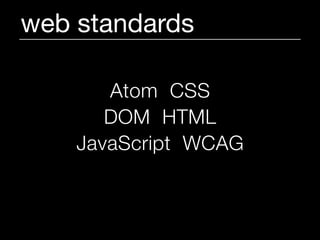
web standards

       Atom CSS
       DOM HTML
    JavaScript WCAG
web standards


Those all have a baseline of
useful support across
browsers and tools.
web standards

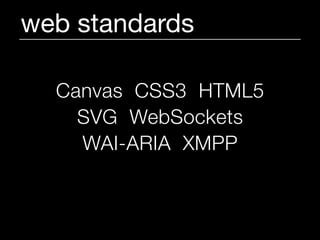
  Canvas CSS3 HTML5
    SVG WebSockets
    WAI-ARIA XMPP
web standards


Those are still gaining support.
web standards


They’re all web standards.
web standards


That means they’ve been
approved by a standards body.
web standards


W3C.   (World Wide Web Consortium)
web standards


IETF.   (Internet Engineering Task Force)
web standards


No single entity has control.
web standards


They’re all open.
Open
specifications
open specifications


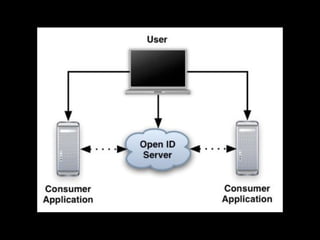
OpenID is a decentralized
framework for user-centric
digital identity.
open specifications


OpenID is a decentralized
framework for user-centric
digital identity.
open specifications


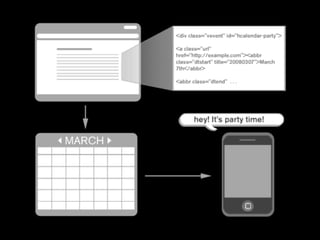
Microformats are a set of
simple, open data formats.
open specifications


Microformats are a set of
simple, open data formats.
open specifications


OAuth allows secure API
authentication from desktop
and web applications.
open specifications


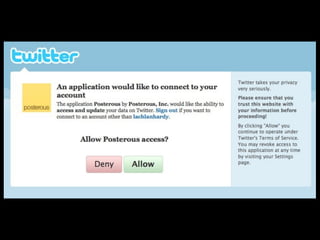
OAuth allows secure API
authentication from desktop,
mobile & web applications.
open specifications


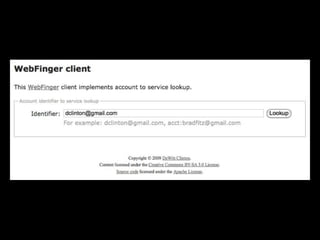
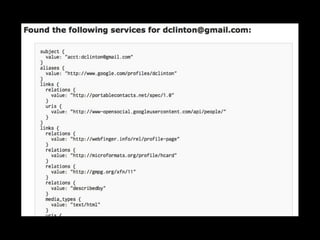
WebFinger attaches public
metadata to email addresses.
open specifications


WebFinger attaches public
metadata to email addresses.
open specifications


I think you can see where
we’re going here...
open specifications


WebFinger can connect an
email address to an OpenID.
open specifications


OpenID gives you a
recognisable public identity.
open specifications


Microformats let you publish
more meaningful content.
open specifications


OAuth allows you to securely
grant access to the content.
open specifications


There are many more...
open specifications


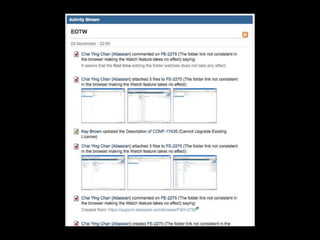
Activity Streams extends Atom
to show what people are doing
open specifications


Activity Streams extends Atom
to show what people are doing
open specifications


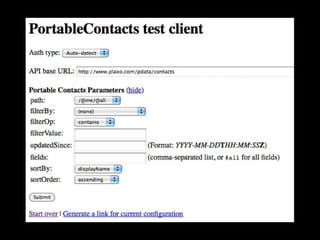
Portable Contacts provides a
common access pattern and
contact schema
open specifications


Portable Contacts provides a
common access pattern and
contact schema
open specifications


It’s built around OAuth & vCard
open specifications


Do you see why I love this?
open specifications


People built these technologies
as pieces of a puzzle.
open specifications


It’s not some monolithic stack.
open specifications


It’s modular.
open specifications


Each can be used independently.
open specifications


They’re designed to work
together.
open specifications


They’re not standards yet.
open specifications


But they’re guaranteed to be
open.
Enough with the
    open
Let’s talk about
cold hard cash
cheaper & better


More people have looked at it
cheaper & better


More people have worked on it
cheaper & better


More people have used it
cheaper & better


You didn’t have to   pay them
Open architecture
open architecture


The components are less
defined.
open architecture


Let’s start simply.
open architecture


URLs.
open architecture


They should be readable.
open architecture


They should be hackable.
open architecture


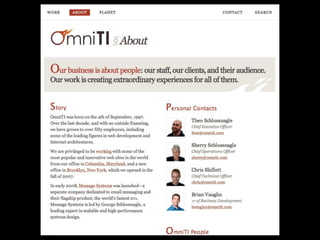
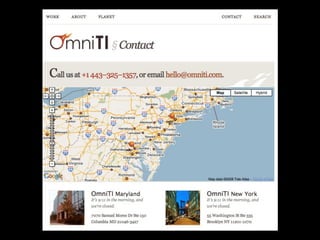
http://omniti.com/is/
open architecture


http://omniti.com/is/here/
open architecture

  What about their jobs
        page?

http://omniti.com/is/hiring/
open architecture

  What about their jobs
        page?

http://omniti.com/is/hiring/
open architecture

     Their legal page?

http://omniti.com/has/legal/
open architecture

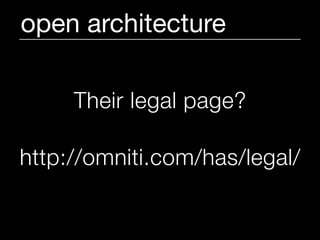
     Their legal page?

http://omniti.com/has/legal/
open architecture

       Services?

 http://omniti.com/does/
         design/
open architecture

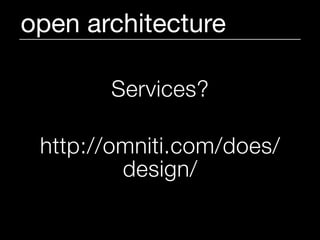
       Services?

 http://omniti.com/does/
         design/
open architecture

     Case studies?

 http://omniti.com/helps/
   national-geographic/
open architecture

     Case studies?

 http://omniti.com/helps/
   national-geographic/
open architecture


How’s that for SEO?
open architecture


And readability.
open architecture


And usability.
open architecture


URLs require planning.
open architecture


API   (Application Programming Interface)
open architecture


REST   (Representational State Transfer)
Example time
twitter as exemplar


Simplicity.
twitter as exemplar


Ubiquity.
twitter as exemplar


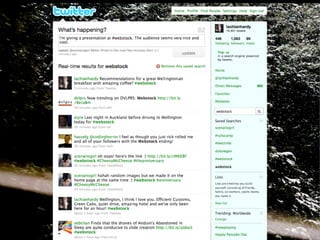
Open API.
twitter as exemplar


Microformats
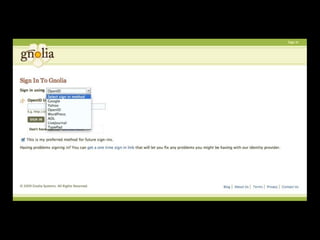
gnolia as exemplar


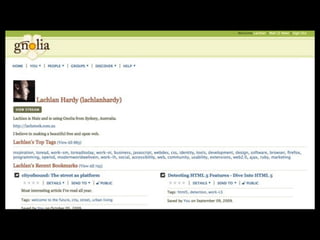
Outsourcing identity
gnolia as exemplar


It’s not as crazy as it sounds.
gnolia as exemplar


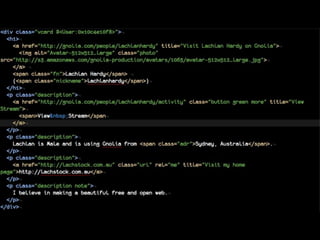
Microformats.
example time


These are simple things.
example time


Anybody can implement them.
example time


Want to run an OpenID server?
example time


Want to use Microformats?
example time


The code is freely available.
Use the Open Web
use the open web


The web connects...
use the open web


The web connects stuff.
use the open web


I’m going make stuff up now.
use the open web


You’re the experts.
use the open web


You’ll find the solutions.
use the open web


I’m just going to offer you the
pieces.
use the open web


I spend a lot of time on the
web.
use the open web


I spend a lot of time on the
web. A whole lot of time.
use the open web


There are common threads.
use the open web


Things that must be done.
use the open web


Microformat your content.
use the open web


Make your URLs readable.
use the open web


Make your URLs hackable.
use the open web


  Take all the data in your
     40,00 PDFs
 and put it on a web page.
use the open web


Then microformat those too.
use the open web


Offer relevant web feeds.
use the open web


Offer an API.
use the open web


Offer web services.
use the open web


Offer an API for them too.
use the open web


Offer and/or accept OpenIDs.
use the open web


Once users have identities...
use the open web


You can really go to work.
use the open web


They’re not just users
anymore.
use the open web


They’re community members.
use the open web


You can offer so many more
services when you know who
people are.
use the open web


The community member
controls their OpenID.
use the open web


Offer OAuth access to data.
use the open web


Who are third-parties, anyway?
use the open web


Some of them will be in your
community.
use the open web


Offer personalised feeds.
The Open Web
Thank you
find me on the open web


 http://lachstock.com.au/
references


http://dev.aol.com/article/2007/openid_primer_for_php
http://aarronwalter.com/presentations/sxsw08/

The Open Web

Editor's Notes

  • #5 if you will
  • #6 Folks like to use it for marketing. Big organisations have differing uses depending on departments and focus.
  • #8 There are techniques, practices and technologies that promote the Open Web, and there are those that discourage it.
  • #9 Folks like Brad Neuberg and Chris Messina have led a lot of discussion around this. I joined the Open Web Group. We use the 4 following guidelines
  • #10 (royalty & patent free)
  • #14 Some of you may not agree.
  • #16 There is a reason philosophers are such respected figures in human history.
  • #43 Okay. If you remember Finger? It’s back. Now with added HTTP.
  • #44 Basically, it’s Personal Data Discovery. Google have had it in alpha for some time and rolled it out to Google Profiles to coincide with the launch of Buzz last week. Many other companies are working on implementations.
  • #52 To throw in the mix depending on what your site or product does
  • #54 It uses a simple grammatical pattern of subjects, verbs and objects. Johnny threw the ball. Spot chased the ball.
  • #59 Harmonised with a schema from OpenSocial and using the same discovery specs as OAuth and WebFinger
  • #67 OpenID Foundation. Microformats is tidying up IP issues but intend to submit to IETF or W3C. Open Web Foundation.
  • #68 Let’s take a break from the openness for a second.
  • #69 I’m not a hippie. I’m not a fanatic. And I’m not a communist. Not that I have anything against hippies or communists. I like making money. I’d *prefer* to make lots of it. Like most people I’m only passionate about certain things. Everything else is boring and should be easy so I can get on with the interesting things that pay well.
  • #73 Or pay for their work. But it makes sense to pay your teams to spend some of their time working on these specs, because they’ll know them better and make them more useful to you.
  • #75 Web standards are easy. They’re made by standards bodies. Open specifications are easy. They’re made by open process and guaranteed to be open.
  • #90 While we’re here, did you know that Google reads “national-geographic” as two words?
  • #91 While we’re here, did you know that Google reads “national-geographic” as two words?
  • #95 I’m not suggesting you leave here and put verbs in all your URLs. I am suggesting you think through what your URLs do for your site. AND for your users.
  • #96 Not every site needs one, but you’d be surprised how far you can get with microformats and hackable URLs.
  • #97 We’re not going to go diving into software architecture here, but if you’re building an API, build REST. You may add other types on top, but REST is simple, hackable and everybody understands how to use it.
  • #99 Twitter. Of course. By this stage, you probably either love it or hate it. Or both.
  • #100 140 characters. That’s it? When you first hear that it sounds so limited. But that limitation provides so much flexibility. All you can do is add 140 characters. There’s very little metadata. Very little cruft. Just content. What if your site was just content?
  • #101 You can use it from everywhere. What if everyone in your council area could access council services from - not anywhere - but *everywhere*?
  • #102 Anybody can write code to access tweets. Anybody can pull tweets into their own site or service. What if anybody could write code to access your service?
  • #103 Twitter uses the XFN microformat to connect your friend’s profiles with your own. And they use them to connect back to your own site and claim it. What if your site automatically associated people’s accounts with their own site?
  • #104 Gnolia - formerly known as...
  • #105 Gnolia does not accept new registrations by itself. All new accounts must come from third parties.
  • #107 When I’ve explained this in the past, I’ve asked for hands. I won’t do that, but I reckon we’d pretty much cover everybody here.
  • #109 This is my hCard on Ma.gnolia. A microformat. They use others on my profile too. Like hAtom, NoFollow, XFolk etc
  • #114 In so many languages. You just have to set it up.
  • #116 We hear this time and again at conferences. The Web of Things. The Web of the Real. I say,
  • #117 The web connects stuff. The web connects increasingly more *stuff* because it’s getting easier to do so.
  • #118 Some of this will have problems. Maybe all of it. Maybe budget constraints or resource limitations. That’s okay.
  • #119 Whatever you’re working on is your problem space. You’re the experts. I’m just trying to show you what I see.
  • #122 You guys offer a *lot* of services!
  • #129 Or Word Docs or whatever. Offer the document file for download if anybody wants it, but make the data available in HTML.
  • #131 Do you have regular updates on certain pages? Offer a feed. It doesn’t have to be a blog page to have Atom. And if you write it with the hAtom microformat, you can just generate the Atom.
  • #132 Or just publicise all your nice accessible data sets.
  • #133 Build your own services and share your data.
  • #135 Everybody you offer services to.
  • #139 They always were, of course.
  • #141 They change their address as necessary.
  • #142 Let third-parties offer services to your customers. Saves you having to do it.
  • #144 Every developer lives somewhere. Every designer uses web sites. Some of them will use yours. Give them incentives to work with your site.
  • #145 You know my name. You know my interests. You may even know where I live or where I am right now. How about explicit notifications? There will be roadworks on my street next week. There’s an amazing sushi restaurant around the corner and it’s lunch time.
  • #146 It’s free