What are the FAIR data
principles
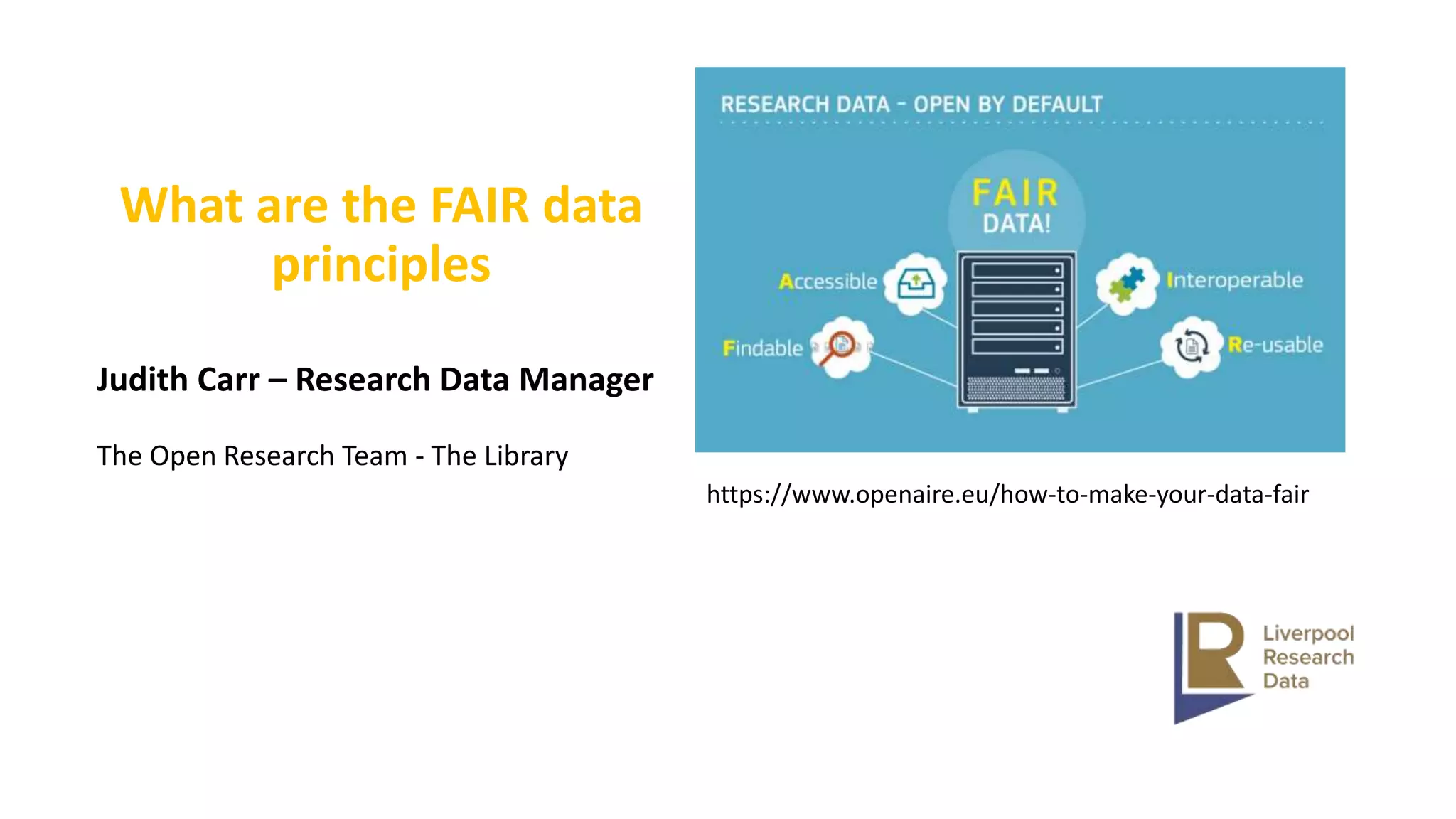
https://www.openaire.eu/how-to-make-your-data-fair
Judith Carr – Research Data Manager
The Open Research Team - The Library
AIM
At the end of this session you will know what the FAIR data
principles are, what is required and be in a position to think how
these would relate to your research practice.
Why do we have the FAIR data principles? why do they help ?
Four things to remember about FAIR data principles
The principles themselves
Tips on getting started
Why are the FAIR data principles needed ?
What do the FAIR data principles help with ?
• Research data is an asset and digital research data can be stored, reused,
repurposed
• Access to this data facilitates knowledge, discovery, improves research
transparency
• Sharing aids innovations/solves problems – avoids repetition
• Obligation to keep for a long time
• Provide a description of how outputs should be organised
so they can be more easily accessed, understood,
exchanged and reused.
• Funders support and FAIR data to maximise the integrity and
impact of their research investment. Adopting FAIR data
principles can help you as researcher maximise your impact/
contribution to your field.
Both humans and machines are
intended as digesters of data.
The FAIR principles apply to
both data and metadata.
The principles are not necessarily about open
data.
The FAIR principles are not rules
or standards.
Four thing to note about FAIR data principles
Photo by Markus Winkler on Unsplash
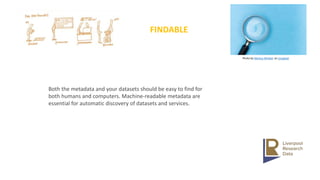
FINDABLE
Both the metadata and your datasets should be easy to find for
both humans and computers. Machine-readable metadata are
essential for automatic discovery of datasets and services.
Photo by Nareeta Martin on Unsplash
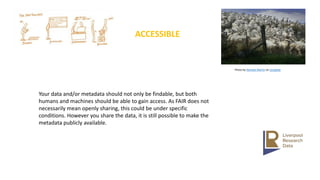
ACCESSIBLE
Your data and/or metadata should not only be findable, but both
humans and machines should be able to gain access. As FAIR does not
necessarily mean openly sharing, this could be under specific
conditions. However you share the data, it is still possible to make the
metadata publicly available.
INTEROPERABLE
As the aim is to speed up discovery and uncover new
insights, research data should be easily combined with
other datasets, applications and workflows by humans
and computer systems.
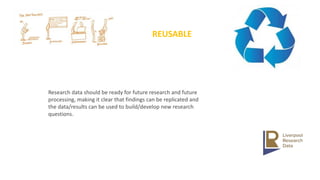
REUSABLE
Research data should be ready for future research and future
processing, making it clear that findings can be replicated and
the data/results can be used to build/develop new research
questions.
Tips on how to get started
What happens now in your discipline - are there specific repositories that are used?
Do you use secondary data? Think about the issues you have had in interpreting the data?
What could you do differently? Would thinking about FAIR help?
Pick on one thing you would like to do that relates to FAIR and investigate how to go about it.
If you are funded, find out what your funder’s policy is. Follow it and ask us if necessary.
Publishing open access, what about your data? ( Note UKRI new requirements).
FAIR data underpins Open Research, open research tools often follow FAIR principles.
Don’t panic
Thank you and any questions?
Useful Webpages
www.Liverpool.ac.uk/rdm – Liverpool Research Data
https://www.howtofair.dk/what-is-fair/
https://www.go-fair.org/fair-principles/fairification-process/
https://www.re3data.org/ - registry of research data repositories

What are the FAIR data principles?

  • 1.
    What are theFAIR data principles https://www.openaire.eu/how-to-make-your-data-fair Judith Carr – Research Data Manager The Open Research Team - The Library
  • 2.
    AIM At the endof this session you will know what the FAIR data principles are, what is required and be in a position to think how these would relate to your research practice. Why do we have the FAIR data principles? why do they help ? Four things to remember about FAIR data principles The principles themselves Tips on getting started
  • 3.
    Why are theFAIR data principles needed ? What do the FAIR data principles help with ? • Research data is an asset and digital research data can be stored, reused, repurposed • Access to this data facilitates knowledge, discovery, improves research transparency • Sharing aids innovations/solves problems – avoids repetition • Obligation to keep for a long time • Provide a description of how outputs should be organised so they can be more easily accessed, understood, exchanged and reused. • Funders support and FAIR data to maximise the integrity and impact of their research investment. Adopting FAIR data principles can help you as researcher maximise your impact/ contribution to your field.
  • 4.
    Both humans andmachines are intended as digesters of data. The FAIR principles apply to both data and metadata. The principles are not necessarily about open data. The FAIR principles are not rules or standards. Four thing to note about FAIR data principles
  • 5.
    Photo by MarkusWinkler on Unsplash FINDABLE Both the metadata and your datasets should be easy to find for both humans and computers. Machine-readable metadata are essential for automatic discovery of datasets and services.
  • 6.
    Photo by NareetaMartin on Unsplash ACCESSIBLE Your data and/or metadata should not only be findable, but both humans and machines should be able to gain access. As FAIR does not necessarily mean openly sharing, this could be under specific conditions. However you share the data, it is still possible to make the metadata publicly available.
  • 7.
    INTEROPERABLE As the aimis to speed up discovery and uncover new insights, research data should be easily combined with other datasets, applications and workflows by humans and computer systems.
  • 8.
    REUSABLE Research data shouldbe ready for future research and future processing, making it clear that findings can be replicated and the data/results can be used to build/develop new research questions.
  • 9.
    Tips on howto get started What happens now in your discipline - are there specific repositories that are used? Do you use secondary data? Think about the issues you have had in interpreting the data? What could you do differently? Would thinking about FAIR help? Pick on one thing you would like to do that relates to FAIR and investigate how to go about it. If you are funded, find out what your funder’s policy is. Follow it and ask us if necessary. Publishing open access, what about your data? ( Note UKRI new requirements). FAIR data underpins Open Research, open research tools often follow FAIR principles. Don’t panic
  • 10.
    Thank you andany questions? Useful Webpages www.Liverpool.ac.uk/rdm – Liverpool Research Data https://www.howtofair.dk/what-is-fair/ https://www.go-fair.org/fair-principles/fairification-process/ https://www.re3data.org/ - registry of research data repositories