Turning FAIR into Reality
Recommendations from the
European Commission FAIR Data Expert Group
LIBER, 26 June 2019
Natalie Harrower
Director, Digital Repository of Ireland
Member, EC FAIR data expert group
@natalieharrower
Role of Expert Group
• To develop recommendations on what needs to be done to turn the
FAIR data principles into reality (EC, member states, international
level).
• Develop the FAIR Data Action Plan with a list of proposed concrete actions
• Provide guidance to EOSC governance on next steps
Timeline
• 13 June 2018: Interim report launched at EOSC summit, Stakeholder
workshop, Open consultation launched
• 5 Aug 2018: Open Consultation closed (over 500 comments received)
• 23 Nov 2018: Official publication at EOSC launch, Vienna
@natalieharrower
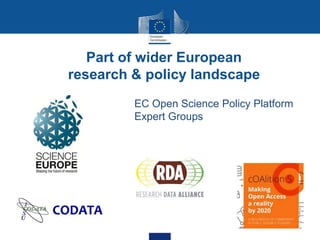
Part of wider European
research & policy landscape
EC Open Science Policy Platform
Expert Groups
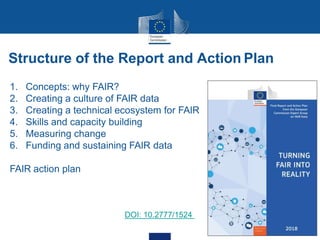
Structure of the Report and Action Plan
1. Concepts: why FAIR?
2. Creating a culture of FAIR data
3. Creating a technical ecosystem for FAIR
4. Skills and capacity building
5. Measuring change
6. Funding and sustaining FAIR data
FAIR action plan
DOI: 10.2777/1524
Key Points: To make FAIR a reality …
• Report takes a research-ecosystem approach, not a data-centric approach
• Need to address research culture, practices and technologies – not just
focus on the data and its attributes
• Research communities must define how the FAIR principles and related
concepts apply in their context. (Disciplines know their data and practices)
• Need to consider all digital outputs (data, code, metadata etc)
• Objective is to make data and other digital research outputs FAIR for
humans and machines.
• Requires: concept of FAIR digital objects, FAIR ecosystem, interoperability
frameworks for disciplines and across disciplines, FAIR services including
trusted digital repositories, skills, metrics and sustainable funding.
Concepts Implied by the Principles
Making FAIR a reality depends on additional concepts that are
implied by the principles, including:
• The timeliness of sharing
• Data appraisal and selection
• Long-term preservation and stewardship
• Assessability – to assess quality, accuracy, reliability
• Legal interoperability – licenses, automated
CONCEPTS: WHY FAIR?
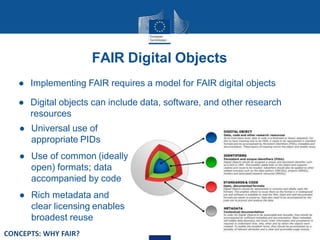
FAIR Digital Objects
12
● Implementing FAIR requires a model for FAIR digital objects
● Digital objects can include data, software, and other research
resources
● Universal use of
appropriate PIDs
● Use of common (ideally
open) formats; data
accompanied by code
● Rich metadata and
clear licensing enables
broadest reuse
CONCEPTS: WHY FAIR?
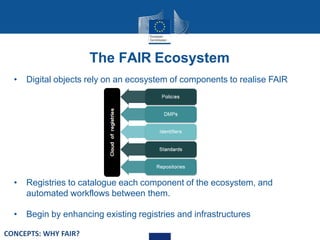
The FAIR Ecosystem
• Digital objects rely on an ecosystem of components to realise FAIR
• Registries to catalogue each component of the ecosystem, and
automated workflows between them.
• Begin by enhancing existing registries and infrastructures
CONCEPTS: WHY FAIR?
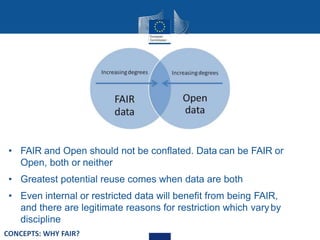
• FAIR and Open should not be conflated. Data can be FAIR or
Open, both or neither
• Greatest potential reuse comes when data are both
• Even internal or restricted data will benefit from being FAIR,
and there are legitimate reasons for restriction which varyby
discipline
CONCEPTS: WHY FAIR?
FAIR and Open
● ‘As Open as possible, as closed as necessary'
● By default, data created by publicly funded research
projects, initiatives and infrastructures should be to made
available as soon as possible.
● Policies could allow for (short) embargo periods to facilitate
the right of first use for creators
● Guidance should be provided to researchers to help find
optimal balance between sharing and privacy
CONCEPTS: WHY FAIR?
Action Plan /
What can Libraries do to help
Realise FAIR
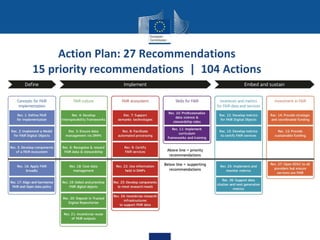
Action Plan: 27 Recommendations
15 priority recommendations | 104 Actions
Research communities: practitioners from all research fields, clustered around disciplinary
interests, data types or cross-cutting grand challenges.
Data service providers: domain repositories, research infrastructures and e-infrastructures,
institutional, community and commercial tools and services.
Data stewards: support staff from research communities and research libraries, and those
managing data repositories.
Standards bodies: formal organisations and consortia coordinating data standards and
governing procedures relevant to FAIR
Coordination fora: global and national bodies such as the Research Data Alliance, CODATA,
WDS Communities of Excellence, GO FAIR.
Policymakers: governments, international entities like OECD, research funders, institutions,
publishers and others defining data policy.
Research funders: the European Commission, national research funders, charitable
organisations and foundations, and other funders of research activity.
Institutions: universities and research performing organisations.
Publishers: not-for-profit and commercial, Open Access and paywall publishers of research
papers and data.
Stakeholders with responsibilities
Creating a Culture of FAIR Data
FAIR data: cultural change
● Some communities share and use FAIR data, some are making
progress, some are reluctant
● FAIR data availability does change the way science is done
● Disciplines know their data and have work to do to provide them FAIRly
● Interdisciplinary work should be enabled in particular to tackle the 'Grand
Challenges'
● Incentives and rewards are fundamental to enable the change
CULTURE
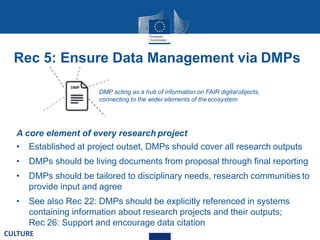
Rec 5: Ensure Data Management via DMPs
A core element of every research project
• Established at project outset, DMPs should cover all research outputs
• DMPs should be living documents from proposal through final reporting
• DMPs should be tailored to disciplinary needs, research communities to
provide input and agree
• See also Rec 22: DMPs should be explicitly referenced in systems
containing information about research projects and their outputs;
Rec 26: Support and encourage data citation
DMP acting as a hub of information on FAIR digitalobjects,
connecting to the wider elements of theecosystem
CULTURE
Rec 6: Recognise and reward FAIR Data
Stewardship
Recognise provision of FAIR data, infrastructure and services in
assessment of research contributions and career progression
• Recognition of the diversity of research contributions and include them
in CVs, researchers’ applications and activity reports, assessments
• Credit should be given to all roles supporting FAIR data and definition of
interoperability frameworks, whether for existing or new
• Evidence of past practice in support to FAIR should be included in
assessments of research contribution
• Contribution to development and operation of certified and trusted
infrastructures that support FAIR data should be recognized, rewarded
and incentivised
CULTURE
Creating a Technical Ecosystem for FAIR
• Infrastructure should build on what is already ‘in the system’, support
best practice, facilitate transition to FAIR practices, be FAIR beyond
data e.g. software, services
• Semantic technologies are essential for interoperability; machine
readability should be built into the system (e.g. DMPs)
• Data services should be encouraged and supported to obtain
certification. Use/building on existing community-endorsed (e.g.
CoreTrustSeal for data repositories)
• Rec 20: Deposit in Trusted Digital Repositories: Research data
should be made available by means of TDRs, and where possible
in those with a mission and expertise to support a specific
discipline or interdisciplinary research community
Technical Ecosystem
Skills and Capacity Building
Two cohorts of professionals to support FAIR data
• data scientists embedded in research projects
• data stewards who will ensure the curation of FAIR
data
* All researchers also need a foundational level of data
skills
* Information management skills at the core
* Hands-on data prep, guidance + defining standards, best
practices and interoperability frameworks
Skills and Capacity
Rec 10: Professionalise data science and data stewardship roles
and train researchers
• recognition and reward
• formal career pathways
• professional bodies for accreditation
• data skills training at all levels of higher education
Rec 11: Implement curriculum frameworks and training: co-ordinate
and accelerate the pedagogy for professional data roles
SKILLS
Skills and Capacity
Measuring Change
Funding and Sustaining FAIR
Metrics
• A set of metrics for FAIR Digital Objects should be
developed and implemented, starting from the basic
common core of descriptive metadata, PIDs and access.
• Certification schemes are needed to assess all
components of the ecosystem as FAIR services. Existing
frameworks like CoreTrustSeal for repository certification
should be used and adapted rather than initiating new
schemes.
METRICS
How metrics relate to incentives
• Use metrics to measure practice but beware misuse
• Generate genuine incentives – career progression for data
sharing & curation, recognise all outputs of research,
include in recruitment and project evaluation processes…
• Implement ‘next-generation’ metrics
• Automate reporting as far as possible
METRICS
Investment
• Provide strategic and coordinated funding to maintain the
components of the FAIR ecosystem
• Ensure funding is sustainable – no unfunded mandates
• Economies of scale
FUNDING/SUSTAINABILITY
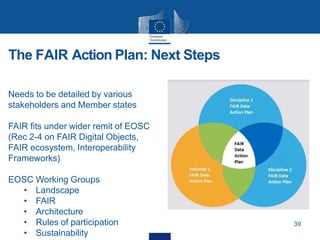
The FAIR Action Plan: Next Steps
39
Needs to be detailed by various
stakeholders and Member states
FAIR fits under wider remit of EOSC
(Rec 2-4 on FAIR Digital Objects,
FAIR ecosystem, Interoperability
Frameworks)
EOSC Working Groups
• Landscape
• FAIR
• Architecture
• Rules of participation
• Sustainability
Thank you
Contact
www.dri.ie
n.harrower@ria.ie
@natalieharrower

Turning FAIR into Reality - Role for Libraries

  • 1.
    Turning FAIR intoReality Recommendations from the European Commission FAIR Data Expert Group LIBER, 26 June 2019 Natalie Harrower Director, Digital Repository of Ireland Member, EC FAIR data expert group @natalieharrower
  • 2.
    Role of ExpertGroup • To develop recommendations on what needs to be done to turn the FAIR data principles into reality (EC, member states, international level). • Develop the FAIR Data Action Plan with a list of proposed concrete actions • Provide guidance to EOSC governance on next steps Timeline • 13 June 2018: Interim report launched at EOSC summit, Stakeholder workshop, Open consultation launched • 5 Aug 2018: Open Consultation closed (over 500 comments received) • 23 Nov 2018: Official publication at EOSC launch, Vienna @natalieharrower
  • 3.
    Part of widerEuropean research & policy landscape EC Open Science Policy Platform Expert Groups
  • 4.
    Structure of theReport and Action Plan 1. Concepts: why FAIR? 2. Creating a culture of FAIR data 3. Creating a technical ecosystem for FAIR 4. Skills and capacity building 5. Measuring change 6. Funding and sustaining FAIR data FAIR action plan DOI: 10.2777/1524
  • 5.
    Key Points: Tomake FAIR a reality … • Report takes a research-ecosystem approach, not a data-centric approach • Need to address research culture, practices and technologies – not just focus on the data and its attributes • Research communities must define how the FAIR principles and related concepts apply in their context. (Disciplines know their data and practices) • Need to consider all digital outputs (data, code, metadata etc) • Objective is to make data and other digital research outputs FAIR for humans and machines. • Requires: concept of FAIR digital objects, FAIR ecosystem, interoperability frameworks for disciplines and across disciplines, FAIR services including trusted digital repositories, skills, metrics and sustainable funding.
  • 6.
    Concepts Implied bythe Principles Making FAIR a reality depends on additional concepts that are implied by the principles, including: • The timeliness of sharing • Data appraisal and selection • Long-term preservation and stewardship • Assessability – to assess quality, accuracy, reliability • Legal interoperability – licenses, automated CONCEPTS: WHY FAIR?
  • 7.
    FAIR Digital Objects 12 ●Implementing FAIR requires a model for FAIR digital objects ● Digital objects can include data, software, and other research resources ● Universal use of appropriate PIDs ● Use of common (ideally open) formats; data accompanied by code ● Rich metadata and clear licensing enables broadest reuse CONCEPTS: WHY FAIR?
  • 8.
    The FAIR Ecosystem •Digital objects rely on an ecosystem of components to realise FAIR • Registries to catalogue each component of the ecosystem, and automated workflows between them. • Begin by enhancing existing registries and infrastructures CONCEPTS: WHY FAIR?
  • 9.
    • FAIR andOpen should not be conflated. Data can be FAIR or Open, both or neither • Greatest potential reuse comes when data are both • Even internal or restricted data will benefit from being FAIR, and there are legitimate reasons for restriction which varyby discipline CONCEPTS: WHY FAIR?
  • 10.
    FAIR and Open ●‘As Open as possible, as closed as necessary' ● By default, data created by publicly funded research projects, initiatives and infrastructures should be to made available as soon as possible. ● Policies could allow for (short) embargo periods to facilitate the right of first use for creators ● Guidance should be provided to researchers to help find optimal balance between sharing and privacy CONCEPTS: WHY FAIR?
  • 11.
    Action Plan / Whatcan Libraries do to help Realise FAIR
  • 12.
    Action Plan: 27Recommendations 15 priority recommendations | 104 Actions
  • 13.
    Research communities: practitionersfrom all research fields, clustered around disciplinary interests, data types or cross-cutting grand challenges. Data service providers: domain repositories, research infrastructures and e-infrastructures, institutional, community and commercial tools and services. Data stewards: support staff from research communities and research libraries, and those managing data repositories. Standards bodies: formal organisations and consortia coordinating data standards and governing procedures relevant to FAIR Coordination fora: global and national bodies such as the Research Data Alliance, CODATA, WDS Communities of Excellence, GO FAIR. Policymakers: governments, international entities like OECD, research funders, institutions, publishers and others defining data policy. Research funders: the European Commission, national research funders, charitable organisations and foundations, and other funders of research activity. Institutions: universities and research performing organisations. Publishers: not-for-profit and commercial, Open Access and paywall publishers of research papers and data. Stakeholders with responsibilities
  • 14.
    Creating a Cultureof FAIR Data
  • 15.
    FAIR data: culturalchange ● Some communities share and use FAIR data, some are making progress, some are reluctant ● FAIR data availability does change the way science is done ● Disciplines know their data and have work to do to provide them FAIRly ● Interdisciplinary work should be enabled in particular to tackle the 'Grand Challenges' ● Incentives and rewards are fundamental to enable the change CULTURE
  • 16.
    Rec 5: EnsureData Management via DMPs A core element of every research project • Established at project outset, DMPs should cover all research outputs • DMPs should be living documents from proposal through final reporting • DMPs should be tailored to disciplinary needs, research communities to provide input and agree • See also Rec 22: DMPs should be explicitly referenced in systems containing information about research projects and their outputs; Rec 26: Support and encourage data citation DMP acting as a hub of information on FAIR digitalobjects, connecting to the wider elements of theecosystem CULTURE
  • 17.
    Rec 6: Recogniseand reward FAIR Data Stewardship Recognise provision of FAIR data, infrastructure and services in assessment of research contributions and career progression • Recognition of the diversity of research contributions and include them in CVs, researchers’ applications and activity reports, assessments • Credit should be given to all roles supporting FAIR data and definition of interoperability frameworks, whether for existing or new • Evidence of past practice in support to FAIR should be included in assessments of research contribution • Contribution to development and operation of certified and trusted infrastructures that support FAIR data should be recognized, rewarded and incentivised CULTURE
  • 18.
    Creating a TechnicalEcosystem for FAIR
  • 19.
    • Infrastructure shouldbuild on what is already ‘in the system’, support best practice, facilitate transition to FAIR practices, be FAIR beyond data e.g. software, services • Semantic technologies are essential for interoperability; machine readability should be built into the system (e.g. DMPs) • Data services should be encouraged and supported to obtain certification. Use/building on existing community-endorsed (e.g. CoreTrustSeal for data repositories) • Rec 20: Deposit in Trusted Digital Repositories: Research data should be made available by means of TDRs, and where possible in those with a mission and expertise to support a specific discipline or interdisciplinary research community Technical Ecosystem
  • 20.
  • 21.
    Two cohorts ofprofessionals to support FAIR data • data scientists embedded in research projects • data stewards who will ensure the curation of FAIR data * All researchers also need a foundational level of data skills * Information management skills at the core * Hands-on data prep, guidance + defining standards, best practices and interoperability frameworks Skills and Capacity
  • 22.
    Rec 10: Professionalisedata science and data stewardship roles and train researchers • recognition and reward • formal career pathways • professional bodies for accreditation • data skills training at all levels of higher education Rec 11: Implement curriculum frameworks and training: co-ordinate and accelerate the pedagogy for professional data roles SKILLS Skills and Capacity
  • 23.
  • 24.
    Metrics • A setof metrics for FAIR Digital Objects should be developed and implemented, starting from the basic common core of descriptive metadata, PIDs and access. • Certification schemes are needed to assess all components of the ecosystem as FAIR services. Existing frameworks like CoreTrustSeal for repository certification should be used and adapted rather than initiating new schemes. METRICS
  • 25.
    How metrics relateto incentives • Use metrics to measure practice but beware misuse • Generate genuine incentives – career progression for data sharing & curation, recognise all outputs of research, include in recruitment and project evaluation processes… • Implement ‘next-generation’ metrics • Automate reporting as far as possible METRICS
  • 26.
    Investment • Provide strategicand coordinated funding to maintain the components of the FAIR ecosystem • Ensure funding is sustainable – no unfunded mandates • Economies of scale FUNDING/SUSTAINABILITY
  • 27.
    The FAIR ActionPlan: Next Steps 39 Needs to be detailed by various stakeholders and Member states FAIR fits under wider remit of EOSC (Rec 2-4 on FAIR Digital Objects, FAIR ecosystem, Interoperability Frameworks) EOSC Working Groups • Landscape • FAIR • Architecture • Rules of participation • Sustainability
  • 28.

Editor's Notes

  • #10 Concepts of FAIR and Open should not be conflated. Data can be FAIR or Open, both or neither Even internal or restricted data will benefit from being FAIR, and there are legitimate reasons for restriction which vary by discipline ‘As Open as possible, as closed as necessary' By default, data created by publicly funded research projects, initiatives and infrastructures should be to made available as soon as possible. Policies could allow for (short) embargo periods to facilitate the right of first use for creators