Open Data, FAIR Data, Research
Data Management?
Some clarifications
Myriam Mertens | Ghent University Library
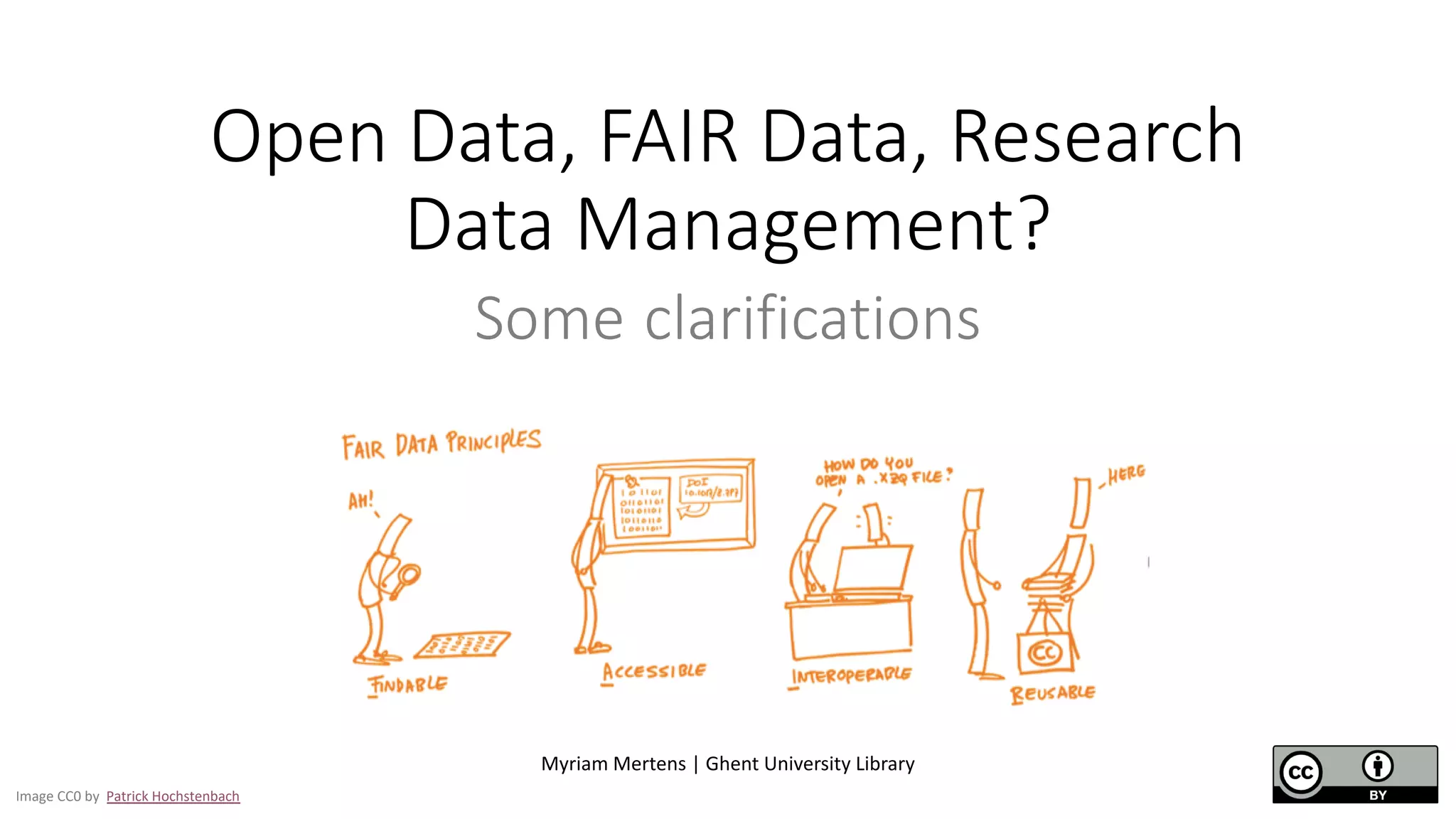
Image CC0 by Patrick Hochstenbach
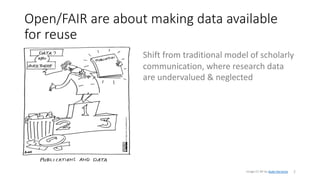
Open/FAIR are about making data available
for reuse
2
Shift from traditional model of scholarly
communication, where research data
are undervalued & neglected
Image CC-BY by Auke Herrema
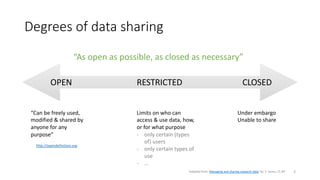
Degrees of data sharing
3
OPEN RESTRICTED CLOSED
“Can be freely used,
modified & shared by
anyone for any
purpose”
http://opendefinition.org
Limits on who can
access & use data, how,
or for what purpose
- only certain (types
of) users
- only certain types of
use
- …
Under embargo
Unable to share
“As open as possible, as closed as necessary”
Adapted from ‘Managing and sharing research data’ by S. Jones, CC-BY
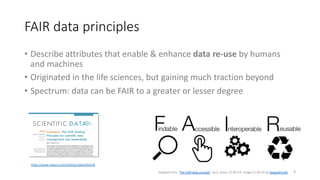
FAIR data principles
• Describe attributes that enable & enhance data re-use by humans
and machines
• Originated in the life sciences, but gaining much traction beyond
• Spectrum: data can be FAIR to a greater or lesser degree
4
https://www.nature.com/articles/sdata201618
Adapted from ‘The FAIR data concept’, by S. Jones, CC-BY 4.0. Image CC-BY-SA by SangyaPundir
5
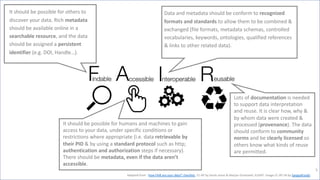
It should be possible for others to
discover your data. Rich metadata
should be available online in a
searchable resource, and the data
should be assigned a persistent
identifier (e.g. DOI, Handle…).
It should be possible for humans and machines to gain
access to your data, under specific conditions or
restrictions where appropriate (i.e. data retrievable by
their PID & by using a standard protocol such as http;
authentication and authorization steps if necessary).
There should be metadata, even if the data aren’t
accessible.
Data and metadata should be conform to recognized
formats and standards to allow them to be combined &
exchanged (file formats, metadata schemas, controlled
vocabularies, keywords, ontologies, qualified references
& links to other related data).
Lots of documentation is needed
to support data interpretation
and reuse. It is clear how, why &
by whom data were created &
processed (provenance). The data
should conform to community
norms and be clearly licensed so
others know what kinds of reuse
are permitted.
Adapted from ‘How FAIR are your data?’ checklist, CC-BY by Sarah Jones & Marjan Grootveld, EUDAT. Image CC-BY-SA by SangyaPundir
FAIR vs. Open?
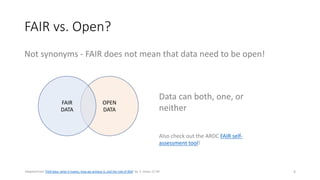
Not synonyms - FAIR does not mean that data need to be open!
6
OPEN
DATA
FAIR
DATA
Data can both, one, or
neither
Also check out the ARDC FAIR self-
assessment tool!
Adapted from ‘FAIR data: what it means, how we achieve it, and the role of RDA’ by S. Jones, CC-BY
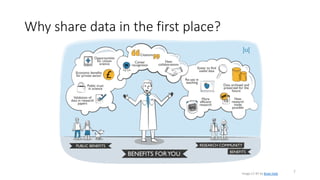
Why share data in the first place?
7Image CC-BY by Brian Hole
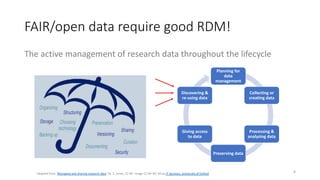
FAIR/open data require good RDM!
The active management of research data throughout the lifecycle
8
Planning for
data
management
Collecting or
creating data
Processing &
analyzing data
Preserving data
Giving access
to data
Discovering &
re-using data
Adapted from ‘Managing and sharing research data’ by S. Jones, CC-BY. Image CC-BY-NC-SA by IT Services, University of Oxford
Thank you for listening!
9Image CC-BY by digitalbevaring.dk

20181024 oa week_rdm_myriam_mertens

  • 1.
    Open Data, FAIRData, Research Data Management? Some clarifications Myriam Mertens | Ghent University Library Image CC0 by Patrick Hochstenbach
  • 2.
    Open/FAIR are aboutmaking data available for reuse 2 Shift from traditional model of scholarly communication, where research data are undervalued & neglected Image CC-BY by Auke Herrema
  • 3.
    Degrees of datasharing 3 OPEN RESTRICTED CLOSED “Can be freely used, modified & shared by anyone for any purpose” http://opendefinition.org Limits on who can access & use data, how, or for what purpose - only certain (types of) users - only certain types of use - … Under embargo Unable to share “As open as possible, as closed as necessary” Adapted from ‘Managing and sharing research data’ by S. Jones, CC-BY
  • 4.
    FAIR data principles •Describe attributes that enable & enhance data re-use by humans and machines • Originated in the life sciences, but gaining much traction beyond • Spectrum: data can be FAIR to a greater or lesser degree 4 https://www.nature.com/articles/sdata201618 Adapted from ‘The FAIR data concept’, by S. Jones, CC-BY 4.0. Image CC-BY-SA by SangyaPundir
  • 5.
    5 It should bepossible for others to discover your data. Rich metadata should be available online in a searchable resource, and the data should be assigned a persistent identifier (e.g. DOI, Handle…). It should be possible for humans and machines to gain access to your data, under specific conditions or restrictions where appropriate (i.e. data retrievable by their PID & by using a standard protocol such as http; authentication and authorization steps if necessary). There should be metadata, even if the data aren’t accessible. Data and metadata should be conform to recognized formats and standards to allow them to be combined & exchanged (file formats, metadata schemas, controlled vocabularies, keywords, ontologies, qualified references & links to other related data). Lots of documentation is needed to support data interpretation and reuse. It is clear how, why & by whom data were created & processed (provenance). The data should conform to community norms and be clearly licensed so others know what kinds of reuse are permitted. Adapted from ‘How FAIR are your data?’ checklist, CC-BY by Sarah Jones & Marjan Grootveld, EUDAT. Image CC-BY-SA by SangyaPundir
  • 6.
    FAIR vs. Open? Notsynonyms - FAIR does not mean that data need to be open! 6 OPEN DATA FAIR DATA Data can both, one, or neither Also check out the ARDC FAIR self- assessment tool! Adapted from ‘FAIR data: what it means, how we achieve it, and the role of RDA’ by S. Jones, CC-BY
  • 7.
    Why share datain the first place? 7Image CC-BY by Brian Hole
  • 8.
    FAIR/open data requiregood RDM! The active management of research data throughout the lifecycle 8 Planning for data management Collecting or creating data Processing & analyzing data Preserving data Giving access to data Discovering & re-using data Adapted from ‘Managing and sharing research data’ by S. Jones, CC-BY. Image CC-BY-NC-SA by IT Services, University of Oxford
  • 9.
    Thank you forlistening! 9Image CC-BY by digitalbevaring.dk