www.fairplus-project.eu
Carole Goble
The University of Manchester, UK
FAIRplus WP2
ELIXIR-UK Head of Node & Interoperability Platform
FAIRDOM Association e.V.
carole.goble@manchester.ac.uk
FAIRplus Innovation and SME Forum,
29 January 2020, Hinxton, UK
FAIR History and
the Future
1
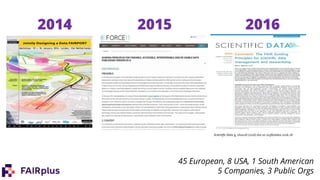
Scientific Data 3, 160018 (2016) doi:10.1038/sdata.2016.18
2014 2015 2016
45 European, 8 USA, 1 South American
5 Companies, 3 Public Orgs
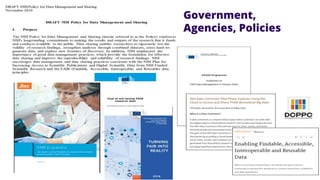
Government,
Agencies, Policies
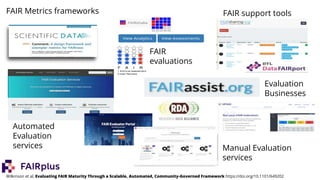
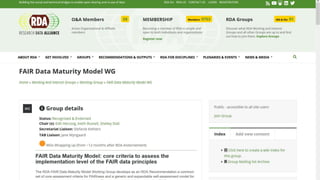
FAIR Metrics frameworks
Automated
Evaluation
services Manual Evaluation
services
Wilkinson et al, Evaluating FAIR Maturity Through a Scalable, Automated, Community-Governed Framework https://doi.org/10.1101/649202
Evaluation
Businesses
FAIR
evaluations
FAIR support tools
6
A Rallying
Call
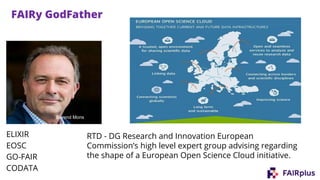
ELIXIR
EOSC
GO-FAIR
CODATA
Barend Mons
RTD - DG Research and Innovation European
Commission’s high level expert group advising regarding
the shape of a European Open Science Cloud initiative.
FAIRy GodFather
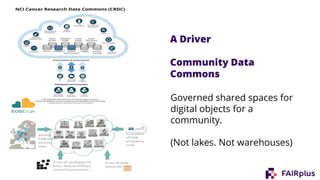
A Driver
Community Data
Commons
Governed shared spaces for
digital objects for a
community.
(Not lakes. Not warehouses)
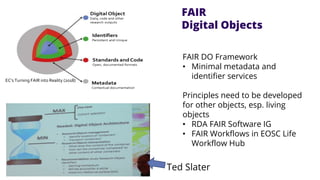
FAIR
Digital Objects
FAIR DO Framework
• Minimal metadata and
identifier services
Principles need to be developed
for other objects, esp. living
objects
• RDA FAIR Software IG
• FAIR Workflows in EOSC Life
Workflow Hub
EC’s Turning FAIR into Reality (2018)
Ted Slater
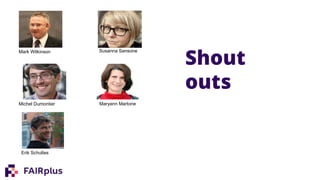
Shout
outs
Mark Wilkinson
Michel Dumontier
Susanna Sansone
Maryann Martone
Erik Schultes
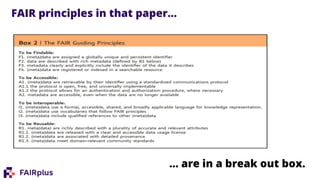
FAIR principles in that paper…
… are in a break out box.
It’s not Gospel
Monty Python’s Life of Brian, RIP Terry Jones
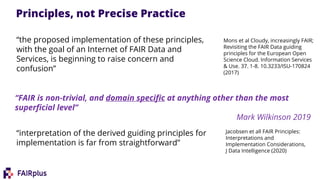
Jacobsen et all FAIR Principles:
Interpretations and
Implementation Considerations,
J Data Intelligence (2020)
“FAIR is non-trivial, and domain specific at anything other than the most
superficial level”
Mark Wilkinson 2019
Mons et al Cloudy, increasingly FAIR;
Revisiting the FAIR Data guiding
principles for the European Open
Science Cloud. Information Services
& Use. 37. 1-8. 10.3233/ISU-170824
(2017)
Principles, not Precise Practice
“the proposed implementation of these principles,
with the goal of an Internet of FAIR Data and
Services, is beginning to raise concern and
confusion”
“interpretation of the derived guiding principles for
implementation is far from straightforward”
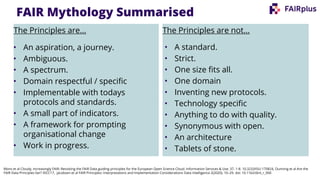
The Principles are…
FAIR Mythology Summarised
• An aspiration, a journey.
• Ambiguous.
• A spectrum.
• Domain respectful / specific
• Implementable with todays
protocols and standards.
• A small part of indicators.
• A framework for prompting
organisational change
• Work in progress.
The Principles are not…
• A standard.
• Strict.
• One size fits all.
• One domain
• Inventing new protocols.
• Technology specific
• Anything to do with quality.
• Synonymous with open.
• An architecture
• Tablets of stone.
Mons et al Cloudy, increasingly FAIR; Revisiting the FAIR Data guiding principles for the European Open Science Cloud. Information Services & Use. 37. 1-8. 10.3233/ISU-170824, Dunning et al Are the
FAIR Data Principles fair? IDCC17, Jacobsen et al FAIR Principles: Interpretations and Implementation Considerations Data Intelligence 2(2020), 10–29. doi: 10.1162/dint_r_000
The
Second
Wave
Special Issue "FAIR Data, FAIR Services,
and the European Open Science Cloud"
Special Issue on FAIR Data, Systems and Analysis
The why and what of FAIR has things to say about FAIR
today and the future.
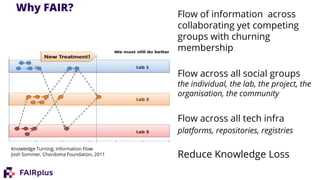
Why FAIR?
Knowledge Turning, Information Flow
Josh Sommer, Chordoma Foundation, 2011
Flow of information across
collaborating yet competing
groups with churning
membership
Flow across all social groups
the individual, the lab, the project, the
organisation, the community
Flow across all tech infra
platforms, repositories, registries
Reduce Knowledge Loss
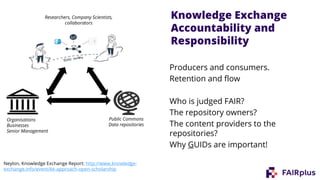
Knowledge Exchange
Accountability and
Responsibility
Producers and consumers.
Retention and flow
Who is judged FAIR?
The repository owners?
The content providers to the
repositories?
Why GUIDs are important!
Researchers, Company Scientists,
collaborators
Neylon, Knowledge Exchange Report: http://www.knowledge-
exchange.info/event/ke-approach-open-scholarship
Organisations
Businesses
Senior Management
Public Commons
Data repositories
Neylon, Knowledge Exchange Report: http://www.knowledge-
exchange.info/event/ke-approach-open-scholarship
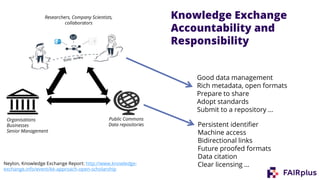
Good data management
Rich metadata, open formats
Prepare to share
Adopt standards
Submit to a repository …
Persistent identifier
Machine access
Bidirectional links
Future proofed formats
Data citation
Clear licensing …
Knowledge Exchange
Accountability and
Responsibility
Researchers, Company Scientists,
collaborators
Organisations
Businesses
Senior Management
Public Commons
Data repositories
Neylon, Knowledge Exchange Report: http://www.knowledge-
exchange.info/event/ke-approach-open-scholarship
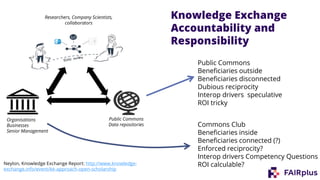
Public Commons
Beneficiaries outside
Beneficiaries disconnected
Dubious reciprocity
Interop drivers speculative
ROI tricky
Commons Club
Beneficiaries inside
Beneficiaries connected (?)
Enforced reciprocity?
Interop drivers Competency Questions
ROI calculable?
Knowledge Exchange
Accountability and
Responsibility
Researchers, Company Scientists,
collaborators
Organisations
Businesses
Senior Management
Public Commons
Data repositories
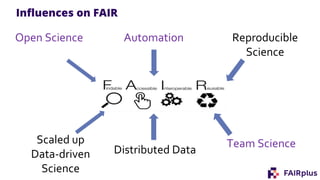
Open Science Automation Reproducible
Science
Scaled up
Data-driven
Science
Team Science
Distributed Data
Influences on FAIR
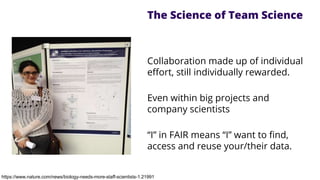
The Science of Team Science
Collaboration made up of individual
effort, still individually rewarded.
Even within big projects and
company scientists
“I” in FAIR means “I” want to find,
access and reuse your/their data.
https://www.nature.com/news/biology-needs-more-staff-scientists-1.21991
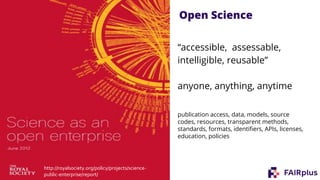
Open Science
“accessible, assessable,
intelligible, reusable”
anyone, anything, anytime
publication access, data, models, source
codes, resources, transparent methods,
standards, formats, identifiers, APIs, licenses,
education, policies
http://royalsociety.org/policy/projects/science-
public-enterprise/report/
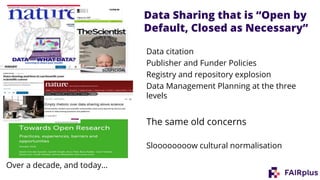
Data citation
Publisher and Funder Policies
Registry and repository explosion
Data Management Planning at the three
levels
The same old concerns
Sloooooooow cultural normalisation
Over a decade, and today…
Data Sharing that is “Open by
Default, Closed as Necessary”
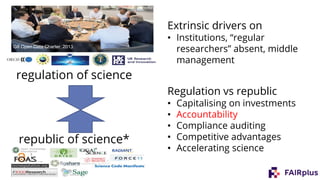
republic of science*
regulation of science
G8 Open Data Charter, 2013
Extrinsic drivers on
• Institutions, “regular
researchers” absent, middle
management
Regulation vs republic
• Capitalising on investments
• Accountability
• Compliance auditing
• Competitive advantages
• Accelerating science
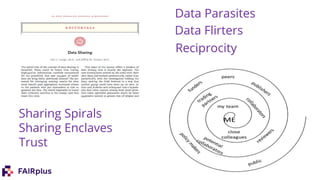
Data Parasites
Data Flirters
Sharing Spirals
Sharing Enclaves
Trust
Reciprocity
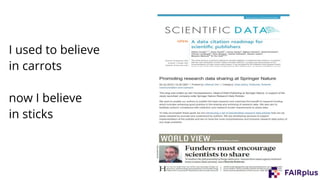
I used to believe
in carrots
now I believe
in sticks
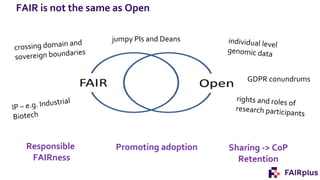
FAIR is not the same as Open
GDPR conundrums
jumpy PIs and Deans
Responsible
FAIRness
Promoting adoption Sharing -> CoP
Retention
Automation
for data at scale
Distributed processing
Data mining, Search
Workflows, AI
Machine Processable
Metadata mark-up & self
description
Semantic Web ->
Linked Data ->
Knowledge Graphs.
formats
APIs
persistent
identifiers
reporting checklists
mark-up terms
(aka ontologies)
[Finn]
[Sansone]
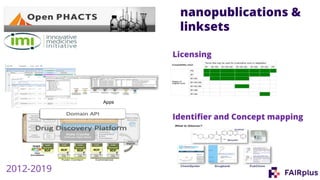
nanopublications &
linksets
2012-2019
Licensing
Identifier and Concept mapping
Apps
FAIR
https://www.natureindex.com/news-blog/what-scientists-need-to-know-about-fair-data
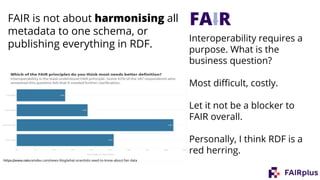
FAIR is not about harmonising all
metadata to one schema, or
publishing everything in RDF.
Interoperability requires a
purpose. What is the
business question?
Most difficult, costly.
Let it not be a blocker to
FAIR overall.
Personally, I think RDF is a
red herring.
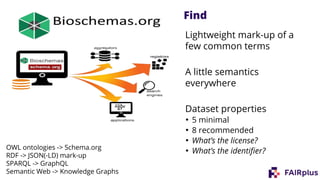
Find
Lightweight mark-up of a
few common terms
A little semantics
everywhere
Dataset properties
• 5 minimal
• 8 recommended
• What’s the license?
• What’s the identifier?OWL ontologies -> Schema.org
RDF -> JSON(-LD) mark-up
SPARQL -> GraphQL
Semantic Web -> Knowledge Graphs
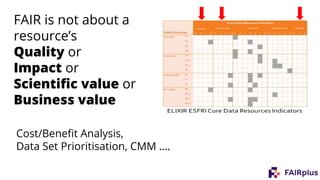
FAIR is not about a
resource’s
Quality or
Impact or
Scientific value or
Business value
Cost/Benefit Analysis,
Data Set Prioritisation, CMM ….
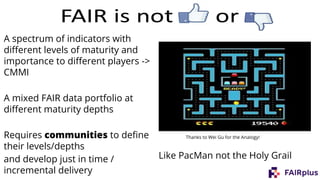
Thanks to Wei Gu for the Analogy!
Like PacMan not the Holy Grail
A spectrum of indicators with
different levels of maturity and
importance to different players ->
CMMI
A mixed FAIR data portfolio at
different maturity depths
Requires communities to define
their levels/depths
and develop just in time /
incremental delivery
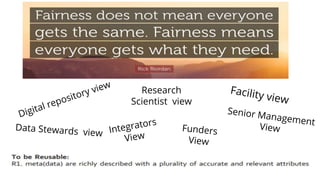
Research
Scientist view
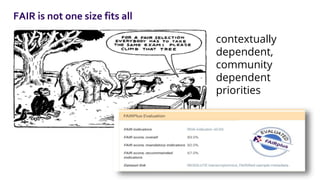
FAIR is not one size fits all
contextually
dependent,
community
dependent
priorities
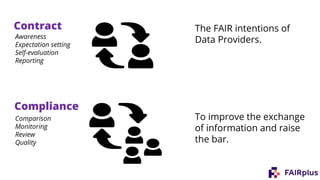
The FAIR intentions of
Data Providers.
To improve the exchange
of information and raise
the bar.
Contract
Compliance
Awareness
Expectation setting
Self-evaluation
Reporting
Comparison
Monitoring
Review
Quality
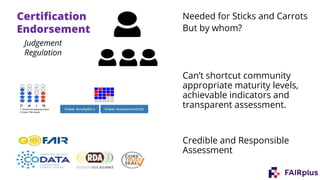
Certification
Endorsement
Judgement
Regulation
Needed for Sticks and Carrots
But by whom?
Can’t shortcut community
appropriate maturity levels,
achievable indicators and
transparent assessment.
Credible and Responsible
Assessment
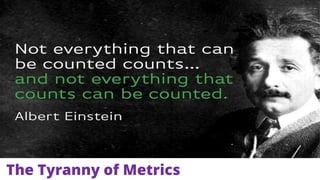
The Tyranny of Metrics
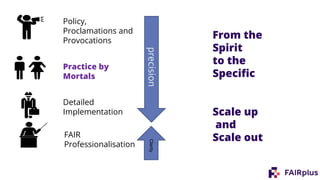
From the
Spirit
to the
Specific
Scale up
and
Scale out
Policy,
Proclamations and
Provocations
Detailed
Implementation
Practice by
Mortals
precision
FAIR
Professionalisation Clarity
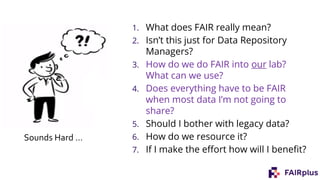
1. What does FAIR really mean?
2. Isn’t this just for Data Repository
Managers?
3. How do we do FAIR into our lab?
What can we use?
4. Does everything have to be FAIR
when most data I’m not going to
share?
5. Should I bother with legacy data?
6. How do we resource it?
7. If I make the effort how will I benefit?
Sounds Hard …
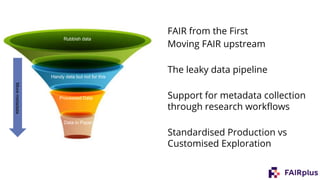
FAIR from the First
Moving FAIR upstream
The leaky data pipeline
Support for metadata collection
through research workflows
Standardised Production vs
Customised Exploration
Rubbish data
Handy data but not for this
Processed Data
Data in Paper
Moremetadata
Challenges facing FAIR mortals
• Granularity levels
• Overthinking, analysis paralysis
• Disconnect of providers from
consumers
• Examples to copy
• Assembling a FAIR mixed skills
football team
• Process + People
Execution
Organisation
MetricsCulture
Process
[Daron Green]
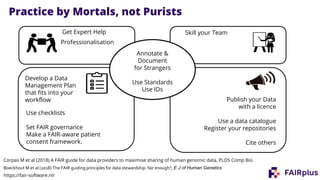
Practice by Mortals, not Purists
Get Expert Help Skill your Team
Publish your Data
with a licence
Use a data catalogue
Register your repositories
Cite others
Use checklists
Set FAIR governance
Make a FAIR-aware patient
consent framework.
Annotate &
Document
for Strangers
Use Standards
Use IDs
https://fair-software.nl/
Develop a Data
Management Plan
that fits into your
workflow
Professionalisation
Corpas M et al (2018) A FAIR guide for data providers to maximise sharing of human genomic data, PLOS Comp Bio
Boeckhout M et al (2018) The FAIR guiding principles for data stewardship: fair enough?, E J of Human Genetics
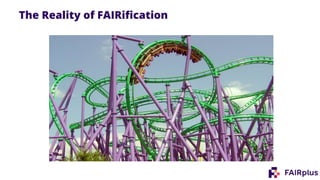
The Reality of FAIRification
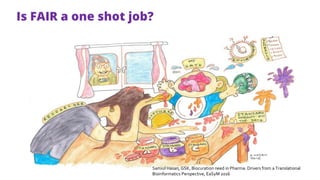
Samiul Hasan, GSK, Biocuration need in Pharma: Drivers from a Translational
Bioinformatics Perspective, EaSyM 2016
Is FAIR a one shot job?
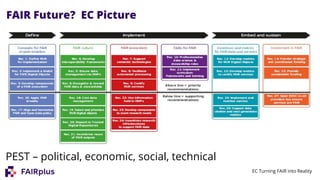
FAIR Future? EC Picture
PEST – political, economic, social, technical
EC Turning FAIR into Reality
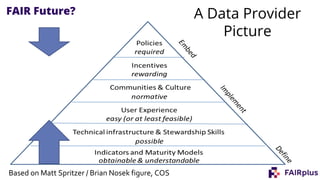
FAIR Future?
Based on Matt Spritzer / Brian Nosek figure, COS
A Data Provider
Picture
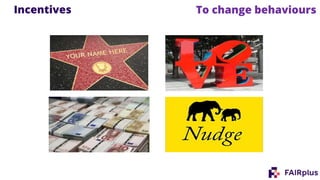
Incentives To change behaviours
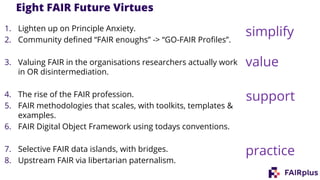
Eight FAIR Future Virtues
1. Lighten up on Principle Anxiety.
2. Community defined “FAIR enoughs” -> “GO-FAIR Profiles”.
3. Valuing FAIR in the organisations researchers actually work
in OR disintermediation.
4. The rise of the FAIR profession.
5. FAIR methodologies that scales, with toolkits, templates &
examples.
6. FAIR Digital Object Framework using todays conventions.
7. Selective FAIR data islands, with bridges.
8. Upstream FAIR via libertarian paternalism.
simplify
value
support
practice
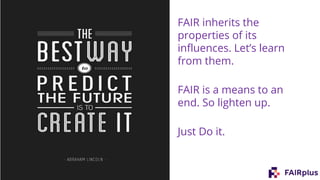
FAIR inherits the
properties of its
influences. Let’s learn
from them.
FAIR is a means to an
end. So lighten up.
Just Do it.
www.fairplus-project.eu
This project has received funding from the Innovative Medicines Initiative 2 Joint Undertaking under
grant agreement No. 802750. This Joint Undertaking receives support from the European Union’s
Horizon 2020 research and innovation and EFPIA companies.
www.imi.europa.eu
Thank you!
60
Wei Gu
Oya Deniz Beyan
Ibrahim Emam
Nick Juty
Mark Wilkinson
Susanna Sansone
Barend Mons
Ian Harrow
Helen Parkinson
Kristian Garza
Get in touch
• Website: www.fairplus-project.eu
• Twitter: @FAIRplus_eu
• LinkedIn: www.linkedin.com/company/fairplus
• Newsletter:
• Sign-up: http://eepurl.com/ghuHeT
• Archive: http://bit.ly/2UG6mZI
• Email:FAIRplus-PM@elixir-europe.org

FAIR History and the Future

  • 1.
    www.fairplus-project.eu Carole Goble The Universityof Manchester, UK FAIRplus WP2 ELIXIR-UK Head of Node & Interoperability Platform FAIRDOM Association e.V. carole.goble@manchester.ac.uk FAIRplus Innovation and SME Forum, 29 January 2020, Hinxton, UK FAIR History and the Future 1
  • 2.
    Scientific Data 3,160018 (2016) doi:10.1038/sdata.2016.18 2014 2015 2016 45 European, 8 USA, 1 South American 5 Companies, 3 Public Orgs
  • 3.
  • 5.
    FAIR Metrics frameworks Automated Evaluation servicesManual Evaluation services Wilkinson et al, Evaluating FAIR Maturity Through a Scalable, Automated, Community-Governed Framework https://doi.org/10.1101/649202 Evaluation Businesses FAIR evaluations FAIR support tools
  • 6.
  • 7.
  • 8.
    ELIXIR EOSC GO-FAIR CODATA Barend Mons RTD -DG Research and Innovation European Commission’s high level expert group advising regarding the shape of a European Open Science Cloud initiative. FAIRy GodFather
  • 9.
    A Driver Community Data Commons Governedshared spaces for digital objects for a community. (Not lakes. Not warehouses)
  • 10.
    FAIR Digital Objects FAIR DOFramework • Minimal metadata and identifier services Principles need to be developed for other objects, esp. living objects • RDA FAIR Software IG • FAIR Workflows in EOSC Life Workflow Hub EC’s Turning FAIR into Reality (2018) Ted Slater
  • 11.
    Shout outs Mark Wilkinson Michel Dumontier SusannaSansone Maryann Martone Erik Schultes
  • 12.
    FAIR principles inthat paper… … are in a break out box.
  • 13.
    It’s not Gospel MontyPython’s Life of Brian, RIP Terry Jones
  • 14.
    Jacobsen et allFAIR Principles: Interpretations and Implementation Considerations, J Data Intelligence (2020) “FAIR is non-trivial, and domain specific at anything other than the most superficial level” Mark Wilkinson 2019 Mons et al Cloudy, increasingly FAIR; Revisiting the FAIR Data guiding principles for the European Open Science Cloud. Information Services & Use. 37. 1-8. 10.3233/ISU-170824 (2017) Principles, not Precise Practice “the proposed implementation of these principles, with the goal of an Internet of FAIR Data and Services, is beginning to raise concern and confusion” “interpretation of the derived guiding principles for implementation is far from straightforward”
  • 15.
    The Principles are… FAIRMythology Summarised • An aspiration, a journey. • Ambiguous. • A spectrum. • Domain respectful / specific • Implementable with todays protocols and standards. • A small part of indicators. • A framework for prompting organisational change • Work in progress. The Principles are not… • A standard. • Strict. • One size fits all. • One domain • Inventing new protocols. • Technology specific • Anything to do with quality. • Synonymous with open. • An architecture • Tablets of stone. Mons et al Cloudy, increasingly FAIR; Revisiting the FAIR Data guiding principles for the European Open Science Cloud. Information Services & Use. 37. 1-8. 10.3233/ISU-170824, Dunning et al Are the FAIR Data Principles fair? IDCC17, Jacobsen et al FAIR Principles: Interpretations and Implementation Considerations Data Intelligence 2(2020), 10–29. doi: 10.1162/dint_r_000
  • 16.
    The Second Wave Special Issue "FAIRData, FAIR Services, and the European Open Science Cloud" Special Issue on FAIR Data, Systems and Analysis
  • 17.
    The why andwhat of FAIR has things to say about FAIR today and the future.
  • 18.
    Why FAIR? Knowledge Turning,Information Flow Josh Sommer, Chordoma Foundation, 2011 Flow of information across collaborating yet competing groups with churning membership Flow across all social groups the individual, the lab, the project, the organisation, the community Flow across all tech infra platforms, repositories, registries Reduce Knowledge Loss
  • 19.
    Knowledge Exchange Accountability and Responsibility Producersand consumers. Retention and flow Who is judged FAIR? The repository owners? The content providers to the repositories? Why GUIDs are important! Researchers, Company Scientists, collaborators Neylon, Knowledge Exchange Report: http://www.knowledge- exchange.info/event/ke-approach-open-scholarship Organisations Businesses Senior Management Public Commons Data repositories
  • 20.
    Neylon, Knowledge ExchangeReport: http://www.knowledge- exchange.info/event/ke-approach-open-scholarship Good data management Rich metadata, open formats Prepare to share Adopt standards Submit to a repository … Persistent identifier Machine access Bidirectional links Future proofed formats Data citation Clear licensing … Knowledge Exchange Accountability and Responsibility Researchers, Company Scientists, collaborators Organisations Businesses Senior Management Public Commons Data repositories
  • 21.
    Neylon, Knowledge ExchangeReport: http://www.knowledge- exchange.info/event/ke-approach-open-scholarship Public Commons Beneficiaries outside Beneficiaries disconnected Dubious reciprocity Interop drivers speculative ROI tricky Commons Club Beneficiaries inside Beneficiaries connected (?) Enforced reciprocity? Interop drivers Competency Questions ROI calculable? Knowledge Exchange Accountability and Responsibility Researchers, Company Scientists, collaborators Organisations Businesses Senior Management Public Commons Data repositories
  • 22.
    Open Science AutomationReproducible Science Scaled up Data-driven Science Team Science Distributed Data Influences on FAIR
  • 23.
    The Science ofTeam Science Collaboration made up of individual effort, still individually rewarded. Even within big projects and company scientists “I” in FAIR means “I” want to find, access and reuse your/their data. https://www.nature.com/news/biology-needs-more-staff-scientists-1.21991
  • 24.
    Open Science “accessible, assessable, intelligible,reusable” anyone, anything, anytime publication access, data, models, source codes, resources, transparent methods, standards, formats, identifiers, APIs, licenses, education, policies http://royalsociety.org/policy/projects/science- public-enterprise/report/
  • 25.
    Data citation Publisher andFunder Policies Registry and repository explosion Data Management Planning at the three levels The same old concerns Sloooooooow cultural normalisation Over a decade, and today… Data Sharing that is “Open by Default, Closed as Necessary”
  • 26.
    republic of science* regulationof science G8 Open Data Charter, 2013 Extrinsic drivers on • Institutions, “regular researchers” absent, middle management Regulation vs republic • Capitalising on investments • Accountability • Compliance auditing • Competitive advantages • Accelerating science
  • 27.
    Data Parasites Data Flirters SharingSpirals Sharing Enclaves Trust Reciprocity
  • 29.
    I used tobelieve in carrots now I believe in sticks
  • 30.
    FAIR is notthe same as Open GDPR conundrums jumpy PIs and Deans Responsible FAIRness Promoting adoption Sharing -> CoP Retention
  • 31.
    Automation for data atscale Distributed processing Data mining, Search Workflows, AI Machine Processable Metadata mark-up & self description Semantic Web -> Linked Data -> Knowledge Graphs. formats APIs persistent identifiers reporting checklists mark-up terms (aka ontologies) [Finn] [Sansone]
  • 32.
  • 33.
    FAIR https://www.natureindex.com/news-blog/what-scientists-need-to-know-about-fair-data FAIR is notabout harmonising all metadata to one schema, or publishing everything in RDF. Interoperability requires a purpose. What is the business question? Most difficult, costly. Let it not be a blocker to FAIR overall. Personally, I think RDF is a red herring.
  • 34.
    Find Lightweight mark-up ofa few common terms A little semantics everywhere Dataset properties • 5 minimal • 8 recommended • What’s the license? • What’s the identifier?OWL ontologies -> Schema.org RDF -> JSON(-LD) mark-up SPARQL -> GraphQL Semantic Web -> Knowledge Graphs
  • 35.
    FAIR is notabout a resource’s Quality or Impact or Scientific value or Business value Cost/Benefit Analysis, Data Set Prioritisation, CMM ….
  • 36.
    Thanks to WeiGu for the Analogy! Like PacMan not the Holy Grail A spectrum of indicators with different levels of maturity and importance to different players -> CMMI A mixed FAIR data portfolio at different maturity depths Requires communities to define their levels/depths and develop just in time / incremental delivery
  • 37.
  • 38.
    FAIR is notone size fits all contextually dependent, community dependent priorities
  • 39.
    The FAIR intentionsof Data Providers. To improve the exchange of information and raise the bar. Contract Compliance Awareness Expectation setting Self-evaluation Reporting Comparison Monitoring Review Quality
  • 40.
    Certification Endorsement Judgement Regulation Needed for Sticksand Carrots But by whom? Can’t shortcut community appropriate maturity levels, achievable indicators and transparent assessment. Credible and Responsible Assessment
  • 41.
  • 42.
    From the Spirit to the Specific Scaleup and Scale out Policy, Proclamations and Provocations Detailed Implementation Practice by Mortals precision FAIR Professionalisation Clarity
  • 43.
    1. What doesFAIR really mean? 2. Isn’t this just for Data Repository Managers? 3. How do we do FAIR into our lab? What can we use? 4. Does everything have to be FAIR when most data I’m not going to share? 5. Should I bother with legacy data? 6. How do we resource it? 7. If I make the effort how will I benefit? Sounds Hard …
  • 44.
    FAIR from theFirst Moving FAIR upstream The leaky data pipeline Support for metadata collection through research workflows Standardised Production vs Customised Exploration Rubbish data Handy data but not for this Processed Data Data in Paper Moremetadata
  • 45.
    Challenges facing FAIRmortals • Granularity levels • Overthinking, analysis paralysis • Disconnect of providers from consumers • Examples to copy • Assembling a FAIR mixed skills football team • Process + People Execution Organisation MetricsCulture Process [Daron Green]
  • 46.
    Practice by Mortals,not Purists Get Expert Help Skill your Team Publish your Data with a licence Use a data catalogue Register your repositories Cite others Use checklists Set FAIR governance Make a FAIR-aware patient consent framework. Annotate & Document for Strangers Use Standards Use IDs https://fair-software.nl/ Develop a Data Management Plan that fits into your workflow Professionalisation Corpas M et al (2018) A FAIR guide for data providers to maximise sharing of human genomic data, PLOS Comp Bio Boeckhout M et al (2018) The FAIR guiding principles for data stewardship: fair enough?, E J of Human Genetics
  • 47.
    The Reality ofFAIRification
  • 48.
    Samiul Hasan, GSK,Biocuration need in Pharma: Drivers from a Translational Bioinformatics Perspective, EaSyM 2016 Is FAIR a one shot job?
  • 49.
    FAIR Future? ECPicture PEST – political, economic, social, technical EC Turning FAIR into Reality
  • 50.
    FAIR Future? Based onMatt Spritzer / Brian Nosek figure, COS A Data Provider Picture
  • 51.
  • 53.
    Eight FAIR FutureVirtues 1. Lighten up on Principle Anxiety. 2. Community defined “FAIR enoughs” -> “GO-FAIR Profiles”. 3. Valuing FAIR in the organisations researchers actually work in OR disintermediation. 4. The rise of the FAIR profession. 5. FAIR methodologies that scales, with toolkits, templates & examples. 6. FAIR Digital Object Framework using todays conventions. 7. Selective FAIR data islands, with bridges. 8. Upstream FAIR via libertarian paternalism. simplify value support practice
  • 54.
    FAIR inherits the propertiesof its influences. Let’s learn from them. FAIR is a means to an end. So lighten up. Just Do it.
  • 55.
    www.fairplus-project.eu This project hasreceived funding from the Innovative Medicines Initiative 2 Joint Undertaking under grant agreement No. 802750. This Joint Undertaking receives support from the European Union’s Horizon 2020 research and innovation and EFPIA companies. www.imi.europa.eu Thank you! 60 Wei Gu Oya Deniz Beyan Ibrahim Emam Nick Juty Mark Wilkinson Susanna Sansone Barend Mons Ian Harrow Helen Parkinson Kristian Garza
  • 56.
    Get in touch •Website: www.fairplus-project.eu • Twitter: @FAIRplus_eu • LinkedIn: www.linkedin.com/company/fairplus • Newsletter: • Sign-up: http://eepurl.com/ghuHeT • Archive: http://bit.ly/2UG6mZI • Email:FAIRplus-PM@elixir-europe.org