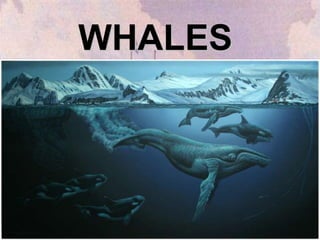
WHALES
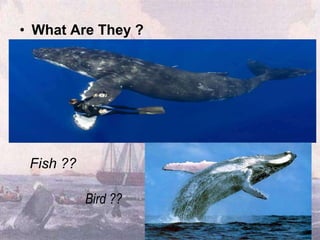
• What Are They ?


 Fish ??

           Bird ??
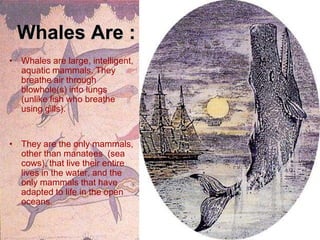
Whales Are :
• Whales are large, intelligent,
  aquatic mammals. They
  breathe air through
  blowhole(s) into lungs
  (unlike fish who breathe
  using gills).


• They are the only mammals,
  other than manatees (sea
  cows), that live their entire
  lives in the water, and the
  only mammals that have
  adapted to life in the open
  oceans.
 Scientific Classification
Kingdom: Animalia

Phylum:     Chordata

Class:      Mammalia

Subclass:    Eutheria

Order:        Cetacea
                        Whale (origin Old English hwæl)
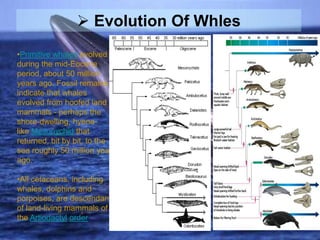
 Evolution Of Whles
•Primitive whales evolved
during the mid-Eocene
period, about 50 million
years ago. Fossil remains
indicate that whales
evolved from hoofed land
mammals - perhaps the
shore-dwelling, hyena-
like Mesonychid that
returned, bit by bit, to the
sea roughly 50 million years
ago.

•All cetaceans, including
whales, dolphins and
porpoises, are descendants
of land-living mammals of
the Artiodactyl order
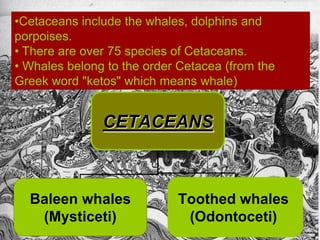
•Cetaceans include the whales, dolphins and
porpoises.
• There are over 75 species of Cetaceans.
• Whales belong to the order Cetacea (from the
Greek word "ketos" which means whale)


               CETACEANS


  Baleen whales             Toothed whales
   (Mysticeti)               (Odontoceti)
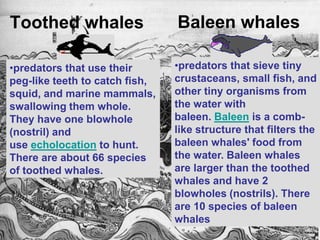
Toothed whales                  Baleen whales

•predators that use their       •predators that sieve tiny
peg-like teeth to catch fish,   crustaceans, small fish, and
squid, and marine mammals,      other tiny organisms from
swallowing them whole.          the water with
They have one blowhole          baleen. Baleen is a comb-
(nostril) and                   like structure that filters the
use echolocation to hunt.       baleen whales' food from
There are about 66 species      the water. Baleen whales
of toothed whales.              are larger than the toothed
                                whales and have 2
                                blowholes (nostrils). There
                                are 10 species of baleen
                                whales
 Anatomy

Like all mammals, whales breathe air, are warm-
blooded, nurse their young with milk
from mammary glands, and have body hair
SIZE
 • The Blue Whale has
     been the largest
   animal that ever lived
        on Earth.
• The adult is 28-33 M
  long (98 ft )

The smallest whale is
 the dwarf sperm
 whale which as an
 adult is only 8.5 feet
 (2.6 m) long.
Special Structures
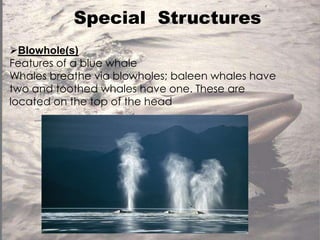
Blowhole(s)
Features of a blue whale
Whales breathe via blowholes; baleen whales have
two and toothed whales have one. These are
located on the top of the head
Behavior
Sleep

A humpback whale breaching.
Unlike most animals, whales are
conscious breathers. All
mammals sleep, but whales
cannot afford to become
unconscious for long because
they may drown. It is thought that
only one hemisphere of the
whale's brain sleeps at a time, so
they rest but are never
completely asleep
 Feeding
• Whales are generally classed as
  predators, but their food ranges from
  microscopic plankton to very large
  animals.
• Toothed whales eat fish and squid
  which they hunt by use
  of echolocation. Killer
  whales sometimes eat other marine
  mammals, including whales.
• Baleen whales such as humpbacks
  and blues, when feeding in higher
  latitudes (such as the Southern
  Ocean), eat mostly krill. They imbibe
  enormous amounts of seawater which
  they expel through their baleen plates.
  The water is then expelled and the krill
  is retained on the plates and then
  swallowed.
• Whales do not drink seawater but
  indirectly extract water from their food
  by metabolizing fat
SWIMMING AND OTHER WATER ACTIVITIES
    Breaching: Many whales are
    very acrobatic, even breaching
    (jumping) high out of the water
    and then slapping the water as
    they come back down.
    Sometimes they twirl around
    while breaching. Breaching may
    be purely for play or may be
    used to loosen skin parasites or
    have some social meaning.


   Logging: Logging is when a whale
   lies still at the surface of the
   water, resting, with its tail
   hanging down. While floating
   motionless, part of the head, the
   dorsal fin or parts of the back
   are exposed at the surface.
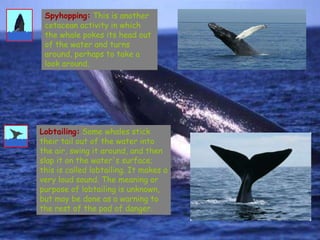
Spyhopping: This is another
 cetacean activity in which
 the whale pokes its head out
 of the water and turns
 around, perhaps to take a
 look around.


Lobtailing: Some whales stick
their tail out of the water into
the air, swing it around, and then
slap it on the water's surface;
this is called lobtailing. It makes a
very loud sound. The meaning or
purpose of lobtailing is unknown,
but may be done as a warning to
the rest of the pod of danger.
REPRODUCTION
Cetaceans give birth to live
young which are nourished with
milk from their mothers - they
don't lay eggs. Cetaceans
breed seasonally, usually in
warm tropical waters, and
females usually have one calf
every 1-3 years. The gestation
times range from 9-18 months.
Whale calves can swim at or
soon after birth. Mother whales
care for their young for an           Young cetaceans are frequently
                                   mottled in color, camouflaging them
extended period of time, usually   from predators. Newborns have a
at least a year, feeding them      sparse covering of hair which they
milk and protecting them.          lose as adults.
MIGRATION
• Many ceteaceans, especially baleen whales, migrate
over very long distances each year. They travel,
sometimes in groups (pods), from cold-water feeding
grounds to warm-water breeding grounds.

•Gray whales make the longest seasonal migration of any of the
whales. They travel about 12,500 miles each year.
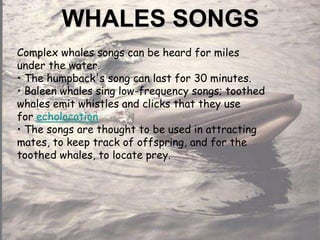
WHALES SONGS
Complex whales songs can be heard for miles
under the water.
• The humpback's song can last for 30 minutes.
• Baleen whales sing low-frequency songs; toothed
whales emit whistles and clicks that they use
for echolocation
• The songs are thought to be used in attracting
mates, to keep track of offspring, and for the
toothed whales, to locate prey.
WHALES OF THE WORLD
Amazing Whales …..


  • BELUGA WHALE
                     .
• The beluga or white whale or sea canary ,Beluga means    "white
  one" in Russian , Its genus, Delphinapterus, means "whale without
  fins"
• They have one blowhole
• They blow air bubbles …. Just for fun
• their unusual color makes them one of the most familiar
  and easily
• They are social animals
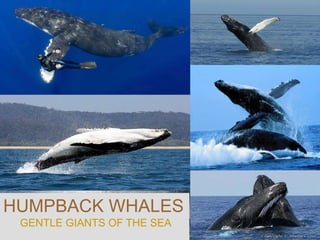
HUMPBACK WHALES
 GENTLE GIANTS OF THE SEA
•Blue Whales are the biggest animals ever
known to man kind. They are even bigger then
the dinosaurs.
                                                 BLUE WHALE
•The Blue Whale eats zooplankton[Small
crustaceans]
•The biggest Blue Whale ever to be caught was
a female Blue Whale. It was 29 metres long and
weighed more then 158 tonnes.
•Also, female Blue Whales are bigger then the
males and their blood vessels are so big that
you could swim in it.
SPERM WHALE
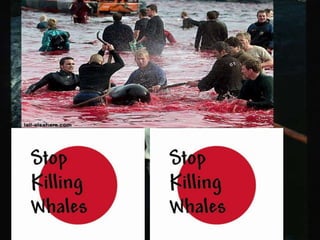
WHALES    VS   HUMAN


HUMAN IS THE MAIN PREDATOR FOR
          THE WHALES
Uses of whale oil
Soap, shampoo, detergent,
cooking fat, lipstick,
margarine, ice cream,
crayons, paint,
polish, lino,
lubricants &
dynamite
                                   Uses of baleen
                                     riding crops,
                                       shoehorns,
                                    umbrella ribs,
                          brushes, watch springs,
                      shop shutters, fishing rods,
                      fans, corsets and crinolines
Uses of whale tissues
Skin: bootlaces, bike saddles,
handbags, shoes.
Tendons: tennis racquets,
surgical thread.
Blood: sausages, fertilizer.
Connective tissue:
jelly, sweets
& photo film
                                 Uses of whale meat
                                          fertilizer,
                                         dog food,
                                      animal feed.
   Only eaten in Iceland, Norway, Korea and Japan
SAVE THE WHALES
WHALING
REFERENCES

• Carwardine, M. (2000). Whales, Dolphins
  and Porpoises. Dorling
  Kindersley. ISBN 0751327816..
• Williams, Heathcote (1988). Whale Nation.
  New York: Harmony
  Books. ISBN 0517569329..
• http://www.enchantedlearning.com/subj
  ects/whales/allabout/
BY:
        Salma Mohamed Abdelkhalek Al-anwar

      3rd year Biotechnology Faculty Of Science
      Zoology Dept. – Benha University


Under the supervision of :

           Dr / Hany A. Abdel-Salam
THANKS A LOT ^_^

Whales.ppt

  • 1.
  • 2.
    • What AreThey ? Fish ?? Bird ??
  • 3.
    Whales Are : •Whales are large, intelligent, aquatic mammals. They breathe air through blowhole(s) into lungs (unlike fish who breathe using gills). • They are the only mammals, other than manatees (sea cows), that live their entire lives in the water, and the only mammals that have adapted to life in the open oceans.
  • 4.
     Scientific Classification Kingdom:Animalia Phylum: Chordata Class: Mammalia Subclass: Eutheria Order: Cetacea Whale (origin Old English hwæl)
  • 5.
     Evolution OfWhles •Primitive whales evolved during the mid-Eocene period, about 50 million years ago. Fossil remains indicate that whales evolved from hoofed land mammals - perhaps the shore-dwelling, hyena- like Mesonychid that returned, bit by bit, to the sea roughly 50 million years ago. •All cetaceans, including whales, dolphins and porpoises, are descendants of land-living mammals of the Artiodactyl order
  • 6.
    •Cetaceans include thewhales, dolphins and porpoises. • There are over 75 species of Cetaceans. • Whales belong to the order Cetacea (from the Greek word "ketos" which means whale) CETACEANS Baleen whales Toothed whales (Mysticeti) (Odontoceti)
  • 7.
    Toothed whales Baleen whales •predators that use their •predators that sieve tiny peg-like teeth to catch fish, crustaceans, small fish, and squid, and marine mammals, other tiny organisms from swallowing them whole. the water with They have one blowhole baleen. Baleen is a comb- (nostril) and like structure that filters the use echolocation to hunt. baleen whales' food from There are about 66 species the water. Baleen whales of toothed whales. are larger than the toothed whales and have 2 blowholes (nostrils). There are 10 species of baleen whales
  • 8.
     Anatomy Like allmammals, whales breathe air, are warm- blooded, nurse their young with milk from mammary glands, and have body hair
  • 9.
    SIZE • TheBlue Whale has been the largest animal that ever lived on Earth. • The adult is 28-33 M long (98 ft ) The smallest whale is the dwarf sperm whale which as an adult is only 8.5 feet (2.6 m) long.
  • 10.
    Special Structures Blowhole(s) Features ofa blue whale Whales breathe via blowholes; baleen whales have two and toothed whales have one. These are located on the top of the head
  • 11.
    Behavior Sleep A humpback whalebreaching. Unlike most animals, whales are conscious breathers. All mammals sleep, but whales cannot afford to become unconscious for long because they may drown. It is thought that only one hemisphere of the whale's brain sleeps at a time, so they rest but are never completely asleep
  • 12.
     Feeding • Whalesare generally classed as predators, but their food ranges from microscopic plankton to very large animals. • Toothed whales eat fish and squid which they hunt by use of echolocation. Killer whales sometimes eat other marine mammals, including whales. • Baleen whales such as humpbacks and blues, when feeding in higher latitudes (such as the Southern Ocean), eat mostly krill. They imbibe enormous amounts of seawater which they expel through their baleen plates. The water is then expelled and the krill is retained on the plates and then swallowed. • Whales do not drink seawater but indirectly extract water from their food by metabolizing fat
  • 13.
    SWIMMING AND OTHERWATER ACTIVITIES Breaching: Many whales are very acrobatic, even breaching (jumping) high out of the water and then slapping the water as they come back down. Sometimes they twirl around while breaching. Breaching may be purely for play or may be used to loosen skin parasites or have some social meaning. Logging: Logging is when a whale lies still at the surface of the water, resting, with its tail hanging down. While floating motionless, part of the head, the dorsal fin or parts of the back are exposed at the surface.
  • 14.
    Spyhopping: This isanother cetacean activity in which the whale pokes its head out of the water and turns around, perhaps to take a look around. Lobtailing: Some whales stick their tail out of the water into the air, swing it around, and then slap it on the water's surface; this is called lobtailing. It makes a very loud sound. The meaning or purpose of lobtailing is unknown, but may be done as a warning to the rest of the pod of danger.
  • 15.
    REPRODUCTION Cetaceans give birthto live young which are nourished with milk from their mothers - they don't lay eggs. Cetaceans breed seasonally, usually in warm tropical waters, and females usually have one calf every 1-3 years. The gestation times range from 9-18 months. Whale calves can swim at or soon after birth. Mother whales care for their young for an Young cetaceans are frequently mottled in color, camouflaging them extended period of time, usually from predators. Newborns have a at least a year, feeding them sparse covering of hair which they milk and protecting them. lose as adults.
  • 17.
    MIGRATION • Many ceteaceans,especially baleen whales, migrate over very long distances each year. They travel, sometimes in groups (pods), from cold-water feeding grounds to warm-water breeding grounds. •Gray whales make the longest seasonal migration of any of the whales. They travel about 12,500 miles each year.
  • 18.
    WHALES SONGS Complex whalessongs can be heard for miles under the water. • The humpback's song can last for 30 minutes. • Baleen whales sing low-frequency songs; toothed whales emit whistles and clicks that they use for echolocation • The songs are thought to be used in attracting mates, to keep track of offspring, and for the toothed whales, to locate prey.
  • 20.
  • 21.
    Amazing Whales ….. • BELUGA WHALE .
  • 22.
    • The belugaor white whale or sea canary ,Beluga means "white one" in Russian , Its genus, Delphinapterus, means "whale without fins" • They have one blowhole • They blow air bubbles …. Just for fun • their unusual color makes them one of the most familiar and easily • They are social animals
  • 23.
    HUMPBACK WHALES GENTLEGIANTS OF THE SEA
  • 24.
    •Blue Whales arethe biggest animals ever known to man kind. They are even bigger then the dinosaurs. BLUE WHALE •The Blue Whale eats zooplankton[Small crustaceans] •The biggest Blue Whale ever to be caught was a female Blue Whale. It was 29 metres long and weighed more then 158 tonnes. •Also, female Blue Whales are bigger then the males and their blood vessels are so big that you could swim in it.
  • 25.
  • 26.
    WHALES VS HUMAN HUMAN IS THE MAIN PREDATOR FOR THE WHALES
  • 27.
    Uses of whaleoil Soap, shampoo, detergent, cooking fat, lipstick, margarine, ice cream, crayons, paint, polish, lino, lubricants & dynamite Uses of baleen riding crops, shoehorns, umbrella ribs, brushes, watch springs, shop shutters, fishing rods, fans, corsets and crinolines
  • 28.
    Uses of whaletissues Skin: bootlaces, bike saddles, handbags, shoes. Tendons: tennis racquets, surgical thread. Blood: sausages, fertilizer. Connective tissue: jelly, sweets & photo film Uses of whale meat fertilizer, dog food, animal feed. Only eaten in Iceland, Norway, Korea and Japan
  • 29.
  • 30.
  • 34.
    REFERENCES • Carwardine, M.(2000). Whales, Dolphins and Porpoises. Dorling Kindersley. ISBN 0751327816.. • Williams, Heathcote (1988). Whale Nation. New York: Harmony Books. ISBN 0517569329.. • http://www.enchantedlearning.com/subj ects/whales/allabout/
  • 35.
    BY: Salma Mohamed Abdelkhalek Al-anwar 3rd year Biotechnology Faculty Of Science Zoology Dept. – Benha University Under the supervision of : Dr / Hany A. Abdel-Salam
  • 36.