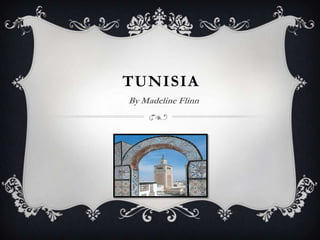
TUNISIA
By Madeline Flinn
GOVERNMENT
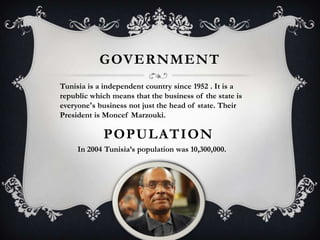
Tunisia is a independent country since 1952 . It is a
republic which means that the business of the state is
everyone's business not just the head of state. Their
President is Moncef Marzouki.

            POPULATION
     In 2004 Tunisia’s population was 10,300,000.
FLAG , COAT OF ARMS AND
     THE NATIONAL FLOWER


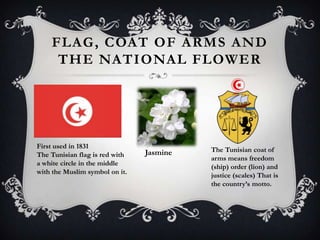
First used in 1831
                                Jasmine   The Tunisian coat of
The Tunisian flag is red with
                                          arms means freedom
a white circle in the middle
                                          (ship) order (lion) and
with the Muslim symbol on it.
                                          justice (scales) That is
                                          the country’s motto.
MAP

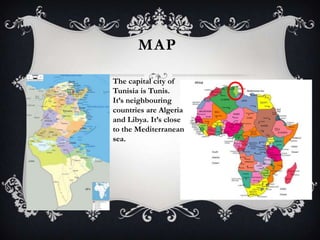
The capital city of
Tunisia is Tunis.
It’s neighbouring
countries are Algeria
and Libya. It’s close
to the Mediterranean
sea.
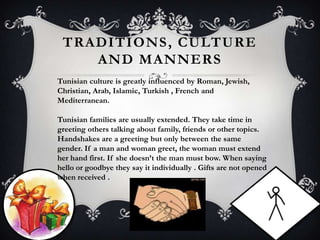
TRADITIONS , CULTURE
    AND MANNERS
Tunisian culture is greatly influenced by Roman, Jewish,
Christian, Arab, Islamic, Turkish , French and
Mediterranean.

Tunisian families are usually extended. They take time in
greeting others talking about family, friends or other topics.
Handshakes are a greeting but only between the same
gender. If a man and woman greet, the woman must extend
her hand first. If she doesn’t the man must bow. When saying
hello or goodbye they say it individually . Gifts are not opened
when received .
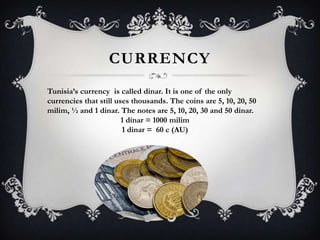
CURRENCY
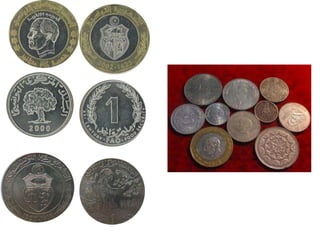
Tunisia’s currency is called dinar. It is one of the only
currencies that still uses thousands. The coins are 5, 10, 20, 50
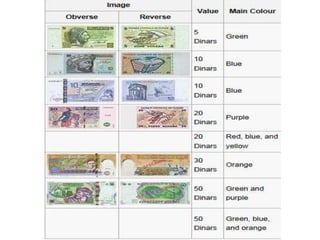
milim, ½ and 1 dinar. The notes are 5, 10, 20, 30 and 50 dinar.
                        1 dinar = 1000 milim
                        1 dinar = 60 c (AU)
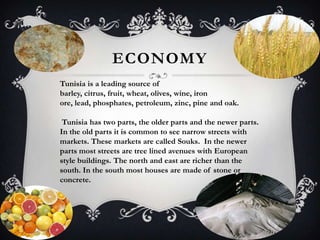
ECONOMY
Tunisia is a leading source of
barley, citrus, fruit, wheat, olives, wine, iron
ore, lead, phosphates, petroleum, zinc, pine and oak.

 Tunisia has two parts, the older parts and the newer parts.
In the old parts it is common to see narrow streets with
markets. These markets are called Souks. In the newer
parts most streets are tree lined avenues with European
style buildings. The north and east are richer than the
south. In the south most houses are made of stone or
concrete.
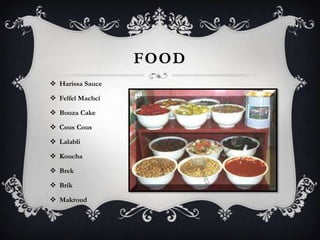
FOOD
 Harissa Sauce

 Felfel Machci

 Bouza Cake

 Cous Cous

 Lalabli

 Koucha

 Brek

 Brik

 Makroud
HOW THEY EAT
When eating, Tunisians remove their shoes. First they
wash their hands and gather at a knee high round table
called a mida. The food must be blessed before it’s eaten.
The food is served in one bowl. They do not use cutlery
but use the first two fingers of their right hand. They only
eat the food in front of them. After eating they wash their
hands again. Men and woman don’t usually eat together.
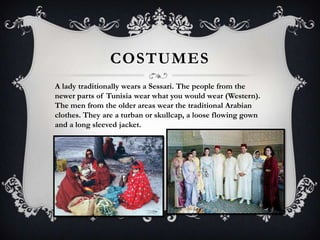
COSTUMES
A lady traditionally wears a Sessari. The people from the
newer parts of Tunisia wear what you would wear (Western).
The men from the older areas wear the traditional Arabian
clothes. They are a turban or skullcap, a loose flowing gown
and a long sleeved jacket.
RELIGIONS AND
             LANGUAGES
The official language of Tunisia is Arabic. Some people speak
French as a second language.

98% of Tunisians are Muslim. 1% are Jewish and 1% are
Christian.
WEATHER
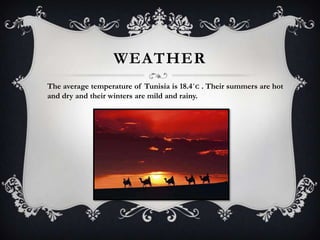
The average temperature of Tunisia is 18.4˚C . Their summers are hot
and dry and their winters are mild and rainy.
FLORA AND FAUNA
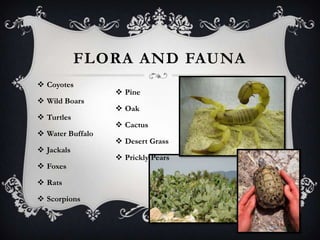
 Coyotes
                   Pine
 Wild Boars
                   Oak
 Turtles
                   Cactus
 Water Buffalo
                   Desert Grass
 Jackals
                   Prickly Pears
 Foxes

 Rats

 Scorpions
THANK YOU FOR
  LISTENING

Tunisia

  • 1.
  • 2.
    GOVERNMENT Tunisia is aindependent country since 1952 . It is a republic which means that the business of the state is everyone's business not just the head of state. Their President is Moncef Marzouki. POPULATION In 2004 Tunisia’s population was 10,300,000.
  • 3.
    FLAG , COATOF ARMS AND THE NATIONAL FLOWER First used in 1831 Jasmine The Tunisian coat of The Tunisian flag is red with arms means freedom a white circle in the middle (ship) order (lion) and with the Muslim symbol on it. justice (scales) That is the country’s motto.
  • 4.
    MAP The capital cityof Tunisia is Tunis. It’s neighbouring countries are Algeria and Libya. It’s close to the Mediterranean sea.
  • 5.
    TRADITIONS , CULTURE AND MANNERS Tunisian culture is greatly influenced by Roman, Jewish, Christian, Arab, Islamic, Turkish , French and Mediterranean. Tunisian families are usually extended. They take time in greeting others talking about family, friends or other topics. Handshakes are a greeting but only between the same gender. If a man and woman greet, the woman must extend her hand first. If she doesn’t the man must bow. When saying hello or goodbye they say it individually . Gifts are not opened when received .
  • 6.
    CURRENCY Tunisia’s currency iscalled dinar. It is one of the only currencies that still uses thousands. The coins are 5, 10, 20, 50 milim, ½ and 1 dinar. The notes are 5, 10, 20, 30 and 50 dinar. 1 dinar = 1000 milim 1 dinar = 60 c (AU)
  • 9.
    ECONOMY Tunisia is aleading source of barley, citrus, fruit, wheat, olives, wine, iron ore, lead, phosphates, petroleum, zinc, pine and oak. Tunisia has two parts, the older parts and the newer parts. In the old parts it is common to see narrow streets with markets. These markets are called Souks. In the newer parts most streets are tree lined avenues with European style buildings. The north and east are richer than the south. In the south most houses are made of stone or concrete.
  • 10.
    FOOD  Harissa Sauce Felfel Machci  Bouza Cake  Cous Cous  Lalabli  Koucha  Brek  Brik  Makroud
  • 11.
    HOW THEY EAT Wheneating, Tunisians remove their shoes. First they wash their hands and gather at a knee high round table called a mida. The food must be blessed before it’s eaten. The food is served in one bowl. They do not use cutlery but use the first two fingers of their right hand. They only eat the food in front of them. After eating they wash their hands again. Men and woman don’t usually eat together.
  • 12.
    COSTUMES A lady traditionallywears a Sessari. The people from the newer parts of Tunisia wear what you would wear (Western). The men from the older areas wear the traditional Arabian clothes. They are a turban or skullcap, a loose flowing gown and a long sleeved jacket.
  • 13.
    RELIGIONS AND LANGUAGES The official language of Tunisia is Arabic. Some people speak French as a second language. 98% of Tunisians are Muslim. 1% are Jewish and 1% are Christian.
  • 14.
    WEATHER The average temperatureof Tunisia is 18.4˚C . Their summers are hot and dry and their winters are mild and rainy.
  • 15.
    FLORA AND FAUNA Coyotes  Pine  Wild Boars  Oak  Turtles  Cactus  Water Buffalo  Desert Grass  Jackals  Prickly Pears  Foxes  Rats  Scorpions
  • 16.
    THANK YOU FOR LISTENING