Elephants
Contents
• Asian and African Elephant
• Classification
• Evolution
• Difference
• Distribution
• Diet and Foraging
• Vocalization and Communication
• Social Organization
• Reproduction
• Threats and Conservation.
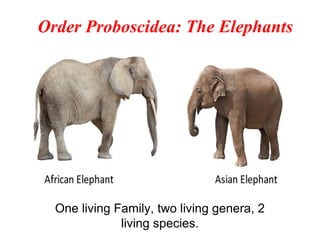
Order Proboscidea: The Elephants
One living Family, two living genera, 2
living species.
Proboscidea
• Proboscidea is an order of mammals that
includes the elephants and their extinct relatives.
Modern-day proboscideans have a long
muscular trunk, long tusks, and thick column-like
legs.
• The word Proboscidea comes from the word
proboscis, which means "nose."
Elephantidae
•Modern-day Proboscidea is represented by one
family, the family Elephantidae. There are two
living members of the family Elephantidae
(elephants),
•The Asian Elephant (Elephas maximus) and
The African Elephant (Loxodonta africana).
•Some extinct proboscideans include the woolly
mammoth and the mastodon.
Classification of Proboscidea:
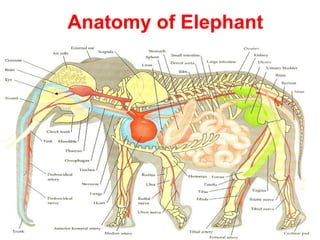
Anatomy of Elephant
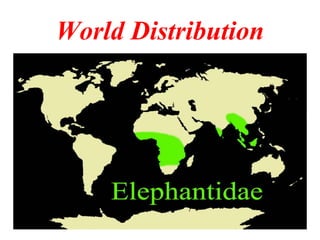
World Distribution
Evolution
Evolution
• Elephants should probably be considered part
of the Afrotheria. Closest living relatives are
sea cows and hyraxes (see next slide).
• Earliest proboscideans were tapir-like.
• Evolutionary trends were deepening the teeth,
shortening skull, lengthening trunk and legs.
• Elephas & Mammuthus evolved in Africa; they
were most modern elephants, invading Eurasia,
North America and finally South America.
• Loxodonta, more primitive, survived in Africa.
Evolutionary Difference
Range and status today
• Loxodonta: Once pan-African, now intra-tropical.
– In plains and savannas, African elephants are now largely
restricted to hunting preserves and national parks.
– In thick forest, status less well known (but may be common).
• Elephas: Once widely distributed from India
throughout continental S.E. Asia and into southern
China. Now very rare.
– Working elephants in Myanmar; tourist elephants elsewhere.
– Wild elephants in Indian national parks– and a few are
widely scattered in some other national parks.
Savannah of Africa & Forest of India
African
Asian
Uses of the trunk
• As a tool
– Grazing & browsing
– Manipulating objects
– Moving water
• As a sense organ
– Touch
– Smell
• As a social-signaling organ
– A trumpet that amplifies vocalizations
– A bearer of visual signals
– A touch-communicator
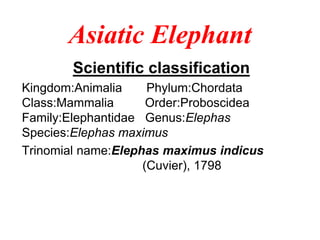
Asiatic Elephant
Scientific classification
Kingdom:Animalia Phylum:Chordata
Class:Mammalia Order:Proboscidea
Family:Elephantidae Genus:Elephas
Species:Elephas maximus
Trinomial name:Elephas maximus indicus
(Cuvier), 1798
Distribution In India
Distribution In Asia
Diet & Foraging
• Require large amount of food
• Full grown eat up to 240 Kg of fresh plant in 18 hours
• Large grinding molars ensure that they can eat any kind of matter
including twig, bark, grass, fruits, roots up to 59 spp of plants & 23
grasses.
• Move continuously as they feed-allowing the vegetation to
regenerate also defecate continuously producing about 100 Kg if
dung in a day
Vocalization & Communication
• Asian Elephants use a range of vocalizations to communicate from
tummy rumbles to loose chirps, roar and loud trumpets.
• The latter two are largely used in aggression or when disturbed
Social Organization
• Elephants are intelligent, social animals that live in closely knit
family groups lead by a matriarch.
• Elephants have a fission-fusion form of society where as resources
become scarce; they become nuclear (one mother one calves) and
when food resources are plentiful; they rejoin their kith & kin and
form larger herds.
Reproduction
• Males sexually matures by 15 yr of age while Female can give birth by
12 yr
• Gestation takes 20-22 months and only one calf is born that suckles
for more than a year
• Female give birth to only one calf every 4-5 years.
• Elephant is polygynous ie. more females than males breed.
• Musth in males increases the chances of breeding. It secrets a
pungent-smelling fluid from its temporal gland of eyes.
Elephants in Indian Culture
• Ramayana and Mahabharata are perhaps the earliest texts
dealing with the elephants in India
Elephants in Captivity
• Used in war early as the Mahabharata, Mughals and many other
emperors in India and Asia.
• In south India used in religious ceremonies.
• In illegal logging in north east India and south east Asia.
• Central Government forces.
Threats
• Four words that define an elephants big, social, intelligent and
nomadic
• Naturally they have to move continuously for feeding (part of natural
cycle)
• Move ranges 300-1000 sq. Km annually through protected areas
and land, farms, railway crossings etc & conflicts with human
• Crop riding is another perennial issue
• Man-elephant conflicts main issue
• Poaching for tusks, ivory trade
Conservation
• Project Elephant was launched in 1992 by the Govt. Of
India Ministry of Environment and Forests
• National Heritage Animal of India declared in 2010
• Elephant task forces
• NGO’s like WTI, ANCF, ATREE, ARANYAK, NCF, WWF-India
putting elephants back into wild with the help of forest department
• Grain-for-grain as conflict mitigation for farmers.
Elephants of the World

Elephants of the World

  • 1.
  • 2.
    Contents • Asian andAfrican Elephant • Classification • Evolution • Difference • Distribution • Diet and Foraging • Vocalization and Communication • Social Organization • Reproduction • Threats and Conservation.
  • 3.
    Order Proboscidea: TheElephants One living Family, two living genera, 2 living species.
  • 4.
    Proboscidea • Proboscidea isan order of mammals that includes the elephants and their extinct relatives. Modern-day proboscideans have a long muscular trunk, long tusks, and thick column-like legs. • The word Proboscidea comes from the word proboscis, which means "nose."
  • 5.
    Elephantidae •Modern-day Proboscidea isrepresented by one family, the family Elephantidae. There are two living members of the family Elephantidae (elephants), •The Asian Elephant (Elephas maximus) and The African Elephant (Loxodonta africana). •Some extinct proboscideans include the woolly mammoth and the mastodon.
  • 6.
  • 7.
  • 8.
  • 9.
  • 10.
    Evolution • Elephants shouldprobably be considered part of the Afrotheria. Closest living relatives are sea cows and hyraxes (see next slide). • Earliest proboscideans were tapir-like. • Evolutionary trends were deepening the teeth, shortening skull, lengthening trunk and legs. • Elephas & Mammuthus evolved in Africa; they were most modern elephants, invading Eurasia, North America and finally South America. • Loxodonta, more primitive, survived in Africa.
  • 11.
  • 12.
    Range and statustoday • Loxodonta: Once pan-African, now intra-tropical. – In plains and savannas, African elephants are now largely restricted to hunting preserves and national parks. – In thick forest, status less well known (but may be common). • Elephas: Once widely distributed from India throughout continental S.E. Asia and into southern China. Now very rare. – Working elephants in Myanmar; tourist elephants elsewhere. – Wild elephants in Indian national parks– and a few are widely scattered in some other national parks.
  • 13.
    Savannah of Africa& Forest of India
  • 16.
  • 17.
    Uses of thetrunk • As a tool – Grazing & browsing – Manipulating objects – Moving water • As a sense organ – Touch – Smell • As a social-signaling organ – A trumpet that amplifies vocalizations – A bearer of visual signals – A touch-communicator
  • 18.
    Asiatic Elephant Scientific classification Kingdom:AnimaliaPhylum:Chordata Class:Mammalia Order:Proboscidea Family:Elephantidae Genus:Elephas Species:Elephas maximus Trinomial name:Elephas maximus indicus (Cuvier), 1798
  • 20.
  • 21.
  • 22.
    Diet & Foraging •Require large amount of food • Full grown eat up to 240 Kg of fresh plant in 18 hours • Large grinding molars ensure that they can eat any kind of matter including twig, bark, grass, fruits, roots up to 59 spp of plants & 23 grasses. • Move continuously as they feed-allowing the vegetation to regenerate also defecate continuously producing about 100 Kg if dung in a day
  • 23.
    Vocalization & Communication •Asian Elephants use a range of vocalizations to communicate from tummy rumbles to loose chirps, roar and loud trumpets. • The latter two are largely used in aggression or when disturbed
  • 24.
    Social Organization • Elephantsare intelligent, social animals that live in closely knit family groups lead by a matriarch. • Elephants have a fission-fusion form of society where as resources become scarce; they become nuclear (one mother one calves) and when food resources are plentiful; they rejoin their kith & kin and form larger herds.
  • 25.
    Reproduction • Males sexuallymatures by 15 yr of age while Female can give birth by 12 yr • Gestation takes 20-22 months and only one calf is born that suckles for more than a year • Female give birth to only one calf every 4-5 years. • Elephant is polygynous ie. more females than males breed. • Musth in males increases the chances of breeding. It secrets a pungent-smelling fluid from its temporal gland of eyes.
  • 26.
    Elephants in IndianCulture • Ramayana and Mahabharata are perhaps the earliest texts dealing with the elephants in India
  • 27.
    Elephants in Captivity •Used in war early as the Mahabharata, Mughals and many other emperors in India and Asia. • In south India used in religious ceremonies. • In illegal logging in north east India and south east Asia. • Central Government forces.
  • 28.
    Threats • Four wordsthat define an elephants big, social, intelligent and nomadic • Naturally they have to move continuously for feeding (part of natural cycle) • Move ranges 300-1000 sq. Km annually through protected areas and land, farms, railway crossings etc & conflicts with human • Crop riding is another perennial issue • Man-elephant conflicts main issue • Poaching for tusks, ivory trade
  • 29.
    Conservation • Project Elephantwas launched in 1992 by the Govt. Of India Ministry of Environment and Forests • National Heritage Animal of India declared in 2010 • Elephant task forces • NGO’s like WTI, ANCF, ATREE, ARANYAK, NCF, WWF-India putting elephants back into wild with the help of forest department • Grain-for-grain as conflict mitigation for farmers.