Chapter 14 Sec 2
Chapter 14 Sec 2
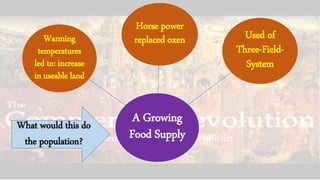
A Growing
Food Supply
Horse power
replaced oxen Used of
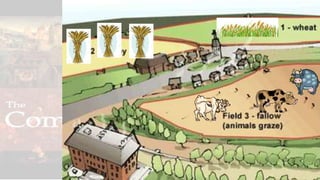
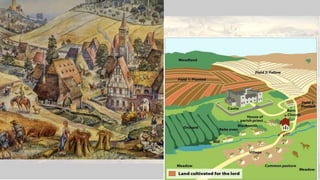
Three-Field-
System
Warming
temperatures
led to: increase
in useable land
What would this do
the population?
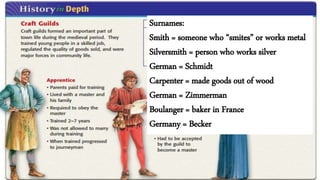
Surnames:
Smith = someone who “smites” or works metal
Silversmith = person who works silver
German = Schmidt
Carpenter = made goods out of wood
German = Zimmerman
Boulanger = baker in France
Germany = Becker
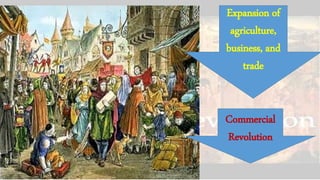
Expansion of
agriculture,
business, and
trade
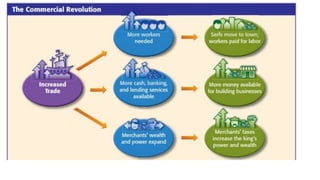
Commercial
Revolution
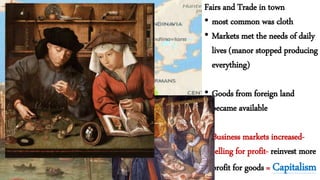
Fairs and Trade in town
• most common was cloth
• Markets met the needs of daily
lives (manor stopped producing
everything)
• Goods from foreign land
became available
• Business markets increased-
selling for profit- reinvest more
profit for goods = Capitalism
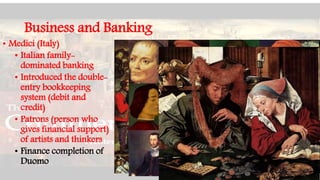
Business and Banking
• Medici (Italy)
• Italian family-
dominated banking
• Introduced the double-
entry bookkeeping
system (debit and
credit)
• Patrons (person who
gives financial support)
of artists and thinkers
• Finance completion of
Duomo
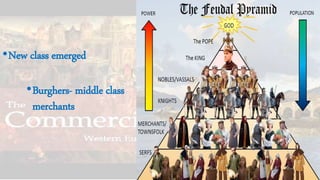
•New class emerged
•Burghers- middle class
merchants
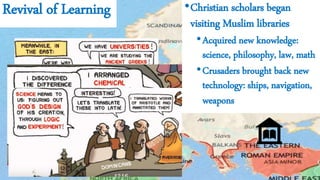
Revival of Learning •Christian scholars began
visiting Muslim libraries
•Acquired new knowledge:
science, philosophy, law, math
•Crusaders brought back new
technology: ships, navigation,
weapons
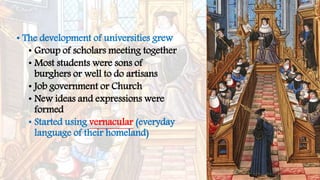
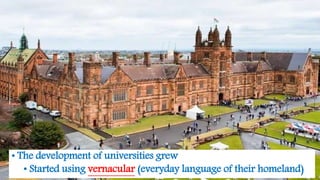
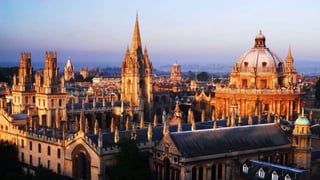
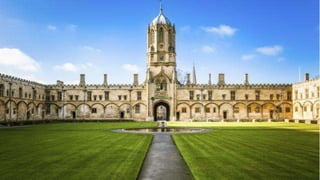
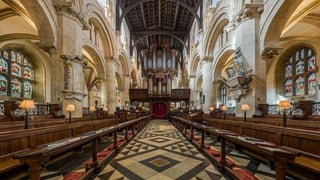
• The development of universities grew
• Group of scholars meeting together
• Most students were sons of
burghers or well to do artisans
• Job government or Church
• New ideas and expressions were
formed
• Started using vernacular (everyday
language of their homeland)
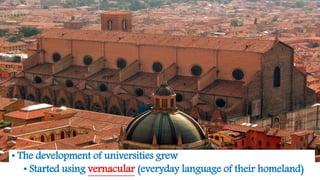
• The development of universities grew
• Started using vernacular (everyday language of their homeland)
• The development of universities grew
• Started using vernacular (everyday language of their homeland)
• The development of universities grew
• Started using vernacular (everyday language of their homeland)
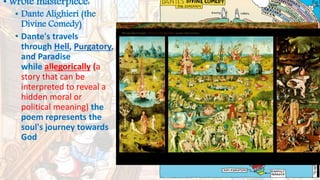
• wrote masterpiece:
• Dante Alighieri (the
Divine Comedy)
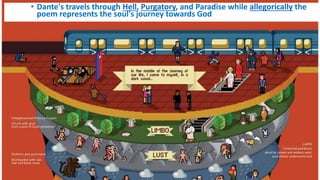
• Dante's travels
through Hell, Purgatory,
and Paradise
while allegorically (a
story that can be
interpreted to reveal a
hidden moral or
political meaning) the
poem represents the
soul's journey towards
God
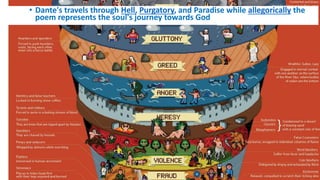
• Dante's travels through Hell, Purgatory, and Paradise while allegorically the
poem represents the soul's journey towards God
• Dante's travels through Hell, Purgatory, and Paradise while allegorically the
poem represents the soul's journey towards God
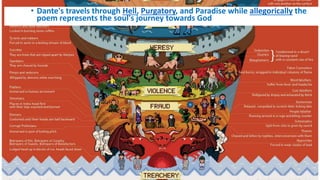
• Dante's travels through Hell, Purgatory, and Paradise while allegorically the
poem represents the soul's journey towards God
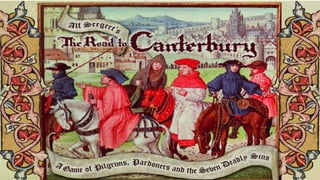
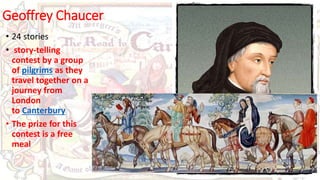
Geoffrey Chaucer
• 24 stories
• story-telling
contest by a group
of pilgrims as they
travel together on a
journey from
London
to Canterbury
• The prize for this
contest is a free
meal
• After getting a drink, the Pardoner begins his Prologue. “greed is the
root of all evil.” He gives a similar sermon to every congregation and
then breaks out his bag of “relics”—which, he readily admits to the
listening pilgrims, are fake. He will take a sheep’s bone and claim it
has miraculous healing powers for all kinds of ailments. The
parishioners always believe him and make their offerings to the relics,
which the Pardoner quickly pockets. He would rather take the last
penny from a widow and her starving family than give up his money,
and the good cheeses, breads, and wines that such income brings
him. Speaking of alcohol, he notes, he has now finished his drink of
“corny ale” and is ready to begin his tale.
• As three of these rioters sit drinking, they hear a funeral knell. One of the
revelers’ servants tells the group that an old friend of theirs was slain that
very night by a mysterious figure named Death. The rioters are outraged
and, in their drunkenness, decide to find and kill Death to avenge their
friend. Traveling down the road, they meet an old man who appears
sorrowful. He says his sorrow stems from old age—he has been waiting for
Death to come and take him for some time, and he has wandered all over
the world. The youths, hearing the name of Death, demand to know where
they can find him. The old man directs them into a grove, where he says he
just left Death under an oak tree. The rioters rush to the tree, underneath
which they find not Death but eight bushels of gold coins with no owner in
sight.
• At first, they are speechless, but, then, the slyest of the three reminds
them that if they carry the gold into town in daylight, they will be
taken for thieves. They must transport the gold under cover of night,
and so someone must run into town to fetch bread and wine in the
meantime. They draw lots, and the youngest of the three loses and
runs off toward town.
• As soon as he is gone, the sly plotter turns to his friend and divulges
his plan: when their friend returns from town, they will kill him and
therefore receive greater shares of the wealth. The second rioter
agrees, and they prepare their trap.
• Back in town, the youngest vagrant is having similar thoughts. He
could easily be the richest man in town, he realizes, if he could have
all the gold to himself. He goes to the apothecary and buys the
strongest poison available, then puts the poison into two bottles of
wine, leaving a third bottle pure for himself.
• He returns to the tree, but the other two rioters leap out and kill him.
• They sit down to drink their friend’s wine and celebrate, but each
happens to pick up a poisoned bottle. Within minutes, they lie dead
next to their friend.
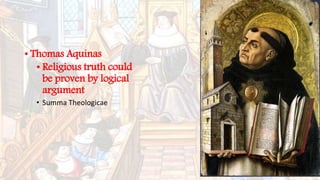
• Thomas Aquinas
• Religious truth could
be proven by logical
argument
• Summa Theologicae

WH CH14 Commercial Rev

  • 1.
    Chapter 14 Sec2 Chapter 14 Sec 2
  • 2.
    A Growing Food Supply Horsepower replaced oxen Used of Three-Field- System Warming temperatures led to: increase in useable land What would this do the population?
  • 5.
    Surnames: Smith = someonewho “smites” or works metal Silversmith = person who works silver German = Schmidt Carpenter = made goods out of wood German = Zimmerman Boulanger = baker in France Germany = Becker
  • 6.
  • 7.
    Fairs and Tradein town • most common was cloth • Markets met the needs of daily lives (manor stopped producing everything) • Goods from foreign land became available • Business markets increased- selling for profit- reinvest more profit for goods = Capitalism
  • 8.
    Business and Banking •Medici (Italy) • Italian family- dominated banking • Introduced the double- entry bookkeeping system (debit and credit) • Patrons (person who gives financial support) of artists and thinkers • Finance completion of Duomo
  • 9.
    •New class emerged •Burghers-middle class merchants
  • 11.
    Revival of Learning•Christian scholars began visiting Muslim libraries •Acquired new knowledge: science, philosophy, law, math •Crusaders brought back new technology: ships, navigation, weapons
  • 12.
    • The developmentof universities grew • Group of scholars meeting together • Most students were sons of burghers or well to do artisans • Job government or Church • New ideas and expressions were formed • Started using vernacular (everyday language of their homeland)
  • 13.
    • The developmentof universities grew • Started using vernacular (everyday language of their homeland)
  • 14.
    • The developmentof universities grew • Started using vernacular (everyday language of their homeland)
  • 15.
    • The developmentof universities grew • Started using vernacular (everyday language of their homeland)
  • 21.
    • wrote masterpiece: •Dante Alighieri (the Divine Comedy) • Dante's travels through Hell, Purgatory, and Paradise while allegorically (a story that can be interpreted to reveal a hidden moral or political meaning) the poem represents the soul's journey towards God
  • 22.
    • Dante's travelsthrough Hell, Purgatory, and Paradise while allegorically the poem represents the soul's journey towards God
  • 23.
    • Dante's travelsthrough Hell, Purgatory, and Paradise while allegorically the poem represents the soul's journey towards God
  • 24.
    • Dante's travelsthrough Hell, Purgatory, and Paradise while allegorically the poem represents the soul's journey towards God
  • 26.
    Geoffrey Chaucer • 24stories • story-telling contest by a group of pilgrims as they travel together on a journey from London to Canterbury • The prize for this contest is a free meal
  • 27.
    • After gettinga drink, the Pardoner begins his Prologue. “greed is the root of all evil.” He gives a similar sermon to every congregation and then breaks out his bag of “relics”—which, he readily admits to the listening pilgrims, are fake. He will take a sheep’s bone and claim it has miraculous healing powers for all kinds of ailments. The parishioners always believe him and make their offerings to the relics, which the Pardoner quickly pockets. He would rather take the last penny from a widow and her starving family than give up his money, and the good cheeses, breads, and wines that such income brings him. Speaking of alcohol, he notes, he has now finished his drink of “corny ale” and is ready to begin his tale.
  • 28.
    • As threeof these rioters sit drinking, they hear a funeral knell. One of the revelers’ servants tells the group that an old friend of theirs was slain that very night by a mysterious figure named Death. The rioters are outraged and, in their drunkenness, decide to find and kill Death to avenge their friend. Traveling down the road, they meet an old man who appears sorrowful. He says his sorrow stems from old age—he has been waiting for Death to come and take him for some time, and he has wandered all over the world. The youths, hearing the name of Death, demand to know where they can find him. The old man directs them into a grove, where he says he just left Death under an oak tree. The rioters rush to the tree, underneath which they find not Death but eight bushels of gold coins with no owner in sight.
  • 29.
    • At first,they are speechless, but, then, the slyest of the three reminds them that if they carry the gold into town in daylight, they will be taken for thieves. They must transport the gold under cover of night, and so someone must run into town to fetch bread and wine in the meantime. They draw lots, and the youngest of the three loses and runs off toward town.
  • 30.
    • As soonas he is gone, the sly plotter turns to his friend and divulges his plan: when their friend returns from town, they will kill him and therefore receive greater shares of the wealth. The second rioter agrees, and they prepare their trap.
  • 31.
    • Back intown, the youngest vagrant is having similar thoughts. He could easily be the richest man in town, he realizes, if he could have all the gold to himself. He goes to the apothecary and buys the strongest poison available, then puts the poison into two bottles of wine, leaving a third bottle pure for himself.
  • 32.
    • He returnsto the tree, but the other two rioters leap out and kill him. • They sit down to drink their friend’s wine and celebrate, but each happens to pick up a poisoned bottle. Within minutes, they lie dead next to their friend.
  • 36.
    • Thomas Aquinas •Religious truth could be proven by logical argument • Summa Theologicae

Editor's Notes

  • #4 Surnames:
  • #6 Surnames: Smith = someone who “smites” or works metal Silversmith = person who works silver German = Schmidt Carpenter = made goods out of wood German = Zimmerman Boulanger = baker in France Germany = Becker
  • #8 Trade: others are bacon, salt, honey, cheese, wine, leather, dyes, knives, and ropes People would store their gold coins with the local goldsmith who had a safe Goldsmith will give receipts for a certain amount of gold Gradually, the receipts began to circulate as paper money
  • #10 Because of increase in business and trade new class emerged
  • #12 With the Fall of Rome, and invasion of Europe (ransack, looting, burning of towns and monasteries) learning decline During the crusade- contact with Muslim and Byzantine libraries- where books were kept intact
  • #15 Sydney, Australia
  • #16 Bologna, Italy
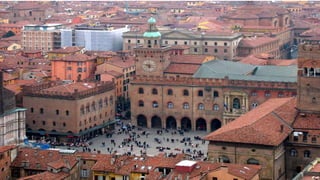
  • #17 Bologna, Italy
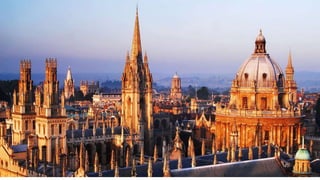
  • #18 Oxford University (Christ Church)
  • #19 Oxford University (Christ Church)
  • #20 Oxford University (Christ Church)