Applying Quality Standards to Assess Information Resources Mary Feeney, Jim Martin, Ping Situ The University of Arizona Libraries
WHY  – background on spending reductions project WHAT’S DIFFERENT?  – organizational structure, project management, approach to assessment HOW  –quality standards, data collection and analysis, issues and recommendations WHAT NEXT?  –results/outcomes
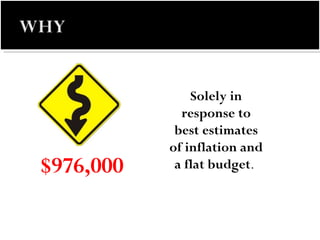
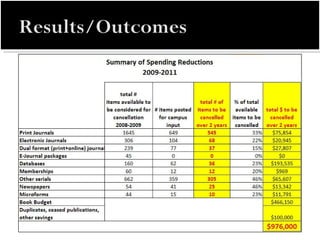
Solely in response to best estimates of inflation and a flat budget .  $976,000
Organizational structure Project management  Approach to assessment
 
Process:  Spreadsheets with resources by type Divided up work  Potential cancellations posted for feedback
Applied systematically across all disciplines and types of resources: Monographs Journals (print and e-journal) E-Journal packages Indexing & Abstracting Services Aggregators Original photo by http://www.flickr.com/photos/aussiegall
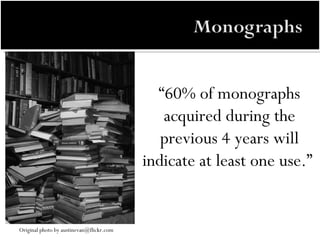
“ 60% of monographs acquired during the previous 4 years will indicate at least one use.”  Original photo by austinevan@flickr.com
Monographs Cut flat amount  Cuts applied to book budget based on QS Impact: Decreases flexibility in having funds for one-time purchases. Increases amount of budget expended for ongoing costs.
“ 95% of individual journal titles will show evidence of use based on articles published in those journal titles within the last 3 years.”
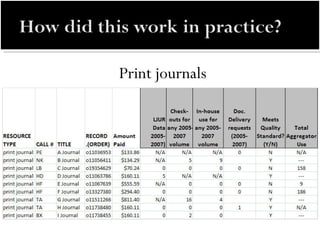
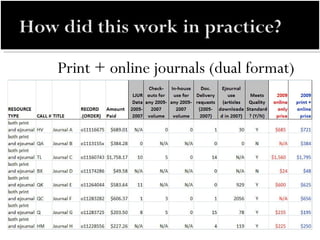
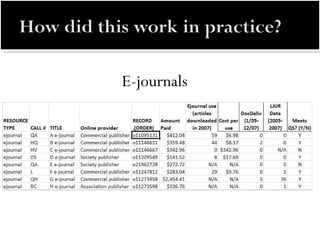
Data gathered for previous three years (2005-2007):  Total checkouts Total internal use Full-text downloads (electronic) LJUR data Document delivery requests Aggregator use
Print journals
Print + online journals (dual format)
E-journals
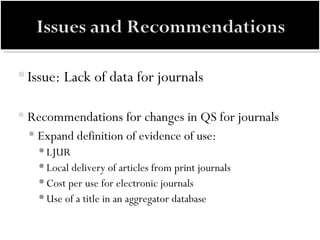
Issue: Lack of data for journals Recommendations for changes in QS for journals Expand definition of evidence of use:  LJUR  Local delivery of articles from print journals Cost per use for electronic journals Use of a title in an aggregator database
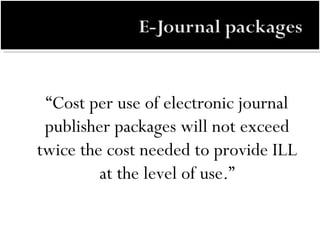
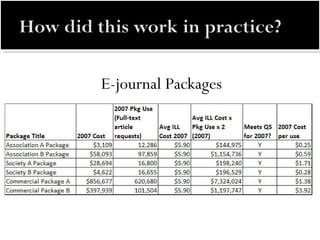
“ Cost per use of electronic journal publisher packages will not exceed twice the cost needed to provide ILL at the level of use.”
E-journal Packages
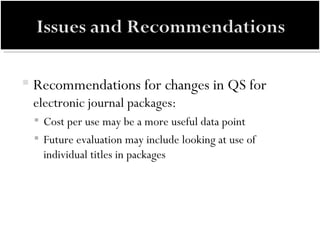
Recommendations for changes in QS for  electronic journal packages: Cost per use may be a more useful data point Future evaluation may include looking at use of individual titles in packages
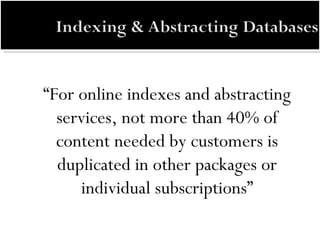
“ For online indexes and abstracting services, not more than 40% of content needed by customers is duplicated in other packages or individual subscriptions”
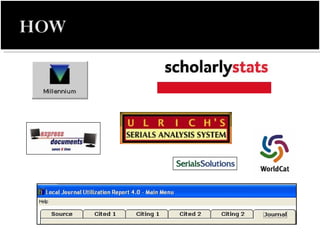
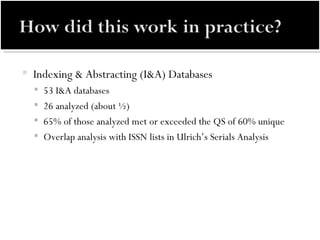
Indexing & Abstracting (I&A) Databases 53 I&A databases 26 analyzed (about ½) 65% of those analyzed met or exceeded the QS of 60% unique Overlap analysis with ISSN lists in Ulrich’s Serials Analysis
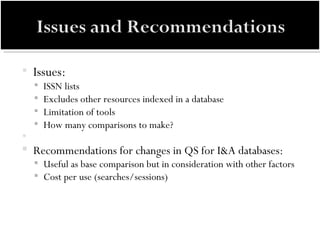
Issues: ISSN lists Excludes other resources indexed in a database Limitation of tools How many comparisons to make?   Recommendations for changes in QS for I&A databases: Useful as base comparison but in consideration with other factors Cost per use (searches/sessions)
Duplication : less than 40% duplication in other owned or subscribed resources.  Embargoing:  less than 10% of materials are embargoed. Completeness of coverage:  90% of articles are included. Customer need for non-duplicated articles:  less than 30% of non-duplicated items represent low-value or unneeded resources.
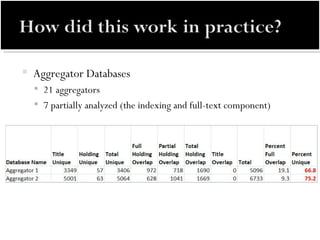
Aggregator Databases 21 aggregators 7 partially analyzed (the indexing and full-text component)
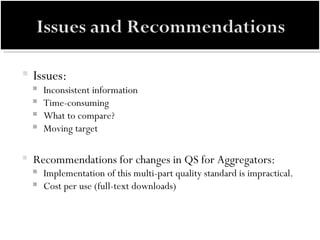
Issues: Inconsistent information Time-consuming What to compare? Moving target   Recommendations for changes in QS for Aggregators: Implementation of this multi-part quality standard is impractical.  Cost per use (full-text downloads)
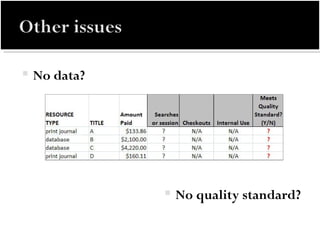
No data? No quality standard?
 
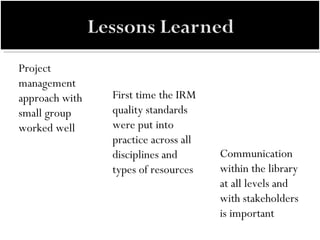
Project management approach with small group worked well Communication within the library at all levels and with stakeholders is important First time the IRM quality standards were put into practice across all disciplines and types of resources
 
The University of Arizona Libraries

We've Got the Data - Now What Do We Do About It? Applying Quality Standard to Assess Information Resources - Mary Feeney, Jim Martin, Ping Situ

  • 1.
    Applying Quality Standardsto Assess Information Resources Mary Feeney, Jim Martin, Ping Situ The University of Arizona Libraries
  • 2.
    WHY –background on spending reductions project WHAT’S DIFFERENT? – organizational structure, project management, approach to assessment HOW –quality standards, data collection and analysis, issues and recommendations WHAT NEXT? –results/outcomes
  • 3.
    Solely in responseto best estimates of inflation and a flat budget . $976,000
  • 4.
    Organizational structure Projectmanagement Approach to assessment
  • 5.
  • 6.
    Process: Spreadsheetswith resources by type Divided up work Potential cancellations posted for feedback
  • 7.
    Applied systematically acrossall disciplines and types of resources: Monographs Journals (print and e-journal) E-Journal packages Indexing & Abstracting Services Aggregators Original photo by http://www.flickr.com/photos/aussiegall
  • 8.
    “ 60% ofmonographs acquired during the previous 4 years will indicate at least one use.” Original photo by austinevan@flickr.com
  • 9.
    Monographs Cut flatamount Cuts applied to book budget based on QS Impact: Decreases flexibility in having funds for one-time purchases. Increases amount of budget expended for ongoing costs.
  • 10.
    “ 95% ofindividual journal titles will show evidence of use based on articles published in those journal titles within the last 3 years.”
  • 11.
    Data gathered forprevious three years (2005-2007): Total checkouts Total internal use Full-text downloads (electronic) LJUR data Document delivery requests Aggregator use
  • 12.
  • 13.
    Print + onlinejournals (dual format)
  • 14.
  • 15.
    Issue: Lack ofdata for journals Recommendations for changes in QS for journals Expand definition of evidence of use: LJUR Local delivery of articles from print journals Cost per use for electronic journals Use of a title in an aggregator database
  • 16.
    “ Cost peruse of electronic journal publisher packages will not exceed twice the cost needed to provide ILL at the level of use.”
  • 17.
  • 18.
    Recommendations for changesin QS for electronic journal packages: Cost per use may be a more useful data point Future evaluation may include looking at use of individual titles in packages
  • 19.
    “ For onlineindexes and abstracting services, not more than 40% of content needed by customers is duplicated in other packages or individual subscriptions”
  • 20.
    Indexing & Abstracting(I&A) Databases 53 I&A databases 26 analyzed (about ½) 65% of those analyzed met or exceeded the QS of 60% unique Overlap analysis with ISSN lists in Ulrich’s Serials Analysis
  • 21.
    Issues: ISSN listsExcludes other resources indexed in a database Limitation of tools How many comparisons to make?   Recommendations for changes in QS for I&A databases: Useful as base comparison but in consideration with other factors Cost per use (searches/sessions)
  • 22.
    Duplication : lessthan 40% duplication in other owned or subscribed resources. Embargoing: less than 10% of materials are embargoed. Completeness of coverage: 90% of articles are included. Customer need for non-duplicated articles: less than 30% of non-duplicated items represent low-value or unneeded resources.
  • 23.
    Aggregator Databases 21aggregators 7 partially analyzed (the indexing and full-text component)
  • 24.
    Issues: Inconsistent informationTime-consuming What to compare? Moving target   Recommendations for changes in QS for Aggregators: Implementation of this multi-part quality standard is impractical. Cost per use (full-text downloads)
  • 25.
    No data? Noquality standard?
  • 26.
  • 27.
    Project management approachwith small group worked well Communication within the library at all levels and with stakeholders is important First time the IRM quality standards were put into practice across all disciplines and types of resources
  • 28.
  • 29.
    The University ofArizona Libraries