A University and its Library
Stephen Town
Director of Information
University of York
The future …
The questions posed …
• Context
– HE Funding
– Globalisation
– Technology
• Repositories
• Digitisation & use
– Customer base
• Business & Industry
• Library
• Provision decisions
• Promotion
• Value (of resources)
• Proof of worth
– Developing services for
• Researchers
– Literature evaluation
– Bibliometrics
• Teachers
– Information literacy
• Students
– Basic academic skills
– Plagiarism
Summary
• HE Context
• University Context, based on York
• The University Library
• Strategy, Quality & Value
• Changing stakeholder needs
– Current issues & service developments
UK AND GLOBAL HE CONTEXT
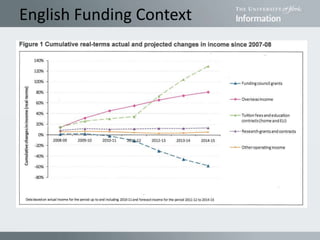
English Funding Context
A LOCAL UNIVERSITY CONTEXT
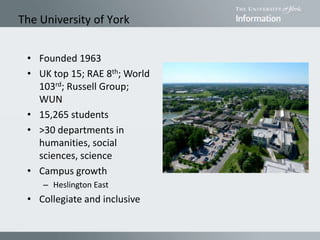
The University of York
• Founded 1963
• UK top 15; RAE 8th; World
103rd; Russell Group;
WUN
• 15,265 students
• >30 departments in
humanities, social
sciences, science
• Campus growth
– Heslington East
• Collegiate and inclusive
The University of York
The University Plan
• Excellence
• Internationalisation
• Inclusivity
• Sustainability
University of York Distinctiveness
• Excellence
• Growth … but preservation of community
• Global focus and reputation
• Commitment to partnerships
• Commitment to the locality and region
• Making significant & increasing investments in
information systems & services
• Unique and distinctive academic foci and
related collections
THE UNIVERSITY LIBRARY
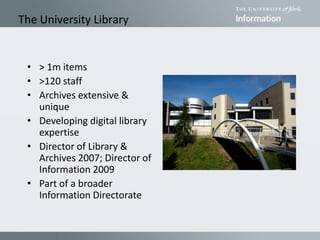
• > 1m items
• >120 staff
• Archives extensive &
unique
• Developing digital library
expertise
• Director of Library &
Archives 2007; Director of
Information 2009
• Part of a broader
Information Directorate
The University Library
Branch Libraries & beyond
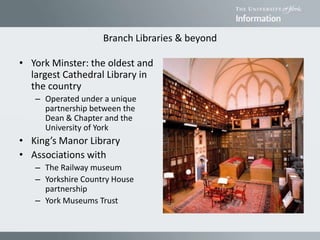
• York Minster: the oldest and
largest Cathedral Library in
the country
– Operated under a unique
partnership between the
Dean & Chapter and the
University of York
• King’s Manor Library
• Associations with
– The Railway museum
– Yorkshire Country House
partnership
– York Museums Trust
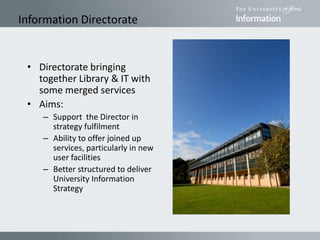
• Directorate bringing
together Library & IT with
some merged services
• Aims:
– Support the Director in
strategy fulfilment
– Ability to offer joined up
services, particularly in new
user facilities
– Better structured to deliver
University Information
Strategy
Information Directorate
Library Finance
• Staff (50%)
– Numbers 150; 100 fte
– Cost £3.8m
• Content (40%)
– Books £0.6m (up through new fees)
– Serials £2.3m (static)
• Other expenditure (10%) £0.4m
• Income (£0.4m), capital (£25m+) & new fees (£0.7m)
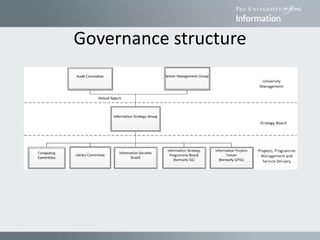
Governance structure
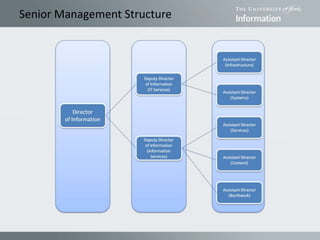
Senior Management Structure
STRATEGY, QUALITY & VALUE
Performance
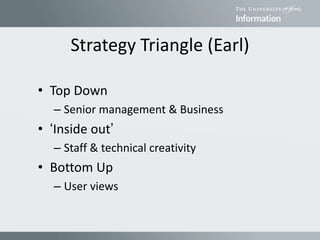
Strategy Triangle (Earl)
• Top Down
– Senior management & Business
• ‘Inside out’
– Staff & technical creativity
• Bottom Up
– User views
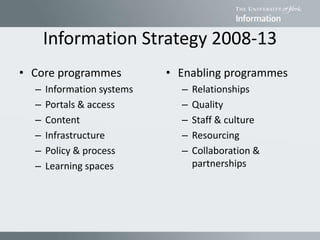
Information Strategy 2008-13
• Core programmes
– Information systems
– Portals & access
– Content
– Infrastructure
– Policy & process
– Learning spaces
• Enabling programmes
– Relationships
– Quality
– Staff & culture
– Resourcing
– Collaboration &
partnerships
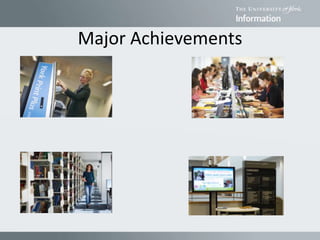
Major Achievements
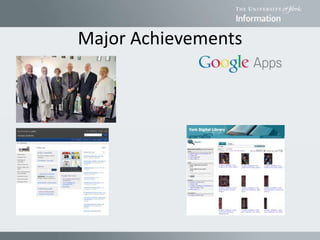
Major Achievements
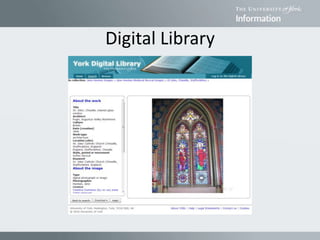
Digital Library
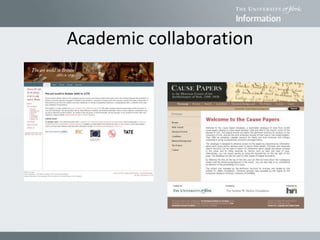
Academic collaboration
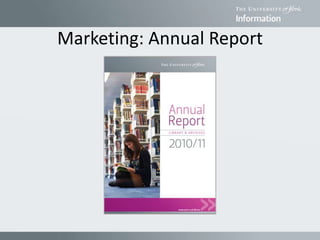
Marketing: Annual Report
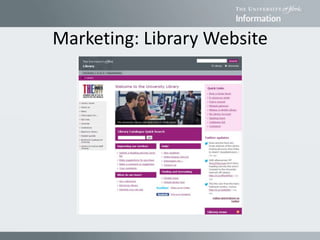
Marketing: Library Website
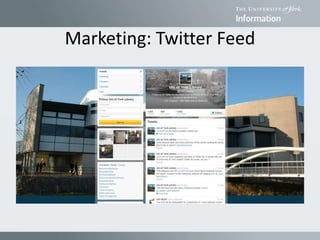
Marketing: Twitter Feed
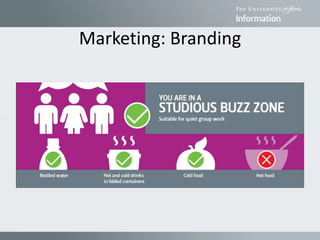
Marketing: Branding
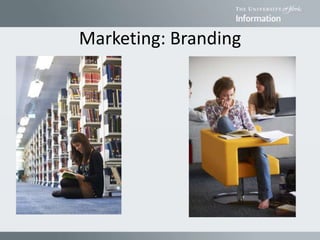
Marketing: Branding
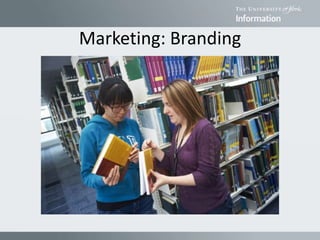
Marketing: Branding
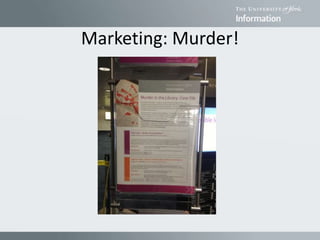
Marketing: Murder!
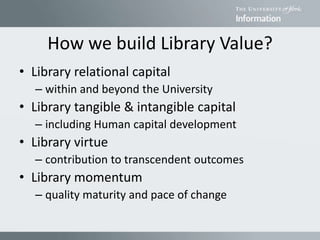
How we build Library Value?
• Library relational capital
– within and beyond the University
• Library tangible & intangible capital
– including Human capital development
• Library virtue
– contribution to transcendent outcomes
• Library momentum
– quality maturity and pace of change
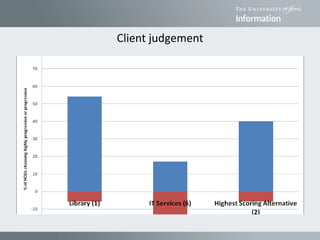
Client judgement
Content Strategy
• Academic repositories
• Digitisation
– Resources
– Service
– Backfiles
• Embedding into learning
• Key texts
• Modern media capability
Content decision making
• Complex
– No longer departmental alone
– Proliferation of possible investments
– Licensing
• Still largely historic
– Financial pressure dictates ‘one in, one out’ approach
• Value
– Little realistic ROI measurement
– Cost per use a factor
Cost and Value
“focusing on cost without being able to
demonstrate [service] value and quality …
leaves the initiative to people whose chief
concern is cost-control or profit: the funders
and the vendors”
Whitehall, T (1995)
Quality & Data collection
• Quality assurance
• Peer review & benchmarking
• Performance indicators
– SCONUL statistics
– Balanced scorecard
• Quality culture
– User satisfaction measures & surveys
Library Survey Questions
Affect of Service
• AS-1 Library staff who instill confidence in users
• AS-2 Giving users individual attention
• AS-3 Library staff who are consistently courteous
• AS-4 Readiness to respond to users’ enquiries
• AS-5 Library staff who have the knowledge to answer user
questions
• AS-6 Library staff who deal with users in a caring fashion
• AS-7 Library staff who understand the needs of their users
• AS-8 Willingness to help users
• AS-9 Dependability in handling users’ service problems
Library Survey Questions
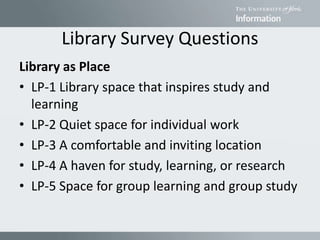
Library as Place
• LP-1 Library space that inspires study and
learning
• LP-2 Quiet space for individual work
• LP-3 A comfortable and inviting location
• LP-4 A haven for study, learning, or research
• LP-5 Space for group learning and group study
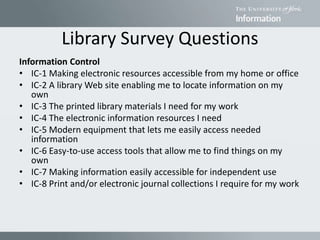
Library Survey Questions
Information Control
• IC-1 Making electronic resources accessible from my home or office
• IC-2 A library Web site enabling me to locate information on my
own
• IC-3 The printed library materials I need for my work
• IC-4 The electronic information resources I need
• IC-5 Modern equipment that lets me easily access needed
information
• IC-6 Easy-to-use access tools that allow me to find things on my
own
• IC-7 Making information easily accessible for independent use
• IC-8 Print and/or electronic journal collections I require for my work
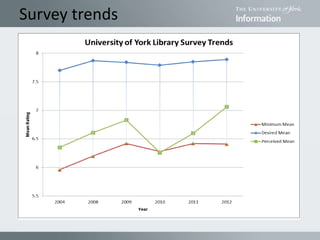
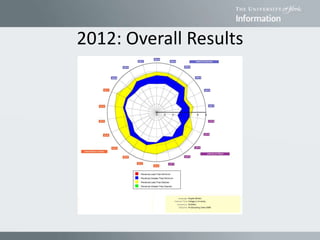
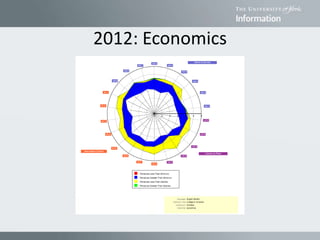
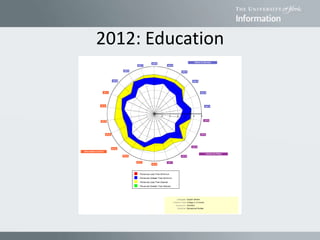
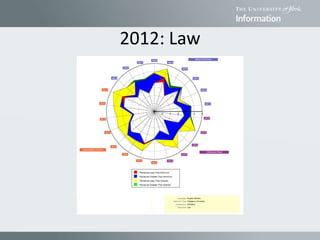
Survey trends
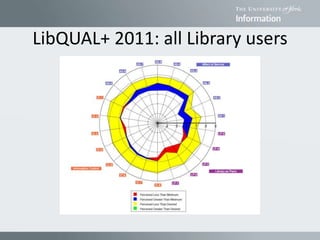
LibQUAL+ 2011: all Library users
2012: Overall Results
2012: Economics
2012: Education
2012: Law
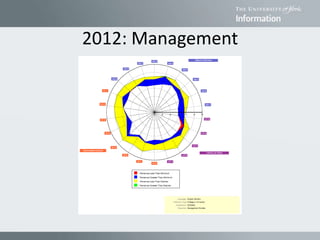
2012: Management
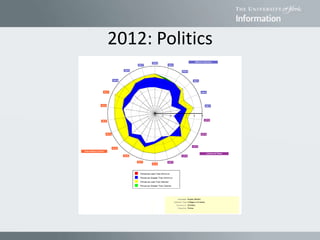
2012: Politics
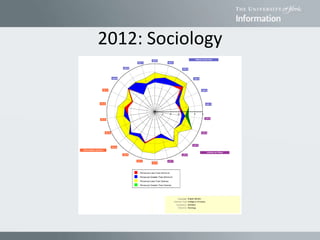
2012: Sociology
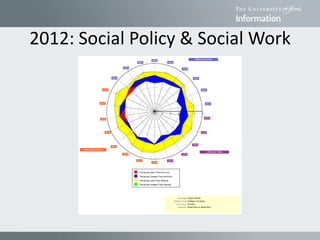
2012: Social Policy & Social Work
Library Survey: E-resource comments
• The more books available electronically, the better, though being
able to make copies of key texts at a reasonable price is a decent
alternative.
• For York Science Park residents it would be ideal if we could offer
them access to all Library services and electronic journals. It would
be fantastic if this could be offered as part of the value of being on
the science park and involved with the University of York.
• The things that matter by far the most to me in my research work
are electronic access to journal articles and a good ILL service.
• I use the electronic access facilities extensively - often to access
publishers web sites via Shibbolith login
Library Survey: E-resource comments
• The personal service is great, however i would like to see more electronic
sources (especially key texts) and a more consistent web-search service
• The system of accessing online journals and electronic resources from the
library website is too long and complicated. I don't want the library
website to be opening several tabs to reach one page, it would be good if
this could be made neater.
• Electronic access to journals is by far the most important service for me.
• Electronic resources (particularly the ability to access PDF journals from
my campus accommodation or from home) are very important to me. I
really appreciate the ability to get certain books online.
Social Science cluster issues
• Data sets demand; costs prohibitive
• Advice and support for data management
– Content very different across disciplines
– National vs local options
• Interdisciplinary
– Inter-institutional partnerships eg DTCs
– Journals cross-department
– Journal cost sharing?
CHANGING STAKEHOLDER NEEDS
Current issues & service developments
The Future …
• of research
• of the university
• of the research library
• of scholarly communication
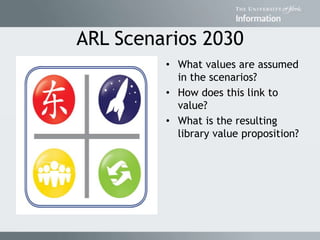
ARL Scenarios 2030
• What values are assumed
in the scenarios?
• How does this link to
value?
• What is the resulting
library value proposition?
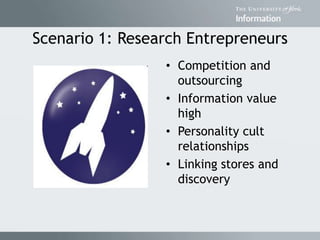
Scenario 1: Research Entrepreneurs
• Competition and
outsourcing
• Information value
high
• Personality cult
relationships
• Linking stores and
discovery
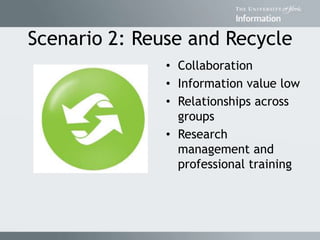
Scenario 2: Reuse and Recycle
• Collaboration
• Information value low
• Relationships across
groups
• Research
management and
professional training
Scenario 3: Disciplines in Charge
• Specialised Universities
• Data stores high value
• Political skills valued
• Research information
decoupled &
disaggregated
Scenario 4: Global Followers
• End of Western
hegemony
• IP looser?
• Relations with East
critical
• Global communal
library?
Academic virtue cycle
“We encourage reading, because people who
read more write more, people who write more
get cited more, and people who get cited more
get more grants, and reputation for themselves
and the University”
But …
• “Needs are endless…” (Thorhauge, 2010)
• The journal article is now not the only answer
to scientific communication
• The academic journal could be seen as
meaningless in the e-environment if no longer
freighted with reputation
• Publishing adds value, but a large component
of this value is provided by Universities
themselves
Key Research developments
• Research support inconsistent
• Research management systems not in place
• Research Information Systems for
– Publications (Repositories)
– REF evidence eg PURE
• Research services for
– Open Access
– Research Data Management
Other areas to “catch up”
• Infrastructure especially wifi provision
• End user training and awareness to unleash benefits
• Quality of content to attract staff and research income
• Communication & colllaboration tools
• Investment in the website
• Reporting from business systems (e.g. Agresso, SITS)
• Supporting core business in learning and teaching
• Student recruitment and marketing using online tools
Information Services SWOT
Strengths
• Building / Physical Space
• Creativity and Collaboration
• Embedding Academic Liaison into departments
• Partnerships and Collaborations
Weaknesses
• Celebration/Communication of achievements
• Patchy engagement with student bodies
• Links with planning (MTP/LTP)
• Fragmentation with staff in different office buildings
Information Services SWOT
Opportunities
• Student experience funding
• New forums for engagement - Academic Co-ordinators, GSA
Forum, Student/staff liaison groups
• Membership of RLUK
Threats
• Above inflation increases in content subscription costs
• Raised expectations in new funding regime
• Needs for funding with student growth
• Open Access
Resulting current Library issues
• Change and staff culture & capability
• Extension of traditional role
• Digital media, services and curation
• Pedagogical change & technology
• Relationships
• Information policy
• Publishing
Recent additions to the portfolio
• Open access publishing management
• Research data management
• Digital archiving (multimedia)
• Widening participation outreach
• The University Art collection
• Digital signage
Forthcoming Developments
• Customer Service Excellence
• Open Access Publishing
• Research Data Management
• Implementation of new Library Management
System (Alma)
• 10th Northumbria Conference, 22nd-25th July
• Digitisation of core/unique resources
Questions?
Conclusions 1
• Costs must be controlled
– Individually
– Institutionally
– Collectively
• Purchase choice must shift to value
– Quantitative measures insufficient
– Qualitative evaluation critical to debate
– Understanding and influencing of new user
behaviours
Conclusions 2
• Maximising return
– Better awareness
– Active exploitation
– Intermediate guidance
• Minimising overheads
– Licensing, compliance and bureaucracy
– Active engagement with publishers at all levels
– Charging back for University contributions?
– Managing expectations

A University and its Library

  • 1.
    A University andits Library Stephen Town Director of Information University of York
  • 2.
  • 3.
    The questions posed… • Context – HE Funding – Globalisation – Technology • Repositories • Digitisation & use – Customer base • Business & Industry • Library • Provision decisions • Promotion • Value (of resources) • Proof of worth – Developing services for • Researchers – Literature evaluation – Bibliometrics • Teachers – Information literacy • Students – Basic academic skills – Plagiarism
  • 4.
    Summary • HE Context •University Context, based on York • The University Library • Strategy, Quality & Value • Changing stakeholder needs – Current issues & service developments
  • 5.
    UK AND GLOBALHE CONTEXT
  • 6.
  • 8.
    A LOCAL UNIVERSITYCONTEXT The University of York
  • 9.
    • Founded 1963 •UK top 15; RAE 8th; World 103rd; Russell Group; WUN • 15,265 students • >30 departments in humanities, social sciences, science • Campus growth – Heslington East • Collegiate and inclusive The University of York
  • 10.
    The University Plan •Excellence • Internationalisation • Inclusivity • Sustainability
  • 11.
    University of YorkDistinctiveness • Excellence • Growth … but preservation of community • Global focus and reputation • Commitment to partnerships • Commitment to the locality and region • Making significant & increasing investments in information systems & services • Unique and distinctive academic foci and related collections
  • 12.
  • 13.
    • > 1mitems • >120 staff • Archives extensive & unique • Developing digital library expertise • Director of Library & Archives 2007; Director of Information 2009 • Part of a broader Information Directorate The University Library
  • 14.
    Branch Libraries &beyond • York Minster: the oldest and largest Cathedral Library in the country – Operated under a unique partnership between the Dean & Chapter and the University of York • King’s Manor Library • Associations with – The Railway museum – Yorkshire Country House partnership – York Museums Trust
  • 15.
    • Directorate bringing togetherLibrary & IT with some merged services • Aims: – Support the Director in strategy fulfilment – Ability to offer joined up services, particularly in new user facilities – Better structured to deliver University Information Strategy Information Directorate
  • 16.
    Library Finance • Staff(50%) – Numbers 150; 100 fte – Cost £3.8m • Content (40%) – Books £0.6m (up through new fees) – Serials £2.3m (static) • Other expenditure (10%) £0.4m • Income (£0.4m), capital (£25m+) & new fees (£0.7m)
  • 17.
  • 18.
  • 19.
    STRATEGY, QUALITY &VALUE Performance
  • 20.
    Strategy Triangle (Earl) •Top Down – Senior management & Business • ‘Inside out’ – Staff & technical creativity • Bottom Up – User views
  • 21.
    Information Strategy 2008-13 •Core programmes – Information systems – Portals & access – Content – Infrastructure – Policy & process – Learning spaces • Enabling programmes – Relationships – Quality – Staff & culture – Resourcing – Collaboration & partnerships
  • 22.
  • 23.
  • 24.
  • 25.
  • 26.
  • 27.
  • 28.
  • 29.
  • 30.
  • 31.
  • 32.
  • 33.
    How we buildLibrary Value? • Library relational capital – within and beyond the University • Library tangible & intangible capital – including Human capital development • Library virtue – contribution to transcendent outcomes • Library momentum – quality maturity and pace of change
  • 34.
  • 35.
    Content Strategy • Academicrepositories • Digitisation – Resources – Service – Backfiles • Embedding into learning • Key texts • Modern media capability
  • 36.
    Content decision making •Complex – No longer departmental alone – Proliferation of possible investments – Licensing • Still largely historic – Financial pressure dictates ‘one in, one out’ approach • Value – Little realistic ROI measurement – Cost per use a factor
  • 37.
    Cost and Value “focusingon cost without being able to demonstrate [service] value and quality … leaves the initiative to people whose chief concern is cost-control or profit: the funders and the vendors” Whitehall, T (1995)
  • 38.
    Quality & Datacollection • Quality assurance • Peer review & benchmarking • Performance indicators – SCONUL statistics – Balanced scorecard • Quality culture – User satisfaction measures & surveys
  • 39.
    Library Survey Questions Affectof Service • AS-1 Library staff who instill confidence in users • AS-2 Giving users individual attention • AS-3 Library staff who are consistently courteous • AS-4 Readiness to respond to users’ enquiries • AS-5 Library staff who have the knowledge to answer user questions • AS-6 Library staff who deal with users in a caring fashion • AS-7 Library staff who understand the needs of their users • AS-8 Willingness to help users • AS-9 Dependability in handling users’ service problems
  • 40.
    Library Survey Questions Libraryas Place • LP-1 Library space that inspires study and learning • LP-2 Quiet space for individual work • LP-3 A comfortable and inviting location • LP-4 A haven for study, learning, or research • LP-5 Space for group learning and group study
  • 41.
    Library Survey Questions InformationControl • IC-1 Making electronic resources accessible from my home or office • IC-2 A library Web site enabling me to locate information on my own • IC-3 The printed library materials I need for my work • IC-4 The electronic information resources I need • IC-5 Modern equipment that lets me easily access needed information • IC-6 Easy-to-use access tools that allow me to find things on my own • IC-7 Making information easily accessible for independent use • IC-8 Print and/or electronic journal collections I require for my work
  • 42.
  • 43.
    LibQUAL+ 2011: allLibrary users
  • 44.
  • 45.
  • 46.
  • 47.
  • 48.
  • 49.
  • 50.
  • 51.
    2012: Social Policy& Social Work
  • 52.
    Library Survey: E-resourcecomments • The more books available electronically, the better, though being able to make copies of key texts at a reasonable price is a decent alternative. • For York Science Park residents it would be ideal if we could offer them access to all Library services and electronic journals. It would be fantastic if this could be offered as part of the value of being on the science park and involved with the University of York. • The things that matter by far the most to me in my research work are electronic access to journal articles and a good ILL service. • I use the electronic access facilities extensively - often to access publishers web sites via Shibbolith login
  • 53.
    Library Survey: E-resourcecomments • The personal service is great, however i would like to see more electronic sources (especially key texts) and a more consistent web-search service • The system of accessing online journals and electronic resources from the library website is too long and complicated. I don't want the library website to be opening several tabs to reach one page, it would be good if this could be made neater. • Electronic access to journals is by far the most important service for me. • Electronic resources (particularly the ability to access PDF journals from my campus accommodation or from home) are very important to me. I really appreciate the ability to get certain books online.
  • 54.
    Social Science clusterissues • Data sets demand; costs prohibitive • Advice and support for data management – Content very different across disciplines – National vs local options • Interdisciplinary – Inter-institutional partnerships eg DTCs – Journals cross-department – Journal cost sharing?
  • 55.
    CHANGING STAKEHOLDER NEEDS Currentissues & service developments
  • 56.
    The Future … •of research • of the university • of the research library • of scholarly communication
  • 57.
    ARL Scenarios 2030 •What values are assumed in the scenarios? • How does this link to value? • What is the resulting library value proposition?
  • 58.
    Scenario 1: ResearchEntrepreneurs • Competition and outsourcing • Information value high • Personality cult relationships • Linking stores and discovery
  • 59.
    Scenario 2: Reuseand Recycle • Collaboration • Information value low • Relationships across groups • Research management and professional training
  • 60.
    Scenario 3: Disciplinesin Charge • Specialised Universities • Data stores high value • Political skills valued • Research information decoupled & disaggregated
  • 61.
    Scenario 4: GlobalFollowers • End of Western hegemony • IP looser? • Relations with East critical • Global communal library?
  • 62.
    Academic virtue cycle “Weencourage reading, because people who read more write more, people who write more get cited more, and people who get cited more get more grants, and reputation for themselves and the University”
  • 63.
    But … • “Needsare endless…” (Thorhauge, 2010) • The journal article is now not the only answer to scientific communication • The academic journal could be seen as meaningless in the e-environment if no longer freighted with reputation • Publishing adds value, but a large component of this value is provided by Universities themselves
  • 64.
    Key Research developments •Research support inconsistent • Research management systems not in place • Research Information Systems for – Publications (Repositories) – REF evidence eg PURE • Research services for – Open Access – Research Data Management
  • 65.
    Other areas to“catch up” • Infrastructure especially wifi provision • End user training and awareness to unleash benefits • Quality of content to attract staff and research income • Communication & colllaboration tools • Investment in the website • Reporting from business systems (e.g. Agresso, SITS) • Supporting core business in learning and teaching • Student recruitment and marketing using online tools
  • 66.
    Information Services SWOT Strengths •Building / Physical Space • Creativity and Collaboration • Embedding Academic Liaison into departments • Partnerships and Collaborations Weaknesses • Celebration/Communication of achievements • Patchy engagement with student bodies • Links with planning (MTP/LTP) • Fragmentation with staff in different office buildings
  • 67.
    Information Services SWOT Opportunities •Student experience funding • New forums for engagement - Academic Co-ordinators, GSA Forum, Student/staff liaison groups • Membership of RLUK Threats • Above inflation increases in content subscription costs • Raised expectations in new funding regime • Needs for funding with student growth • Open Access
  • 68.
    Resulting current Libraryissues • Change and staff culture & capability • Extension of traditional role • Digital media, services and curation • Pedagogical change & technology • Relationships • Information policy • Publishing
  • 69.
    Recent additions tothe portfolio • Open access publishing management • Research data management • Digital archiving (multimedia) • Widening participation outreach • The University Art collection • Digital signage
  • 70.
    Forthcoming Developments • CustomerService Excellence • Open Access Publishing • Research Data Management • Implementation of new Library Management System (Alma) • 10th Northumbria Conference, 22nd-25th July • Digitisation of core/unique resources
  • 71.
  • 72.
    Conclusions 1 • Costsmust be controlled – Individually – Institutionally – Collectively • Purchase choice must shift to value – Quantitative measures insufficient – Qualitative evaluation critical to debate – Understanding and influencing of new user behaviours
  • 73.
    Conclusions 2 • Maximisingreturn – Better awareness – Active exploitation – Intermediate guidance • Minimising overheads – Licensing, compliance and bureaucracy – Active engagement with publishers at all levels – Charging back for University contributions? – Managing expectations