Striving for Excellence with Electronic Library Statistics  Indicators for Performance Evaluation Introduction - Basics Institut für Informationswissenschaft, University of Applied Sciences,  Cologne (FH-Köln IIW)  Seminar on  Library Evaluation  (S. FÜHLES-UBACH) Peter Ahrens   Guest Lecture V 1.00a – 2009-05-18 Cologne, 7th May 2009
LibMeter  Seminar The LibMeter Introduction Seminar  is continued with the following  Slideshare Presentations: Current Practice eUsage Reporting It also relates to: LibMeter Case Study #1 (University of Düsseldorf) x
Roadmap of this Presentation Introduction - Basics I. Introduction - Basics A Quick Futuristic Web Tour Usage Stats for the Rest of Us  (No Maths please!) Library Role, Services & Usage II. Introduction – Current Practise Where to get Usage Figures from ? How to interpret usage Figures ?  LibMeter Case Studies III. Perspectives
Roadmap of this Presentation LibMeter Introduction Basics I. Introduction A Quick Futuristic Web Tour Usage Stats for the Rest of Us  (No Maths please!) Library Role, Services & Usage II. Practise Where to get Usage Figures from ? How to interpret usage Figures ?  LibMeter Case Studies III. Perspectives
LibMeter  Seminar Introduction x
Questions to Start Are you familiar with ? EZB DBIS DBS BIX DOI/CrossRef COUNTER OpenURL
New Kind of Science & Library Stats on Web 2.0
Example for Webometrics: Ranking of World Universities http://www.webometrics.info/top100_continent.asp?cont=europe  [2009-04-25]
What „Google Insight“ can tell about German Libraries and Archives ? (I) http://www.google.com/insights/search/# q=Anna%20amalia&cmpt=q   [2009-05-18]
What „Google Insight“ tells about German Libraries and Archives II http://www.google.com/insights/search/#q=anna%20amalia%2Cstadtarchiv%20k%C3%B6ln&cmpt=q  (2009-04-24)
Usage Stats  Theory Part I  For the Rest of Us  (No Maths please!)
Basic Terms I Log Record of Events  Count = Value = Figure Numerical Quantity Data Parameter Variable (numerical) value; Here: Output ! Indicator Something giving information Statistics = „Stats“ Collection of numerical data Analysis and Interpretation of Statistical Data
Basic Terms II Logging Storing and preserving a File-record with detailed technical Information about all occuring service events (Web)  Usage (figures or statistics) Quantitative parameters/values derived from filtering and processing Log-Files (aggregating, relating, normalizing) Usage monitoring = analysing (web) usage figures over time (longitudinal) or between services (transversal) Usability Degree of suitability of (web) service for purpose
Basic Terms III Performance Degree of Effectiveness (e.g. of work or a service) Ranking Position in Relation to others Working out Ranking Order Rating classification of something on a scale according to how much or how little of a quality it possesses Benchmarking Comparing against a standard against which something can be measured
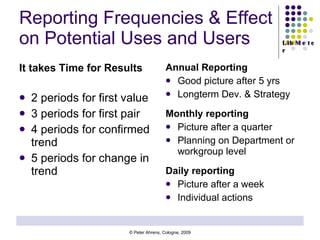
Reporting Frequencies & Effect on Potential Uses and Users It takes Time for Results 2 periods for first value 3 periods for first pair 4 periods for confirmed trend 5 periods for change in trend Annual Reporting Good picture after 5 yrs Longterm Dev. & Strategy Monthly reporting Picture after a quarter Planning on Department or workgroup level Daily reporting Picture after a week Individual actions
Usage Stats  Theory Part II  Analysis &   Interpretation  (Sorry some Maths required!)
Digesting Usage Figures - I Determining Relevant Derivatives Help! Too many too confusing too large numbers ... Various Aspects of „Usage“ Baseline Figures Normalized and Standardized Figures Change-Rates Previous Periods (+/- Comparison with other Services) (+/- External Comparison) Ranking, Rating
Basic Terms IV Usage Counts and Derivatives Value Example: Downloads (D) Normalized Value or Ratio (per external basis) Example: Downloads per User (DpU) First Derivative (by time=rate) – per period Example: Downloads per User per Year (DpUpY) Second Derivative –> Trend  Example: Growth/Decline=Change (CoDpUpY) Third Derivative - > Trend Change Example: Acceleation/Slowdown (CoCoDpUpY)
Product Introduction Phases  My Own Idealized Schema Phase I – Breakout Accelleration from zero base Pattern A/B/C  0>+ / 0>++ / 0>+++ Low counts, quickly rising growth rate, very positive trend Timeline: 0 - 33 % Phase II – Growth (exponent.) +>+++ / ++>+++>++ / +++>0> --- Timeline: 34 – 66 % Phase III – Maturation Slowing Growth, to Plateau +++ / ++>0  / - >0 Timeline: 67 – 100 % I II III
From Library Service Introduction to  Product Life Cycle Approach Consider  a Library Service a Standard Product Apply  Theories from Econometrics to „Webometrics“ See Overlaps Substitution Cycles
Questions asked: How is the Library doing with eServices? How high is a specific usage ? Absolute / standardized / ranked / rated Where is Library/are Users heading ? Externally: Ranking compared to Peer-Institutions Other Countries  Internally Count development: Growth/Decline Increased Speed or Slowdown Reversal of current Trend  Comparison with potential alternative/competing Services
Which Library Decicisons are supported by Usage Figures ? CONTENT Acquisitions / Subscriptions Renewals Cancelations Newly identified content SERVICES Web Customer Communication Web Services, Interfaces & Features Computer System Investments Human Resource Allocation
LibMeter  Seminar Current Practise eUsage Reporting x
(Electronic) Library Role, Services & Usage
How Needs, Services, Usage & Community Value are related ? C O M M U N I T Y  with  N E E D S E R V I C E S C O P E U T I L I T Y USABILITY ACCESSIBILITY VISIBILITY AWARENESS USAGE ( = ACCEPTANCE) VALUE
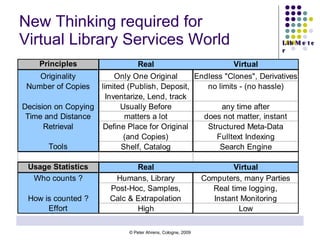
New Thinking required for  Virtual Library Services World
Who is your Customer ?  Many ways to count Users   Multiple Definitions for User Base Affiliated Users Primary users (Students, Staff) Guests (registered and others) Special User Groups (faculties, institutes etc.) Active Users Recurring Users (e.g. last 12 months) Power Users (frequent uses) Identification methods Individual Registration (OPAC for Borrowing, ILL, Copies) IP-based Log-In (+/- Proxy; -> Institutional IP-Domains) Other Authentication via single-sign-on, SHIBBOLETH
Selected Readings to broaden and to deepen your Understanding BIX  - Der Bibliotheksindex 2008. B.I.T.online Sonderheft. 2008 Juni ;1-56.    Blecic DD, Fiscella JB, Wiberley Jr SE .  Measurement of Use of Electronic Resources: Advances in Use Statistics and Innovations in Resource Functionality.  College and Research Libraries. 2007 ;68(1):26-44.    Ceynowa VK, Coners A . Balanced Scorecard für wissensch. Bibliotheken. Vittorio Klostermann; 2002.    Gallagher J, Bauer K, Dollar DM .  Evidence-based librarianship: Utilizing data from all available sources to make judicious print cancellation decisions.  Lib. Collections, Acq. & Tech. Serv.. 2005 ;29(2):169-179.    George Boston, Whang M . E-Resources Usage Data: Apples to Oranges and Fixing Holes   [Internet]. Atlanta: 2008. [zitiert 2009 Apr 22]  Available_from:http://209.85.129.132/search?q=cache:mj5wfYDT2BoJ:https://smartech.gatech.edu/bitstream/1853/20874/13/Boston_Whang_ERL_final.ppt+scholarly-stats+sfx&cd=4&hl=de&ct=clnk&gl=de&client=firefox-a  Hutzler E . Bibliotheken gestalten Zukunft : Kooperative Wege zur digitalen Bibliothek. Dr. Friedrich Geißelmann zum 65. Geburtstag. Universitätsverlag Göttingen; 2008.    Kreische J . Die Messung von Vernetzung. Nutzungsstatistiken mit SFX [Internet]. Münster: 2006.  Available from: http://docserv.uni-duesseldorf.de/servlets/DocumentServlet?id=9728  7. Kreische J . Zwischen Ranking und Qualitätsmanagement: BIX WB [Internet]. Mannheim: 2008.  Available from:  http://www.opus-bayern.de/bib-info/volltexte/2008/583/pdf/BIX%20Mannheim%20(Word%202003).pdf Poll R, te Boekhorst P , Measuring quality, Saur, München, 2007.     Lossau N . digital services in academic libraries. In: Digital Convergence - Libraries of the Future: Libraries of the Future‎.  Springer; 2008.    Shepherd P . The feasibility of developing and implementing journal usage factors: a research project sponsored by UKSG. Serials. 2007;20(2):117-123.
Special Thanks for critical & constructive discussions to: Joachim KREISCHE, ULB Düsseldorf Simone FÜHLES-UBACH, FH Köln Eric MULDER, Den Haag Marion MÜLLER , ULB Düsseldorf Jessica BUSCHMANN, Dortmund Nol VERHAGEN, UvA, Amsterdam Sylvia THIELE , UB Dortmund Britta RIEBSCHLÄGER , ULB Düsseldorf Peter KOSTÄDT, UB Köln
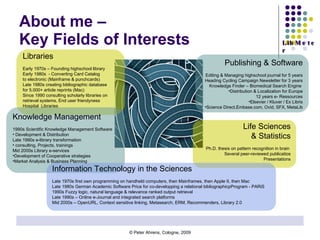
About me –  Key Fields of Interests Libraries Early 1970s – Founding highschool library Early 1980s  - Converting Card Catalog  to electronic (Mainframe & punchcards) Late 1980s creating bibliographic database  for 5.000+ article reprints (Mac)  Since 1990 consulting scholarly libraries on  retrieval systems, End user friendyness Hospital  Libraries  Life Sciences & Statistics Ph.D. thesis on pattern recognition in brain  Several peer-reviewed publicatios Presentations Publishing & Software Editing & Managing highschool journal for 5 years Heading Cycling Campaign Newsletter for 3 years Knowledge Finder – Biomedical Search Engine  Distribution & Localization for Europe 12 years e- Ressources Elsevier / Kluver / Ex Libris Science Direct,Embase.com, Ovid, SFX, MetaLib Knowledge Management 1990s Scientific Knowledge Management Software  Development & Distribution Late 1990s e-library transformation consulting, Projects, trainings Mid 2000s Library e-services Development of Cooperative strategies Market Analysis & Business Planning Information Technology in the Sciences Late 1970s first own programming on handheld computers, then Mainframes, then Apple II, then Mac Late 1980s German Academic Software Price for co-developping a relational bibliographicpProgram - PARiS 1990s Fuzzy logic, natural language & relevance ranked output retrieval Late 1990s – Online e-Journal and integrated search platforms Mid 2000s – OpenURL, Context sensitive linking, Metasearch, ERM, Recommenders, Library 2.0
LibMeter  Seminar The LibMeter Introduction Seminar  is continued with the following  Slideshare Presentations: Current Practice eUsage Reporting It also relates to: LibMeter Case Study #1 (University of Düsseldorf) x
LibMeter  Seminar Personal Announcement: It is intended to continue this series slowly  with further modules amongst others on: Detecting, following and predicting Usage-Trends Measuring Impact of e-Service Marketing Events International Library Comparisons Comparing Academic & Library Excellence x
LibMeter  Seminar The End ! Thank You Peter Ahrens libmeter-at-gmail.com x

LibMeter Seminar Introduction Basics

  • 1.
    Striving for Excellencewith Electronic Library Statistics Indicators for Performance Evaluation Introduction - Basics Institut für Informationswissenschaft, University of Applied Sciences, Cologne (FH-Köln IIW) Seminar on Library Evaluation (S. FÜHLES-UBACH) Peter Ahrens Guest Lecture V 1.00a – 2009-05-18 Cologne, 7th May 2009
  • 2.
    LibMeter SeminarThe LibMeter Introduction Seminar is continued with the following Slideshare Presentations: Current Practice eUsage Reporting It also relates to: LibMeter Case Study #1 (University of Düsseldorf) x
  • 3.
    Roadmap of thisPresentation Introduction - Basics I. Introduction - Basics A Quick Futuristic Web Tour Usage Stats for the Rest of Us (No Maths please!) Library Role, Services & Usage II. Introduction – Current Practise Where to get Usage Figures from ? How to interpret usage Figures ? LibMeter Case Studies III. Perspectives
  • 4.
    Roadmap of thisPresentation LibMeter Introduction Basics I. Introduction A Quick Futuristic Web Tour Usage Stats for the Rest of Us (No Maths please!) Library Role, Services & Usage II. Practise Where to get Usage Figures from ? How to interpret usage Figures ? LibMeter Case Studies III. Perspectives
  • 5.
    LibMeter SeminarIntroduction x
  • 6.
    Questions to StartAre you familiar with ? EZB DBIS DBS BIX DOI/CrossRef COUNTER OpenURL
  • 7.
    New Kind ofScience & Library Stats on Web 2.0
  • 8.
    Example for Webometrics:Ranking of World Universities http://www.webometrics.info/top100_continent.asp?cont=europe [2009-04-25]
  • 9.
    What „Google Insight“can tell about German Libraries and Archives ? (I) http://www.google.com/insights/search/# q=Anna%20amalia&cmpt=q [2009-05-18]
  • 10.
    What „Google Insight“tells about German Libraries and Archives II http://www.google.com/insights/search/#q=anna%20amalia%2Cstadtarchiv%20k%C3%B6ln&cmpt=q (2009-04-24)
  • 11.
    Usage Stats Theory Part I For the Rest of Us (No Maths please!)
  • 12.
    Basic Terms ILog Record of Events Count = Value = Figure Numerical Quantity Data Parameter Variable (numerical) value; Here: Output ! Indicator Something giving information Statistics = „Stats“ Collection of numerical data Analysis and Interpretation of Statistical Data
  • 13.
    Basic Terms IILogging Storing and preserving a File-record with detailed technical Information about all occuring service events (Web) Usage (figures or statistics) Quantitative parameters/values derived from filtering and processing Log-Files (aggregating, relating, normalizing) Usage monitoring = analysing (web) usage figures over time (longitudinal) or between services (transversal) Usability Degree of suitability of (web) service for purpose
  • 14.
    Basic Terms IIIPerformance Degree of Effectiveness (e.g. of work or a service) Ranking Position in Relation to others Working out Ranking Order Rating classification of something on a scale according to how much or how little of a quality it possesses Benchmarking Comparing against a standard against which something can be measured
  • 15.
    Reporting Frequencies &Effect on Potential Uses and Users It takes Time for Results 2 periods for first value 3 periods for first pair 4 periods for confirmed trend 5 periods for change in trend Annual Reporting Good picture after 5 yrs Longterm Dev. & Strategy Monthly reporting Picture after a quarter Planning on Department or workgroup level Daily reporting Picture after a week Individual actions
  • 16.
    Usage Stats Theory Part II Analysis & Interpretation (Sorry some Maths required!)
  • 17.
    Digesting Usage Figures- I Determining Relevant Derivatives Help! Too many too confusing too large numbers ... Various Aspects of „Usage“ Baseline Figures Normalized and Standardized Figures Change-Rates Previous Periods (+/- Comparison with other Services) (+/- External Comparison) Ranking, Rating
  • 18.
    Basic Terms IVUsage Counts and Derivatives Value Example: Downloads (D) Normalized Value or Ratio (per external basis) Example: Downloads per User (DpU) First Derivative (by time=rate) – per period Example: Downloads per User per Year (DpUpY) Second Derivative –> Trend Example: Growth/Decline=Change (CoDpUpY) Third Derivative - > Trend Change Example: Acceleation/Slowdown (CoCoDpUpY)
  • 19.
    Product Introduction Phases My Own Idealized Schema Phase I – Breakout Accelleration from zero base Pattern A/B/C 0>+ / 0>++ / 0>+++ Low counts, quickly rising growth rate, very positive trend Timeline: 0 - 33 % Phase II – Growth (exponent.) +>+++ / ++>+++>++ / +++>0> --- Timeline: 34 – 66 % Phase III – Maturation Slowing Growth, to Plateau +++ / ++>0 / - >0 Timeline: 67 – 100 % I II III
  • 20.
    From Library ServiceIntroduction to Product Life Cycle Approach Consider a Library Service a Standard Product Apply Theories from Econometrics to „Webometrics“ See Overlaps Substitution Cycles
  • 21.
    Questions asked: Howis the Library doing with eServices? How high is a specific usage ? Absolute / standardized / ranked / rated Where is Library/are Users heading ? Externally: Ranking compared to Peer-Institutions Other Countries Internally Count development: Growth/Decline Increased Speed or Slowdown Reversal of current Trend Comparison with potential alternative/competing Services
  • 22.
    Which Library Decicisonsare supported by Usage Figures ? CONTENT Acquisitions / Subscriptions Renewals Cancelations Newly identified content SERVICES Web Customer Communication Web Services, Interfaces & Features Computer System Investments Human Resource Allocation
  • 23.
    LibMeter SeminarCurrent Practise eUsage Reporting x
  • 24.
  • 25.
    How Needs, Services,Usage & Community Value are related ? C O M M U N I T Y with N E E D S E R V I C E S C O P E U T I L I T Y USABILITY ACCESSIBILITY VISIBILITY AWARENESS USAGE ( = ACCEPTANCE) VALUE
  • 26.
    New Thinking requiredfor Virtual Library Services World
  • 27.
    Who is yourCustomer ? Many ways to count Users Multiple Definitions for User Base Affiliated Users Primary users (Students, Staff) Guests (registered and others) Special User Groups (faculties, institutes etc.) Active Users Recurring Users (e.g. last 12 months) Power Users (frequent uses) Identification methods Individual Registration (OPAC for Borrowing, ILL, Copies) IP-based Log-In (+/- Proxy; -> Institutional IP-Domains) Other Authentication via single-sign-on, SHIBBOLETH
  • 28.
    Selected Readings tobroaden and to deepen your Understanding BIX - Der Bibliotheksindex 2008. B.I.T.online Sonderheft. 2008 Juni ;1-56.    Blecic DD, Fiscella JB, Wiberley Jr SE . Measurement of Use of Electronic Resources: Advances in Use Statistics and Innovations in Resource Functionality. College and Research Libraries. 2007 ;68(1):26-44.    Ceynowa VK, Coners A . Balanced Scorecard für wissensch. Bibliotheken. Vittorio Klostermann; 2002.    Gallagher J, Bauer K, Dollar DM . Evidence-based librarianship: Utilizing data from all available sources to make judicious print cancellation decisions. Lib. Collections, Acq. & Tech. Serv.. 2005 ;29(2):169-179.    George Boston, Whang M . E-Resources Usage Data: Apples to Oranges and Fixing Holes   [Internet]. Atlanta: 2008. [zitiert 2009 Apr 22] Available_from:http://209.85.129.132/search?q=cache:mj5wfYDT2BoJ:https://smartech.gatech.edu/bitstream/1853/20874/13/Boston_Whang_ERL_final.ppt+scholarly-stats+sfx&cd=4&hl=de&ct=clnk&gl=de&client=firefox-a  Hutzler E . Bibliotheken gestalten Zukunft : Kooperative Wege zur digitalen Bibliothek. Dr. Friedrich Geißelmann zum 65. Geburtstag. Universitätsverlag Göttingen; 2008.    Kreische J . Die Messung von Vernetzung. Nutzungsstatistiken mit SFX [Internet]. Münster: 2006. Available from: http://docserv.uni-duesseldorf.de/servlets/DocumentServlet?id=9728  7. Kreische J . Zwischen Ranking und Qualitätsmanagement: BIX WB [Internet]. Mannheim: 2008. Available from: http://www.opus-bayern.de/bib-info/volltexte/2008/583/pdf/BIX%20Mannheim%20(Word%202003).pdf Poll R, te Boekhorst P , Measuring quality, Saur, München, 2007.   Lossau N . digital services in academic libraries. In: Digital Convergence - Libraries of the Future: Libraries of the Future‎. Springer; 2008.    Shepherd P . The feasibility of developing and implementing journal usage factors: a research project sponsored by UKSG. Serials. 2007;20(2):117-123.
  • 29.
    Special Thanks forcritical & constructive discussions to: Joachim KREISCHE, ULB Düsseldorf Simone FÜHLES-UBACH, FH Köln Eric MULDER, Den Haag Marion MÜLLER , ULB Düsseldorf Jessica BUSCHMANN, Dortmund Nol VERHAGEN, UvA, Amsterdam Sylvia THIELE , UB Dortmund Britta RIEBSCHLÄGER , ULB Düsseldorf Peter KOSTÄDT, UB Köln
  • 30.
    About me – Key Fields of Interests Libraries Early 1970s – Founding highschool library Early 1980s - Converting Card Catalog to electronic (Mainframe & punchcards) Late 1980s creating bibliographic database for 5.000+ article reprints (Mac) Since 1990 consulting scholarly libraries on retrieval systems, End user friendyness Hospital Libraries Life Sciences & Statistics Ph.D. thesis on pattern recognition in brain Several peer-reviewed publicatios Presentations Publishing & Software Editing & Managing highschool journal for 5 years Heading Cycling Campaign Newsletter for 3 years Knowledge Finder – Biomedical Search Engine Distribution & Localization for Europe 12 years e- Ressources Elsevier / Kluver / Ex Libris Science Direct,Embase.com, Ovid, SFX, MetaLib Knowledge Management 1990s Scientific Knowledge Management Software Development & Distribution Late 1990s e-library transformation consulting, Projects, trainings Mid 2000s Library e-services Development of Cooperative strategies Market Analysis & Business Planning Information Technology in the Sciences Late 1970s first own programming on handheld computers, then Mainframes, then Apple II, then Mac Late 1980s German Academic Software Price for co-developping a relational bibliographicpProgram - PARiS 1990s Fuzzy logic, natural language & relevance ranked output retrieval Late 1990s – Online e-Journal and integrated search platforms Mid 2000s – OpenURL, Context sensitive linking, Metasearch, ERM, Recommenders, Library 2.0
  • 31.
    LibMeter SeminarThe LibMeter Introduction Seminar is continued with the following Slideshare Presentations: Current Practice eUsage Reporting It also relates to: LibMeter Case Study #1 (University of Düsseldorf) x
  • 32.
    LibMeter SeminarPersonal Announcement: It is intended to continue this series slowly with further modules amongst others on: Detecting, following and predicting Usage-Trends Measuring Impact of e-Service Marketing Events International Library Comparisons Comparing Academic & Library Excellence x
  • 33.
    LibMeter SeminarThe End ! Thank You Peter Ahrens libmeter-at-gmail.com x