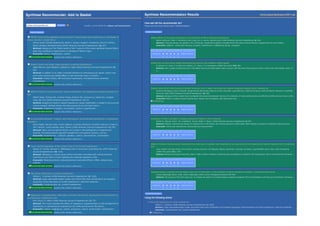
Recommendations
and the Library


Nettie Lagace
Product Manager, Ex Libris
Copyright Statement
All of the information and material inclusive of text, images, logos, product names is either the
property of, or used with permission by Ex Libris Ltd. The information may not be distributed,
modified, displayed, reproduced – in whole or in part – without the prior written permission of
Ex Libris Ltd.

TRADEMARKS
Ex Libris, the Ex Libris logo, Aleph, SFX, SFXIT, MetaLib, DigiTool, Verde, Primo, Voyager,
MetaSearch, MetaIndex, bX and other Ex Libris products and services referenced herein are
trademarks of Ex Libris, and may be registered in certain jurisdictions. All other product names,
company names, marks and logos referenced may be trademarks of their respective owners.

DISCLAIMER
The information contained in this document is compiled from various sources and provided on an
"AS IS" basis for general information purposes only without any representations, conditions or
warranties whether express or implied, including any implied warranties of satisfactory quality,
completeness, accuracy or fitness for a particular purpose.


Ex Libris, its subsidiaries and related corporations ("Ex Libris Group") disclaim any and all liability
for all use of this information, including losses, damages, claims or expenses any person may
incur as a result of the use of this information, even if advised of the possibility of such loss or
damage.


© Ex Libris Ltd., 2009
Agenda

•   What will the future be like?
•   Recommender systems in general
•   “In the Wild”
•   New scholarly environments
•   Article recommenders
•   Interfaces
•   Contributions
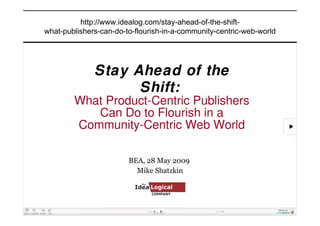
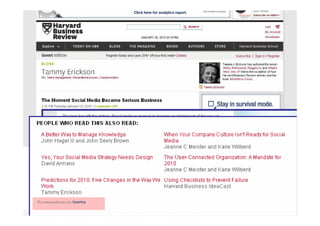
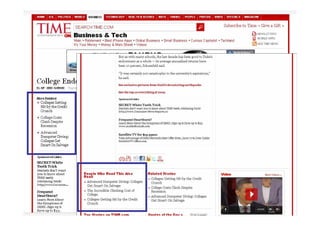
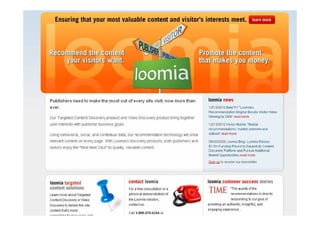
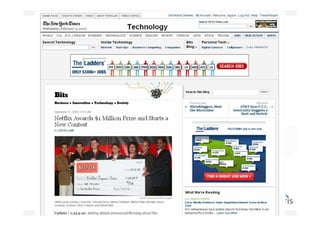
http://www.idealog.com/stay-ahead-of-the-shift-
what-publishers-can-do-to-flourish-in-a-community-centric-web-world
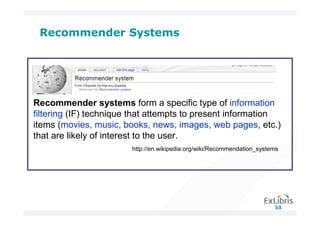
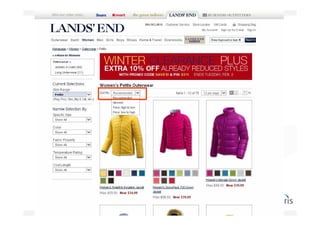
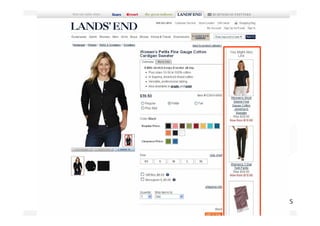
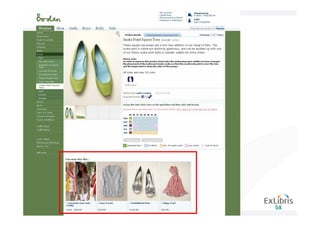
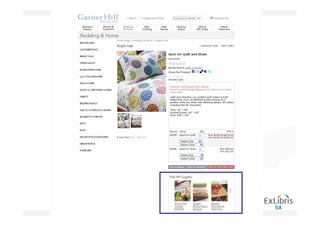
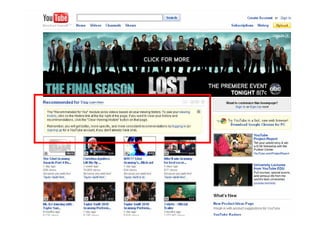
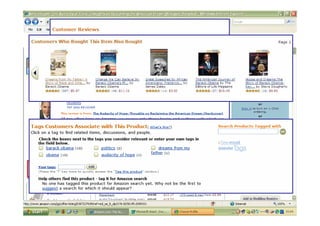
Recommender Systems


Recommender systems form a specific type of information
filtering (IF) technique that attempts to present information
items (movies, music, books, news, images, web pages, etc.)
that are likely of interest to the user.
                        http://en.wikipedia.org/wiki/Recommendation_systems
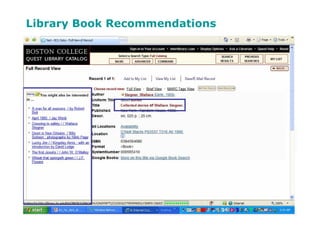
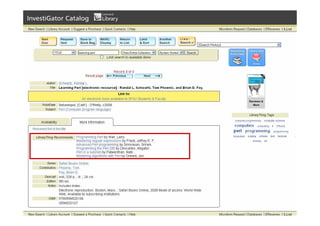
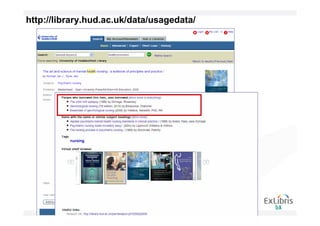
Library Book Recommendations
http://library.hud.ac.uk/data/usagedata/
Changes in Scholarly Communication
• Greater focus on content users create and
  choices & preferences they make

• User contribution increasingly important
     • Contributed explicitly by individuals


• The Web is multi-directional
Changes in Scholarly Communication
• Greater focus on content users create and
  choices & preferences they make

• User contribution increasingly important
     • Contributed explicitly by individuals
      • Implicitly - usage data captured by the
        system (‘clickstreams’)


• The Web is multi-directional
There is a need

• Information overload calls for new tools
  that assist users in finding relevant
  information
• Useful in the context of:
   • learning
   • exploring new fields of interest
   • inter-disciplinary work
   • specific information needs that are
     outside one’s field of expertise
• Search is NOT the only way to find…
Scholarly Recommender Service

Need to:
  • Focus on scholarly materials – particularly
    articles (core unit of use)
  • Be based on structural analysis of usage and
    not just based on popularity
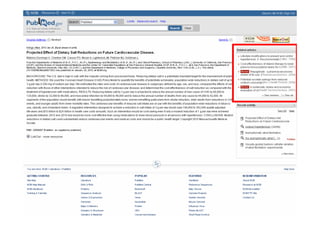
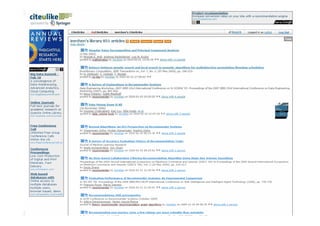
CiteULike Recommendations

/embedded video removed from PPT – see
http://www.youtube.com/watch?v=ium2fS1LW5w
What is bX?
• A service which taps into the power of the
  networked scholarly community to
  generate recommendations based on
  article usage
• Based on data mining and structural
  analysis of aggregated usage data,
  across libraries and scholarly information
  environments
   • Massive repository of user data -
     growing
• Derives from research done at Los
  Alamos National Laboratory by Johan
  Bollen and Herbert Van de Sompel
Interest in usage-based measures

• COUNTER – www.projectcounter.org
• SUSHI - www.niso.org/workrooms/sushi
• JISC MOSAIC – www.sero.co.uk/jisc-mosaic.html
• Metrics for scholarly evaluation:
   • UKSG Usage Factors project
     - uksg.org/usagefactors
   • Project MESUR - www.mesur.org
Implicit user contribution

• Circulation data
• Clickstreams, recording a search process
• Actions
   • Item viewed
   • Item downloaded
   • Item sent
   • Item bookmarked
   • Item printed
   • Item stored
Potential uses of implicit contribution
• Collection development
• Evaluation
• Trend analysis
• Relevance ranking
• Recommendations
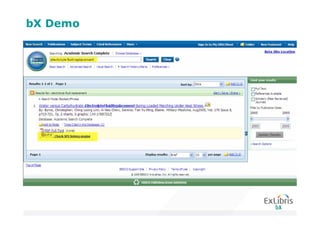
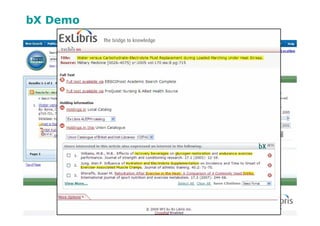
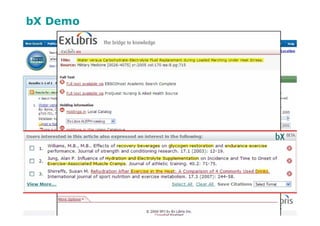
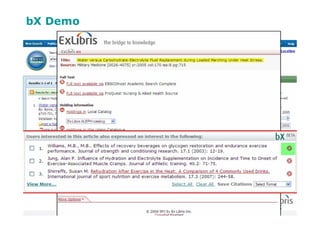
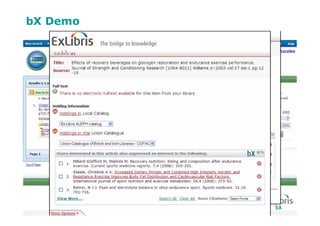
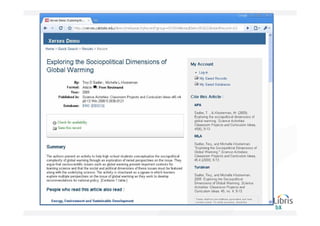
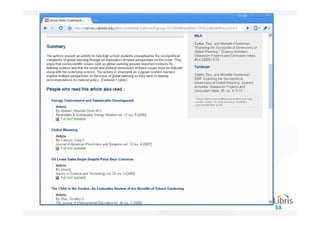
bX Demo
bX Demo
bX Demo
bX Demo
bX Demo
Link resolver usage logs

 • A good basis:
    • Represent users’ information-seeking paths
      in a standardized way
    • Are across information providers
    • Are across institutions
 • There are a lot of them
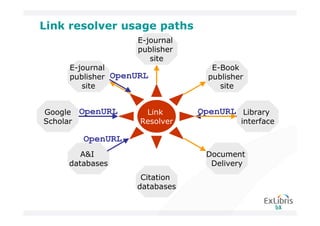
Link resolver usage paths
                  E-journal
                  publisher
                     site
    E-journal                    E-Book
    publisher OpenURL           publisher
       site                        site


Google OpenURL      Link      OpenURL Library
Scholar            Resolver             interface

       OpenURL
       A&I                     Document
    databases                   Delivery
                   Citation
                  databases
Built on OpenURL
• Usage data –OpenURL context objects-- is
  harvested from link resolver logs through OAI-PMH
• Build a (very large) aggregate of usage data
• Mine the aggregate to derive scholarly
  recommender services: a structure describing
  relationships between scholarly materials is created
• bX receives OpenURL requests
• A list of recommended materials is generated per
  request
   • open interface - accessible via API
   • viewable via SFX menu, other discovery
     interfaces
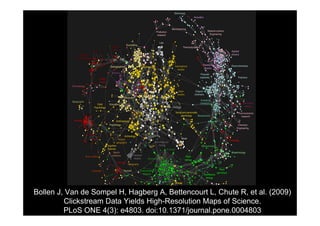
Bollen J, Van de Sompel H, Hagberg A, Bettencourt L, Chute R, et al. (2009)
         Clickstream Data Yields High-Resolution Maps of Science.
         PLoS ONE 4(3): e4803. doi:10.1371/journal.pone.0004803
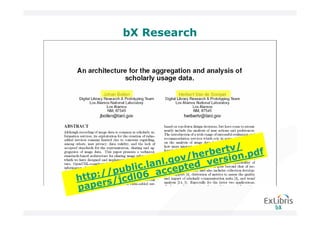
bX Research


                            rbertv/ .pdf
                      o v/he version
               .lanl.g pted_
        p ublic _acce
ht tp:// jcdl06
pa  pers/
More about the interaction with bX

• Request to bX is sent through an API
• Results are returned as
   • XML (default)
   • Text
   • ATOM
   • RSS
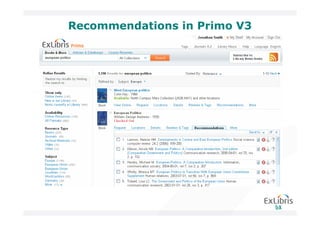
Recommendations in Primo V3
Benefits of bX Contribution
       • Ongoing analysis of SFX
         usage data created by
         library users
       • Continual improvement of
         recommendations
       • Cooperation with other
         research library sites – on a
         grand scale
What do people say?
“JSTOR meets Amazon!?”
              - ELUNA twitterer

“On May 5, Ex Libris rolled out the shiny new fabulousness
   that is bX. … (turns) the Services Menu into a point-of-
   need discovery tool. I think this is awesome. ”
                  - Jamene Brooks-Kieffer, Kansas State Univ.

“I found exactly what I wanted. I've already found even more relevant
    articles in 10 minutes than I've found in the last 10 months using more
    traditional methods of research.”
                   - Ph.D. student, Arizona State University

“I’m always trying to find new connections between biological systems. This
    looks like a really useful tool for this discovery. I’m interested in seeing
    others’ connections. An unknown system can link to one which is well-
    studied.”
                   - Laboratory director, University of Ottawa Heart Institute

“One thing I've noticed and got a few comments about is that the increase in
   amount of recommendations has been noticeable from last summer to
   now. Now it's much easier (to find recommendations). The recommendations
   seem … relevant”
                 - Systems librarian, FinELib
“The Web, they say, is leaving the era of
search and entering one of discovery.
What's the difference? Search is what you
do when you're looking for something.
Discovery is when something wonderful
that you didn't know existed, or didn't
know how to ask for, finds you.“


Jeffrey M. O’Brien, "The race to create a 'smart' Google“
http://money.cnn.com/magazines/fortune/fortune_archive/
2006/11/27/8394347/
Thank you!


nettie.lagace@exlibrisgroup.com

Recommendation and the Library

  • 1.
    Recommendations and the Library NettieLagace Product Manager, Ex Libris
  • 2.
    Copyright Statement All ofthe information and material inclusive of text, images, logos, product names is either the property of, or used with permission by Ex Libris Ltd. The information may not be distributed, modified, displayed, reproduced – in whole or in part – without the prior written permission of Ex Libris Ltd. TRADEMARKS Ex Libris, the Ex Libris logo, Aleph, SFX, SFXIT, MetaLib, DigiTool, Verde, Primo, Voyager, MetaSearch, MetaIndex, bX and other Ex Libris products and services referenced herein are trademarks of Ex Libris, and may be registered in certain jurisdictions. All other product names, company names, marks and logos referenced may be trademarks of their respective owners. DISCLAIMER The information contained in this document is compiled from various sources and provided on an "AS IS" basis for general information purposes only without any representations, conditions or warranties whether express or implied, including any implied warranties of satisfactory quality, completeness, accuracy or fitness for a particular purpose. Ex Libris, its subsidiaries and related corporations ("Ex Libris Group") disclaim any and all liability for all use of this information, including losses, damages, claims or expenses any person may incur as a result of the use of this information, even if advised of the possibility of such loss or damage. © Ex Libris Ltd., 2009
  • 3.
    Agenda • What will the future be like? • Recommender systems in general • “In the Wild” • New scholarly environments • Article recommenders • Interfaces • Contributions
  • 4.
  • 5.
    Recommender Systems Recommender systemsform a specific type of information filtering (IF) technique that attempts to present information items (movies, music, books, news, images, web pages, etc.) that are likely of interest to the user. http://en.wikipedia.org/wiki/Recommendation_systems
  • 16.
  • 18.
  • 19.
    Changes in ScholarlyCommunication • Greater focus on content users create and choices & preferences they make • User contribution increasingly important • Contributed explicitly by individuals • The Web is multi-directional
  • 20.
    Changes in ScholarlyCommunication • Greater focus on content users create and choices & preferences they make • User contribution increasingly important • Contributed explicitly by individuals • Implicitly - usage data captured by the system (‘clickstreams’) • The Web is multi-directional
  • 21.
    There is aneed • Information overload calls for new tools that assist users in finding relevant information • Useful in the context of: • learning • exploring new fields of interest • inter-disciplinary work • specific information needs that are outside one’s field of expertise • Search is NOT the only way to find…
  • 22.
    Scholarly Recommender Service Needto: • Focus on scholarly materials – particularly articles (core unit of use) • Be based on structural analysis of usage and not just based on popularity
  • 25.
    CiteULike Recommendations /embedded videoremoved from PPT – see http://www.youtube.com/watch?v=ium2fS1LW5w
  • 27.
    What is bX? •A service which taps into the power of the networked scholarly community to generate recommendations based on article usage • Based on data mining and structural analysis of aggregated usage data, across libraries and scholarly information environments • Massive repository of user data - growing • Derives from research done at Los Alamos National Laboratory by Johan Bollen and Herbert Van de Sompel
  • 28.
    Interest in usage-basedmeasures • COUNTER – www.projectcounter.org • SUSHI - www.niso.org/workrooms/sushi • JISC MOSAIC – www.sero.co.uk/jisc-mosaic.html • Metrics for scholarly evaluation: • UKSG Usage Factors project - uksg.org/usagefactors • Project MESUR - www.mesur.org
  • 29.
    Implicit user contribution •Circulation data • Clickstreams, recording a search process • Actions • Item viewed • Item downloaded • Item sent • Item bookmarked • Item printed • Item stored
  • 31.
    Potential uses ofimplicit contribution • Collection development • Evaluation • Trend analysis • Relevance ranking • Recommendations
  • 32.
  • 33.
  • 34.
  • 35.
  • 36.
  • 37.
    Link resolver usagelogs • A good basis: • Represent users’ information-seeking paths in a standardized way • Are across information providers • Are across institutions • There are a lot of them
  • 38.
    Link resolver usagepaths E-journal publisher site E-journal E-Book publisher OpenURL publisher site site Google OpenURL Link OpenURL Library Scholar Resolver interface OpenURL A&I Document databases Delivery Citation databases
  • 39.
    Built on OpenURL •Usage data –OpenURL context objects-- is harvested from link resolver logs through OAI-PMH • Build a (very large) aggregate of usage data • Mine the aggregate to derive scholarly recommender services: a structure describing relationships between scholarly materials is created • bX receives OpenURL requests • A list of recommended materials is generated per request • open interface - accessible via API • viewable via SFX menu, other discovery interfaces
  • 40.
    Bollen J, Vande Sompel H, Hagberg A, Bettencourt L, Chute R, et al. (2009) Clickstream Data Yields High-Resolution Maps of Science. PLoS ONE 4(3): e4803. doi:10.1371/journal.pone.0004803
  • 41.
    bX Research rbertv/ .pdf o v/he version .lanl.g pted_ p ublic _acce ht tp:// jcdl06 pa pers/
  • 42.
    More about theinteraction with bX • Request to bX is sent through an API • Results are returned as • XML (default) • Text • ATOM • RSS
  • 43.
  • 46.
    Benefits of bXContribution • Ongoing analysis of SFX usage data created by library users • Continual improvement of recommendations • Cooperation with other research library sites – on a grand scale
  • 47.
    What do peoplesay? “JSTOR meets Amazon!?” - ELUNA twitterer “On May 5, Ex Libris rolled out the shiny new fabulousness that is bX. … (turns) the Services Menu into a point-of- need discovery tool. I think this is awesome. ” - Jamene Brooks-Kieffer, Kansas State Univ. “I found exactly what I wanted. I've already found even more relevant articles in 10 minutes than I've found in the last 10 months using more traditional methods of research.” - Ph.D. student, Arizona State University “I’m always trying to find new connections between biological systems. This looks like a really useful tool for this discovery. I’m interested in seeing others’ connections. An unknown system can link to one which is well- studied.” - Laboratory director, University of Ottawa Heart Institute “One thing I've noticed and got a few comments about is that the increase in amount of recommendations has been noticeable from last summer to now. Now it's much easier (to find recommendations). The recommendations seem … relevant” - Systems librarian, FinELib
  • 48.
    “The Web, theysay, is leaving the era of search and entering one of discovery. What's the difference? Search is what you do when you're looking for something. Discovery is when something wonderful that you didn't know existed, or didn't know how to ask for, finds you.“ Jeffrey M. O’Brien, "The race to create a 'smart' Google“ http://money.cnn.com/magazines/fortune/fortune_archive/ 2006/11/27/8394347/
  • 49.