Datavi$
Negotiate Resource Pricing Using Data Visualization
Stephanie J. Spratt
sspratt@missouriwestern.edu
Missouri Western State University
NASIG 2017
Agenda and Goal
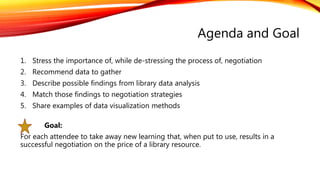
1. Stress the importance of, while de-stressing the process of, negotiation
2. Recommend data to gather
3. Describe possible findings from library data analysis
4. Match those findings to negotiation strategies
5. Share examples of data visualization methods
Goal:
For each attendee to take away new learning that, when put to use, results in a
successful negotiation on the price of a library resource.
Why so wordy?
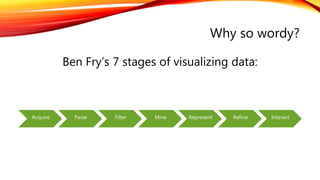
Ben Fry’s 7 stages of visualizing data:
Acquire Parse Filter Mine Represent Refine Interact
Why so wordy?
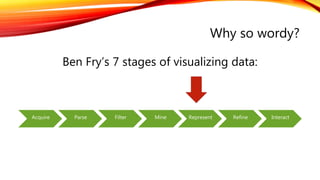
Ben Fry’s 7 stages of visualizing data:
Acquire Parse Filter Mine Represent Refine Interact
Why so wordy?
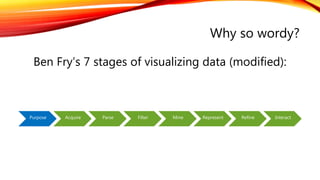
Ben Fry’s 7 stages of visualizing data (modified):
Purpose Acquire Parse Filter Mine Represent Refine Interact
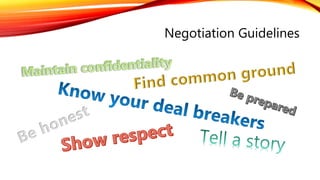
Negotiation Guidelines
Useful Data to Collect
• Significant events for the library or institution
• Annual library budget (commonly split by format)
• Resource costs
• Resource usage
• Total spending by vendor
• Unique holdings by product
• Count of service requests to vendor
Calculations from Collected Data
• Resource inflation by product
• Cost-per-use (CPU)
• Percent of total spending by vendor
• Average pay-per-view article fees
• Benefits of resources
• Cost-benefit analysis (CBA)
• Return on investment (ROI)
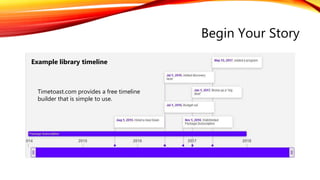
Begin Your Story
Timetoast.com provides a free timeline
builder that is simple to use.
Example library timeline
Common Scenarios
1. Library budget decreases, while resource prices increase
Common Scenarios
1. Library budget decreases, while resource prices increase
If you can avoid cancelling, tell the
vendor at what price you can
afford to renew.
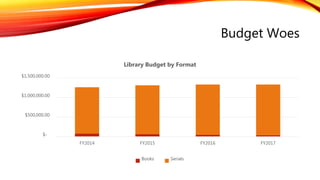
Budget Woes
$-
$500,000.00
$1,000,000.00
$1,500,000.00
FY2014 FY2015 FY2016 FY2017
Library Budget by Format
Books Serials
Common Scenarios
1. Library budget decreases, while resource prices increase
2. Cost of resource is higher than average
Common Scenarios
1. Library budget decreases, while resource prices increase
2. Cost of resource is higher than average
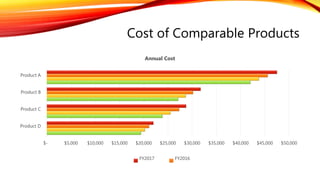
Request that vendor bring price
down to something closer to an
average price.
Cost of Comparable Products
$- $5,000 $10,000 $15,000 $20,000 $25,000 $30,000 $35,000 $40,000 $45,000 $50,000
Product A
Product B
Product C
Product D
Annual Cost
FY2017 FY2016
Common Scenarios
1. Library budget decreases, while resource prices increase
2. Cost of resource is higher than average
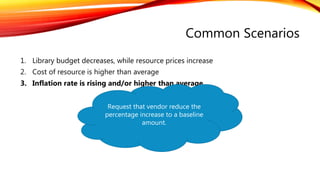
3. Inflation rate is rising and/or higher than average
Common Scenarios
1. Library budget decreases, while resource prices increase
2. Cost of resource is higher than average
3. Inflation rate is rising and/or higher than average
Request that vendor reduce the
percentage increase to a baseline
amount.
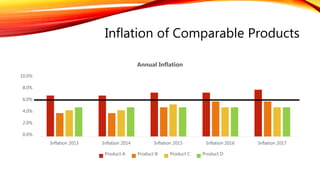
Inflation of Comparable Products
0.0%
2.0%
4.0%
6.0%
8.0%
10.0%
Inflation 2013 Inflation 2014 Inflation 2015 Inflation 2016 Inflation 2017
Annual Inflation
Product A Product B Product C Product D
Common Scenarios
1. Library budget decreases, while resource prices increase
2. Cost of resource is higher than average
3. Inflation rate is rising and/or higher than average
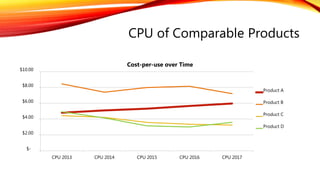
4. CPU is steadily rising
5. Usage is dropping
Common Scenarios
1. Library budget decreases, while resource prices increase
2. Cost of resource is higher than average
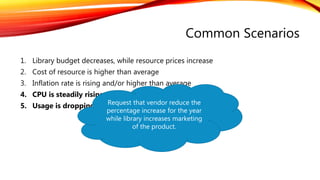
3. Inflation rate is rising and/or higher than average
4. CPU is steadily rising
5. Usage is dropping Request that vendor reduce the
percentage increase for the year
while library increases marketing
of the product.
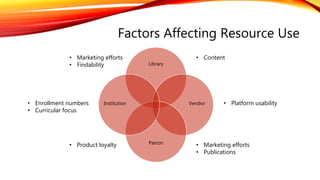
Factors Affecting Resource Use
Library
Vendor
Patron
Institution • Platform usability
• Content
• Product loyalty
• Enrollment numbers
• Curricular focus
• Marketing efforts
• Publications
• Marketing efforts
• Findability
CPU of Comparable Products
$-
$2.00
$4.00
$6.00
$8.00
$10.00
CPU 2013 CPU 2014 CPU 2015 CPU 2016 CPU 2017
Cost-per-use over Time
Product A
Product B
Product C
Product D
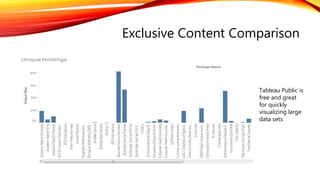
Exclusive Content Comparison
Tableau Public is
free and great
for quickly
visualizing large
data sets
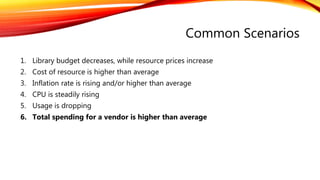
Common Scenarios
1. Library budget decreases, while resource prices increase
2. Cost of resource is higher than average
3. Inflation rate is rising and/or higher than average
4. CPU is steadily rising
5. Usage is dropping
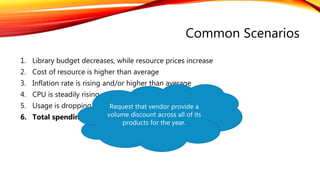
6. Total spending for a vendor is higher than average
Common Scenarios
1. Library budget decreases, while resource prices increase
2. Cost of resource is higher than average
3. Inflation rate is rising and/or higher than average
4. CPU is steadily rising
5. Usage is dropping
6. Total spending for a vendor is higher than average
Request that vendor provide a
volume discount across all of its
products for the year.
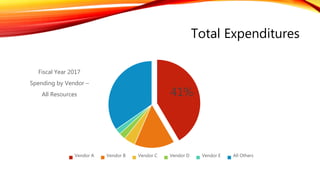
Total Expenditures
41%
Fiscal Year 2017
Spending by Vendor –
All Resources
Vendor A Vendor B Vendor C Vendor D Vendor E All Others
Common Scenarios
1. Library budget decreases, while resource prices increase
2. Cost of resource is higher than average
3. Inflation rate is rising and/or higher than average
4. CPU is steadily rising
5. Usage is dropping
6. Total spending for a vendor is higher than average
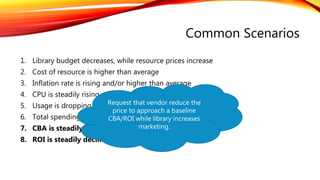
7. CBA is steadily declining
8. ROI is steadily declining
Common Scenarios
1. Library budget decreases, while resource prices increase
2. Cost of resource is higher than average
3. Inflation rate is rising and/or higher than average
4. CPU is steadily rising
5. Usage is dropping
6. Total spending for a vendor is higher than average
7. CBA is steadily declining
8. ROI is steadily declining
Request that vendor reduce the
price to approach a baseline
CBA/ROI while library increases
marketing.
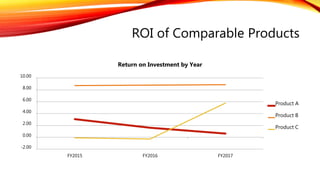
ROI of Comparable Products
-2.00
0.00
2.00
4.00
6.00
8.00
10.00
FY2015 FY2016 FY2017
Return on Investment by Year
Product A
Product B
Product C
Common Scenarios
1. Library budget decreases, while resource prices increase
2. Cost of resource is higher than average
3. Inflation rate is rising and/or higher than average
4. CPU is steadily rising
5. Usage is dropping
6. Total spending for a vendor is higher than average
7. CBA is steadily declining
8. ROI is steadily declining
9. Service needs are declining
Common Scenarios
1. Library budget decreases, while resource prices increase
2. Cost of resource is higher than average
3. Inflation rate is rising and/or higher than average
4. CPU is steadily rising
5. Usage is dropping
6. Total spending for a vendor is higher than average
7. CBA is steadily declining
8. ROI is steadily declining
9. Service needs are declining
Request that vendor lower the
service fee.
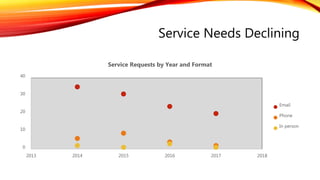
Service Needs Declining
0
10
20
30
40
2013 2014 2015 2016 2017 2018
Service Requests by Year and Format
Email
Phone
In person
Additional Strategies to Try
• Reduce or lengthen the typical 12-month subscription period
• Changes the amount you owe for one fiscal year
• May extend the inflation rate beyond 12 months
• Request a temporary waiver of hosting fees
• Consolidate consortial partnerships
Wrapping Up
• Anticipate counter-offers
• Inflation rate higher than your proposal
• Multi-year commitments
• Purchase or lease additional resources from the vendor
• Know your deal breakers
• Do not be afraid to cancel if you have exhausted other options
• Avoid hard negotiation with the same vendor year after year
• Secure support from your administration
• Document the process and outcome
Tools Used
• EBSCO Holdings Management
• Microsoft Excel
• Microsoft Power Point
• Tableau Public
• TimeToast.com
References
Bosch, S. & Henderson, K. (2017). New world, same model. Library Journal, 142(7),
40-45.
Brigham, T. J. (2016). Feast for the eyes: An introduction to data visualization.
Medical Reference Services Quarterly, 35(2), 215-223. doi:
10.1080/02763869.2016.1152146
Brown, A. (2012). Assertive negotiation for librarians [PowerPoint slides]. Retrieved
from http://molib.org/2014archive/conference/2012/presentations/
assertivenegotiation.pdf
References (cont.)
Dygert, C. & Barrett, H. (2016). Building your licensing and negotiation skills toolkit.
The Serials Librarian, 70(1-4), 333-342. doi: 10.1080/0361526X.2016.1157008
Fry, B. (2007). The seven stages of visualizing data. In Visualizing data (chapter 1).
Retrieved from https://www.safaribooksonline.com/library/view/visualizing-
data/9780596514556/ch01.html
Peet, L., Schwartz, M., & Enis, M. (2017). Conference catch-up: The 2017 ACRL and
ER&L conferences covered trends ranging from diversity to emerging technology.
Library Journal, 142(8), 34-36.

Datavi$: Negotiate Resource Pricing Using Data Visualization

  • 1.
    Datavi$ Negotiate Resource PricingUsing Data Visualization Stephanie J. Spratt sspratt@missouriwestern.edu Missouri Western State University NASIG 2017
  • 2.
    Agenda and Goal 1.Stress the importance of, while de-stressing the process of, negotiation 2. Recommend data to gather 3. Describe possible findings from library data analysis 4. Match those findings to negotiation strategies 5. Share examples of data visualization methods Goal: For each attendee to take away new learning that, when put to use, results in a successful negotiation on the price of a library resource.
  • 3.
    Why so wordy? BenFry’s 7 stages of visualizing data: Acquire Parse Filter Mine Represent Refine Interact
  • 4.
    Why so wordy? BenFry’s 7 stages of visualizing data: Acquire Parse Filter Mine Represent Refine Interact
  • 5.
    Why so wordy? BenFry’s 7 stages of visualizing data (modified): Purpose Acquire Parse Filter Mine Represent Refine Interact
  • 6.
  • 7.
    Useful Data toCollect • Significant events for the library or institution • Annual library budget (commonly split by format) • Resource costs • Resource usage • Total spending by vendor • Unique holdings by product • Count of service requests to vendor
  • 8.
    Calculations from CollectedData • Resource inflation by product • Cost-per-use (CPU) • Percent of total spending by vendor • Average pay-per-view article fees • Benefits of resources • Cost-benefit analysis (CBA) • Return on investment (ROI)
  • 9.
    Begin Your Story Timetoast.comprovides a free timeline builder that is simple to use. Example library timeline
  • 10.
    Common Scenarios 1. Librarybudget decreases, while resource prices increase
  • 11.
    Common Scenarios 1. Librarybudget decreases, while resource prices increase If you can avoid cancelling, tell the vendor at what price you can afford to renew.
  • 12.
    Budget Woes $- $500,000.00 $1,000,000.00 $1,500,000.00 FY2014 FY2015FY2016 FY2017 Library Budget by Format Books Serials
  • 13.
    Common Scenarios 1. Librarybudget decreases, while resource prices increase 2. Cost of resource is higher than average
  • 14.
    Common Scenarios 1. Librarybudget decreases, while resource prices increase 2. Cost of resource is higher than average Request that vendor bring price down to something closer to an average price.
  • 15.
    Cost of ComparableProducts $- $5,000 $10,000 $15,000 $20,000 $25,000 $30,000 $35,000 $40,000 $45,000 $50,000 Product A Product B Product C Product D Annual Cost FY2017 FY2016
  • 16.
    Common Scenarios 1. Librarybudget decreases, while resource prices increase 2. Cost of resource is higher than average 3. Inflation rate is rising and/or higher than average
  • 17.
    Common Scenarios 1. Librarybudget decreases, while resource prices increase 2. Cost of resource is higher than average 3. Inflation rate is rising and/or higher than average Request that vendor reduce the percentage increase to a baseline amount.
  • 18.
    Inflation of ComparableProducts 0.0% 2.0% 4.0% 6.0% 8.0% 10.0% Inflation 2013 Inflation 2014 Inflation 2015 Inflation 2016 Inflation 2017 Annual Inflation Product A Product B Product C Product D
  • 19.
    Common Scenarios 1. Librarybudget decreases, while resource prices increase 2. Cost of resource is higher than average 3. Inflation rate is rising and/or higher than average 4. CPU is steadily rising 5. Usage is dropping
  • 20.
    Common Scenarios 1. Librarybudget decreases, while resource prices increase 2. Cost of resource is higher than average 3. Inflation rate is rising and/or higher than average 4. CPU is steadily rising 5. Usage is dropping Request that vendor reduce the percentage increase for the year while library increases marketing of the product.
  • 21.
    Factors Affecting ResourceUse Library Vendor Patron Institution • Platform usability • Content • Product loyalty • Enrollment numbers • Curricular focus • Marketing efforts • Publications • Marketing efforts • Findability
  • 22.
    CPU of ComparableProducts $- $2.00 $4.00 $6.00 $8.00 $10.00 CPU 2013 CPU 2014 CPU 2015 CPU 2016 CPU 2017 Cost-per-use over Time Product A Product B Product C Product D
  • 23.
    Exclusive Content Comparison TableauPublic is free and great for quickly visualizing large data sets
  • 24.
    Common Scenarios 1. Librarybudget decreases, while resource prices increase 2. Cost of resource is higher than average 3. Inflation rate is rising and/or higher than average 4. CPU is steadily rising 5. Usage is dropping 6. Total spending for a vendor is higher than average
  • 25.
    Common Scenarios 1. Librarybudget decreases, while resource prices increase 2. Cost of resource is higher than average 3. Inflation rate is rising and/or higher than average 4. CPU is steadily rising 5. Usage is dropping 6. Total spending for a vendor is higher than average Request that vendor provide a volume discount across all of its products for the year.
  • 26.
    Total Expenditures 41% Fiscal Year2017 Spending by Vendor – All Resources Vendor A Vendor B Vendor C Vendor D Vendor E All Others
  • 27.
    Common Scenarios 1. Librarybudget decreases, while resource prices increase 2. Cost of resource is higher than average 3. Inflation rate is rising and/or higher than average 4. CPU is steadily rising 5. Usage is dropping 6. Total spending for a vendor is higher than average 7. CBA is steadily declining 8. ROI is steadily declining
  • 28.
    Common Scenarios 1. Librarybudget decreases, while resource prices increase 2. Cost of resource is higher than average 3. Inflation rate is rising and/or higher than average 4. CPU is steadily rising 5. Usage is dropping 6. Total spending for a vendor is higher than average 7. CBA is steadily declining 8. ROI is steadily declining Request that vendor reduce the price to approach a baseline CBA/ROI while library increases marketing.
  • 29.
    ROI of ComparableProducts -2.00 0.00 2.00 4.00 6.00 8.00 10.00 FY2015 FY2016 FY2017 Return on Investment by Year Product A Product B Product C
  • 30.
    Common Scenarios 1. Librarybudget decreases, while resource prices increase 2. Cost of resource is higher than average 3. Inflation rate is rising and/or higher than average 4. CPU is steadily rising 5. Usage is dropping 6. Total spending for a vendor is higher than average 7. CBA is steadily declining 8. ROI is steadily declining 9. Service needs are declining
  • 31.
    Common Scenarios 1. Librarybudget decreases, while resource prices increase 2. Cost of resource is higher than average 3. Inflation rate is rising and/or higher than average 4. CPU is steadily rising 5. Usage is dropping 6. Total spending for a vendor is higher than average 7. CBA is steadily declining 8. ROI is steadily declining 9. Service needs are declining Request that vendor lower the service fee.
  • 32.
    Service Needs Declining 0 10 20 30 40 20132014 2015 2016 2017 2018 Service Requests by Year and Format Email Phone In person
  • 33.
    Additional Strategies toTry • Reduce or lengthen the typical 12-month subscription period • Changes the amount you owe for one fiscal year • May extend the inflation rate beyond 12 months • Request a temporary waiver of hosting fees • Consolidate consortial partnerships
  • 34.
    Wrapping Up • Anticipatecounter-offers • Inflation rate higher than your proposal • Multi-year commitments • Purchase or lease additional resources from the vendor • Know your deal breakers • Do not be afraid to cancel if you have exhausted other options • Avoid hard negotiation with the same vendor year after year • Secure support from your administration • Document the process and outcome
  • 35.
    Tools Used • EBSCOHoldings Management • Microsoft Excel • Microsoft Power Point • Tableau Public • TimeToast.com
  • 36.
    References Bosch, S. &Henderson, K. (2017). New world, same model. Library Journal, 142(7), 40-45. Brigham, T. J. (2016). Feast for the eyes: An introduction to data visualization. Medical Reference Services Quarterly, 35(2), 215-223. doi: 10.1080/02763869.2016.1152146 Brown, A. (2012). Assertive negotiation for librarians [PowerPoint slides]. Retrieved from http://molib.org/2014archive/conference/2012/presentations/ assertivenegotiation.pdf
  • 37.
    References (cont.) Dygert, C.& Barrett, H. (2016). Building your licensing and negotiation skills toolkit. The Serials Librarian, 70(1-4), 333-342. doi: 10.1080/0361526X.2016.1157008 Fry, B. (2007). The seven stages of visualizing data. In Visualizing data (chapter 1). Retrieved from https://www.safaribooksonline.com/library/view/visualizing- data/9780596514556/ch01.html Peet, L., Schwartz, M., & Enis, M. (2017). Conference catch-up: The 2017 ACRL and ER&L conferences covered trends ranging from diversity to emerging technology. Library Journal, 142(8), 34-36.