KONGUNADU COLLEGE OF ENGINEERING AND TECHNOLOGY
(Autonomous)
Department of Agriculture Engineering
Course: Groundwater and Well Engineering
Topic :Well Completion, Development and
Maintenance
By
Mr. M.Sundharan,
Assistant Professor,
Department of Agricultural Engineering,
Kongunadu College of Engineering and Technology
•After the construction of a pumping well, proper
sanitary completion is necessary to produce safe water
required for drinking and other purposes.
• Different well completion operations generally
required for the wells constructed in
unconsolidated formations are as follows:
•Placement of casing and well screens
•Cementing/Grouting of casing
•Gravel packing.
Completion of Well Installation
 (1) Types of Well Casing
 Well casing is a lining to maintain an open vertical hole from ground
surface to the aquifer.
 It seals out surface water and any undesirable quality groundwater and
also provides structural stability against caving materials outside the well.
 Materials used for construction of well casings are wrought iron, alloyed
or unalloyed steel and ingot iron.
 Polyvinyl chloride pipe is widely used as casing for shallow or deep,
small-diameter observation wells.
 In cable tool drilling, the casing is driven into place, whereas in rotary
drilling, the casing is smaller than the drilled hole.
o Surface casing
o Pump-chamber casing
1. Placement of Well Casing and Well Screen
 It is installed from ground surface through upper strata
of unstable or fractured materials into a stable or
relatively impermeable material.
 Surface casing has several functions:
 it supports unstable materials during drilling,
 it reduces loss of drilling fluids
 it facilitates installation or removal of other casing,
 it helps in placing a sanitary seal and serves as a
reservoir for a gravel pack.
(I) Surface Casing
 It comprises all the casing above the screen in wells of
uniform diameter.
 The pump-chamber casing should have a nominal
diameter at least 5 cm larger than the nominal diameter
of the pump bowls.
 Non-metallic pipes such as ceramic clay, concrete,
asbestos-cement, plastic, or fiberglass-reinforced
plastic pipes are used where corrosion or
incrustation is a problem.
(ii) Pump-Chamber Casing
 The method of installing well screens is influenced by
the design of the well, drilling method and the
problems encountered during drilling.
 Pull-back method,
 Open-hole method,
 Bail-down method
 Wash-down method.
(2) Placement of Well Screen
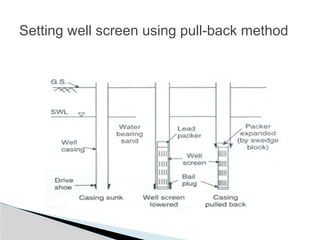
 In this method, the casing is driven to the full depth of the
well.
 Thereafter, the screen is lowered inside the casing and
allowed to rest on the bottom of the hole.
 The casing pipe is then pulled upward enough to expose the
full length of the screen in the water bearing formation.
 The lead packer provided at the top of the well screen is
expanded by the swedge block in order to form a seal
between the inside of the casing and the screen.
 This method is commonly used in cable-tool drilled wells as
well as in rotary drilled wells.
(i) Pull-Back Method
Setting well screen using pull-back method
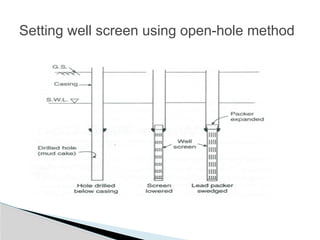
 In this method, the casing is first driven to a depth a
little below the desired position for the top of the well
screen.
 An open hole is then drilled in the sand below the
casing and the casing is filled with the mud fluid.
 The well screen is then lowered and the lead packer is
swedged to the casing.
 This method is applicable to rotary-drilled wells.
(ii) Open-Hole Method
Setting well screen using open-hole method
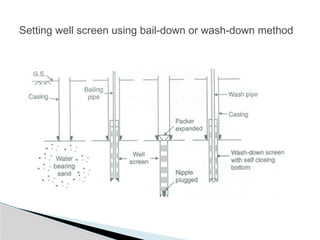
 In this method, the casing is driven to the intended position of the
top of the screen.
 A bail-down shoe with connection fittings is fitted to the bottom
of the screen.
 A string of bailing pipe is screwed on to the coupling of the bail-
down shoe and the screen is suspended on this string.
 The screen is then lowered inside the casing till it bailed out from
below the screen.
 The lead packer is provided and expanded with the swedge block
to seal the casing and screen.
 This method is suitable for rotary drilled wells as well as for
percussion drilled wells.
(iii) Bail-Down Method
Setting well screen using bail-down or wash-down method
 In this method, the well casing is first set to the desired
depth.
 A high velocity jet of drilling fluid is applied from a
wash-down bottom, fitted to the end of the screen.
 As a result, the sand is loosened and the screen is
driven to the desired depth.
 Thereafter, water is circulated through the wash pipe to
remove the drilling mud and the lead packer is
expanded.
(iv) Wash-Down Method
 Wells are grouted/cemented in the annular space surrounding the
casing to prevent entry of polluted water, to protect the casing against
the external corrosion and to stabilize caving rock formations.
 The grouting is achieved by using a cement grout between the outside
of the casing and the inside of the drilled hole.
 The grout is a mixture of cement and water of such a consistency that
can be forced through the grout pipes and placed as needed.
 The top of the casing should normally extend at least 50 cm above the
level of the surrounding surface in such a way that it is isolated from
direct contact with drainage wastes and sudden drainage discharges.
 The space around the casing should be grouted to a depth of about 6 m
to seal the well from the entrance of surface drainage. A concrete
platform should be constructed around the casing at the ground surface.
2. Grouting of Casing
Cementing/Grouting of the well casing
Shallow aquifer of inferior quality sealed and Aquifers II and III screened
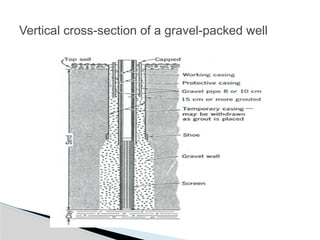
 Gravel packing is done by placing an artificially packed
gravel screen or envelope around the well screen.
 The gravel pack has several advantages including the
increase in well yield.
 A cross-section of a gravel-packed well.
 Maximum grain size of a gravel pack should be nearly 1 cm,
whereas the thickness should be in the range of 8 to 15 cm.
 The selected gravel should be washed and screened siliceous
material that is rounded, abrasive-resistant and dense.
 Gravel should be placed in such a manner that it completely
fills the annular space and minimizes segregation.
3 Gravel Packing
 Gravel packing is generally done by placing two tremie pipes to the
bottom of the well on opposite sides of the screen.
 Then the gravel is poured, washed, or pumped into the tremie pipes.
 The pipes are then pulled out of the well in stages as the pack is placed.
 In the cable-tool/percussion method of well drilling, the inner casing
and screen are set inside the blank outer casing, the annular space is
filled with gravel and then the outer casing is withdrawn out of the
well.
 In sandy aquifers where a gravel pack is most essential, deep wells
should be constructed by the rotary or reverse-circulation rotary
method.
 The drilling fluid should be circulated and diluted with water before
the gravel is introduced so as to avoid the clogging of the gravel pack.
Vertical cross-section of a gravel-packed well
 After the completion of well installation, the pumping well
and its appurtenances like the casing, pump, and pipe
systems have to be disinfected or sterilized properly.
 Chlorinated water, prepared by dissolving dry calcium
hypochlorite, liquid sodium hypochlorite or gaseous
chlorine in water, is most effectively used for this purpose.
 The solution is poured into the well through the top of the
casing, the water in the well is thoroughly agitated and
allowed to stand for several hours.
 The well is then flushed to remove the entire disinfecting
agent.
Wells Disinfection
 Regular Inspection: Inspect your well at least once a year for any signs of
damage, corrosion, or wear and tear. Check the wellhead, casing, and
surrounding area for any cracks, leaks, or contamination sources.
 Water Quality Testing: Test your well water regularly for contaminants
such as bacteria, nitrates, and other pollutants. You can either do this
yourself using testing kits or hire a professional water testing service.
 Keep the Area Clear: Ensure that the area around the well is clear of
debris, vegetation, and potential contaminants. This includes keeping
chemicals, fertilizers, and other pollutants away from the wellhead.
 Protect the Wellhead: Install a protective cover or cap on the wellhead to
prevent debris, insects, and animals from entering the well.
 Maintain the Pump and Components: Regularly inspect and maintain
the well pump, pressure tank, and other components of the water system.
Check for any leaks, unusual noises, or signs of malfunction.
Well maintenance
 After the completion of a well, the new well is developed
to increase its specific capacity (well discharge per unit
drawdown), prevent sand pumping and obtain maximum
economic well life.
 Well development is the process which causes reversals of
flow through the screen openings so as to remove the finer
material from the natural formations surrounding the
perforated sections of the casing.
 As a result, the well provides clear (sand-free) water,
thereby maximizing its specific capacity and well
efficiency.
Methods of Well Development
 Various methods are available for developing a well,
which include:
 Surging,
 Compressed air,
 Hydraulic jetting,
 Addition of chemicals/dispersing agents,
 Backwashing
 In this method, a surge block attached to the bottom of
a drill stem is repeatedly operated up and down in the
well casing like a piston in a cylinder, thereby
producing the required alternate reversals of flow.
 The procedure is completed when the loose materials
accumulating in the bottom of the well become
negligible.
Surging
 This method essentially involves both surging and pumping.
 During surging, a large volume of air is suddenly released and strong
surge is produced by virtue of the resistance of water head, friction and
inertia.
 Pumping is done using an ordinary air lift.
 The equipments required for well development by compressed air are:
 (a) air compressor capable of developing a maximum pressure of 700-
1000 kN/m2
and capacity of providing about 6 liters of free air for each
liter of water
 (b) pumping pipeline and air line with suitable means of raising and
lowering each other independently
 (c) accessories such as flexible high pressure hose, relief value, quick
opening value, pressure gauge, etc.
Using Compressed Air
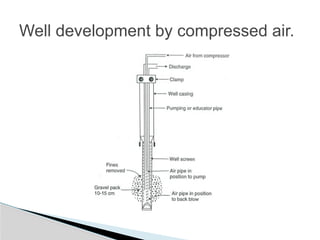
Well development by compressed air.
 In this method, a high velocity jet of water is applied horizontally through
the screen openings with the tip of the nozzle at about 12-25 mm from the
inner wall of the screen.
 A jetting tool coupled to the end of the pipe is lowered into the well. The top
of the pipe is connected by a hose to a high pressure pump.
 As a pump is started, the jetting tool is slowly rotated and gradually raised
or lowered so that the entire surface of the screen receives jetting action.
 The well is pumped by another pump to maintain the hydraulic gradient so
that water and the loosened fine particles will keep entering the well.
 Hydraulic jetting is particularly effective in developing gravel-packed wells.
 However, this method is not suitable when a perforated or slotted pipe is
used as a screen.
 The disadvantage of the hydraulic jetting method is that it requires
considerable amount of water for effective operation.
Hydraulic Jetting
 Sometimes, chemicals/dispersing agents are added during well development
to disperse the clay particles in the mud cake or in the formation to avoid
their sticking to sand grains and to speed up the well development process.
 Several polyphosphates are used for this purpose such as tetrasodium
pyrophosphate, sodium tripolyphosphate, and sodium hexametaphosphate
and sodium septaphosphate .
 Sometimes, blocks of solid carbon dioxide (dry ice) are added to a well after
aciditizing and surging with compressed air.
 The accumulation of gaseous carbon dioxide released by sublimation
creates a pressure within the well and upon release this causes a burst of
muddy water from the well, thereby helping in well development.
 For developing open-hole wells in limestone or dolomite formations,
hydrochloric acid is added to water, which removes fine particles and
widens fractures/fissures leading into the well bore.
Addition of Chemicals/Dispersing Agents
 The backwashing method provides a surging effect for
well development and is widely used by well drillers.
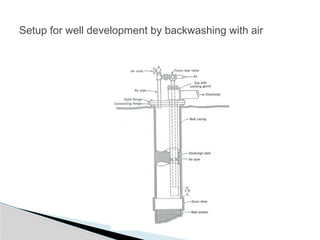
 In this method, the top of the well is fitted with an air-
tight cover.
 The backwashing system consists of a discharge pipe, a
long air pipe, a short air pipe, and a three-way valve.
Backwashing
Setup for well development by backwashing with air
 Compressed air is released through the long air pipe, forcing air and
water out of the well through the discharge pipe.
 After the water becomes clear, the air supply is stopped and the
water is allowed to return to its static level.
 Thereafter, the three-way valve is turned to supply air into the top of
the well through the short air pipe.
 This backwashes water from the well through the discharge pipe and
at the same time agitates sand grains surrounding the well.
 Air is forced into the well until it starts escaping from the discharge
pipe, after which the three-way valve is turned and the air supply is
again directed down the long air pipe to pump the well.
 This procedure is repeated until the well is fully developed.
 Although the expected service life of a well depends on
the design, construction, development and operation of
the well, proper maintenance of wells helps to improve
their performance and increase their service life.
 Proper records of well discharge, drawdown, power
consumption, operating hours, periodic checking of
water quality and other such observations are very
useful for formulating proper maintenance and
rehabilitation plans.
Well Maintenance and Rehabilitation
 In order to ensure that well performance does not deteriorate considerably,
periodic test for well efficiency should be conducted and the results
compared with the value obtained when the well was new.
 The well can be considered to be maintaining reasonable performance, if the
well efficiency (ratio of theoretical drawdown to the measured drawdown in a
pumping well) does not decline more than 15% from the original value.
 When performance falls below an acceptable standard, redevelopment should
be considered.
 As the monitoring of well efficiency is difficult and expensive, specific
capacity (ratio of discharge to drawdown in a pumping well), which is a
measure of the productivity of a pumping well, is often used to evaluate well
performance with time.
 Seasonal and yearly influences on the pumping level must also be considered.
Well Maintenance
 The performance of wells can deteriorate because of one or
combination of the following factors :
 Change in hydrogeologic conditions, leading to declining
groundwater levels.
 Excessive pumping of sand causing deterioration of the filter zone.
 Clogging of the filter zone by fine particles.
 Reduction in well discharge and well efficiency due to incrustation
or bacterial growth in the well screen and/or filter zone.
 Degradation of water quality due to contamination.
 Structural damage of well casing and/or screen due to corrosion or
other reasons.
Major Causes of Deteriorating Well Performance
 Once the cause of deterioration in well performance is
identified, one or more maintenance and rehabilitation
techniques can be effective in restoring specific
capacity and discharge of a pumping well or in
protecting the well from further deterioration.
 Salient maintenance and rehabilitation techniques are
as follows
Well Maintenance and Rehabilitation Techniques
 Static water level
 Pumping rate
 Pumping water level
 Total well depth
 Impact of nearby wells
Well owner
 Notify all users
 Determine the characteristics of the well
 Remove the pumping mechanism of lifting device
 Remove all polluted water, sediments and debris – Jetting
 Remove the damage
 Clean the well physically
 Clean the well chemically
 Disinfect the well – high strength calcium hypochlorine
 Dewater the well
 Seal top of the well
Well Rehabilitation Procedures

Unit - 4 Well Completion, Development and Maintenance.pptx

  • 1.
    KONGUNADU COLLEGE OFENGINEERING AND TECHNOLOGY (Autonomous) Department of Agriculture Engineering Course: Groundwater and Well Engineering Topic :Well Completion, Development and Maintenance By Mr. M.Sundharan, Assistant Professor, Department of Agricultural Engineering, Kongunadu College of Engineering and Technology
  • 2.
    •After the constructionof a pumping well, proper sanitary completion is necessary to produce safe water required for drinking and other purposes. • Different well completion operations generally required for the wells constructed in unconsolidated formations are as follows: •Placement of casing and well screens •Cementing/Grouting of casing •Gravel packing. Completion of Well Installation
  • 3.
     (1) Typesof Well Casing  Well casing is a lining to maintain an open vertical hole from ground surface to the aquifer.  It seals out surface water and any undesirable quality groundwater and also provides structural stability against caving materials outside the well.  Materials used for construction of well casings are wrought iron, alloyed or unalloyed steel and ingot iron.  Polyvinyl chloride pipe is widely used as casing for shallow or deep, small-diameter observation wells.  In cable tool drilling, the casing is driven into place, whereas in rotary drilling, the casing is smaller than the drilled hole. o Surface casing o Pump-chamber casing 1. Placement of Well Casing and Well Screen
  • 4.
     It isinstalled from ground surface through upper strata of unstable or fractured materials into a stable or relatively impermeable material.  Surface casing has several functions:  it supports unstable materials during drilling,  it reduces loss of drilling fluids  it facilitates installation or removal of other casing,  it helps in placing a sanitary seal and serves as a reservoir for a gravel pack. (I) Surface Casing
  • 5.
     It comprisesall the casing above the screen in wells of uniform diameter.  The pump-chamber casing should have a nominal diameter at least 5 cm larger than the nominal diameter of the pump bowls.  Non-metallic pipes such as ceramic clay, concrete, asbestos-cement, plastic, or fiberglass-reinforced plastic pipes are used where corrosion or incrustation is a problem. (ii) Pump-Chamber Casing
  • 6.
     The methodof installing well screens is influenced by the design of the well, drilling method and the problems encountered during drilling.  Pull-back method,  Open-hole method,  Bail-down method  Wash-down method. (2) Placement of Well Screen
  • 7.
     In thismethod, the casing is driven to the full depth of the well.  Thereafter, the screen is lowered inside the casing and allowed to rest on the bottom of the hole.  The casing pipe is then pulled upward enough to expose the full length of the screen in the water bearing formation.  The lead packer provided at the top of the well screen is expanded by the swedge block in order to form a seal between the inside of the casing and the screen.  This method is commonly used in cable-tool drilled wells as well as in rotary drilled wells. (i) Pull-Back Method
  • 8.
    Setting well screenusing pull-back method
  • 9.
     In thismethod, the casing is first driven to a depth a little below the desired position for the top of the well screen.  An open hole is then drilled in the sand below the casing and the casing is filled with the mud fluid.  The well screen is then lowered and the lead packer is swedged to the casing.  This method is applicable to rotary-drilled wells. (ii) Open-Hole Method
  • 10.
    Setting well screenusing open-hole method
  • 11.
     In thismethod, the casing is driven to the intended position of the top of the screen.  A bail-down shoe with connection fittings is fitted to the bottom of the screen.  A string of bailing pipe is screwed on to the coupling of the bail- down shoe and the screen is suspended on this string.  The screen is then lowered inside the casing till it bailed out from below the screen.  The lead packer is provided and expanded with the swedge block to seal the casing and screen.  This method is suitable for rotary drilled wells as well as for percussion drilled wells. (iii) Bail-Down Method
  • 12.
    Setting well screenusing bail-down or wash-down method
  • 13.
     In thismethod, the well casing is first set to the desired depth.  A high velocity jet of drilling fluid is applied from a wash-down bottom, fitted to the end of the screen.  As a result, the sand is loosened and the screen is driven to the desired depth.  Thereafter, water is circulated through the wash pipe to remove the drilling mud and the lead packer is expanded. (iv) Wash-Down Method
  • 14.
     Wells aregrouted/cemented in the annular space surrounding the casing to prevent entry of polluted water, to protect the casing against the external corrosion and to stabilize caving rock formations.  The grouting is achieved by using a cement grout between the outside of the casing and the inside of the drilled hole.  The grout is a mixture of cement and water of such a consistency that can be forced through the grout pipes and placed as needed.  The top of the casing should normally extend at least 50 cm above the level of the surrounding surface in such a way that it is isolated from direct contact with drainage wastes and sudden drainage discharges.  The space around the casing should be grouted to a depth of about 6 m to seal the well from the entrance of surface drainage. A concrete platform should be constructed around the casing at the ground surface. 2. Grouting of Casing
  • 15.
    Cementing/Grouting of thewell casing Shallow aquifer of inferior quality sealed and Aquifers II and III screened
  • 16.
     Gravel packingis done by placing an artificially packed gravel screen or envelope around the well screen.  The gravel pack has several advantages including the increase in well yield.  A cross-section of a gravel-packed well.  Maximum grain size of a gravel pack should be nearly 1 cm, whereas the thickness should be in the range of 8 to 15 cm.  The selected gravel should be washed and screened siliceous material that is rounded, abrasive-resistant and dense.  Gravel should be placed in such a manner that it completely fills the annular space and minimizes segregation. 3 Gravel Packing
  • 17.
     Gravel packingis generally done by placing two tremie pipes to the bottom of the well on opposite sides of the screen.  Then the gravel is poured, washed, or pumped into the tremie pipes.  The pipes are then pulled out of the well in stages as the pack is placed.  In the cable-tool/percussion method of well drilling, the inner casing and screen are set inside the blank outer casing, the annular space is filled with gravel and then the outer casing is withdrawn out of the well.  In sandy aquifers where a gravel pack is most essential, deep wells should be constructed by the rotary or reverse-circulation rotary method.  The drilling fluid should be circulated and diluted with water before the gravel is introduced so as to avoid the clogging of the gravel pack.
  • 18.
    Vertical cross-section ofa gravel-packed well
  • 19.
     After thecompletion of well installation, the pumping well and its appurtenances like the casing, pump, and pipe systems have to be disinfected or sterilized properly.  Chlorinated water, prepared by dissolving dry calcium hypochlorite, liquid sodium hypochlorite or gaseous chlorine in water, is most effectively used for this purpose.  The solution is poured into the well through the top of the casing, the water in the well is thoroughly agitated and allowed to stand for several hours.  The well is then flushed to remove the entire disinfecting agent. Wells Disinfection
  • 20.
     Regular Inspection:Inspect your well at least once a year for any signs of damage, corrosion, or wear and tear. Check the wellhead, casing, and surrounding area for any cracks, leaks, or contamination sources.  Water Quality Testing: Test your well water regularly for contaminants such as bacteria, nitrates, and other pollutants. You can either do this yourself using testing kits or hire a professional water testing service.  Keep the Area Clear: Ensure that the area around the well is clear of debris, vegetation, and potential contaminants. This includes keeping chemicals, fertilizers, and other pollutants away from the wellhead.  Protect the Wellhead: Install a protective cover or cap on the wellhead to prevent debris, insects, and animals from entering the well.  Maintain the Pump and Components: Regularly inspect and maintain the well pump, pressure tank, and other components of the water system. Check for any leaks, unusual noises, or signs of malfunction. Well maintenance
  • 21.
     After thecompletion of a well, the new well is developed to increase its specific capacity (well discharge per unit drawdown), prevent sand pumping and obtain maximum economic well life.  Well development is the process which causes reversals of flow through the screen openings so as to remove the finer material from the natural formations surrounding the perforated sections of the casing.  As a result, the well provides clear (sand-free) water, thereby maximizing its specific capacity and well efficiency. Methods of Well Development
  • 22.
     Various methodsare available for developing a well, which include:  Surging,  Compressed air,  Hydraulic jetting,  Addition of chemicals/dispersing agents,  Backwashing
  • 23.
     In thismethod, a surge block attached to the bottom of a drill stem is repeatedly operated up and down in the well casing like a piston in a cylinder, thereby producing the required alternate reversals of flow.  The procedure is completed when the loose materials accumulating in the bottom of the well become negligible. Surging
  • 24.
     This methodessentially involves both surging and pumping.  During surging, a large volume of air is suddenly released and strong surge is produced by virtue of the resistance of water head, friction and inertia.  Pumping is done using an ordinary air lift.  The equipments required for well development by compressed air are:  (a) air compressor capable of developing a maximum pressure of 700- 1000 kN/m2 and capacity of providing about 6 liters of free air for each liter of water  (b) pumping pipeline and air line with suitable means of raising and lowering each other independently  (c) accessories such as flexible high pressure hose, relief value, quick opening value, pressure gauge, etc. Using Compressed Air
  • 25.
    Well development bycompressed air.
  • 26.
     In thismethod, a high velocity jet of water is applied horizontally through the screen openings with the tip of the nozzle at about 12-25 mm from the inner wall of the screen.  A jetting tool coupled to the end of the pipe is lowered into the well. The top of the pipe is connected by a hose to a high pressure pump.  As a pump is started, the jetting tool is slowly rotated and gradually raised or lowered so that the entire surface of the screen receives jetting action.  The well is pumped by another pump to maintain the hydraulic gradient so that water and the loosened fine particles will keep entering the well.  Hydraulic jetting is particularly effective in developing gravel-packed wells.  However, this method is not suitable when a perforated or slotted pipe is used as a screen.  The disadvantage of the hydraulic jetting method is that it requires considerable amount of water for effective operation. Hydraulic Jetting
  • 27.
     Sometimes, chemicals/dispersingagents are added during well development to disperse the clay particles in the mud cake or in the formation to avoid their sticking to sand grains and to speed up the well development process.  Several polyphosphates are used for this purpose such as tetrasodium pyrophosphate, sodium tripolyphosphate, and sodium hexametaphosphate and sodium septaphosphate .  Sometimes, blocks of solid carbon dioxide (dry ice) are added to a well after aciditizing and surging with compressed air.  The accumulation of gaseous carbon dioxide released by sublimation creates a pressure within the well and upon release this causes a burst of muddy water from the well, thereby helping in well development.  For developing open-hole wells in limestone or dolomite formations, hydrochloric acid is added to water, which removes fine particles and widens fractures/fissures leading into the well bore. Addition of Chemicals/Dispersing Agents
  • 28.
     The backwashingmethod provides a surging effect for well development and is widely used by well drillers.  In this method, the top of the well is fitted with an air- tight cover.  The backwashing system consists of a discharge pipe, a long air pipe, a short air pipe, and a three-way valve. Backwashing
  • 29.
    Setup for welldevelopment by backwashing with air
  • 30.
     Compressed airis released through the long air pipe, forcing air and water out of the well through the discharge pipe.  After the water becomes clear, the air supply is stopped and the water is allowed to return to its static level.  Thereafter, the three-way valve is turned to supply air into the top of the well through the short air pipe.  This backwashes water from the well through the discharge pipe and at the same time agitates sand grains surrounding the well.  Air is forced into the well until it starts escaping from the discharge pipe, after which the three-way valve is turned and the air supply is again directed down the long air pipe to pump the well.  This procedure is repeated until the well is fully developed.
  • 31.
     Although theexpected service life of a well depends on the design, construction, development and operation of the well, proper maintenance of wells helps to improve their performance and increase their service life.  Proper records of well discharge, drawdown, power consumption, operating hours, periodic checking of water quality and other such observations are very useful for formulating proper maintenance and rehabilitation plans. Well Maintenance and Rehabilitation
  • 32.
     In orderto ensure that well performance does not deteriorate considerably, periodic test for well efficiency should be conducted and the results compared with the value obtained when the well was new.  The well can be considered to be maintaining reasonable performance, if the well efficiency (ratio of theoretical drawdown to the measured drawdown in a pumping well) does not decline more than 15% from the original value.  When performance falls below an acceptable standard, redevelopment should be considered.  As the monitoring of well efficiency is difficult and expensive, specific capacity (ratio of discharge to drawdown in a pumping well), which is a measure of the productivity of a pumping well, is often used to evaluate well performance with time.  Seasonal and yearly influences on the pumping level must also be considered. Well Maintenance
  • 33.
     The performanceof wells can deteriorate because of one or combination of the following factors :  Change in hydrogeologic conditions, leading to declining groundwater levels.  Excessive pumping of sand causing deterioration of the filter zone.  Clogging of the filter zone by fine particles.  Reduction in well discharge and well efficiency due to incrustation or bacterial growth in the well screen and/or filter zone.  Degradation of water quality due to contamination.  Structural damage of well casing and/or screen due to corrosion or other reasons. Major Causes of Deteriorating Well Performance
  • 34.
     Once thecause of deterioration in well performance is identified, one or more maintenance and rehabilitation techniques can be effective in restoring specific capacity and discharge of a pumping well or in protecting the well from further deterioration.  Salient maintenance and rehabilitation techniques are as follows Well Maintenance and Rehabilitation Techniques
  • 35.
     Static waterlevel  Pumping rate  Pumping water level  Total well depth  Impact of nearby wells Well owner
  • 36.
     Notify allusers  Determine the characteristics of the well  Remove the pumping mechanism of lifting device  Remove all polluted water, sediments and debris – Jetting  Remove the damage  Clean the well physically  Clean the well chemically  Disinfect the well – high strength calcium hypochlorine  Dewater the well  Seal top of the well Well Rehabilitation Procedures