Wellheads and Trees
• Simple to complex
• Seal Points and Control Points
• Basic use and intervention
3/14/2009 1George E. King Engineering
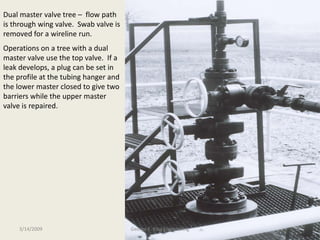
Dual master valve tree – flow path
is through wing valve. Swab valve is
removed for a wireline run.
Operations on a tree with a dual
master valve use the top valve. If a
leak develops, a plug can be set in
the profile at the tubing hanger and
the lower master closed to give two
barriers while the upper master
valve is repaired.
3/14/2009 2George E. King Engineering
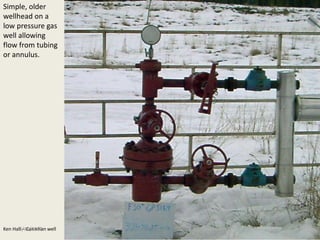
Simple, older
wellhead on a
low pressure gas
well allowing
flow from tubing
or annulus.
Ken Hall – Canadian well3/14/2009 3George E. King Engineering
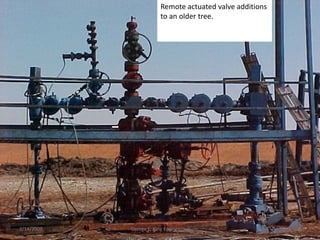
Remote actuated valve additions
to an older tree.
3/14/2009 4George E. King Engineering
3/14/2009 5George E. King Engineering
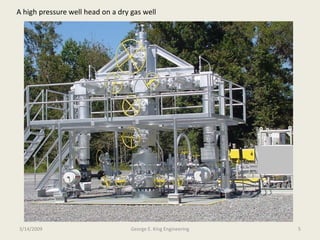
A high pressure well head on a dry gas well
Casing Hangers
• Transfers part of the load of the casing string
(any tubular string) to the wellhead. The
actual weight is transferred to the string on
which the wellhead flange is mounted.
• Two Types
– Slip type
– Mandrel type
3/14/2009 6George E. King Engineering
Hangers
• Slip Type:
– Used to suspend the casing in the slip bowl
– The hanger may also incorporate seals to casing
and annulus.
• Mandrel type thread to the casing
3/14/2009 7George E. King Engineering
Casing Head
• Other names:
– “A” section
– Casing head
– Starting head
– Lower-most housing
– Braden head
3/14/2009 8George E. King Engineering
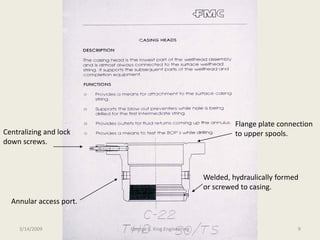
Welded, hydraulically formed
or screwed to casing.
Centralizing and lock
down screws.
Annular access port.
Flange plate connection
to upper spools.
3/14/2009 9George E. King Engineering
Casing Head
• The first piece of wellhead equipment
installed.
• Most likely affixed to most outside, fully
cemented casing string.
• Designed for universal use on all types and
depths of wells.
3/14/2009 10George E. King Engineering
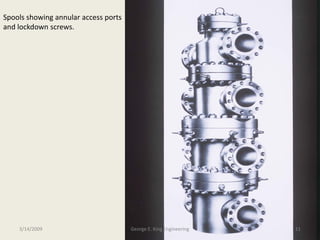
Spools showing annular access ports
and lockdown screws.
3/14/2009 11George E. King Engineering
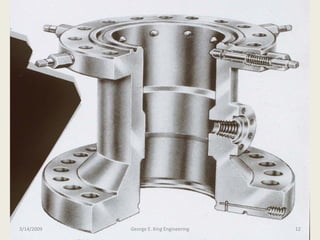
3/14/2009 12George E. King Engineering
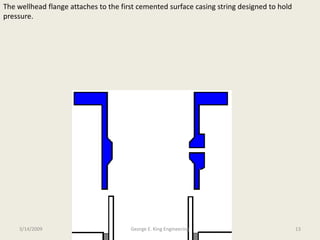
The wellhead flange attaches to the first cemented surface casing string designed to hold
pressure.
3/14/2009 13George E. King Engineering
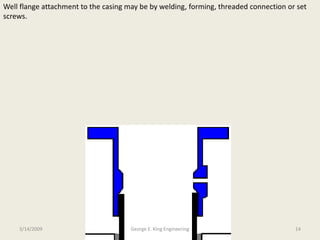
Well flange attachment to the casing may be by welding, forming, threaded connection or set
screws.
3/14/2009 14George E. King Engineering
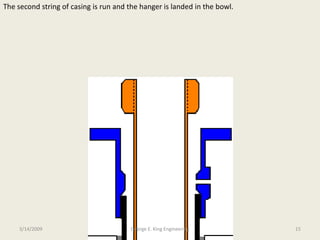
The second string of casing is run and the hanger is landed in the bowl.
3/14/2009 15George E. King Engineering
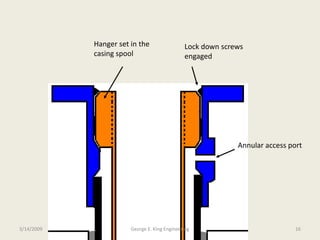
Lock down screws
engaged
Hanger set in the
casing spool
Annular access port
3/14/2009 16George E. King Engineering
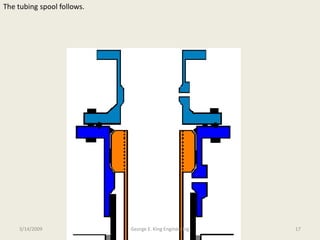
The tubing spool follows.
3/14/2009 17George E. King Engineering
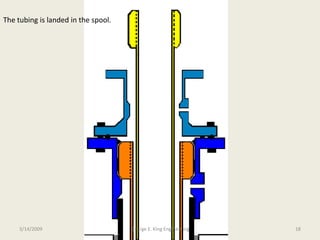
The tubing is landed in the spool.
3/14/2009 18George E. King Engineering
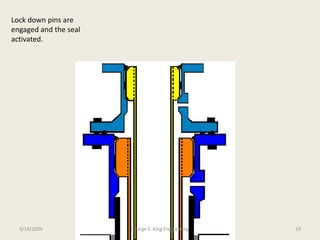
Lock down pins are
engaged and the seal
activated.
3/14/2009 19George E. King Engineering
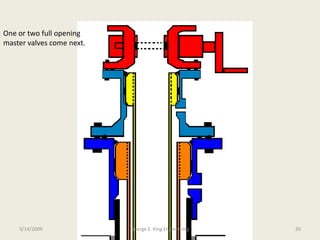
One or two full opening
master valves come next.
3/14/2009 20George E. King Engineering
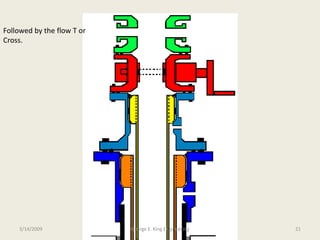
Followed by the flow T or
Cross.
3/14/2009 21George E. King Engineering
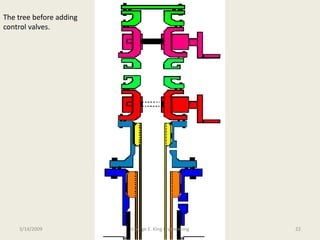
The tree before adding
control valves.
3/14/2009 22George E. King Engineering
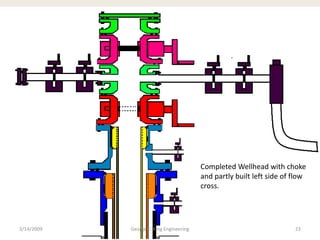
Completed Wellhead with choke
and partly built left side of flow
cross.
3/14/2009 23George E. King Engineering
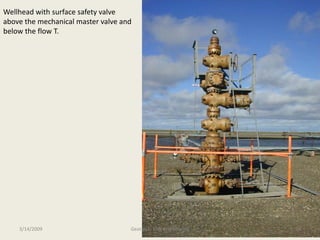
Wellhead with surface safety valve
above the mechanical master valve and
below the flow T.
3/14/2009 24George E. King Engineering
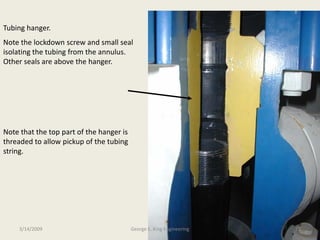
Tubing hanger.
Note the lockdown screw and small seal
isolating the tubing from the annulus.
Other seals are above the hanger.
Note that the top part of the hanger is
threaded to allow pickup of the tubing
string.
3/14/2009 25George E. King Engineering
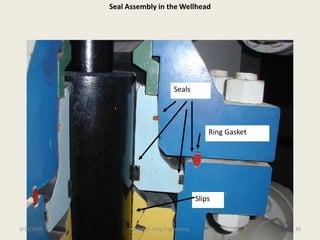
Seal Assembly in the Wellhead
Slips
Ring Gasket
Seals
3/14/2009 26George E. King Engineering
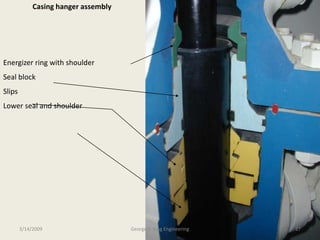
Energizer ring with shoulder
Seal block
Slips
Lower seal and shoulder
Casing hanger assembly
3/14/2009 27George E. King Engineering
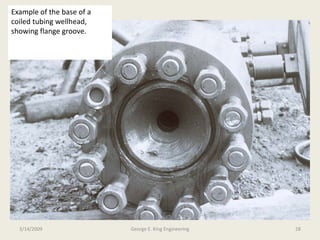
Example of the base of a
coiled tubing wellhead,
showing flange groove.
3/14/2009 28George E. King Engineering
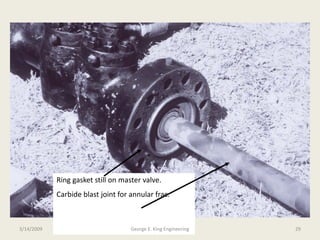
Ring gasket still on master valve.
Carbide blast joint for annular frac.
3/14/2009 29George E. King Engineering
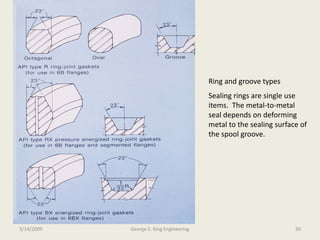
Ring and groove types
Sealing rings are single use
items. The metal-to-metal
seal depends on deforming
metal to the sealing surface of
the spool groove.
3/14/2009 30George E. King Engineering
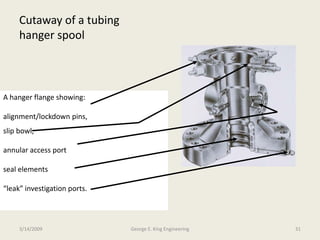
A hanger flange showing:
alignment/lockdown pins,
slip bowl,
annular access port
seal elements
“leak” investigation ports.
3/14/2009 31George E. King Engineering
Cutaway of a tubing
hanger spool
3/14/2009 32George E. King Engineering
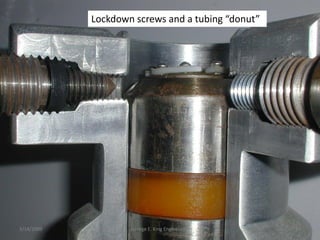
Lockdown screws and a tubing “donut”
Pressure Tests
• Before testing wellhead or BOP’s, consider the
condition of the casing. Many older wells with
low grade or poor quality casing can be
damaged by a pressure test on a new
wellhead.
3/14/2009 33George E. King Engineering
3/14/2009 34George E. King Engineering
3/14/2009 35George E. King Engineering
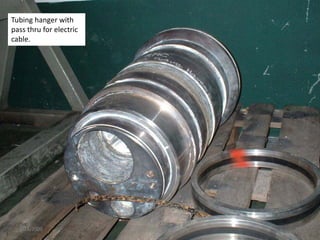
Tubing hanger with
pass thru for electric
cable.
3/14/2009 36George E. King Engineering
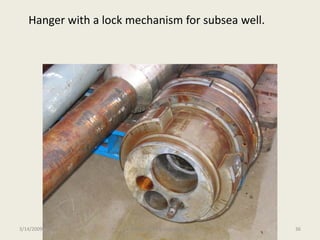
Hanger with a lock mechanism for subsea well.
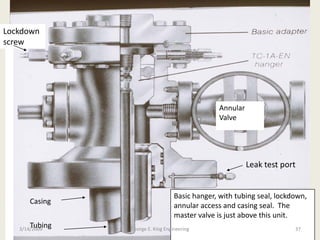
Basic hanger, with tubing seal, lockdown,
annular access and casing seal. The
master valve is just above this unit.
Leak test port
Annular
Valve
Lockdown
screw
Casing
Tubing3/14/2009 37George E. King Engineering
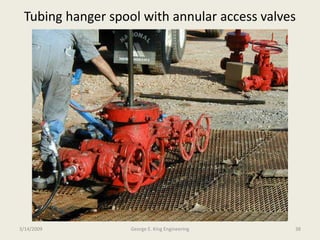
Tubing hanger spool with annular access valves
3/14/2009 George E. King Engineering 38
3/14/2009 39George E. King Engineering
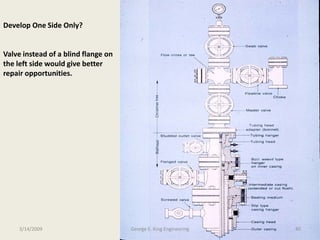
Develop One Side Only?
Valve instead of a blind flange on
the left side would give better
repair opportunities.
3/14/2009 40George E. King Engineering
Develop both sides?
In high rate, high pressure,
sensitive wells, or H2S wells, the
second side may be a well saver!
3/14/2009 41George E. King Engineering
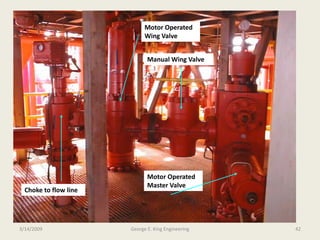
Motor Operated
Master Valve
Manual Wing Valve
Motor Operated
Wing Valve
Choke to flow line
3/14/2009 42George E. King Engineering
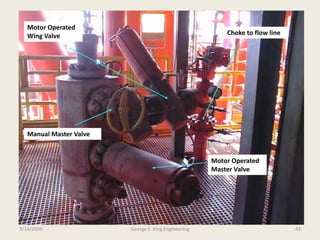
Motor Operated
Master Valve
Manual Master Valve
Motor Operated
Wing Valve Choke to flow line
3/14/2009 43George E. King Engineering
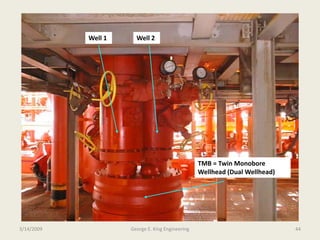
TMB = Twin Monobore
Wellhead (Dual Wellhead)
Well 1 Well 2
3/14/2009 44George E. King Engineering
Flanges
• Basic types
• Assembly and Inspection
• Seal types
Source: Woodco
3/14/2009 45George E. King Engineering
3/14/2009 46George E. King Engineering
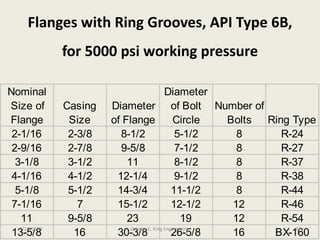
Nominal
Size of
Flange
Casing
Size
Diameter
of Flange
Diameter
of Bolt
Circle
Number of
Bolts Ring Type
2-1/16 2-3/8 8-1/2 5-1/2 8 R-24
2-9/16 2-7/8 9-5/8 7-1/2 8 R-27
3-1/8 3-1/2 11 8-1/2 8 R-37
4-1/16 4-1/2 12-1/4 9-1/2 8 R-38
5-1/8 5-1/2 14-3/4 11-1/2 8 R-44
7-1/16 7 15-1/2 12-1/2 12 R-46
11 9-5/8 23 19 12 R-54
13-5/8 16 30-3/8 26-5/8 16 BX-160
Flanges with Ring Grooves, API Type 6B,
for 5000 psi working pressure
3/14/2009 47George E. King Engineering
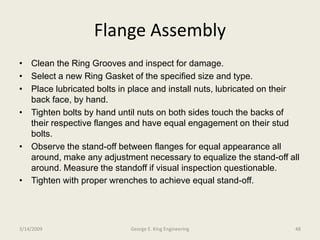
Flange Assembly
• Clean the Ring Grooves and inspect for damage.
• Select a new Ring Gasket of the specified size and type.
• Place lubricated bolts in place and install nuts, lubricated on their
back face, by hand.
• Tighten bolts by hand until nuts on both sides touch the backs of
their respective flanges and have equal engagement on their stud
bolts.
• Observe the stand-off between flanges for equal appearance all
around, make any adjustment necessary to equalize the stand-off all
around. Measure the standoff if visual inspection questionable.
• Tighten with proper wrenches to achieve equal stand-off.
3/14/2009 48George E. King Engineering
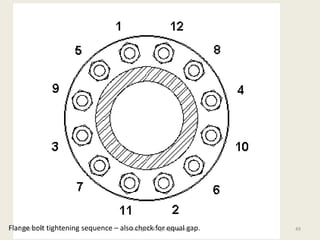
Flange bolt tightening sequence – also check for equal gap.3/14/2009 49George E. King Engineering
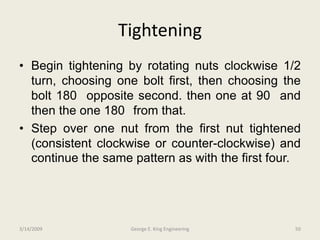
Tightening
• Begin tightening by rotating nuts clockwise 1/2
turn, choosing one bolt first, then choosing the
bolt 180 opposite second. then one at 90 and
then the one 180 from that.
• Step over one nut from the first nut tightened
(consistent clockwise or counter-clockwise) and
continue the same pattern as with the first four.
3/14/2009 50George E. King Engineering
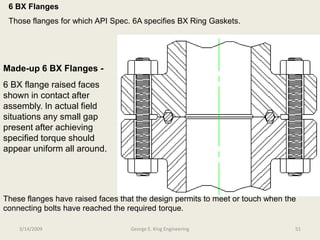
6 BX Flanges
Those flanges for which API Spec. 6A specifies BX Ring Gaskets.
These flanges have raised faces that the design permits to meet or touch when the
connecting bolts have reached the required torque.
Made-up 6 BX Flanges -
6 BX flange raised faces
shown in contact after
assembly. In actual field
situations any small gap
present after achieving
specified torque should
appear uniform all around.
3/14/2009 51George E. King Engineering
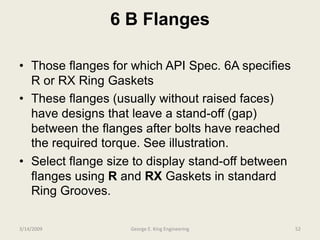
6 B Flanges
• Those flanges for which API Spec. 6A specifies
R or RX Ring Gaskets
• These flanges (usually without raised faces)
have designs that leave a stand-off (gap)
between the flanges after bolts have reached
the required torque. See illustration.
• Select flange size to display stand-off between
flanges using R and RX Gaskets in standard
Ring Grooves.
3/14/2009 52George E. King Engineering
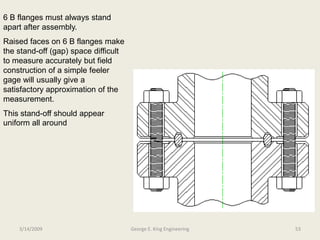
6 B flanges must always stand
apart after assembly.
Raised faces on 6 B flanges make
the stand-off (gap) space difficult
to measure accurately but field
construction of a simple feeler
gage will usually give a
satisfactory approximation of the
measurement.
This stand-off should appear
uniform all around
3/14/2009 53George E. King Engineering
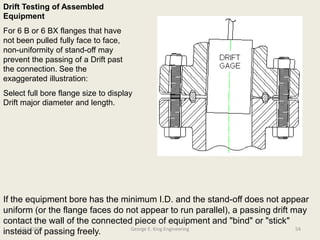
Drift Testing of Assembled
Equipment
For 6 B or 6 BX flanges that have
not been pulled fully face to face,
non-uniformity of stand-off may
prevent the passing of a Drift past
the connection. See the
exaggerated illustration:
Select full bore flange size to display
Drift major diameter and length.
If the equipment bore has the minimum I.D. and the stand-off does not appear
uniform (or the flange faces do not appear to run parallel), a passing drift may
contact the wall of the connected piece of equipment and "bind" or "stick"
instead of passing freely.3/14/2009 54George E. King Engineering
Assembly
• API Spec. 6A or Spec. 16A requires a drift test on each piece of
flange equipment.
• When separate units of equipment require field assembly, the
person(s) making the assembly may create an unexpected problem
by not keeping any stand-off between flanges uniform all around.
Rarely do field personnel have a drift gage available, so the best
insurance against a stuck working tool comes from careful make-up
of flange connections.
• Even if the job doesn't require close fitting tools, such tools may
come into play should a well emergency occur.
3/14/2009 55George E. King Engineering
Flange Assembly Learnings
• BOP stacks frequently experience Kelly wear on
their I.D. because flange make-up lacked
uniformity all around and all or a portion of the
stack leaned from the vertical, allowing the Kelly
to rub against the side leaning in.
• If operators do anticipate the need for running
tools that have a small clearance with the I.D. of
the BOP or Trees, then having a Drift Gage
available and used at the make-up site will
provide cheap insurance against later downtime.
3/14/2009 56George E. King Engineering
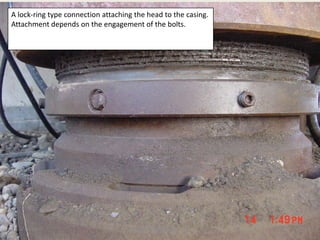
A lock-ring type connection attaching the head to the casing.
Attachment depends on the engagement of the bolts.
3/14/2009 57George E. King Engineering
3/14/2009 58George E. King Engineering
3/14/2009 59George E. King Engineering
3/14/2009 60George E. King Engineering
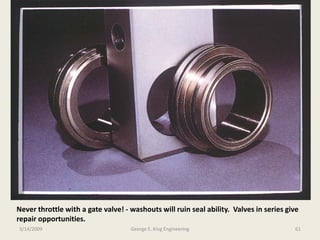
Never throttle with a gate valve! - washouts will ruin seal ability. Valves in series give
repair opportunities.
3/14/2009 61George E. King Engineering

Wellhead basics

  • 1.
    Wellheads and Trees •Simple to complex • Seal Points and Control Points • Basic use and intervention 3/14/2009 1George E. King Engineering
  • 2.
    Dual master valvetree – flow path is through wing valve. Swab valve is removed for a wireline run. Operations on a tree with a dual master valve use the top valve. If a leak develops, a plug can be set in the profile at the tubing hanger and the lower master closed to give two barriers while the upper master valve is repaired. 3/14/2009 2George E. King Engineering
  • 3.
    Simple, older wellhead ona low pressure gas well allowing flow from tubing or annulus. Ken Hall – Canadian well3/14/2009 3George E. King Engineering
  • 4.
    Remote actuated valveadditions to an older tree. 3/14/2009 4George E. King Engineering
  • 5.
    3/14/2009 5George E.King Engineering A high pressure well head on a dry gas well
  • 6.
    Casing Hangers • Transferspart of the load of the casing string (any tubular string) to the wellhead. The actual weight is transferred to the string on which the wellhead flange is mounted. • Two Types – Slip type – Mandrel type 3/14/2009 6George E. King Engineering
  • 7.
    Hangers • Slip Type: –Used to suspend the casing in the slip bowl – The hanger may also incorporate seals to casing and annulus. • Mandrel type thread to the casing 3/14/2009 7George E. King Engineering
  • 8.
    Casing Head • Othernames: – “A” section – Casing head – Starting head – Lower-most housing – Braden head 3/14/2009 8George E. King Engineering
  • 9.
    Welded, hydraulically formed orscrewed to casing. Centralizing and lock down screws. Annular access port. Flange plate connection to upper spools. 3/14/2009 9George E. King Engineering
  • 10.
    Casing Head • Thefirst piece of wellhead equipment installed. • Most likely affixed to most outside, fully cemented casing string. • Designed for universal use on all types and depths of wells. 3/14/2009 10George E. King Engineering
  • 11.
    Spools showing annularaccess ports and lockdown screws. 3/14/2009 11George E. King Engineering
  • 12.
    3/14/2009 12George E.King Engineering
  • 13.
    The wellhead flangeattaches to the first cemented surface casing string designed to hold pressure. 3/14/2009 13George E. King Engineering
  • 14.
    Well flange attachmentto the casing may be by welding, forming, threaded connection or set screws. 3/14/2009 14George E. King Engineering
  • 15.
    The second stringof casing is run and the hanger is landed in the bowl. 3/14/2009 15George E. King Engineering
  • 16.
    Lock down screws engaged Hangerset in the casing spool Annular access port 3/14/2009 16George E. King Engineering
  • 17.
    The tubing spoolfollows. 3/14/2009 17George E. King Engineering
  • 18.
    The tubing islanded in the spool. 3/14/2009 18George E. King Engineering
  • 19.
    Lock down pinsare engaged and the seal activated. 3/14/2009 19George E. King Engineering
  • 20.
    One or twofull opening master valves come next. 3/14/2009 20George E. King Engineering
  • 21.
    Followed by theflow T or Cross. 3/14/2009 21George E. King Engineering
  • 22.
    The tree beforeadding control valves. 3/14/2009 22George E. King Engineering
  • 23.
    Completed Wellhead withchoke and partly built left side of flow cross. 3/14/2009 23George E. King Engineering
  • 24.
    Wellhead with surfacesafety valve above the mechanical master valve and below the flow T. 3/14/2009 24George E. King Engineering
  • 25.
    Tubing hanger. Note thelockdown screw and small seal isolating the tubing from the annulus. Other seals are above the hanger. Note that the top part of the hanger is threaded to allow pickup of the tubing string. 3/14/2009 25George E. King Engineering
  • 26.
    Seal Assembly inthe Wellhead Slips Ring Gasket Seals 3/14/2009 26George E. King Engineering
  • 27.
    Energizer ring withshoulder Seal block Slips Lower seal and shoulder Casing hanger assembly 3/14/2009 27George E. King Engineering
  • 28.
    Example of thebase of a coiled tubing wellhead, showing flange groove. 3/14/2009 28George E. King Engineering
  • 29.
    Ring gasket stillon master valve. Carbide blast joint for annular frac. 3/14/2009 29George E. King Engineering
  • 30.
    Ring and groovetypes Sealing rings are single use items. The metal-to-metal seal depends on deforming metal to the sealing surface of the spool groove. 3/14/2009 30George E. King Engineering
  • 31.
    A hanger flangeshowing: alignment/lockdown pins, slip bowl, annular access port seal elements “leak” investigation ports. 3/14/2009 31George E. King Engineering Cutaway of a tubing hanger spool
  • 32.
    3/14/2009 32George E.King Engineering Lockdown screws and a tubing “donut”
  • 33.
    Pressure Tests • Beforetesting wellhead or BOP’s, consider the condition of the casing. Many older wells with low grade or poor quality casing can be damaged by a pressure test on a new wellhead. 3/14/2009 33George E. King Engineering
  • 34.
    3/14/2009 34George E.King Engineering
  • 35.
    3/14/2009 35George E.King Engineering Tubing hanger with pass thru for electric cable.
  • 36.
    3/14/2009 36George E.King Engineering Hanger with a lock mechanism for subsea well.
  • 37.
    Basic hanger, withtubing seal, lockdown, annular access and casing seal. The master valve is just above this unit. Leak test port Annular Valve Lockdown screw Casing Tubing3/14/2009 37George E. King Engineering
  • 38.
    Tubing hanger spoolwith annular access valves 3/14/2009 George E. King Engineering 38
  • 39.
    3/14/2009 39George E.King Engineering
  • 40.
    Develop One SideOnly? Valve instead of a blind flange on the left side would give better repair opportunities. 3/14/2009 40George E. King Engineering
  • 41.
    Develop both sides? Inhigh rate, high pressure, sensitive wells, or H2S wells, the second side may be a well saver! 3/14/2009 41George E. King Engineering
  • 42.
    Motor Operated Master Valve ManualWing Valve Motor Operated Wing Valve Choke to flow line 3/14/2009 42George E. King Engineering
  • 43.
    Motor Operated Master Valve ManualMaster Valve Motor Operated Wing Valve Choke to flow line 3/14/2009 43George E. King Engineering
  • 44.
    TMB = TwinMonobore Wellhead (Dual Wellhead) Well 1 Well 2 3/14/2009 44George E. King Engineering
  • 45.
    Flanges • Basic types •Assembly and Inspection • Seal types Source: Woodco 3/14/2009 45George E. King Engineering
  • 46.
    3/14/2009 46George E.King Engineering
  • 47.
    Nominal Size of Flange Casing Size Diameter of Flange Diameter ofBolt Circle Number of Bolts Ring Type 2-1/16 2-3/8 8-1/2 5-1/2 8 R-24 2-9/16 2-7/8 9-5/8 7-1/2 8 R-27 3-1/8 3-1/2 11 8-1/2 8 R-37 4-1/16 4-1/2 12-1/4 9-1/2 8 R-38 5-1/8 5-1/2 14-3/4 11-1/2 8 R-44 7-1/16 7 15-1/2 12-1/2 12 R-46 11 9-5/8 23 19 12 R-54 13-5/8 16 30-3/8 26-5/8 16 BX-160 Flanges with Ring Grooves, API Type 6B, for 5000 psi working pressure 3/14/2009 47George E. King Engineering
  • 48.
    Flange Assembly • Cleanthe Ring Grooves and inspect for damage. • Select a new Ring Gasket of the specified size and type. • Place lubricated bolts in place and install nuts, lubricated on their back face, by hand. • Tighten bolts by hand until nuts on both sides touch the backs of their respective flanges and have equal engagement on their stud bolts. • Observe the stand-off between flanges for equal appearance all around, make any adjustment necessary to equalize the stand-off all around. Measure the standoff if visual inspection questionable. • Tighten with proper wrenches to achieve equal stand-off. 3/14/2009 48George E. King Engineering
  • 49.
    Flange bolt tighteningsequence – also check for equal gap.3/14/2009 49George E. King Engineering
  • 50.
    Tightening • Begin tighteningby rotating nuts clockwise 1/2 turn, choosing one bolt first, then choosing the bolt 180 opposite second. then one at 90 and then the one 180 from that. • Step over one nut from the first nut tightened (consistent clockwise or counter-clockwise) and continue the same pattern as with the first four. 3/14/2009 50George E. King Engineering
  • 51.
    6 BX Flanges Thoseflanges for which API Spec. 6A specifies BX Ring Gaskets. These flanges have raised faces that the design permits to meet or touch when the connecting bolts have reached the required torque. Made-up 6 BX Flanges - 6 BX flange raised faces shown in contact after assembly. In actual field situations any small gap present after achieving specified torque should appear uniform all around. 3/14/2009 51George E. King Engineering
  • 52.
    6 B Flanges •Those flanges for which API Spec. 6A specifies R or RX Ring Gaskets • These flanges (usually without raised faces) have designs that leave a stand-off (gap) between the flanges after bolts have reached the required torque. See illustration. • Select flange size to display stand-off between flanges using R and RX Gaskets in standard Ring Grooves. 3/14/2009 52George E. King Engineering
  • 53.
    6 B flangesmust always stand apart after assembly. Raised faces on 6 B flanges make the stand-off (gap) space difficult to measure accurately but field construction of a simple feeler gage will usually give a satisfactory approximation of the measurement. This stand-off should appear uniform all around 3/14/2009 53George E. King Engineering
  • 54.
    Drift Testing ofAssembled Equipment For 6 B or 6 BX flanges that have not been pulled fully face to face, non-uniformity of stand-off may prevent the passing of a Drift past the connection. See the exaggerated illustration: Select full bore flange size to display Drift major diameter and length. If the equipment bore has the minimum I.D. and the stand-off does not appear uniform (or the flange faces do not appear to run parallel), a passing drift may contact the wall of the connected piece of equipment and "bind" or "stick" instead of passing freely.3/14/2009 54George E. King Engineering
  • 55.
    Assembly • API Spec.6A or Spec. 16A requires a drift test on each piece of flange equipment. • When separate units of equipment require field assembly, the person(s) making the assembly may create an unexpected problem by not keeping any stand-off between flanges uniform all around. Rarely do field personnel have a drift gage available, so the best insurance against a stuck working tool comes from careful make-up of flange connections. • Even if the job doesn't require close fitting tools, such tools may come into play should a well emergency occur. 3/14/2009 55George E. King Engineering
  • 56.
    Flange Assembly Learnings •BOP stacks frequently experience Kelly wear on their I.D. because flange make-up lacked uniformity all around and all or a portion of the stack leaned from the vertical, allowing the Kelly to rub against the side leaning in. • If operators do anticipate the need for running tools that have a small clearance with the I.D. of the BOP or Trees, then having a Drift Gage available and used at the make-up site will provide cheap insurance against later downtime. 3/14/2009 56George E. King Engineering
  • 57.
    A lock-ring typeconnection attaching the head to the casing. Attachment depends on the engagement of the bolts. 3/14/2009 57George E. King Engineering
  • 58.
    3/14/2009 58George E.King Engineering
  • 59.
    3/14/2009 59George E.King Engineering
  • 60.
    3/14/2009 60George E.King Engineering
  • 61.
    Never throttle witha gate valve! - washouts will ruin seal ability. Valves in series give repair opportunities. 3/14/2009 61George E. King Engineering