Well-Child Visits
(Infants and Young Children)
Hasan Ismail
Family Medicine, Lebanese University
1
Objectives
• To stress on the importance of the well-child visits
• To know the U.S. Preventive Services Task Force (USPSTF)
and the American Academy of Pediatrics (AAP) guidelines
for screenings and recommendations for infants and
young children
• To recognize the most useful assessment tools applied
during a well-child visit according to EBM
2
Visits
• Infants and young children (up to 5 years)
• Provide opportunities for physicians to screen
for medical problems (including psychosocial
concerns)
• anticipatory guidance
• promote good health
• allow the family physician to establish a
relationship with the parents or caregivers
3
HISTORY
• brief review of birth history
• prematurity can be associated with complex
medical conditions.
• Evaluate breastfed infants for any feeding problems
• assess formula-fed infants for type and quantity of
iron-fortified formula being given.
4
• For children eating solid foods, feeding history should
include everything the child eats and drinks.
• Sleep, urination, defecation, nutrition, dental care, and
child safety should be reviewed.
• Medical, surgical, family, and social histories should be
reviewed and updated.
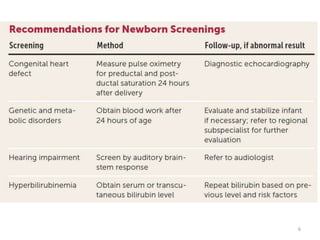
• For newborns, review the results of all newborn
screening tests (Table) and schedule follow-up visits as
necessary.
5
6
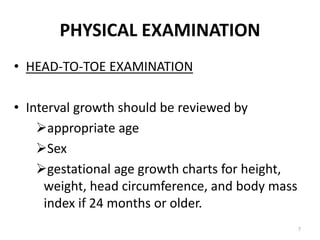
PHYSICAL EXAMINATION
• HEAD-TO-TOE EXAMINATION
• Interval growth should be reviewed by
appropriate age
Sex
gestational age growth charts for height,
weight, head circumference, and body mass
index if 24 months or older.
7
Screenings
8
MATERNAL DEPRESSION
• Prevalence of postpartum depression ~ 12%
• Edinburgh Postnatal Depression Scale or PHQ-2
• AAP recommends screening mothers at the one-
, two-, four-, and six-month well-child visits,
with further evaluation for positive results
(expert opinions)
9
PSYCHOSOCIAL
• The prevalence of mental health disorders (i.e., primarily anxiety,
depression, behavioral disorders, attention-deficit/ hyperactivity
disorder) in preschool-aged children is around 6%
• Risk factors for these disorders include having a lower
socioeconomic status, being a member of an ethnic minority, and
having a non–English-speaking parent or primary caregiver. 10
• The USPSTF found insufficient evidence
regarding screening for depression in children up
to 11 years of age.
• Based on expert opinion, the AAP recommends
that physicians consider screening, although
screening in young children has not been
validated or standardized (SOR C) 11
• No standardized tool
• We may consider:
 Baby Pediatric Symptom Checklist
 Preschool Pediatric Symptom Checklist
 Strengths and Difficulties Questionnaire
12
DEVELOPMENT AND SURVEILLANCE
• the AAP recommends early identification of
developmental delays and autism
• the USPSTF found insufficient evidence to
recommend formal developmental screening13
or autism-specific screening if the
parents/caregivers or physician have no
concerns
13
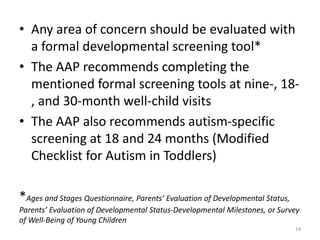
• Any area of concern should be evaluated with
a formal developmental screening tool*
• The AAP recommends completing the
mentioned formal screening tools at nine-, 18-
, and 30-month well-child visits
• The AAP also recommends autism-specific
screening at 18 and 24 months (Modified
Checklist for Autism in Toddlers)
*Ages and Stages Questionnaire, Parents’ Evaluation of Developmental Status,
Parents’ Evaluation of Developmental Status-Developmental Milestones, or Survey
of Well-Being of Young Children
14
IRON DEFICIENCY
• it is essential to ensure adequate iron intake.
• Based on expert opinion, the AAP recommends
supplements for preterm infants beginning at
one month of age and exclusively breastfed
term infants at six months of age
• Based on expert opinion, the AAP recommends
measuring a child’s hemoglobin level at 12
months of age.
• USPSTF: insufficient evidence for screening
15
LEAD
• elevated lead blood levels are prevalent in young
children
• targeted screening approach (AAP and CDC)
• between six months and six years in high-risk
• USPSTF does not recommend screening for lead
poisoning in children at average risk who are
asymptomatic
16
VISION
• The USPSTF recommends at least one vision
screening to detect amblyopia between three
and five years of age.
• Testing options include visual acuity,
photoscreening, and autorefractors.
• AAP recommends the use of an instrument-based
screening (photoscreening or autorefractors)
between 12 months and three years of age and
annual visual acuity screening beginning at four
years of age (Lea test).
17
IMMUNIZATIONS
• The AAFP recommends that all children be
immunized.
• Immunizations are usually administered at the
two-, four-, six-, 12-, and 15- to 18-month
well-child visits; the four- to six-year well-child
visit; and annually during influenza season
• Additional vaccinations may be necessary
based on medical history
18
Anticipatory Guidance
• SAFETY
• DENTAL CARE
• SCREEN TIME
• SLEEP
• DIET AND ACTIVITY
19
SAFETY
• Injuries remain the leading cause of death
among children
• Appropriate use of child restraints
• Infants need a rear-facing car safety seat until
two years of age or until they reach the height
or weight limit for the specific car seat
• Children should then switch to a forward-
facing car seat for as long as the seat allows,
usually (30 to 36 kg)
20
• Young children should wear bicycle helmets
• Having functioning smoke detectors and an escape plan
decreases the risk of fire- and smoke-related deaths
• Water heaters should be set to a maximum of 120°F (49°C)
to prevent scald burn
• Infants should not be left alone on any high surface, and
stairs should be secured by gates
• Infant walkers should be discouraged because they
provide no benefit and they increase falls down stairs, even
if stair gates are installed
21
DENTAL CARE
• Infants should never have a bottle in bed, and
babies should be weaned to a cup by 12 months
of age.
• Juices should be avoided in infants younger than
12 months.
• Fluoride use inhibits tooth demineralization and
bacterial enzymes and also enhances
remineralization.
22
• The AAP and USPSTF recommend fluoride
supplementation and the application of
fluoride varnish for teeth if the water supply is
insufficient.
• Begin brushing teeth at tooth eruption with
parents or caregivers supervising brushing
until mastery.
• Children should visit a dentist regularly, and
an assessment of dental health should occur
at well-child visits.
23
SCREEN TIME
• Hands-on exploration of their environment is essential
to development in children younger than two years
• Video chatting is acceptable for children younger than
18 months; otherwise digital media should be avoided.
• Parents and caregivers may use educational programs
and applications with children 18 to 24 months of age 24
• the AAP recommends a maximum of one hour
per day that occurs at least one hour before
bedtime.
• Longer usage can cause sleep problems and
increases the risk of obesity and social-emotional
delays.
• The AAFP and AAP recommend that children
participate in at least 60 minutes of active free
play per day.
25
SLEEP
• To decrease the risk of sudden infant death
syndrome (SIDS), the AAP recommends that
infants sleep on their backs on a firm mattress for
the first year of life with no blankets or other soft
objects in the crib.
26
• Breastfeeding, pacifier use, and room sharing
without bed sharing protect against SIDS
• infant exposure to tobacco, alcohol, drugs,
and sleeping in bed with parents or caregivers
increases the risk of SIDS.
27
DIET AND ACTIVITY
• The USPSTF, AAFP, and AAP all recommend
breastfeeding until at least six months of age
and ideally for the first 12 months.
• Vitamin D 400 IU supplementation for the first
year of life in exclusively breastfed infants is
recommended to prevent vitamin D deficiency
and rickets.
28
• Early transition to solid foods before six months
is associated with higher consumption of fatty
and sugary foods and an increased risk of atopic
disease.
• The AAFP and AAP recommend that children
participate in at least 60 minutes of active free
play per day
29
• Delayed transition to cow’s milk until 12
months of age decreases the incidence of iron
deficiency
• Introduction of highly allergenic foods, such as
peanut-based foods and eggs, before one year
decreases the likelihood that a child will
develop food allergies
30
• 17% of children are obese
• USPSTF does not have a recommendation for screening
or interventions to prevent obesity in children younger
than six years.
• Cessation of breastfeeding before six months and
introduction of solid foods before six months are
associated with childhood obesity and are not
recommended. 31
• Drinking juice should be avoided before one
year of age, and, if given to older children, only
100% fruit juice should be provided in limited
quantities: 4 ounces per day from one to three
years of age and 4 to 6 ounces per day from
four to six years of age
• Intake of other sugar-sweetened beverages
should be discouraged to help prevent obesity.
32
TAKE HOME MESSAGES
• Always do a head-toe-exam
• Assess for psycho-social because it is usually
missed
• Stick to recommendations in diet to avoid
increasing incidence of obesity
• Stress on dental care
• Advice families to avoid smartphones and media
devices
33

Well child visits

  • 1.
    Well-Child Visits (Infants andYoung Children) Hasan Ismail Family Medicine, Lebanese University 1
  • 2.
    Objectives • To stresson the importance of the well-child visits • To know the U.S. Preventive Services Task Force (USPSTF) and the American Academy of Pediatrics (AAP) guidelines for screenings and recommendations for infants and young children • To recognize the most useful assessment tools applied during a well-child visit according to EBM 2
  • 3.
    Visits • Infants andyoung children (up to 5 years) • Provide opportunities for physicians to screen for medical problems (including psychosocial concerns) • anticipatory guidance • promote good health • allow the family physician to establish a relationship with the parents or caregivers 3
  • 4.
    HISTORY • brief reviewof birth history • prematurity can be associated with complex medical conditions. • Evaluate breastfed infants for any feeding problems • assess formula-fed infants for type and quantity of iron-fortified formula being given. 4
  • 5.
    • For childreneating solid foods, feeding history should include everything the child eats and drinks. • Sleep, urination, defecation, nutrition, dental care, and child safety should be reviewed. • Medical, surgical, family, and social histories should be reviewed and updated. • For newborns, review the results of all newborn screening tests (Table) and schedule follow-up visits as necessary. 5
  • 6.
  • 7.
    PHYSICAL EXAMINATION • HEAD-TO-TOEEXAMINATION • Interval growth should be reviewed by appropriate age Sex gestational age growth charts for height, weight, head circumference, and body mass index if 24 months or older. 7
  • 8.
  • 9.
    MATERNAL DEPRESSION • Prevalenceof postpartum depression ~ 12% • Edinburgh Postnatal Depression Scale or PHQ-2 • AAP recommends screening mothers at the one- , two-, four-, and six-month well-child visits, with further evaluation for positive results (expert opinions) 9
  • 10.
    PSYCHOSOCIAL • The prevalenceof mental health disorders (i.e., primarily anxiety, depression, behavioral disorders, attention-deficit/ hyperactivity disorder) in preschool-aged children is around 6% • Risk factors for these disorders include having a lower socioeconomic status, being a member of an ethnic minority, and having a non–English-speaking parent or primary caregiver. 10
  • 11.
    • The USPSTFfound insufficient evidence regarding screening for depression in children up to 11 years of age. • Based on expert opinion, the AAP recommends that physicians consider screening, although screening in young children has not been validated or standardized (SOR C) 11
  • 12.
    • No standardizedtool • We may consider:  Baby Pediatric Symptom Checklist  Preschool Pediatric Symptom Checklist  Strengths and Difficulties Questionnaire 12
  • 13.
    DEVELOPMENT AND SURVEILLANCE •the AAP recommends early identification of developmental delays and autism • the USPSTF found insufficient evidence to recommend formal developmental screening13 or autism-specific screening if the parents/caregivers or physician have no concerns 13
  • 14.
    • Any areaof concern should be evaluated with a formal developmental screening tool* • The AAP recommends completing the mentioned formal screening tools at nine-, 18- , and 30-month well-child visits • The AAP also recommends autism-specific screening at 18 and 24 months (Modified Checklist for Autism in Toddlers) *Ages and Stages Questionnaire, Parents’ Evaluation of Developmental Status, Parents’ Evaluation of Developmental Status-Developmental Milestones, or Survey of Well-Being of Young Children 14
  • 15.
    IRON DEFICIENCY • itis essential to ensure adequate iron intake. • Based on expert opinion, the AAP recommends supplements for preterm infants beginning at one month of age and exclusively breastfed term infants at six months of age • Based on expert opinion, the AAP recommends measuring a child’s hemoglobin level at 12 months of age. • USPSTF: insufficient evidence for screening 15
  • 16.
    LEAD • elevated leadblood levels are prevalent in young children • targeted screening approach (AAP and CDC) • between six months and six years in high-risk • USPSTF does not recommend screening for lead poisoning in children at average risk who are asymptomatic 16
  • 17.
    VISION • The USPSTFrecommends at least one vision screening to detect amblyopia between three and five years of age. • Testing options include visual acuity, photoscreening, and autorefractors. • AAP recommends the use of an instrument-based screening (photoscreening or autorefractors) between 12 months and three years of age and annual visual acuity screening beginning at four years of age (Lea test). 17
  • 18.
    IMMUNIZATIONS • The AAFPrecommends that all children be immunized. • Immunizations are usually administered at the two-, four-, six-, 12-, and 15- to 18-month well-child visits; the four- to six-year well-child visit; and annually during influenza season • Additional vaccinations may be necessary based on medical history 18
  • 19.
    Anticipatory Guidance • SAFETY •DENTAL CARE • SCREEN TIME • SLEEP • DIET AND ACTIVITY 19
  • 20.
    SAFETY • Injuries remainthe leading cause of death among children • Appropriate use of child restraints • Infants need a rear-facing car safety seat until two years of age or until they reach the height or weight limit for the specific car seat • Children should then switch to a forward- facing car seat for as long as the seat allows, usually (30 to 36 kg) 20
  • 21.
    • Young childrenshould wear bicycle helmets • Having functioning smoke detectors and an escape plan decreases the risk of fire- and smoke-related deaths • Water heaters should be set to a maximum of 120°F (49°C) to prevent scald burn • Infants should not be left alone on any high surface, and stairs should be secured by gates • Infant walkers should be discouraged because they provide no benefit and they increase falls down stairs, even if stair gates are installed 21
  • 22.
    DENTAL CARE • Infantsshould never have a bottle in bed, and babies should be weaned to a cup by 12 months of age. • Juices should be avoided in infants younger than 12 months. • Fluoride use inhibits tooth demineralization and bacterial enzymes and also enhances remineralization. 22
  • 23.
    • The AAPand USPSTF recommend fluoride supplementation and the application of fluoride varnish for teeth if the water supply is insufficient. • Begin brushing teeth at tooth eruption with parents or caregivers supervising brushing until mastery. • Children should visit a dentist regularly, and an assessment of dental health should occur at well-child visits. 23
  • 24.
    SCREEN TIME • Hands-onexploration of their environment is essential to development in children younger than two years • Video chatting is acceptable for children younger than 18 months; otherwise digital media should be avoided. • Parents and caregivers may use educational programs and applications with children 18 to 24 months of age 24
  • 25.
    • the AAPrecommends a maximum of one hour per day that occurs at least one hour before bedtime. • Longer usage can cause sleep problems and increases the risk of obesity and social-emotional delays. • The AAFP and AAP recommend that children participate in at least 60 minutes of active free play per day. 25
  • 26.
    SLEEP • To decreasethe risk of sudden infant death syndrome (SIDS), the AAP recommends that infants sleep on their backs on a firm mattress for the first year of life with no blankets or other soft objects in the crib. 26
  • 27.
    • Breastfeeding, pacifieruse, and room sharing without bed sharing protect against SIDS • infant exposure to tobacco, alcohol, drugs, and sleeping in bed with parents or caregivers increases the risk of SIDS. 27
  • 28.
    DIET AND ACTIVITY •The USPSTF, AAFP, and AAP all recommend breastfeeding until at least six months of age and ideally for the first 12 months. • Vitamin D 400 IU supplementation for the first year of life in exclusively breastfed infants is recommended to prevent vitamin D deficiency and rickets. 28
  • 29.
    • Early transitionto solid foods before six months is associated with higher consumption of fatty and sugary foods and an increased risk of atopic disease. • The AAFP and AAP recommend that children participate in at least 60 minutes of active free play per day 29
  • 30.
    • Delayed transitionto cow’s milk until 12 months of age decreases the incidence of iron deficiency • Introduction of highly allergenic foods, such as peanut-based foods and eggs, before one year decreases the likelihood that a child will develop food allergies 30
  • 31.
    • 17% ofchildren are obese • USPSTF does not have a recommendation for screening or interventions to prevent obesity in children younger than six years. • Cessation of breastfeeding before six months and introduction of solid foods before six months are associated with childhood obesity and are not recommended. 31
  • 32.
    • Drinking juiceshould be avoided before one year of age, and, if given to older children, only 100% fruit juice should be provided in limited quantities: 4 ounces per day from one to three years of age and 4 to 6 ounces per day from four to six years of age • Intake of other sugar-sweetened beverages should be discouraged to help prevent obesity. 32
  • 33.
    TAKE HOME MESSAGES •Always do a head-toe-exam • Assess for psycho-social because it is usually missed • Stick to recommendations in diet to avoid increasing incidence of obesity • Stress on dental care • Advice families to avoid smartphones and media devices 33