APPROACH TO SICK NEONATE
Dr. Abid Ali Jamali, MBBS, FCPS
Fellow PEM
24/7 Emergency & Acute Care
Aga Khan University Hospital
QUOTE OF THE DAY:
• “Try not to resist the changes that come your
way. Instead let life live through you. And do
not worry that your life is turning upside
down. How do you know that the side you are
used to is better than the one to come?”
― Elif Shafak, The Forty Rules of Love
OBJECTIVES
• To understand the structured approach to the
recognition of a seriously ill neonate.
• To learn a rapid clinical assessment
sequence to identify serious illness in
neonate based on NRP algorithms
• To know the emergency management of
common neonatal emergencies including
sepsis, congenital heart diseases and
metabolic disturbances
Why to deal neonates separately from
older children?
• The neonatal period (<28 days of age) and young infancy (<
3months ) is the most common time for presentation of
congenital conditions and the highest susceptibility for
infection.
• Young babies are renowned for their vague presentations and
lack of localizing clinical signs.
• In fact, they can be a bit of a diagnostic nightmare!
• So in order to avoid panicking when faced with a sick baby,
keep in mind these big 5 diagnoses not to be missed, how to
spot them and a few tips about management.
• An understanding of normal newborn anatomy,
physiology, and behavior can be of great practical
value in the safe and effective evaluation and
treatment of newborn patients.
• Understanding the range of acceptable normal
variation can help the ED physician in the
recognition of more serious underlying
pathology.
Why the Evaluation of a neonate is
challenging?
• Neonates are unable to provide any history related to their
chief complaints and physical examination findings can be
unreliable and variable.
• While evaluation of the overall appearance can be helpful,
a well appearance does not rule out significant illness.
• Signs such as listlessness, poor feeding, and cyanosis are
strongly suggestive of serious illness.
• However, a well-appearing neonate, even with a social
smile, does exclude significant illness, including occult
sepsis.
EVALUATION OF THE NEONATE
VITAL SIGNS
• Assessment of a newborn’s vital signs can provide vital clues to the
health of a newborn.
• Normal body temperature in neonates is less than 38° C. Normal
heart rate is 120-180 beats per minute. Normal respiratory rate is
30-60 breaths per minute. Normal blood pressure is 60/40 mmHg
or higher. Typical weights are 3-4 kg.
• Any fever greater than 100.5° F rectally is abnormal; elevated
respiratory rates should suggest underlying respiratory or cardiac
disease and elevated blood pressures should be repeated and, if
hypertension is confirmed, the infant carefully assessed for
underlying cardiac or renal disease.
• Infection is the most common cause of illness, with
urinary tract infections (UTI) the most common
bacterial infection
– Fever is not always present, and neonates and young
infants can present hypothermic (rectal temperature
<36.5°C)
• Neonates and young infants at particular risk include:
– low birth weight and premature babies
– those with a known medical condition eg congenital
anomaly
– babies from socially disadvantaged families
Assessment
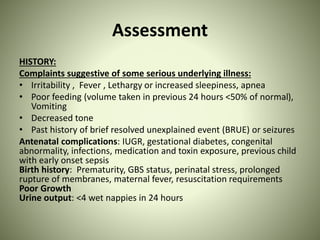
HISTORY:
Complaints suggestive of some serious underlying illness:
• Irritability , Fever , Lethargy or increased sleepiness, apnea
• Poor feeding (volume taken in previous 24 hours <50% of normal),
Vomiting
• Decreased tone
• Past history of brief resolved unexplained event (BRUE) or seizures
Antenatal complications: IUGR, gestational diabetes, congenital
abnormality, infections, medication and toxin exposure, previous child
with early onset sepsis
Birth history: Prematurity, GBS status, perinatal stress, prolonged
rupture of membranes, maternal fever, resuscitation requirements
Poor Growth
Urine output: <4 wet nappies in 24 hours
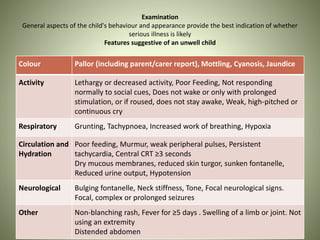
Examination
General aspects of the child's behaviour and appearance provide the best indication of whether
serious illness is likely
Features suggestive of an unwell child
Colour Pallor (including parent/carer report), Mottling, Cyanosis, Jaundice
Activity Lethargy or decreased activity, Poor Feeding, Not responding
normally to social cues, Does not wake or only with prolonged
stimulation, or if roused, does not stay awake, Weak, high-pitched or
continuous cry
Respiratory Grunting, Tachypnoea, Increased work of breathing, Hypoxia
Circulation and
Hydration
Poor feeding, Murmur, weak peripheral pulses, Persistent
tachycardia, Central CRT ≥3 seconds
Dry mucous membranes, reduced skin turgor, sunken fontanelle,
Reduced urine output, Hypotension
Neurological Bulging fontanelle, Neck stiffness, Tone, Focal neurological signs.
Focal, complex or prolonged seizures
Other Non-blanching rash, Fever for ≥5 days . Swelling of a limb or joint. Not
using an extremity
Distended abdomen
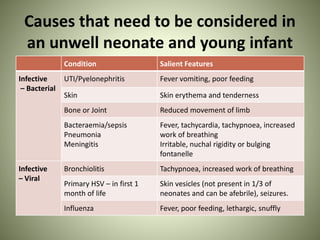
Causes that need to be considered in
an unwell neonate and young infant
Condition Salient Features
Infective
– Bacterial
UTI/Pyelonephritis Fever vomiting, poor feeding
Skin Skin erythema and tenderness
Bone or Joint Reduced movement of limb
Bacteraemia/sepsis
Pneumonia
Meningitis
Fever, tachycardia, tachypnoea, increased
work of breathing
Irritable, nuchal rigidity or bulging
fontanelle
Infective
– Viral
Bronchiolitis Tachypnoea, increased work of breathing
Primary HSV – in first 1
month of life
Skin vesicles (not present in 1/3 of
neonates and can be afebrile), seizures.
Influenza Fever, poor feeding, lethargic, snuffly
Surgical Malrotation with
volvulus
Bile-stained vomit
Pyloric stenosis Progressive, non-bilious and projectile vomiting,
mass , hypochloraemic hypokalaemic metabolic
alkalosis
Incarcerated hernia Irreducible inguinal swelling
NEC Abdominal distention, tenderness, vomiting, blood
in stool
Intussusception Intermittent severe abdominal pain, vomiting,
pallor, lethargy and rectal bleeding (red currant
stool)
Cardiac Congenital cardiac
disease
Cyanosis, murmur (not always present), diaphoresis
(sweating) with feeding, Cardiac failure
(tachypnoea, enlarged liver, hypoperfusion), poor or
absent peripheral pulses
Supraventricular
tachycardia and
other arrhythmias
Persistent marked tachycardia, pallor, poor feeding
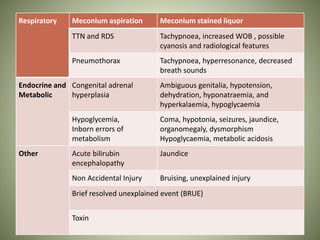
Respiratory Meconium aspiration Meconium stained liquor
TTN and RDS Tachypnoea, increased WOB , possible
cyanosis and radiological features
Pneumothorax Tachypnoea, hyperresonance, decreased
breath sounds
Endocrine and
Metabolic
Congenital adrenal
hyperplasia
Ambiguous genitalia, hypotension,
dehydration, hyponatraemia, and
hyperkalaemia, hypoglycaemia
Hypoglycemia,
Inborn errors of
metabolism
Coma, hypotonia, seizures, jaundice,
organomegaly, dysmorphism
Hypoglycaemia, metabolic acidosis
Other Acute bilirubin
encephalopathy
Jaundice
Non Accidental Injury Bruising, unexplained injury
Brief resolved unexplained event (BRUE)
Toxin
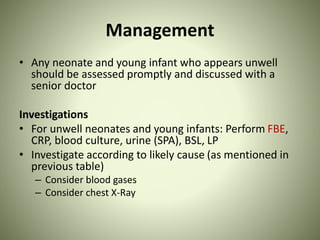
Management
• Any neonate and young infant who appears unwell
should be assessed promptly and discussed with a
senior doctor
Investigations
• For unwell neonates and young infants: Perform FBE,
CRP, blood culture, urine (SPA), BSL, LP
• Investigate according to likely cause (as mentioned in
previous table)
– Consider blood gases
– Consider chest X-Ray
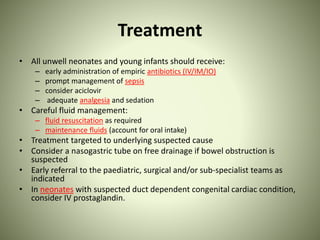
Treatment
• All unwell neonates and young infants should receive:
– early administration of empiric antibiotics (IV/IM/IO)
– prompt management of sepsis
– consider aciclovir
– adequate analgesia and sedation
• Careful fluid management:
– fluid resuscitation as required
– maintenance fluids (account for oral intake)
• Treatment targeted to underlying suspected cause
• Consider a nasogastric tube on free drainage if bowel obstruction is
suspected
• Early referral to the paediatric, surgical and/or sub-specialist teams as
indicated
• In neonates with suspected duct dependent congenital cardiac condition,
consider IV prostaglandin.
• Consider Consultation with local
neonatologist team when assessing
any unwell neonate.
• Consider transfer when child requiring care
beyond the comfort level of the hospital
• Consider discharge when
• The neonate/infant is clinically well and there is
low likelihood of infection based on examination
and negative infective indices
– In this setting, and if cultures are negative at 48 hours,
antibiotics can be ceased
• Note: a clinically well child (≥3 months) with
normal investigations can be discharged with
follow up in 12-24 hours
Which place?

approach to sick neonate.pptx

  • 1.
    APPROACH TO SICKNEONATE Dr. Abid Ali Jamali, MBBS, FCPS Fellow PEM 24/7 Emergency & Acute Care Aga Khan University Hospital
  • 2.
    QUOTE OF THEDAY: • “Try not to resist the changes that come your way. Instead let life live through you. And do not worry that your life is turning upside down. How do you know that the side you are used to is better than the one to come?” ― Elif Shafak, The Forty Rules of Love
  • 3.
    OBJECTIVES • To understandthe structured approach to the recognition of a seriously ill neonate. • To learn a rapid clinical assessment sequence to identify serious illness in neonate based on NRP algorithms • To know the emergency management of common neonatal emergencies including sepsis, congenital heart diseases and metabolic disturbances
  • 4.
    Why to dealneonates separately from older children? • The neonatal period (<28 days of age) and young infancy (< 3months ) is the most common time for presentation of congenital conditions and the highest susceptibility for infection. • Young babies are renowned for their vague presentations and lack of localizing clinical signs. • In fact, they can be a bit of a diagnostic nightmare! • So in order to avoid panicking when faced with a sick baby, keep in mind these big 5 diagnoses not to be missed, how to spot them and a few tips about management.
  • 6.
    • An understandingof normal newborn anatomy, physiology, and behavior can be of great practical value in the safe and effective evaluation and treatment of newborn patients. • Understanding the range of acceptable normal variation can help the ED physician in the recognition of more serious underlying pathology.
  • 7.
    Why the Evaluationof a neonate is challenging? • Neonates are unable to provide any history related to their chief complaints and physical examination findings can be unreliable and variable. • While evaluation of the overall appearance can be helpful, a well appearance does not rule out significant illness. • Signs such as listlessness, poor feeding, and cyanosis are strongly suggestive of serious illness. • However, a well-appearing neonate, even with a social smile, does exclude significant illness, including occult sepsis.
  • 8.
    EVALUATION OF THENEONATE VITAL SIGNS • Assessment of a newborn’s vital signs can provide vital clues to the health of a newborn. • Normal body temperature in neonates is less than 38° C. Normal heart rate is 120-180 beats per minute. Normal respiratory rate is 30-60 breaths per minute. Normal blood pressure is 60/40 mmHg or higher. Typical weights are 3-4 kg. • Any fever greater than 100.5° F rectally is abnormal; elevated respiratory rates should suggest underlying respiratory or cardiac disease and elevated blood pressures should be repeated and, if hypertension is confirmed, the infant carefully assessed for underlying cardiac or renal disease.
  • 9.
    • Infection isthe most common cause of illness, with urinary tract infections (UTI) the most common bacterial infection – Fever is not always present, and neonates and young infants can present hypothermic (rectal temperature <36.5°C) • Neonates and young infants at particular risk include: – low birth weight and premature babies – those with a known medical condition eg congenital anomaly – babies from socially disadvantaged families
  • 10.
    Assessment HISTORY: Complaints suggestive ofsome serious underlying illness: • Irritability , Fever , Lethargy or increased sleepiness, apnea • Poor feeding (volume taken in previous 24 hours <50% of normal), Vomiting • Decreased tone • Past history of brief resolved unexplained event (BRUE) or seizures Antenatal complications: IUGR, gestational diabetes, congenital abnormality, infections, medication and toxin exposure, previous child with early onset sepsis Birth history: Prematurity, GBS status, perinatal stress, prolonged rupture of membranes, maternal fever, resuscitation requirements Poor Growth Urine output: <4 wet nappies in 24 hours
  • 11.
    Examination General aspects ofthe child's behaviour and appearance provide the best indication of whether serious illness is likely Features suggestive of an unwell child Colour Pallor (including parent/carer report), Mottling, Cyanosis, Jaundice Activity Lethargy or decreased activity, Poor Feeding, Not responding normally to social cues, Does not wake or only with prolonged stimulation, or if roused, does not stay awake, Weak, high-pitched or continuous cry Respiratory Grunting, Tachypnoea, Increased work of breathing, Hypoxia Circulation and Hydration Poor feeding, Murmur, weak peripheral pulses, Persistent tachycardia, Central CRT ≥3 seconds Dry mucous membranes, reduced skin turgor, sunken fontanelle, Reduced urine output, Hypotension Neurological Bulging fontanelle, Neck stiffness, Tone, Focal neurological signs. Focal, complex or prolonged seizures Other Non-blanching rash, Fever for ≥5 days . Swelling of a limb or joint. Not using an extremity Distended abdomen
  • 12.
    Causes that needto be considered in an unwell neonate and young infant Condition Salient Features Infective – Bacterial UTI/Pyelonephritis Fever vomiting, poor feeding Skin Skin erythema and tenderness Bone or Joint Reduced movement of limb Bacteraemia/sepsis Pneumonia Meningitis Fever, tachycardia, tachypnoea, increased work of breathing Irritable, nuchal rigidity or bulging fontanelle Infective – Viral Bronchiolitis Tachypnoea, increased work of breathing Primary HSV – in first 1 month of life Skin vesicles (not present in 1/3 of neonates and can be afebrile), seizures. Influenza Fever, poor feeding, lethargic, snuffly
  • 13.
    Surgical Malrotation with volvulus Bile-stainedvomit Pyloric stenosis Progressive, non-bilious and projectile vomiting, mass , hypochloraemic hypokalaemic metabolic alkalosis Incarcerated hernia Irreducible inguinal swelling NEC Abdominal distention, tenderness, vomiting, blood in stool Intussusception Intermittent severe abdominal pain, vomiting, pallor, lethargy and rectal bleeding (red currant stool) Cardiac Congenital cardiac disease Cyanosis, murmur (not always present), diaphoresis (sweating) with feeding, Cardiac failure (tachypnoea, enlarged liver, hypoperfusion), poor or absent peripheral pulses Supraventricular tachycardia and other arrhythmias Persistent marked tachycardia, pallor, poor feeding
  • 14.
    Respiratory Meconium aspirationMeconium stained liquor TTN and RDS Tachypnoea, increased WOB , possible cyanosis and radiological features Pneumothorax Tachypnoea, hyperresonance, decreased breath sounds Endocrine and Metabolic Congenital adrenal hyperplasia Ambiguous genitalia, hypotension, dehydration, hyponatraemia, and hyperkalaemia, hypoglycaemia Hypoglycemia, Inborn errors of metabolism Coma, hypotonia, seizures, jaundice, organomegaly, dysmorphism Hypoglycaemia, metabolic acidosis Other Acute bilirubin encephalopathy Jaundice Non Accidental Injury Bruising, unexplained injury Brief resolved unexplained event (BRUE) Toxin
  • 15.
    Management • Any neonateand young infant who appears unwell should be assessed promptly and discussed with a senior doctor Investigations • For unwell neonates and young infants: Perform FBE, CRP, blood culture, urine (SPA), BSL, LP • Investigate according to likely cause (as mentioned in previous table) – Consider blood gases – Consider chest X-Ray
  • 16.
    Treatment • All unwellneonates and young infants should receive: – early administration of empiric antibiotics (IV/IM/IO) – prompt management of sepsis – consider aciclovir – adequate analgesia and sedation • Careful fluid management: – fluid resuscitation as required – maintenance fluids (account for oral intake) • Treatment targeted to underlying suspected cause • Consider a nasogastric tube on free drainage if bowel obstruction is suspected • Early referral to the paediatric, surgical and/or sub-specialist teams as indicated • In neonates with suspected duct dependent congenital cardiac condition, consider IV prostaglandin.
  • 17.
    • Consider Consultationwith local neonatologist team when assessing any unwell neonate. • Consider transfer when child requiring care beyond the comfort level of the hospital
  • 18.
    • Consider dischargewhen • The neonate/infant is clinically well and there is low likelihood of infection based on examination and negative infective indices – In this setting, and if cultures are negative at 48 hours, antibiotics can be ceased • Note: a clinically well child (≥3 months) with normal investigations can be discharged with follow up in 12-24 hours
  • 19.

Editor's Notes

  • #10 https://www.rch.org.au/clinicalguide/guideline_index/Recognition_of_the_seriously_unwell_neonate_and_young_infant/