Reliability & Safety Engineering
CLO
CO-1: Analyze the fundamental concepts of reliability
CO-2: Interpret the concepts of redundancy and maintenance
CO-3: Compare the various concepts of maintainability
CO-4: Identify the techniques used for of reliability test.
CO-5: Explain the techniques of safety engineering
Unit 1
Reliability as a Function of Time
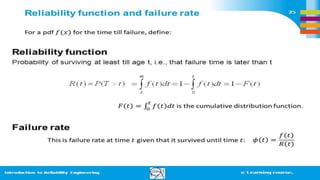
• Reliability R(t): failure occurs after time ‘t’. Let X be
the lifetime of a component subject to failures.
• Let N0: total no. of components (fixed); Ns(t):
surviving ones; Nf(t): failed one by time t.
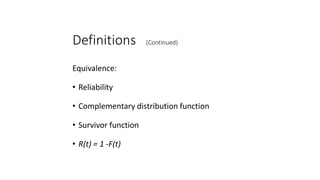
Definitions (Continued)
Equivalence:
• Reliability
• Complementary distribution function
• Survivor function
• R(t) = 1 -F(t)
Hazard Rate and the pdf
h(t) t = Conditional Prob. system will fail in
(t, t + t) given that it has survived until time t
f(t) t = Unconditional Prob. System will fail in
(t, t + t)
• Difference between:
• probability that someone will die between 90 and 91, given that he lives to 90
• probability that someone will die between 90 and 91
)
(
1
)
(
)
(
)
(
)
(
t
F
t
f
t
R
t
f
t
h



Weibull Distribution
• Frequently used to model fatigue failure, ball bearing failure
etc. (very long tails)
• Reliability:
• Weibull distribution is capable of modeling DFR (α < 1), CFR (α
= 1) and IFR (α >1) behavior.
• α is called the shape parameter and  is the scale parameter
  0

 
t
e
t
R t

Failure rate of the weibull
distribution with various values of
 and  = 1
5.0
1.0 2.0 3.0 4.0
Infant Mortality Effects in System Modeling
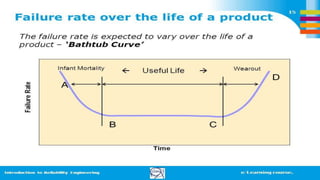
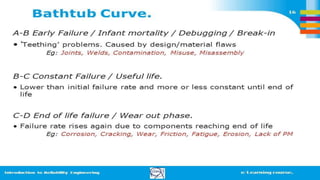
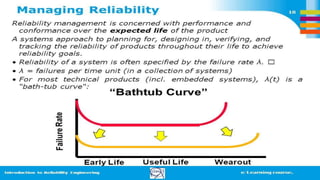
• Bathtub curves
• Early-life period
• Steady-state period
• Wear out period
• Failure rate models
Bathtub Curve
Steady State
Infant Mortality
(Early Life Failures) Wear out
•Until now we assumed that failure rate of equipment is time (age)
independent. In real-life, variation as per the bathtub shape has been
observed
Failure
Rate
(t)
Operating Time
Early-life Period
• Also called infant mortality phase or reliability
growth phase
• Caused by undetected hardware/software defects
that are being fixed resulting in reliability growth
• Can cause significant prediction errors if steady-
state failure rates are used
• Availability models can be constructed and solved
to include this effect
• Weibull Model can be used
Steady-state Period
• Failure rate much lower than in early-life
period
• Either constant (age independent) or slowly
varying failure rate
• Failures caused by environmental shocks
• Arrival process of environmental shocks can
be assumed to be a Poisson process
• Hence time between two shocks has the
exponential distribution
• Failure rate increases rapidly with age
• Properly qualified electronic hardware do not
exhibit wear out failure during its intended service
life (Motorola)
• Applicable for mechanical and other systems
• Weibull Failure Model can be used
Wear out Period
•We use a truncated Weibull Model
•Infant mortality phase modeled by DFR Weibull and the steady-
state phase by the exponential
0 2,190 4,380 6,570 8,760 10,950 13,140 15,330 17,520
Operating Times (hrs)
Failure-Rate
Multiplier
7
6
5
4
3
2
1
0
Failure Rate Models
Failure Rate Models (cont.)
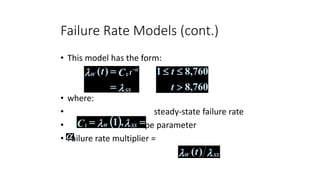
• This model has the form:
• where:
• steady-state failure rate
• is the Weibull shape parameter
• Failure rate multiplier =

 
SS
W t
C
t

 
1
)
(
760
,
8
760
,
8
1



t
t
  
 
 SS
W
C ,
1
1


 SS
W t)
(
Failure Rate Models (cont.)
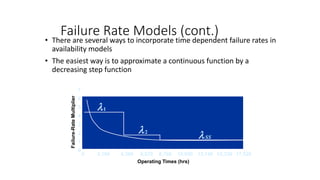
• There are several ways to incorporate time dependent failure rates in
availability models
• The easiest way is to approximate a continuous function by a
decreasing step function
2,190 4,380 6,570 10,950 13,140 15,330 17,520
Operating Times (hrs)
Failure-Rate
Multiplier
7
6
5
4
3
2
1
0
8,760
0
1
2
SS
Failure Rate Models (cont.)
•Here the discrete failure-rate model is
defined by:




ss
W t



2
1
)
(
760
,
8
760
,
8
380
,
4
380
,
4
0





t
t
t
Uniform Random Variable
• All (pseudo) random generators generate random deviates of U(0,1)
distribution; that is, if you generate a large number of random
variables and plot their empirical distribution function, it will
approach this distribution in the limit.
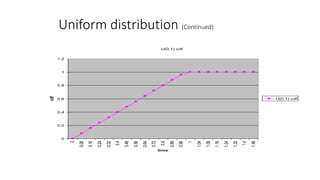
• U(a,b)  pdf constant over the (a,b) interval and CDF is the ramp
function
Uniform density
U(0,1) pdf
0
0.2
0.4
0.6
0.8
1
1.2
0 0.1 0.2 0.3 0.6 0.7 0.8 0.9 1 1.1 1.2 1.3 1.4 1.5 1.6 1.7 1.8 1.9 2 2.1 2.2
time
cdf
0
0.1
0.2
0.3
0.6
0.7
0.8
0.9
1
1.1
1.2
1.3
1.4
1.5
1.6
1.7
1.8
1.9
Uniform distribution
• The distribution function is given by:
{
0 , x < a,
F(x)= , a < x < b
1 , x > b.
a
b
a
x


Uniform distribution (Continued)
U(0,1) cdf
0
0.2
0.4
0.6
0.8
1
1.2
0
0.08
0.16
0.24
0.32
0.4
0.48
0.56
0.64
0.72
0.8
0.88
0.96
1
1.04
1.08
1.16
1.24
1.32
1.4
1.48
time
cdf
U(0,1) cdf

Reliability Engineering intro.pptx

  • 1.
  • 2.
    CLO CO-1: Analyze thefundamental concepts of reliability CO-2: Interpret the concepts of redundancy and maintenance CO-3: Compare the various concepts of maintainability CO-4: Identify the techniques used for of reliability test. CO-5: Explain the techniques of safety engineering Unit 1
  • 49.
    Reliability as aFunction of Time • Reliability R(t): failure occurs after time ‘t’. Let X be the lifetime of a component subject to failures. • Let N0: total no. of components (fixed); Ns(t): surviving ones; Nf(t): failed one by time t.
  • 50.
    Definitions (Continued) Equivalence: • Reliability •Complementary distribution function • Survivor function • R(t) = 1 -F(t)
  • 51.
    Hazard Rate andthe pdf h(t) t = Conditional Prob. system will fail in (t, t + t) given that it has survived until time t f(t) t = Unconditional Prob. System will fail in (t, t + t) • Difference between: • probability that someone will die between 90 and 91, given that he lives to 90 • probability that someone will die between 90 and 91 ) ( 1 ) ( ) ( ) ( ) ( t F t f t R t f t h   
  • 52.
    Weibull Distribution • Frequentlyused to model fatigue failure, ball bearing failure etc. (very long tails) • Reliability: • Weibull distribution is capable of modeling DFR (α < 1), CFR (α = 1) and IFR (α >1) behavior. • α is called the shape parameter and  is the scale parameter   0    t e t R t 
  • 53.
    Failure rate ofthe weibull distribution with various values of  and  = 1 5.0 1.0 2.0 3.0 4.0
  • 54.
    Infant Mortality Effectsin System Modeling • Bathtub curves • Early-life period • Steady-state period • Wear out period • Failure rate models
  • 55.
    Bathtub Curve Steady State InfantMortality (Early Life Failures) Wear out •Until now we assumed that failure rate of equipment is time (age) independent. In real-life, variation as per the bathtub shape has been observed Failure Rate (t) Operating Time
  • 56.
    Early-life Period • Alsocalled infant mortality phase or reliability growth phase • Caused by undetected hardware/software defects that are being fixed resulting in reliability growth • Can cause significant prediction errors if steady- state failure rates are used • Availability models can be constructed and solved to include this effect • Weibull Model can be used
  • 57.
    Steady-state Period • Failurerate much lower than in early-life period • Either constant (age independent) or slowly varying failure rate • Failures caused by environmental shocks • Arrival process of environmental shocks can be assumed to be a Poisson process • Hence time between two shocks has the exponential distribution
  • 58.
    • Failure rateincreases rapidly with age • Properly qualified electronic hardware do not exhibit wear out failure during its intended service life (Motorola) • Applicable for mechanical and other systems • Weibull Failure Model can be used Wear out Period
  • 59.
    •We use atruncated Weibull Model •Infant mortality phase modeled by DFR Weibull and the steady- state phase by the exponential 0 2,190 4,380 6,570 8,760 10,950 13,140 15,330 17,520 Operating Times (hrs) Failure-Rate Multiplier 7 6 5 4 3 2 1 0 Failure Rate Models
  • 60.
    Failure Rate Models(cont.) • This model has the form: • where: • steady-state failure rate • is the Weibull shape parameter • Failure rate multiplier =    SS W t C t    1 ) ( 760 , 8 760 , 8 1    t t       SS W C , 1 1    SS W t) (
  • 61.
    Failure Rate Models(cont.) • There are several ways to incorporate time dependent failure rates in availability models • The easiest way is to approximate a continuous function by a decreasing step function 2,190 4,380 6,570 10,950 13,140 15,330 17,520 Operating Times (hrs) Failure-Rate Multiplier 7 6 5 4 3 2 1 0 8,760 0 1 2 SS
  • 62.
    Failure Rate Models(cont.) •Here the discrete failure-rate model is defined by:     ss W t    2 1 ) ( 760 , 8 760 , 8 380 , 4 380 , 4 0      t t t
  • 63.
    Uniform Random Variable •All (pseudo) random generators generate random deviates of U(0,1) distribution; that is, if you generate a large number of random variables and plot their empirical distribution function, it will approach this distribution in the limit. • U(a,b)  pdf constant over the (a,b) interval and CDF is the ramp function
  • 64.
    Uniform density U(0,1) pdf 0 0.2 0.4 0.6 0.8 1 1.2 00.1 0.2 0.3 0.6 0.7 0.8 0.9 1 1.1 1.2 1.3 1.4 1.5 1.6 1.7 1.8 1.9 2 2.1 2.2 time cdf 0 0.1 0.2 0.3 0.6 0.7 0.8 0.9 1 1.1 1.2 1.3 1.4 1.5 1.6 1.7 1.8 1.9
  • 65.
    Uniform distribution • Thedistribution function is given by: { 0 , x < a, F(x)= , a < x < b 1 , x > b. a b a x  
  • 66.
    Uniform distribution (Continued) U(0,1)cdf 0 0.2 0.4 0.6 0.8 1 1.2 0 0.08 0.16 0.24 0.32 0.4 0.48 0.56 0.64 0.72 0.8 0.88 0.96 1 1.04 1.08 1.16 1.24 1.32 1.4 1.48 time cdf U(0,1) cdf