
Analyzing the Setting and Atmosphere in a Creative Non-Fiction Text
Creative Non-Fiction Quarter 3 Week 4
I. Learning Competency
 Analyze factual/ non-fictional elements (Plot, Characters, Characterization, Point of View,
Angle, Setting, and Atmosphere, Symbols and Symbolisms, Irony, Figures of Speech,
Dialogue, Scene, Other elements and Devices) in the texts
Objectives
By the end of the lesson, you should be able to:
a. Identify the difference between a setting and an atmosphere
b. Analyze the setting and atmosphere in the given text
c. Write a creative nonfiction narrative that focused on setting and atmosphere
II. Background Information
In the previous LAS, we learned about these elements of a creative non-fiction text: 1) plot and
structure, 2) characters and characterization, and 3) point of view. When we talk about elements of
creative non-fiction, we are talking about the parts that make up the whole of a text. We had also
been reading creative non-fiction texts to understand how these elements are used to make these
texts creative.
In this LAS, we are going to look at how the elements of setting and atmosphere are used in a
creative non-fiction text so that you can be guided with how to use these in your own writing.
Read these excerpts from “Mountain Province: Sagada” by Johanna Michelle Lim then answer the
questions that follow.
Excerpt 1:
Past La Trinidad moving to Halsema Highway, an intricate artwork of curves and drops, air starts
to get denser and the cold biting. Mufflers and gloves come out, “decorative” accessories in any
other place but here. The open window feels like an air conditioner set full blast on the cheeks. Atok,
Benguet, appears hazy like in a dream. The fog is constant companion to passersby here and in
seeing them, one wishes that if only, one could just take handfuls of it and pocket them for souvenirs.
So in a much-needed day in the future, he could just take it out, spread it, and continue the same
dream. By the middle of the ride after a brief stopover in Atok, there is no road, no trees, no cliffs.
Just the mist, all-encompassing grays, and a runny nose.
Excerpt 2:
The roads nearer to Sagada itself from the town before are unfinished. It is dominated by narrow
dirt trails that only one vehicle, our bus, can get through. The unpaved road, susceptible to
landslides, is sandwiched by two cliffs that have a direct drop to a thousand or so feet below. And
fortunately, or un, rides are made even more exciting when a driver, insouciant to the shouts of his
tourist passengers, zigzags through as if it were a sin for wheels to touch ground. This continues
on, 80-km. speed on uneven dirt trail, until there is a semblance of asphalt again, and houses on
top of limestone formations, looking as natural there almost as if they were carved with it. And
always, always, is the biting cold, made even chillier by a change in the wind pattern, a coming
Tropical Depression. The coldness is the only welcoming committee needed; greeting even before
feet touches soil. Only then have you reached Sagada.
Questions:
1. What place is being described in Excerpt 1? How about in Excerpt 2?
2. How did you feel while reading Excerpt 1? How about while reading Excerpt 2?
3. What were the words in Excerpt 1 that made you feel this way? How about in Excerpt 2?
The parts of the creative non-fiction text taken from “Mountain Province: Sagada” by Johanna
Michelle Lim describe Atok, Benguet in excerpt 1 and Sagada, Mountain Province in excerpt 2. When
we talk about places, we often refer to the element of SETTING. When you were asked how you felt as
you read these, you were asked to describe the ATMOSPHERE of the text.
SETTING refers to an actual place and time where and when an event happens. The setting is made
more realistic when we incorporate or include the physical, sociological, psychological
environment in depicting settings.
Physical environment refers to the geographical locations, immediate surroundings, weather, or timing.
Sociological environment refers to the cultural context while the psychological environment may refer to
the reflection of what a character thinks or feels.
ATMOSPHERE is the mood which evokes or reminds us of certain feelings or emotions, conveyed by
the words used to describe the setting or reflected by the way your subject speaks or
in the way he or she acts.
When we read these excerpts, we feel how cold Atok is and how exciting it is to travel along
the roads of Sagada because of the words and details that the writer uses. To make us feel the
coldness of Atok, Lim used the following words and phrases:
 biting cold
 mufflers and gloves
 an air conditioner set full blast on the cheeks
 fog
She then evokes the dreamy and wishful mood caused by the coldness of the place through
these sentences: “The fog is constant companion to passersby here and in seeing them, one wishes
that if only, one could just take handfuls of it and pocket them for souvenirs. So, in a much-needed
day in the future, he could just take it out, spread it, and continue the same dream.”
How does Lim make us feel her excitement while she travelled along the roads of Sagada?
She does this by using these details that also describe the setting:
 narrow dirt trails that only one vehicle, our bus, can get through
 unpaved road, susceptible to landslides, is sandwiched by two cliffs that have a direct drop
to a thousand or so feet below
 a driver… zigzags through as if it were a sin for wheels to touch ground
 80-km. speed on uneven dirt trail, until there is a semblance of asphalt again
If you have tried riding a bus on an unpaved or rough road, you will probably feel the same things
she describes in her writing. Through the writer’s effective selection and description of details, we
are also made to feel the exciting atmosphere she felt when she was on her way to Sagada.
How can we write our creative non-fiction text using setting and atmosphere effectively? Cristina
Pantoja-Hidalgo, pioneering writer of creative non-fiction in the Philippines, has this to say for us:
“The most successful pieces of creative non-fiction are rich in details. Bare facts are never
enough. They need to be fleshed out; they need to be humanized. But besides giving information,
details serve other purposes. Details should be accurate and informative first. And they must be
suggestive and evocative. The right details arouse emotions, evoke memories, help to produce the
right response in your reader. Details are extremely important in evoking a sense of time and place.
It must evoke a period as well as location. Descriptive details are of particular importance for travel
writing, the point of which is, to begin with, to literally transport the reader to the place to which the
traveler has been.”
When you write your creative nonfiction text, always remember the following:
 Provide a clear description of the place you are writing about in a way that your readers
feel like you have taken them there.
 To be able to make your readers feel that you are taking them to that place you are
writing about, you have to provide details that will appeal to the senses.
 Show the readers the place by doing the following:
 write vivid descriptions that are of significance
 use sensory imagery
 deploy memorable similes and metaphors to describe a particular place
 include concrete and specific details
 Describing the place or setting is not about telling the reader about the place, which is
nothing more than a summary of the facts as you see them
 You don’t have to include all the details or descriptions–only those that have
significance to yourself and your readers
III. Activities (see attached activity sheets)
IV. Take away
 SETTING refers to an actual PLACE and TIME where and when an event happens.
 The setting is made more realistic when we incorporate or include the PHYSICAL,
SOCIOLOGICAL, PSYCHOLOGICAL environment in depicting settings.
 ATMOSPHERE is the MOOD which evokes or reminds us of certain FEELINGS or
EMOTIONS, conveyed by the WORDS used to describe the setting or reflected by the way
your subject speaks or in the way he or she acts.
 DETAILS are extremely important in evoking a sense of time and place.
MICHELLE B. SAMUEL, Module Developer
Revised by:
IVY KATE T. TORYADEN
Subject Teacher
Analyzing the Setting and Atmosphere in a Creative Non-Fiction Text
Creative Non-Fiction Quarter 3 Week 4
Name of Learner: _________________________ Score: ______
Grade and Section: _________________ Date: __________
Activity 1. Read this CNF text and answer the questions that follow. (PERFORMANCE TASK)
A Letter to an Old Friend
Freda Dao-ines
Paragraph 1
We haven’t seen each other for quite some time now. I remember thinking last time how the
years have changed us both. I’ve always thought you’re invincible, always that slow slithering snake
called Halsema that got me dizzy while riding you during my younger years. As life added a few
lines on my forehead, so has your once unbroken forest-green façade been corrugated with endless
rows of carrots, potatoes, cabbages.
Paragraph 2
You’re never far from mind when I’m cruising on a superbly paved gray highway that seems to
shoot straight into the blue beyond. I have meandered through camel-colored dunes along flat desert
highways. I have tunneled my way through roads bordered by amazing limestone formations. I have yet
to travel a lot of roads, but only you could make me feel like I’m on a kid’s train set, chugging on lumpy
railways, winding and dreaming my way around a city of clouds.
Paragraph 3
As each kilometer fleets by, the clouds that were a part and parcel of you change, making you as
alive as a woman’s mood swings. Sometimes, you weep ever so softly against the bus’s window. After
a few curbs, you are warm and welcoming, your clouds but a wisp bobbing gently with the red and yellow
of children’s flying kites. In a moment you become pensive, veiled by thick and fluffy clouds. Minutes
later and you could be downright angry, pelting heavily on the car’s roof, effectively silencing chaotic
thoughts.
Paragraph 4
But you are most majestic when, on a summer day, darkness starts to close in on you. The clouds
are blinding white for a few minutes, before mellowing down to reflect a sudden shock of brilliant orange
sky. The bus speeds by and at the next turn, the sky is a molten lava, with soft mounds of cotton against
a bloody backdrop, silhouetting the stories of those on the road. Subtly, the lava cools down into a
magenta lake, promising serenity at either end.
Paragraph 5
I pass through you when the city life got too stale or too noisy for me and I long for the silent
dead-to-the world sleep at my dad’s cottage in Buguias. After a few while, I set out again in search of a
different world, only to find myself on your road when the novelty of a current adventure has worn out.
Maybe that’s what you are to me, always a link to an unconditional acceptance.
Paragraph 6
I’ve seen pictures of you recently, parts of you falling down, like several knobby vertebrae have
fallen off your spine. You’ve always been potholed, never a stranger to tragedy, and I should have been
used to seeing you scarred by now. Still, it bothers me that what’s hurting you now isn’t a core-jarring
earthquake. Are you aging far too quickly than you should because the children playing along your 90-
kilometer stretch need to cut into your body, more fervently now than before, to build themselves up? I
hope to see you soon, before both of us become dramatically changed. I had been lost yet again and
I’m looking forward to you shaking me through your tower of clouds and lava lakes, as I retrace my way
back home to start afresh.
QUESTIONS
1. What place is the writer describing in this CNF text?
___________________________________________________________
2. List the details that the writer has used to describe her “old friend”. These can be words or phrases
that are taken from the CNF text. Write one detail from each paragraph.
a. Paragraph 1:
_________________________________________________________________________________
b. Paragraph 2
_________________________________________________________________________________
c. Paragraph 3
_________________________________________________________________________________
d. Paragraph 4
_________________________________________________________________________________
e. Paragraph 5
_________________________________________________________________________________
f. Paragraph 6
_________________________________________________________________________________
3. Given the details that the writer has used to describe her “old friend”, what atmosphere or mood is
being evoked?
___________________________________________________________________________________________
Activity 2. Write T if the statement is true; write F is it is false.
____1. Setting refers to an actual place and time where and when an event happens
____2. Setting is limited to the physical setting where the event happened.
____3. Atmosphere is the mood which evokes or reminds us of certain feelings or emotions.
____4. The description of the setting can affect the atmosphere in a creative nonfiction text.
____5. Details in a creative nonfiction text can be invented.
____6. Details in a creative nonfiction text have to be factual.
____7. The creative nonfiction writer includes all details about setting to make his or her creative
nonfiction text interesting.
____8. The creative nonfiction writer selects the right details to produce the right emotion in his or
her readers.
____9. The creative nonfiction writer establishes the significance of the details he or she is including
in the text.
____10. The creative nonfiction writer uses the description of the setting to establish the mood of
the creative nonfiction text.
Activity 3: Think of a place that is important for you. What are the details about this place that
you will include in your CNF text to make your readers feel as if they have gone
there? What atmosphere or mood would you like to make your readers feel in
connection to this place? Write your answer on the box. (PERFORMANCE TASK)
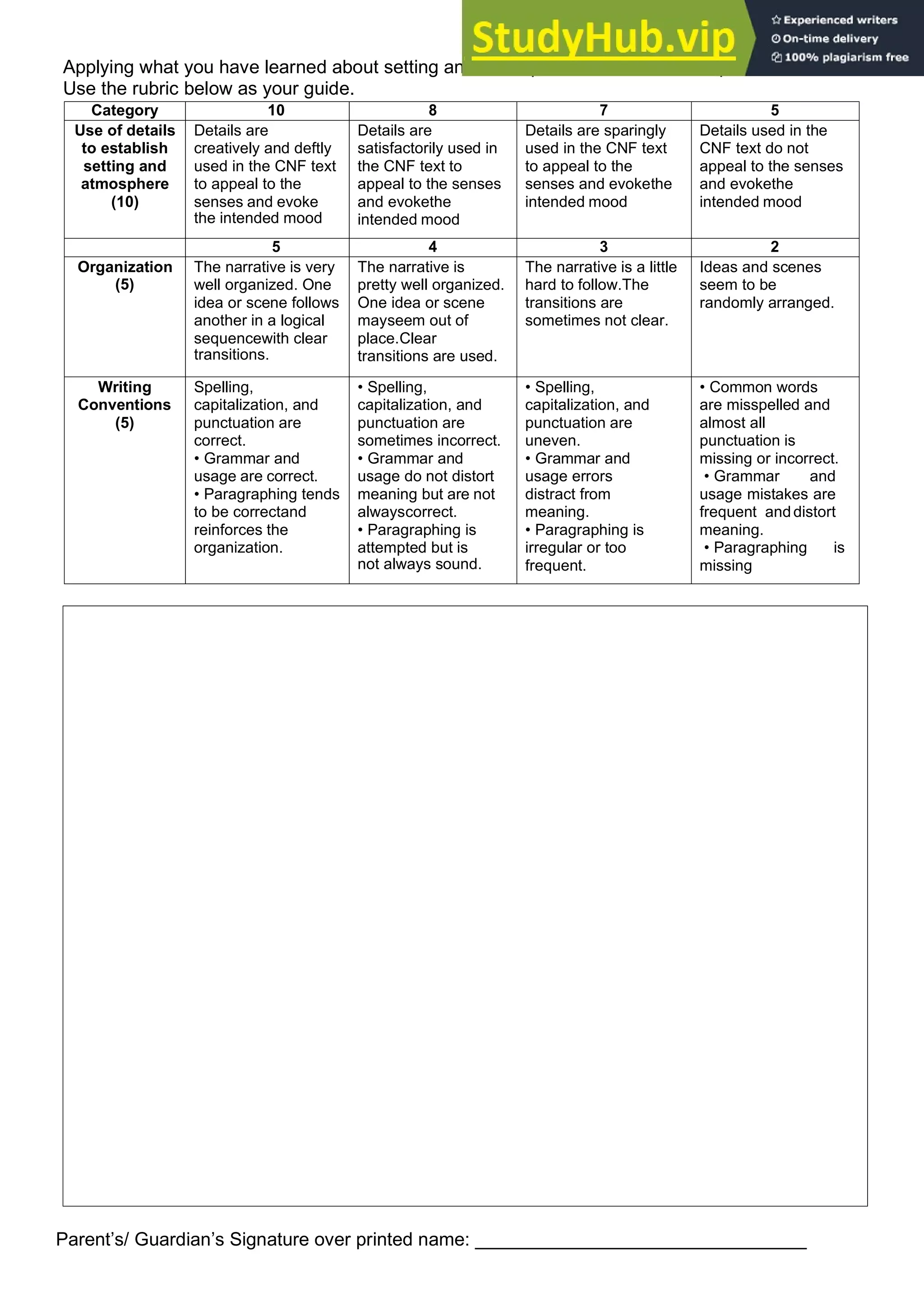
Applying what you have learned about setting and atmosphere, write about this place.
Use the rubric below as your guide.
Category 10 8 7 5
Use of details
to establish
setting and
atmosphere
(10)
Details are
creatively and deftly
used in the CNF text
to appeal to the
senses and evoke
the intended mood
Details are
satisfactorily used in
the CNF text to
appeal to the senses
and evokethe
intended mood
Details are sparingly
used in the CNF text
to appeal to the
senses and evokethe
intended mood
Details used in the
CNF text do not
appeal to the senses
and evokethe
intended mood
5 4 3 2
Organization
(5)
The narrative is very
well organized. One
idea or scene follows
another in a logical
sequencewith clear
transitions.
The narrative is
pretty well organized.
One idea or scene
mayseem out of
place.Clear
transitions are used.
The narrative is a little
hard to follow.The
transitions are
sometimes not clear.
Ideas and scenes
seem to be
randomly arranged.
Writing
Conventions
(5)
Spelling,
capitalization, and
punctuation are
correct.
• Grammar and
usage are correct.
• Paragraphing tends
to be correctand
reinforces the
organization.
• Spelling,
capitalization, and
punctuation are
sometimes incorrect.
• Grammar and
usage do not distort
meaning but are not
alwayscorrect.
• Paragraphing is
attempted but is
not always sound.
• Spelling,
capitalization, and
punctuation are
uneven.
• Grammar and
usage errors
distract from
meaning.
• Paragraphing is
irregular or too
frequent.
• Common words
are misspelled and
almost all
punctuation is
missing or incorrect.
• Grammar and
usage mistakes are
frequent anddistort
meaning.
• Paragraphing is
missing
Parent’s/ Guardian’s Signature over printed name: ________________________________
Analyzing The Setting And Atmosphere In A Creative Non.Docx Week

Analyzing The Setting And Atmosphere In A Creative Non.Docx Week

  • 1.
    Analyzing the Settingand Atmosphere in a Creative Non-Fiction Text Creative Non-Fiction Quarter 3 Week 4 I. Learning Competency  Analyze factual/ non-fictional elements (Plot, Characters, Characterization, Point of View, Angle, Setting, and Atmosphere, Symbols and Symbolisms, Irony, Figures of Speech, Dialogue, Scene, Other elements and Devices) in the texts Objectives By the end of the lesson, you should be able to: a. Identify the difference between a setting and an atmosphere b. Analyze the setting and atmosphere in the given text c. Write a creative nonfiction narrative that focused on setting and atmosphere II. Background Information In the previous LAS, we learned about these elements of a creative non-fiction text: 1) plot and structure, 2) characters and characterization, and 3) point of view. When we talk about elements of creative non-fiction, we are talking about the parts that make up the whole of a text. We had also been reading creative non-fiction texts to understand how these elements are used to make these texts creative. In this LAS, we are going to look at how the elements of setting and atmosphere are used in a creative non-fiction text so that you can be guided with how to use these in your own writing. Read these excerpts from “Mountain Province: Sagada” by Johanna Michelle Lim then answer the questions that follow. Excerpt 1: Past La Trinidad moving to Halsema Highway, an intricate artwork of curves and drops, air starts to get denser and the cold biting. Mufflers and gloves come out, “decorative” accessories in any other place but here. The open window feels like an air conditioner set full blast on the cheeks. Atok, Benguet, appears hazy like in a dream. The fog is constant companion to passersby here and in seeing them, one wishes that if only, one could just take handfuls of it and pocket them for souvenirs. So in a much-needed day in the future, he could just take it out, spread it, and continue the same dream. By the middle of the ride after a brief stopover in Atok, there is no road, no trees, no cliffs. Just the mist, all-encompassing grays, and a runny nose. Excerpt 2: The roads nearer to Sagada itself from the town before are unfinished. It is dominated by narrow dirt trails that only one vehicle, our bus, can get through. The unpaved road, susceptible to landslides, is sandwiched by two cliffs that have a direct drop to a thousand or so feet below. And fortunately, or un, rides are made even more exciting when a driver, insouciant to the shouts of his tourist passengers, zigzags through as if it were a sin for wheels to touch ground. This continues on, 80-km. speed on uneven dirt trail, until there is a semblance of asphalt again, and houses on top of limestone formations, looking as natural there almost as if they were carved with it. And always, always, is the biting cold, made even chillier by a change in the wind pattern, a coming Tropical Depression. The coldness is the only welcoming committee needed; greeting even before feet touches soil. Only then have you reached Sagada. Questions: 1. What place is being described in Excerpt 1? How about in Excerpt 2? 2. How did you feel while reading Excerpt 1? How about while reading Excerpt 2? 3. What were the words in Excerpt 1 that made you feel this way? How about in Excerpt 2?
  • 2.
    The parts ofthe creative non-fiction text taken from “Mountain Province: Sagada” by Johanna Michelle Lim describe Atok, Benguet in excerpt 1 and Sagada, Mountain Province in excerpt 2. When we talk about places, we often refer to the element of SETTING. When you were asked how you felt as you read these, you were asked to describe the ATMOSPHERE of the text. SETTING refers to an actual place and time where and when an event happens. The setting is made more realistic when we incorporate or include the physical, sociological, psychological environment in depicting settings. Physical environment refers to the geographical locations, immediate surroundings, weather, or timing. Sociological environment refers to the cultural context while the psychological environment may refer to the reflection of what a character thinks or feels. ATMOSPHERE is the mood which evokes or reminds us of certain feelings or emotions, conveyed by the words used to describe the setting or reflected by the way your subject speaks or in the way he or she acts. When we read these excerpts, we feel how cold Atok is and how exciting it is to travel along the roads of Sagada because of the words and details that the writer uses. To make us feel the coldness of Atok, Lim used the following words and phrases:  biting cold  mufflers and gloves  an air conditioner set full blast on the cheeks  fog She then evokes the dreamy and wishful mood caused by the coldness of the place through these sentences: “The fog is constant companion to passersby here and in seeing them, one wishes that if only, one could just take handfuls of it and pocket them for souvenirs. So, in a much-needed day in the future, he could just take it out, spread it, and continue the same dream.” How does Lim make us feel her excitement while she travelled along the roads of Sagada? She does this by using these details that also describe the setting:  narrow dirt trails that only one vehicle, our bus, can get through  unpaved road, susceptible to landslides, is sandwiched by two cliffs that have a direct drop to a thousand or so feet below  a driver… zigzags through as if it were a sin for wheels to touch ground  80-km. speed on uneven dirt trail, until there is a semblance of asphalt again If you have tried riding a bus on an unpaved or rough road, you will probably feel the same things she describes in her writing. Through the writer’s effective selection and description of details, we are also made to feel the exciting atmosphere she felt when she was on her way to Sagada. How can we write our creative non-fiction text using setting and atmosphere effectively? Cristina Pantoja-Hidalgo, pioneering writer of creative non-fiction in the Philippines, has this to say for us: “The most successful pieces of creative non-fiction are rich in details. Bare facts are never enough. They need to be fleshed out; they need to be humanized. But besides giving information, details serve other purposes. Details should be accurate and informative first. And they must be suggestive and evocative. The right details arouse emotions, evoke memories, help to produce the right response in your reader. Details are extremely important in evoking a sense of time and place. It must evoke a period as well as location. Descriptive details are of particular importance for travel writing, the point of which is, to begin with, to literally transport the reader to the place to which the traveler has been.”
  • 3.
    When you writeyour creative nonfiction text, always remember the following:  Provide a clear description of the place you are writing about in a way that your readers feel like you have taken them there.  To be able to make your readers feel that you are taking them to that place you are writing about, you have to provide details that will appeal to the senses.  Show the readers the place by doing the following:  write vivid descriptions that are of significance  use sensory imagery  deploy memorable similes and metaphors to describe a particular place  include concrete and specific details  Describing the place or setting is not about telling the reader about the place, which is nothing more than a summary of the facts as you see them  You don’t have to include all the details or descriptions–only those that have significance to yourself and your readers III. Activities (see attached activity sheets) IV. Take away  SETTING refers to an actual PLACE and TIME where and when an event happens.  The setting is made more realistic when we incorporate or include the PHYSICAL, SOCIOLOGICAL, PSYCHOLOGICAL environment in depicting settings.  ATMOSPHERE is the MOOD which evokes or reminds us of certain FEELINGS or EMOTIONS, conveyed by the WORDS used to describe the setting or reflected by the way your subject speaks or in the way he or she acts.  DETAILS are extremely important in evoking a sense of time and place. MICHELLE B. SAMUEL, Module Developer Revised by: IVY KATE T. TORYADEN Subject Teacher
  • 4.
    Analyzing the Settingand Atmosphere in a Creative Non-Fiction Text Creative Non-Fiction Quarter 3 Week 4 Name of Learner: _________________________ Score: ______ Grade and Section: _________________ Date: __________ Activity 1. Read this CNF text and answer the questions that follow. (PERFORMANCE TASK) A Letter to an Old Friend Freda Dao-ines Paragraph 1 We haven’t seen each other for quite some time now. I remember thinking last time how the years have changed us both. I’ve always thought you’re invincible, always that slow slithering snake called Halsema that got me dizzy while riding you during my younger years. As life added a few lines on my forehead, so has your once unbroken forest-green façade been corrugated with endless rows of carrots, potatoes, cabbages. Paragraph 2 You’re never far from mind when I’m cruising on a superbly paved gray highway that seems to shoot straight into the blue beyond. I have meandered through camel-colored dunes along flat desert highways. I have tunneled my way through roads bordered by amazing limestone formations. I have yet to travel a lot of roads, but only you could make me feel like I’m on a kid’s train set, chugging on lumpy railways, winding and dreaming my way around a city of clouds. Paragraph 3 As each kilometer fleets by, the clouds that were a part and parcel of you change, making you as alive as a woman’s mood swings. Sometimes, you weep ever so softly against the bus’s window. After a few curbs, you are warm and welcoming, your clouds but a wisp bobbing gently with the red and yellow of children’s flying kites. In a moment you become pensive, veiled by thick and fluffy clouds. Minutes later and you could be downright angry, pelting heavily on the car’s roof, effectively silencing chaotic thoughts. Paragraph 4 But you are most majestic when, on a summer day, darkness starts to close in on you. The clouds are blinding white for a few minutes, before mellowing down to reflect a sudden shock of brilliant orange sky. The bus speeds by and at the next turn, the sky is a molten lava, with soft mounds of cotton against a bloody backdrop, silhouetting the stories of those on the road. Subtly, the lava cools down into a magenta lake, promising serenity at either end. Paragraph 5 I pass through you when the city life got too stale or too noisy for me and I long for the silent dead-to-the world sleep at my dad’s cottage in Buguias. After a few while, I set out again in search of a different world, only to find myself on your road when the novelty of a current adventure has worn out. Maybe that’s what you are to me, always a link to an unconditional acceptance. Paragraph 6 I’ve seen pictures of you recently, parts of you falling down, like several knobby vertebrae have fallen off your spine. You’ve always been potholed, never a stranger to tragedy, and I should have been used to seeing you scarred by now. Still, it bothers me that what’s hurting you now isn’t a core-jarring earthquake. Are you aging far too quickly than you should because the children playing along your 90- kilometer stretch need to cut into your body, more fervently now than before, to build themselves up? I hope to see you soon, before both of us become dramatically changed. I had been lost yet again and I’m looking forward to you shaking me through your tower of clouds and lava lakes, as I retrace my way back home to start afresh.
  • 5.
    QUESTIONS 1. What placeis the writer describing in this CNF text? ___________________________________________________________ 2. List the details that the writer has used to describe her “old friend”. These can be words or phrases that are taken from the CNF text. Write one detail from each paragraph. a. Paragraph 1: _________________________________________________________________________________ b. Paragraph 2 _________________________________________________________________________________ c. Paragraph 3 _________________________________________________________________________________ d. Paragraph 4 _________________________________________________________________________________ e. Paragraph 5 _________________________________________________________________________________ f. Paragraph 6 _________________________________________________________________________________ 3. Given the details that the writer has used to describe her “old friend”, what atmosphere or mood is being evoked? ___________________________________________________________________________________________ Activity 2. Write T if the statement is true; write F is it is false. ____1. Setting refers to an actual place and time where and when an event happens ____2. Setting is limited to the physical setting where the event happened. ____3. Atmosphere is the mood which evokes or reminds us of certain feelings or emotions. ____4. The description of the setting can affect the atmosphere in a creative nonfiction text. ____5. Details in a creative nonfiction text can be invented. ____6. Details in a creative nonfiction text have to be factual. ____7. The creative nonfiction writer includes all details about setting to make his or her creative nonfiction text interesting. ____8. The creative nonfiction writer selects the right details to produce the right emotion in his or her readers. ____9. The creative nonfiction writer establishes the significance of the details he or she is including in the text. ____10. The creative nonfiction writer uses the description of the setting to establish the mood of the creative nonfiction text. Activity 3: Think of a place that is important for you. What are the details about this place that you will include in your CNF text to make your readers feel as if they have gone there? What atmosphere or mood would you like to make your readers feel in connection to this place? Write your answer on the box. (PERFORMANCE TASK)
  • 6.
    Applying what youhave learned about setting and atmosphere, write about this place. Use the rubric below as your guide. Category 10 8 7 5 Use of details to establish setting and atmosphere (10) Details are creatively and deftly used in the CNF text to appeal to the senses and evoke the intended mood Details are satisfactorily used in the CNF text to appeal to the senses and evokethe intended mood Details are sparingly used in the CNF text to appeal to the senses and evokethe intended mood Details used in the CNF text do not appeal to the senses and evokethe intended mood 5 4 3 2 Organization (5) The narrative is very well organized. One idea or scene follows another in a logical sequencewith clear transitions. The narrative is pretty well organized. One idea or scene mayseem out of place.Clear transitions are used. The narrative is a little hard to follow.The transitions are sometimes not clear. Ideas and scenes seem to be randomly arranged. Writing Conventions (5) Spelling, capitalization, and punctuation are correct. • Grammar and usage are correct. • Paragraphing tends to be correctand reinforces the organization. • Spelling, capitalization, and punctuation are sometimes incorrect. • Grammar and usage do not distort meaning but are not alwayscorrect. • Paragraphing is attempted but is not always sound. • Spelling, capitalization, and punctuation are uneven. • Grammar and usage errors distract from meaning. • Paragraphing is irregular or too frequent. • Common words are misspelled and almost all punctuation is missing or incorrect. • Grammar and usage mistakes are frequent anddistort meaning. • Paragraphing is missing Parent’s/ Guardian’s Signature over printed name: ________________________________