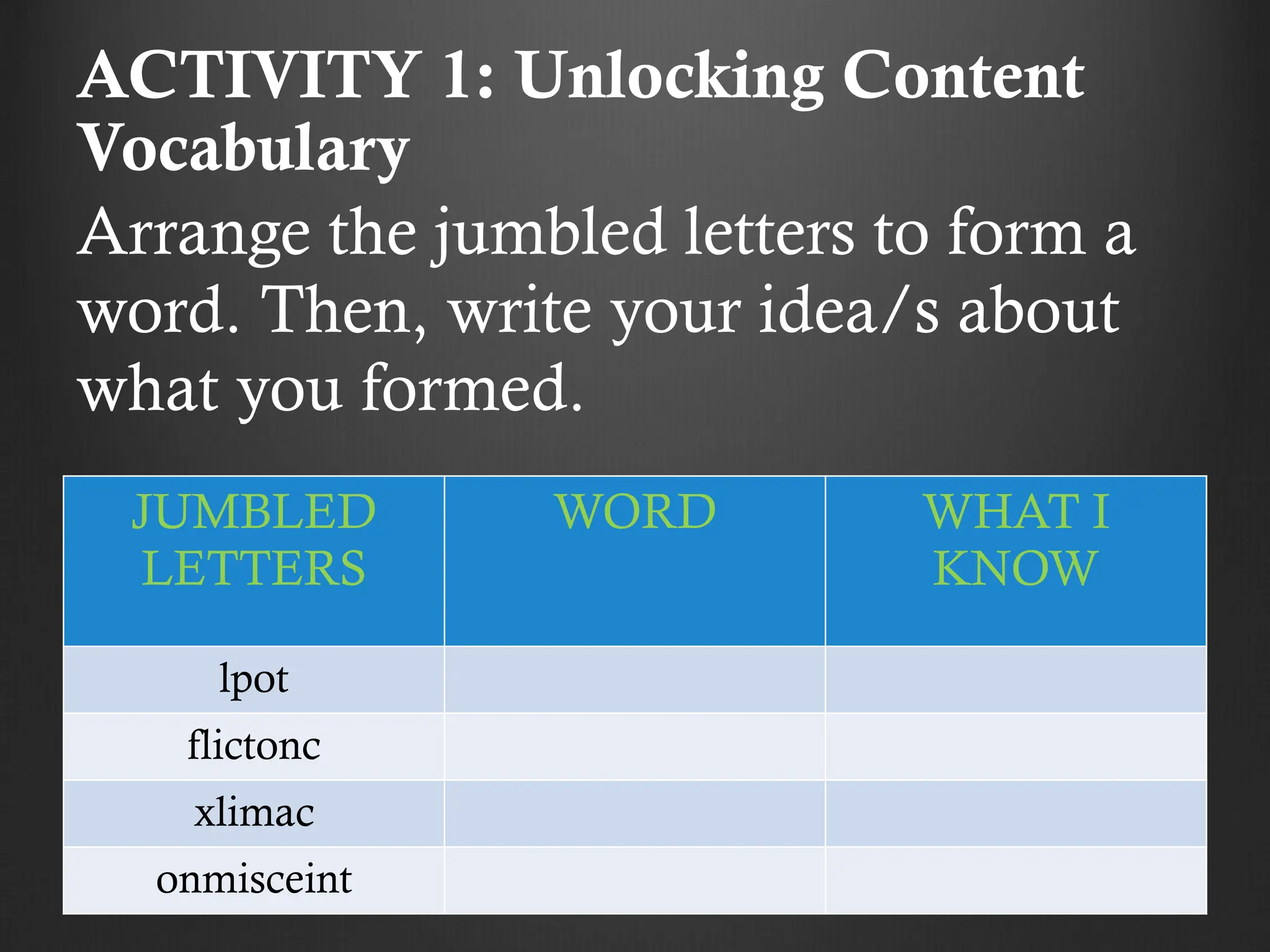
ACTIVITY 1: Unlocking Content
Vocabulary
Arrange the jumbled letters to form a
word. Then, write your idea/s about
what you formed.
JUMBLED
LETTERS
WORD WHAT I
KNOW
lpot
flictonc
xlimac
onmisceint
Questions:
What did the son ask the father?
What was the answer to the
son’s questions?
How did the father show his love
to his mother?
Characters
Walsh Publishing Co. 2009
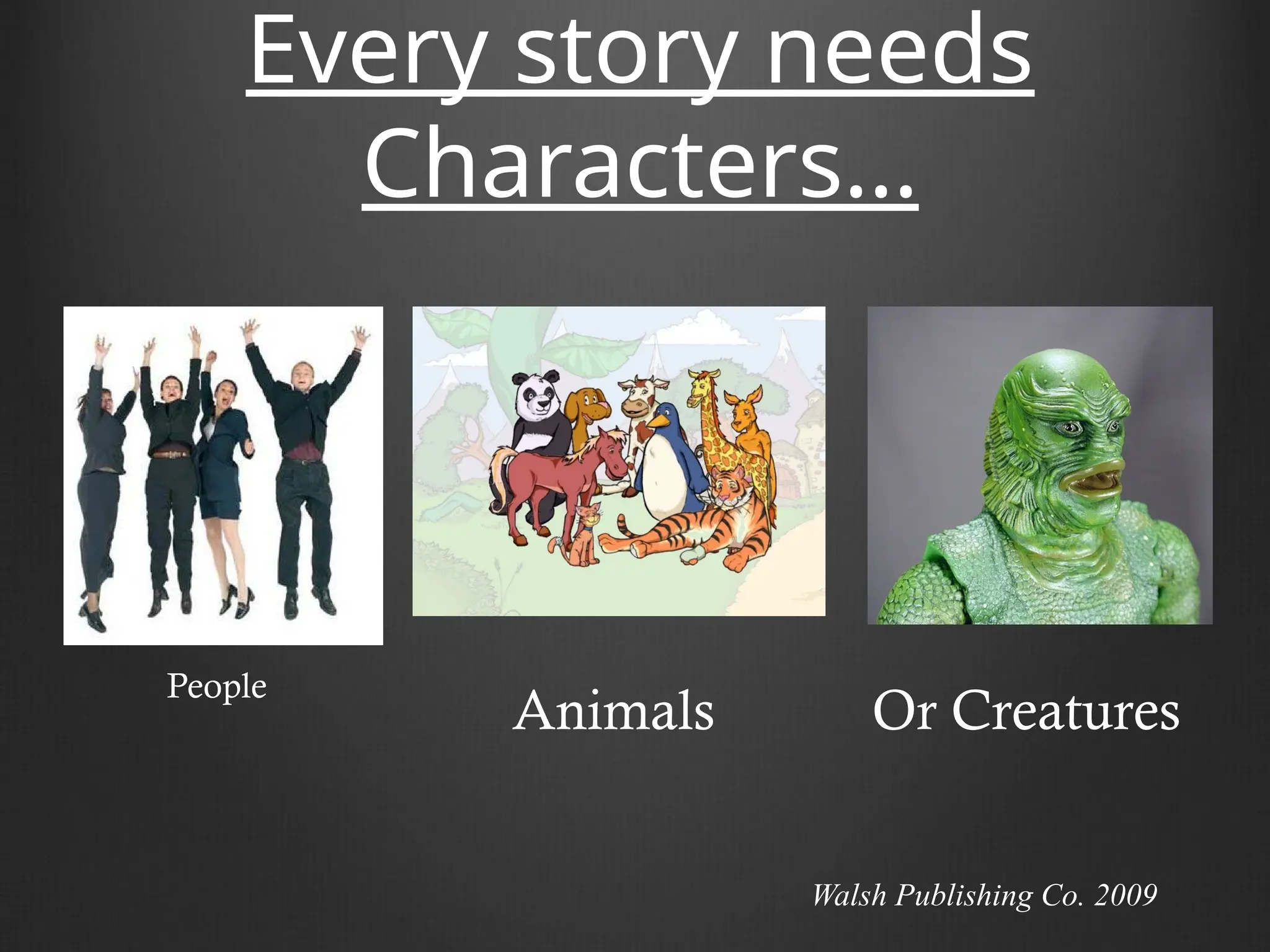
Every story needs
Characters…
People
Animals Or Creatures
Walsh Publishing Co. 2009
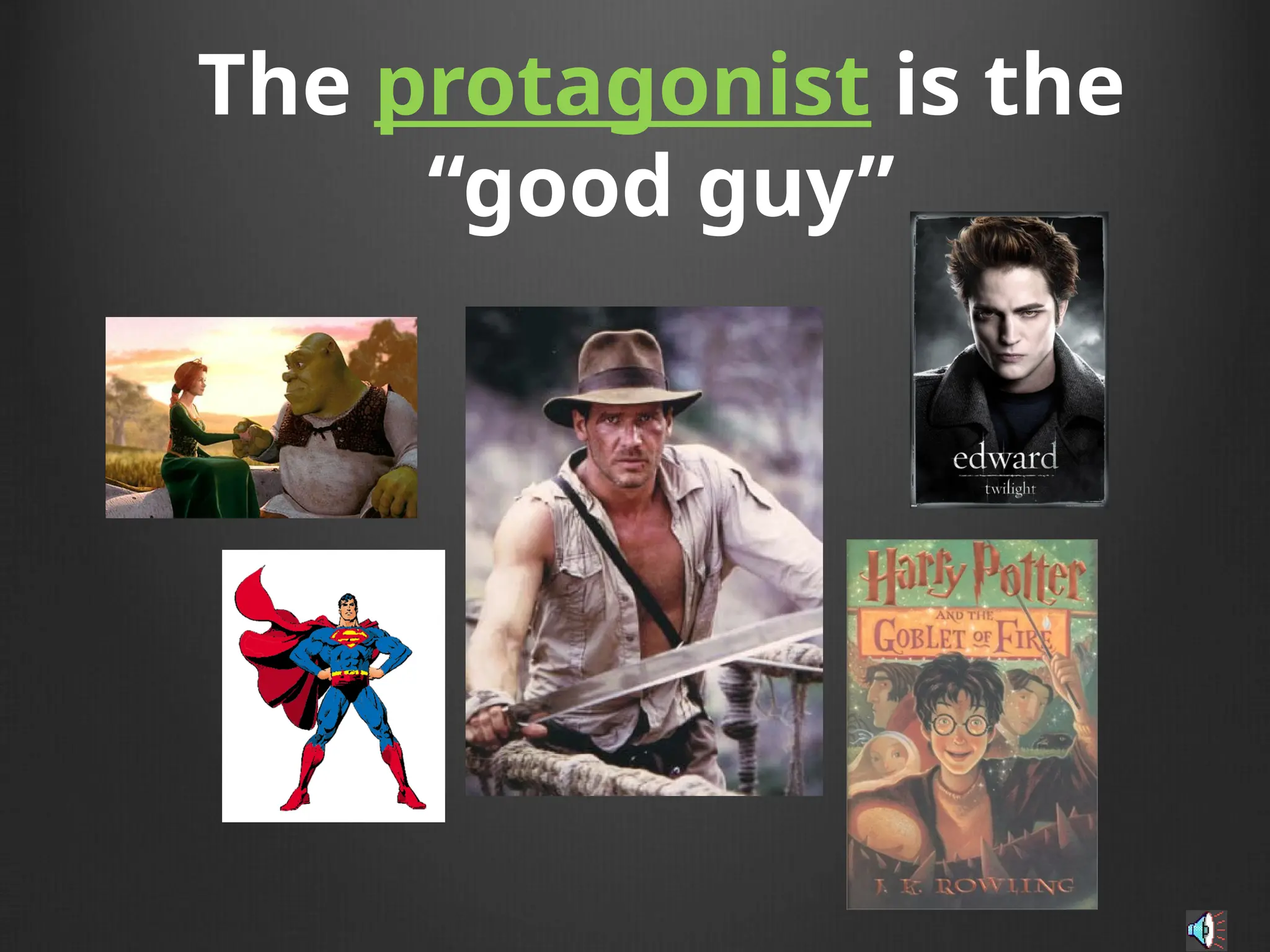
The protagonist is the
“good guy”
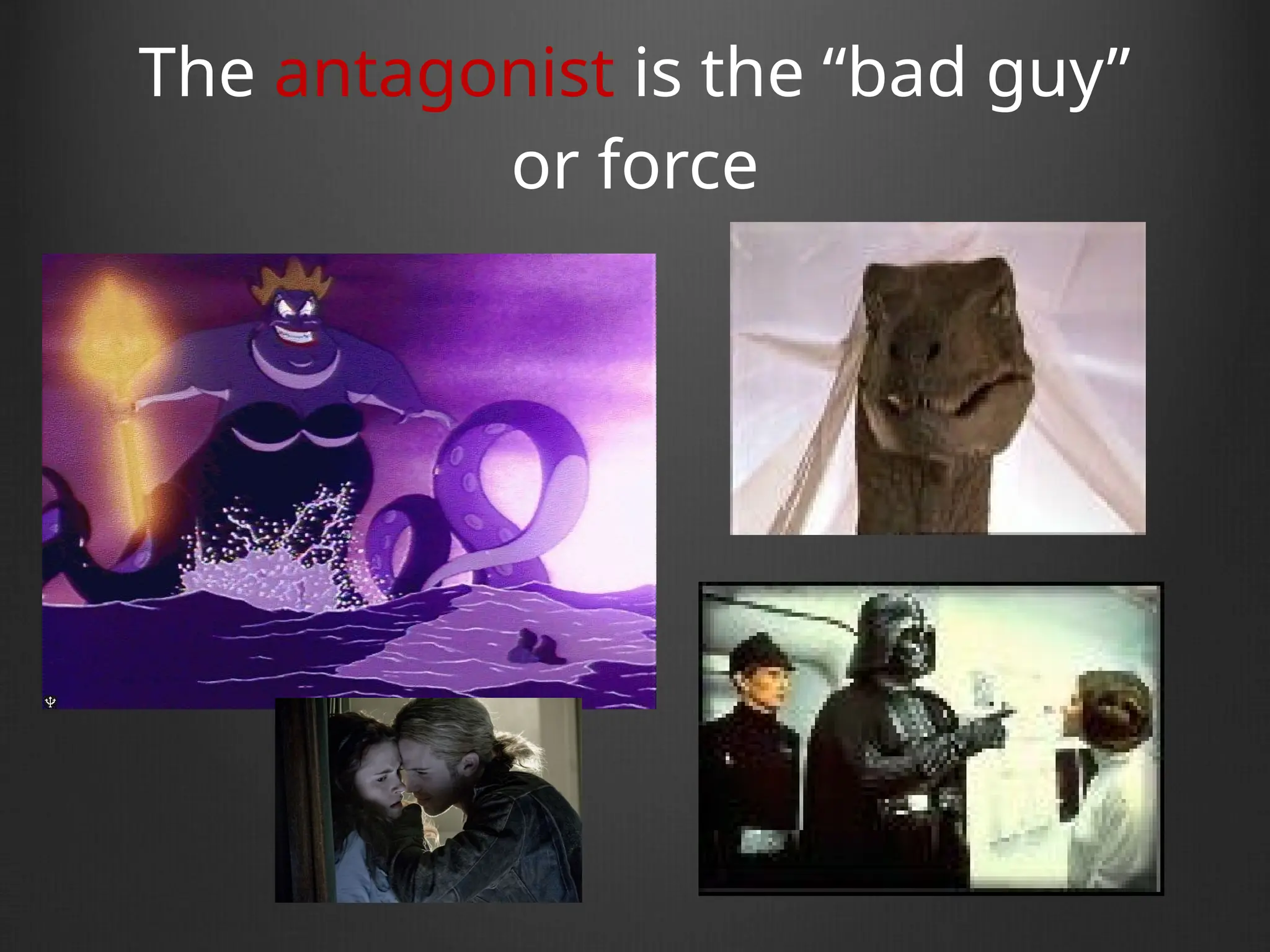
The antagonist is the “bad guy”
or force
Characterization
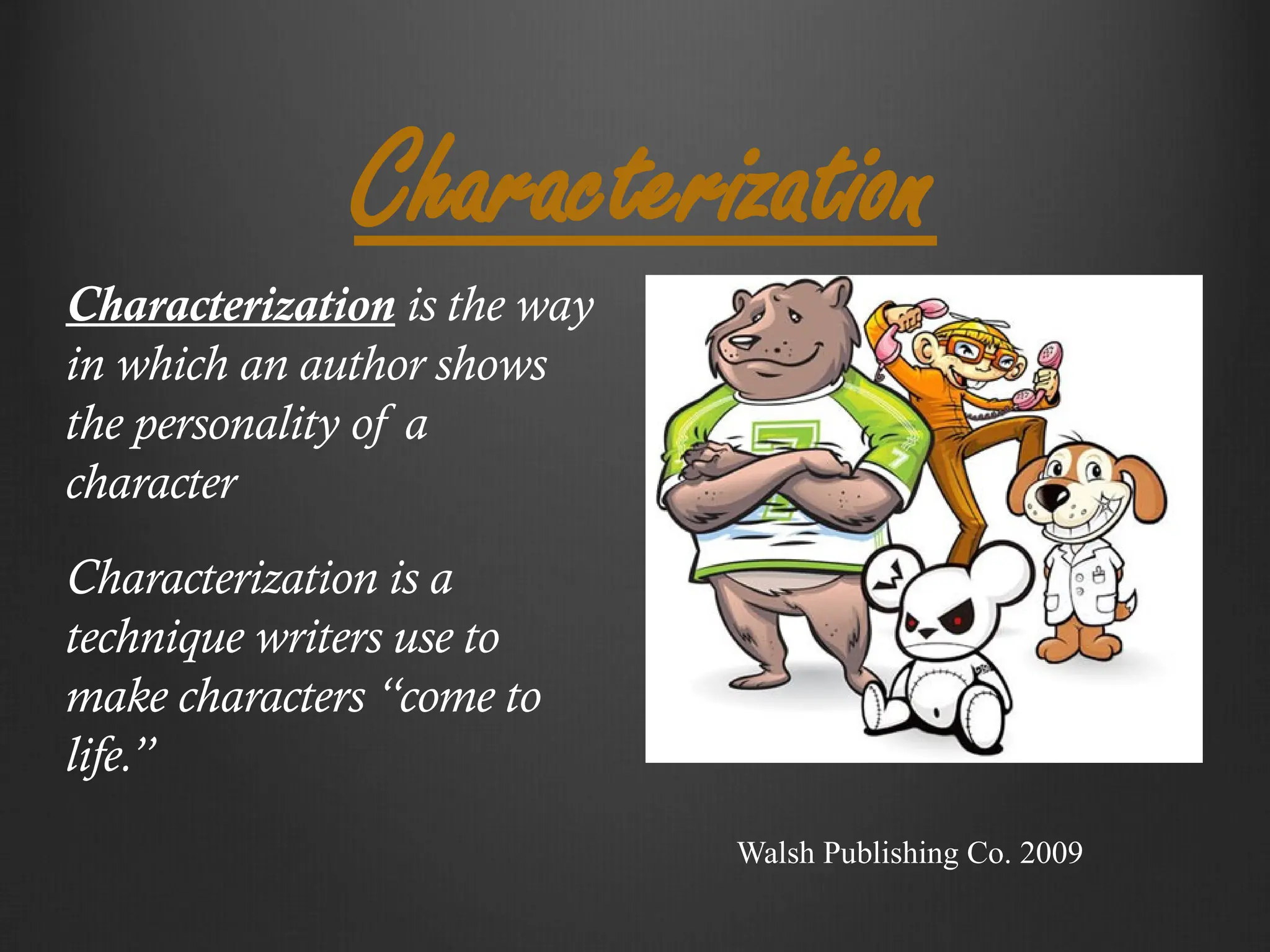
Characterization is the way
in which an author shows
the personality of a
character
Characterization is a
technique writers use to
make characters “come to
life.”
Walsh Publishing Co. 2009
Characterization
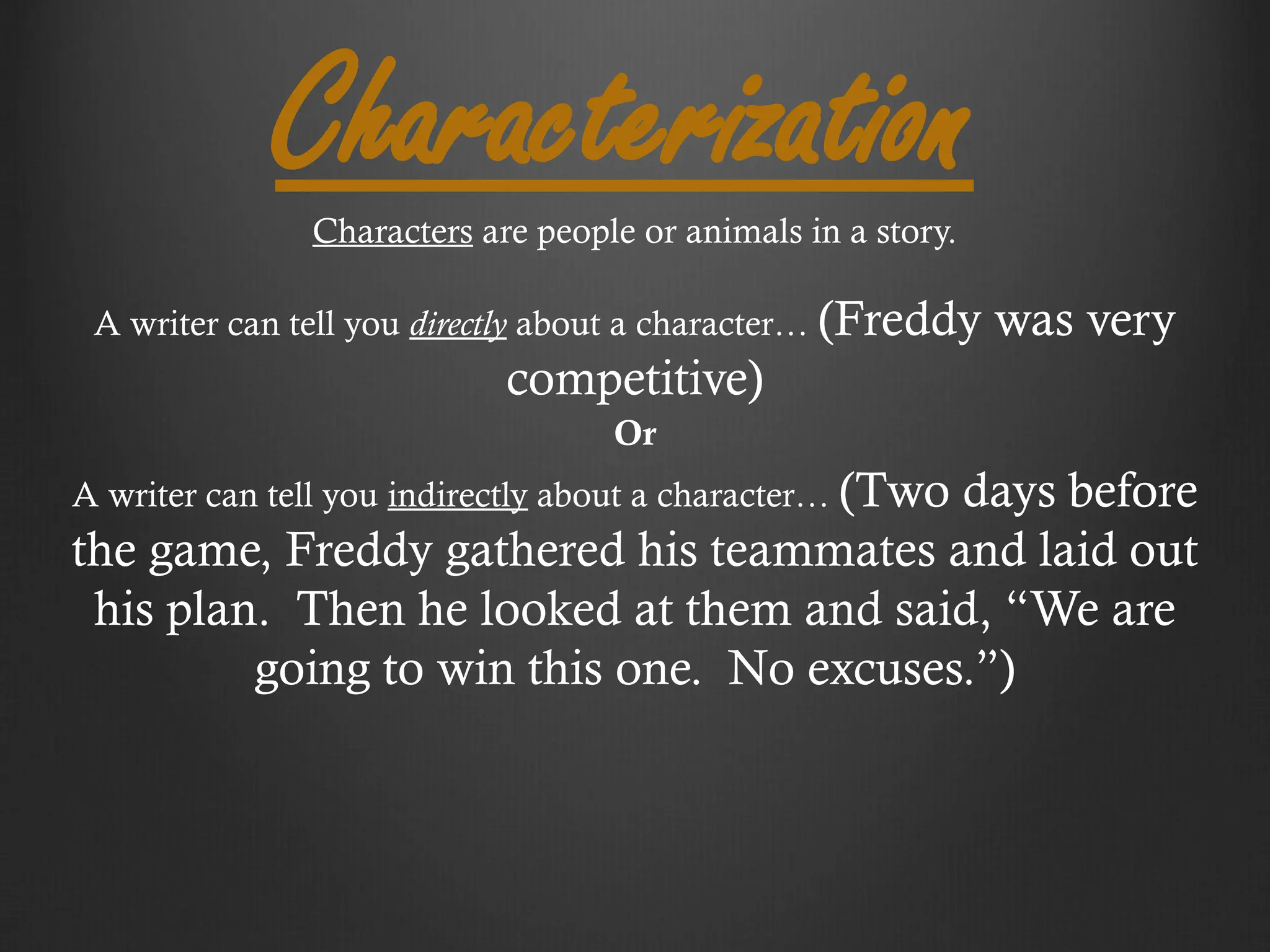
Characters are people or animals in a story.
A writer can tell you directly about a character… (Freddy was very
competitive)
Or
A writer can tell you indirectly about a character… (Two days before
the game, Freddy gathered his teammates and laid out
his plan. Then he looked at them and said, “We are
going to win this one. No excuses.”)
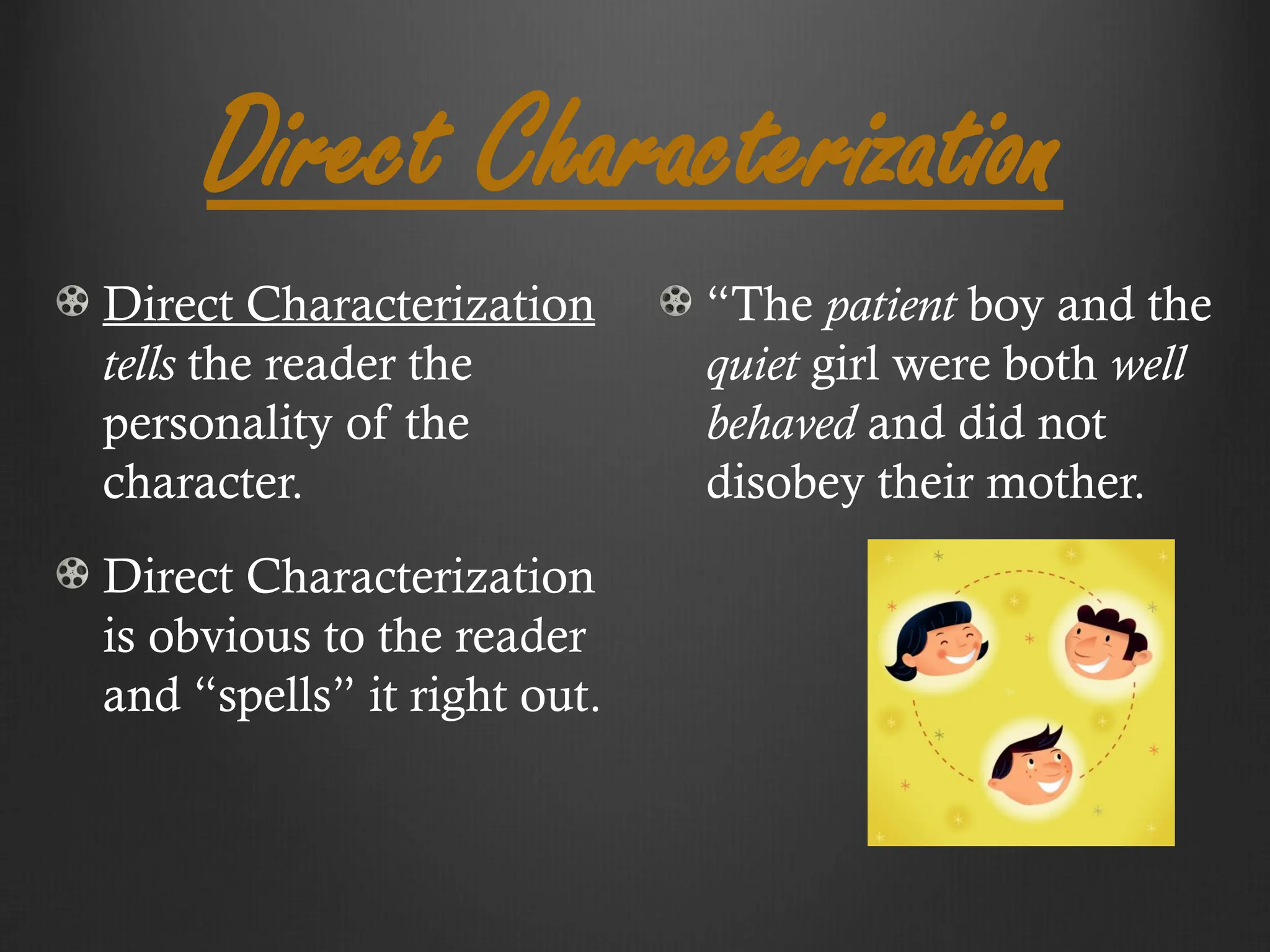
Direct Characterization
tells the reader the
personality of the
character.
Direct Characterization
is obvious to the reader
and “spells” it right out.
“The patient boy and the
quiet girl were both well
behaved and did not
disobey their mother.
Indirect Characterization
shows things that reveal
the personality of the
character.
Speech
Thought
Effect on Others
Actions
Looks
The boy sat next to his
sister as she poked him
and teased him. He did
not react. He carefully
picked up her doll from
the floor and placed it
on her lap saying
gently, “Here you go,
why don’t you play
with your doll?”
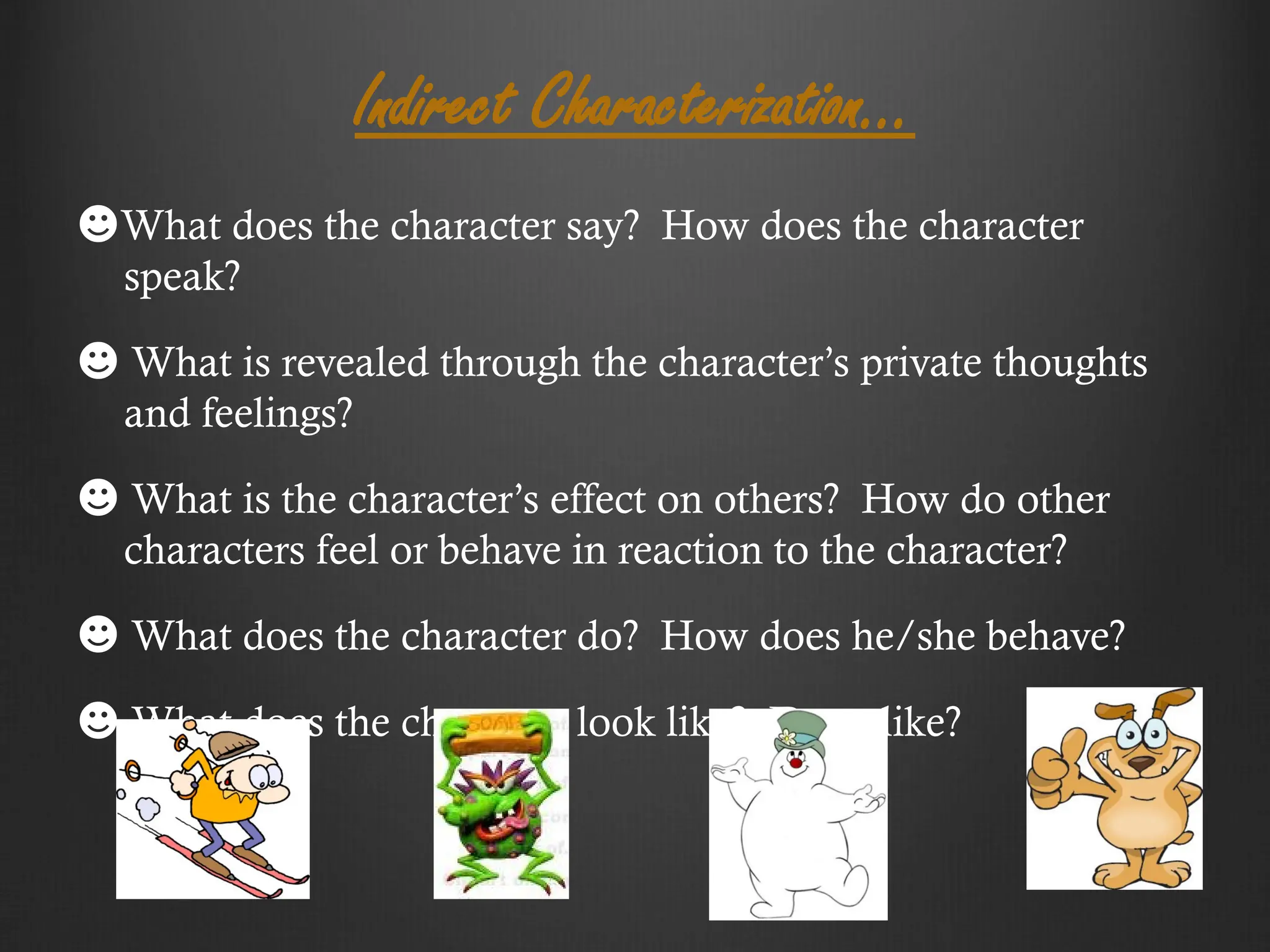
Indirect Characterization…
☻What does the character say? How does the character
speak?
☻ What is revealed through the character’s private thoughts
and feelings?
☻ What is the character’s effect on others? How do other
characters feel or behave in reaction to the character?
☻ What does the character do? How does he/she behave?
☻ What does the character look like? Dress like?
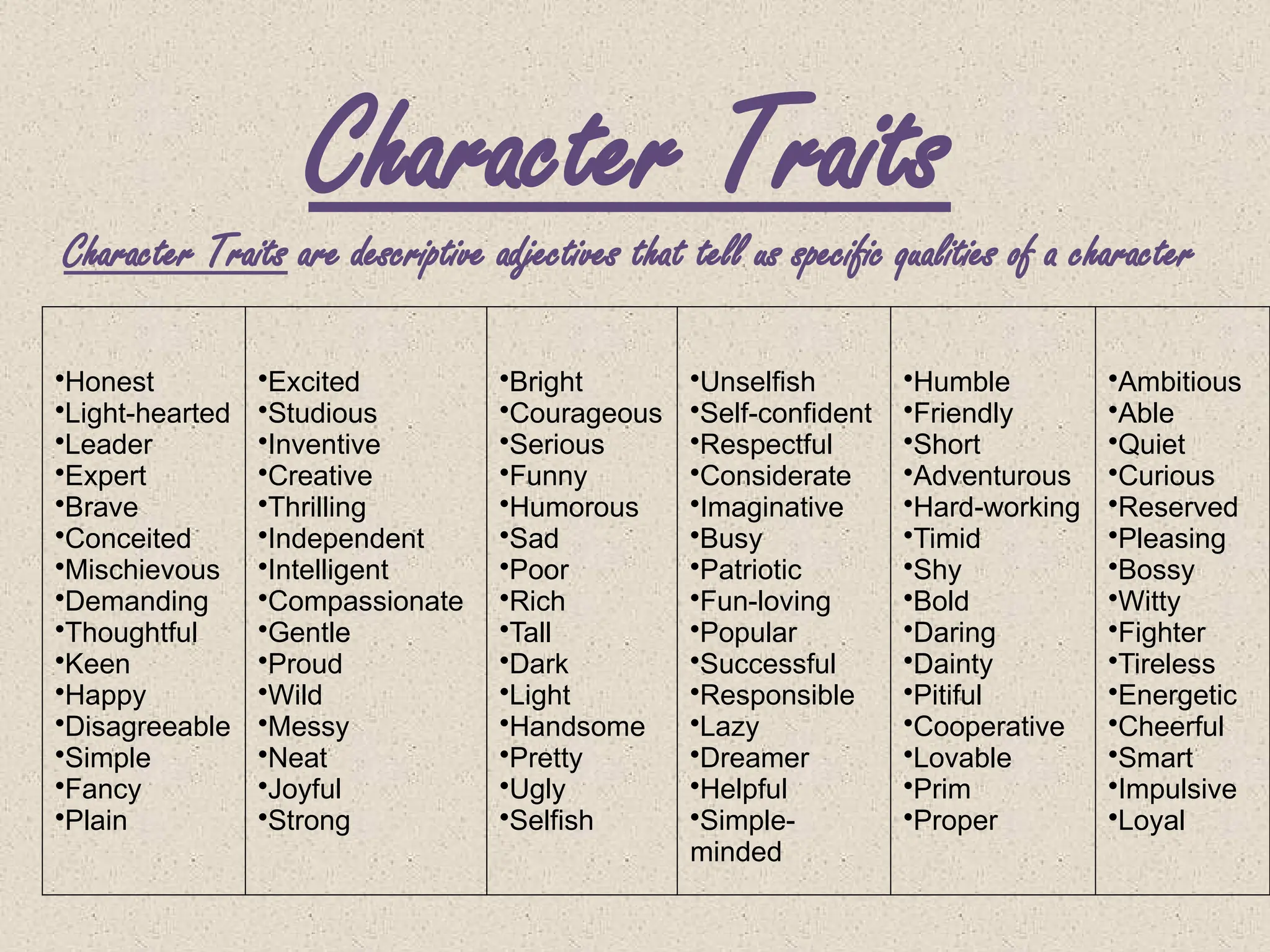
Character Traits
Character Traits are descriptive adjectives that tell us specific qualities of a character
•Honest
•Light-hearted
•Leader
•Expert
•Brave
•Conceited
•Mischievous
•Demanding
•Thoughtful
•Keen
•Happy
•Disagreeable
•Simple
•Fancy
•Plain
•Excited
•Studious
•Inventive
•Creative
•Thrilling
•Independent
•Intelligent
•Compassionate
•Gentle
•Proud
•Wild
•Messy
•Neat
•Joyful
•Strong
•Bright
•Courageous
•Serious
•Funny
•Humorous
•Sad
•Poor
•Rich
•Tall
•Dark
•Light
•Handsome
•Pretty
•Ugly
•Selfish
•Unselfish
•Self-confident
•Respectful
•Considerate
•Imaginative
•Busy
•Patriotic
•Fun-loving
•Popular
•Successful
•Responsible
•Lazy
•Dreamer
•Helpful
•Simple-
minded
•Humble
•Friendly
•Short
•Adventurous
•Hard-working
•Timid
•Shy
•Bold
•Daring
•Dainty
•Pitiful
•Cooperative
•Lovable
•Prim
•Proper
•Ambitious
•Able
•Quiet
•Curious
•Reserved
•Pleasing
•Bossy
•Witty
•Fighter
•Tireless
•Energetic
•Cheerful
•Smart
•Impulsive
•Loyal
Identifying Character Traits Worksheet: http://www.readwritethink.org/lesson_images/lesson175/RWT186-2.pdf
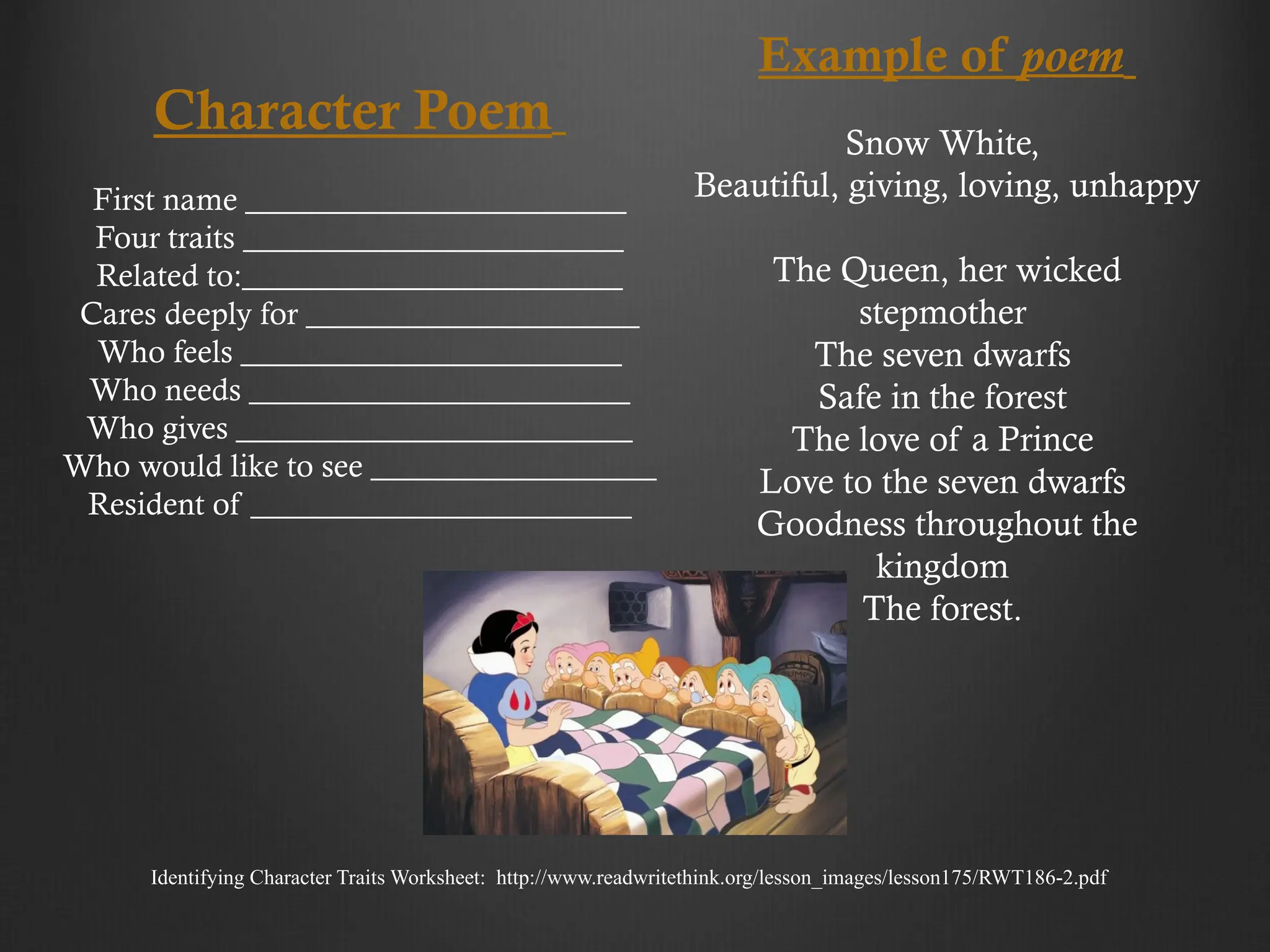
Character Poem
First name ________________________
Four traits ________________________
Related to:________________________
Cares deeply for _____________________
Who feels ________________________
Who needs ________________________
Who gives _________________________
Who would like to see __________________
Resident of ________________________
Example of poem
Snow White,
Beautiful, giving, loving, unhappy
The Queen, her wicked
stepmother
The seven dwarfs
Safe in the forest
The love of a Prince
Love to the seven dwarfs
Goodness throughout the
kingdom
The forest.
Types of Characters
Flat character
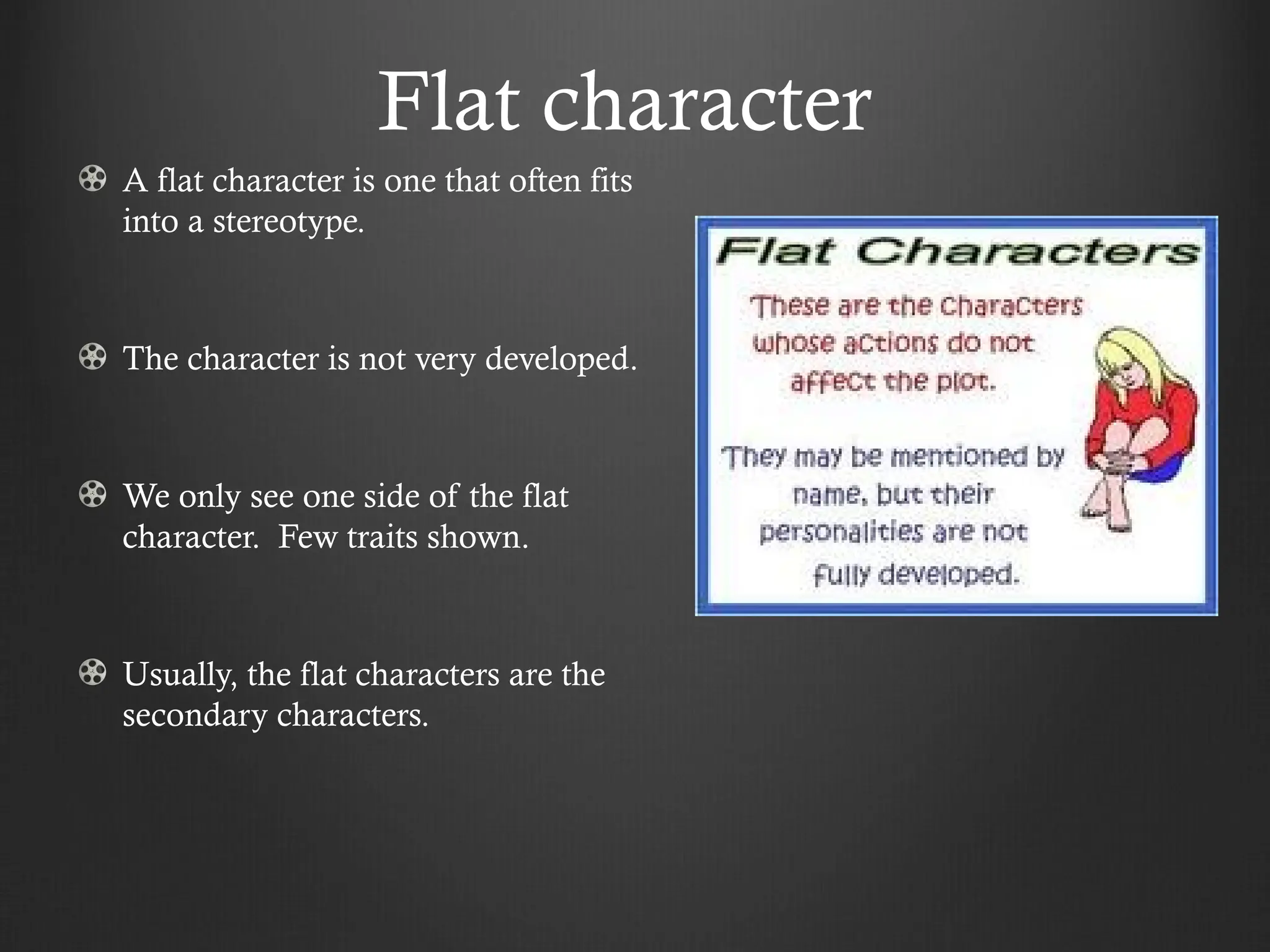
A flat character is one that often fits
into a stereotype.
The character is not very developed.
We only see one side of the flat
character. Few traits shown.
Usually, the flat characters are the
secondary characters.
Example of Flat Character
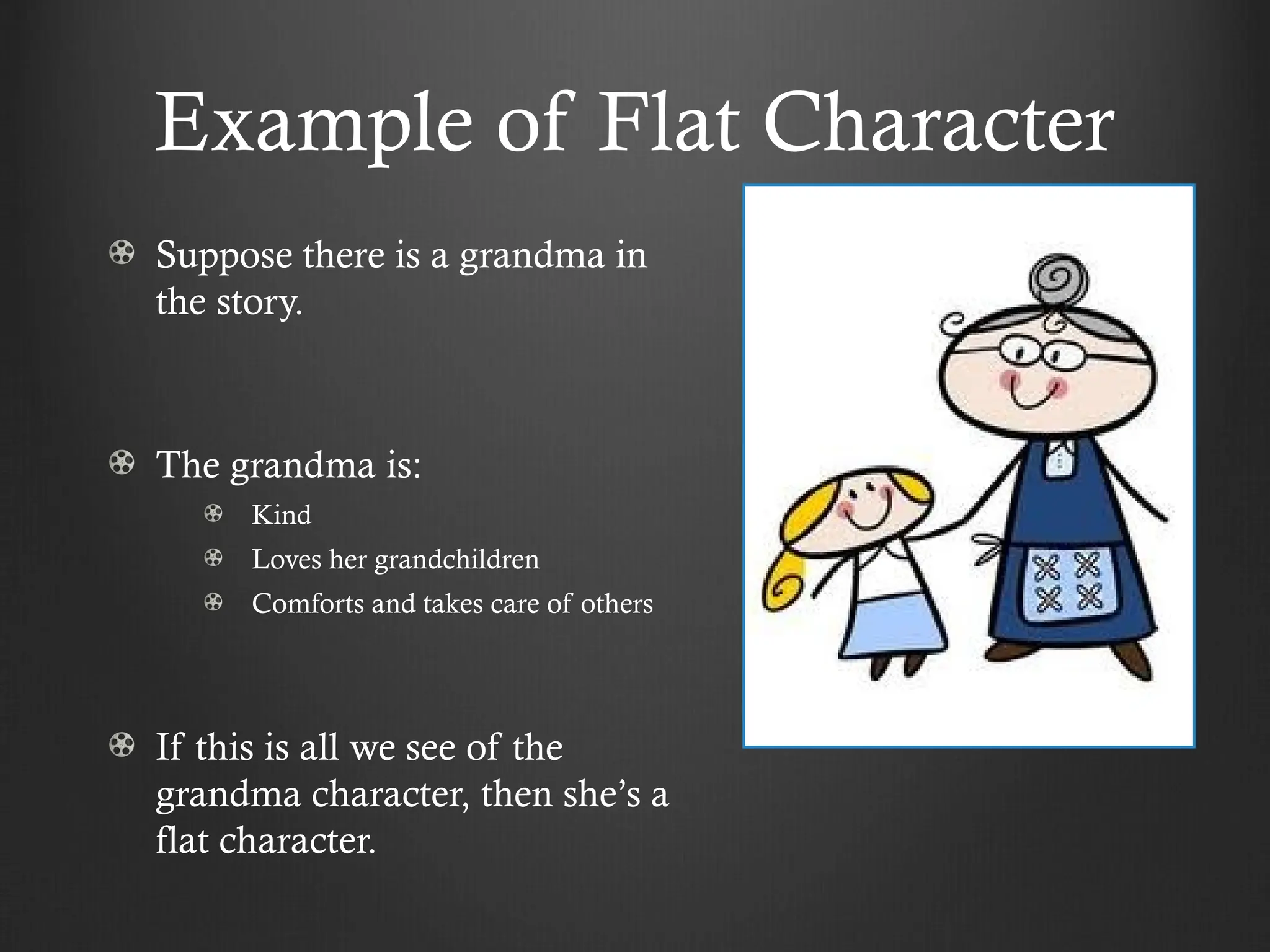
Suppose there is a grandma in
the story.
The grandma is:
Kind
Loves her grandchildren
Comforts and takes care of others
If this is all we see of the
grandma character, then she’s a
flat character.
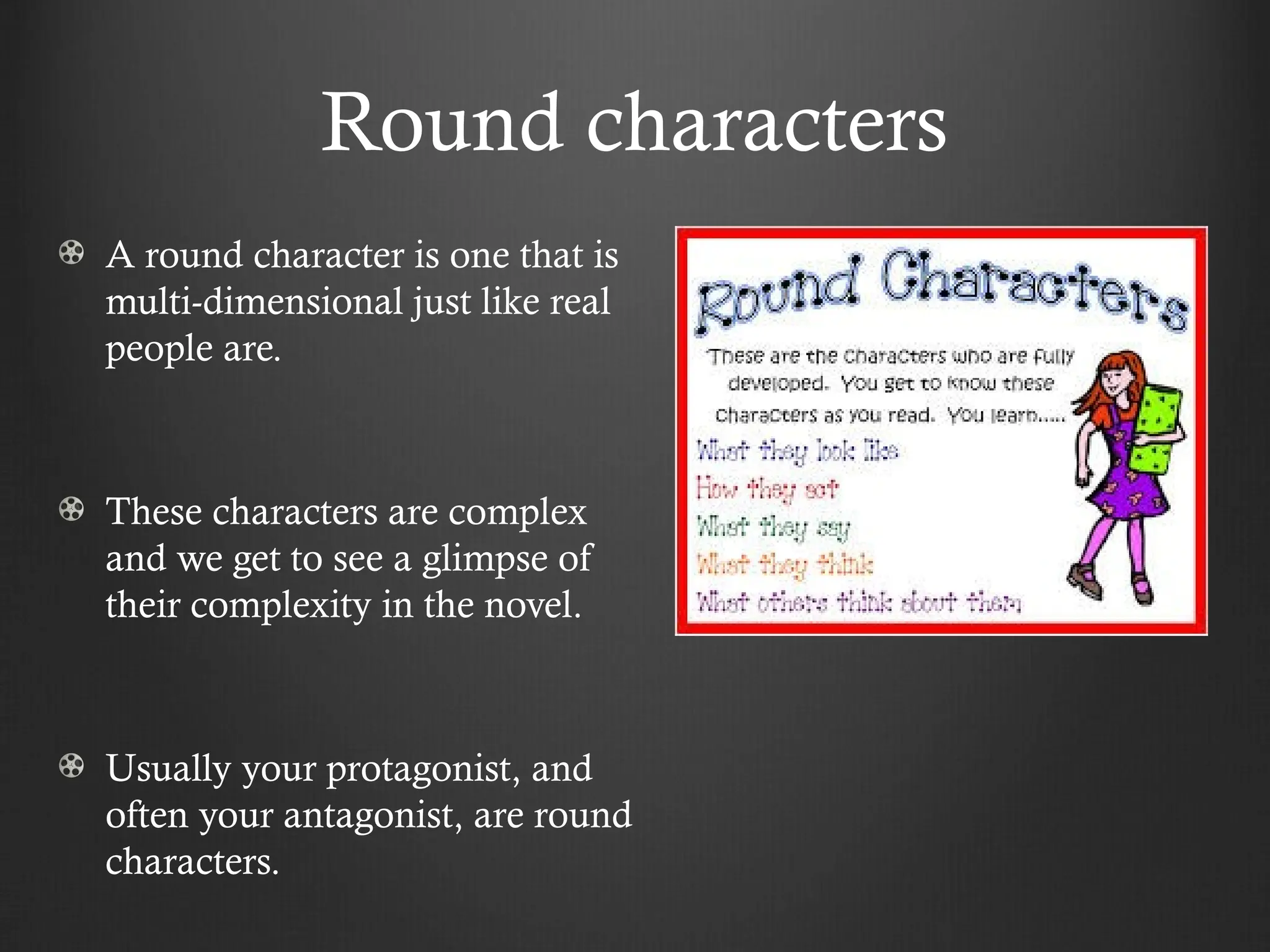
Round characters
A round character is one that is
multi-dimensional just like real
people are.
These characters are complex
and we get to see a glimpse of
their complexity in the novel.
Usually your protagonist, and
often your antagonist, are round
characters.
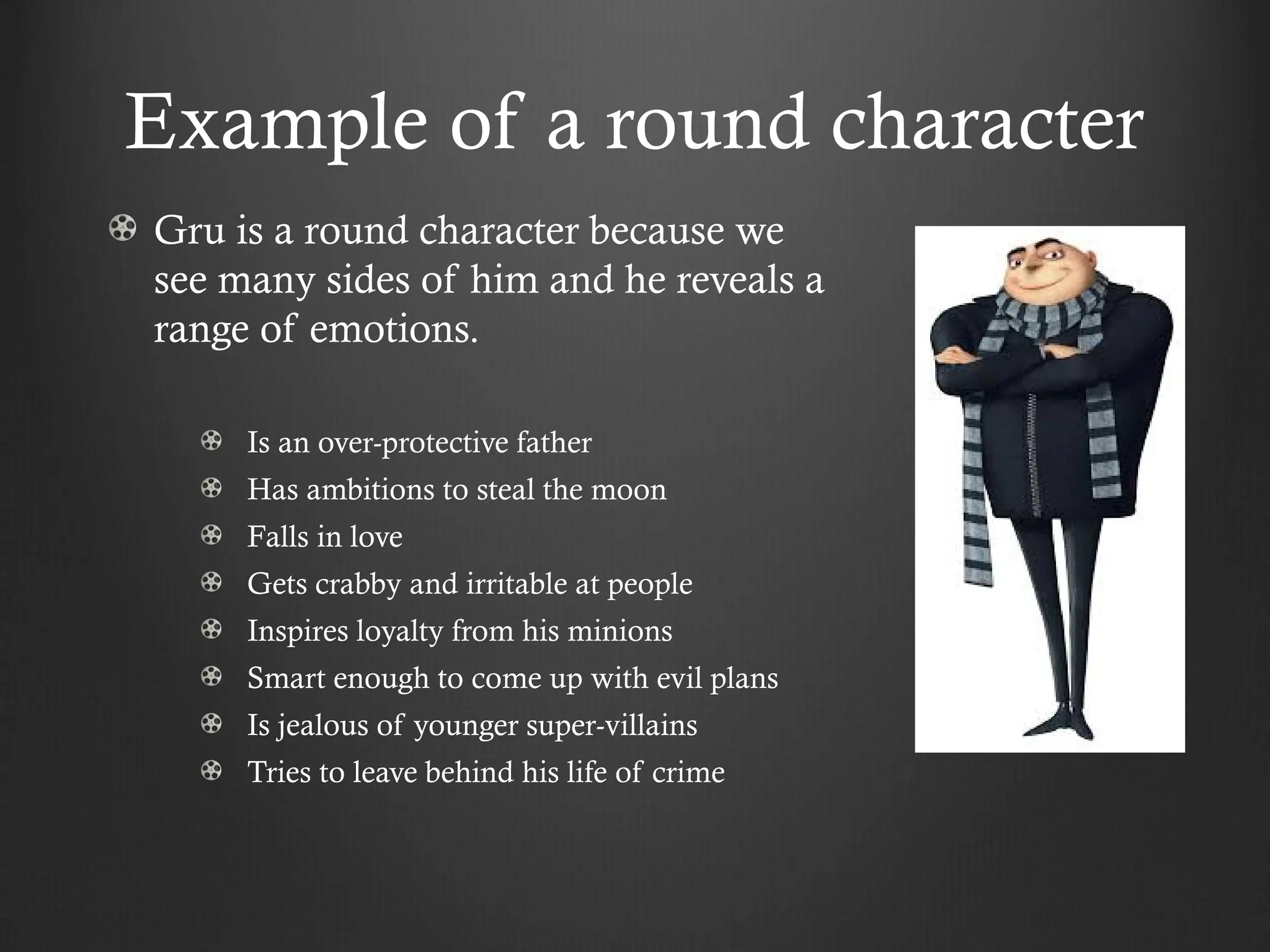
Example of a round character
Gru is a round character because we
see many sides of him and he reveals a
range of emotions.
Is an over-protective father
Has ambitions to steal the moon
Falls in love
Gets crabby and irritable at people
Inspires loyalty from his minions
Smart enough to come up with evil plans
Is jealous of younger super-villains
Tries to leave behind his life of crime
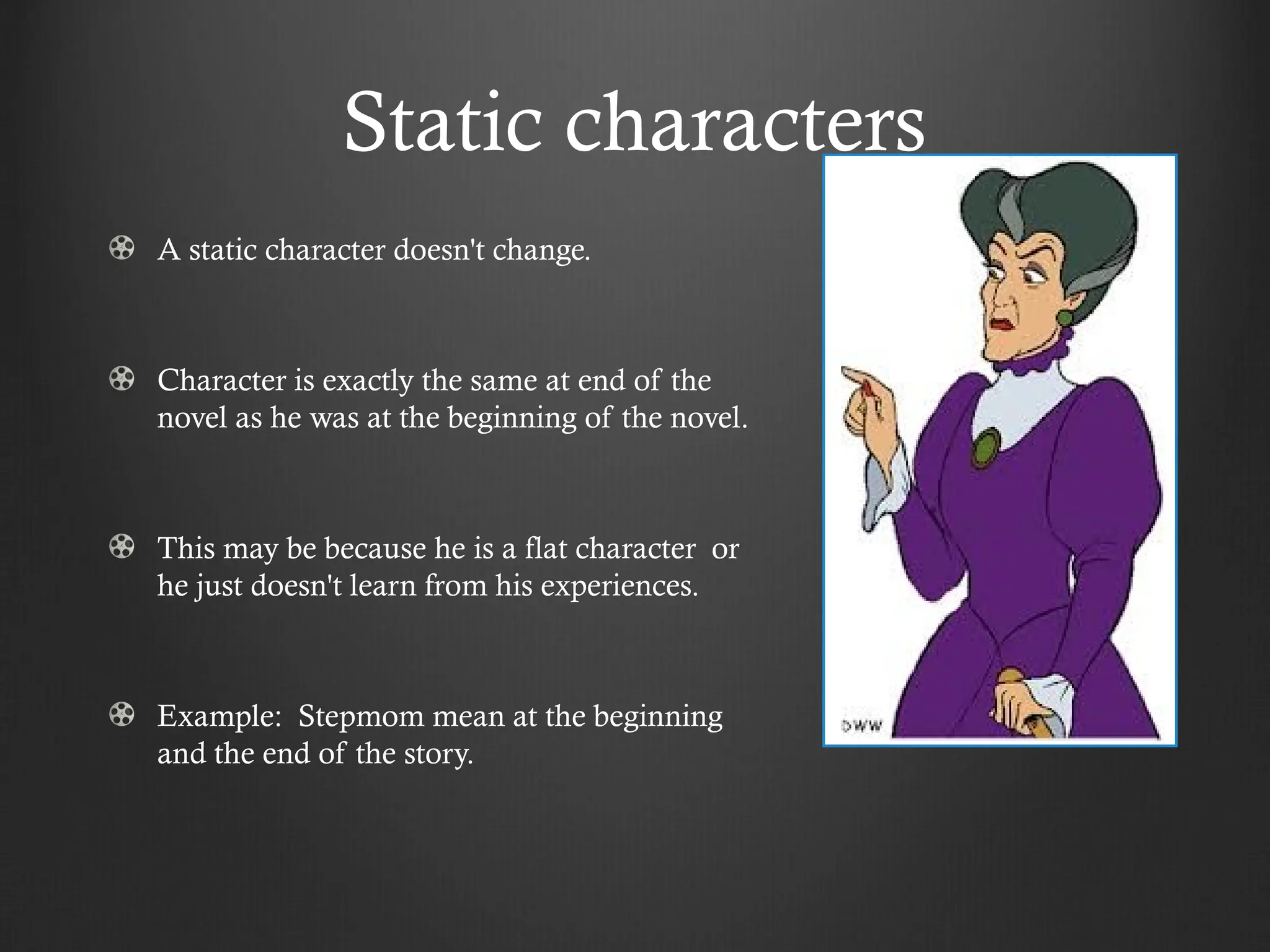
Static characters
A static character doesn't change.
Character is exactly the same at end of the
novel as he was at the beginning of the novel.
This may be because he is a flat character or
he just doesn't learn from his experiences.
Example: Stepmom mean at the beginning
and the end of the story.
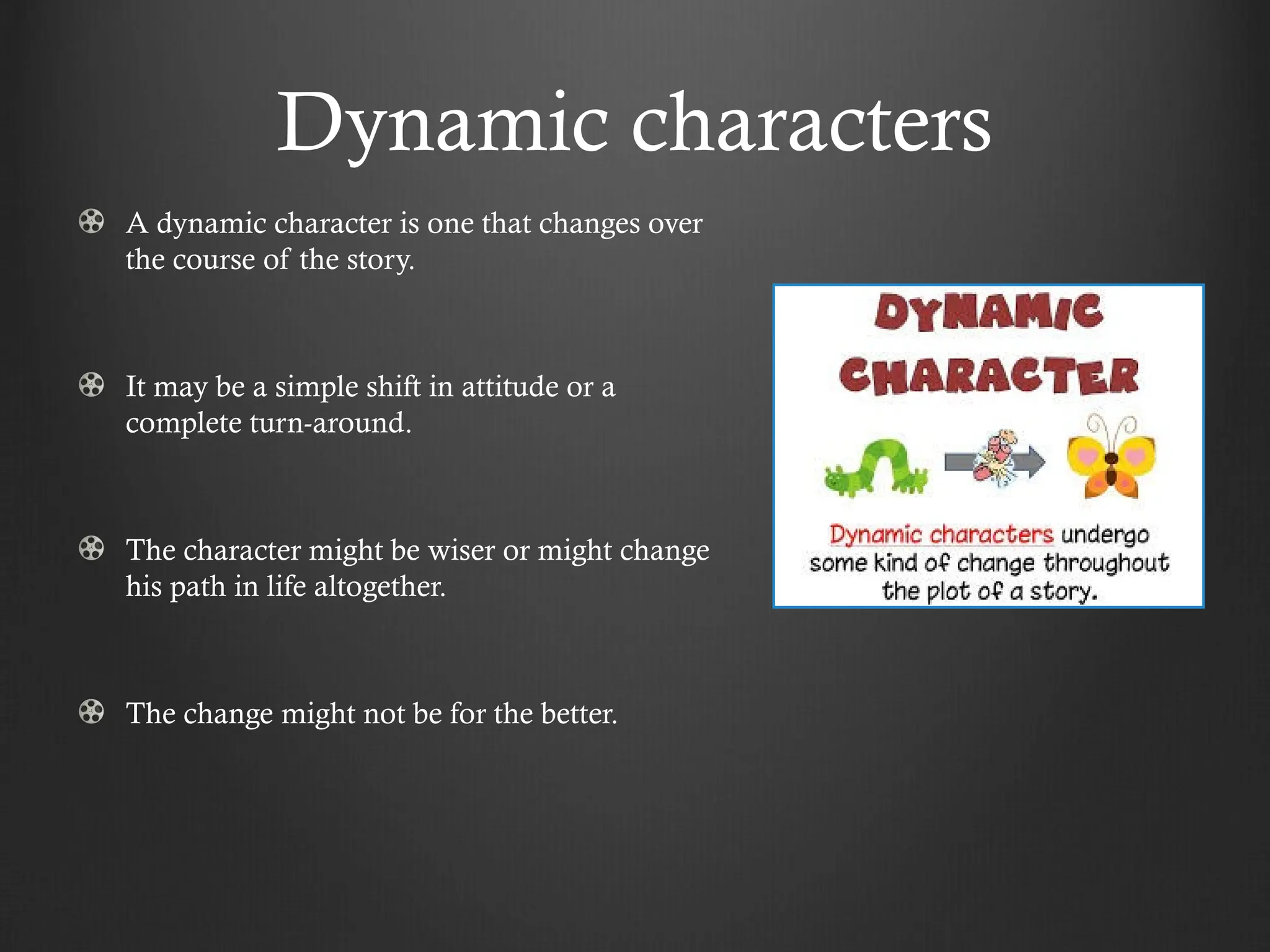
Dynamic characters
A dynamic character is one that changes over
the course of the story.
It may be a simple shift in attitude or a
complete turn-around.
The character might be wiser or might change
his path in life altogether.
The change might not be for the better.
Examples of dynamic
characters
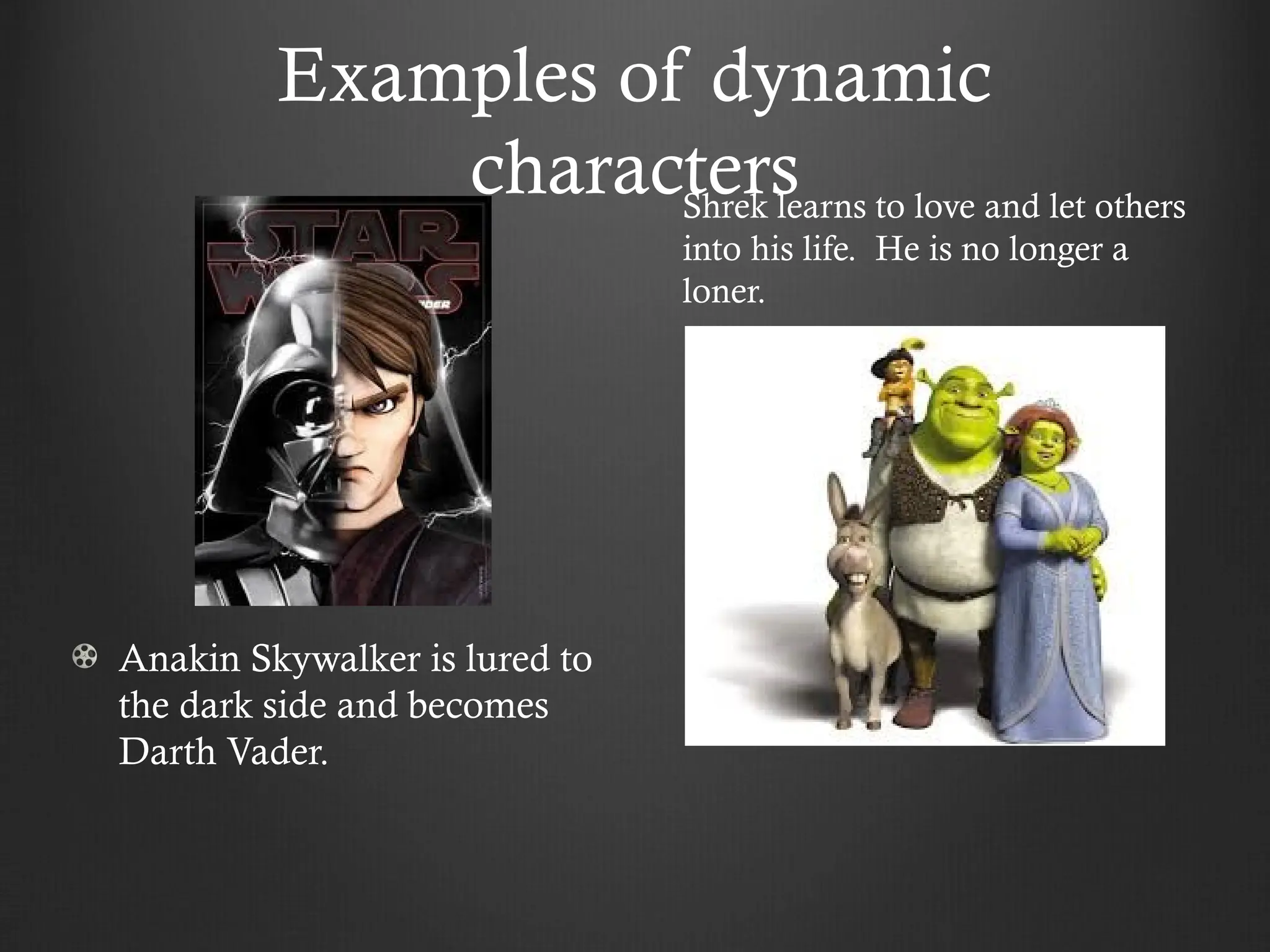
Anakin Skywalker is lured to
the dark side and becomes
Darth Vader.
Shrek learns to love and let others
into his life. He is no longer a
loner.
Stock Characters
Stock characters are stereotyped
prototypes: Ex) super hero,
villian, jock, dumb-blond
Summary of characters
Protagonist—the story revolves around the character.
Antagonist—the character who acts against the protagonist.
Flat Character—one who is not very developed.
Round Character—one who is mutli-dimensional and complex.
Static Character—one who stays the same throughout the story.
Dynamic Character—one who changes over the course of the
story.
Stock character- a character the represents an obvious stereotype
Plot
Walsh Publishing Co. 2009
Plot
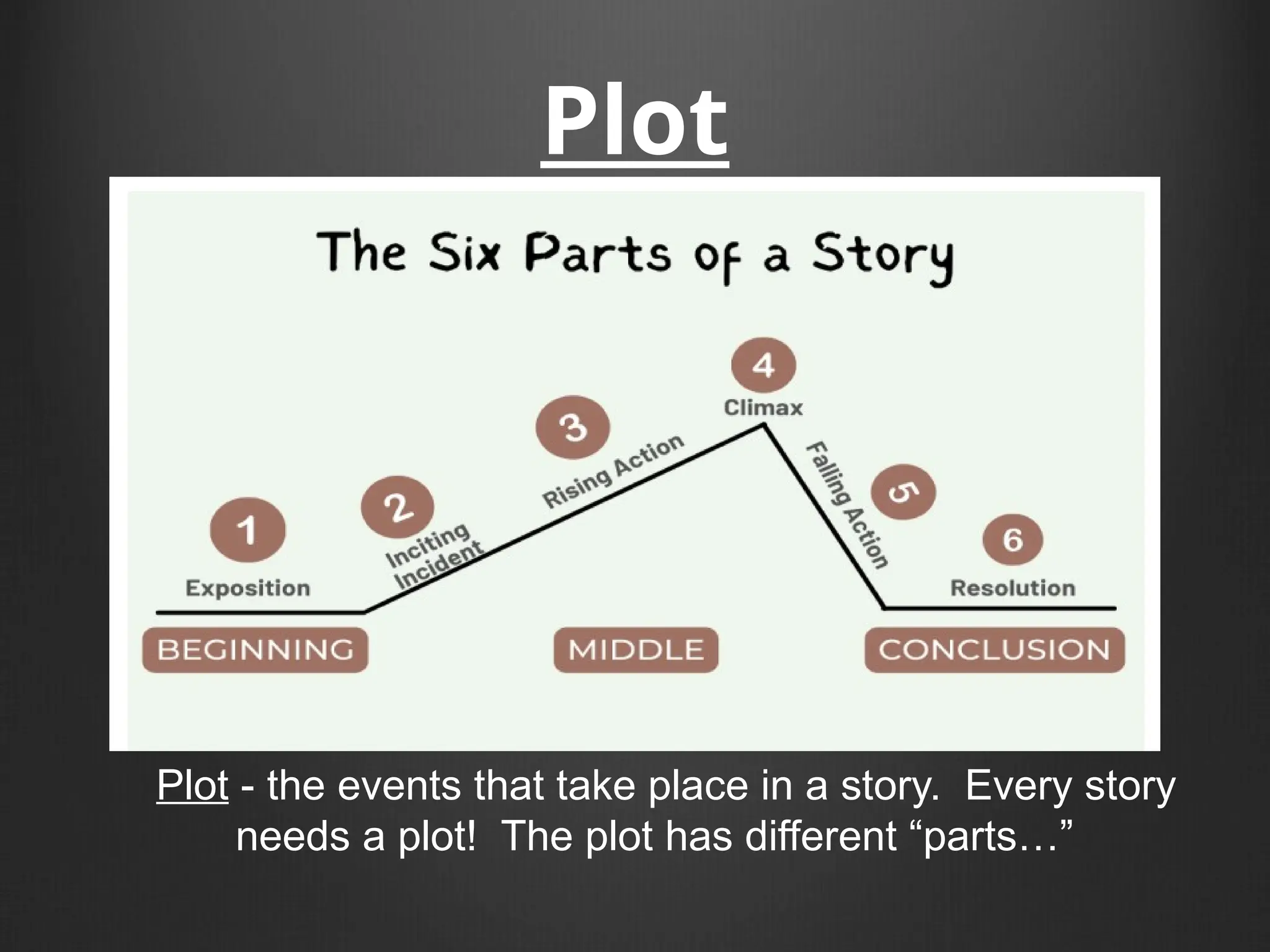
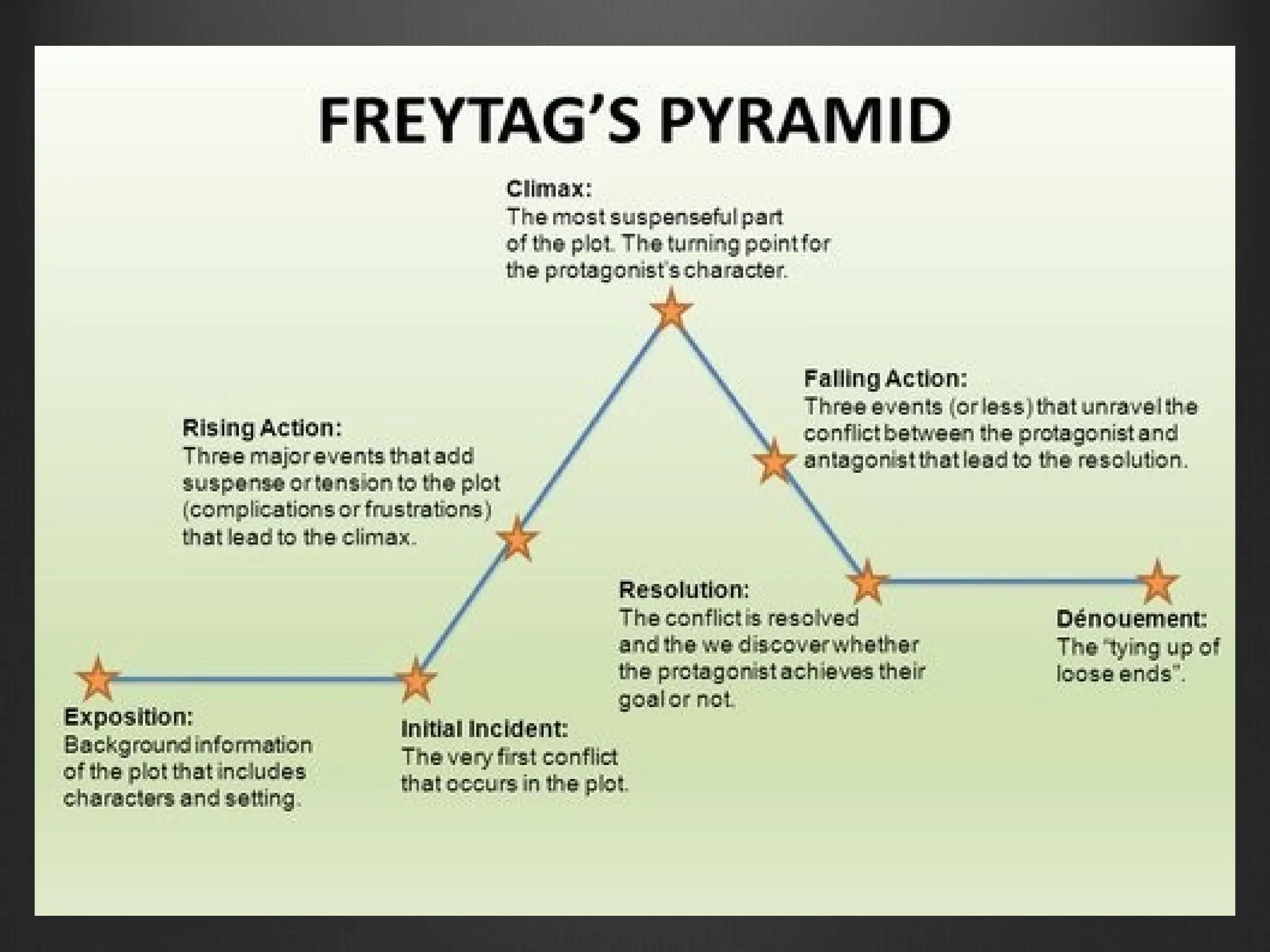
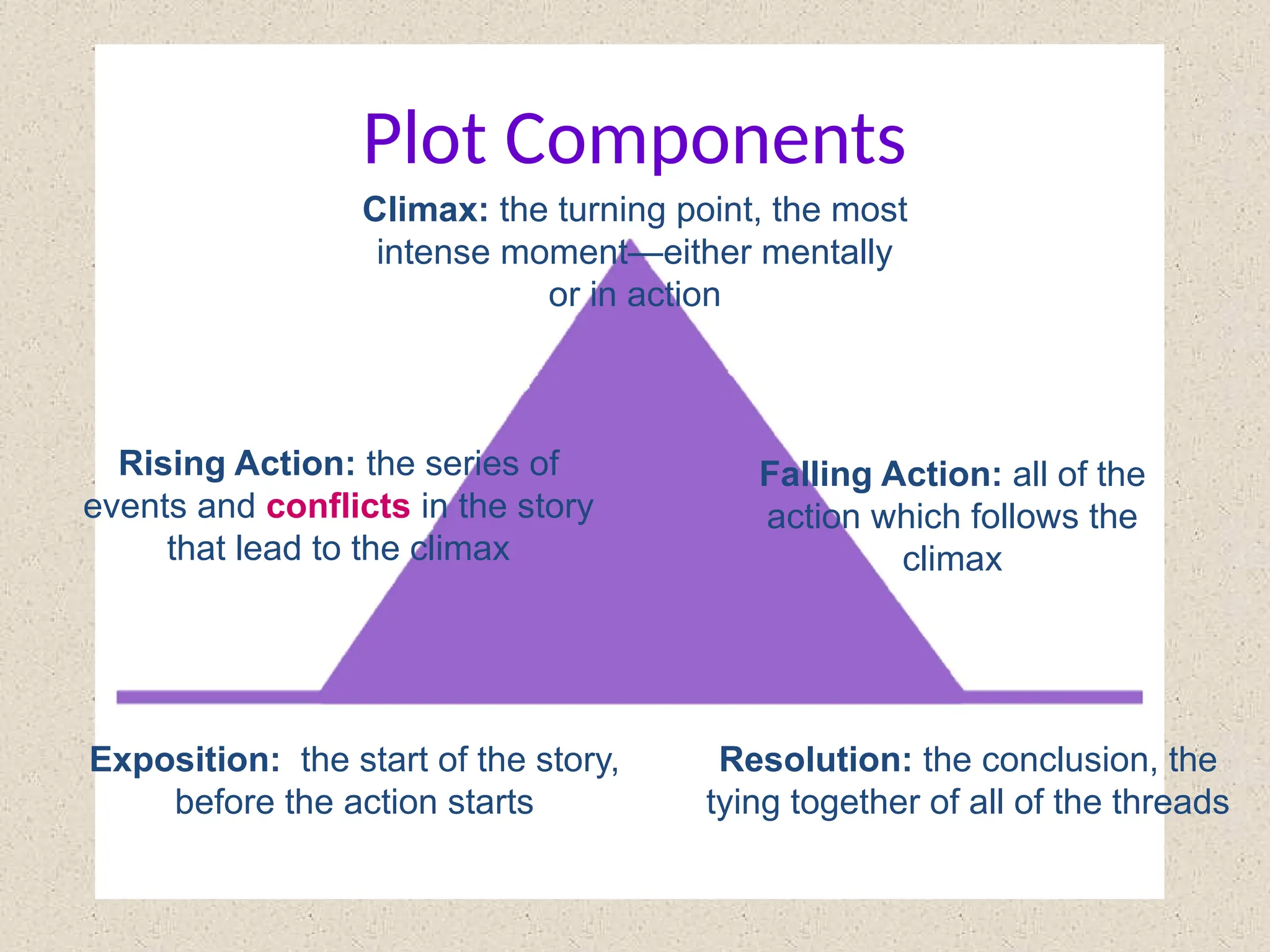
Plot - the events that take place in a story. Every story
needs a plot! The plot has different “parts…”
Exposition: the start of the story,
before the action starts
Rising Action: the series of
events and conflicts in the story
that lead to the climax
Climax: the turning point, the most
intense moment—either mentally
or in action
Falling Action: all of the
action which follows the
climax
Resolution: the conclusion, the
tying together of all of the threads
Plot Components
The climax is the most exciting
part!!
Special Techniques of Plot…
 Suspense- excitement or tension
 Flashback- interrupts the normal sequence of events to tell
about something that happened in the past
 Surprise Ending- conclusion that reader does not expect
 And…Foreshadowing…
A hint about what will happen
next is called foreshadowing
For example, if you hear this:
Then you know someone’s about to get eaten!
Conflict
Walsh Publishing Co. 2009
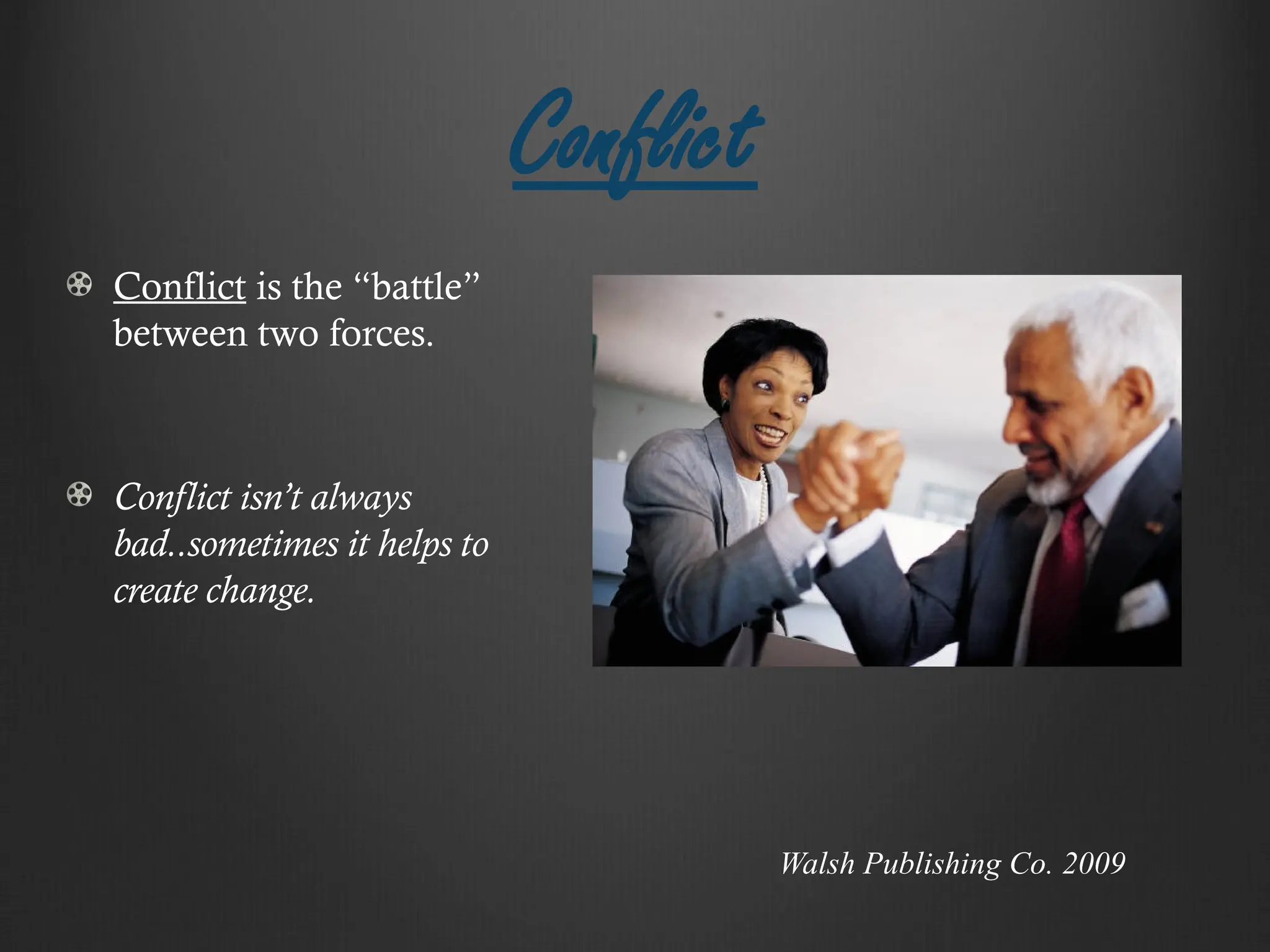
Conflict
Conflict is the “battle”
between two forces.
Conflict isn’t always
bad..sometimes it helps to
create change.
Walsh Publishing Co. 2009
Conflict
Conflict is the struggle between two
forces in a story. Without conflict,
there is no plot.

TYPES OF CHARACTERS POWERPOINT PRESENTATION

  • 1.
    ACTIVITY 1: UnlockingContent Vocabulary Arrange the jumbled letters to form a word. Then, write your idea/s about what you formed. JUMBLED LETTERS WORD WHAT I KNOW lpot flictonc xlimac onmisceint
  • 3.
    Questions: What did theson ask the father? What was the answer to the son’s questions? How did the father show his love to his mother?
  • 4.
  • 5.
    Every story needs Characters… People AnimalsOr Creatures Walsh Publishing Co. 2009
  • 6.
    The protagonist isthe “good guy”
  • 7.
    The antagonist isthe “bad guy” or force
  • 8.
    Characterization Characterization is theway in which an author shows the personality of a character Characterization is a technique writers use to make characters “come to life.” Walsh Publishing Co. 2009
  • 9.
    Characterization Characters are peopleor animals in a story. A writer can tell you directly about a character… (Freddy was very competitive) Or A writer can tell you indirectly about a character… (Two days before the game, Freddy gathered his teammates and laid out his plan. Then he looked at them and said, “We are going to win this one. No excuses.”)
  • 10.
    Direct Characterization Direct Characterization tellsthe reader the personality of the character. Direct Characterization is obvious to the reader and “spells” it right out. “The patient boy and the quiet girl were both well behaved and did not disobey their mother.
  • 11.
    Indirect Characterization Indirect Characterization showsthings that reveal the personality of the character. Speech Thought Effect on Others Actions Looks The boy sat next to his sister as she poked him and teased him. He did not react. He carefully picked up her doll from the floor and placed it on her lap saying gently, “Here you go, why don’t you play with your doll?”
  • 12.
    Indirect Characterization… ☻What doesthe character say? How does the character speak? ☻ What is revealed through the character’s private thoughts and feelings? ☻ What is the character’s effect on others? How do other characters feel or behave in reaction to the character? ☻ What does the character do? How does he/she behave? ☻ What does the character look like? Dress like?
  • 13.
    Character Traits Character Traitsare descriptive adjectives that tell us specific qualities of a character •Honest •Light-hearted •Leader •Expert •Brave •Conceited •Mischievous •Demanding •Thoughtful •Keen •Happy •Disagreeable •Simple •Fancy •Plain •Excited •Studious •Inventive •Creative •Thrilling •Independent •Intelligent •Compassionate •Gentle •Proud •Wild •Messy •Neat •Joyful •Strong •Bright •Courageous •Serious •Funny •Humorous •Sad •Poor •Rich •Tall •Dark •Light •Handsome •Pretty •Ugly •Selfish •Unselfish •Self-confident •Respectful •Considerate •Imaginative •Busy •Patriotic •Fun-loving •Popular •Successful •Responsible •Lazy •Dreamer •Helpful •Simple- minded •Humble •Friendly •Short •Adventurous •Hard-working •Timid •Shy •Bold •Daring •Dainty •Pitiful •Cooperative •Lovable •Prim •Proper •Ambitious •Able •Quiet •Curious •Reserved •Pleasing •Bossy •Witty •Fighter •Tireless •Energetic •Cheerful •Smart •Impulsive •Loyal
  • 14.
    Identifying Character TraitsWorksheet: http://www.readwritethink.org/lesson_images/lesson175/RWT186-2.pdf Character Poem First name ________________________ Four traits ________________________ Related to:________________________ Cares deeply for _____________________ Who feels ________________________ Who needs ________________________ Who gives _________________________ Who would like to see __________________ Resident of ________________________ Example of poem Snow White, Beautiful, giving, loving, unhappy The Queen, her wicked stepmother The seven dwarfs Safe in the forest The love of a Prince Love to the seven dwarfs Goodness throughout the kingdom The forest.
  • 15.
  • 16.
    Flat character A flatcharacter is one that often fits into a stereotype. The character is not very developed. We only see one side of the flat character. Few traits shown. Usually, the flat characters are the secondary characters.
  • 17.
    Example of FlatCharacter Suppose there is a grandma in the story. The grandma is: Kind Loves her grandchildren Comforts and takes care of others If this is all we see of the grandma character, then she’s a flat character.
  • 18.
    Round characters A roundcharacter is one that is multi-dimensional just like real people are. These characters are complex and we get to see a glimpse of their complexity in the novel. Usually your protagonist, and often your antagonist, are round characters.
  • 19.
    Example of around character Gru is a round character because we see many sides of him and he reveals a range of emotions. Is an over-protective father Has ambitions to steal the moon Falls in love Gets crabby and irritable at people Inspires loyalty from his minions Smart enough to come up with evil plans Is jealous of younger super-villains Tries to leave behind his life of crime
  • 20.
    Static characters A staticcharacter doesn't change. Character is exactly the same at end of the novel as he was at the beginning of the novel. This may be because he is a flat character or he just doesn't learn from his experiences. Example: Stepmom mean at the beginning and the end of the story.
  • 21.
    Dynamic characters A dynamiccharacter is one that changes over the course of the story. It may be a simple shift in attitude or a complete turn-around. The character might be wiser or might change his path in life altogether. The change might not be for the better.
  • 22.
    Examples of dynamic characters AnakinSkywalker is lured to the dark side and becomes Darth Vader. Shrek learns to love and let others into his life. He is no longer a loner.
  • 23.
    Stock Characters Stock charactersare stereotyped prototypes: Ex) super hero, villian, jock, dumb-blond
  • 24.
    Summary of characters Protagonist—thestory revolves around the character. Antagonist—the character who acts against the protagonist. Flat Character—one who is not very developed. Round Character—one who is mutli-dimensional and complex. Static Character—one who stays the same throughout the story. Dynamic Character—one who changes over the course of the story. Stock character- a character the represents an obvious stereotype
  • 25.
  • 26.
    Plot Plot - theevents that take place in a story. Every story needs a plot! The plot has different “parts…”
  • 28.
    Exposition: the startof the story, before the action starts Rising Action: the series of events and conflicts in the story that lead to the climax Climax: the turning point, the most intense moment—either mentally or in action Falling Action: all of the action which follows the climax Resolution: the conclusion, the tying together of all of the threads Plot Components
  • 29.
    The climax isthe most exciting part!!
  • 30.
    Special Techniques ofPlot…  Suspense- excitement or tension  Flashback- interrupts the normal sequence of events to tell about something that happened in the past  Surprise Ending- conclusion that reader does not expect  And…Foreshadowing…
  • 31.
    A hint aboutwhat will happen next is called foreshadowing For example, if you hear this: Then you know someone’s about to get eaten!
  • 32.
  • 33.
    Conflict Conflict is the“battle” between two forces. Conflict isn’t always bad..sometimes it helps to create change. Walsh Publishing Co. 2009
  • 34.
    Conflict Conflict is thestruggle between two forces in a story. Without conflict, there is no plot.

Editor's Notes

  • #28 Exposition: The mood and conditions existing at the beginning of the story. The setting is identified. The main characters with their positions, circumstances and relationships to one another are established. The exciting force or initial conflict is introduced. Sometimes called the “Narrative HOOK” this begins the conflict that continues throughout the story. Rising Action: The series of events, conflicts, and crises in the story that lead up to the climax, providing the progressive intensity, and complicate the conflict. Climax: The turning point of the story. A crucial event takes place and from this point forward, the protagonist moves toward his inevitable end. The event may be either an action or a mental decision that the protagonist makes. Falling Action: The events occurring from the time of the climax to the end of the story. The main character may encounter more conflicts in this part of the story, but the end is inevitable. Resolution/Denouement: The tying up of loose ends and all of the threads in the story. The conclusion. The hero character either emerges triumphant or is defeated at this point.