
Biological Explanation
• Complete the
worksheet revising
the biological
approach.
www.jamiesflipped.co.uk
@jamiesflipped
Lesson Objectives
By the end of the lesson you …
• Must be able to define (AO1) the central nervous
system, synapse, neurones and
neurotransmitters.
• Must be able to describe (AO1) how the synapse,
receptors, neurons and neurotransmitters pass
‘messages’
• Should be able to describe (AO1) and evaluate
(AO2) the biological approach to understanding
depression.
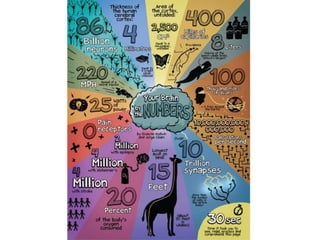
Pinky and The Brain …
1.
2.
3.
4.
5.

6.

How many brain cells does
an average brain contain?
What percentage of the
bodies energy does the
brain use?
How much does a brain
weigh?
What percentage of our
brain do we use?
How many times do our
brain cells fire a second?
How many times do
synapses send information
every second?
?
?

?
Biological
Approach
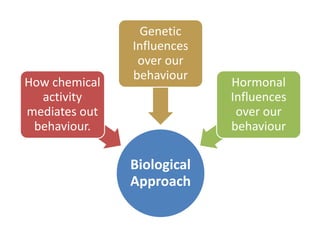
How chemical
activity
mediates out
behaviour.

Genetic
Influences
over our
behaviour

Biological
Approach

Hormonal
Influences
over our
behaviour
How chemical
activity
mediates out
behaviour.

Neurotransmitters

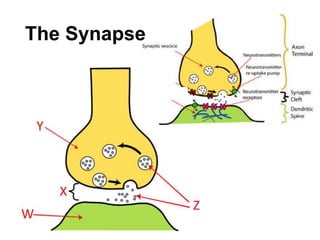
• One way messages are passed within the brain
is by neurotransmitters.
• These are chemicals that pass from neuron to
neuron.
• Between neurones there are gaps called
synapses.
• If the receptors of one neuron are set to
receive the neurotransmitters of another,
then the message continues.
Genetic
Influences
over our
behaviour

Genetic Influences

• Genes are passed on from parents to children
and they govern behaviour as well as physical
characteristics. Children receive (approx.) half
their genes from their fathers and half from their
mothers.
• The human genome has recently been decoded,
which means that all genes have been identified.
• Does not mean the function of each gene is
known because it is often the combination or the
position of genes that leads to certain
characteristics, rather than one particular gene.
Hormonal
Influences
over our
behaviour

Hormonal Transmission

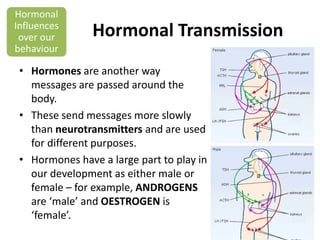
• Hormones are another way
messages are passed around the
body.
• These send messages more slowly
than neurotransmitters and are used
for different purposes.
• Hormones have a large part to play in
our development as either male or
female – for example, ANDROGENS
are ‘male’ and OESTROGEN is
‘female’.
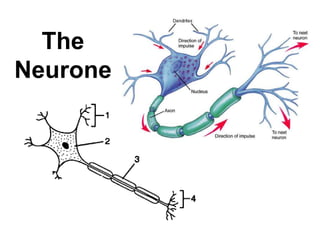
The
Neurone
The Synapse
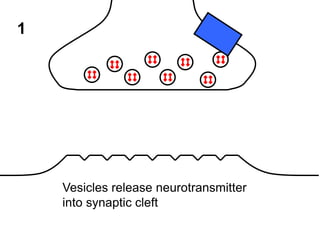
1

Vesicles release neurotransmitter
into synaptic cleft
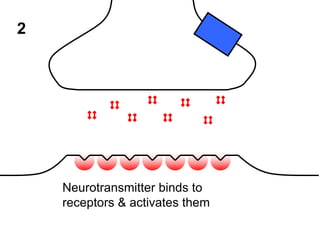
2

Neurotransmitter binds to
receptors & activates them
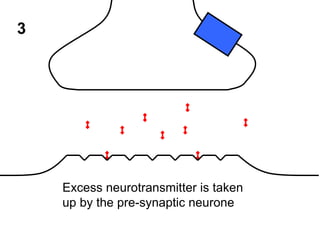
3

Excess neurotransmitter is taken
up by the pre-synaptic neurone
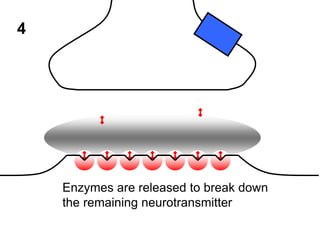
4

Enzymes are released to break down
the remaining neurotransmitter
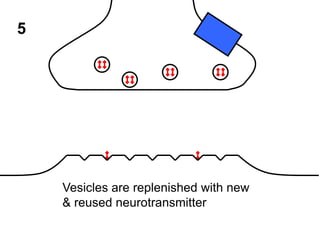
5

Vesicles are replenished with new
& reused neurotransmitter
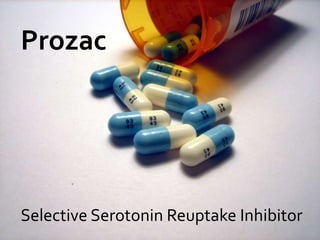
Prozac

Selective Serotonin Reuptake Inhibitor
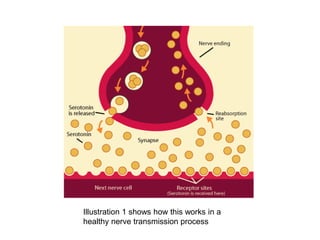
Illustration 1 shows how this works in a
healthy nerve transmission process
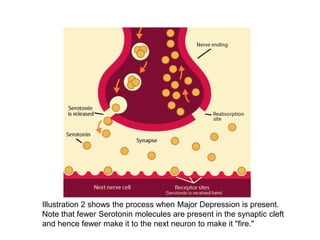
Illustration 2 shows the process when Major Depression is present.
Note that fewer Serotonin molecules are present in the synaptic cleft
and hence fewer make it to the next neuron to make it "fire."
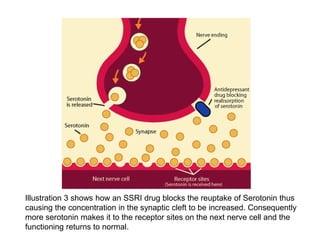
Illustration 3 shows how an SSRI drug blocks the reuptake of Serotonin thus
causing the concentration in the synaptic cleft to be increased. Consequently
more serotonin makes it to the receptor sites on the next nerve cell and the
functioning returns to normal.
Describe how neurotransmitters
work differently in a person with
depression. Include an explanation
of synaptic transmission in your
answer and give a reason for the
difference.
• Must be able to define (AO1) the central nervous
system, synapse, neurones and neurotransmitters.
• Must be able to describe (AO1) how the synapse,
receptors, neurons and neurotransmitters pass
‘messages’
• Should be able to describe (AO1) and evaluate (AO2) the
biological approach to understanding depression.
Emailing a friend …
Imagine your are emailing a friend who
has depression and who does not know
much about psychology and describing
to them how the biological approach
would explain their depression.
Lesson Objectives
By the end of the lesson you …
• Must be able to compare (AO2) the biological
and cognitive explanations of depression.
• Should be able to mark a 12 mark question
and give feedback on it.
There are many explanations for depression
including biological ones.
Describe one explanation for depression and
compare this with one other explanation.
Comparisons include considering similarities
and/or differences.
[12]
*in the exam they cannot specifically name depression.
• Must be able to compare (AO2) the
biological and cognitive explanations of
depression.
• Should be able to mark a 12 mark question
and give feedback on it.
www.jamiesflipped.co.uk
@jamiesflipped

Week 11 A2 Biology and Depression

  • 1.
    Biological Explanation • Completethe worksheet revising the biological approach.
  • 2.
  • 3.
    Lesson Objectives By theend of the lesson you … • Must be able to define (AO1) the central nervous system, synapse, neurones and neurotransmitters. • Must be able to describe (AO1) how the synapse, receptors, neurons and neurotransmitters pass ‘messages’ • Should be able to describe (AO1) and evaluate (AO2) the biological approach to understanding depression.
  • 4.
    Pinky and TheBrain … 1. 2. 3. 4. 5. 6. How many brain cells does an average brain contain? What percentage of the bodies energy does the brain use? How much does a brain weigh? What percentage of our brain do we use? How many times do our brain cells fire a second? How many times do synapses send information every second?
  • 6.
  • 7.
    How chemical activity mediates out behaviour. Genetic Influences overour behaviour Biological Approach Hormonal Influences over our behaviour
  • 8.
    How chemical activity mediates out behaviour. Neurotransmitters •One way messages are passed within the brain is by neurotransmitters. • These are chemicals that pass from neuron to neuron. • Between neurones there are gaps called synapses. • If the receptors of one neuron are set to receive the neurotransmitters of another, then the message continues.
  • 9.
    Genetic Influences over our behaviour Genetic Influences •Genes are passed on from parents to children and they govern behaviour as well as physical characteristics. Children receive (approx.) half their genes from their fathers and half from their mothers. • The human genome has recently been decoded, which means that all genes have been identified. • Does not mean the function of each gene is known because it is often the combination or the position of genes that leads to certain characteristics, rather than one particular gene.
  • 10.
    Hormonal Influences over our behaviour Hormonal Transmission •Hormones are another way messages are passed around the body. • These send messages more slowly than neurotransmitters and are used for different purposes. • Hormones have a large part to play in our development as either male or female – for example, ANDROGENS are ‘male’ and OESTROGEN is ‘female’.
  • 12.
  • 13.
  • 14.
  • 15.
  • 16.
    3 Excess neurotransmitter istaken up by the pre-synaptic neurone
  • 17.
    4 Enzymes are releasedto break down the remaining neurotransmitter
  • 18.
    5 Vesicles are replenishedwith new & reused neurotransmitter
  • 19.
  • 20.
    Illustration 1 showshow this works in a healthy nerve transmission process
  • 21.
    Illustration 2 showsthe process when Major Depression is present. Note that fewer Serotonin molecules are present in the synaptic cleft and hence fewer make it to the next neuron to make it "fire."
  • 22.
    Illustration 3 showshow an SSRI drug blocks the reuptake of Serotonin thus causing the concentration in the synaptic cleft to be increased. Consequently more serotonin makes it to the receptor sites on the next nerve cell and the functioning returns to normal.
  • 23.
    Describe how neurotransmitters workdifferently in a person with depression. Include an explanation of synaptic transmission in your answer and give a reason for the difference.
  • 24.
    • Must beable to define (AO1) the central nervous system, synapse, neurones and neurotransmitters. • Must be able to describe (AO1) how the synapse, receptors, neurons and neurotransmitters pass ‘messages’ • Should be able to describe (AO1) and evaluate (AO2) the biological approach to understanding depression.
  • 25.
    Emailing a friend… Imagine your are emailing a friend who has depression and who does not know much about psychology and describing to them how the biological approach would explain their depression.
  • 26.
    Lesson Objectives By theend of the lesson you … • Must be able to compare (AO2) the biological and cognitive explanations of depression. • Should be able to mark a 12 mark question and give feedback on it.
  • 27.
    There are manyexplanations for depression including biological ones. Describe one explanation for depression and compare this with one other explanation. Comparisons include considering similarities and/or differences. [12] *in the exam they cannot specifically name depression.
  • 28.
    • Must beable to compare (AO2) the biological and cognitive explanations of depression. • Should be able to mark a 12 mark question and give feedback on it.
  • 29.