Twins & Adoption Studies
1. What are identical twins?
2. Why are they useful to study in Psychology?
3. If Identical twins behave in similar ways and
share traits, what does this tell us about these
behaviours?
4. However, might there be another reason as to
why identical twins behave in similar ways or
share traits?
5. Why are identical twins reared apart (adoption
studies) useful to study?
Learning Objectives
By the end of this lesson you:
• Must be able to describe (AO1) the Gottesman
and Shields study.
• Must be able to describe (AO1) and evaluate
(AO2) twin studies as a method in psychology.
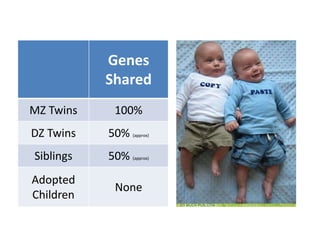
Genes
Shared
MZ Twins

100%

DZ Twins

50%

(approx)

Siblings

50%

(approx)

Adopted
Children

None
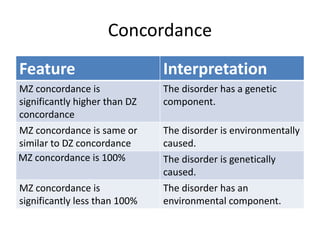
Concordance
Feature

Interpretation

MZ concordance is
significantly higher than DZ
concordance
MZ concordance is same or
similar to DZ concordance
MZ concordance is 100%

The disorder has a genetic
component.

MZ concordance is
significantly less than 100%

The disorder is environmentally
caused.
The disorder is genetically
caused.
The disorder has an
environmental component.
Consolidation Task [twin studies]
1. Describe one research method used in the
study of schizophrenia (6)
2. Evaluate one research method used in the
study of schizophrenia (6)
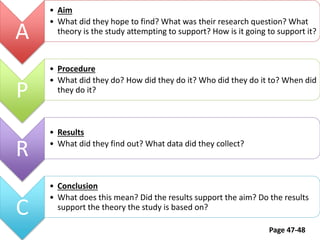
A
P

R
C

• Aim
• What did they hope to find? What was their research question? What
theory is the study attempting to support? How is it going to support it?

• Procedure
• What did they do? How did they do it? Who did they do it to? When did
they do it?

• Results
• What did they find out? What data did they collect?

• Conclusion
• What does this mean? Did the results support the aim? Do the results
support the theory the study is based on?
Page 47-48
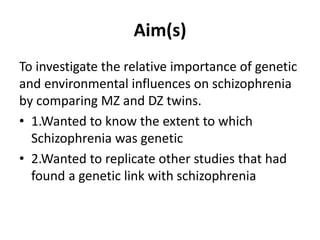
Aim(s)
To investigate the relative importance of genetic
and environmental influences on schizophrenia
by comparing MZ and DZ twins.
• 1.Wanted to know the extent to which
Schizophrenia was genetic
• 2.Wanted to replicate other studies that had
found a genetic link with schizophrenia
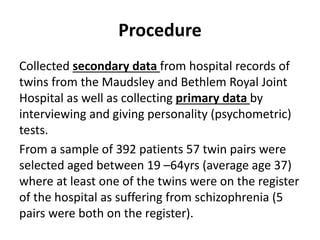
Procedure
Collected secondary data from hospital records of
twins from the Maudsley and Bethlem Royal Joint
Hospital as well as collecting primary data by
interviewing and giving personality (psychometric)
tests.
From a sample of 392 patients 57 twin pairs were
selected aged between 19 –64yrs (average age 37)
where at least one of the twins were on the register
of the hospital as suffering from schizophrenia (5
pairs were both on the register).
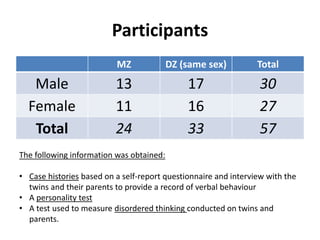
Participants
MZ

Male
Female
Total

DZ (same sex)

Total

13
11
24

17
16
33

30
27
57

The following information was obtained:
• Case histories based on a self-report questionnaire and interview with the
twins and their parents to provide a record of verbal behaviour
• A personality test
• A test used to measure disordered thinking conducted on twins and
parents.
Results
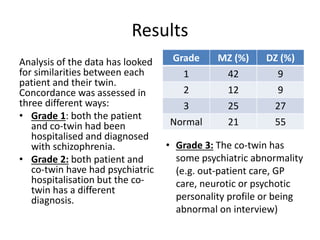
Analysis of the data has looked
for similarities between each
patient and their twin.
Concordance was assessed in
three different ways:
• Grade 1: both the patient
and co-twin had been
hospitalised and diagnosed
with schizophrenia.
• Grade 2: both patient and
co-twin have had psychiatric
hospitalisation but the cotwin has a different
diagnosis.

Grade
1

MZ (%)
42

DZ (%)
9

2
3
Normal

12
25
21

9
27
55

• Grade 3: The co-twin has
some psychiatric abnormality
(e.g. out-patient care, GP
care, neurotic or psychotic
personality profile or being
abnormal on interview)
Conclusions
NATURE
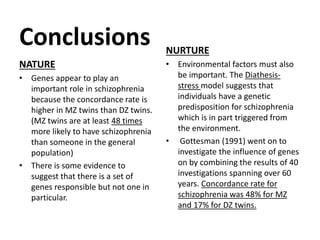
• Genes appear to play an
important role in schizophrenia
because the concordance rate is
higher in MZ twins than DZ twins.
(MZ twins are at least 48 times
more likely to have schizophrenia
than someone in the general
population)
• There is some evidence to
suggest that there is a set of
genes responsible but not one in
particular.

NURTURE
• Environmental factors must also
be important. The Diathesisstress model suggests that
individuals have a genetic
predisposition for schizophrenia
which is in part triggered from
the environment.
• Gottesman (1991) went on to
investigate the influence of genes
on by combining the results of 40
investigations spanning over 60
years. Concordance rate for
schizophrenia was 48% for MZ
and 17% for DZ twins.
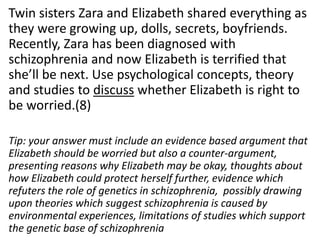
Twin sisters Zara and Elizabeth shared everything as
they were growing up, dolls, secrets, boyfriends.
Recently, Zara has been diagnosed with
schizophrenia and now Elizabeth is terrified that
she’ll be next. Use psychological concepts, theory
and studies to discuss whether Elizabeth is right to
be worried.(8)
Tip: your answer must include an evidence based argument that
Elizabeth should be worried but also a counter-argument,
presenting reasons why Elizabeth may be okay, thoughts about
how Elizabeth could protect herself further, evidence which
refuters the role of genetics in schizophrenia, possibly drawing
upon theories which suggest schizophrenia is caused by
environmental experiences, limitations of studies which support
the genetic base of schizophrenia
• Must be able to describe (AO1) the Gottesman
and Shields study.
• Must be able to describe (AO1) and evaluate
(AO2) twin studies as a method in psychology.
Complete the worksheet
Learning Objectives
By the end of this lesson you:
• Must be able to evaluate (AO2) the Gottesman
and Shields study.
• Must be able to describe (AO1) and evaluate
(AO2) twin studies as a method in psychology.
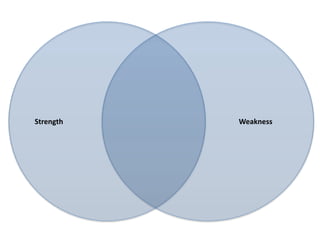
Strength

Weakness
Conversion Task (from Venn)
Evaluate the Gottesman and
Shields study [8]

20 minutes
• Must be able to evaluate (AO2) the Gottesman
and Shields study.
• Must be able to describe (AO1) and evaluate
(AO2) twin studies as a method in psychology.
www.jamiesflipped.co.uk
@jamiesflipped

Week 6 A2 Gottesman and Shields

  • 1.
    Twins & AdoptionStudies 1. What are identical twins? 2. Why are they useful to study in Psychology? 3. If Identical twins behave in similar ways and share traits, what does this tell us about these behaviours? 4. However, might there be another reason as to why identical twins behave in similar ways or share traits? 5. Why are identical twins reared apart (adoption studies) useful to study?
  • 2.
    Learning Objectives By theend of this lesson you: • Must be able to describe (AO1) the Gottesman and Shields study. • Must be able to describe (AO1) and evaluate (AO2) twin studies as a method in psychology.
  • 3.
  • 4.
    Concordance Feature Interpretation MZ concordance is significantlyhigher than DZ concordance MZ concordance is same or similar to DZ concordance MZ concordance is 100% The disorder has a genetic component. MZ concordance is significantly less than 100% The disorder is environmentally caused. The disorder is genetically caused. The disorder has an environmental component.
  • 5.
    Consolidation Task [twinstudies] 1. Describe one research method used in the study of schizophrenia (6) 2. Evaluate one research method used in the study of schizophrenia (6)
  • 6.
    A P R C • Aim • Whatdid they hope to find? What was their research question? What theory is the study attempting to support? How is it going to support it? • Procedure • What did they do? How did they do it? Who did they do it to? When did they do it? • Results • What did they find out? What data did they collect? • Conclusion • What does this mean? Did the results support the aim? Do the results support the theory the study is based on? Page 47-48
  • 7.
    Aim(s) To investigate therelative importance of genetic and environmental influences on schizophrenia by comparing MZ and DZ twins. • 1.Wanted to know the extent to which Schizophrenia was genetic • 2.Wanted to replicate other studies that had found a genetic link with schizophrenia
  • 8.
    Procedure Collected secondary datafrom hospital records of twins from the Maudsley and Bethlem Royal Joint Hospital as well as collecting primary data by interviewing and giving personality (psychometric) tests. From a sample of 392 patients 57 twin pairs were selected aged between 19 –64yrs (average age 37) where at least one of the twins were on the register of the hospital as suffering from schizophrenia (5 pairs were both on the register).
  • 9.
    Participants MZ Male Female Total DZ (same sex) Total 13 11 24 17 16 33 30 27 57 Thefollowing information was obtained: • Case histories based on a self-report questionnaire and interview with the twins and their parents to provide a record of verbal behaviour • A personality test • A test used to measure disordered thinking conducted on twins and parents.
  • 10.
    Results Analysis of thedata has looked for similarities between each patient and their twin. Concordance was assessed in three different ways: • Grade 1: both the patient and co-twin had been hospitalised and diagnosed with schizophrenia. • Grade 2: both patient and co-twin have had psychiatric hospitalisation but the cotwin has a different diagnosis. Grade 1 MZ (%) 42 DZ (%) 9 2 3 Normal 12 25 21 9 27 55 • Grade 3: The co-twin has some psychiatric abnormality (e.g. out-patient care, GP care, neurotic or psychotic personality profile or being abnormal on interview)
  • 11.
    Conclusions NATURE • Genes appearto play an important role in schizophrenia because the concordance rate is higher in MZ twins than DZ twins. (MZ twins are at least 48 times more likely to have schizophrenia than someone in the general population) • There is some evidence to suggest that there is a set of genes responsible but not one in particular. NURTURE • Environmental factors must also be important. The Diathesisstress model suggests that individuals have a genetic predisposition for schizophrenia which is in part triggered from the environment. • Gottesman (1991) went on to investigate the influence of genes on by combining the results of 40 investigations spanning over 60 years. Concordance rate for schizophrenia was 48% for MZ and 17% for DZ twins.
  • 12.
    Twin sisters Zaraand Elizabeth shared everything as they were growing up, dolls, secrets, boyfriends. Recently, Zara has been diagnosed with schizophrenia and now Elizabeth is terrified that she’ll be next. Use psychological concepts, theory and studies to discuss whether Elizabeth is right to be worried.(8) Tip: your answer must include an evidence based argument that Elizabeth should be worried but also a counter-argument, presenting reasons why Elizabeth may be okay, thoughts about how Elizabeth could protect herself further, evidence which refuters the role of genetics in schizophrenia, possibly drawing upon theories which suggest schizophrenia is caused by environmental experiences, limitations of studies which support the genetic base of schizophrenia
  • 13.
    • Must beable to describe (AO1) the Gottesman and Shields study. • Must be able to describe (AO1) and evaluate (AO2) twin studies as a method in psychology.
  • 14.
  • 15.
    Learning Objectives By theend of this lesson you: • Must be able to evaluate (AO2) the Gottesman and Shields study. • Must be able to describe (AO1) and evaluate (AO2) twin studies as a method in psychology.
  • 17.
  • 18.
    Conversion Task (fromVenn) Evaluate the Gottesman and Shields study [8] 20 minutes
  • 19.
    • Must beable to evaluate (AO2) the Gottesman and Shields study. • Must be able to describe (AO1) and evaluate (AO2) twin studies as a method in psychology.
  • 20.