More on Aristotle’s Appeals
Pathos, Ethos, Logos
Pathos
• “Emotional appeals” or “appeals to pathos” –
sometimes called “pathetic appeals”; arguments
from the heart.
• It’s not necessarily the emotion a writer puts into
the work: it’s how he appeals to the readers’
emotions.
• Sometimes the facts alone won’t carry the
argument, and sometimes eliciting emotion from
readers will help the writer fulfill her purpose.
Pathos (cont’d)
• “When writers and speakers can find the
words and images to evoke certain emotions
in people, they might also move their
audiences to sympathize with ideas they
connect to those feelings, and even to act on
them” (Lunsford and Ruszkiewicz 49).
Pathos (cont’d)
• “To the Troops at Tillbury” –
Queen Elizabeth I
• The ASPCA commercials
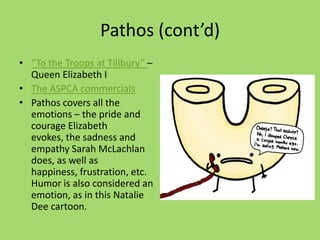
• Pathos covers all the
emotions – the pride and
courage Elizabeth
evokes, the sadness and
empathy Sarah McLachlan
does, as well as
happiness, frustration, etc.
Humor is also considered an
emotion, as in this Natalie
Dee cartoon.
Ethos
• “Ethical appeals” or “appeals to ethos”;
Arguments based on character.
• Writers can appeal to pathos in order to “build
a bridge” between themselves and their
readers. This leads us to ethos.
• It has to do with ethics some – in that as a
writer you want your readers to trust you, and
as readers you listen to whom you trust.
Here’s a different/better way to think about it:
Ethos (cont’d)
• “Before we’ll listen to others, we usually must
respect their authority, admire their integrity
and motives, or at least acknowledge what
they stand for [. . . .] Establishing persuasive
ethos, however, is not simply a matter of
seeming honest or likable but also of affirming
an identity and sharing values with one’s
intended audiences” (61).
Ethos (cont’d)
• Appeal to ethos in two
ways:
– Writers shape themselves
as they make their
argument: with their
language, the evidence
they offer, the respect they
show for their audience
and for whom they
disagree.
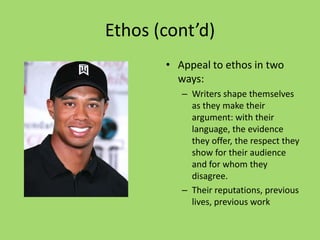
– Their reputations, previous
lives, previous work
Ethos (cont’d)
To establish a persuasive ethos, a writer can
• Claim authority – by showing he is
knowledgeable (from doing the right research,
from past experiences).
• Establish credibility – by making reasonable
claims and backing them up, by showing respect
for his audience (this includes visual conveyance
of his message as well) .
• Come clean about his motives – what is the
purpose behind the argument?
Logos
• “Appeals to logic” or “logical appeals”; appeals
based on fact and reason.
• The most valued appeal in most academic
writing.
• Note that appealing to ethos—setting that
foundation of trust between writer and
reader—will open readers up to trusting a
writer’s logic.
Logos (cont’d)
To appeal to logos, a
writer can
• Provide hard evidence
– Facts
– Statistics
– Surveys and polls
– Testimonies, narratives, i
nterviews
• Use reason and
common sense
Logos (cont’d)
• Provide logical structure for argument
– Degree: more of a good thing or less of a bad
thing is good. Example: “If I can get a ten-year
warranty on a humble Kia, shouldn’t I get the
same or better from Lexus?” or “Better a
conventional war now than a nuclear
confrontation later.”
– Analogies: explaining by comparison.
– Precedent: citing past/other situations to explain
the reasonableness of the argument at hand.
Works Cited
Lunsford, Andrea A. and John J. Ruszkiewicz.
Everything’s An Argument 4th ed. Boston:
Bedford/St. Martin’s, 2007. Print.

Aristotle’s appeals

  • 1.
    More on Aristotle’sAppeals Pathos, Ethos, Logos
  • 2.
    Pathos • “Emotional appeals”or “appeals to pathos” – sometimes called “pathetic appeals”; arguments from the heart. • It’s not necessarily the emotion a writer puts into the work: it’s how he appeals to the readers’ emotions. • Sometimes the facts alone won’t carry the argument, and sometimes eliciting emotion from readers will help the writer fulfill her purpose.
  • 3.
    Pathos (cont’d) • “Whenwriters and speakers can find the words and images to evoke certain emotions in people, they might also move their audiences to sympathize with ideas they connect to those feelings, and even to act on them” (Lunsford and Ruszkiewicz 49).
  • 4.
    Pathos (cont’d) • “Tothe Troops at Tillbury” – Queen Elizabeth I • The ASPCA commercials • Pathos covers all the emotions – the pride and courage Elizabeth evokes, the sadness and empathy Sarah McLachlan does, as well as happiness, frustration, etc. Humor is also considered an emotion, as in this Natalie Dee cartoon.
  • 5.
    Ethos • “Ethical appeals”or “appeals to ethos”; Arguments based on character. • Writers can appeal to pathos in order to “build a bridge” between themselves and their readers. This leads us to ethos. • It has to do with ethics some – in that as a writer you want your readers to trust you, and as readers you listen to whom you trust. Here’s a different/better way to think about it:
  • 6.
    Ethos (cont’d) • “Beforewe’ll listen to others, we usually must respect their authority, admire their integrity and motives, or at least acknowledge what they stand for [. . . .] Establishing persuasive ethos, however, is not simply a matter of seeming honest or likable but also of affirming an identity and sharing values with one’s intended audiences” (61).
  • 7.
    Ethos (cont’d) • Appealto ethos in two ways: – Writers shape themselves as they make their argument: with their language, the evidence they offer, the respect they show for their audience and for whom they disagree. – Their reputations, previous lives, previous work
  • 8.
    Ethos (cont’d) To establisha persuasive ethos, a writer can • Claim authority – by showing he is knowledgeable (from doing the right research, from past experiences). • Establish credibility – by making reasonable claims and backing them up, by showing respect for his audience (this includes visual conveyance of his message as well) . • Come clean about his motives – what is the purpose behind the argument?
  • 9.
    Logos • “Appeals tologic” or “logical appeals”; appeals based on fact and reason. • The most valued appeal in most academic writing. • Note that appealing to ethos—setting that foundation of trust between writer and reader—will open readers up to trusting a writer’s logic.
  • 10.
    Logos (cont’d) To appealto logos, a writer can • Provide hard evidence – Facts – Statistics – Surveys and polls – Testimonies, narratives, i nterviews • Use reason and common sense
  • 11.
    Logos (cont’d) • Providelogical structure for argument – Degree: more of a good thing or less of a bad thing is good. Example: “If I can get a ten-year warranty on a humble Kia, shouldn’t I get the same or better from Lexus?” or “Better a conventional war now than a nuclear confrontation later.” – Analogies: explaining by comparison. – Precedent: citing past/other situations to explain the reasonableness of the argument at hand.
  • 12.
    Works Cited Lunsford, AndreaA. and John J. Ruszkiewicz. Everything’s An Argument 4th ed. Boston: Bedford/St. Martin’s, 2007. Print.