LIB440
Week 5
Rhetorical Analysis (Written Text)
DR. RUSSELL RODRIGO
Outline
1. Review syllogisms
2. Mini lecture: Pathos, logos and ethos
3. Reading “Cleaning: the final feminist frontier”
4. Rhetorical Analysis Essay Writing
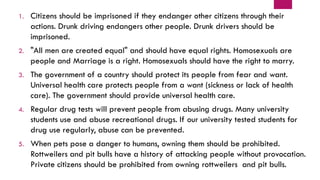
1. Citizens should be imprisoned if they endanger other citizens through their
actions. Drunk driving endangers other people. Drunk drivers should be
imprisoned.
2. "All men are created equal" and should have equal rights. Homosexuals are
people and Marriage is a right. Homosexuals should have the right to marry.
3. The government of a country should protect its people from fear and want.
Universal health care protects people from a want (sickness or lack of health
care). The government should provide universal health care.
4. Regular drug tests will prevent people from abusing drugs. Many university
students use and abuse recreational drugs. If our university tested students for
drug use regularly, abuse can be prevented.
5. When pets pose a danger to humans, owning them should be prohibited.
Rottweilers and pit bulls have a history of attacking people without provocation.
Private citizens should be prohibited from owning rottweilers and pit bulls.
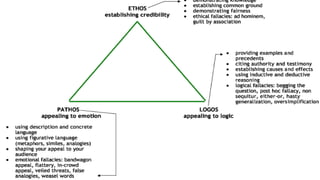
Aristotelian Appeals: Logos, Ethos, and Pathos
Whenever you read an argument you must ask yourself, “Is
this persuasive? If so, why? And to whom?” There are many
ways to appeal to an audience. Among them are appealing
to logos, ethos, and pathos. These appeals are identifiable in
almost all arguments.
Logos
 Logos or the appeal to reason and it relies on logic.
 Logos often depends on the use of inductive or deductive reasoning.
 Inductive reasoning takes a specific representative case or facts and then draws
generalizations or conclusions from them. Inductive reasoning must be based on a
sufficient amount of reliable evidence. In other words, the facts you draw on must
fairly represent the larger situation or population.
 Deductive reasoning begins with a generalization and then applies it to a specific
case. The generalization you start with must have been based on a sufficient amount
of reliable evidence.
 Logos can be developed by citing facts and statistics (very important), using
advanced and well developed language, using historical incidents, analogies,
and by constructing logical arguments.
Ethos
 Ethos is the appeal based on credibility or authority. – the character
reputation of the writer The audience asks themselves, "What does this
person know about this topic?" and "Why should I trust this person?"
 There are two kinds of ethos:
extrinsic (the character, expertise, education, and experience of the
rhetor), and
intrinsic (how the rhetor writes or speaks).
Pathos
 Pathos is the appeal based on emotion.
 It is often done by telling a story or an anecdote.
 Example: Let's say a rhetor is trying to convince an audience of middle-class Americans to donate
money to a hurricane relief fund. The rhetor can make pathetic appeals to an audience's feelings of
love, pity, fear, and perhaps anger. (The extent to which any of these emotions will be successfully
engaged will vary from audience to audience.)
 "Love" will be felt if the audience can be made to believe in their fundamental connections to other
human beings.
 "Pity" will be felt if the plight of the homeless hurricane victim can be made very vivid to the
audience.
 "Fear" will be felt if the audience can be made to imagine what they would feel like in that
homeless victim's place.
 "Anger" will be felt if the audience realizes how little has been done by those who are responsible
for helping.
How to use these appeals in
your writing
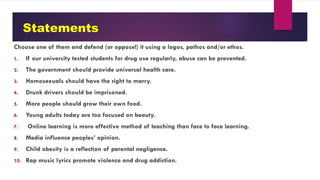
Statements
Choose one of them and defend (or oppose!) it using a logos, pathos and/or ethos.
1. If our university tested students for drug use regularly, abuse can be prevented.
2. The government should provide universal health care.
3. Homosexuals should have the right to marry.
4. Drunk drivers should be imprisoned.
5. More people should grow their own food.
6. Young adults today are too focused on beauty.
7. Online learning is more effective method of teaching than face to face learning.
8. Media influence peoples’ opinion.
9. Child obesity is a reflection of parental negligence.
10. Rap music lyrics promote violence and drug addiction.
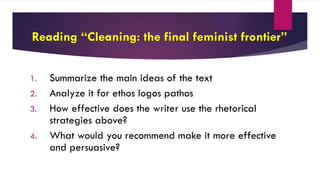
Reading “Cleaning: the final feminist frontier”
1. Summarize the main ideas of the text
2. Analyze it for ethos logos pathos
3. How effective does the writer use the rhetorical
strategies above?
4. What would you recommend make it more effective
and persuasive?
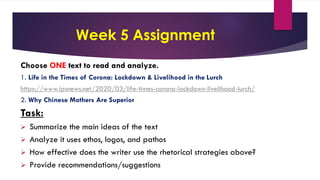
Week 5 Assignment
Choose ONE text to read and analyze.
1. Life in the Times of Corona: Lockdown & Livelihood in the Lurch
https://www.ipsnews.net/2020/03/life-times-corona-lockdown-livelihood-lurch/
2. Why Chinese Mothers Are Superior
Task:
 Summarize the main ideas of the text
 Analyze it uses ethos, logos, and pathos
 How effective does the writer use the rhetorical strategies above?
 Provide recommendations/suggestions
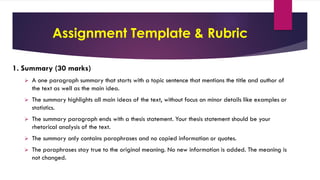
Assignment Template & Rubric
1. Summary (30 marks)
 A one paragraph summary that starts with a topic sentence that mentions the title and author of
the text as well as the main idea.
 The summary highlights all main ideas of the text, without focus on minor details like examples or
statistics.
 The summary paragraph ends with a thesis statement. Your thesis statement should be your
rhetorical analysis of the text.
 The summary only contains paraphrases and no copied information or quotes.
 The paraphrases stay true to the original meaning. No new information is added. The meaning is
not changed.
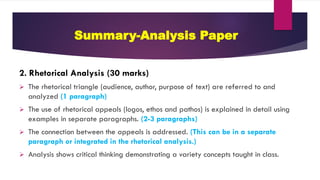
Summary-Analysis Paper
2. Rhetorical Analysis (30 marks)
 The rhetorical triangle (audience, author, purpose of text) are referred to and
analyzed (1 paragraph)
 The use of rhetorical appeals (logos, ethos and pathos) is explained in detail using
examples in separate paragraphs. (2-3 paragraphs)
 The connection between the appeals is addressed. (This can be in a separate
paragraph or integrated in the rhetorical analysis.)
 Analysis shows critical thinking demonstrating a variety concepts taught in class.
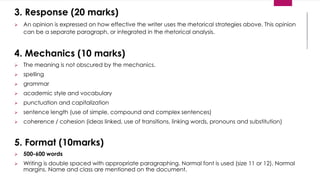
3. Response (20 marks)
 An opinion is expressed on how effective the writer uses the rhetorical strategies above. This opinion
can be a separate paragraph, or integrated in the rhetorical analysis.
4. Mechanics (10 marks)
 The meaning is not obscured by the mechanics.
 spelling
 grammar
 academic style and vocabulary
 punctuation and capitalization
 sentence length (use of simple, compound and complex sentences)
 coherence / cohesion (ideas linked, use of transitions, linking words, pronouns and substitution)
5. Format (10marks)
 500-600 words
 Writing is double spaced with appropriate paragraphing. Normal font is used (size 11 or 12). Normal
margins. Name and class are mentioned on the document.

Week 5 rhetorical analysis (written) copy

  • 1.
    LIB440 Week 5 Rhetorical Analysis(Written Text) DR. RUSSELL RODRIGO
  • 2.
    Outline 1. Review syllogisms 2.Mini lecture: Pathos, logos and ethos 3. Reading “Cleaning: the final feminist frontier” 4. Rhetorical Analysis Essay Writing
  • 3.
    1. Citizens shouldbe imprisoned if they endanger other citizens through their actions. Drunk driving endangers other people. Drunk drivers should be imprisoned. 2. "All men are created equal" and should have equal rights. Homosexuals are people and Marriage is a right. Homosexuals should have the right to marry. 3. The government of a country should protect its people from fear and want. Universal health care protects people from a want (sickness or lack of health care). The government should provide universal health care. 4. Regular drug tests will prevent people from abusing drugs. Many university students use and abuse recreational drugs. If our university tested students for drug use regularly, abuse can be prevented. 5. When pets pose a danger to humans, owning them should be prohibited. Rottweilers and pit bulls have a history of attacking people without provocation. Private citizens should be prohibited from owning rottweilers and pit bulls.
  • 4.
    Aristotelian Appeals: Logos,Ethos, and Pathos Whenever you read an argument you must ask yourself, “Is this persuasive? If so, why? And to whom?” There are many ways to appeal to an audience. Among them are appealing to logos, ethos, and pathos. These appeals are identifiable in almost all arguments.
  • 5.
    Logos  Logos orthe appeal to reason and it relies on logic.  Logos often depends on the use of inductive or deductive reasoning.  Inductive reasoning takes a specific representative case or facts and then draws generalizations or conclusions from them. Inductive reasoning must be based on a sufficient amount of reliable evidence. In other words, the facts you draw on must fairly represent the larger situation or population.  Deductive reasoning begins with a generalization and then applies it to a specific case. The generalization you start with must have been based on a sufficient amount of reliable evidence.  Logos can be developed by citing facts and statistics (very important), using advanced and well developed language, using historical incidents, analogies, and by constructing logical arguments.
  • 6.
    Ethos  Ethos isthe appeal based on credibility or authority. – the character reputation of the writer The audience asks themselves, "What does this person know about this topic?" and "Why should I trust this person?"  There are two kinds of ethos: extrinsic (the character, expertise, education, and experience of the rhetor), and intrinsic (how the rhetor writes or speaks).
  • 7.
    Pathos  Pathos isthe appeal based on emotion.  It is often done by telling a story or an anecdote.  Example: Let's say a rhetor is trying to convince an audience of middle-class Americans to donate money to a hurricane relief fund. The rhetor can make pathetic appeals to an audience's feelings of love, pity, fear, and perhaps anger. (The extent to which any of these emotions will be successfully engaged will vary from audience to audience.)  "Love" will be felt if the audience can be made to believe in their fundamental connections to other human beings.  "Pity" will be felt if the plight of the homeless hurricane victim can be made very vivid to the audience.  "Fear" will be felt if the audience can be made to imagine what they would feel like in that homeless victim's place.  "Anger" will be felt if the audience realizes how little has been done by those who are responsible for helping.
  • 9.
    How to usethese appeals in your writing
  • 10.
    Statements Choose one ofthem and defend (or oppose!) it using a logos, pathos and/or ethos. 1. If our university tested students for drug use regularly, abuse can be prevented. 2. The government should provide universal health care. 3. Homosexuals should have the right to marry. 4. Drunk drivers should be imprisoned. 5. More people should grow their own food. 6. Young adults today are too focused on beauty. 7. Online learning is more effective method of teaching than face to face learning. 8. Media influence peoples’ opinion. 9. Child obesity is a reflection of parental negligence. 10. Rap music lyrics promote violence and drug addiction.
  • 11.
    Reading “Cleaning: thefinal feminist frontier” 1. Summarize the main ideas of the text 2. Analyze it for ethos logos pathos 3. How effective does the writer use the rhetorical strategies above? 4. What would you recommend make it more effective and persuasive?
  • 12.
    Week 5 Assignment ChooseONE text to read and analyze. 1. Life in the Times of Corona: Lockdown & Livelihood in the Lurch https://www.ipsnews.net/2020/03/life-times-corona-lockdown-livelihood-lurch/ 2. Why Chinese Mothers Are Superior Task:  Summarize the main ideas of the text  Analyze it uses ethos, logos, and pathos  How effective does the writer use the rhetorical strategies above?  Provide recommendations/suggestions
  • 13.
    Assignment Template &Rubric 1. Summary (30 marks)  A one paragraph summary that starts with a topic sentence that mentions the title and author of the text as well as the main idea.  The summary highlights all main ideas of the text, without focus on minor details like examples or statistics.  The summary paragraph ends with a thesis statement. Your thesis statement should be your rhetorical analysis of the text.  The summary only contains paraphrases and no copied information or quotes.  The paraphrases stay true to the original meaning. No new information is added. The meaning is not changed.
  • 14.
    Summary-Analysis Paper 2. RhetoricalAnalysis (30 marks)  The rhetorical triangle (audience, author, purpose of text) are referred to and analyzed (1 paragraph)  The use of rhetorical appeals (logos, ethos and pathos) is explained in detail using examples in separate paragraphs. (2-3 paragraphs)  The connection between the appeals is addressed. (This can be in a separate paragraph or integrated in the rhetorical analysis.)  Analysis shows critical thinking demonstrating a variety concepts taught in class.
  • 15.
    3. Response (20marks)  An opinion is expressed on how effective the writer uses the rhetorical strategies above. This opinion can be a separate paragraph, or integrated in the rhetorical analysis. 4. Mechanics (10 marks)  The meaning is not obscured by the mechanics.  spelling  grammar  academic style and vocabulary  punctuation and capitalization  sentence length (use of simple, compound and complex sentences)  coherence / cohesion (ideas linked, use of transitions, linking words, pronouns and substitution) 5. Format (10marks)  500-600 words  Writing is double spaced with appropriate paragraphing. Normal font is used (size 11 or 12). Normal margins. Name and class are mentioned on the document.