PARAGRAPH
WRITING
WHAT IS PARAGRAPH?
paragraphs
sentences
words
 A paragraph is often defined as a group of related sentences in which one
single, main idea is developed.
In a typical paragraph, the first sentence declares the main topic of the
paragraph and the rest of the sentences develop or support the main
idea.
IN SHORT , A PARAGRAPH IS….
A group of sentences.
A clear main idea.
Supporting information.
Part of a longer composition
A miniature essay!
WHAT IS MAIN IDEA?
The main idea is the key concept being
expressed.
WHAT IS SUPPORTING DETAILS?
Details , major and minor, support the main
idea by telling the how, what, when, where,
why, how much , or how many.
The definition of a miniature is a
something that is much smaller than the
original.
WHAT IS MINIATURE?
A GOOD PARAGRAPH HAS…
Unity
Support
Coherence
Good language
Variety of structures
UNITY
A paragraph with unity develops a
single idea thoroughly and links it to
the rest of the paper. Support the main
idea of the paragraph with details.
Topic sentences
Other sentences support
One main idea
COHERENCE
Coherence in writing is the logical bridge between
words, sentences, and paragraphs. Main ideas and
meaning can be difficult for reader to follow if the
writing lacks coherence.
 Well organized details
 Spatial ‫ہو‬ ‫رکھتا‬ ‫تعلق‬
 Chronological ‫وار‬ ‫تاریخ‬ ‫کی‬ ‫واقعات‬
‫ترتیب‬
 Importance
 Logical
 A clear sensible connection
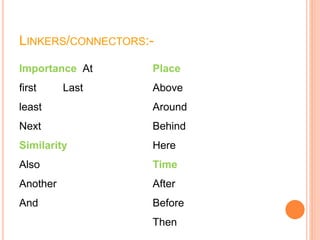
 Linkers/ Connectors
LINKERS/CONNECTORS:-
Importance At
first Last
least
Next
Similarity
Also
Another
And
Place
Above
Around
Behind
Here
Time
After
Before
Then
TOPIC SENTENCE
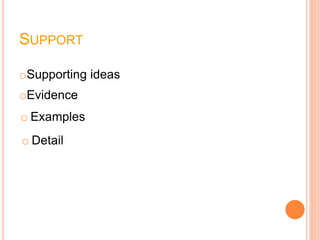
SUPPORT
oEvidence
oSupporting ideas
o Examples
o Detail
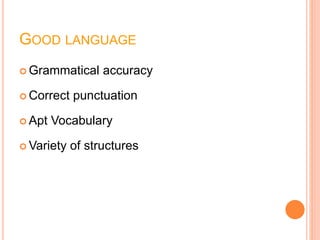
GOOD LANGUAGE
 Grammatical accuracy
 Correct punctuation
 Apt Vocabulary
 Variety of structures
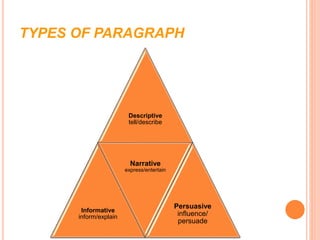
TYPES OF PARAGRAPH
Descriptive
tell/describe
Informative
inform/explain
Narrative
express/entertain
Persuasive
influence/
persuade
NARRATIVE PARAGRAPH
 Narrative paragraph tells a story or an event.
 It could be tale , novel ,an account of one’s life,
natural phenomena, or social events…
 The story/events in narrative paragraph should be
arranged Chronologically (time order), that is in the
order in which they have happened.
 Almost everyone narrates, reads , or listens to
stories from books, other people, or media.
However, the audience expects and needs more
from a written narrative.
Therefore, a narrative paragraph must have :
Character (who it is about),
A central idea (what the story/event is about
A plot (conflict, complication, climax, and resolution of
the story/event),
Adequate description,
And setting (when and where the story happens).
DESCRIPTIVE PARAGRAPH
 A descriptive paragraph describes a thing, a
person, or a place. Detailed information allows the
reader to form an image in his or her imagination.
The better the description, the clearer the image.
INFORMATIVE PARAGRAPH EXPLAINS AN IDEA AND
INFORM FACTS
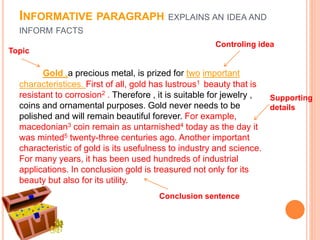
Gold ,a precious metal, is prized for two important
characteristices. First of all, gold has lustrous1 beauty that is
resistant to corrosion2 . Therefore , it is suitable for jewelry ,
coins and ornamental purposes. Gold never needs to be
polished and will remain beautiful forever. For example,
macedonian3 coin remain as untarnished4 today as the day it
was minted5 twenty-three centuries ago. Another important
characteristic of gold is its usefulness to industry and science.
For many years, it has been used hundreds of industrial
applications. In conclusion gold is treasured not only for its
beauty but also for its utility.
Topic
Controling idea
Supporting
details
Conclusion sentence
PERSUASIVE PARAGRAPH TRIES TO
CONVINCE THE READER OF SOMETHING
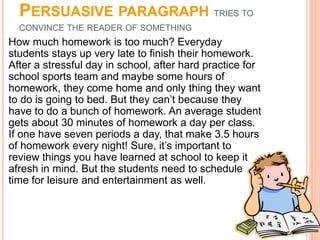
How much homework is too much? Everyday
students stays up very late to finish their homework.
After a stressful day in school, after hard practice for
school sports team and maybe some hours of
homework, they come home and only thing they want
to do is going to bed. But they can’t because they
have to do a bunch of homework. An average student
gets about 30 minutes of homework a day per class.
If one have seven periods a day, that make 3.5 hours
of homework every night! Sure, it’s important to
review things you have learned at school to keep it
afresh in mind. But the students need to schedule
time for leisure and entertainment as well.
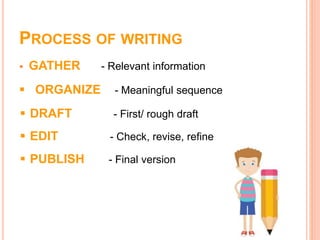
PROCESS OF WRITING
 GATHER - Relevant information
 ORGANIZE - Meaningful sequence
 DRAFT - First/ rough draft
 EDIT - Check, revise, refine
 PUBLISH - Final version

Paragraph writing

  • 1.
  • 2.
    WHAT IS PARAGRAPH? paragraphs sentences words A paragraph is often defined as a group of related sentences in which one single, main idea is developed. In a typical paragraph, the first sentence declares the main topic of the paragraph and the rest of the sentences develop or support the main idea.
  • 3.
    IN SHORT ,A PARAGRAPH IS…. A group of sentences. A clear main idea. Supporting information. Part of a longer composition A miniature essay!
  • 4.
    WHAT IS MAINIDEA? The main idea is the key concept being expressed. WHAT IS SUPPORTING DETAILS? Details , major and minor, support the main idea by telling the how, what, when, where, why, how much , or how many. The definition of a miniature is a something that is much smaller than the original. WHAT IS MINIATURE?
  • 5.
    A GOOD PARAGRAPHHAS… Unity Support Coherence Good language Variety of structures
  • 6.
    UNITY A paragraph withunity develops a single idea thoroughly and links it to the rest of the paper. Support the main idea of the paragraph with details. Topic sentences Other sentences support One main idea
  • 7.
    COHERENCE Coherence in writingis the logical bridge between words, sentences, and paragraphs. Main ideas and meaning can be difficult for reader to follow if the writing lacks coherence.
  • 8.
     Well organizeddetails  Spatial ‫ہو‬ ‫رکھتا‬ ‫تعلق‬  Chronological ‫وار‬ ‫تاریخ‬ ‫کی‬ ‫واقعات‬ ‫ترتیب‬  Importance  Logical  A clear sensible connection  Linkers/ Connectors
  • 9.
  • 10.
  • 11.
  • 12.
    GOOD LANGUAGE  Grammaticalaccuracy  Correct punctuation  Apt Vocabulary  Variety of structures
  • 13.
  • 14.
    NARRATIVE PARAGRAPH  Narrativeparagraph tells a story or an event.  It could be tale , novel ,an account of one’s life, natural phenomena, or social events…  The story/events in narrative paragraph should be arranged Chronologically (time order), that is in the order in which they have happened.  Almost everyone narrates, reads , or listens to stories from books, other people, or media. However, the audience expects and needs more from a written narrative.
  • 15.
    Therefore, a narrativeparagraph must have : Character (who it is about), A central idea (what the story/event is about A plot (conflict, complication, climax, and resolution of the story/event), Adequate description, And setting (when and where the story happens).
  • 16.
    DESCRIPTIVE PARAGRAPH  Adescriptive paragraph describes a thing, a person, or a place. Detailed information allows the reader to form an image in his or her imagination. The better the description, the clearer the image.
  • 18.
    INFORMATIVE PARAGRAPH EXPLAINSAN IDEA AND INFORM FACTS Gold ,a precious metal, is prized for two important characteristices. First of all, gold has lustrous1 beauty that is resistant to corrosion2 . Therefore , it is suitable for jewelry , coins and ornamental purposes. Gold never needs to be polished and will remain beautiful forever. For example, macedonian3 coin remain as untarnished4 today as the day it was minted5 twenty-three centuries ago. Another important characteristic of gold is its usefulness to industry and science. For many years, it has been used hundreds of industrial applications. In conclusion gold is treasured not only for its beauty but also for its utility. Topic Controling idea Supporting details Conclusion sentence
  • 19.
    PERSUASIVE PARAGRAPH TRIESTO CONVINCE THE READER OF SOMETHING How much homework is too much? Everyday students stays up very late to finish their homework. After a stressful day in school, after hard practice for school sports team and maybe some hours of homework, they come home and only thing they want to do is going to bed. But they can’t because they have to do a bunch of homework. An average student gets about 30 minutes of homework a day per class. If one have seven periods a day, that make 3.5 hours of homework every night! Sure, it’s important to review things you have learned at school to keep it afresh in mind. But the students need to schedule time for leisure and entertainment as well.
  • 20.
    PROCESS OF WRITING GATHER - Relevant information  ORGANIZE - Meaningful sequence  DRAFT - First/ rough draft  EDIT - Check, revise, refine  PUBLISH - Final version