The Prsuasive tools:
Ethos Pathos and Logos
By
Group 5
What it actually is?
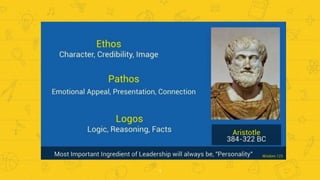
✘ Aristotle's "modes for persuasion" - otherwise known as
rhetorical appeals - are known by the names
of ethos, pathos, and logos.
✘ They are means of persuading others to believe a
particular point of view.
✘ They are often used in speech writing and advertising to
sway the audience.
3
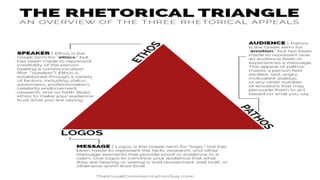
The Rhetorical Appeal (Rhetorical triangle)
✘ The rhetorical triangle is a common reference to the
three rhetorical appeals identified by Aristotle: ethos,
pathos, and logos.
✘ These three Greek terms make reference to the
primary concepts from which messages–in any
communication channel–are created.
Check out the diagram for a quick overview of the
rhetorical triangle.
4
1.
Ethos
7
✘ In English, the direct translation of ethos from Greek is
“ethics.” But when we talk about the rhetorical appeals,
“ethos” makes broader reference to what makes the
speaker (person or organization) credible.
✘ Credibility, depending on the topic or substance of a
communication, can take years to establish
Example of ethos
8
9
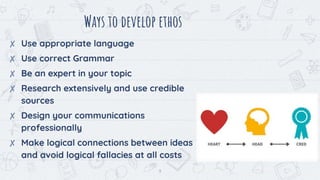
Ways to develop ethos
✘ Use appropriate language
✘ Use correct Grammar
✘ Be an expert in your topic
✘ Research extensively and use credible
sources
✘ Design your communications
professionally
✘ Make logical connections between ideas
and avoid logical fallacies at all costs
Ethos Advertisement:
10
2.
Pathos
11
What is pathos?
✘ In English, the direct translation of pathos is “emotion.”
✘ But when we talk about the rhetorical appeals, “pathos”
makes broader reference to the audience and the way
in which they react to a message.
✘ The idea behind pathos is that you want your audience
to feel a certain way when you communicate to them.
12
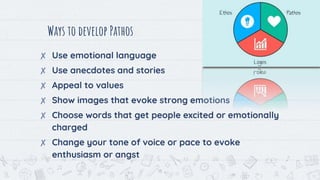
Ways to develop Pathos
✘ Use emotional language
✘ Use anecdotes and stories
✘ Appeal to values
✘ Show images that evoke strong emotions
✘ Choose words that get people excited or emotionally
charged
✘ Change your tone of voice or pace to evoke
enthusiasm or angst
13
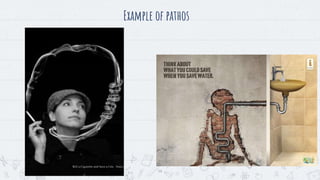
Example of pathos
14
Pathos advertisement
15
3.
Logos
16
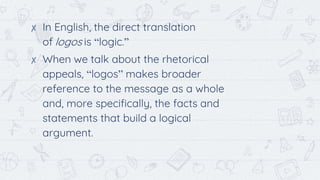
✘ In English, the direct translation
of logos is “logic.”
✘ When we talk about the rhetorical
appeals, “logos” makes broader
reference to the message as a whole
and, more specifically, the facts and
statements that build a logical
argument.
18
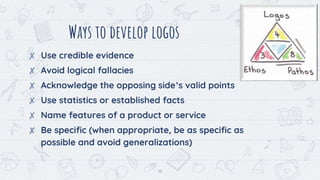
✘ Use credible evidence
✘ Avoid logical fallacies
✘ Acknowledge the opposing side’s valid points
✘ Use statistics or established facts
✘ Name features of a product or service
✘ Be specific (when appropriate, be as specific as
possible and avoid generalizations)
Ways to develop logos
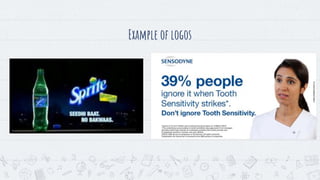
Example of logos
19
Logos Advertisement
20
21
THANKS! Presented by :
Ayush Chaturvedi
Vijay Kumar Thakur
Siddharth Jadhav

Ethos Pathos Logos

  • 1.
    The Prsuasive tools: EthosPathos and Logos By Group 5
  • 2.
    What it actuallyis? ✘ Aristotle's "modes for persuasion" - otherwise known as rhetorical appeals - are known by the names of ethos, pathos, and logos. ✘ They are means of persuading others to believe a particular point of view. ✘ They are often used in speech writing and advertising to sway the audience.
  • 3.
  • 4.
    The Rhetorical Appeal(Rhetorical triangle) ✘ The rhetorical triangle is a common reference to the three rhetorical appeals identified by Aristotle: ethos, pathos, and logos. ✘ These three Greek terms make reference to the primary concepts from which messages–in any communication channel–are created. Check out the diagram for a quick overview of the rhetorical triangle. 4
  • 6.
  • 7.
    7 ✘ In English,the direct translation of ethos from Greek is “ethics.” But when we talk about the rhetorical appeals, “ethos” makes broader reference to what makes the speaker (person or organization) credible. ✘ Credibility, depending on the topic or substance of a communication, can take years to establish
  • 8.
  • 9.
    9 Ways to developethos ✘ Use appropriate language ✘ Use correct Grammar ✘ Be an expert in your topic ✘ Research extensively and use credible sources ✘ Design your communications professionally ✘ Make logical connections between ideas and avoid logical fallacies at all costs
  • 10.
  • 11.
  • 12.
    What is pathos? ✘In English, the direct translation of pathos is “emotion.” ✘ But when we talk about the rhetorical appeals, “pathos” makes broader reference to the audience and the way in which they react to a message. ✘ The idea behind pathos is that you want your audience to feel a certain way when you communicate to them. 12
  • 13.
    Ways to developPathos ✘ Use emotional language ✘ Use anecdotes and stories ✘ Appeal to values ✘ Show images that evoke strong emotions ✘ Choose words that get people excited or emotionally charged ✘ Change your tone of voice or pace to evoke enthusiasm or angst 13
  • 14.
  • 15.
  • 16.
  • 17.
    ✘ In English,the direct translation of logos is “logic.” ✘ When we talk about the rhetorical appeals, “logos” makes broader reference to the message as a whole and, more specifically, the facts and statements that build a logical argument.
  • 18.
    18 ✘ Use credibleevidence ✘ Avoid logical fallacies ✘ Acknowledge the opposing side’s valid points ✘ Use statistics or established facts ✘ Name features of a product or service ✘ Be specific (when appropriate, be as specific as possible and avoid generalizations) Ways to develop logos
  • 19.
  • 20.
  • 21.
    21 THANKS! Presented by: Ayush Chaturvedi Vijay Kumar Thakur Siddharth Jadhav