Gathering
Manifestos
And Analyzing
Arguments
English for
Academic and
Professional
Purposes
Manifesto
 is a published declaration of
principles, intentions,
motives, or views often
political in nature, but it may
also be life stance related.
TYPES OF MANIFESTOS
1. Election or electoral manifesto-
 list of promises to citizens which is issued by a
political party.
 The list shows the ideology of the party and its
commitment to the citizens.
 It is in the form of a pamphlet or booklet
issued to tell people about the party's
programs and policies.
2. Manifestos relating to religious
belief are referred to as creeds
 A creed is a set of fundamental
beliefs; a guiding principle.
 Other synonyms are credo,
doctrine, dogma, gospel, ideology,
philosophy, and testament.
3. Educational manifestos
 These are manifestos
involving issues concerning
education and are written by
educators and professionals
in the field of education.
4. Scientific and technological
manifestos
These cover topics normally
dealing with policies on the
areas of science and
technology, by scientists and
technology experts.
5. Professional manifestos (pertaining
to an individual or organization)
 Manifestos can also be
categorized as artistic,
philosophical, corporate,
personal, religious (creed) and
political.
Examples of Short Manifestos
Some companies and artists pack their goals into a few lines. Others might use a page to
declare the impact they want to make on the world.
Nike: Purpose Moves Us
Our purpose is to unite the
world through sport to create
a healthy planet, active
communities and an equal
playing field for all.
Apple: To the Crazy Ones
Here’s to the crazy ones. The misfits. The
rebels. The troublemakers. The round pegs in
the square holes. The ones who see things
differently. They’re not fond of rules. And they
have no respect for the status quo. You can
praise them, disagree with them, quote them,
disbelieve them, glorify them or vilify them.
About the only thing you can’t do is ignore
Other personal manifestos look like:
Argument
is a claim or proposition
put forward along with
reasons or evidence
supporting it.
3 Parts of Argument :an assertion, reasoning and
evidence (easily remembered with the mnemonic
ARE).
1. Assertion-is usually a simple statement (claim or
proposition) such as
“Television news is boring.”
“Tomato soup is better than grilled cheese
sandwiches.”
2. Reasoning
 is the “because” part of an
argument or the premise. It
supports the
assertion/proposition. It answers
the question, ”Why did you say
that?”,
Examples:
1.“Television news is boring because it
doesn’t talk about issues that are
relevant to me.”
2.“Tomato soup is better than a grilled
cheese sandwich because it is more
nutritious.”
3. Evidence
supports reasoning.
Evidence must relate to the
reason and must be enough
or sufficient to support the
reason.
“Television news is boring
because it doesn’t talk about
issues that are relevant to me.
For example, I never see
stories about the issues that
kids deal with every day.”
“Tomato soup is better than a grilled
cheese sandwich because it is more
nutritious. For example, tomato soup
contains important vitamins such as
lycopene, while grilled cheese
sandwiches really don’t have that
much nutritional value at all.”
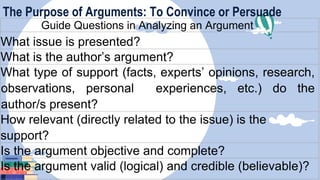
The Purpose of Arguments: To Convince or Persuade
Guide Questions in Analyzing an Argument
What issue is presented?
What is the author’s argument?
What type of support (facts, experts’ opinions, research,
observations, personal experiences, etc.) do the
author/s present?
How relevant (directly related to the issue) is the
support?
Is the argument objective and complete?
Is the argument valid (logical) and credible (believable)?
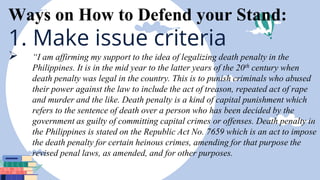
Ways on How to Defend your Stand:
1. Make issue criteria
 “I am affirming my support to the idea of legalizing death penalty in the
Philippines. It is in the mid year to the latter years of the 20th century when
death penalty was legal in the country. This is to punish criminals who abused
their power against the law to include the act of treason, repeated act of rape
and murder and the like. Death penalty is a kind of capital punishment which
refers to the sentence of death over a person who has been decided by the
government as guilty of committing capital crimes or offenses. Death penalty in
the Philippines is stated on the Republic Act No. 7659 which is an act to impose
the death penalty for certain heinous crimes, amending for that purpose the
revised penal laws, as amended, and for other purposes.
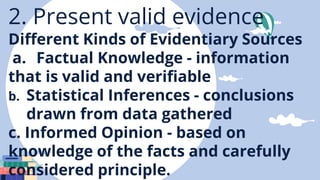
2. Present valid evidence
Different Kinds of Evidentiary Sources
a. Factual Knowledge - information
that is valid and verifiable
b. Statistical Inferences - conclusions
drawn from data gathered
c. Informed Opinion - based on
knowledge of the facts and carefully
considered principle.
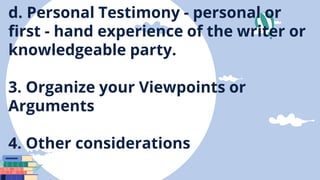
d. Personal Testimony - personal or
first - hand experience of the writer or
knowledgeable party.
3. Organize your Viewpoints or
Arguments
4. Other considerations
a. Emotional appeal
 This is the use of the audience’s
feelings for the subject of the paper
such as anger, pity, and aversion in
order to persuade.
Example: How can you say that the
government shouldn’t censor the
internet? Think of the poor children
who might be exposed to inappropriate
b. Tacit Knowledge
 refers to the amount of knowledge
that you have about the topic that
your are about to talk about.

Gathering Manifesto.pptx

  • 1.
  • 2.
  • 4.
    Manifesto  is apublished declaration of principles, intentions, motives, or views often political in nature, but it may also be life stance related.
  • 5.
    TYPES OF MANIFESTOS 1.Election or electoral manifesto-  list of promises to citizens which is issued by a political party.  The list shows the ideology of the party and its commitment to the citizens.  It is in the form of a pamphlet or booklet issued to tell people about the party's programs and policies.
  • 6.
    2. Manifestos relatingto religious belief are referred to as creeds  A creed is a set of fundamental beliefs; a guiding principle.  Other synonyms are credo, doctrine, dogma, gospel, ideology, philosophy, and testament.
  • 7.
    3. Educational manifestos These are manifestos involving issues concerning education and are written by educators and professionals in the field of education.
  • 8.
    4. Scientific andtechnological manifestos These cover topics normally dealing with policies on the areas of science and technology, by scientists and technology experts.
  • 9.
    5. Professional manifestos(pertaining to an individual or organization)  Manifestos can also be categorized as artistic, philosophical, corporate, personal, religious (creed) and political.
  • 10.
    Examples of ShortManifestos Some companies and artists pack their goals into a few lines. Others might use a page to declare the impact they want to make on the world. Nike: Purpose Moves Us Our purpose is to unite the world through sport to create a healthy planet, active communities and an equal playing field for all.
  • 11.
    Apple: To theCrazy Ones Here’s to the crazy ones. The misfits. The rebels. The troublemakers. The round pegs in the square holes. The ones who see things differently. They’re not fond of rules. And they have no respect for the status quo. You can praise them, disagree with them, quote them, disbelieve them, glorify them or vilify them. About the only thing you can’t do is ignore
  • 12.
  • 13.
    Argument is a claimor proposition put forward along with reasons or evidence supporting it.
  • 14.
    3 Parts ofArgument :an assertion, reasoning and evidence (easily remembered with the mnemonic ARE). 1. Assertion-is usually a simple statement (claim or proposition) such as “Television news is boring.” “Tomato soup is better than grilled cheese sandwiches.”
  • 15.
    2. Reasoning  isthe “because” part of an argument or the premise. It supports the assertion/proposition. It answers the question, ”Why did you say that?”,
  • 16.
    Examples: 1.“Television news isboring because it doesn’t talk about issues that are relevant to me.” 2.“Tomato soup is better than a grilled cheese sandwich because it is more nutritious.”
  • 17.
    3. Evidence supports reasoning. Evidencemust relate to the reason and must be enough or sufficient to support the reason.
  • 18.
    “Television news isboring because it doesn’t talk about issues that are relevant to me. For example, I never see stories about the issues that kids deal with every day.”
  • 19.
    “Tomato soup isbetter than a grilled cheese sandwich because it is more nutritious. For example, tomato soup contains important vitamins such as lycopene, while grilled cheese sandwiches really don’t have that much nutritional value at all.”
  • 20.
    The Purpose ofArguments: To Convince or Persuade Guide Questions in Analyzing an Argument What issue is presented? What is the author’s argument? What type of support (facts, experts’ opinions, research, observations, personal experiences, etc.) do the author/s present? How relevant (directly related to the issue) is the support? Is the argument objective and complete? Is the argument valid (logical) and credible (believable)?
  • 21.
    Ways on Howto Defend your Stand: 1. Make issue criteria  “I am affirming my support to the idea of legalizing death penalty in the Philippines. It is in the mid year to the latter years of the 20th century when death penalty was legal in the country. This is to punish criminals who abused their power against the law to include the act of treason, repeated act of rape and murder and the like. Death penalty is a kind of capital punishment which refers to the sentence of death over a person who has been decided by the government as guilty of committing capital crimes or offenses. Death penalty in the Philippines is stated on the Republic Act No. 7659 which is an act to impose the death penalty for certain heinous crimes, amending for that purpose the revised penal laws, as amended, and for other purposes.
  • 22.
    2. Present validevidence Different Kinds of Evidentiary Sources a. Factual Knowledge - information that is valid and verifiable b. Statistical Inferences - conclusions drawn from data gathered c. Informed Opinion - based on knowledge of the facts and carefully considered principle.
  • 23.
    d. Personal Testimony- personal or first - hand experience of the writer or knowledgeable party. 3. Organize your Viewpoints or Arguments 4. Other considerations
  • 24.
    a. Emotional appeal This is the use of the audience’s feelings for the subject of the paper such as anger, pity, and aversion in order to persuade. Example: How can you say that the government shouldn’t censor the internet? Think of the poor children who might be exposed to inappropriate
  • 25.
    b. Tacit Knowledge refers to the amount of knowledge that you have about the topic that your are about to talk about.

Editor's Notes

  • #2 Manifesto – guideline, policies, strategies, philosophies, declaration and statements.
  • #25 It may also refer to values that the reader may identify with such as the importance of family ties, hospitality and the Bayanihan spirit.
  • #26 It questions the credibility that you have based on the concept that you are defending.